Back
NM_001128425.2:c.53C>T
p.Pro18Leu · MUTYH
0%
complete
Final classification
Likely Benign
BS1BP4
MUTYH
c.53C>T
p.Pro18Leu
missense · exon 2

MUTYH encodes a DNA repair enzyme (a glycosylase) that fixes oxidative DNA damage by removing adenine bases that have been mistakenly paired with guanine or with oxidized guanine lesions. Inherited mutations in both copies of the gene cause MUTYH-associated polyposis (MAP), a recessive condition that strongly predisposes people to multiple colorectal polyps and colorectal cancer. The gene acts as a tumor suppressor whose loss of function allows DNA damage to accumulate, and somatic changes in it have also been reported in colon cancer, though whether they drive cancer on their own is not fully established.

This variant

MUTYH encodes a DNA glycosylase that removes adenine mispaired with 8-oxoguanine, and biallelic loss of this repair function causes autosomal recessive MUTYH-associated polyposis (familial adenomatous polyposis 2, MONDO:0012041) with a markedly increased risk of multiple colorectal polyps and colorectal cancer; NM_001128425.2:c.53C>T (p.Pro18Leu) lies in the N-terminal mitochondrial-targeting/RPA-binding region rather than the catalytic core, and even a fully damaging single allele would only confer recessive carrier status rather than a dominantly acting cancer predisposition.

Transcript
NM_001128425.2
HGVS · transcript:coding
NM_001128425.2:c.53C>T
GRCh38
chr1:45334495 G>A
GRCh37
chr1:45800167 G>A
Likely Benign: BS1 (strong, East Asian allele frequency 1.30%) plus BP4 (supporting, REVEL 0.2) satisfy the generic ACMG/AMP 2015 Likely Benign combination rules.
Classification rationale
BS1BP4 Likely Benign
MUTYH c.53C>T missense · exon 2

Likely Benign: BS1 (strong) - the variant reaches 1.30% allele frequency in gnomAD v2.1 East Asian samples, above the 1% strong-benign threshold. Likely Benign: BP4 (supporting) - the missense REVEL score of 0.2 indicates a benign protein-level computational effect.

BS1 + BP4 Likely Benign
LYFE Sciences is an AI system, and it can make mistakes. Criteria may be applied incorrectly, sources may be misread, and a confident-looking classification can still be wrong. Double-check every criterion and its underlying evidence before relying on any call.
Gene diagram · NM_001128425.2 · variants mapped to exon structure
MUTYH NM_001128425.2
Fetching transcript structure from UCSC…
Applied criteria · 2 applied · 22 assessed
MetEvidence satisfies this criterion.
Not metEvaluated against available evidence; threshold not reached.
Not assessedApplies in principle, but no evidence was found to evaluate it.
N/ADoesn't apply to this variant type.
Applied · 2
Strength Supporting Moderate Strong Very strong
BS1 strong Benign
Met at strong: gnomAD v2.1 East Asian frequency 1.30% exceeds the generic BS1 threshold of 1%.
The InSiGHT MUTYH specification retrieved for this case has an empty rule payload and no BS1 population threshold, so the supplied generic ACMG/ClinGen-SVI default was applied.gnomAD v2.1 East Asian AF 0.01302997 (260/19,954 alleles) and grpmax FAF 0.0132979 exceed 0.01; gnomAD v4.1 East Asian AF 0.01133883 (509/44,890 alleles) and grpmax FAF 0.01052478 also exceed 0.01.gnomAD v2.1 non-cancer East Asian exomes independently give 0.01324538 (255/19,252 alleles); the non-cancer subsets are consistent with the all-comers data and do not change the verdict.
BP4 supporting Benign
Met (supporting): missense REVEL score 0.2 is at or below the <=0.29 BP4 supporting threshold.
Scope: missense variant (NP_001121897.1:p.(Pro18Leu)), so BP4 is evaluated on the REVEL missense path only; the SpliceAI splice path is not applicable to this variant class.Governing framework: MUTYH ClinGen InSiGHT Expert Panel Specification v1.0 (doc 1742141534) retrieved with an empty criteria payload (framework_complete=false), pre-assigning no BP4 code; generic ACMG/AMP fallback used.REVEL = 0.2 (local REVEL v1.3 lookup) satisfies the BP4 supporting threshold REVEL <= 0.29 and does not reach BP4 moderate (<= 0.183) or strong (<= 0.016) (Pejaver et al. 2022, Am J Hum Genet, PMID:36413997). BP4 is met at supporting strength only.
Assessed · not applied · 17 not met · 5 not assessed
Pathogenic
PS1 Not met: no pathogenic variant carrying the same p.Pro18Leu change exists, and the only c.53C>T records are Benign/Likely benign in ClinVar.
PS2 Not assessed: no source provides parental genotypes or a confirmed de novo occurrence for MUTYH p.Pro18Leu.
PS3 Not met: the validated 47-variant MUTYH complementation assay scored p.Pro18Leu as a 2.7-fold partial defect, an intermediate result that is not a well-established damaging effect.
PS4 Not met: the p.Pro18Leu enrichment (OR 4.43, CI 1.33-14.72) is haplotype-level and gastric-cancer-only, with no case-control excess in MUTYH-associated polyposis.
PM1 Not met: no approved MUTYH critical-domain entry covers residue 18, and the region carries benign variation reaching 1.3% in East Asian gnomAD v2.1.
PM2 Not met: the gnomAD v4.1 all-comers frequency of 0.0441% is above the generic PM2 threshold of 0.01%.
PM3 Not met: the one reported affected proband carries c.53C>T alongside G25D, Q324H and c.1389G>C, none of which is an established pathogenic trans partner.
PM5 Not met: no alternate missense at MUTYH Pro18 is established pathogenic; the system-wide ClinVar screen returned zero same-residue comparators.
PM6 Not assessed: no parental testing or presumed de novo evidence is documented for MUTYH p.Pro18Leu.
PP1 Not assessed: no relative genotypes or informative meioses are reported for MUTYH p.Pro18Leu.
PP2 Not met: MUTYH lacks missense constraint (gnomAD mis_z 0.63) and carries common benign missense alleles, so the low-benign-missense-rate arm of PP2 fails.
PP3 Not met: this missense variant's REVEL score of 0.2 is below the >=0.644 PP3 supporting threshold.
PP4 Not met: no MUTYH-specific phenotype is documented - adenomatous polyposis overlaps APC-associated FAP and Lynch syndrome, and no proband phenotype accompanies this variant.
PP5 Not met: the ClinVar record (20 submissions, 0 expert-panel) has no expert-panel assertion, and its conflicting 1-star lab classifications cannot support PP5.
Benign
BA1 Not met: the highest credible frequency is 1.30% (gnomAD v2.1 East Asian), below the generic BA1 stand-alone threshold of 5%.
BS2 Not assessed: 4-7 gnomAD homozygotes are reported, but healthy-adult status, age and phenotype are undocumented for this adult-onset recessive disorder.
BS3 Not met: the validated MUTYH complementation assay shows a 2.7-fold partial defect rather than normal function, and the mitochondrial-localization result is an unvalidated one-component proxy.
BS4 Not assessed: no genotyped affected relatives or documented non-segregation exist for MUTYH p.Pro18Leu.
BP1 Not met: MUTYH disease is caused by biallelic missense alleles (biallelic p.Gly272Glu/p.Ala359Val reported in an affected patient), not primarily truncating variants.
BP2 Not met: the only documented cis partner, c.74G>A (p.Gly25Asp), is not an established pathogenic MUTYH variant.
BP5 Not met: the only polyposis patient documented with this variant was APC-negative and classed as MAP, so no alternate molecular basis is documented.
BP6 Not met: ClinVar's Benign content is entirely from 20 ordinary laboratory submissions with 0 expert-panel assertions and a 1-star conflicting status.
N/A · 4 PVS1 · PM4 · BP3 · BP7
Research & evidence
Population frequency · supports benign
gnomAD v4.1 screenshot
gnomAD v4.1
gnomAD v2.1 screenshot
gnomAD v2.1
v4.1
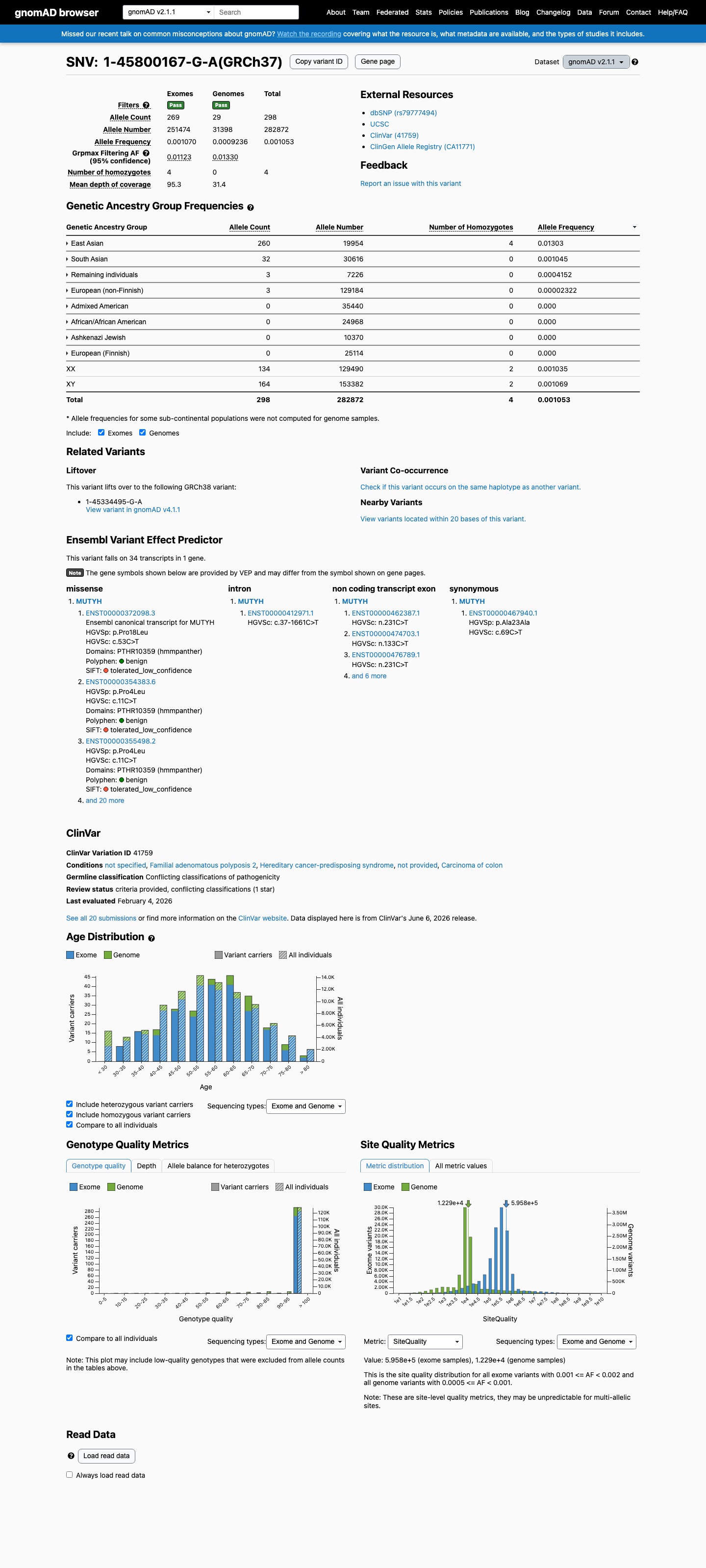
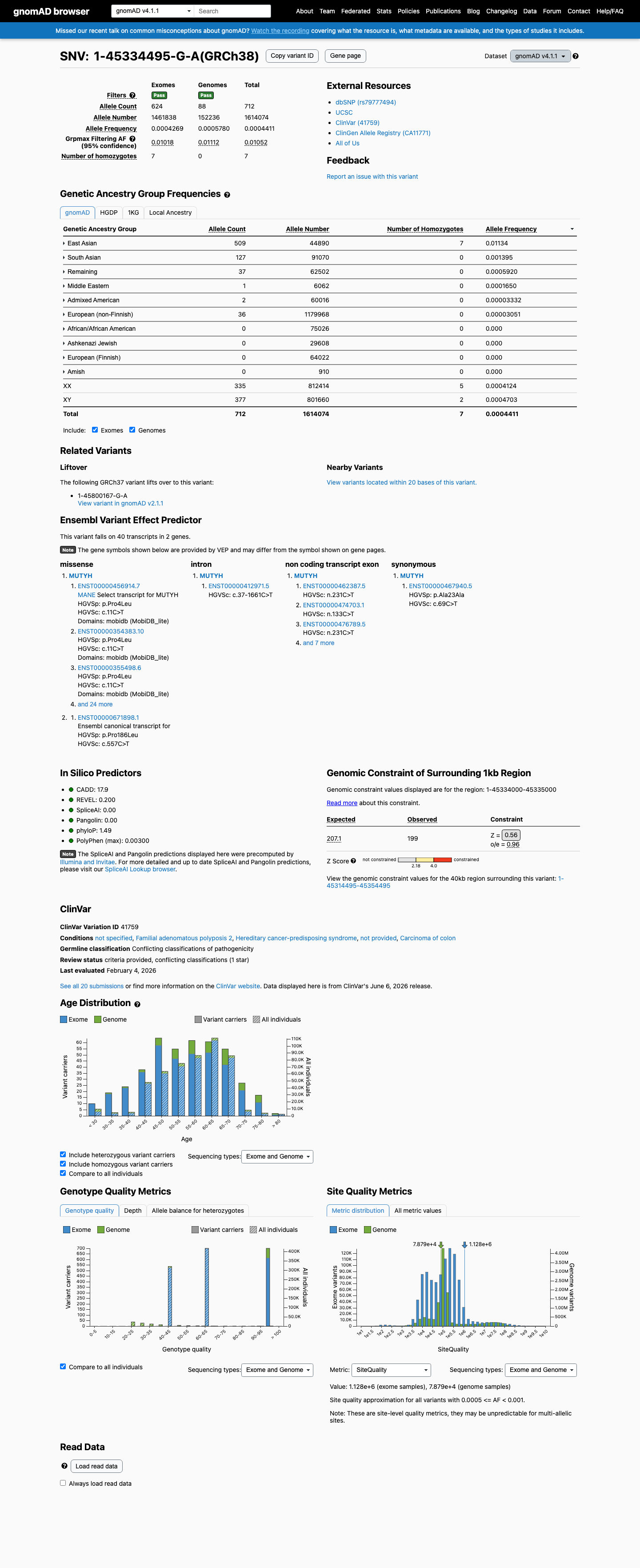
This variant is present in gnomAD v4.1 (AF= 0.00044112; MAF= 0.04411%, 712/1614074 alleles, homozygotes = 7) and has highest observed frequency in the East Asian population (AF= 0.0113388; MAF= 1.13388%, 509/44890 alleles, homozygotes = 7); grpmax FAF= 0.0105248.
v2.1
This variant is present in gnomAD v2.1 (AF= 0.00105348; MAF= 0.10535%, 298/282872 alleles, homozygotes = 4) and has highest observed frequency in the East Asian population (AF= 0.01303; MAF= 1.30300%, 260/19954 alleles, homozygotes = 4); grpmax FAF= 0.0132979.
🇨🇦 CA
Not available in gnomAD-Canada v1.0.
Allele frequency by ancestry
three datasets · side by side
gnomAD v4.1
0.044% · 712 / 1,614,074
7 hom · FAF 1.1%
East Asian
509 / 44,890
1.1%
7 hom
South Asian
127 / 91,070
0.14%
Remaining individuals
37 / 62,502
0.059%
Middle Eastern
1 / 6,062
0.016%
Admixed American
2 / 60,016
0.0033%
European (non-Finnish)
36 / 1,179,968
0.0031%
+ 4 not observed (European (Finnish), Amish, Ashkenazi Jewish, African/African American)
gnomAD v2.1
0.11% · 298 / 282,872
4 hom · FAF 1.3%
East Asian
260 / 19,954
1.3%
4 hom
South Asian
32 / 30,616
0.1%
Remaining individuals
3 / 7,226
0.042%
European (non-Finnish)
3 / 129,184
0.0023%
+ 4 not observed (African/African American, Admixed American, Ashkenazi Jewish, European (Finnish))
gnomAD Canada 🇨🇦
Absent · 0 / ?
0 hom
Not observed in any ancestry group.
ClinVar screenshot
ClinVar
This variant has been reported in ClinVar as Benign (9 clinical laboratories) and as Likely benign (3 clinical laboratories) and as Uncertain significance (2 clinical laboratories) and as likely benign (1 clinical laboratory). (ClinVarID = 41759)
SpliceAI screenshot
In silico
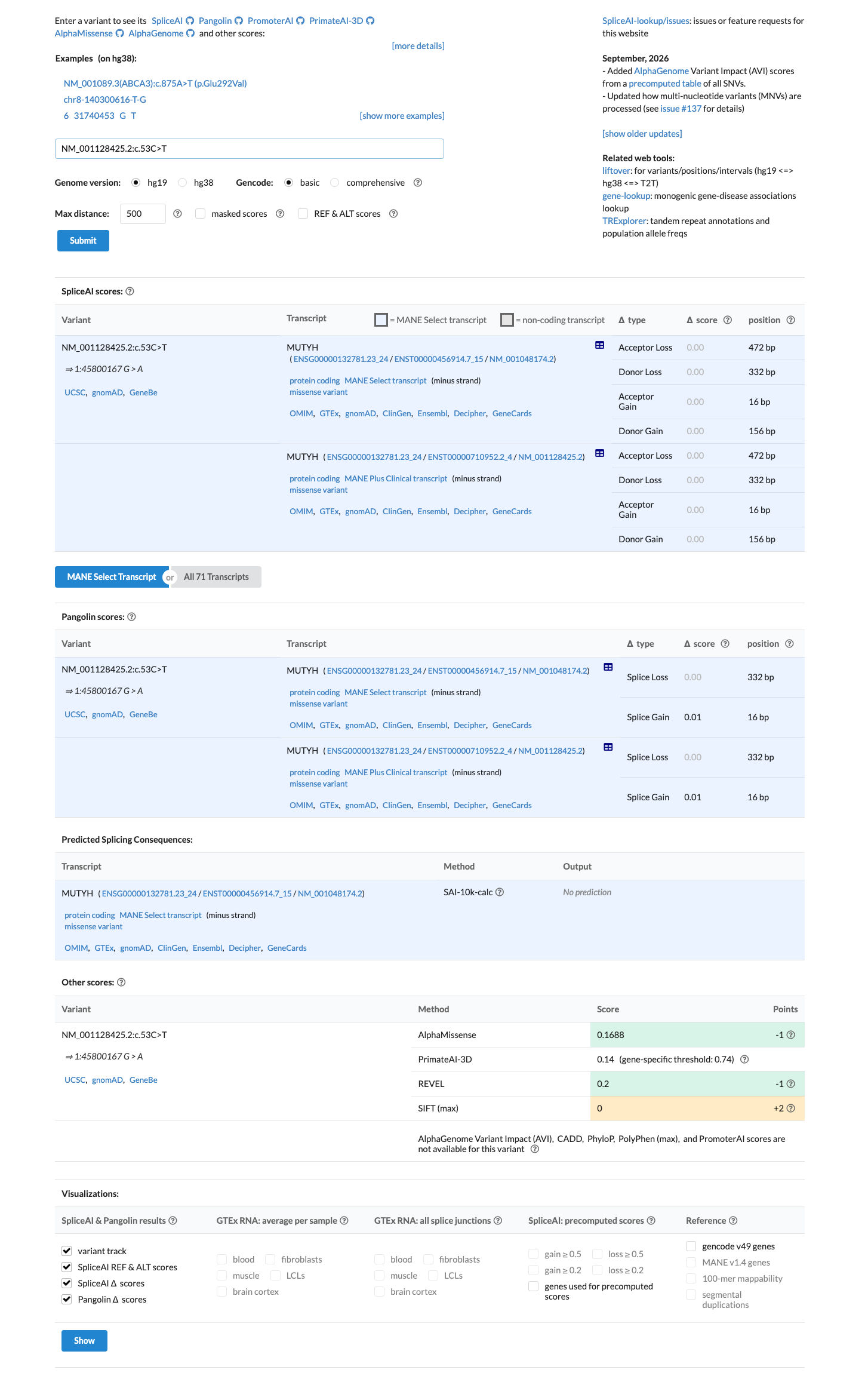
SpliceAI returned NO scores for this variant, so no SpliceAI-based splice prediction is available. This is missing data, NOT evidence of absent splice impact: it must not be used to support BP4 or to argue against PP3/PVS1. Pangolin scores may be present but are not calibrated for PP3/BP4 here. REVEL score = 0.2. BayesDel score = -0.0488581.
Functional / OncoKB screenshot
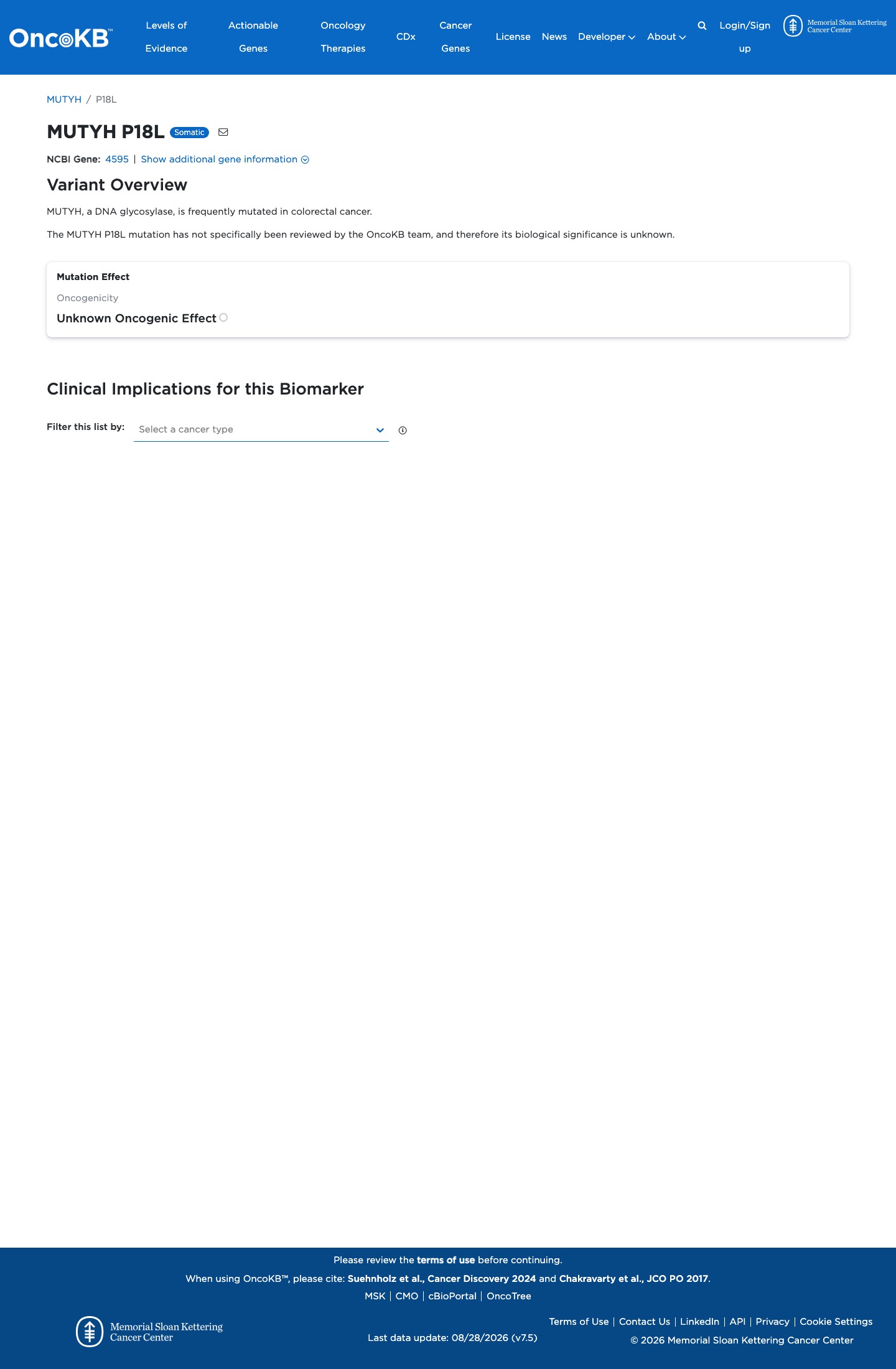
Functional Unknown Oncogenic Effect
OncoKB did not identify variant-specific reviewed functional evidence for this variant; gene-level curated context is available for reviewer follow-up. MUTYH, a DNA glycosylase, is frequently mutated in colorectal cancer.
OncoKB ↗
COSMIC screenshot
COSMIC
Cancer hotspots screenshot
Cancer hotspots
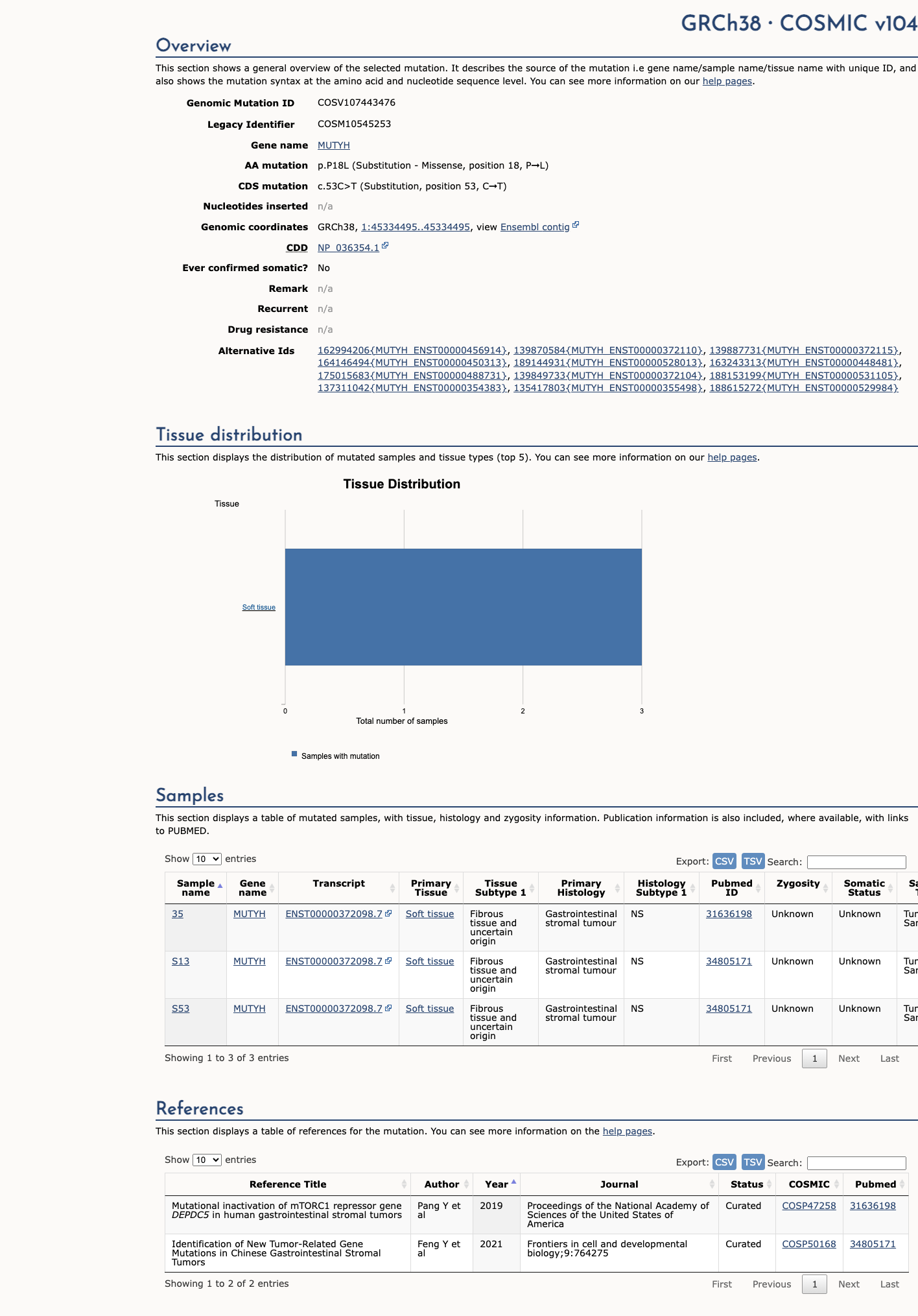
Somatic evidence Not in COSMIC / hotspots
COSMIC
This variant does not lie in a statistically significant hotspot. This variant has previously been reported in somatic cancers (COSMIC; COSV107443476, n = 3 times).
Hotspots
This variant does not lie in a statistically significant hotspot.
Literature · how each cited paper was used
5papers cited
Each card is an audit: what was searched, what was found, whether it names the variant, which criteria it fed, and why. 3 further PMIDs triaged but not cited — see Sources & references.
Germline mutations and polymorphic variants in MMR, E-cadherin and MYH genes associated with familial gastric cancer in Jiangsu of China.
Searched
c.53C>Tc.53C > Tp.Pro18Leup.(P18L)NP_001121897.1:p.(P18L)P18L
Found
This Jiangsu (China) case-control study reports MUTYH c.53C>T (p.Pro18Leu) in suspected hereditary gastric cancer patients, detected in 10/101 patients versus 3/129 healthy controls (p=0.019). Sequencing and cloning showed the change always occurred in cis with c.74G>A (p.Gly25Asp) on the same allele, forming a T/A haplotype with allele frequency 4.95% in patients versus 1.18% in controls (p=0.021, OR 4.43, 95% CI 1.33-14.72), driven by patients with a gastric cancer family history and young-onset cases. The authors interpret the T/A haplotype as a polymorphism in MYH rather than a definite pathogenic mutation, note that no biallelic MYH mutation was found in any patient, and speculate that p.Pro18Leu lies in the N-terminal RPA-binding domain / mitochondrial targeting signal where N-terminal modification could weaken MYH function. No functional assay of the variant was performed.
Variant
✓ Names this variant — characterised directly
Applied to
BS1 strong
Independent healthy-control frequency (3/129 controls, 1.18% haplotype frequency) for the exact variant, corroborating the East Asian allele frequency used for BS1.
An abnormal DHPLC peak was found in exon2 of MYH gene in 10 GC patients. Sequencing of PCR product of this exon showed that this altered DHPLC peak resulted from 2 heterozygous substitutions c.53C > T and c.74G > A, which is predicted to yield missense mutations of p.Pro18Leu and p.Gly25Asp, respectively. ... The allele frequency of this variant detected in suspected hereditary GC patients (4.95%) is significantly higher than that in healthy individuals (1.18%), OR 5 4.43 and 95% CI 5 1.33-14.72.
Location Results, Genetic analysis (paragraph 3, MYH exon 2) and Discussion, paragraph 2; data in Table II (MYH exon 2 row: c.53C > T, p.Pro18Leu, 10/101 vs 3/129, p 0.019) and Table III (c.53C>T/c.74G>A MYH allele frequencies)  ·  Context Case-control germline screening: 101 suspected hereditary gastric cancer patients from three counties of Jiangsu province and 129 healthy controls of the same geographic origin. All exons and intron-exon boundaries of MYH, MSH2, MLH1 and E-cadherin were screened by PCR-DHPLC with direct sequencing of aberrant peaks and TA cloning to phase the two MYH substitutions; Fisher's exact test for frequency comparisons. No functional assay was performed.  ·  full text
Genomic and functional analyses of MUTYH in Japanese patients with adenomatous polyposis.
Searched
c.53C>Tc.53 C>Tp.P18LNP_001121897.1:p.(P18L)P18L
Found
This Japanese adenomatous polyposis study reports MUTYH c.53C>T (p.Pro18Leu) directly. It was found once as a heterozygous germ-line change among 66 patients with an allele frequency of 0.76% (no homozygotes) and always co-occurred with other variants: Table 5 patient 2 carried P18L with G25D, Q324H and 1389G>C as a compound heterozygous genotype and was counted as MAP only because of that biallelic set. No functional assay was performed for P18L: the authors state they did not functionally analyse P18L and G25D because proline 18 and glycine 25 are not conserved across species. The missense variants assayed by nicking assay were G272E and A359V from patient 1, and the paper also notes Q324H should be regarded as a polymorphism.
Variant
✓ Names this variant — characterised directly
Applied to
BS1 strong
Documents the variant at 0.76% in a Japanese series, consistent with the East Asian allele frequency near 1% on which BS1 rests; used as ancestry context only, since this is a patient rather than population cohort.
Two patients carried biallelic mutations other than Q324H; a patient had biallelic G272E and A359V mutations, while the other had compound heterozygotes of P18L and G25D mutations.
Location Abstract; Table 2 (c.53 C>T, p.P18L, 1 heterozygous, allele frequency 0.76%); Table 5, patient 2; Discussion, paragraph 8 (functional analysis not performed for P18L)  ·  Context 66 Japanese patients from 52 families with adenomatous polyposis at Kyushu University Hospital; germ-line MUTYH screened by PCR-based SSCP and direct sequencing of the whole coding region in duplicate, APC screened by protein truncation test. Functional nicking assay used recombinant thioredoxin-tagged mouse MUTYH mutants (G257E, A341V) on oligonucleotides containing adenine opposite 8-oxoG or 2-hydroxyadenine opposite guanine; P18L was not functionally assayed.  ·  full text
A haplotype variation affecting the mitochondrial transportation of hMYH protein could be a risk factor for colorectal cancer in Chinese.
Searched
c.53C>Tp.(P18L)NP_001121897.1:p.(P18L)p.Pro18Leu
Found
This Chinese case-control and cell-biology study reports MUTYH c.53C>T (p.Pro18Leu) occurring in cis with c.74G>A (p.Gly25Asp) on the same allele (the T/A haplotype), detected in 6/138 sporadic colorectal cancer patients versus 3/343 healthy controls (allele frequency 2.17% vs 0.44%, P=0.020), with no homozygotes. In COS-7 cells the doubly-mutant haplotype protein showed dual nuclear plus mitochondrial localisation instead of the wild-type mitochondrial-only pattern, but the single p.Pro18Leu mutant protein remained mitochondrially localised like wild type, leading the authors to conclude each single substitution is insufficient to impair the mitochondrial targeting sequence. The authors note the low variant frequency, possible selection bias and the absence of glycosylase-activity or mitochondrial-genome-stability assays.
Variant
✓ Names this variant — characterised directly
Applied to
BS1 strong
Reports the exact variant in 3/343 healthy Chinese controls (0.87% haplotype frequency), independent control-cohort support for the East Asian allele frequency that drives BS1.
Interestingly, immunofluorescence showed that the hMYH proteins with single missense mutation, p.Pro18Leu or p.Gly25Asp, remained in the mitochondria, similar to the wild-type protein. It seems that the effect of the mutations are additive and either one of the missense mutations in the haplotype is not enough to impair the function of MTS domain.
Location Results, 'Distinct subcellular localization of wild- and variant-type hMYH protein' (Figure 2B); also Discussion, paragraphs 5-6, and Table 3 / Results for allele frequencies  ·  Context COS-7 cells transfected with FLAG-tagged hMYH type 1 cDNA (wild type, single c.53C>T, single c.74G>A, and the double haplotype) constructed by overlapping-PCR site-directed mutagenesis; subcellular localisation by anti-FLAG immunofluorescence with MitoTracker Red and confocal microscopy, plus a case-control study of 138 Chinese sporadic CRC patients and 343 healthy controls genotyped by DHPLC/direct sequencing/cloning.  ·  full text
Rule & framework references · cited for criterion definitions, not variant evidence
24033266 ↗ A systematic approach to assessing the clinical significance of genetic variants.
25741868 ↗ Standards and guidelines for the interpretation of sequence variants: a joint consensus recommendation of the American College of Medical Genetics and Genomics and the Association for Molecular Pathology.
Sources & reference links
9Sources
CSpec VCEP
ClinVar
gnomAD v2.1
gnomAD v4.1
gnomAD-Canada
SpliceAI
OncoKB
COSMIC
Cancer hotspots
Triaged references · 3 PMIDs not cited in assessment
21325953 ↗ Lynch syndrome and MYH-associated polyposis: review and testing strategy. CLINVAR
22855150 ↗ Guidelines for biomarker testing in colorectal carcinoma (CRC): a national consensus of the Spanish Society of Pathology (SEAP) and the Spanish Society of Medical Oncology (SEOM). CLINVAR
23852704 ↗ Tumor markers in colorectal cancer, gastric cancer and gastrointestinal stromal cancers: European group on tumor markers 2014 guidelines update. CLINVAR