Back
NM_001128425.2:c.925C>T
p.Arg309Cys · MUTYH
0%
complete
Final classification
VUS
PS3
MUTYH
c.925C>T
p.Arg309Cys
missense · exon 10

MUTYH encodes a DNA repair enzyme (a glycosylase) that fixes oxidative DNA damage by removing adenine bases that have been mistakenly paired with guanine or with oxidized guanine lesions. Inherited mutations in both copies of the gene cause MUTYH-associated polyposis (MAP), a recessive condition that strongly predisposes people to multiple colorectal polyps and colorectal cancer. The gene acts as a tumor suppressor whose loss of function allows DNA damage to accumulate, and somatic changes in it have also been reported in colon cancer, though whether they drive cancer on their own is not fully established.

This variant

MUTYH encodes a DNA-repair glycosylase, and biallelic pathogenic variants cause recessive MUTYH-associated polyposis with increased colorectal polyp and cancer risk.

Transcript
NM_001128425.2
HGVS · transcript:coding
NM_001128425.2:c.925C>T
GRCh38
chr1:45332174 G>A
GRCh37
chr1:45797846 G>A
VUS: PS3 (supporting) was the only applied criterion, and one supporting criterion does not meet generic ACMG/AMP thresholds for pathogenic, likely pathogenic, likely benign, or benign classification.
Classification rationale
PS3 VUS
MUTYH c.925C>T missense · exon 10

VUS: PS3 supporting was assigned because p.Arg309Cys was partially defective in a controlled complementation assay, but this alone is insufficient for a definitive classification.

PS3 VUS
LYFE Sciences is an AI system, and it can make mistakes. Criteria may be applied incorrectly, sources may be misread, and a confident-looking classification can still be wrong. Double-check every criterion and its underlying evidence before relying on any call.
Gene diagram · NM_001128425.2 · variants mapped to exon structure
MUTYH NM_001128425.2
Fetching transcript structure from UCSC…
Applied criteria · 1 applied · 23 assessed
MetEvidence satisfies this criterion.
Not metEvaluated against available evidence; threshold not reached.
Not assessedApplies in principle, but no evidence was found to evaluate it.
N/ADoesn't apply to this variant type.
Applied · 1
Strength Supporting Moderate Strong Very strong
PS3 supporting review Pathogenic
Met at supporting: p.R309C was partially defective in a controlled MutY-deficient E. coli assay using the 1.7-fold partial-defect threshold.
The governing InSiGHT MUTYH specification was present, but its extracted ruleset contained no criterion-specific PS3/BS3 rules or strength calibration; therefore the generic ACMG/AMP functional framework was used cautiously.PMID:25820570 tested the exact p.R309C variant in MutY-deficient E. coli CC104mutY, using wild-type MUTYH and empty-vector controls and nine independent overnight cultures.The assay established a wild-type mutation rate of 9.67/10^8 versus 137/10^8 for empty vector; variants less than 1.7-fold above wild type were functionally retained, 1.7-fold to less than 4.8-fold were partially defective, and at least 4.8-fold were defective.
Assessed · not applied · 7 not met · 16 not assessed
Pathogenic
PS1 Not met: no pathogenic alternate nucleotide change producing the same p.Arg309Cys substitution was identified.
PS2 Not assessed: no documented affected proband with confirmed parental genotypes and proven de novo occurrence is available for PS2 evaluation.
PS4 Not assessed: p.R309C lacks a validated PS4 case-control enrichment statistic or applicable MUTYH-specific threshold.
PM1 Not assessed: the MUTYH specification provides no retrieved authoritative domain table to verify whether residue 309 lies in an approved critical domain.
PM2 Not met: gnomAD v4.1 total allele frequency is 0.00069446, exceeding the generic PM2 threshold of 0.0001.
PM3 Not assessed: c.925C>T was reported once in a MAP cohort, but the partner allele and cis/trans phase were not documented.
PM5 Not assessed: no pathogenic alternate missense variant at MUTYH residue Arg309 was established in the available evidence.
PM6 Not assessed: no unconfirmed de novo occurrence in a clinically characterized proband is documented for PM6.
PP1 Not assessed: no informative affected-relative segregation series or count of concordant meioses is reported for p.Arg309Cys.
PP2 Not assessed: no MUTYH-specific evidence establishes the required combination of common pathogenic missense variation and rare benign missense variation.
PP3 Not met: REVEL 0.592 is below the PP3 supporting threshold of 0.644, while SpliceAI is unavailable and BayesDel lacks a calibrated generic cutoff.
PP4 Not assessed: reported colorectal phenotypes are not sufficiently specific, and no MUTYH-specific PP4 phenotype rule was available.
PP5 Not assessed: ClinVar reports zero exact-variant expert-panel submissions supporting Pathogenic or Likely pathogenic.
Benign
BA1 Not met: gnomAD v4.1 allele frequency is 0.00069446, far below the generic BA1 stand-alone threshold of 0.05.
BS1 Not met: the highest observed gnomAD v4.1 population frequency is 0.000883025, below the generic BS1 threshold of 0.01.
BS2 Not assessed: gnomAD v4.1 has one homozygote, but its clinical unaffected status is unavailable for the BS2 requirement.
BS3 Not met: prior normal glycosylase activity conflicts with the exact-variant complementation result showing partial dysfunction at the 1.7-fold threshold.
BS4 Not assessed: no well-phenotyped affected relatives shown to lack p.Arg309Cys in an informative family are documented.
BP1 Not assessed: available MUTYH evidence does not establish the gene-level truncating-predominance pattern required for BP1.
BP2 Not assessed: c.925C>T was observed in heterozygous controls, but no pathogenic partner allele or trans phase was documented.
BP4 Not met: REVEL 0.592 exceeds the BP4 supporting threshold of 0.29, while SpliceAI is unavailable and BayesDel lacks a calibrated generic cutoff.
BP5 Not assessed: no validated BP5 alternative-molecular-diagnosis evidence or MUTYH-specific threshold was available.
BP6 Not assessed: ClinVar reports zero exact-variant expert-panel submissions supporting Benign or Likely benign.
N/A · 4 PVS1 · PM4 · BP3 · BP7
Research & evidence
Population frequency
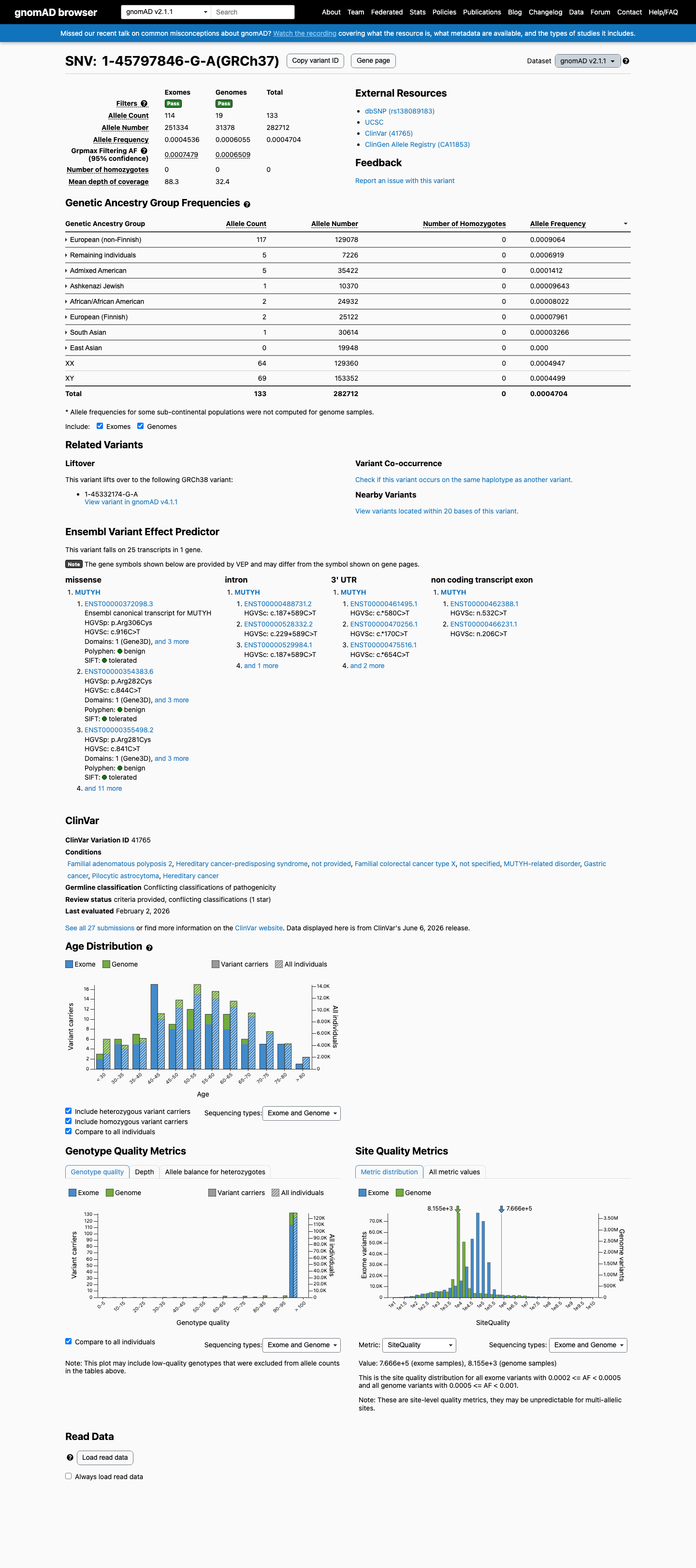
gnomAD v4.1 screenshot
gnomAD v4.1
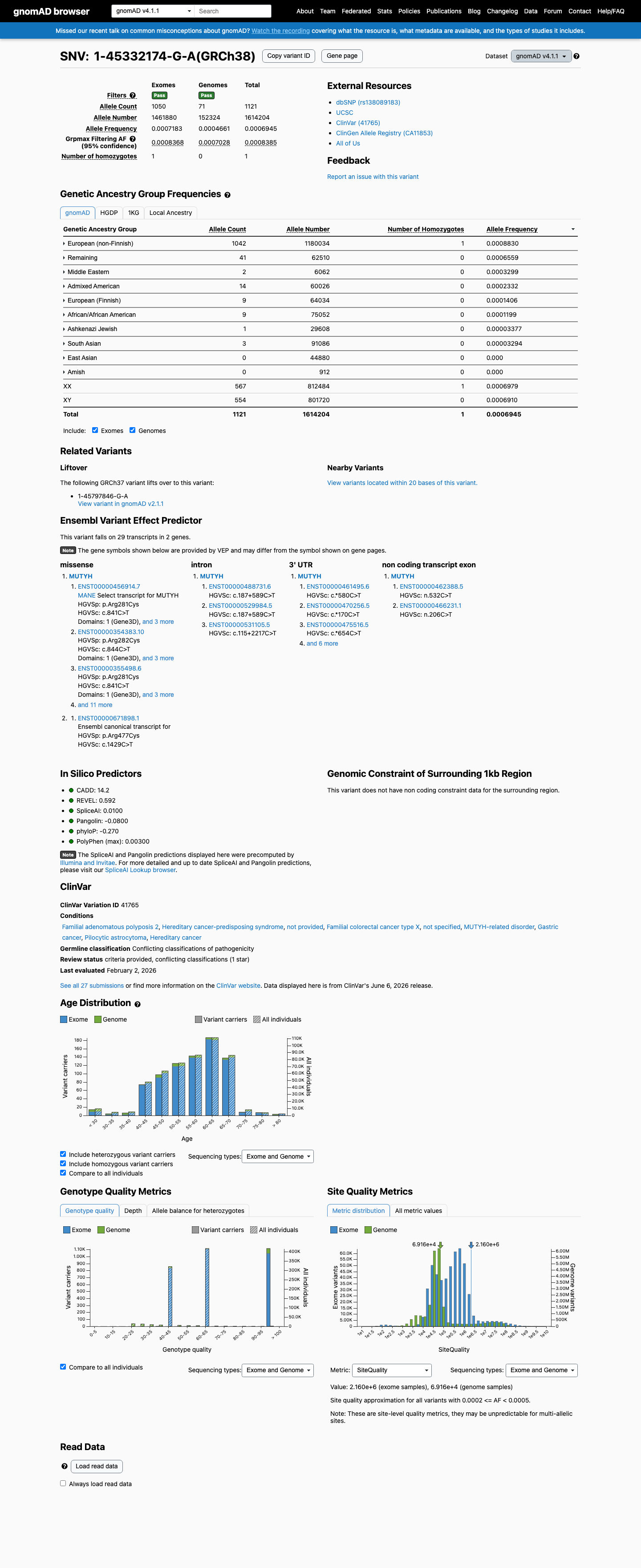
gnomAD v2.1 screenshot
gnomAD v2.1
v4.1
This variant is present in gnomAD v4.1 (AF= 0.00069446; MAF= 0.06945%, 1121/1614204 alleles, homozygotes = 1) and has highest observed frequency in the European (non-Finnish) population (AF= 0.000883025; MAF= 0.08830%, 1042/1180034 alleles, homozygotes = 1); grpmax FAF= 0.00083849.
v2.1
This variant is present in gnomAD v2.1 (AF= 0.000470443; MAF= 0.04704%, 133/282712 alleles, homozygotes = 0) and has highest observed frequency in the European (non-Finnish) population (AF= 0.000906429; MAF= 0.09064%, 117/129078 alleles, homozygotes = 0); grpmax FAF= 0.00074786.
🇨🇦 CA
Not available in gnomAD-Canada v1.0.
Allele frequency by ancestry
three datasets · side by side
gnomAD v4.1
0.069% · 1121 / 1,614,204
1 hom · FAF 0.084%
European (non-Finnish)
1042 / 1,180,034
0.088%
1 hom
Remaining individuals
41 / 62,510
0.066%
Middle Eastern
2 / 6,062
0.033%
Admixed American
14 / 60,026
0.023%
European (Finnish)
9 / 64,034
0.014%
African/African American
9 / 75,052
0.012%
Ashkenazi Jewish
1 / 29,608
0.0034%
South Asian
3 / 91,086
0.0033%
+ 2 not observed (Amish, East Asian)
gnomAD v2.1
0.047% · 133 / 282,712
0 hom · FAF 0.075%
European (non-Finnish)
117 / 129,078
0.091%
Remaining individuals
5 / 7,226
0.069%
Admixed American
5 / 35,422
0.014%
Ashkenazi Jewish
1 / 10,370
0.0096%
African/African American
2 / 24,932
0.008%
European (Finnish)
2 / 25,122
0.008%
South Asian
1 / 30,614
0.0033%
+ 1 not observed (East Asian)
gnomAD Canada 🇨🇦
Absent · 0 / ?
0 hom
Not observed in any ancestry group.
ClinVar screenshot
ClinVar
Error retrieving ClinVar entry.
SpliceAI screenshot
In silico
SpliceAI returned NO scores for this variant, so no SpliceAI-based splice prediction is available. This is missing data, NOT evidence of absent splice impact: it must not be used to support BP4 or to argue against PP3/PVS1. Pangolin scores may be present but are not calibrated for PP3/BP4 here. REVEL score = 0.592. BayesDel score = 0.0266467.
Functional / OncoKB screenshot
Functional Unknown Oncogenic Effect
OncoKB did not identify variant-specific reviewed functional evidence for this variant; gene-level curated context is available for reviewer follow-up. MUTYH, a DNA glycosylase, is frequently mutated in colorectal cancer.
OncoKB ↗
COSMIC screenshot
COSMIC
Cancer hotspots screenshot
Cancer hotspots
Somatic evidence Not in COSMIC / hotspots
COSMIC
This variant does not lie in a statistically significant hotspot. This variant has not previously been reported in somatic cancers (COSMIC).
Hotspots
This variant does not lie in a statistically significant hotspot.
Literature · how each cited paper was used
2papers cited
Each card is an audit: what was searched, what was found, whether it names the variant, which criteria it fed, and why. 6 further PMIDs triaged but not cited — see Sources & references.
MUTYH gene variants and breast cancer in a Dutch case–control study.
Searched
c.925C>TNP_001121897.1:p.(R309C)p.Arg309Cys
Found
The paper reports MUTYH c.925C>T, p.Arg309Cys as a variant of uncertain significance and notes that a cited functional study found normal glycosylase activity; it provides no pathogenic same-amino-acid or same-residue comparator.
Variant
✓ Names this variant — characterised directly
Applied to
PS3 supporting
The variant, p.Arg309Cys, has been described as a VUS in polyposis patients [6, 27]. Its effect was tested in one functional study, and showed normal glycosylase activity [28].
Location Results and discussion: ‘Sequencing of the MUTYH coding region’  ·  Context Direct sequencing and TaqMan genotyping in breast cancer patients, controls, and BRCAx subjects, with discussion of prior functional testing.  ·  full text
Functional Complementation Assay for 47 MUTYH Variants in a MutY-Disrupted Escherichia coli Strain.
Searched
c.925C>Tp.(R309C)p.R309C
Found
The paper explicitly studied MUTYH p.R309C in a MutY-deficient E. coli complementation assay and categorized it as partially defective; this is evidence about the queried substitution rather than a same-amino-acid or same-residue comparator.
Variant
✓ Names this variant — characterised directly
Applied to
PS3 supporting
The exact variant was partially defective in a controlled, biologically relevant complementation assay.
17 variants (p.P18L, p.Y128H, p.P157L, p.G189E, p.A227V, p.V234M, p.R241W, p.R245C, p.R309C, p.P380T, p.G396D, p.P405S, p.R437P, p.A489T, p.V493F, p.G503E, and p.E480del) were partially defective
Location Results, ‘BER Detection with a MutY-Deficient E. coli Complementation Assay’  ·  Context Functional complementation assay in MutY-deficient E. coli CC104mutY measuring rifampicin-resistant mutation rates, with comparison to prior in vitro glycosylase testing.  ·  full text
Sources & reference links
9Sources
CSpec VCEP
ClinVar
gnomAD v2.1
gnomAD v4.1
gnomAD-Canada
SpliceAI
OncoKB
COSMIC
Cancer hotspots
Triaged references · 6 PMIDs not cited in assessment
16557584 ↗ MUTYH-associated polyposis: 70 of 71 patients with biallelic mutations present with an attenuated or atypical phenotype. CLINVAR
19032956 ↗ Analysis of MUTYH genotypes and colorectal phenotypes in patients With MUTYH-associated polyposis. CLINVAR
20848659 ↗ Adenine DNA glycosylase activity of 14 human MutY homolog (MUTYH) variant proteins found in patients with colorectal polyposis and cancer. CLINVAR
25741868 ↗ Standards and guidelines for the interpretation of sequence variants: a joint consensus recommendation of the American College of Medical Genetics and Genomics and the Association for Molecular Pathology. CLINVAR
26377631 ↗ Distinct functional consequences of MUTYH variants associated with colorectal cancer: Damaged DNA affinity, glycosylase activity and interaction with PCNA and Hus1. CLINVAR
27153395 ↗ Evaluation of ACMG-Guideline-Based Variant Classification of Cancer Susceptibility and Non-Cancer-Associated Genes in Families Affected by Breast Cancer. CLINVAR