Analysis in progress
Initialising…
0%
complete
This report is still being assembled — sections appear as each stage finishes. It isn't final yet.
CDKN2A
Final classification
VUS
PM2PM4BP4
CDKN2A
c.44_46dup
p.Trp15_Leu16insArg
in_frame_indel_unknown · exon 1

CDKN2A encodes two key proteins, p16(INK4a) and p14(ARF), that help control cell division. p16 blocks the cell cycle by inhibiting CDK4 and CDK6, preventing progression from the G1 to S phase, while p14 stabilizes the tumor suppressor p53 by preventing its degradation. CDKN2A is an important tumor suppressor: it is frequently mutated, deleted, or silenced in many cancers, including melanoma, lymphoma, and pancreatic and lung cancer, and inherited changes in the gene can predispose people to familial melanoma and pancreatic cancer.

This variant

CDKN2A's p16(INK4a) protein restrains cell division by blocking CDK4/6, and inherited changes in the gene predispose to familial melanoma and pancreatic cancer. This in-frame duplication adds one arginine to p16(INK4a), but it remains a variant of uncertain significance: it is absent from reference populations and predicted not to affect splicing, yet no functional or clinical evidence shows whether the lengthened protein impairs tumor-suppressor activity.

Transcript
NM_001195132.1
HGVS · transcript:coding
NM_001195132.1:c.44_46dup
GRCh38
chr9:21974781 A>AGCC
GRCh37
chr9:21974780 A>AGCC
Basis VUS: generic ACMG/AMP 2015 rules applied (no CDKN2A-specific ClinGen framework); PM2, PM4, and BP4 (two supporting, one moderate) reach no Pathogenic or Benign threshold.
VUS: generic ACMG/AMP 2015 rules applied (no CDKN2A-specific ClinGen framework); PM2, PM4, and BP4 (two supporting, one moderate) reach no Pathogenic or Benign threshold.
Classification rationale
PM2PM4 BP4 VUS
CDKN2A c.44_46dup in_frame_indel_unknown · exon 1

PM2 (Supporting): the exact variant is absent from gnomAD v2.1, v4.1, and gnomAD-Canada v1.0, supporting rarity in reference populations. PM4 (Moderate): the in-frame duplication inserts one arginine, lengthening p16INK4A from 156 to 157 residues in a non-repeat region, with no predicted splice impact. BP4 (Supporting): SpliceAI predicts negligible splice impact (max delta 0.014, below the ~0.2 splice-altering threshold). Overall: VUS — under generic ACMG/AMP 2015 combination rules, PM2 (supporting), PM4 (moderate), and BP4 (supporting) together reach no Pathogenic or Benign threshold.

PM2 + PM4 + BP4 VUS
Gene diagram · NM_001195132.1 · variants mapped to exon structure
CDKN2A NM_001195132.1
Fetching transcript structure from UCSC…
Applied criteria · 3 applied · 18 assessed
MetEvidence satisfies this criterion.
Not metEvaluated against available evidence; threshold not reached.
Not assessedApplies in principle, but no evidence was found to evaluate it.
N/ADoesn't apply to this variant type.
Applied · 3
Strength Supporting Moderate Strong Very strong
PM2 supporting Pathogenic
Met (supporting): the exact variant is absent from gnomAD v2.1, v4.1, and gnomAD-Canada v1.0, supporting rarity.
gnomAD v2.1 reports the exact variant as absent.gnomAD v4.1 reports the exact variant as absent.gnomAD-Canada v1.0 reports the exact variant as absent.
PM4 moderate Pathogenic
Met (moderate): the in-frame duplication inserts one arginine, lengthening p16INK4A from 156 to 157 residues in a non-repeat region.
Variant normalization (prefetch.json, Mutalyzer/VariantValidator) confirms c.44_46dupGGC is an in-frame 3-bp duplication (NM_001195132.1:c.44_46dup) predicting NP_001182061.1:p.(Trp15_Leu16insArg), a single-amino-acid insertion lengthening p16INK4A from 156 to 157 residues; no frameshift or premature stop, so NMD is not triggered.pvs1_variant_assessment classifies the consequence as in_frame_indel_unknown and places it in a non-null variant bucket; the variant is not a canonical splice-consensus variant, consistent with a purely protein-level in-frame change.Direct inspection of the reference genomic sequence (NC_000009.11, GRCh37) around chr9:21974781-21974783 shows the duplicated unit GGC (plus-strand GCC) is not part of a tandem repeat, homopolymer, or low-complexity array (no (GCC)n or (GGC)n repeat flanks the site), so the duplication lies in a non-repeat region.
BP4 supporting Benign
Met (supporting): SpliceAI predicts negligible splice impact (max delta 0.014, below the ~0.2 splice-altering threshold).
SpliceAI Lookup query for NM_001195132.1:c.44_46dup returned max delta score = 0.014, well below the ~0.2 delta-score threshold from the SpliceAI publication (Jaganathan et al., Cell 2019, PMID 30661751) used to flag a predicted splice-altering variant.REVEL was explicitly skipped by the pipeline for this variant ('not snv or no coords') and BayesDel score/found are both null, so neither missense predictor contributes to BP4 for this in-frame insertion.
Assessed · not applied · 6 not met · 12 not assessed
Pathogenic
PS2 Not assessed: no parental testing or de novo observation was documented.
PS3 Not assessed: no functional assay data for this variant was available.
PS4 Not assessed: no case-control enrichment or affected-case series data was available.
PM3 Not assessed: no evidence of a pathogenic variant in trans or a recessive disease context was available.
PM6 Not assessed: no presumed de novo occurrence without confirmed parentage was documented.
PP1 Not assessed: no family segregation or affected-relative data was available.
PP3 Not met: SpliceAI max delta score 0.014, well below the ~0.2 splice-altering threshold.
PP4 Not assessed: no patient phenotype or CDKN2A-specific clinical presentation was documented.
PP5 Not met: the ClinVar record has no expert-panel submission, only single-laboratory assertions.
Benign
BA1 Not met: the variant is absent from gnomAD v2.1, v4.1, and gnomAD-Canada v1.0, below the stand-alone benign frequency threshold.
BS1 Not met: absent from gnomAD v2.1, v4.1, and gnomAD-Canada v1.0, no allele frequency above the disease-prevalence threshold is demonstrated.
BS2 Not assessed: no evidence of the variant in healthy adults or homozygous individuals was provided.
BS3 Not assessed: no functional assay showing normal, wild-type-like activity was available.
BS4 Not assessed: no unaffected-relatives or non-segregation data was available.
BP2 Not assessed: no genotype data establishing trans or cis configuration with a pathogenic variant was available.
BP3 Not met: the duplicated unit lies outside a repeat region, and CDKN2A has well-established function.
BP5 Not assessed: no alternative pathogenic variant or molecular workup explaining the phenotype was provided.
BP6 Not met: the ClinVar record has no expert-panel Benign or Likely benign submission.
N/A · 7 PVS1 · PS1 · PM1 · PM5 · PP2 · BP1 · BP7
Research & evidence
Population frequency
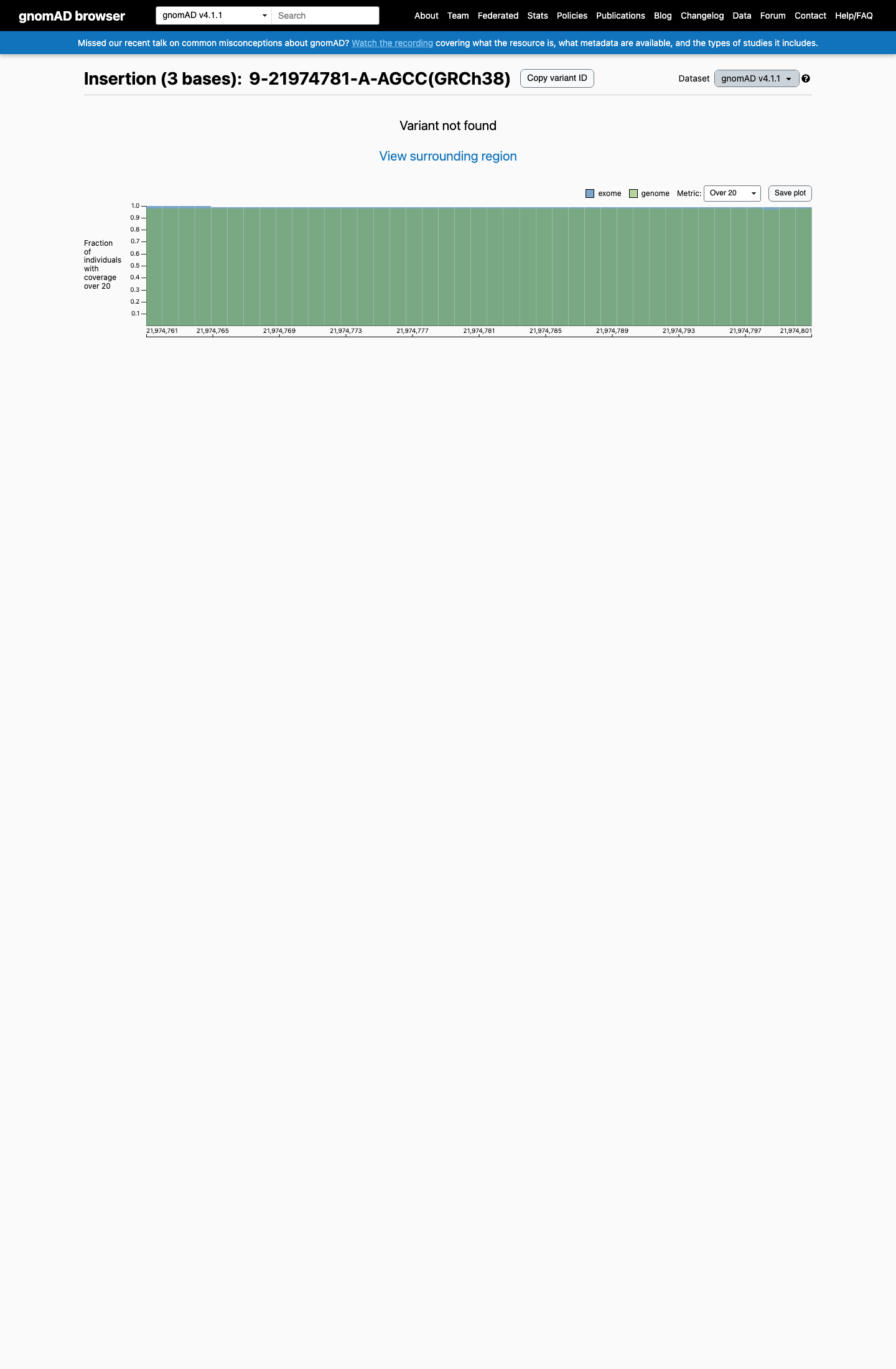
gnomAD v4.1 screenshot
gnomAD v4.1
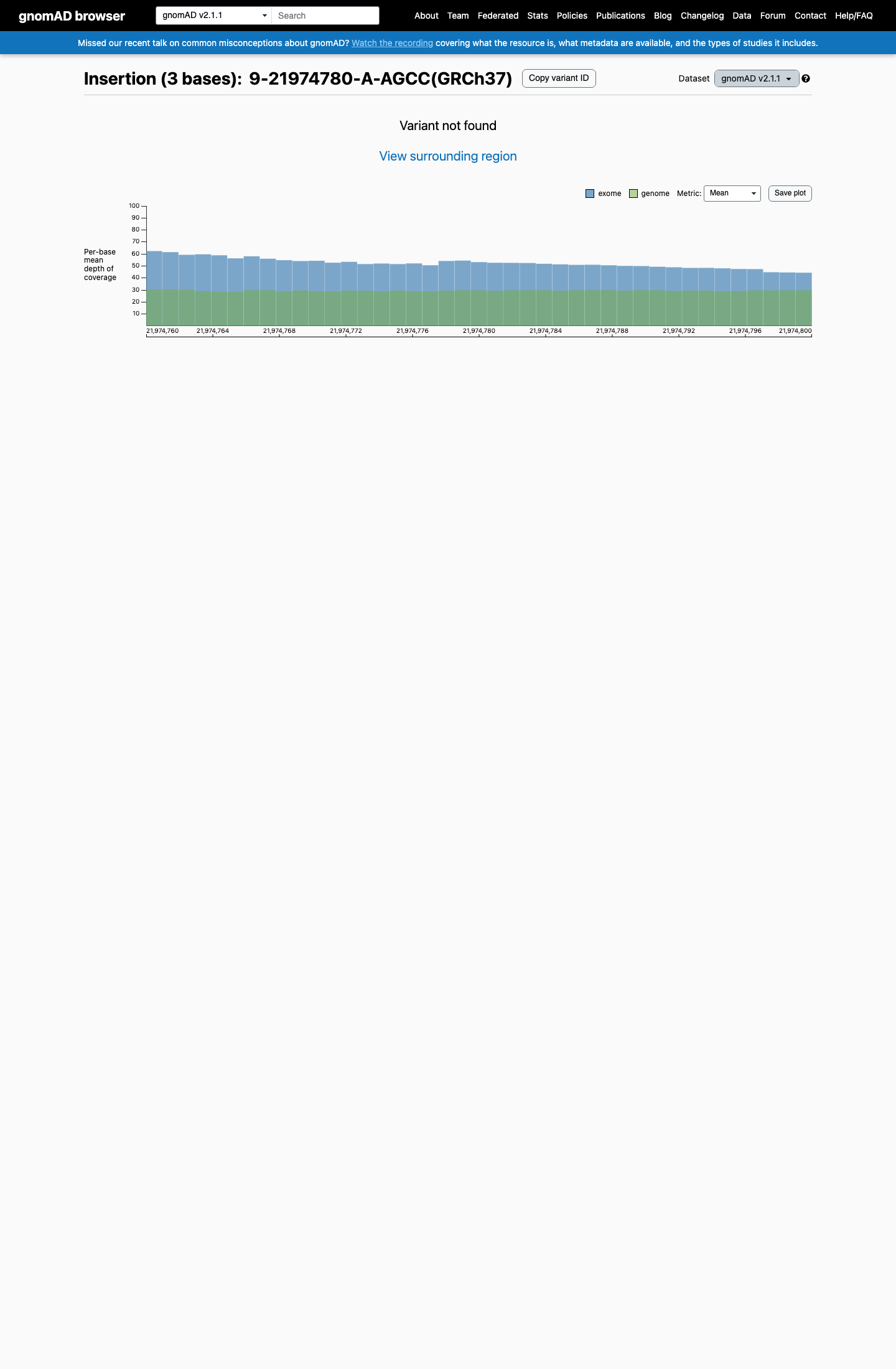
gnomAD v2.1 screenshot
gnomAD v2.1
v4.1
Absent from gnomAD v4.1.
v2.1
Absent from gnomAD v2.1.
🇨🇦 CA
Absent from gnomAD-Canada v1.0.
Allele frequency by ancestry
three datasets · side by side
gnomAD v4.1
Absent · 0 / ?
0 hom
Not observed in any ancestry group.
gnomAD v2.1
Absent · 0 / ?
0 hom
Not observed in any ancestry group.
gnomAD Canada 🇨🇦
Absent · 0 / ?
0 hom
Not observed in any ancestry group.
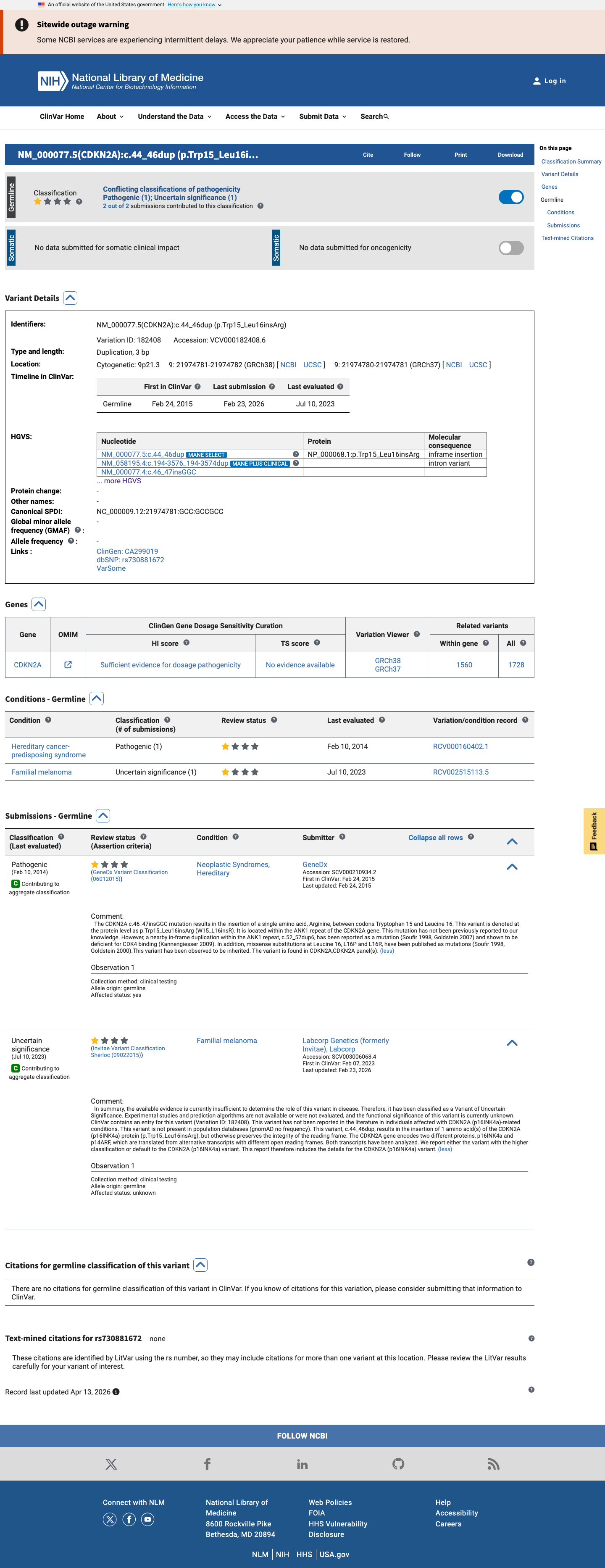
ClinVar screenshot
ClinVar
This variant has been reported in ClinVar as Pathogenic (1 clinical laboratory) and as Uncertain significance (1 clinical laboratory). (ClinVarID = 182408)
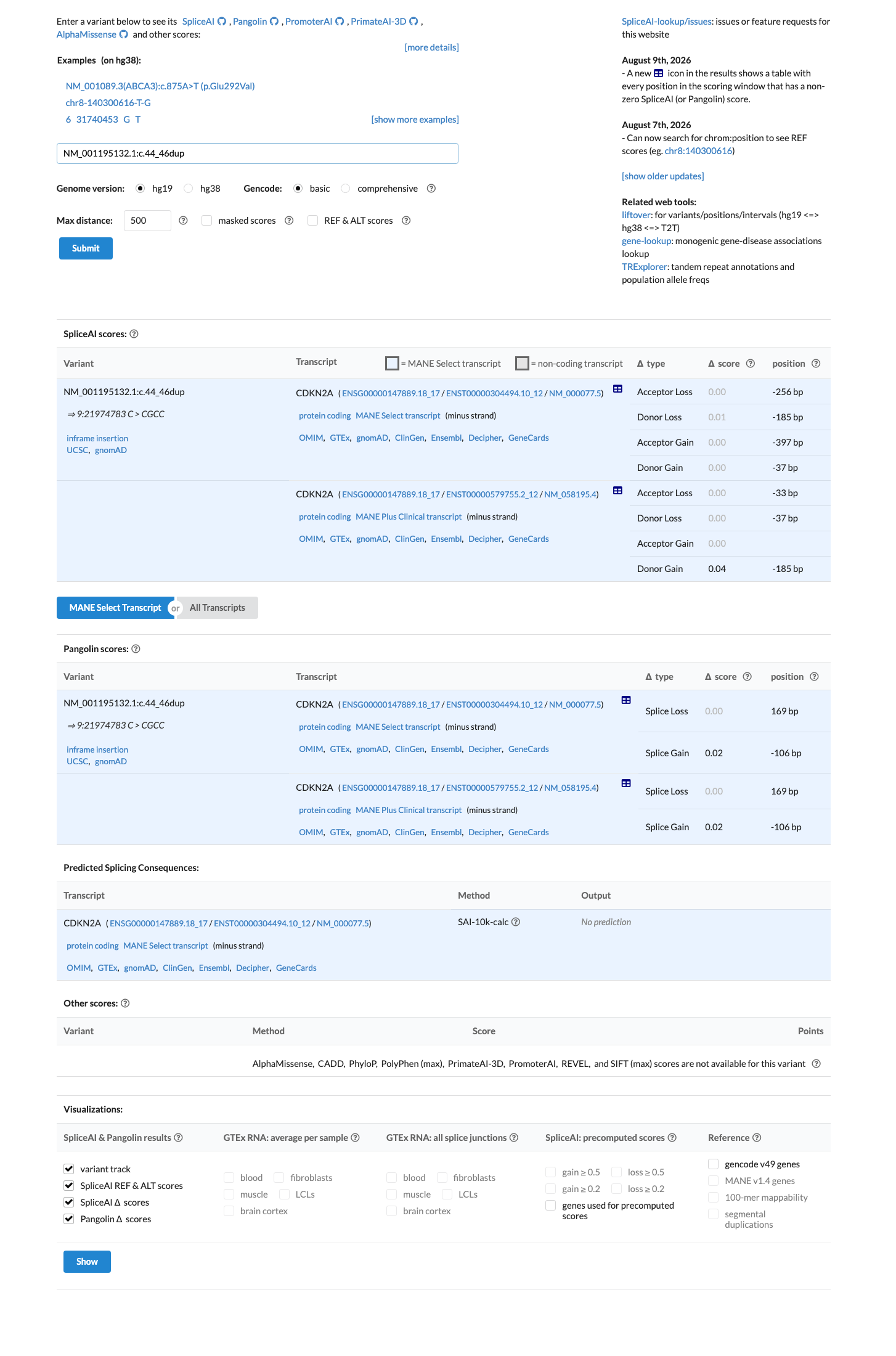
SpliceAI screenshot
In silico
SpliceAI predicts no significant splice impact for this variant (max delta score = 0.01).
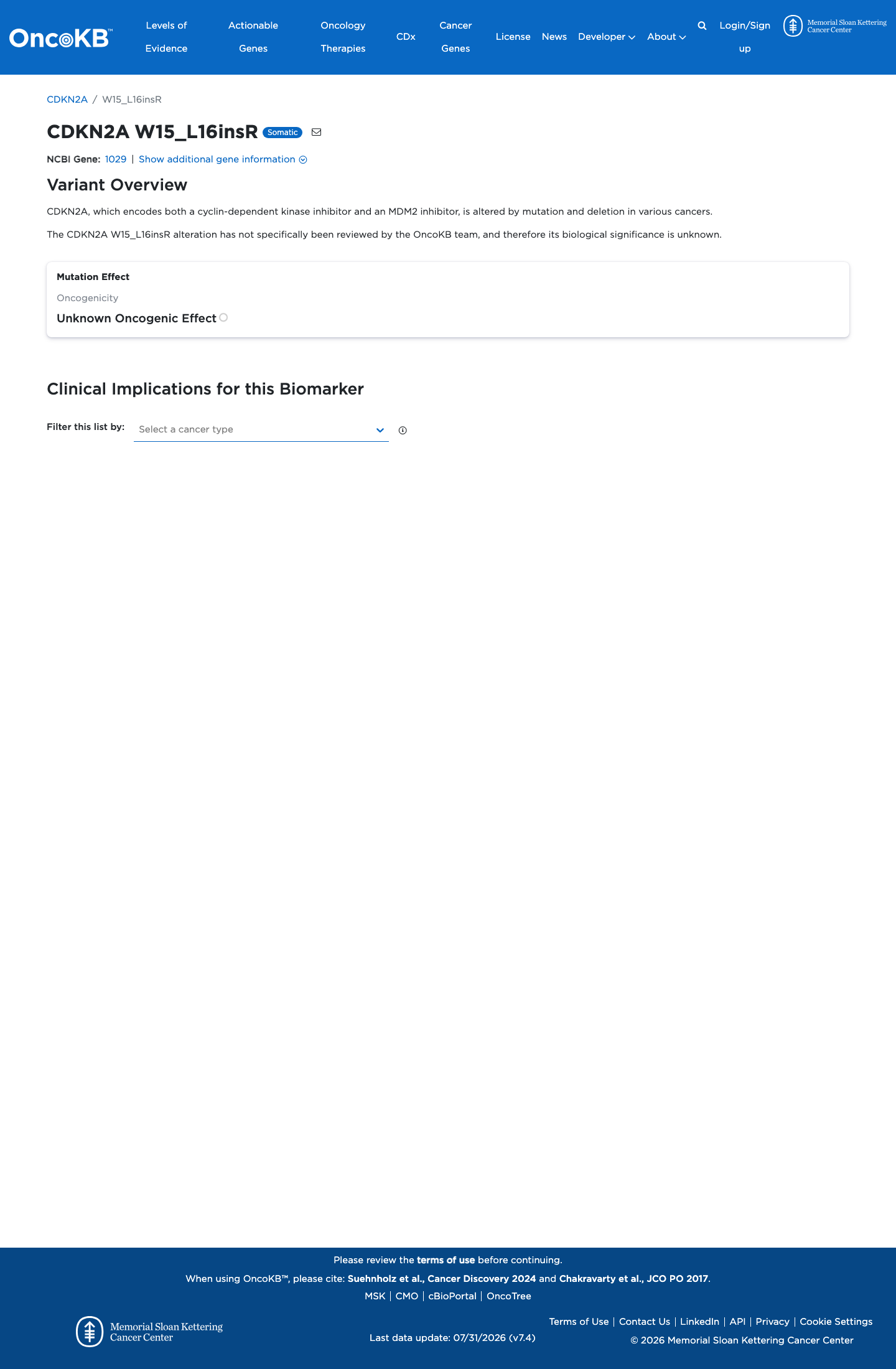
Functional / OncoKB screenshot
Functional Unknown Oncogenic Effect
OncoKB did not identify variant-specific reviewed functional evidence for this variant; gene-level curated context is available for reviewer follow-up. CDKN2A, which encodes both a cyclin-dependent kinase inhibitor and an MDM2 inhibitor, is altered by mutation and deletion in various cancers.
OncoKB ↗
COSMIC screenshot
COSMIC
Cancer hotspots screenshot
Cancer hotspots
Somatic evidence Not in COSMIC / hotspots
COSMIC
This variant does not lie in a statistically significant hotspot. This variant has not previously been reported in somatic cancers (COSMIC).
Hotspots
This variant does not lie in a statistically significant hotspot.
Sources & reference links
8Sources
ClinVar
gnomAD v2.1
gnomAD v4.1
gnomAD-Canada
SpliceAI
OncoKB
COSMIC
Cancer hotspots
Triaged references · 3 PMIDs not cited in assessment
25394175 ↗ A practice guideline from the American College of Medical Genetics and Genomics and the National Society of Genetic Counselors: referral indications for cancer predisposition assessment. CLINVAR
26389258 ↗ Cancer Genetics Risk Assessment and Counseling (PDQ®): Health Professional Version. CLINVAR
26389333 ↗ Genetics of Skin Cancer (PDQ®): Health Professional Version. CLINVAR