Analysis in progress
Initialising…
0%
complete
This report is still being assembled — sections appear as each stage finishes. It isn't final yet.
CUX1
Final classification
Benign
CUX1 c.2598_2606dup · p.Ser868_Gly870dup
CUX1 ·in_frame_indel_unknown

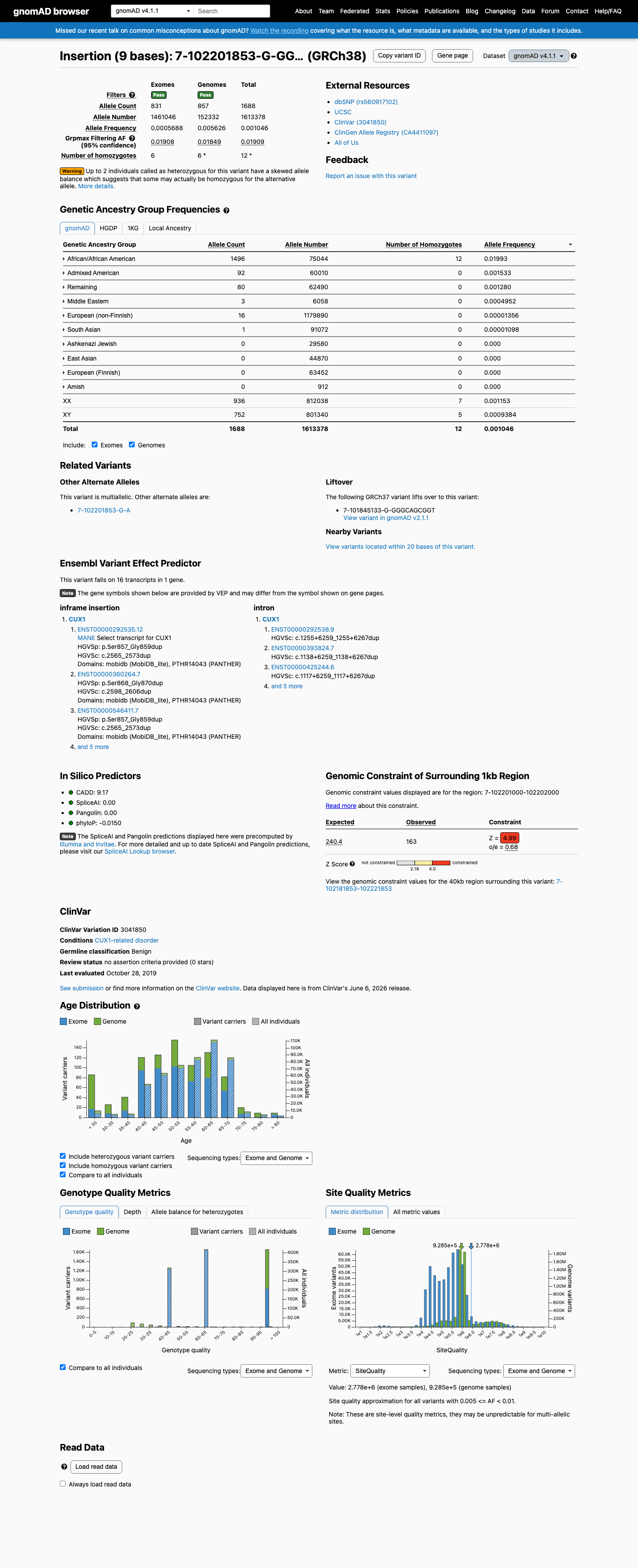
BA1 (Stand-alone): highest observed population allele frequency 1.99% in African/African American (gnomAD v4.1) exceeds the 1% BA1 threshold, corroborated by gnomAD v2.1 (1.77%) and gnomAD-Canada (2.55%).

Gene
CUX1
Transcript
NM_001202543.1
HGVS · transcript:coding
NM_001202543.1:c.2598_2606dup
Consequence
in_frame_indel_unknown
exon 18
GRCh38
chr7:102201853 G>GGGCAGCGGT
GRCh37
chr7:101845133 G>GGGCAGCGGT
Basis Benign: BA1 is met at stand-alone strength, with the highest observed population allele frequency 1.99% (gnomAD v4.1, African/African American) exceeding the 1% BA1 threshold.
Benign: BA1 is met at stand-alone strength, with the highest observed population allele frequency 1.99% (gnomAD v4.1, African/African American) exceeding the 1% BA1 threshold.
Classification rationale
BA1BP3 Benign
CUX1 c.2598_2606dup in_frame_indel_unknown · exon 18

BA1 (Stand-alone): highest observed population allele frequency 1.99% in African/African American (gnomAD v4.1) exceeds the 1% BA1 threshold, corroborated by gnomAD v2.1 (1.77%) and gnomAD-Canada (2.55%). BP3 (Supporting): in-frame 9-bp/3-amino-acid duplication p.(Ser868_Gly870dup) lies in a tandem SGG repeat region without known function, outside all CUT/homeodomain DNA-binding domains, with no predicted splice impact (SpliceAI max delta 0.006). Overall classification: Benign, per the generic ACMG/AMP 2015 combination rule '(1 BA1) -> Benign'; no pathogenic criterion is met.

BA1 + BP3 Benign
Gene diagram · NM_001202543.1 · variants mapped to exon structure
CUX1 NM_001202543.1
Fetching transcript structure from UCSC…
Applied criteria · 2 applied · 18 assessed
Applied · 2
Strength Supporting Moderate Strong Very strong
BA1 stand-alone Benign
Met (stand-alone benign): highest population allele frequency 1.99% in African/African American (gnomAD v4.1) exceeds the 1% BA1 threshold.
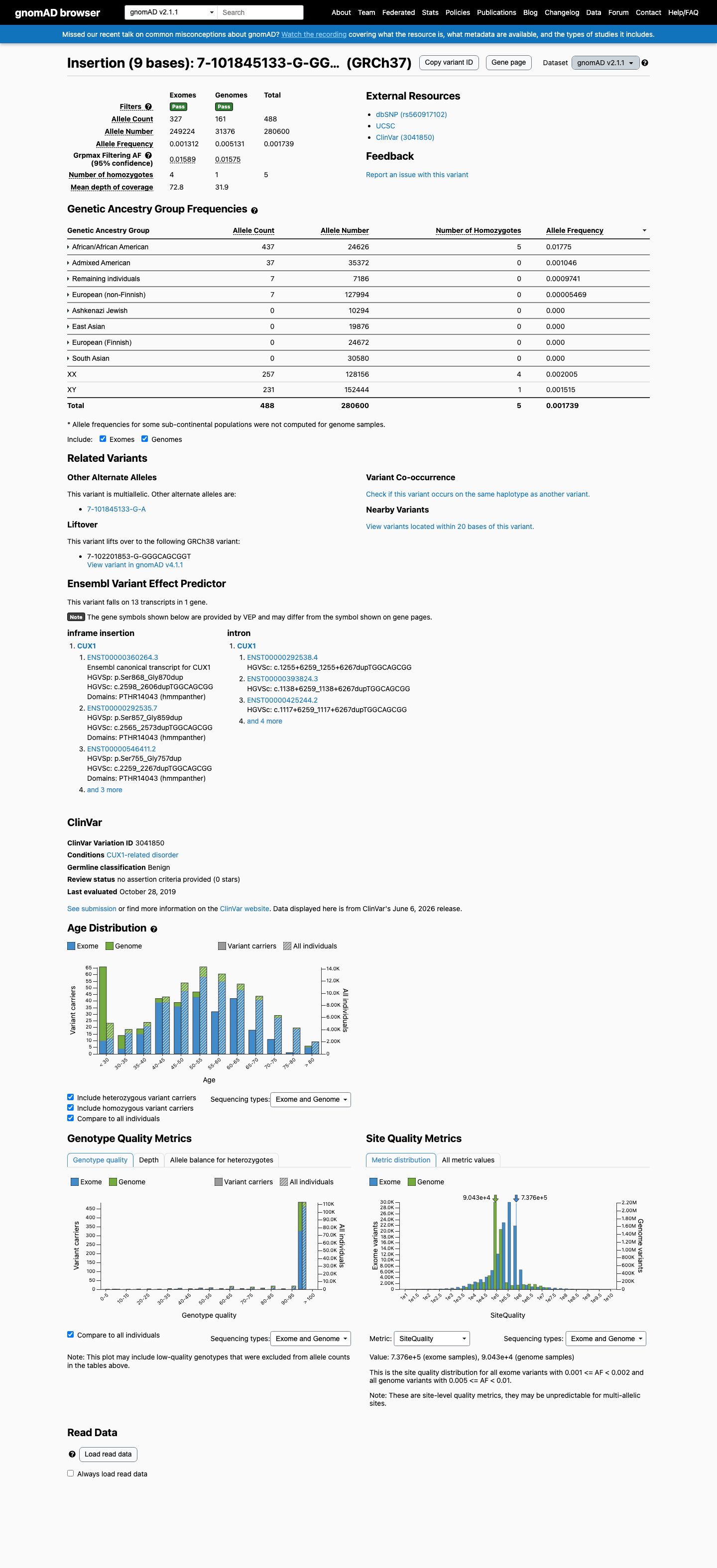
gnomAD v4.1 (GRCh38, joint exome+genome, 1,613,378 alleles): total AF 0.10463% (1688 alleles), highest observed frequency in African/African American at AF 1.99350% (1496/75044 alleles, 12 homozygotes); joint grpmax FAF 0.0190942 (1.91%); NFE AF 0.0014%, AMR AF 0.153%, MID AF 0.0495%, SAS AF 0.0011%, EAS/FIN/ASJ AF 0%.gnomAD v2.1 (GRCh37, exome, 280,600 alleles): total AF 0.17391% (488 alleles, 5 homozygotes), highest observed frequency in African/African American at AF 1.77455% (437/24626 alleles, 5 homozygotes); grpmax FAF 0.0158866 (1.59%).gnomAD-Canada v1.0 (HostSeq, 10,487 genomes, 18,418 alleles): overall AF 0.1466% (27 alleles, 0 homozygotes), highest frequency in African/African American at AF 2.554% (26/1018 alleles); grpmax faf95 0.0179 (1.79%).
BP3 supporting Benign
Met (supporting benign): in-frame 3-amino-acid duplication in a tandem SGG repeat region without known function.
Generic ACMG/AMP 2015 BP3 (Richards et al., PMID 25741868): 'In-frame indels in a repeat region without known function' (supporting benign). No CSPEC/VCEP exists for CUX1 (vcep_materials.json: generic_acmg_fallback), so the generic framework governs.In-frame: 9-bp duplication of 3 codons, NM_001202543.1:c.2598_2606dupTGGCAGCGG, p.(Ser868_Gly870dup) (Mutalyzer and VariantValidator normalization in prefetch.json; gnomAD-Canada VEP most_severe_consequence 'inframe_insertion'); protein length 1517 to 1520 aa; no frameshift, no premature stop, NMD not applicable; exon 18 of 23 in NM_001202543.1. ClinVar (variation 3041850) reports the same change on the MANE transcript NM_181552.4 as c.2565_2573dup, p.(Gly859_Gly860insSerGlyGly), confirming an in-frame Ser-Gly-Gly insertion across transcripts (ClinVar entry has no assertion criteria and is used here only for transcript/protein notation).Repeat region: the duplicated unit SGG (residues 868-870) is a perfect tandem repeat of the immediately upstream unit (residues 865-867; reference 865-870 = SGGSGG); the variant creates three tandem SGG copies (...GKEKGSGGSGGSGGGSQPR...), verified by CDS-level simulation using the NCBI NM_001202543.1 sequence. The region is Gly/Ser-rich low complexity (33.8% G+S in the +/-40 aa window; 70% GC DNA in c.2538-2667 with adjacent homopolymer runs c.2405 CCCCC, c.2418 CCCCC, c.2464 AAAAA). UniProt P39880 (CUX1) annotates the region as intrinsically disordered (residues 815-930) with flanking compositional-bias 'polar residues' stretches (868-877, 887-911); UniProt is not a source_registry key, so this is narrative context.
Assessed · not applied
Pathogenic
PS2 Not assessed: no proband-parent trio or parental-confirmation data for this variant was available.
PS3 Not assessed: no well-established functional assay evidence for this variant was available.
PS4 Not assessed: no case-control or case-series evidence exists; the only observation is a single somatic COSMIC entry.
PM2 Not met: gnomAD v4.1 overall allele frequency 0.105% exceeds the 0.1% PM2 ceiling (1.99% in African/African American).
PM3 Not met: no trans observation with a pathogenic variant and no recessive disease model; 12 homozygotes exist in gnomAD v4.1.
PM6 Not assessed: no proband-parent testing data exists, so an assumed de novo occurrence cannot be evaluated.
PP1 Not assessed: no pedigree, affected-family-member genotyping, or segregation data for this variant was available.
PP3 Not met: SpliceAI max delta 0.006 predicts no splice impact, far below the 0.2 cutoff; missense predictors do not apply.
PP4 Not assessed: no proband phenotype or family-history data, and no publication reports this exact variant in an affected patient.
PP5 Not met: no ClinVar expert-panel (3-star) classification exists; the sole submission is a 0-star laboratory Benign label.
Benign
BS1 Not met: the 1.99% frequency exceeds both frequency thresholds but triggers BA1 instead, since BS1 and BA1 are mutually exclusive.
BS2 Not met: 12 homozygotes in gnomAD v4.1, but no established penetrance or inheritance model for CUX1-related germline disease.
BS3 Not assessed: no validated functional study showing no damaging effect on protein function or splicing was available.
BS4 Not assessed: no familial segregation testing data for this variant was available.
BP2 Not met: no observation of this variant in trans or cis with a pathogenic variant exists.
BP4 Not met: a single SpliceAI line (max delta 0.006) does not satisfy BP4's multiple-lines-of-evidence requirement.
BP5 Not assessed: no alternate molecular basis of disease was documented for any case carrying this variant.
BP6 Not met: the ClinVar Benign label is a 0-star laboratory submission, not a 3-star expert-panel assertion.
N/A · 8 PVS1 · PS1 · PM1 · PM4 · PM5 · PP2 · BP1 · BP7
Research & evidence
Population frequency · supports benign
gnomAD v4.1 screenshot
gnomAD v4.1
gnomAD v2.1 screenshot
gnomAD v2.1
v4.1
This variant is present in gnomAD v4.1 (AF= 0.00104625; MAF= 0.10463%, 1688/1613378 alleles, homozygotes = 12) and has highest observed frequency in the African/African American population (AF= 0.019935; MAF= 1.99350%, 1496/75044 alleles, homozygotes = 12); grpmax FAF= 0.0190942.
v2.1
This variant is present in gnomAD v2.1 (AF= 0.00173913; MAF= 0.17391%, 488/280600 alleles, homozygotes = 5) and has highest observed frequency in the African/African American population (AF= 0.0177455; MAF= 1.77455%, 437/24626 alleles, homozygotes = 5); grpmax FAF= 0.0158866.
🇨🇦 CA
This variant is present in gnomAD-Canada v1.0 (AF= 0.0014659572157671842, 27/18418 alleles, homozygotes = 0).
Allele frequency by ancestry
three datasets · side by side
gnomAD v4.1
0.1% · 1688 / 1,613,378
12 hom · FAF 1.9%
African/African American
1496 / 75,044
2%
12 hom
Admixed American
92 / 60,010
0.15%
Remaining individuals
80 / 62,490
0.13%
Middle Eastern
3 / 6,058
0.05%
European (non-Finnish)
16 / 1,179,890
0.0014%
South Asian
1 / 91,072
0.0011%
+ 4 not observed (European (Finnish), Amish, East Asian, Ashkenazi Jewish)
gnomAD v2.1
0.17% · 488 / 280,600
5 hom · FAF 1.6%
African/African American
437 / 24,626
1.8%
5 hom
Admixed American
37 / 35,372
0.1%
Remaining individuals
7 / 7,186
0.097%
European (non-Finnish)
7 / 127,994
0.0055%
+ 4 not observed (Ashkenazi Jewish, East Asian, European (Finnish), South Asian)
gnomAD Canada 🇨🇦
0.15% · 27 / 18,418
0 hom · FAF 1.8%
African/African American
26 / 1,018
2.6%
Remaining individuals
1 / 1,138
0.088%
+ 7 not observed (Latino/Admixed American, Ashkenazi Jewish, East Asian, European (Finnish), Middle Eastern, European (non-Finnish), South Asian)
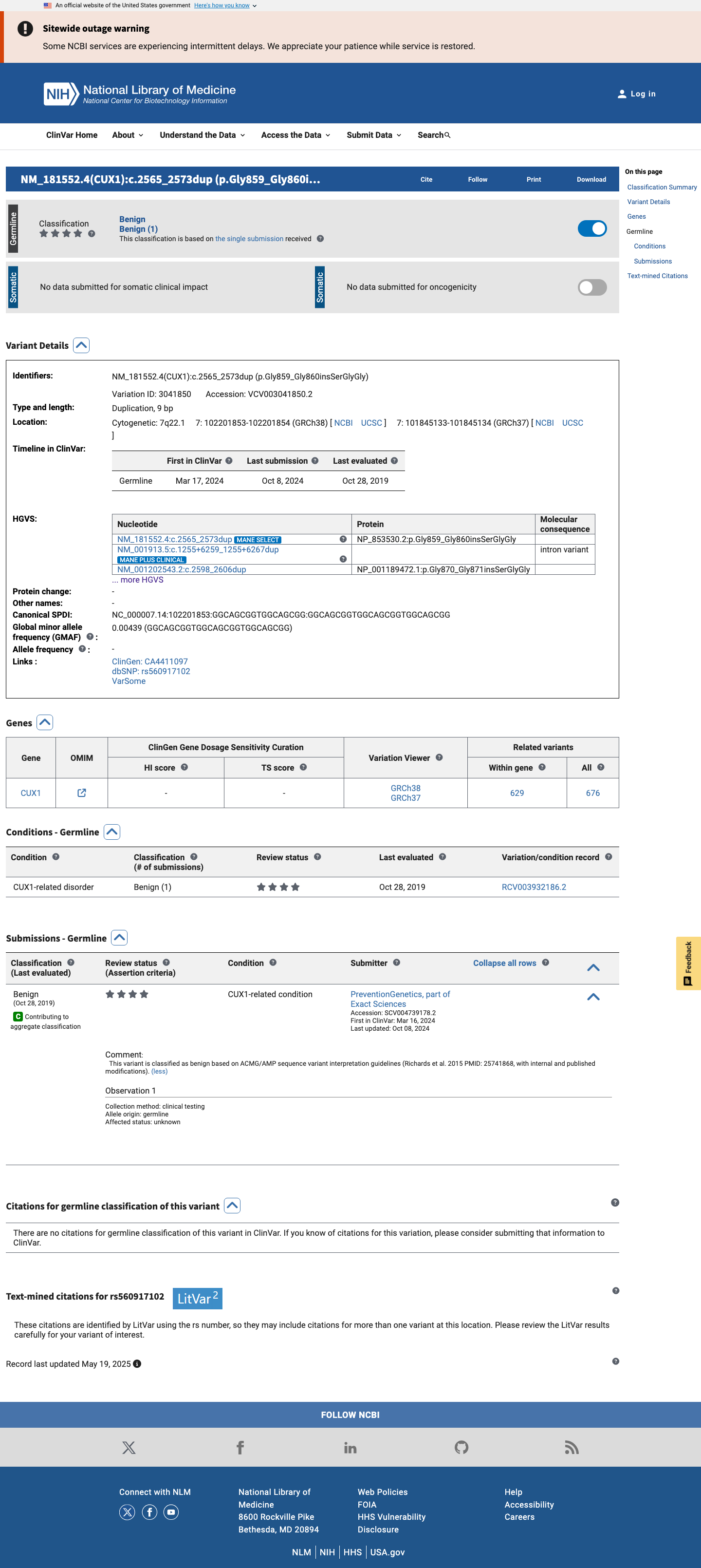
ClinVar screenshot
ClinVar
This variant has been reported in ClinVar as Benign (1 clinical laboratory). (ClinVarID = 3041850)
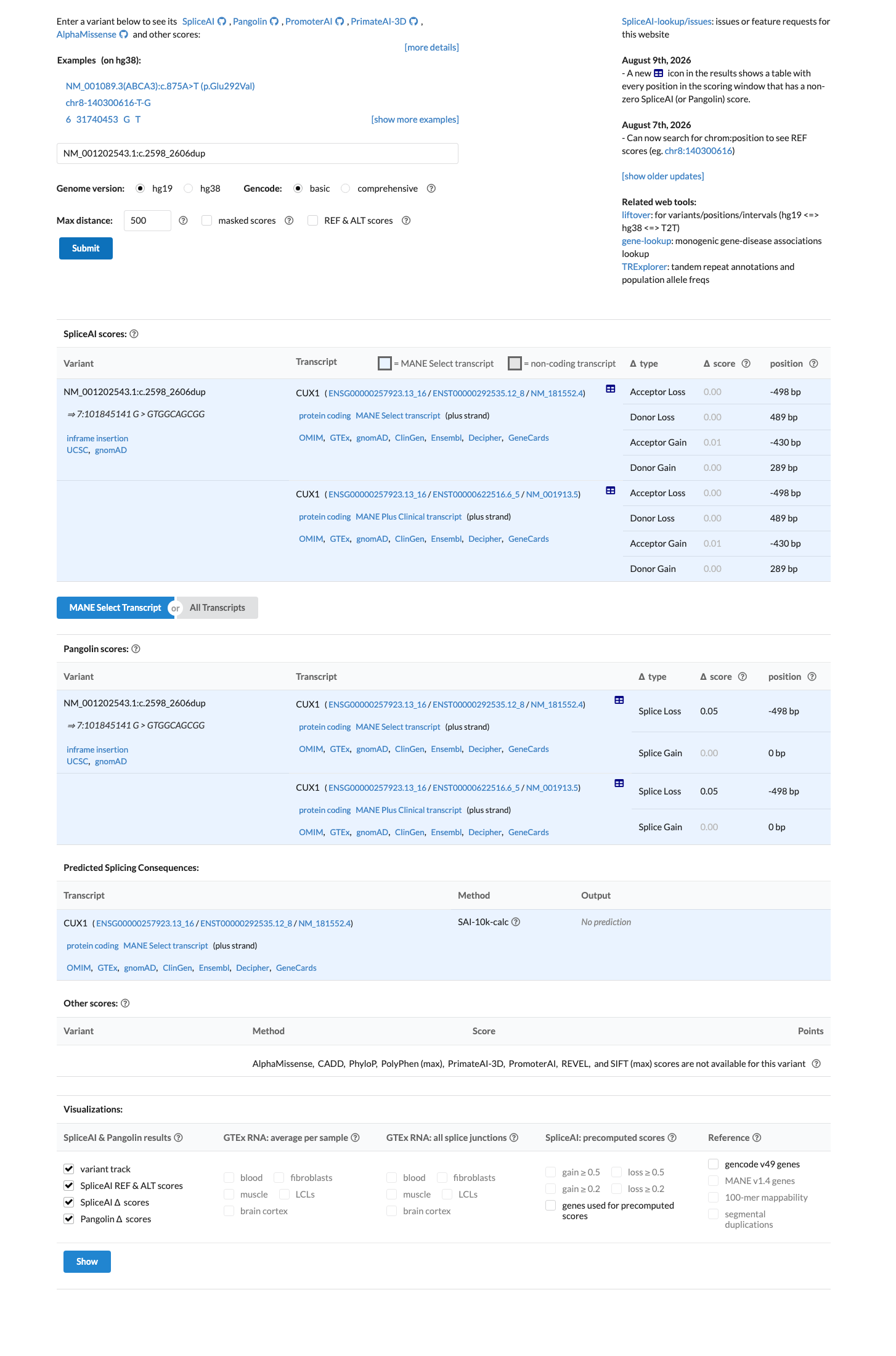
SpliceAI screenshot
In silico
SpliceAI predicts no significant splice impact for this variant (max delta score = 0.01).
Functional / OncoKB screenshot
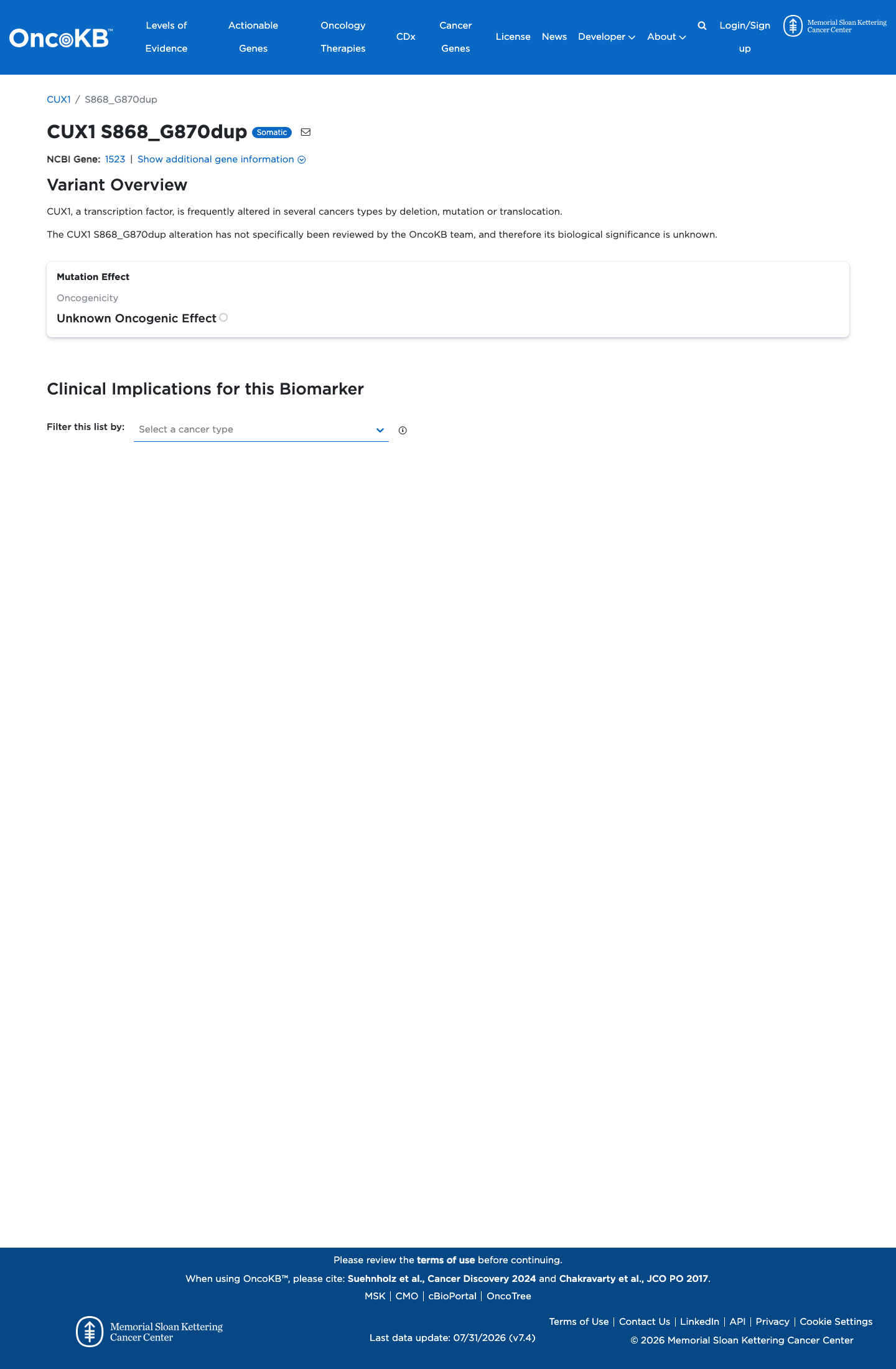
Functional Unknown Oncogenic Effect
OncoKB did not identify variant-specific reviewed functional evidence for this variant; gene-level curated context is available for reviewer follow-up. CUX1, a transcription factor, is frequently altered in several cancers types by deletion, mutation or translocation.
OncoKB ↗
COSMIC screenshot
COSMIC
Cancer hotspots screenshot
Cancer hotspots
Somatic evidence Not in COSMIC / hotspots
COSMIC
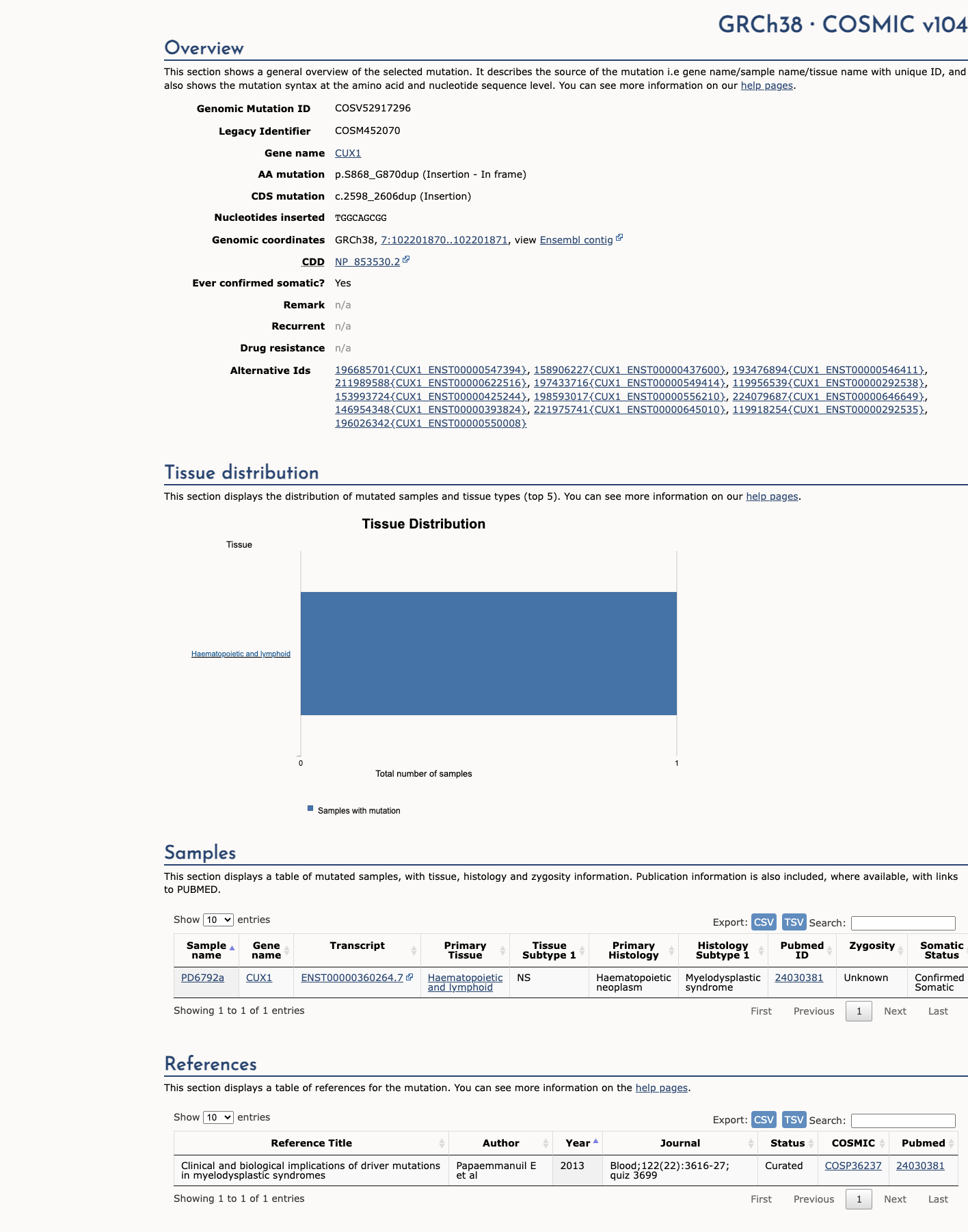
This variant does not lie in a statistically significant hotspot. This variant has previously been reported in somatic cancers (COSMIC; COSV52917296, n = 1 times).
Hotspots
This variant does not lie in a statistically significant hotspot.
Sources & reference links
8Sources
ClinVar
gnomAD v2.1
gnomAD v4.1
gnomAD-Canada
SpliceAI
OncoKB
COSMIC
Cancer hotspots