0%
complete
Final classification
Benign
BA1BS1BP4
MBD4
c.1073T>C
p.Ile358Thr
missense · exon 3

MBD4 encodes a DNA glycosylase that detects and repairs deaminated methyl-cytosines in DNA, using a methyl-CpG binding domain to anchor to methylated DNA and a glycosylase domain to carry out mismatch repair in CpG-rich regions. The protein also helps repress transcription from methylated gene promoters. MBD4 acts as a tumor suppressor, and its loss has been linked to colorectal cancer, acute myeloid leukemia, and uveal melanoma.

This variant

MBD4 is a DNA-repair tumor suppressor whose loss of function has been linked to colorectal cancer, acute myeloid leukemia, and uveal melanoma. This Benign classification indicates that the common p.Ile358Thr change is not expected to disrupt MBD4's DNA-repair activity or contribute to MBD4-associated cancer risk.

Transcript
NM_001276270.2
HGVS · transcript:coding
NM_001276270.2:c.1073T>C
GRCh38
chr3:129436571 A>G
GRCh37
chr3:129155414 A>G
No MBD4-specific VCEP/CSPEC framework was available, so generic ACMG/AMP 2015 criteria applied; BA1 (stand-alone benign) alone establishes Benign, with BS1 and BP4 concordant.
Classification rationale
BA1BS1BP4 Benign
MBD4 c.1073T>C missense · exon 3

BA1 (Stand-alone): gnomAD v4.1 allele frequency of 1.01% exceeds the 1% threshold for a rare Mendelian disorder. BS1 (Strong): population frequency of 1.01% exceeds the 0.3% benign threshold. BP4 (Supporting): REVEL score of 0.218 falls below the 0.250 benign cutoff. BA1 alone is sufficient for a Benign classification; BS1 and BP4 are concordant but not required.

BA1 + BS1 + BP4 Benign
Gene diagram · NM_001276270.2 · variants mapped to exon structure
MBD4 NM_001276270.2
Fetching transcript structure from UCSC…
Applied criteria · 3 applied · 21 assessed
MetEvidence satisfies this criterion.
Not metEvaluated against available evidence; threshold not reached.
Not assessedApplies in principle, but no evidence was found to evaluate it.
N/ADoesn't apply to this variant type.
Applied · 3
Strength Supporting Moderate Strong Very strong
BA1 stand-alone Benign
Met (stand-alone benign): gnomAD v4.1 allele frequency of 1.01% exceeds the 1% BA1 threshold.
gnomAD v4.1: 16,365/1,614,030 alleles, AF 0.0101392; maximum reported population AF 0.0121222 in European (non-Finnish) individuals, with 71 homozygotes.gnomAD v2.1: 2,041/282,712 alleles, AF 0.00721936; maximum reported population AF 0.0112282, with 10 homozygotes overall.gnomAD-Canada v1.0: 190/18,418 alleles, AF 0.0103160, with 2 homozygotes.
BS1 strong Benign
Met (strong benign): allele frequency of 1.01% exceeds the 0.3% BS1 threshold.
gnomAD v4.1: overall AF 0.0101392 and European non-Finnish AF 0.0121222 (14,304/1,179,986 alleles; 71 homozygotes).gnomAD v2.1: overall AF 0.00721936 and maximum reported population AF 0.0112282 (81/7,214 alleles; 1 homozygote in that subgroup).gnomAD-Canada v1.0: AF 0.0103160 (190/18,418 alleles; 2 homozygotes).
BP4 supporting Benign
Met (supporting): REVEL score 0.218 is below the BP4 benign cutoff of 0.250.
No MBD4 VCEP/ClinGen gene-specific specification or pre-assigned PP3/BP4 lookup was available; the generic ACMG/AMP fallback therefore governs.The normalized consequence is missense, NM_001276270.2:c.1073T>C (NP_001263199.1:p.(Ile358Thr)); the generic rule therefore selects the REVEL missense path only.REVEL score is 0.218, below the generic BP4 cutoff of 0.250. The REVEL calibration cutoffs are from ClinGen SVI Bayesian calibration work (PMID:36413997).
Assessed · not applied · 4 not met · 17 not assessed
Pathogenic
PS1 Not assessed: no validated report of this same amino-acid change (p.Ile358Thr) as pathogenic was available.
PS2 Not assessed: no de novo observation of the variant with confirmed maternity and paternity was documented.
PS3 Not assessed: no validated functional assay evidence showing p.Ile358Thr has a damaging effect was available.
PS4 Not assessed: no case-control or cohort data showed enrichment of this variant in affected individuals.
PM1 Not assessed: no authoritative critical-domain or hotspot evidence covering MBD4 residue 358 was available.
PM2 Not met: gnomAD v4.1 allele frequency of 1.01% (84 homozygotes) far exceeds the <0.1% rarity threshold.
PM3 Not assessed: no evidence showed the variant in trans with a pathogenic MBD4 variant in an affected individual.
PM5 Not assessed: no verified pathogenic missense variant at the same residue was available for comparison.
PM6 Not assessed: no case or literature evidence documents the variant as de novo.
PP1 Not assessed: no family segregation data for the variant were available.
PP2 Not assessed: no evidence established that benign missense variation is uncommon in MBD4.
PP3 Not met: REVEL score 0.218 is below the PP3 threshold of 0.750.
PP4 Not assessed: no phenotype or clinical context data were provided.
PP5 Not met: no ClinVar expert-panel pathogenic or likely pathogenic classification exists for this exact variant.
Benign
BS2 Not assessed: homozygote counts in population databases alone do not establish that healthy adults were observed.
BS3 Not assessed: no functional assay evidence showing the variant preserves normal protein function was available.
BS4 Not assessed: no at-risk relatives were tested, so non-segregation could not be evaluated.
BP1 Not assessed: no variant-spectrum evidence established that missense changes do not cause MBD4 disease.
BP2 Not assessed: no evidence placed this variant in cis or trans with another pathogenic variant.
BP5 Not assessed: no evidence of an alternate cause of disease in a tested individual was provided.
BP6 Not met: no ClinVar expert-panel benign or likely benign classification exists for this exact variant.
N/A · 4 PVS1 · PM4 · BP3 · BP7
Research & evidence
Population frequency · supports benign
gnomAD v4.1 screenshot
gnomAD v4.1
gnomAD v2.1 screenshot
gnomAD v2.1
v4.1
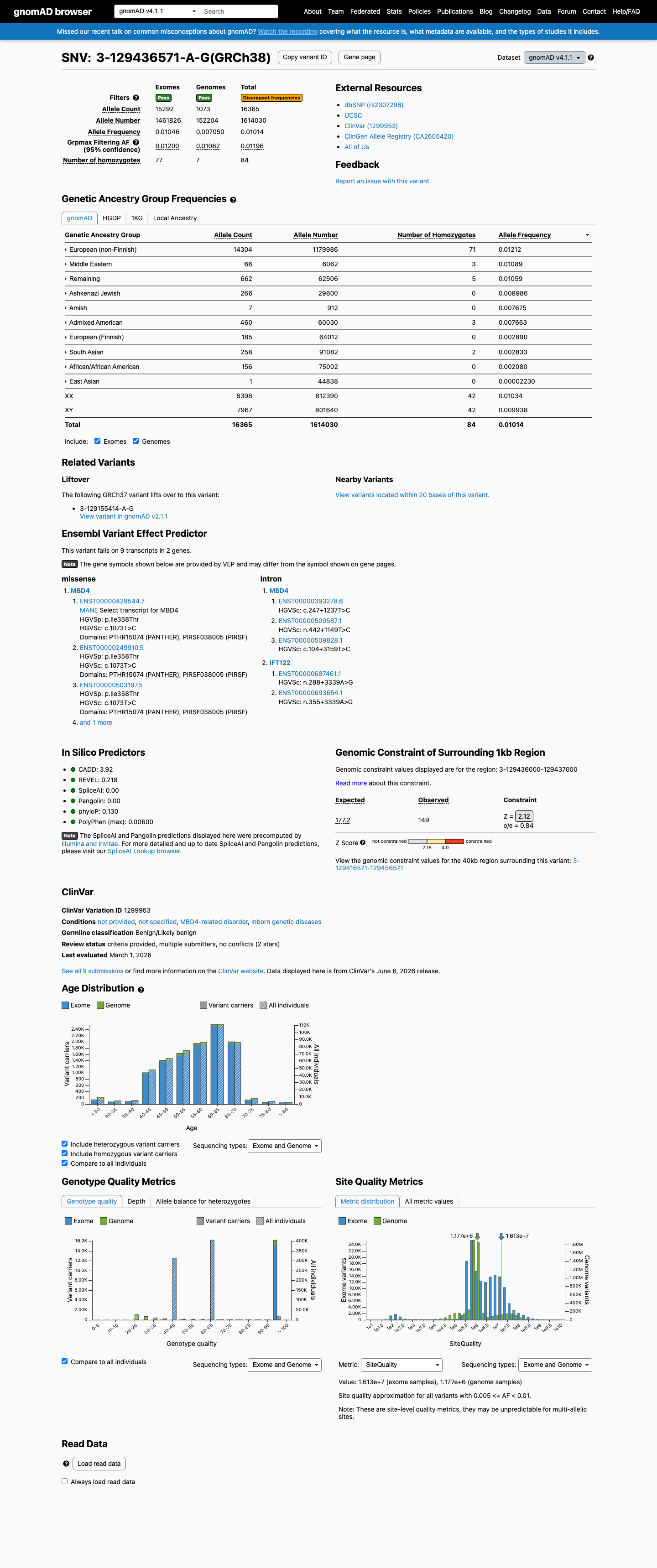
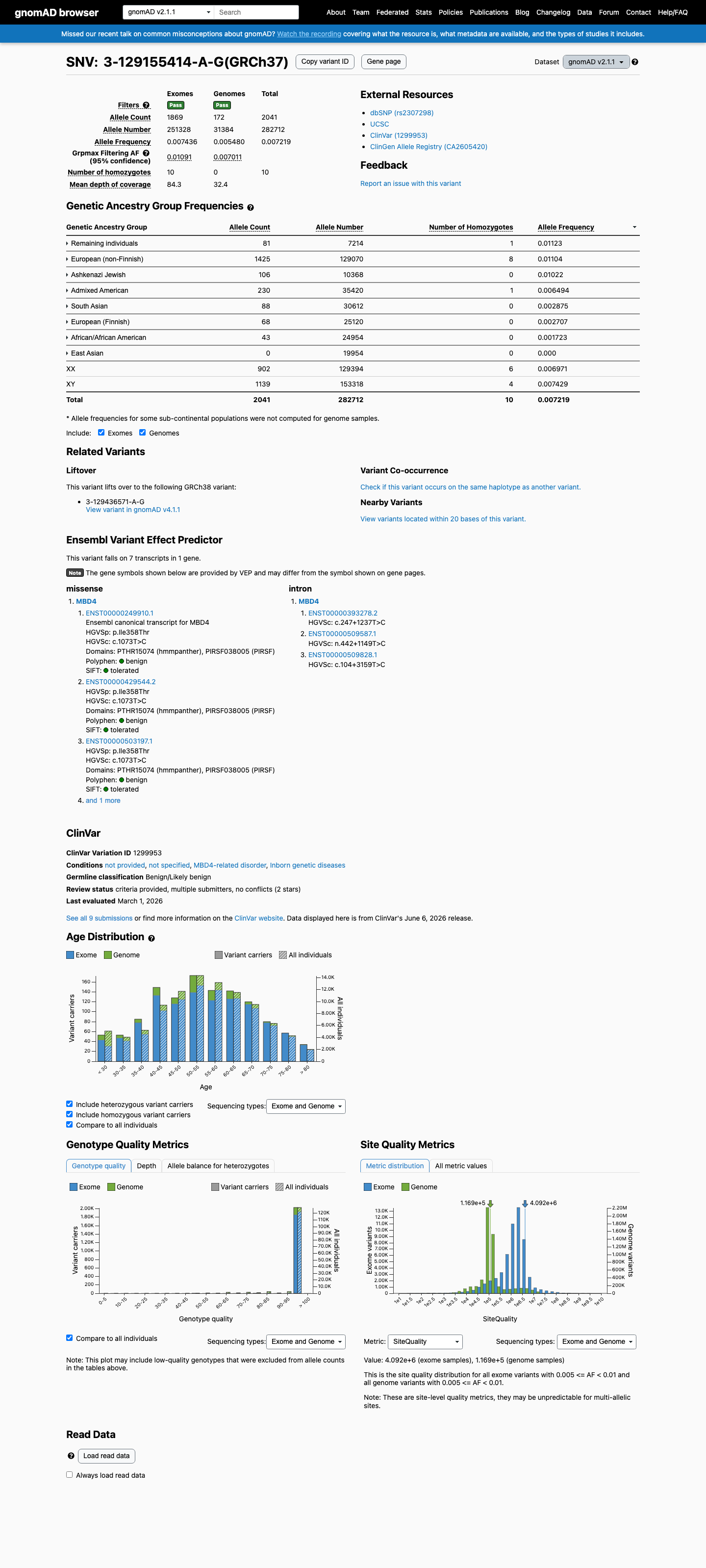
This variant is present in gnomAD v4.1 (AF= 0.0101392; MAF= 1.01392%, 16365/1614030 alleles, homozygotes = 84) and has highest observed frequency in the European (non-Finnish) population (AF= 0.0121222; MAF= 1.21222%, 14304/1179986 alleles, homozygotes = 71); grpmax FAF= 0.0119554.
v2.1
This variant is present in gnomAD v2.1 (AF= 0.00721936; MAF= 0.72194%, 2041/282712 alleles, homozygotes = 10) and has highest observed frequency in the Remaining individuals population (AF= 0.0112282; MAF= 1.12282%, 81/7214 alleles, homozygotes = 1); grpmax FAF= 0.0109125.
🇨🇦 CA
This variant is present in gnomAD-Canada v1.0 (AF= 0.010315995222065371, 190/18418 alleles, homozygotes = 2).
Allele frequency by ancestry
three datasets · side by side
gnomAD v4.1
1% · 16365 / 1,614,030
84 hom · FAF 1.2%
European (non-Finnish)
14304 / 1,179,986
1.2%
71 hom
Middle Eastern
66 / 6,062
1.1%
3 hom
Remaining individuals
662 / 62,506
1.1%
5 hom
Ashkenazi Jewish
266 / 29,600
0.9%
Amish
7 / 912
0.77%
Admixed American
460 / 60,030
0.77%
3 hom
European (Finnish)
185 / 64,012
0.29%
South Asian
258 / 91,082
0.28%
2 hom
African/African American
156 / 75,002
0.21%
East Asian
1 / 44,838
0.0022%
gnomAD v2.1
0.72% · 2041 / 282,712
10 hom · FAF 1.1%
Remaining individuals
81 / 7,214
1.1%
1 hom
European (non-Finnish)
1425 / 129,070
1.1%
8 hom
Ashkenazi Jewish
106 / 10,368
1%
Admixed American
230 / 35,420
0.65%
1 hom
South Asian
88 / 30,612
0.29%
European (Finnish)
68 / 25,120
0.27%
African/African American
43 / 24,954
0.17%
+ 1 not observed (East Asian)
gnomAD Canada 🇨🇦
1% · 190 / 18,418
2 hom · FAF 1.1%
Middle Eastern
3 / 144
2.1%
Ashkenazi Jewish
13 / 832
1.6%
European (non-Finnish)
150 / 11,740
1.3%
1 hom
Remaining individuals
14 / 1,138
1.2%
South Asian
6 / 1,362
0.44%
Latino/Admixed American
3 / 838
0.36%
1 hom
East Asian
1 / 1,338
0.075%
+ 2 not observed (African/African American, European (Finnish))
ClinVar screenshot
ClinVar
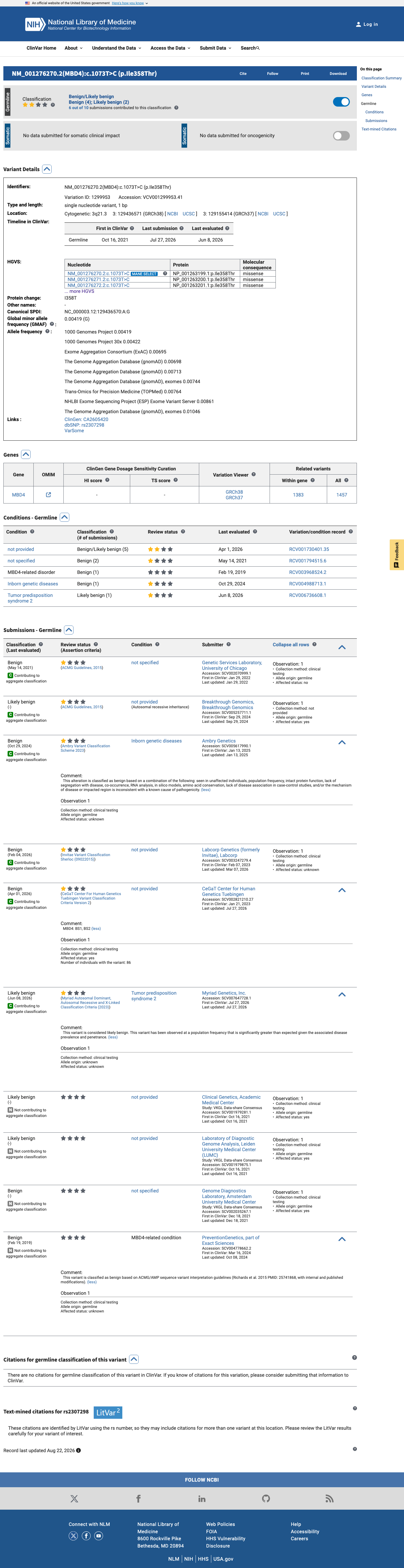
This variant has been reported in ClinVar as Benign (6 clinical laboratories) and as Likely benign (3 clinical laboratories). (ClinVarID = 1299953)
SpliceAI screenshot
In silico
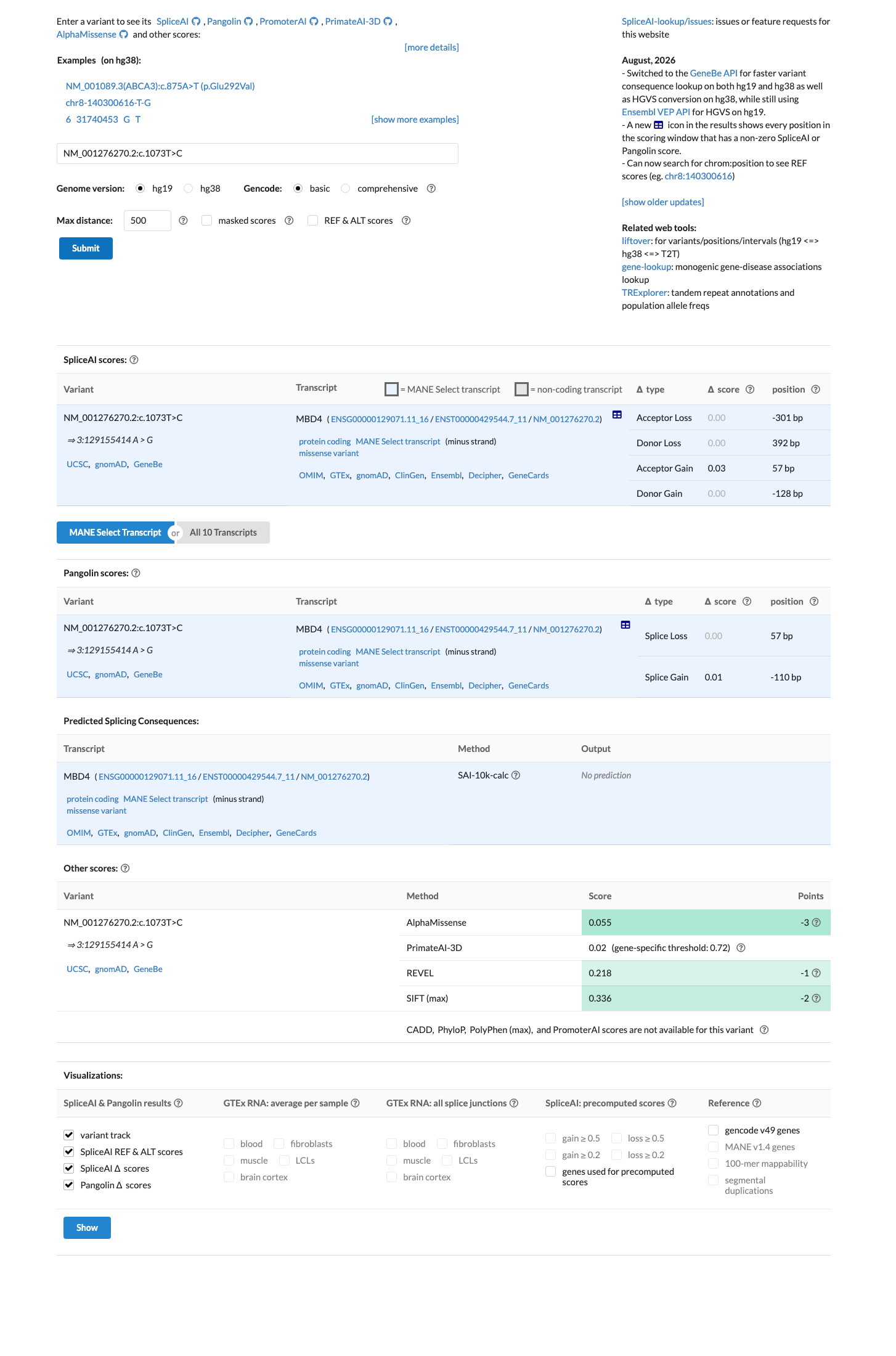
SpliceAI predicts no significant splice impact for this variant (max delta score = 0.00). REVEL score = 0.218. BayesDel score = -0.358238.
Functional / OncoKB screenshot
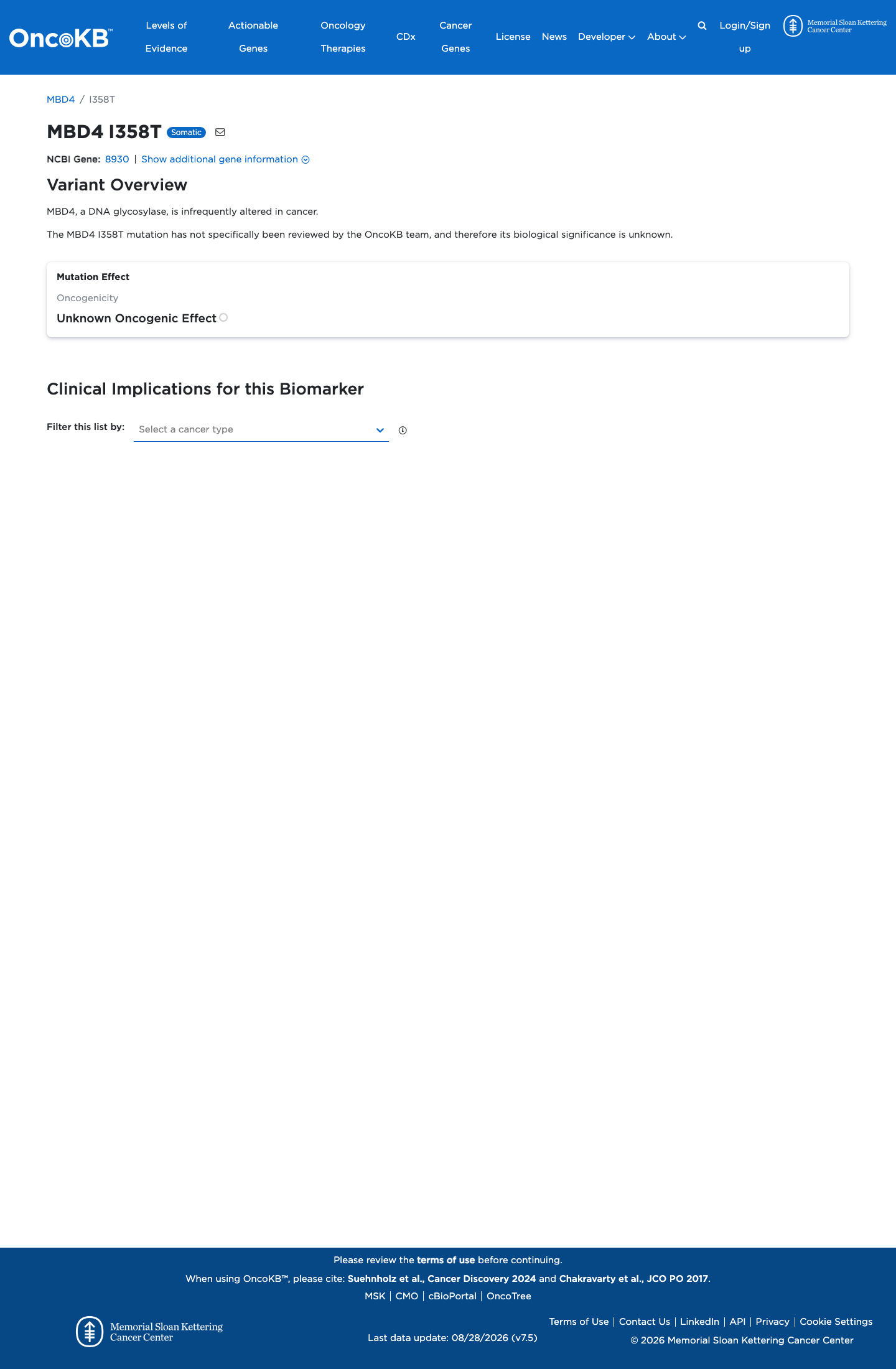
Functional Unknown Oncogenic Effect
OncoKB did not identify variant-specific reviewed functional evidence for this variant; gene-level curated context is available for reviewer follow-up. MBD4, a DNA glycosylase, is infrequently altered in cancer.
OncoKB ↗
COSMIC screenshot
COSMIC
Cancer hotspots screenshot
Cancer hotspots
Somatic evidence Not in COSMIC / hotspots
COSMIC
This variant does not lie in a statistically significant hotspot. This variant has not previously been reported in somatic cancers (COSMIC).
Hotspots
This variant does not lie in a statistically significant hotspot.
Sources & reference links
8Sources
ClinVar
gnomAD v2.1
gnomAD v4.1
gnomAD-Canada
SpliceAI
OncoKB
COSMIC
Cancer hotspots
Triaged references · 7 PMIDs not cited in assessment
23619275 ↗ ACMG position statement on prenatal/preconception expanded carrier screening. CLINVAR
25626707 ↗ Whole-genome sequencing in newborn screening? A statement on the continued importance of targeted approaches in newborn screening programmes. CLINVAR
25741868 ↗ Standards and guidelines for the interpretation of sequence variants: a joint consensus recommendation of the American College of Medical Genetics and Genomics and the Association for Molecular Pathology. CLINVAR
23169492 ↗ The perspective from EASAC and FEAM on direct-to-consumer genetic testing for health-related purposes. CLINVAR
23881473 ↗ Newborn screening: education, consent, and the residual blood spot. The position of the national society of genetic counselors. CLINVAR
24022298 ↗ Offering prenatal diagnostic tests: European guidelines for clinical practice [corrected]. CLINVAR
28492532 ↗ Sherloc: a comprehensive refinement of the ACMG-AMP variant classification criteria. CLINVAR