MEN1 encodes menin, a tumor suppressor protein that helps control gene activity by modifying chromatin structure and histones. Loss of menin function causes multiple endocrine neoplasia type 1 (MEN1 syndrome), an inherited disorder marked by tumors of the pituitary, parathyroid, and pancreas. Menin interacts with several proteins that regulate cell growth and division, and its loss contributes to both inherited and sporadic endocrine tumors.
This variant
MEN1 encodes the menin tumor suppressor, whose loss of function predisposes to MEN1 syndrome tumors of the pituitary, parathyroid, and pancreas. This synonymous c.300C>G change (p.Ala100=) is not predicted to disrupt menin production or splicing and is extremely rare in the general population, yet the available evidence is not strong enough to establish that it is benign. It therefore remains a variant of uncertain significance, and MEN1-related risk can neither be assigned nor excluded on this finding alone.
Transcript
NM_001370259.2
HGVS · transcript:coding
NM_001370259.2:c.300C>G
GRCh38
chr11:64809810 G>C
GRCh37
chr11:64577282 G>C
VUS: the only met criteria conflict, PM2 (supporting, toward pathogenic) and BP4 (supporting, toward benign), so no ACMG/AMP classification threshold is reached. No MEN1-specific interpretation framework exists, so generic ACMG/AMP thresholds were applied.
Classification rationale
PM2BP4VUS
MEN1 c.300C>Gsynonymous · exon 2
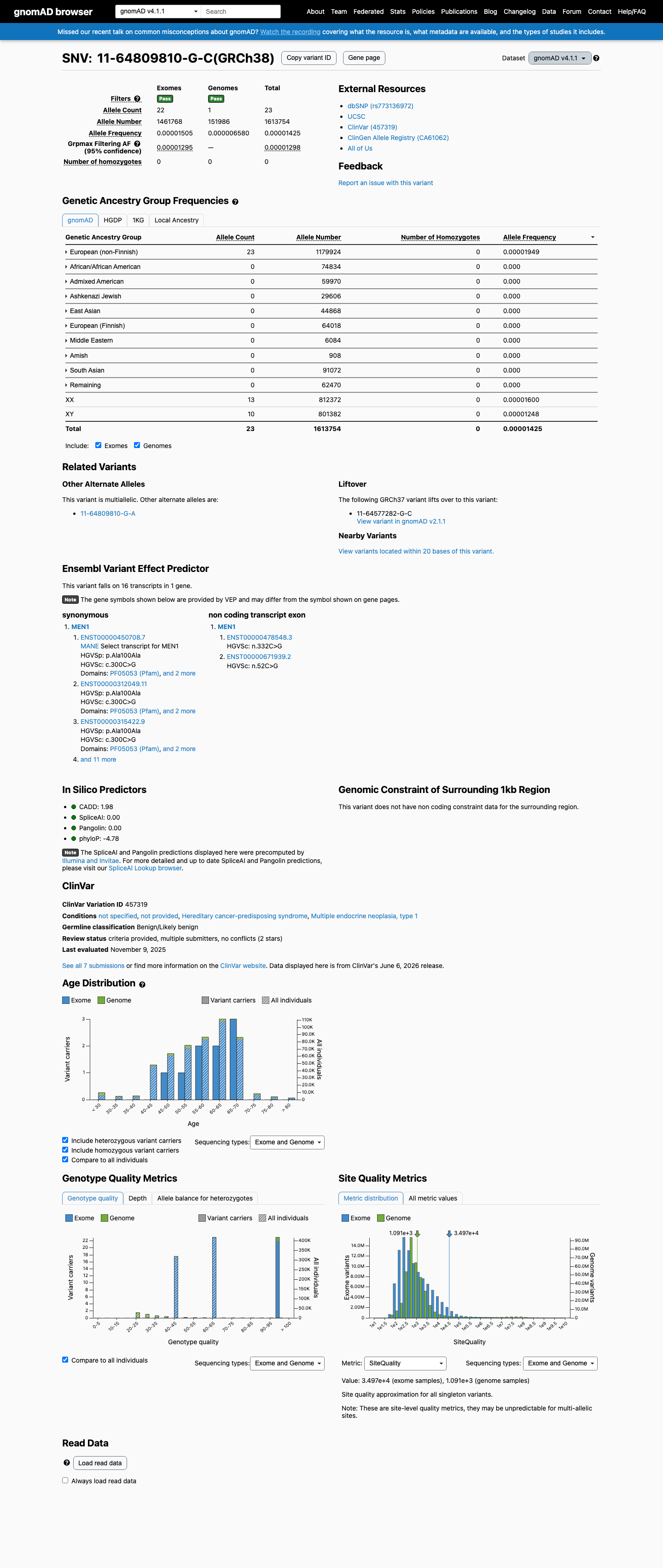
PM2 (Supporting): gnomAD v4.1 allele frequency 0.0014% (23 of 1,613,754 alleles), below the <0.1% threshold for extreme rarity. BP4 (Supporting): SpliceAI maximum delta 0.00, below the <0.10 threshold, predicting no splice effect. VUS overall: PM2 and BP4 are both supporting-strength but point in opposite directions, and this conflicting combination meets no ACMG/AMP pathogenic or benign threshold.
PM2 + BP4→VUS
Gene diagram
· NM_001370259.2 · variants mapped to exon structure
MEN1NM_001370259.2
Fetching transcript structure from UCSC…
Exons
—
Transcript span
—
Strand
—
Variants mapped
—
Source
UCSC ncbiRefSeqCurated
All variants in MEN1—click a row to locate it on the plot · use the link column to open its page
Protein
Location
Classification
Link
Applied criteria · 2 applied · 17 assessed
MetEvidence satisfies this criterion.
Not metEvaluated against available evidence; threshold not reached.
Not assessedApplies in principle, but no evidence was found to evaluate it.
N/ADoesn't apply to this variant type.
Applied · 2
Strength Supporting Moderate Strong Very strong
✓
PM2supportingPathogenic
Met (supporting): extremely rare in gnomAD v4.1, 23 of 1,613,754 alleles (0.0014%), below the 0.1% threshold.
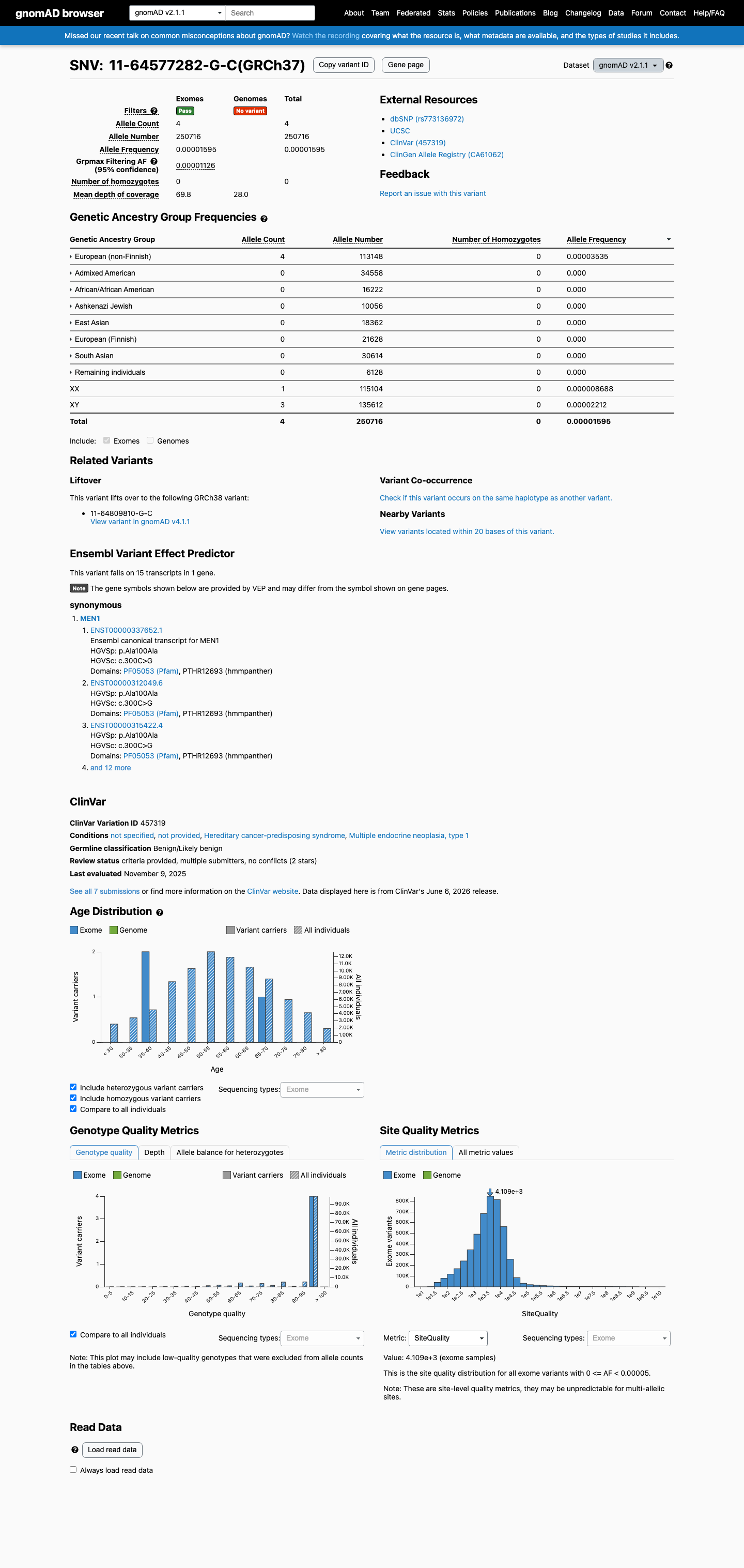
gnomAD v4.1 reports 23/1,613,754 alleles, AF 1.42525e-05, maximum subpopulation AF 1.94928e-05, and 0 homozygotes.gnomAD v2.1 reports 4/250,716 alleles, AF 1.59543e-05, maximum subpopulation AF 3.53519e-05, and 0 homozygotes.gnomAD-Canada v1.0 reports the variant as absent.
Met (supporting): SpliceAI maximum delta 0.00, below the <0.10 BP4 threshold.
No MEN1 VCEP/CSPEC or local gene-specific computational-evidence rule was retrieved; the generic ACMG/AMP fallback is governing.The case SpliceAI result for NM_001370259.2:c.300C>G has maximum delta score 0.00. The supplied generic non-missense rule assigns BP4_supporting when SpliceAI maximum delta is <0.10.This is a synonymous, not missense, variant; the generic rule directs use of SpliceAI only for this path. No independent missense-predictor evidence is added.
This variant is present in gnomAD v4.1 (AF= 1.42525e-05; MAF= 0.00143%, 23/1613754 alleles, homozygotes = 0) and has highest observed frequency in the European (non-Finnish) population (AF= 1.94928e-05; MAF= 0.00195%, 23/1179924 alleles, homozygotes = 0); grpmax FAF= 1.298e-05.
v2.1
This variant is present in gnomAD v2.1 (AF= 1.59543e-05; MAF= 0.00160%, 4/250716 alleles, homozygotes = 0) and has highest observed frequency in the European (non-Finnish) population (AF= 3.53519e-05; MAF= 0.00354%, 4/113148 alleles, homozygotes = 0); grpmax FAF= 1.126e-05.
🇨🇦 CA
Absent from gnomAD-Canada v1.0.
Allele frequency by ancestry
three datasets · side by side
gnomAD v4.1
0.0014%
· 23 / 1,613,754
0 hom · FAF 0.0013%
European (non-Finnish)
23 / 1,179,924
0.0019%
+ 9 not observed (Remaining individuals, Admixed American, European (Finnish), Amish, East Asian, Middle Eastern, South Asian, Ashkenazi Jewish, African/African American)
gnomAD v2.1
0.0016%
· 4 / 250,716
0 hom · FAF 0.0011%
European (non-Finnish)
4 / 113,148
0.0035%
+ 7 not observed (African/African American, Admixed American, Ashkenazi Jewish, East Asian, European (Finnish), Remaining individuals, South Asian)
Each card is an audit: what was searched, what was found, whether it names the variant, which criteria it fed, and why. 6 further PMIDs triaged but not cited — see Sources & references.
Rule & framework references · cited for criterion definitions, not variant evidence
25741868 ↗Standards and guidelines for the interpretation of sequence variants: a joint consensus recommendation of the American College of Medical Genetics and Genomics and the Association for Molecular Pathology.
Sources & reference links
8Sources
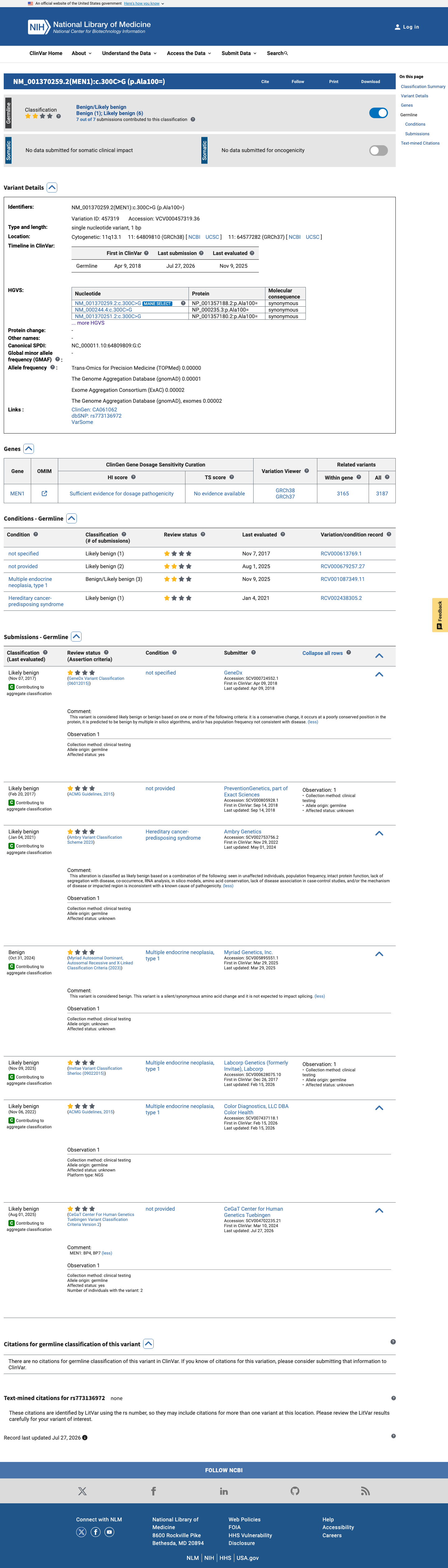
ClinVar
gnomAD v2.1
gnomAD v4.1
gnomAD-Canada
SpliceAI
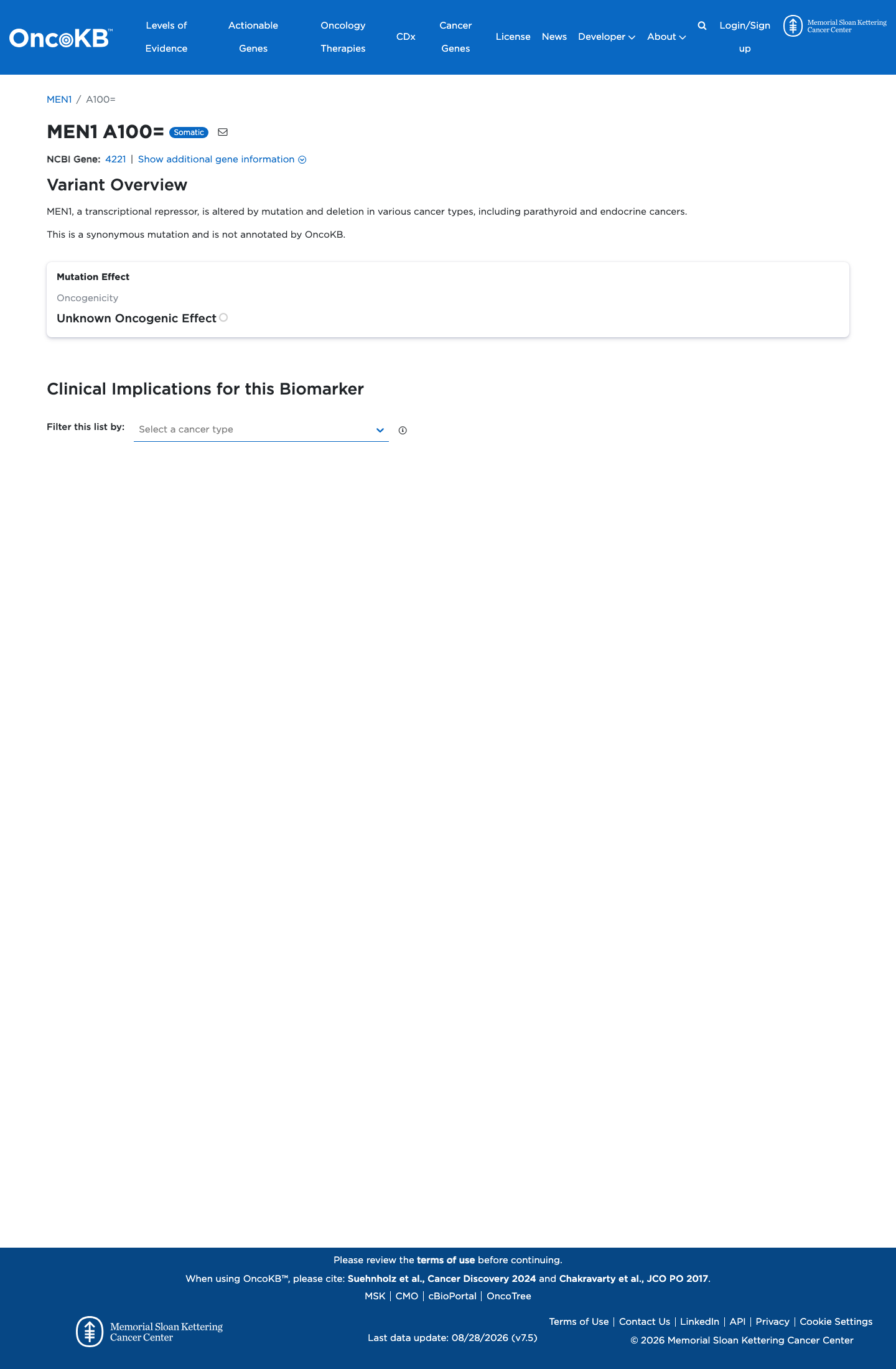
OncoKB
COSMIC
Cancer hotspots
Triaged references · 6 PMIDs not cited in assessment
20065170 ↗American Society of Clinical Oncology policy statement update: genetic and genomic testing for cancer susceptibility.CLINVAR
20301710 ↗Multiple Endocrine Neoplasia Type 1.CLINVAR
26389258 ↗Cancer Genetics Risk Assessment and Counseling (PDQ®): Health Professional VersiCLINVAR
26389271 ↗Genetics of Endocrine and Neuroendocrine Neoplasias (PDQ®): Health Professional Version.CLINVAR
35802134 ↗ACMG SF v3.1 list for reporting of secondary findings in clinical exome and genome sequencing: A policy statement of the American College of Medical Genetics and Genomics (ACMG).CLINVAR
28492532 ↗Sherloc: a comprehensive refinement of the ACMG-AMP variant classification criteria.CLINVAR