Analysis in progress
Initialising…
0%
complete
This report is still being assembled — sections appear as each stage finishes. It isn't final yet.
CDK2
Final classification
VUS
CDK2 c.665C>T · p.Pro222Leu
CDK2

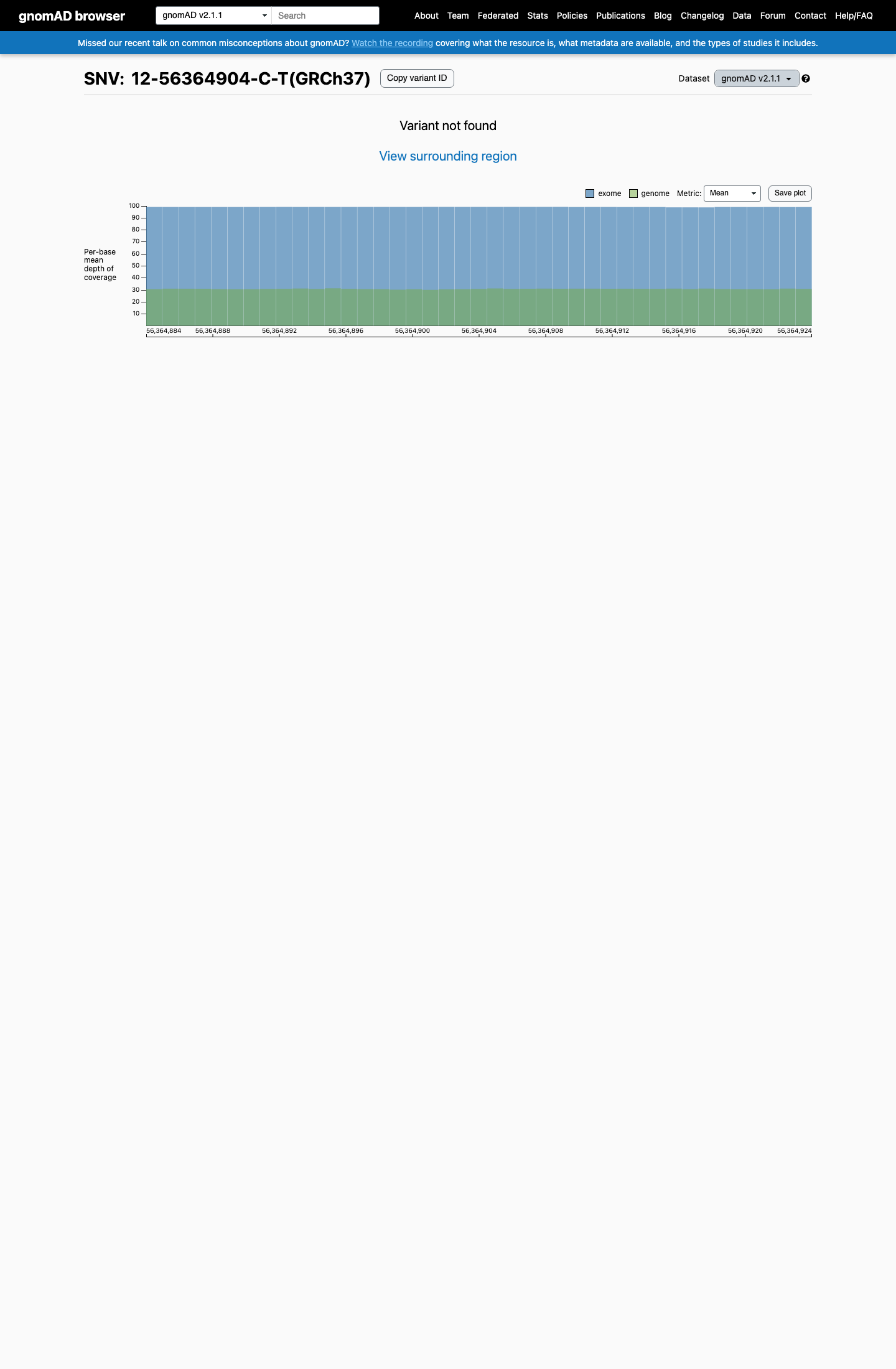
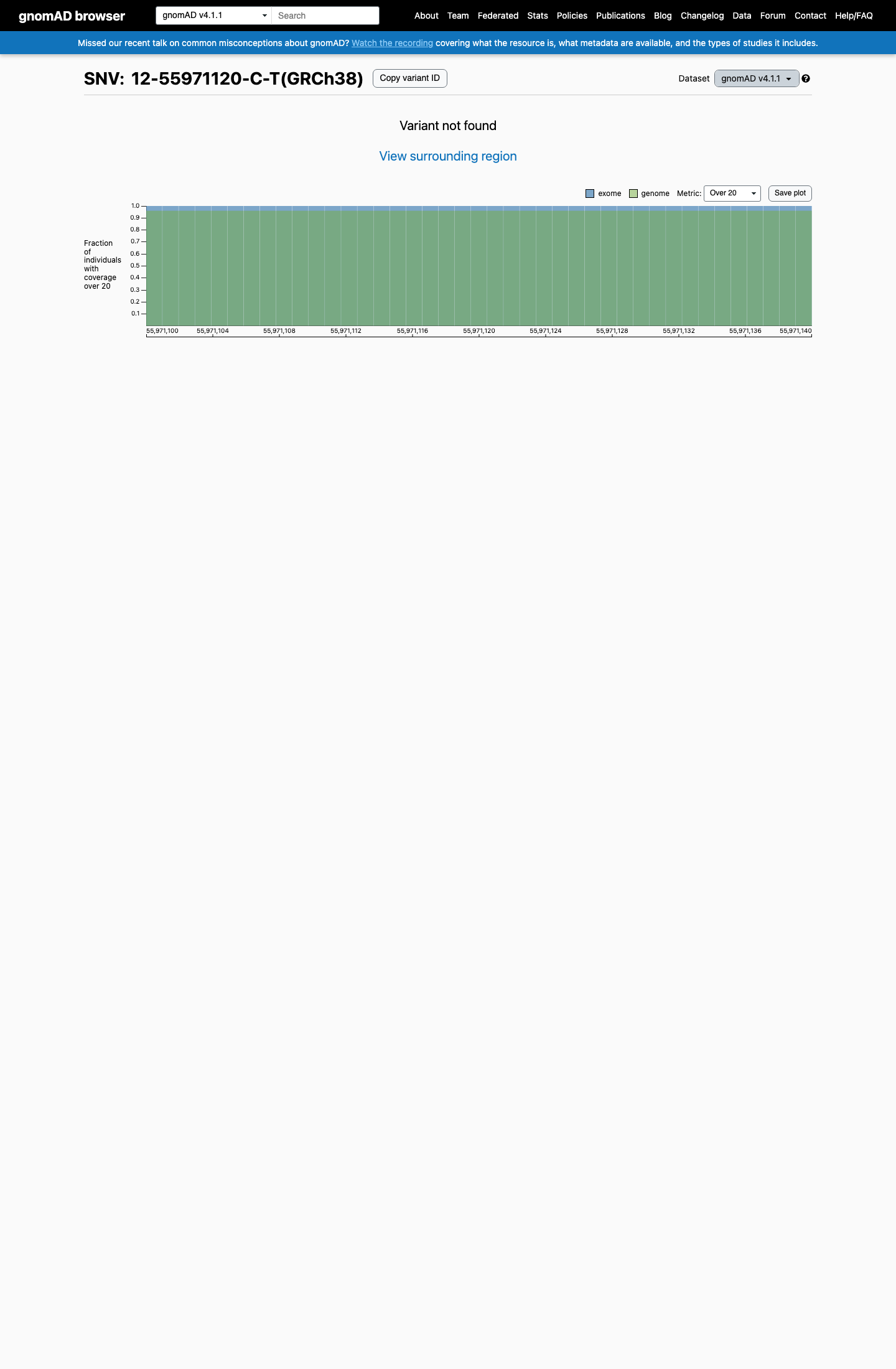
NM_001798.4:c.665C>T (p.Pro222Leu) in CDK2 is absent from population databases (gnomAD v2.1 and v4.1), meeting PM2 at supporting strength.

Gene
CDK2
Transcript
NM_001798.4
HGVS · transcript:coding
NM_001798.4:c.665C>T
Consequence
N/A
GRCh38
chr12:55971120 C>T
GRCh37
chr12:56364904 C>T
Basis gene-specific framework lacked a usable explicit final combination framework, so generic ACMG/AMP 2015 final-combination rules were applied as fallback; applied criteria: PM2 supporting; combination = 1 supporting, which maps to VUS.
gene-specific framework lacked a usable explicit final combination framework, so generic ACMG/AMP 2015 final-combination rules were applied as fallback; applied criteria: PM2 supporting; combination = 1 supporting, which maps to VUS.
Classification rationale
PM2 VUS
CDK2 c.665C>T

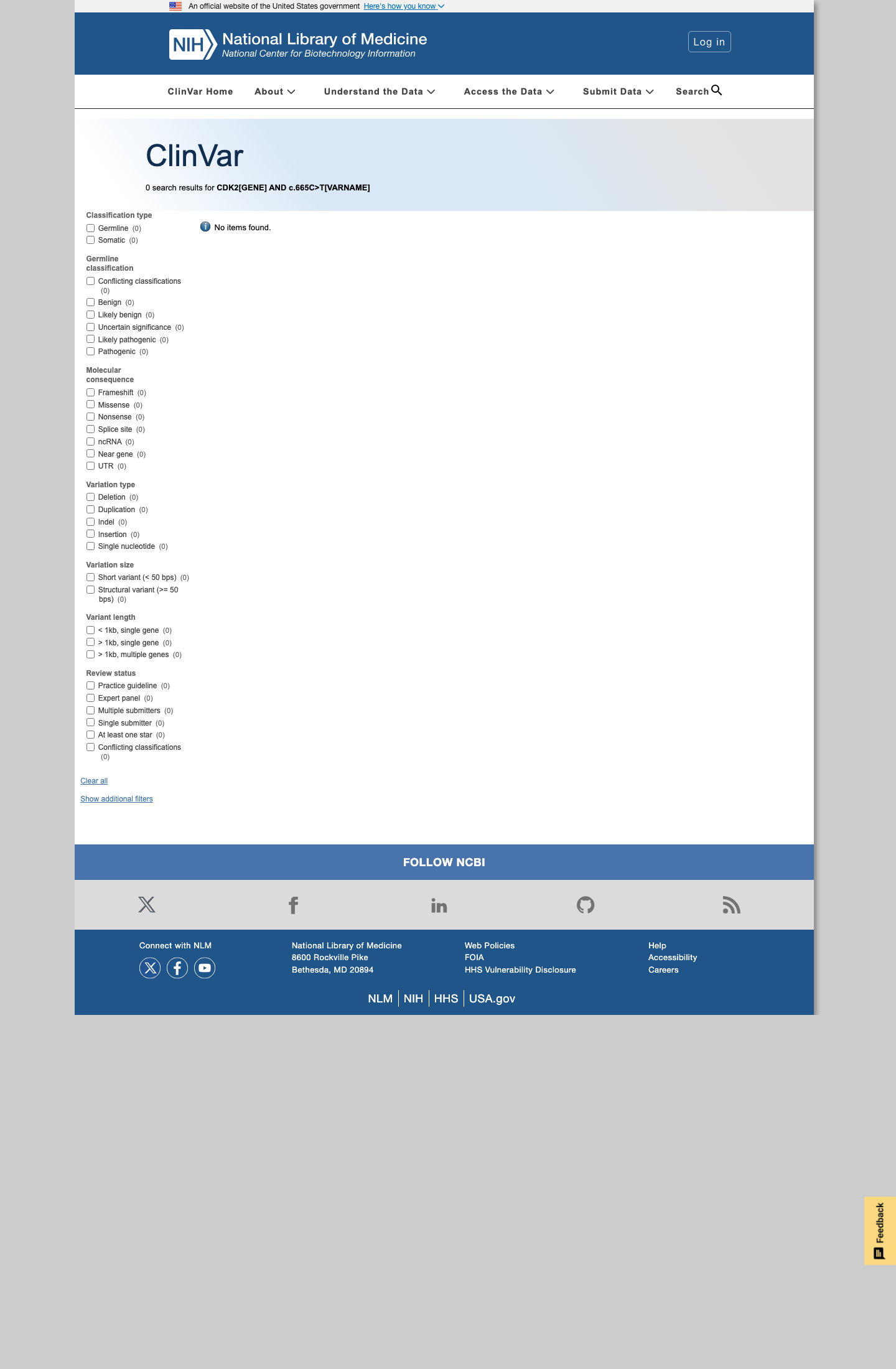
NM_001798.4:c.665C>T (p.Pro222Leu) in CDK2 is absent from population databases (gnomAD v2.1 and v4.1), meeting PM2 at supporting strength.1 No other ACMG/AMP criterion was met. The variant lacks ClinVar classification, functional studies, de novo observations, segregation data, hotspot localization, same-residue pathogenic comparators, and conclusive in silico evidence.2 With only one supporting criterion (PM2_supporting) and no other criteria met in either the pathogenic or benign direction, this variant is classified as a Variant of Uncertain Significance (VUS) per generic ACMG/AMP 2015 combination rules (PMID:25741868).3

PM2 VUS
2 clinvar ↗revelbayesdelspliceai ↗pm5_candidates
3 generic_acmg_combination_rules
Gene diagram · NM_001798.4 · variants mapped to exon structure
CDK2 NM_001798.4
Fetching transcript structure from UCSC…
Applied criteria · 1 applied · 22 assessed
Applied · 1
Strength Supporting Moderate Strong Very strong
PM2 supporting Pathogenic
This variant is absent from gnomAD v2.1 (exomes), gnomAD v4.1 (exomes), and gnomAD-Canada v1.0 population databases, consistent with a rare variant.
Absent from gnomAD v2.1 (0 alleles)absent from gnomAD v4.1 (0 alleles)absent from gnomAD-Canada v1.0.
Assessed · not applied
Pathogenic
PS1 No known pathogenic nucleotide change at the same position (c.665) producing the same amino acid change (p.Pro222Leu) was identified in ClinVar or the literature.
PS2 No de novo observation of NM_001798.4:c.665C>T was identified in the literature or ClinVar.
PS3 No well-established in vitro or in vivo functional studies were identified for this specific variant (NM_001798.4:c.665C>T, p.Pro222Leu) in CDK2.
PS4 No case-control data or statistical enrichment analysis was identified for this variant in any disease cohort.
PM1 This variant does not lie in a statistically significant mutational hotspot (CancerHotspots).
PM5 No same-residue pathogenic comparator variants (different missense change at Pro222) were identified in ClinVar.
PM6 No de novo observation of NM_001798.4:c.665C>T was identified.
PP1 No segregation data are available for this variant.
PP2 HCI prior scores are not available for CDK2.
PP3 In silico evidence is equivocal.
PP4 No patient phenotype information is available.
PP5 No reputable source (e.g., ClinGen-recognized expert panel, clinical diagnostic laboratory) has reported this variant as pathogenic.
Benign
BA1 The variant is absent from gnomAD v2.1 and v4.1 population databases.
BS1 The variant is absent from population databases (gnomAD v2.1, v4.1).
BS2 No observation of this variant in a healthy adult individual has been reported for a fully penetrant disorder.
BS3 No well-established in vitro or in vivo functional studies showing no deleterious effect were identified for NM_001798.4:c.665C>T in CDK2.
BS4 No nonsegregation data are available for this variant.
BP1 While loss of function is supported as a CDK2 germline disease mechanism (pvs1_gene_context: lof_mechanism_supported=true), CDK2 is not an established disease gene where primarily truncating variants are known to cause disease.
BP2 No observation of this variant in trans with a known pathogenic variant in CDK2 was identified.
BP4 In silico evidence is equivocal and does not constitute multiple lines of computational evidence suggesting no impact.
BP5 No observation of this variant in a case where an alternate molecular basis for disease was identified.
BP6 No reputable source reports this variant as benign.
N/A · 5 PVS1 · PM3 · PM4 · BP3 · BP7
Research & evidence
Population frequency
gnomAD v4.1 screenshot
gnomAD v4.1
gnomAD v2.1 screenshot
gnomAD v2.1
v4.1
Absent from gnomAD v4.1.
v2.1
Absent from gnomAD v2.1.
🇨🇦 CA
This variant is absent from gnomAD-Canada.
Allele frequency by ancestry
three datasets · side by side
gnomAD v4.1
Absent · 0 / ?
0 hom
Not observed in any ancestry group.
gnomAD v2.1
Absent · 0 / ?
0 hom
Not observed in any ancestry group.
gnomAD Canada 🇨🇦
Absent · 0 / ?
0 hom
Not observed in any ancestry group.
ClinVar screenshot
ClinVar
This variant is absent from ClinVar.
SpliceAI screenshot
In silico
SpliceAI predicts no significant splice impact for this variant (max delta score = 0.02). REVEL score = 0.661. BayesDel score = -0.0440517.
Functional No data
No calibrated functional assay or RNA evidence was identified for this variant.
OncoKB ↗
COSMIC screenshot
COSMIC
Cancer hotspots screenshot
Cancer hotspots
Somatic evidence Not in COSMIC / hotspots
COSMIC
This variant does not lie in a statistically significant hotspot. This variant has not previously been reported in somatic cancers (COSMIC).
Hotspots
This variant does not lie in a statistically significant hotspot.
Sources & reference links
7Sources
ClinVar
gnomAD v2.1
gnomAD v4.1
SpliceAI
OncoKB
COSMIC
Cancer hotspots