Analysis in progress
Initialising…
0%
complete
This report is still being assembled — sections appear as each stage finishes. It isn't final yet.
COL4A2
Final classification
VUS
PVS1PM2BP4
COL4A2
c.4183C>T
p.Gln1395Ter
nonsense · exon 44
Gene context NCBI Gene ↗

COL4A2 encodes a subunit of type IV collagen, a key structural component of basement membranes that support blood vessels and other tissues. Mutations in this gene are associated with cerebral small vessel disease, porencephaly, and related vascular-brain disorders. The protein's C-terminal fragment, canstatin, inhibits angiogenesis and tumor growth, giving the gene a role in suppressing cancer progression.

This variant

COL4A2 mutations cause cerebral small vessel disease and porencephaly, and this truncating variant would be expected to disrupt the collagen IV subunit that supports basement membranes of blood vessels. Yet the classification is VUS: the strong loss-of-function prediction conflicts with supporting benign evidence, and no clinical or functional data on this specific variant are available. The variant's role in vascular-brain disease therefore remains unconfirmed until further evidence accumulates.

Transcript
NM_001846.4
HGVS · transcript:coding
NM_001846.4:c.4183C>T
GRCh38
chr13:110503891 C>T
GRCh37
chr13:111156238 C>T
Basis Generic ACMG/AMP fallback: PVS1 (very strong) plus PM2 and BP4 (supporting) give conflicting evidence, resulting in a VUS classification.
Generic ACMG/AMP fallback: PVS1 (very strong) plus PM2 and BP4 (supporting) give conflicting evidence, resulting in a VUS classification.
Classification rationale
PVS1PM2 BP4 VUS
COL4A2 c.4183C>T nonsense · exon 44

PVS1 (Very Strong): nonsense variant truncates the protein at residue 1395 of ~1712, removing the essential triple-helix and NC1 domains, consistent with nonsense-mediated decay or severe loss of function. PM2 (Supporting): ultra-rare in populations, with a single gnomAD v4.1 allele and absence from gnomAD v2.1 and gnomAD-Canada. BP4 (Supporting): SpliceAI predicts no splice impact (max delta 0.019), well below the 0.2 high-recall cutoff. Final classification: VUS, per the generic ACMG/AMP combination rule, where conflicting evidence (PVS1 very strong vs. PM2 and BP4 supporting) does not reach any pathogenic or benign classification.

PVS1 + PM2 + BP4 VUS
Gene diagram · NM_001846.4 · variants mapped to exon structure
COL4A2 NM_001846.4
Fetching transcript structure from UCSC…
Applied criteria · 3 applied · 17 assessed
MetEvidence satisfies this criterion.
Not metEvaluated against available evidence; threshold not reached.
Not assessedApplies in principle, but no evidence was found to evaluate it.
N/ADoesn't apply to this variant type.
Applied · 3
Strength Supporting Moderate Strong Very strong
PVS1 very strong review Pathogenic
Met: nonsense variant truncates the protein at residue 1395 of ~1712, removing the essential triple-helix and NC1 domains, consistent with loss of function.
pvs1_variant_assessment classifies the variant as consequence_class 'nonsense', variant_bucket 'nonsense', with framework_source PMC6185798 and suggested_default_strength 'PVS1'.pvs1_gene_context reports germline_disease_context_found=true, lof_mechanism_supported=true, and pvs1_gene_gate='eligible' for COL4A2, based on targeted literature review of germline disease-focused publications.PMID:41499643 (Biallelic COL4A2 Variants Associated With Brain Small Vessel Disease and Brain Malformations) reports a compound heterozygous case where a COL4A2 frameshift variant p.(Gly1426Argfs*30), predicted to cause loss of function via truncated transcript or NMD, was classified ACMG Class-IV likely pathogenic with PVS1 applied, supporting that truncating/LoF variants in COL4A2 are an accepted pathogenic mechanism.
PM2 supporting Pathogenic
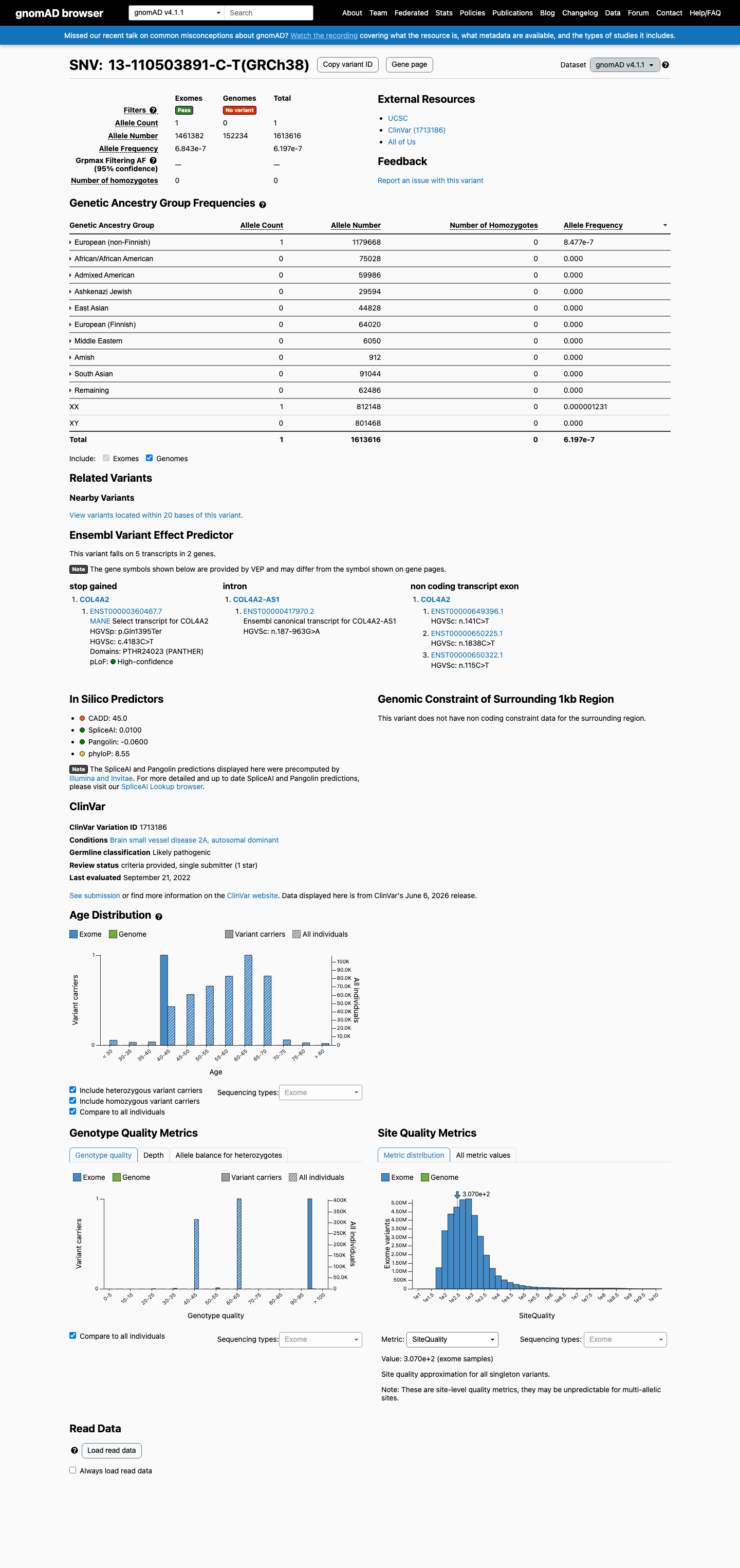
Met at supporting: only one gnomAD v4.1 allele and absence from gnomAD v2.1 and gnomAD-Canada.
No COL4A2-specific VCEP/CSPEC population-frequency specification was retrieved, so generic ACMG/AMP assessment was used.gnomAD v4.1 reports one allele among 1,613,616 total alleles (AF 6.197261306283528e-07), no homozygotes, and a highest reported major-ancestry frequency of 8.476961314539345e-07 in non-Finnish Europeans.The variant is absent from gnomAD v2.1 and gnomAD-Canada v1.0.
BP4 supporting Benign
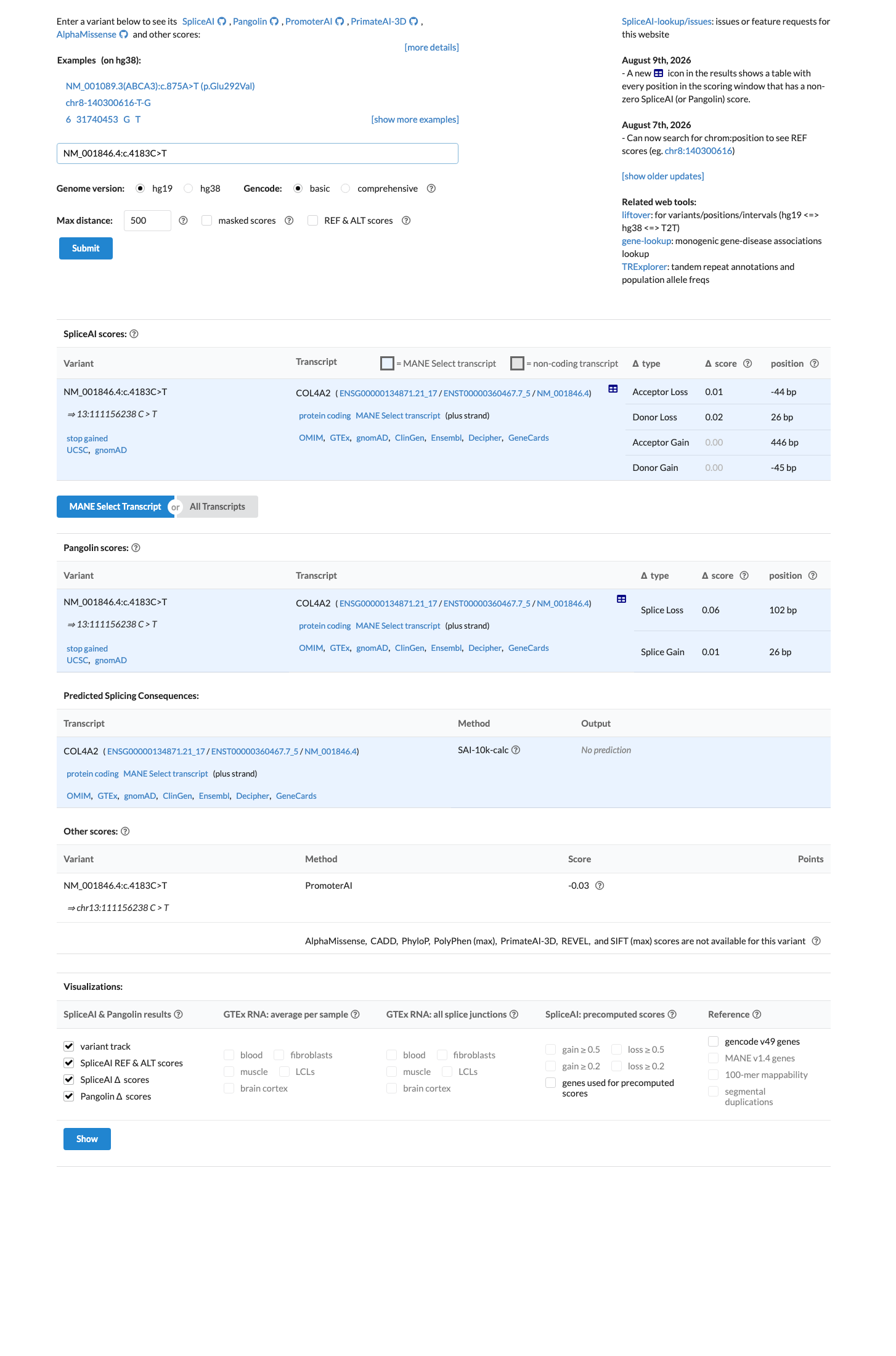
Met at supporting: SpliceAI predicts no splice impact (max delta 0.019), well below the 0.2 high-recall cutoff.
evidence.json spliceai block: 'SpliceAI predicts no significant splice impact for this variant (max delta score = 0.02).' Scores: DS_AG=0.0, DS_AL=0.013, DS_DG=0.001, DS_DL=0.019, max_delta_score=0.019.SpliceAI high-recall threshold of 0.2 for a splice-altering prediction is defined in the tool's original publication: Jaganathan K et al., 'Predicting Splicing from Primary Sequence with Deep Learning', Cell 2019, PMID 30661751. The observed max delta (0.019) is well below this threshold.This variant (p.(Gln1395Ter)) is a nonsense/stop-gain change, so the missense in-silico predictor path (REVEL/BayesDel/aGVGD) is not applicable and was not used to support BP4.
Assessed · not applied · 7 not met · 10 not assessed
Pathogenic
PS2 Not met: inheritance is reported as paternal origin, not a confirmed de novo occurrence, and parental testing documentation is absent.
PS3 Not assessed: no functional assay data for this variant (e.g., collagen IV secretion or trimer assembly studies) were available.
PS4 Not assessed: no case-control or enrichment data for this variant exist; the single ClinVar submission is not case-control evidence.
PM3 Not assessed: no affected proband observed with a pathogenic COL4A2 variant in trans; phase information is unavailable.
PM6 Not met: inheritance is reported as paternal origin, not an assumed de novo occurrence; parental genotypes are undocumented.
PP1 Not assessed: no informative relatives, pedigrees, or meioses were provided; paternal origin alone is not cosegregation evidence.
PP3 Not met: missense in-silico tools do not apply to this nonsense variant, and SpliceAI impact is low (max delta 0.019).
PP4 Not assessed: no phenotype for the tested individual was provided.
PP5 Not met: the sole ClinVar submission is Likely pathogenic from one clinical laboratory, not an expert panel.
Benign
BA1 Not met: allele frequency is far below any stand-alone benign population-frequency range.
BS1 Not met: maximum observed allele frequency (8.5e-07) is far below any benign frequency threshold.
BS2 Not assessed: population data show no homozygotes and no confirmed unaffected, age-appropriate individuals.
BS3 Not assessed: no functional studies demonstrating normal function for this variant were available.
BS4 Not assessed: paternal origin does not establish whether genotype-positive relatives are clinically unaffected.
BP2 Not assessed: no documented cis or trans co-occurrence with a pathogenic variant; paternal origin alone establishes neither.
BP5 Not assessed: no individual phenotype, molecular diagnosis, or alternative molecular cause is provided.
BP6 Not met: no expert-panel benign assertion exists; the sole ClinVar submission is Likely pathogenic from a non-expert laboratory.
N/A · 8 PS1 · PM1 · PM4 · PM5 · PP2 · BP1 · BP3 · BP7
Research & evidence
Population frequency
gnomAD v4.1 screenshot
gnomAD v4.1
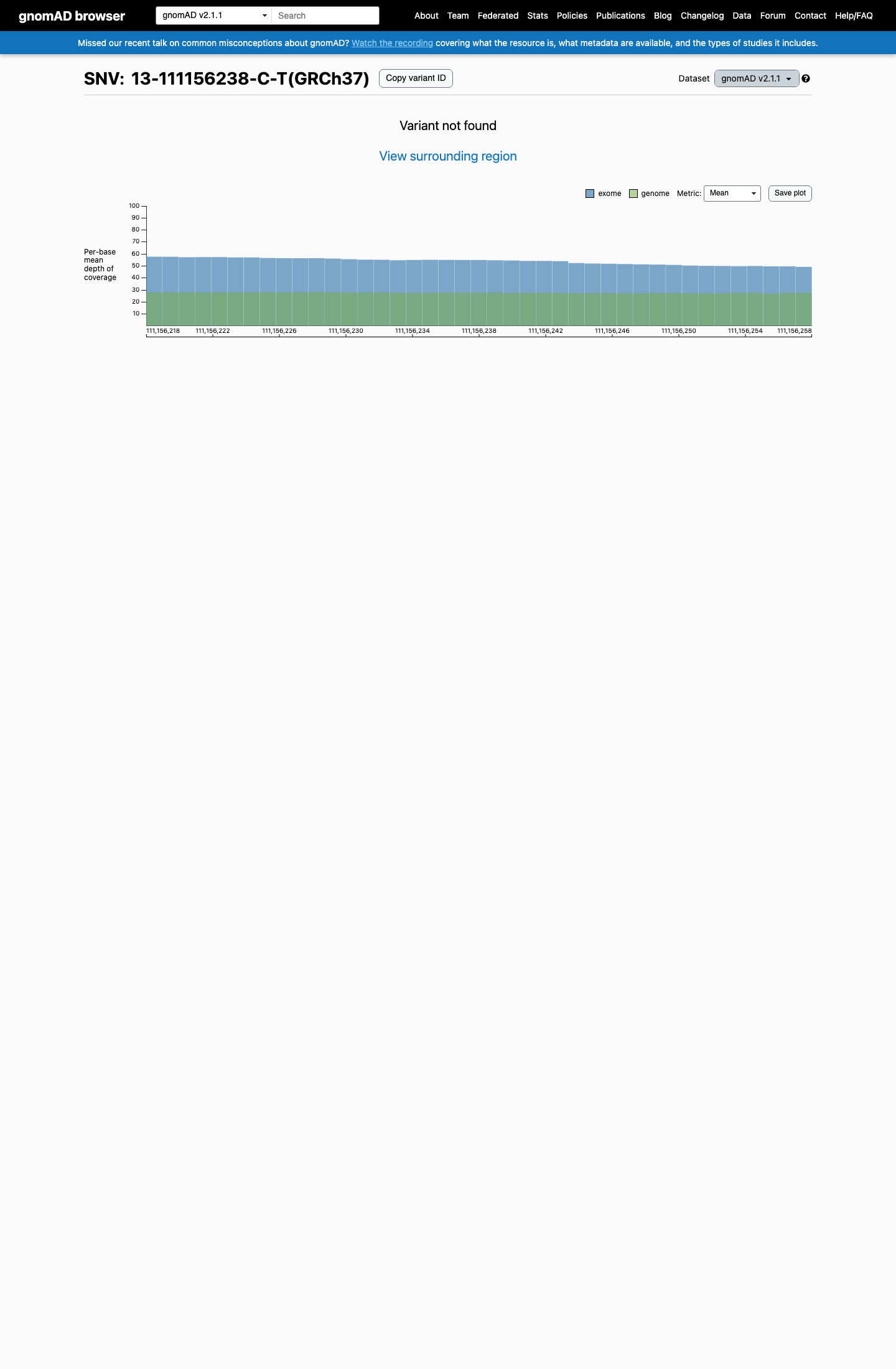
gnomAD v2.1 screenshot
gnomAD v2.1
v4.1
This variant is present in gnomAD v4.1 (AF= 6.19726e-07; MAF= 0.00006%, 1/1613616 alleles, homozygotes = 0) and has highest observed frequency in the European (non-Finnish) population (AF= 8.47696e-07; MAF= 0.00008%, 1/1179668 alleles, homozygotes = 0).
v2.1
Absent from gnomAD v2.1.
🇨🇦 CA
Absent from gnomAD-Canada v1.0.
Allele frequency by ancestry
three datasets · side by side
gnomAD v4.1
6.2e-05% · 1 / 1,613,616
0 hom
European (non-Finnish)
1 / 1,179,668
8.5e-05%
+ 9 not observed (Remaining individuals, Admixed American, European (Finnish), Amish, East Asian, Middle Eastern, South Asian, Ashkenazi Jewish, African/African American)
gnomAD v2.1
Absent · 0 / ?
0 hom
Not observed in any ancestry group.
gnomAD Canada 🇨🇦
Absent · 0 / ?
0 hom
Not observed in any ancestry group.
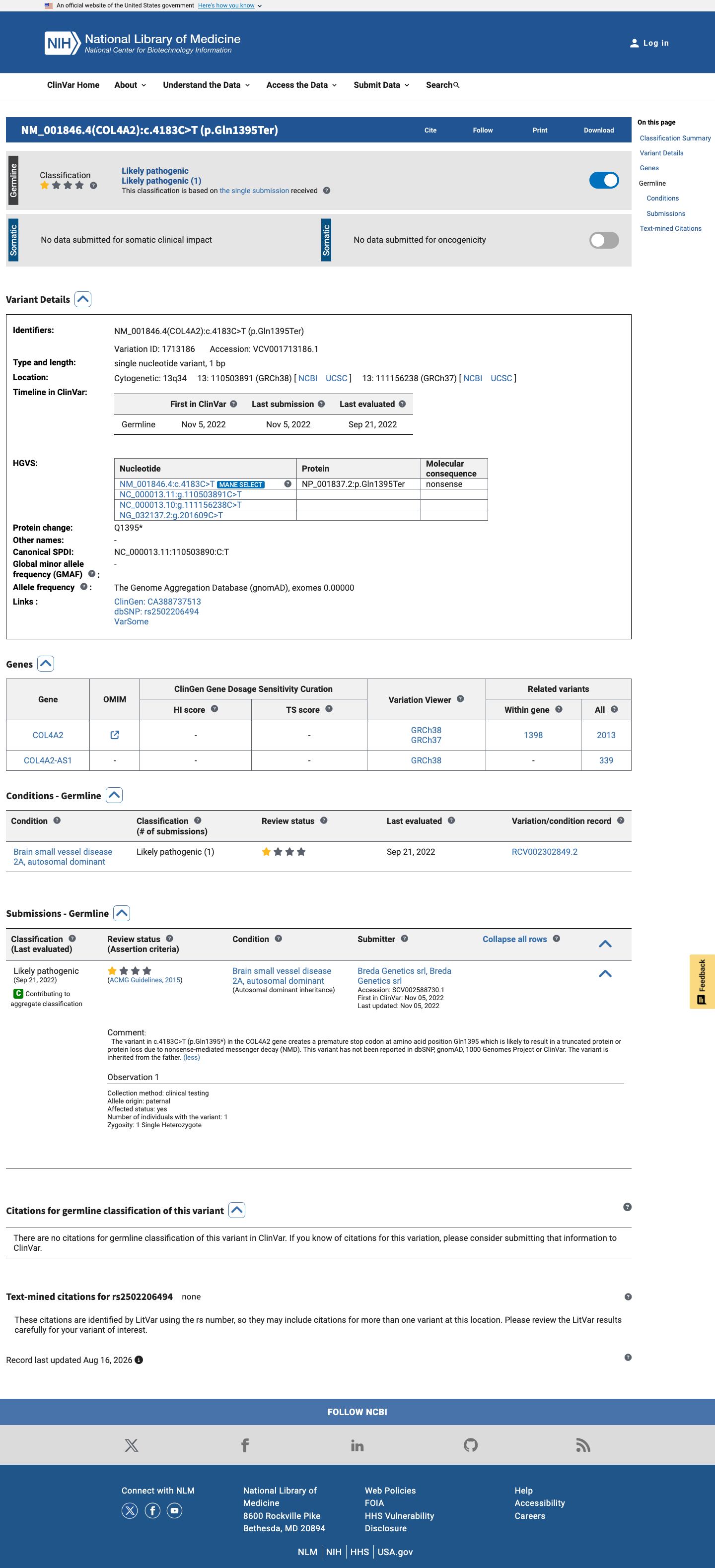
ClinVar screenshot
ClinVar
This variant has been reported in ClinVar as Likely pathogenic (1 clinical laboratory). (ClinVarID = 1713186)
SpliceAI screenshot
In silico
SpliceAI predicts no significant splice impact for this variant (max delta score = 0.02). BayesDel score = 0.66.
Functional No data
No calibrated functional assay or RNA evidence was identified for this variant.
OncoKB ↗
COSMIC screenshot
COSMIC
Cancer hotspots screenshot
Cancer hotspots
Somatic evidence Not in COSMIC / hotspots
COSMIC
This variant does not lie in a statistically significant hotspot. This variant has not previously been reported in somatic cancers (COSMIC).
Hotspots
This variant does not lie in a statistically significant hotspot.
Sources & reference links
8Sources
ClinVar
gnomAD v2.1
gnomAD v4.1
gnomAD-Canada
SpliceAI
OncoKB
COSMIC
Cancer hotspots
Triaged references · 1 PMID not cited in assessment
25741868 ↗ Standards and guidelines for the interpretation of sequence variants: a joint consensus recommendation of the American College of Medical Genetics and Genomics and the Association for Molecular Pathology. CLINVAR