This variant was interpreted by pipeline
7.1.0.
The current version is
8.0.0.
Re-running queues a fresh interpretation; the result replaces this page when complete.
Re-runs are not free. Blank = draws on today's public interpretation allowance.
With a code = uses 1 of that code's uses.
IDH2 encodes a mitochondrial NADP(+)-dependent isocitrate dehydrogenase that catalyzes the oxidative decarboxylation of isocitrate to 2-oxoglutarate (alpha-ketoglutarate) in the tricarboxylic acid (TCA) cycle, where it supports cell metabolism and energy production. Cancer-associated alterations in its catalytic site confer a gain-of-function neomorphic activity that converts alpha-ketoglutarate into the oncometabolite D-2-hydroxyglutarate, which promotes tumor development by inhibiting enzymes involved in DNA and histone demethylation, adaptation to hypoxia, and collagen maturation. As an oncogene, IDH2 is associated with hematologic malignancies, particularly acute myeloid leukemia, as well as solid tumors such as gliomas and cholangiocarcinomas.
This variant
IDH2 drives cancer through gain-of-function mutations in its catalytic site, so this deep intronic variant—with no amino-acid change and no predicted splice impact (SpliceAI max delta 0.003)—does not fit the gene's established oncogenic mechanism. Its classification as a variant of uncertain significance reflects the lack of evidence for either a disease-causing or a benign effect.
Transcript
NM_002168.2
HGVS · transcript:coding
NM_002168.2:c.374-10G>A
GRCh38
chr15:90088757 C>T
GRCh37
chr15:90631989 C>T
No IDH2-specific ClinGen or local gene framework exists, so generic ACMG/AMP 2015 rules were applied; only BP4 (supporting) is met, yielding a VUS.
Classification rationale
BP4VUS
IDH2 c.374-10G>Aunknown · exon 3i
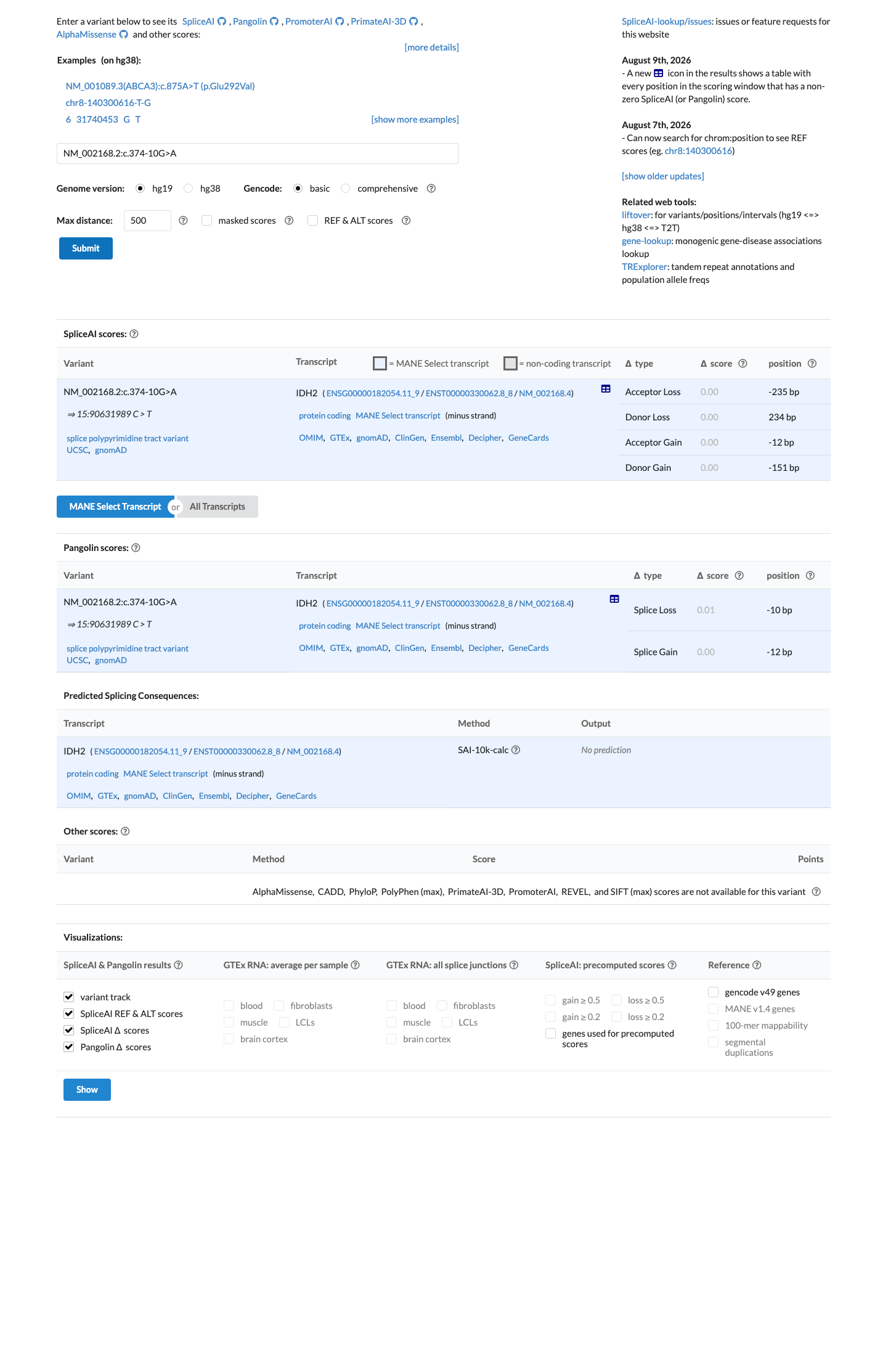
BP4 (Supporting): SpliceAI max delta 0.003, well below the 0.1 threshold, predicts no splice impact. VUS: with only BP4 (supporting) met under the generic ACMG/AMP 2015 combination rules, the evidence is insufficient to classify this variant as pathogenic or benign.
BP4→VUS
LYFE Sciences is an AI system, and it can make mistakes. Criteria
may be applied incorrectly, sources may be misread, and a confident-looking
classification can still be wrong. Double-check every criterion and
its underlying evidence before relying on any call.
Gene diagram
· NM_002168.2 · variants mapped to exon structure
IDH2NM_002168.2
Fetching transcript structure from UCSC…
Exons
—
Transcript span
—
Strand
—
Variants mapped
—
Source
UCSC ncbiRefSeqCurated
All variants in IDH2—click a row to locate it on the plot · use the link column to open its page
Protein
Location
Classification
Link
Applied criteria · 1 applied · 18 assessed
MetEvidence satisfies this criterion.
Not metEvaluated against available evidence; threshold not reached.
Not assessedApplies in principle, but no evidence was found to evaluate it.
N/ADoesn't apply to this variant type.
Applied · 1
Strength Supporting Moderate Strong Very strong
✓
BP4supportingBenign
Met (supporting): SpliceAI max delta 0.003, well below the 0.1 threshold for BP4.
SpliceAI Lookup max delta score = 0.003 for NM_002168.2:c.374-10G>A, below the 0.1 generic-fallback BP4 threshold.generic_acmg_classification_rules.md: SpliceAI max delta < 0.1 -> BP4 (supporting) for intronic/non-canonical-splice-position variants under the generic non-VCEP fallback.
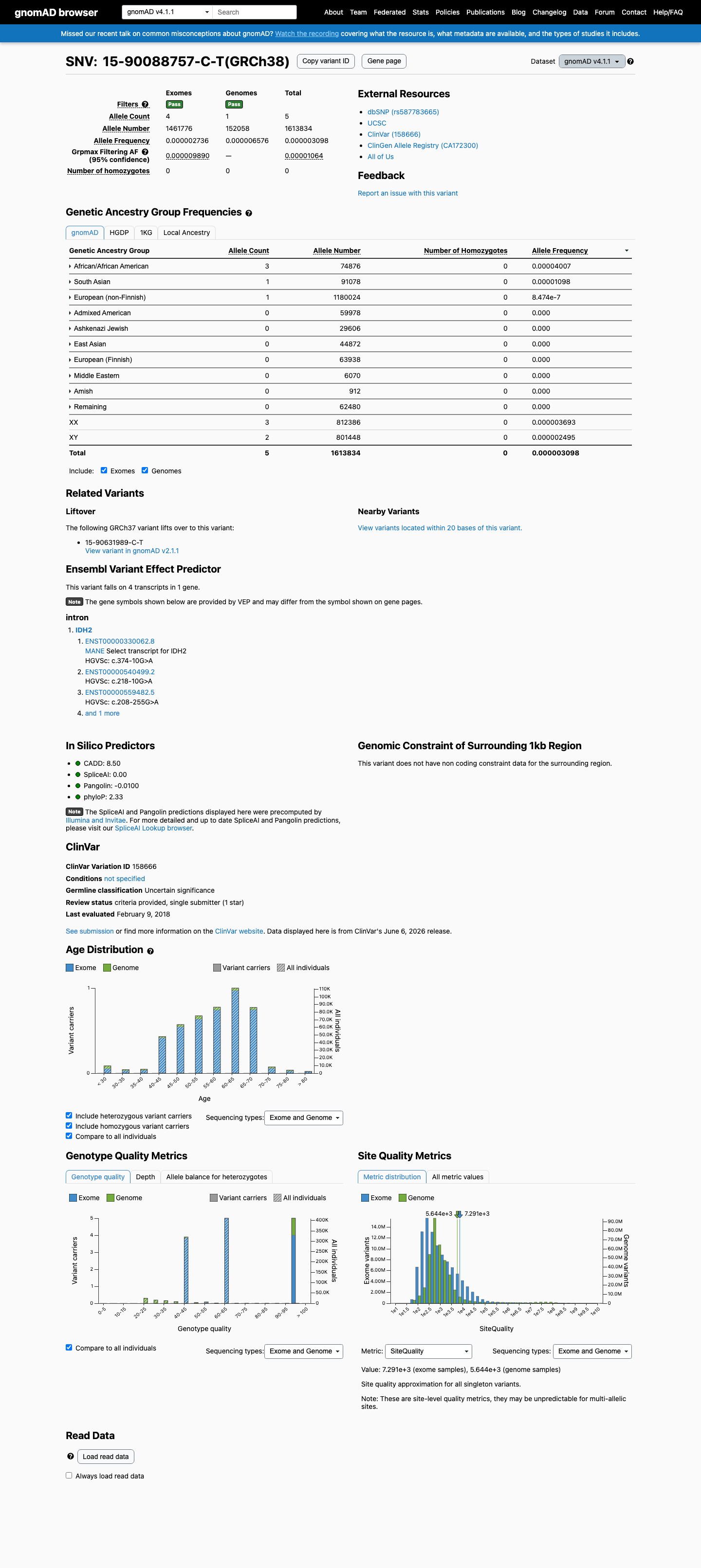
This variant is present in gnomAD v4.1 (AF= 3.09821e-06; MAF= 0.00031%, 5/1613834 alleles, homozygotes = 0) and has highest observed frequency in the African/African American population (AF= 4.00662e-05; MAF= 0.00401%, 3/74876 alleles, homozygotes = 0); grpmax FAF= 1.064e-05.
v2.1
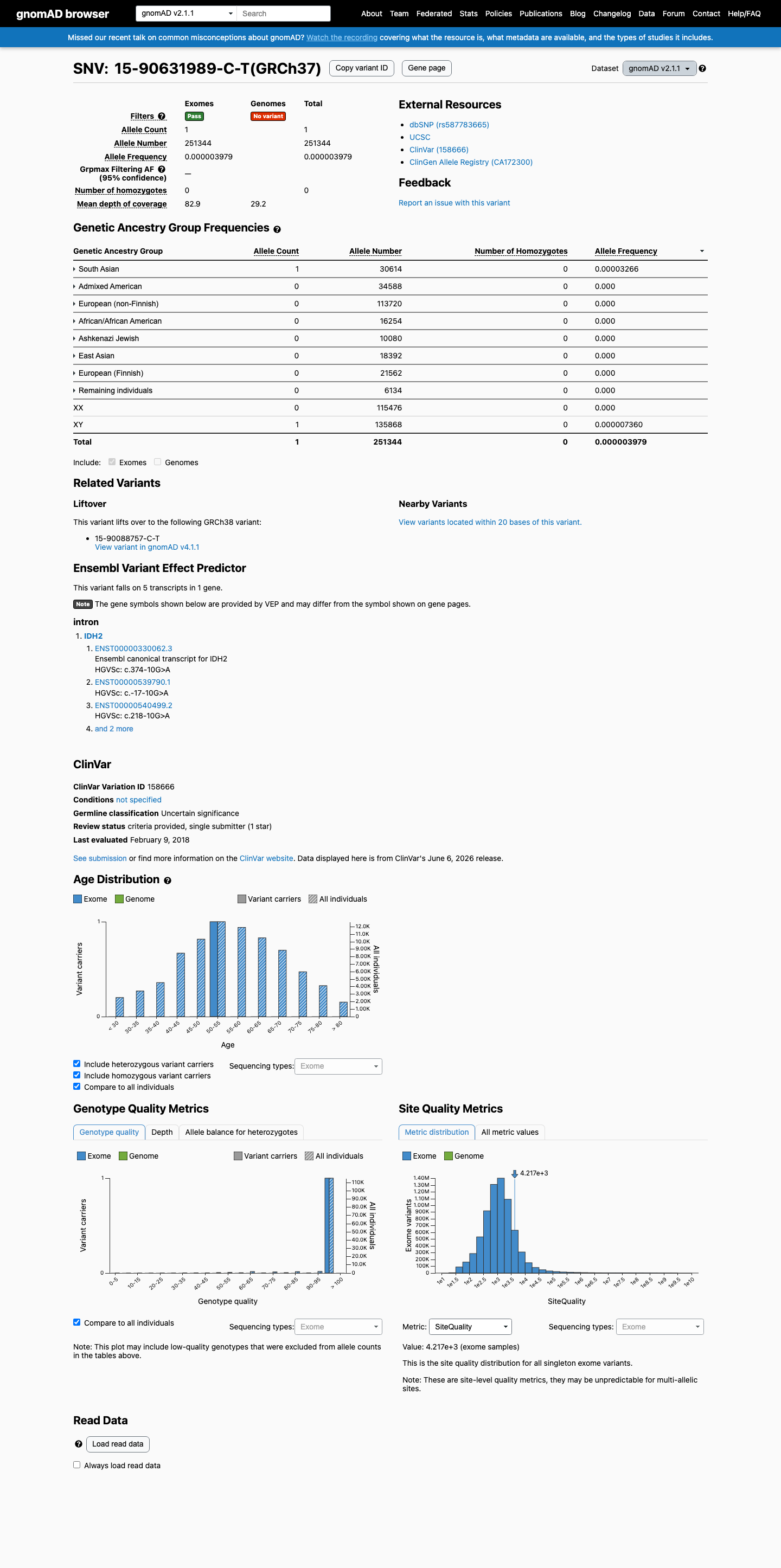
This variant is present in gnomAD v2.1 (AF= 3.97861e-06; MAF= 0.00040%, 1/251344 alleles, homozygotes = 0) and has highest observed frequency in the South Asian population (AF= 3.26648e-05; MAF= 0.00327%, 1/30614 alleles, homozygotes = 0).
🇨🇦 CA
Absent from gnomAD-Canada v1.0.
Allele frequency by ancestry
three datasets · side by side
gnomAD v4.1
0.00031%
· 5 / 1,613,834
0 hom · FAF 0.0011%
African/African American
3 / 74,876
0.004%
South Asian
1 / 91,078
0.0011%
European (non-Finnish)
1 / 1,180,024
8.5e-05%
+ 7 not observed (Remaining individuals, Admixed American, European (Finnish), Amish, East Asian, Middle Eastern, Ashkenazi Jewish)
gnomAD v2.1
0.0004%
· 1 / 251,344
0 hom
South Asian
1 / 30,614
0.0033%
+ 7 not observed (African/African American, Admixed American, Ashkenazi Jewish, East Asian, European (Finnish), European (non-Finnish), Remaining individuals)
Triaged references · 1 PMID not cited in assessment
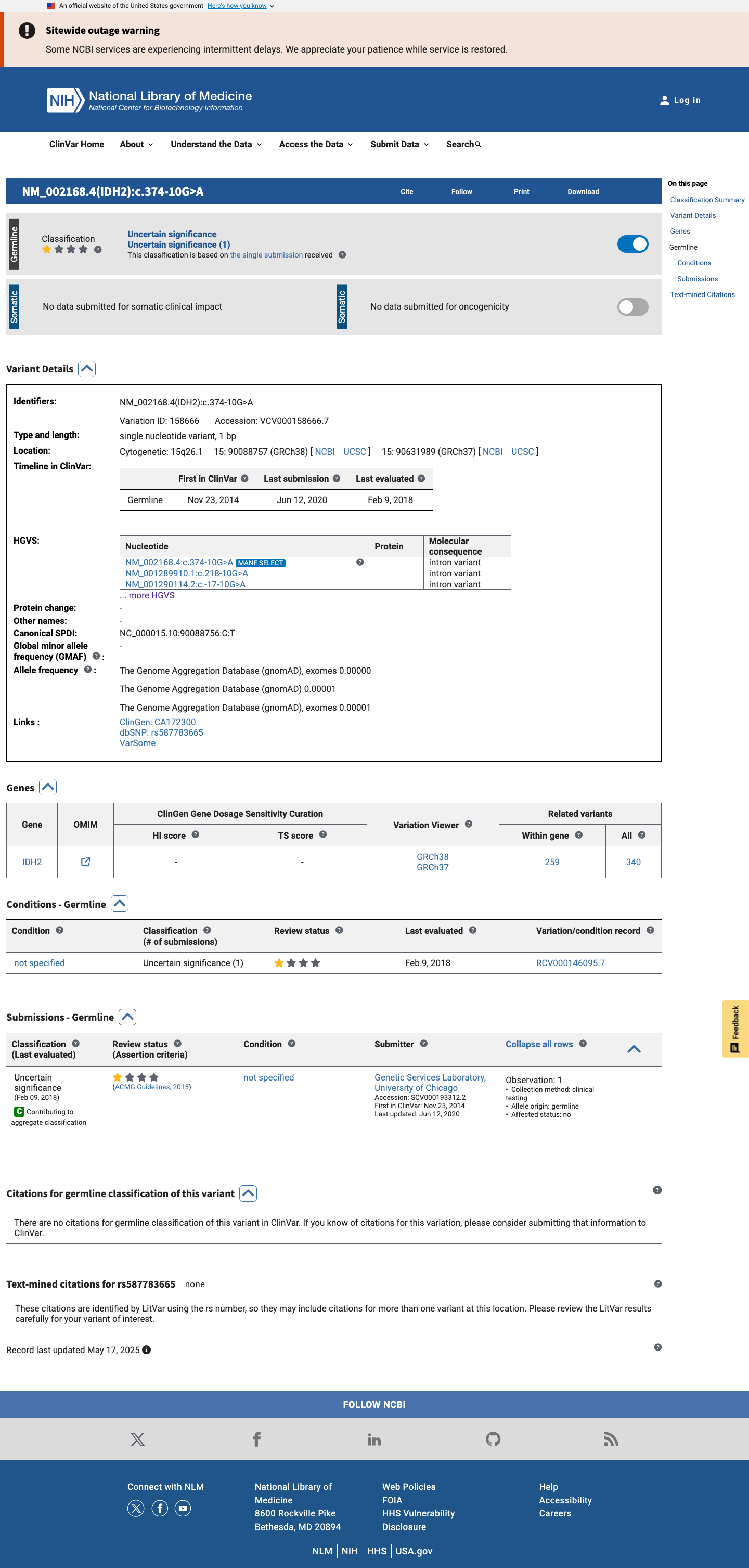
25741868 ↗Standards and guidelines for the interpretation of sequence variants: a joint consensus recommendation of the American College of Medical Genetics and Genomics and the Association for Molecular Pathology.CLINVAR