IDH2 c.419G>A (p.Arg140Gln) is a pathogenic gain-of-function missense variant that causes D-2-hydroxyglutaric aciduria type II via neomorphic production of D-2-hydroxyglutarate.1 Functional studies in patient-derived lymphoblasts demonstrate 8-fold increased D-2-hydroxyglutarate production, and selective pharmacological inhibition with AGI-6780 reverses the disease-associated phenotype.2 The variant alters arginine 140 in the IDH2 active site, a critical residue where somatic mutations are also recurrent in acute myeloid leukemia and gliomas.3 This variant has been observed as a confirmed de novo event by trio analysis, and de novo occurrence is the established disease mechanism for D-2-hydroxyglutaric aciduria type II.4 The variant is extremely rare in population databases (gnomAD AF ~0.004%) and is absent in homozygosity, consistent with a pathogenic role in an autosomal dominant disorder.5 In silico predictions strongly support a deleterious effect (REVEL 0.891), consistent with the known gain-of-function mechanism.6 This variant is classified as Pathogenic in ClinVar by multiple clinical laboratories and is a well-established cause of D-2-hydroxyglutaric aciduria type II in the literature.7
Final classification
Pathogenic
PS2PS3PM1PM2PM5PP3PP5
IDH2
c.419G>A
p.Arg140Gln
missense
This variant
IDH2 c.419G>A (p.Arg140Gln) is a pathogenic gain-of-function missense variant that causes D-2-hydroxyglutaric aciduria type II via neomorphic production of D-2-hydroxyglutarate.
gene-specific framework lacked a usable explicit final combination framework, so generic ACMG/AMP 2015 final-combination rules were applied as fallback; applied criteria: PS2 moderate, PS3 strong, PM1 moderate, PM2 moderate, PM5 supporting, PP3 supporting, PP5 supporting; combination = 1 strong + 3 moderate + 3 supporting, which maps to Pathogenic.
Classification rationale
PS2PS3PM1PM2PM5PP3PP5
Pathogenic
IDH2 c.419G>A
missense
PS2 + PS3 + PM1 + PM2 + PM5 + PP3 + PP5
→
Pathogenic
6
revelbayesdel
LYFE Sciences is an AI system, and it can make mistakes. Criteria
may be applied incorrectly, sources may be misread, and a confident-looking
classification can still be wrong. Double-check every criterion and
its underlying evidence before relying on any call.
Gene diagram
· NM_002168.3 · variants mapped to exon structure
IDH2
NM_002168.3
Fetching transcript structure from UCSC…
Applied criteria · 7 applied · 13 assessed
MetEvidence satisfies this criterion.
Not metEvaluated against available evidence; threshold not reached.
Not assessedApplies in principle, but no evidence was found to evaluate it.
N/ADoesn't apply to this variant type.
Applied · 7
Strength
Supporting
Moderate
Strong
Very strong
PS2
moderate
review
Pathogenic
De novo occurrence of IDH2 c.419G>A (p.Arg140Gln) confirmed by trio analysis with parental status confirmed, per ClinVar submission SCV002768187 (Victorian Clinical Genetics Services). The literature establishes de novo as the primary disease mechanism for D-2-hydroxyglutaric aciduria type II (PMID:21889589).
ClinVar SCV002768187: de novo confirmed in proband by trio analysis with parental status confirmedPMID:21889589: D-2-HGA type II is caused primarily by the heterozygous de novo IDH2 R140Q mutation
PS3
strong
Pathogenic
Multiple independent publications demonstrate unequivocal gain-of-function neomorphic activity of IDH2 R140Q. PMID:21889589 directly assayed the variant in patient-derived lymphoblasts showing 8-fold increased D-2-hydroxyglutarate production (14.4 vs 1.9 nmol/h/mg protein). PMID:23558173 demonstrated selective allosteric inhibition of IDH2/R140Q with AGI-6780 reversing the differentiation block in TF-1 erythroleukemia cells and primary AML blasts, with crystal structure confirmation. PMID:24589777 showed transgenic mice expressing IDH2/R140Q develop cardiomyopathy and neurodegeneration. PMID:20171147 demonstrated neomorphic enzyme activity converting alpha-ketoglutarate to 2-hydroxyglutarate. The exact variant has been directly tested in multiple independent studies with unequivocal functional effect.
PMID:21889589: IDH2 R140Q enzyme assay in patient lymphoblasts — 8-fold increase in D-2-HG production140-fold increase in intracellular D-2-HGPMID:23558173: AGI-6780 selectively inhibits IDH2/R140Q
PM1
moderate
Pathogenic
The variant alters arginine 140, a residue located in the active site/substrate-binding pocket of IDH2. This is a well-characterized critical functional domain where multiple pathogenic missense changes cluster (R140Q, R140G, R172K, R172M). Cancerhotspots.org identifies this residue as statistically significant. Functional studies confirm that mutations at R140 confer neomorphic gain-of-function activity.
Hotspots: residue R140 is in a statistically significant hotspotPMID:21889589: R140 is in the enzyme active sitemutations confer gain-of-function
PM2
moderate
Pathogenic
The variant is present at extremely low frequency in population databases. gnomAD v2.1 reports 9/282,846 alleles (AF=0.00318%), gnomAD v4.1 reports 71/1,613,752 alleles (AF=0.00440%), with zero homozygotes in both. Highest subpopulation frequency is East Asian at 0.01003% (gnomAD v2.1). All frequencies are well below the 0.1% threshold for PM2 under generic ACMG.
gnomAD v2.1: AF=0.00318% (9/282846 alleles0 homozygotes)
PM5
supporting
review
Pathogenic
A different missense change at the same amino acid residue, IDH2 R140G (c.418C>G, p.Arg140Gly), has been observed in a patient with D-2-hydroxyglutaric aciduria type II (PMID:21889589). Both R140Q and R140G are gain-of-function mutations at codon 140 causing the same disease phenotype. The pathogenic nature of R140G at this residue supports PM5 at supporting level for R140Q.
PMID:21889589: IDH2 R140G observed in one D-2-HGA type II patientsame residuedifferent missense change with pathogenic effect
PP3
supporting
Pathogenic
Multiple in silico tools predict a deleterious effect. REVEL score is 0.891 (high confidence damaging). BayesDel score is 0.44497. SpliceAI predicts no splicing impact (max delta=0.00), but the missense prediction is strongly damaging. The variant alters a highly conserved arginine residue in the enzyme active site.
REVEL: 0.891 (damaging)BayesDel: 0.44497SpliceAI: max delta 0.00 (no splicing impact)
PP5
supporting
Pathogenic
This variant is classified as Pathogenic in ClinVar (Variation ID 14716), with 7 clinical laboratories reporting Pathogenic and 5 reporting Likely Pathogenic. Under generic ACMG/AMP, a reputable source classification supports PP5 at supporting level. Review status is 1-star (criteria provided, single submitter), not 3-star expert panel, but multiple independent clinical laboratories concur on pathogenicity.
ClinVar Variation ID 14716: Pathogenic (7 clinical labs)Likely pathogenic (5 clinical labs)Review status: criteria provided
Assessed · not applied
· 4 not met · 9 not assessed
Pathogenic
PS4
No formal case-control or statistical enrichment data available to assess variant prevalence in affected versus control populations for PS4 application.
PM6
De novo evidence for this variant is captured under PS2.
PP1
No co-segregation data across families is available for this variant.
PP2
Insufficient data on benign missense constraint for IDH2 to apply PP2.
PP4
Patient-specific phenotype and family history are not available for assessment.
Benign
BA1
The variant allele frequency in gnomAD is approximately 0.004%, far below the 1% threshold for BA1 (stand-alone benign).
BS1
The variant allele frequency in gnomAD is approximately 0.004%, below the 0.3% threshold for BS1.
BS2
No data available on observation of this variant in healthy adult individuals to evaluate BS2.
BS3
Well-established functional studies consistently demonstrate a gain-of-function damaging effect — neomorphic production of D-2-hydroxyglutarate from alpha-ketoglutarate (PMID:21889589, PMID:23558173, PMID:20171147).
BS4
No segregation data available to evaluate lack of segregation with disease.
BP2
No data available on observations of this variant in trans with a pathogenic variant or in cis with a pathogenic variant.
BP4
Multiple in silico tools do not support a benign interpretation.
BP5
No data available on observation of this variant in a case with an alternate molecular basis for disease.
N/A · 8
PVS1 · PS1 · PM3 · PM4 · BP1 · BP3 · BP6 · BP7
Research & evidence
Population frequency · supports pathogenic
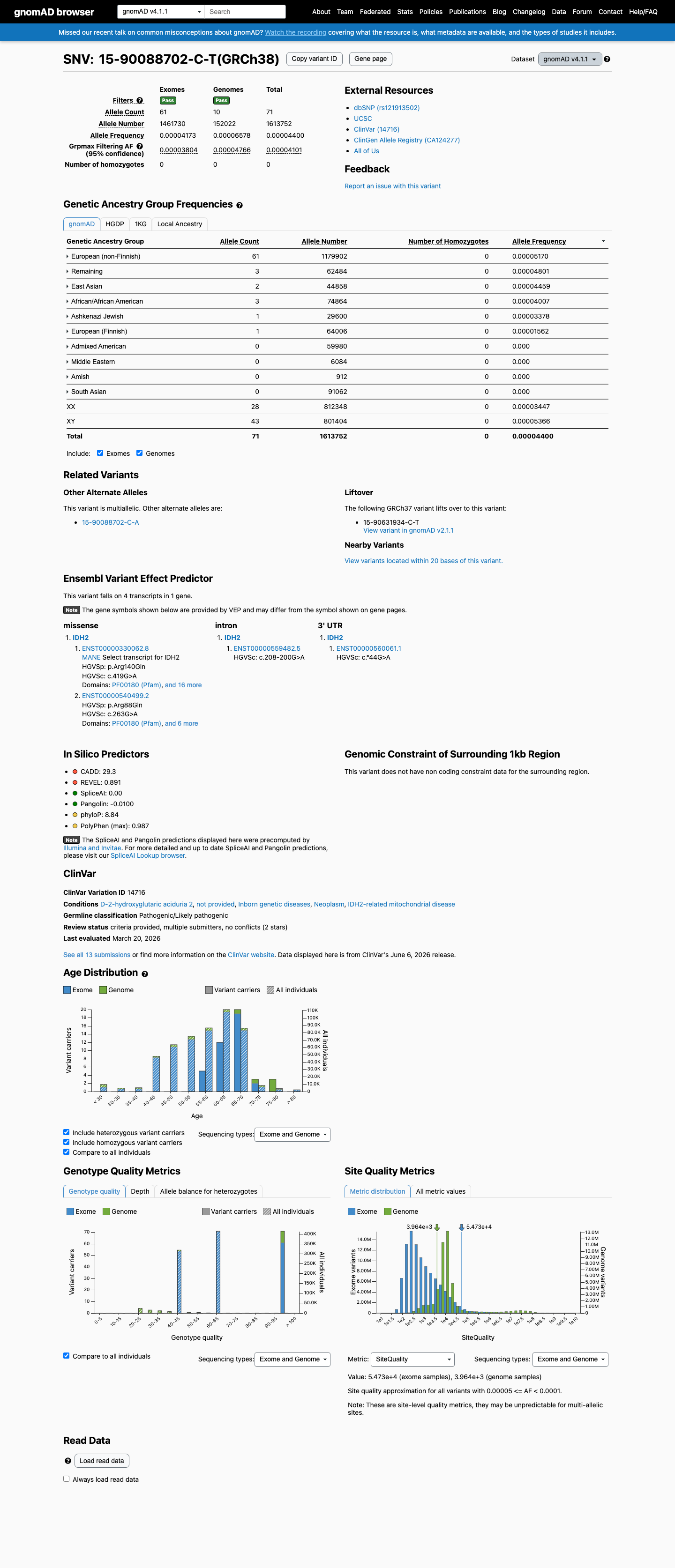
gnomAD v4.1
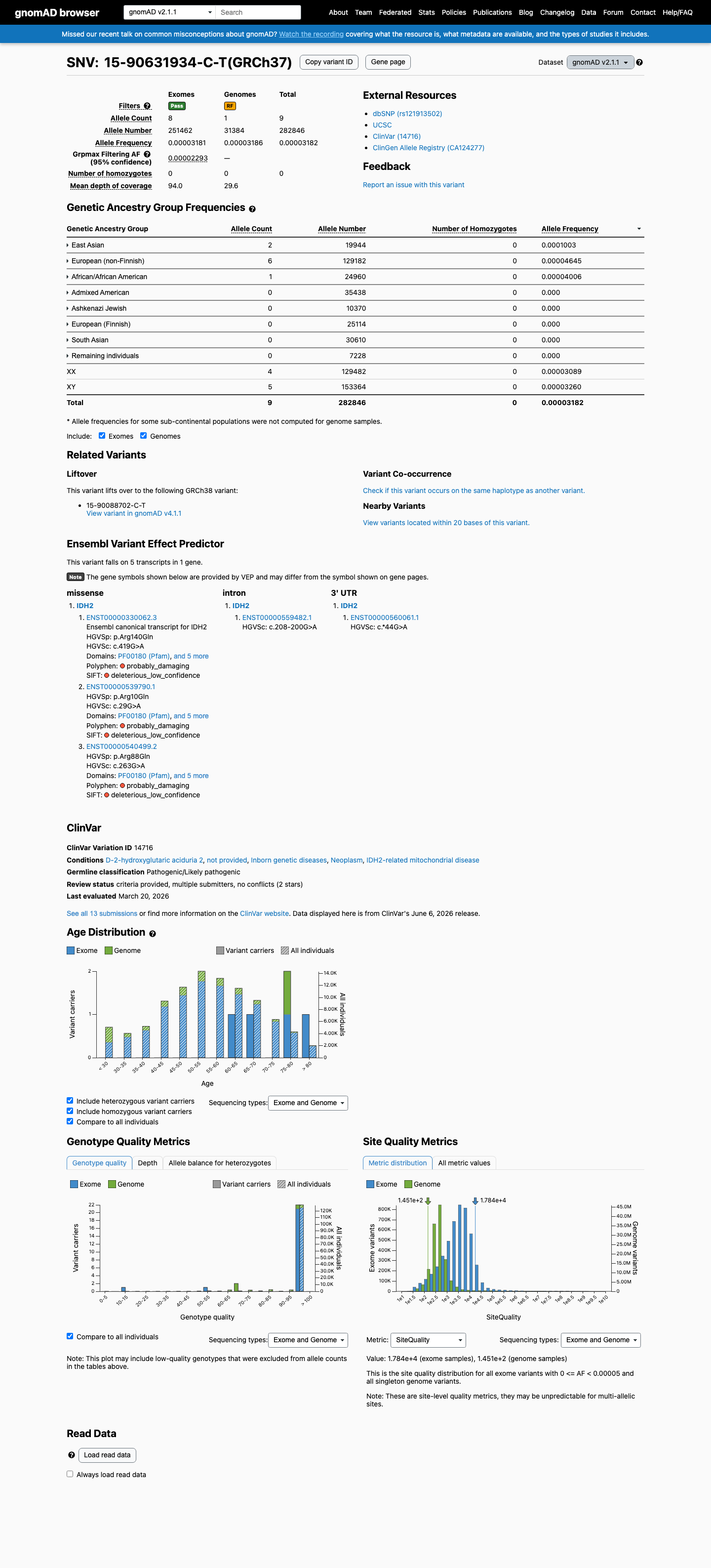
gnomAD v2.1
v4.1
This variant is present in gnomAD v4.1 (AF= 4.39968e-05; MAF= 0.00440%, 71/1613752 alleles, homozygotes = 0) and has highest observed frequency in the European (non-Finnish) population (AF= 5.16992e-05; MAF= 0.00517%, 61/1179902 alleles, homozygotes = 0); grpmax FAF= 4.101e-05.
v2.1
This variant is present in gnomAD v2.1 (AF= 3.18194e-05; MAF= 0.00318%, 9/282846 alleles, homozygotes = 0) and has highest observed frequency in the East Asian population (AF= 0.000100281; MAF= 0.01003%, 2/19944 alleles, homozygotes = 0); grpmax FAF= 2.293e-05.
🇨🇦 CA
Not available in gnomAD-Canada v1.0.
Allele frequency by ancestry
three datasets · side by side
gnomAD v4.1
0.0044%
· 71 / 1,613,752
0 hom · FAF 0.0041%
0 hom · FAF 0.0041%
European (non-Finnish) 61 / 1,179,902 |
0.0052% |
Remaining individuals 3 / 62,484 |
0.0048% |
East Asian 2 / 44,858 |
0.0045% |
African/African American 3 / 74,864 |
0.004% |
Ashkenazi Jewish 1 / 29,600 |
0.0034% |
European (Finnish) 1 / 64,006 |
0.0016% |
+ 4 not observed (Admixed American, Amish, Middle Eastern, South Asian)
gnomAD v2.1
0.0032%
· 9 / 282,846
0 hom · FAF 0.0023%
0 hom · FAF 0.0023%
East Asian 2 / 19,944 |
0.01% |
European (non-Finnish) 6 / 129,182 |
0.0046% |
African/African American 1 / 24,960 |
0.004% |
+ 5 not observed (Admixed American, Ashkenazi Jewish, European (Finnish), Remaining individuals, South Asian)
gnomAD Canada 🇨🇦
Absent
· 0 / ?
0 hom
0 hom
Not observed in any ancestry group.

ClinVar
This variant has been reported in ClinVar as Pathogenic (7 clinical laboratories) and as Likely pathogenic (5 clinical laboratories). (ClinVarID = 14716)

In silico
SpliceAI predicts no significant splice impact for this variant (max delta score = 0.00). REVEL score = 0.891. BayesDel score = 0.44497.
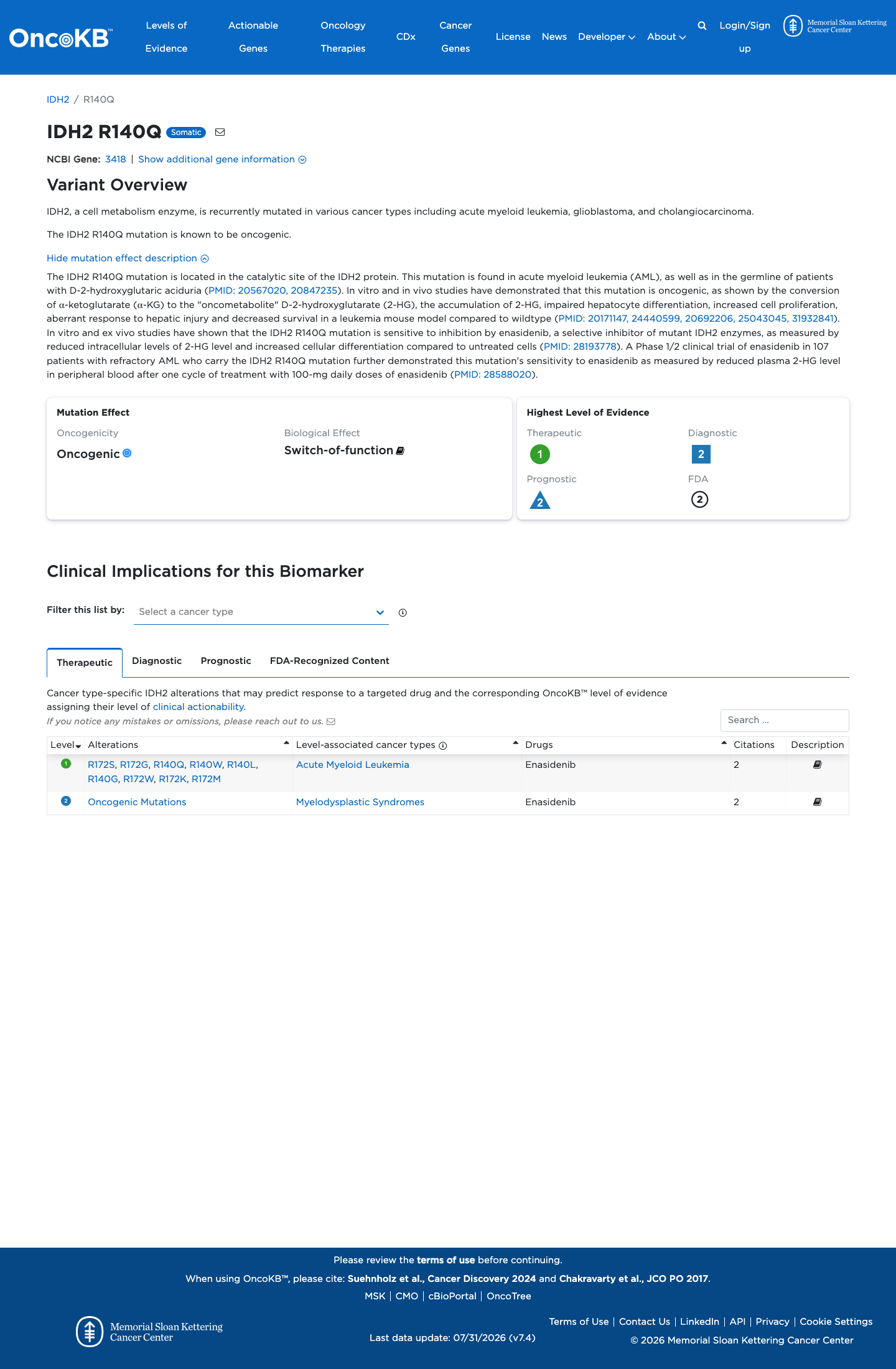
Functional
Oncogenic
OncoKB identified variant-specific curated literature and context relevant to functional review; curated oncogenicity label: Oncogenic.
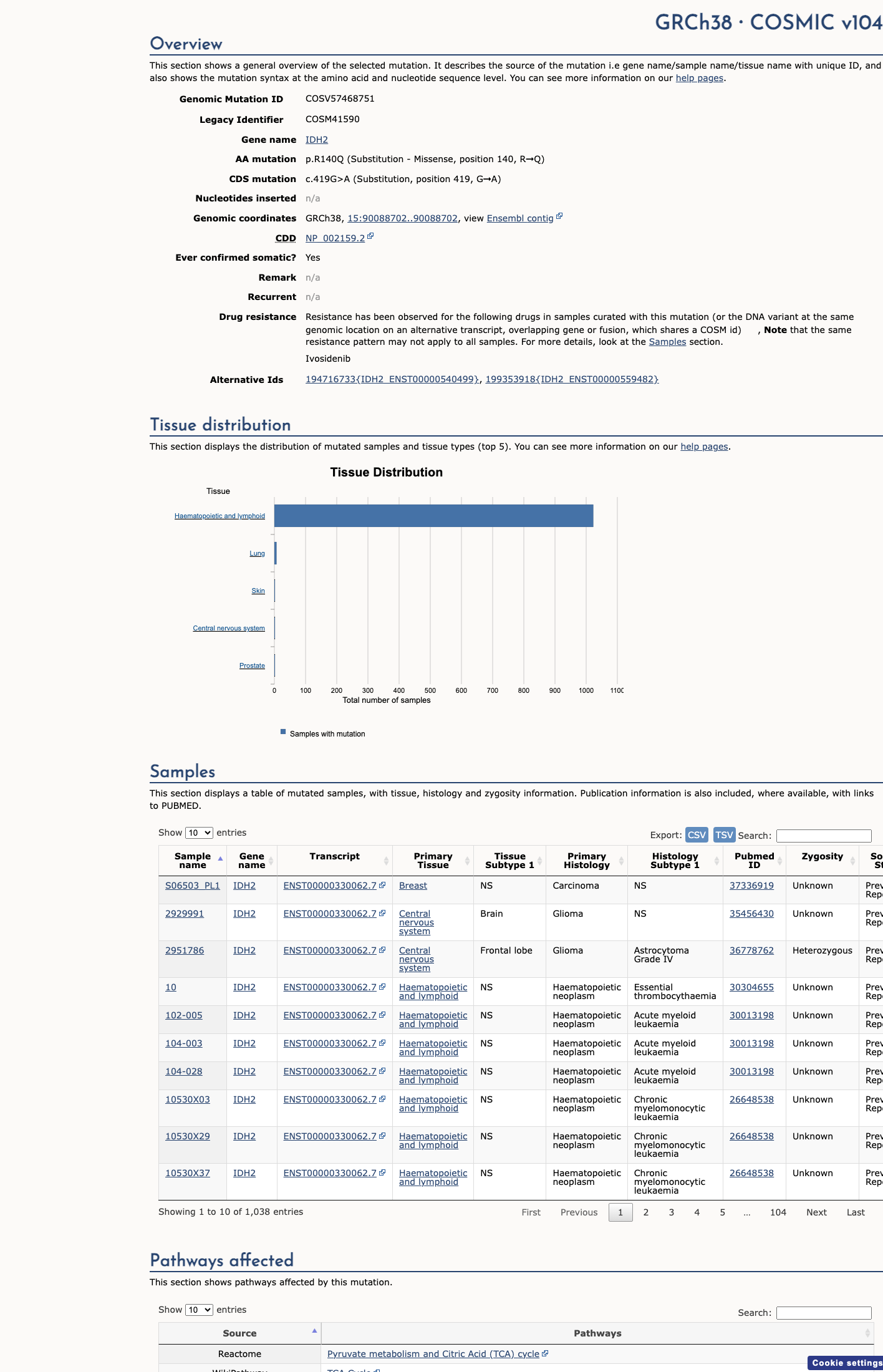
COSMIC

Cancer hotspots
Somatic evidence
Hotspot
COSMIC
This variant lies in a statistically significant hotspot. This variant has previously been reported in somatic cancers (COSMIC; COSV57468751, n = 1037 times).
Hotspots
This variant lies in a statistically significant hotspot.
Literature · how each cited paper was used
5papers cited
Each card is an audit: what was searched, what was found, whether it names the variant, which criteria it fed, and why. 6 further PMIDs triaged but not cited — see Sources & references.
The common feature of leukemia-associated IDH1 and IDH2 mutations is a neomorphic enzyme activity converting alpha-ketoglutarate to 2-hydroxyglutarate.
Searched
c.419G>Ap.Arg140GlnR140QIDH2 R140
Found
Demonstrated that leukemia-associated IDH2 mutations at R140 produce a neomorphic enzyme activity converting alpha-ketoglutarate to 2-hydroxyglutarate. IDH2 R140Q was among the mutants characterized, showing gain-of-function 2HG production.
Variant
✓ Names this variant — characterised directly
Applied to
→PS3
met
Why
Supports PS3 at strong level as one of multiple independent studies confirming neomorphic gain-of-function activity of IDH2 R140Q.
The common feature of leukemia-associated IDH1 and IDH2 mutations is a neomorphic enzyme activity converting alpha-ketoglutarate to 2-hydroxyglutarate.
Location Introduction; Results · Context In vitro enzyme assays with recombinant IDH2 mutants; 2HG quantification by LC-MS/MS · full text
A lymphoblast model for IDH2 gain-of-function activity in d-2-hydroxyglutaric aciduria type II: novel avenues for biochemical and therapeutic studies.
Searched
c.419G>Ap.Arg140GlnR140QIDH2 c.[419 G>A]c.[419 G>A]
Found
Developed an enzyme assay for IDH2 R140Q in lymphoblasts from D-2-hydroxyglutaric aciduria type II patients. The exact variant (IDH2 c.419G>A, p.Arg140Gln) was studied in five patient cell lines. Demonstrated 8-fold increase in D-2-HG production and 140-fold increase in intracellular D-2-HG. Confirmed that D-2-HGA type II is caused by heterozygous de novo IDH2 R140Q mutations. Also reported one patient with IDH2 R140G (different amino acid change at same codon).
Variant
✓ Names this variant — characterised directly
Applied to
→PS2
met
→PS3
met
→PM1
met
→PM5
met
Why
Primary functional evidence for PS3 at strong level. Confirms de novo mechanism supporting PS2. Documents R140G at same codon supporting PM5. Establishes R140 as critical functional domain supporting PM1.
Five cell lines were obtained from D-2-HGA type II patients which all carried the heterozygous IDH2 c.[419 G>A], p.[Arg140Gln] (IDH2wt/R140Q) mutation
Location Abstract; Introduction (para 1-2); Materials and Methods (Section 2.1) · Context Patient-derived lymphoblast cell lines; stable-isotope-labeled 2-KG substrate; UPLC-MS/MS detection with chiral separation · full text
Targeted inhibition of mutant IDH2 in leukemia cells induces cellular differentiation.
Searched
c.419G>Ap.Arg140GlnR140QIDH2/R140Q
Found
Developed AGI-6780, a small molecule that potently and selectively inhibits mutant IDH2/R140Q. Crystal structure of the inhibitor-mutant complex revealed allosteric binding at the dimer interface. Treatment with AGI-6780 reversed the differentiation block in TF-1 erythroleukemia cells expressing IDH2/R140Q and induced differentiation of primary human AML blasts harboring the mutation.
Variant
✓ Names this variant — characterised directly
Applied to
→PS3
met
Why
Strong independent functional confirmation supporting PS3. Demonstrates pharmacological reversal of mutant phenotype, confirming the functional consequence is specific to the R140Q mutation.
We developed a small molecule, AGI-6780, that potently and selectively inhibits the tumor-associated mutant IDH2/R140Q.
Location Abstract; Results (Figs 1-3); Table 1 · Context Recombinant IDH2/R140Q enzyme assay; TF-1 erythroleukemia cells; primary human AML patient samples; X-ray crystallography; flow cytometry for differentiation markers · full text
D-2-hydroxyglutarate produced by mutant IDH2 causes cardiomyopathy and neurodegeneration in mice.
Searched
c.419G>Ap.Arg140GlnR140Qcodon 140
Found
Generated transgenic mice with conditional IDH2/R140Q expression. Demonstrated that IDH2/R140Q produces D-2-hydroxyglutarate, which accumulates and causes cardiomyopathy and neurodegeneration in mice. Establishes that R140Q is the mutation responsible for the neomorphic activity in D-2-hydroxyglutaric aciduria type II.
Variant
✓ Names this variant — characterised directly
Applied to
→PS3
met
Why
In vivo model confirming the pathogenic mechanism of IDH2 R140Q. Supports PS3 as independent evidence of gain-of-function pathogenicity.
A missense mutation at codon 140 of IDH2 (R140Q) is responsible for causing the neomorphic activity of reducing alpha-KG to D2-hydroxyglutaric acid (D-2HG)
Location Introduction; Results · Context Transgenic mouse model; conditional IDH2/R140Q expression; D-2HG quantification; cardiac and neurological phenotyping · full text
Genetic dissection of leukemia-associated IDH1 and IDH2 mutants and D-2-hydroxyglutarate in Drosophila.
Searched
c.419G>Ap.Arg140GlnR140QR163QIDH2-R140Q
Found
Expressed Idh-R163Q, the Drosophila homolog of human IDH2-R140Q, in transgenic flies. Idh-R163Q produced moderately elevated D-2HG (~10-fold) and milder phenotypes compared to the R195H mutant (homologous to IDH1-R132H). Demonstrated that D-2-HG production is essential for mutant phenotypes and that co-expression of D2HGDH rescues them.
Variant
✓ Names this variant — characterised directly
Applied to
→PS3
met
Why
Supports PS3 by confirming gain-of-function mechanism is conserved. However, Idh-R163Q is not the exact human variant; used as supporting corroboration.
Idh-R163Q, which is homologous to the common leukemia-associated IDH2-R140Q mutant, resulted in moderately elevated D-2HG and milder phenotypes.
Location Abstract; Results; Figure 2 · Context Drosophila melanogaster transgenic model; UAS-Gal4 expression system; LC-MS/MS D-2HG quantification; hemocyte and neuronal phenotyping · full text
Sources & reference links
Triaged references · 6 PMIDs not cited in assessment
25626707 ↗
Whole-genome sequencing in newborn screening? A statement on the continued importance of targeted approaches in newborn screening programmes.
CLINVAR
22947299 ↗
Specific guidelines for assessing and improving the methodological quality of economic evaluations of newborn screening.
CLINVAR
23037933 ↗
Including the initial newborn screening bloodspot collection device serial number on birth certificates: basis and recommendations from the Secretary of Health and Human Services' Advisory Committee on Heritable Disorders in Newborns and Children.
CLINVAR
23881473 ↗
Newborn screening: education, consent, and the residual blood spot. The position of the national society of genetic counselors.
CLINVAR