Analysis in progress
Initialising…
0%
complete
This report is still being assembled — sections appear as each stage finishes. It isn't final yet.
EPCAM
Final classification
Likely Benign
EPCAM c.675G>A · p.Leu225=
EPCAM

NM_002354.3:c.675G>A is a synonymous variant (p.Leu225=) in exon 7 of EPCAM.

Gene
EPCAM
Transcript
NM_002354.3
HGVS · transcript:coding
NM_002354.3:c.675G>A
Consequence
N/A
GRCh38
chr2:47379786 G>A
GRCh37
chr2:47606925 G>A
Basis gene-specific framework lacked a usable explicit final combination framework, so generic ACMG/AMP 2015 final-combination rules were applied as fallback; applied criteria: PM2 supporting, BP4 supporting benign, BP6 supporting benign, BP7 supporting benign; combination = 1 supporting + 3 supporting benign, which maps to Likely Benign.
gene-specific framework lacked a usable explicit final combination framework, so generic ACMG/AMP 2015 final-combination rules were applied as fallback; applied criteria: PM2 supporting, BP4 supporting benign, BP6 supporting benign, BP7 supporting benign; combination = 1 supporting + 3 supporting benign, which maps to Likely Benign.
Classification rationale
PM2 BP4BP6BP7 Likely Benign
EPCAM c.675G>A

NM_002354.3:c.675G>A is a synonymous variant (p.Leu225=) in exon 7 of EPCAM. SpliceAI predicts no splicing impact (max delta = 0.00), satisfying BP4 and BP7 at supporting benign strength.1 ClinVar lists this variant as Likely benign by Ambry Genetics, satisfying BP6 at supporting benign strength.2 The variant is extremely rare in population databases: gnomAD v2.1 AF = 0.00004% (1/251,376) and v4.1 AF = 0.000019% (3/1,613,358), satisfying PM2 at supporting strength.3 Overall, three supporting benign criteria (BP4, BP6, BP7) outweigh one supporting pathogenic criterion (PM2), resulting in a Likely Benign classification per generic ACMG/AMP 2015 combination rules.4

PM2 + BP4 + BP6 + BP7 Likely Benign
4 generic_acmg_combination_rules
Gene diagram · NM_002354.3 · variants mapped to exon structure
EPCAM NM_002354.3
Fetching transcript structure from UCSC…
Applied criteria · 4 applied · 16 assessed
Applied · 4
Strength Supporting Moderate Strong Very strong
PM2 supporting Pathogenic
Variant is extremely rare in population databases: gnomAD v2.1 AF = 0.00004% (1/251,376 alleles) and v4.1 AF = 0.000019% (3/1,613,358 alleles), well below the PM2 threshold of 0.1%.
gnomAD v2.1: 1/251376 alleles (AF = 3.98e-60.00040%)
BP4 supporting Benign
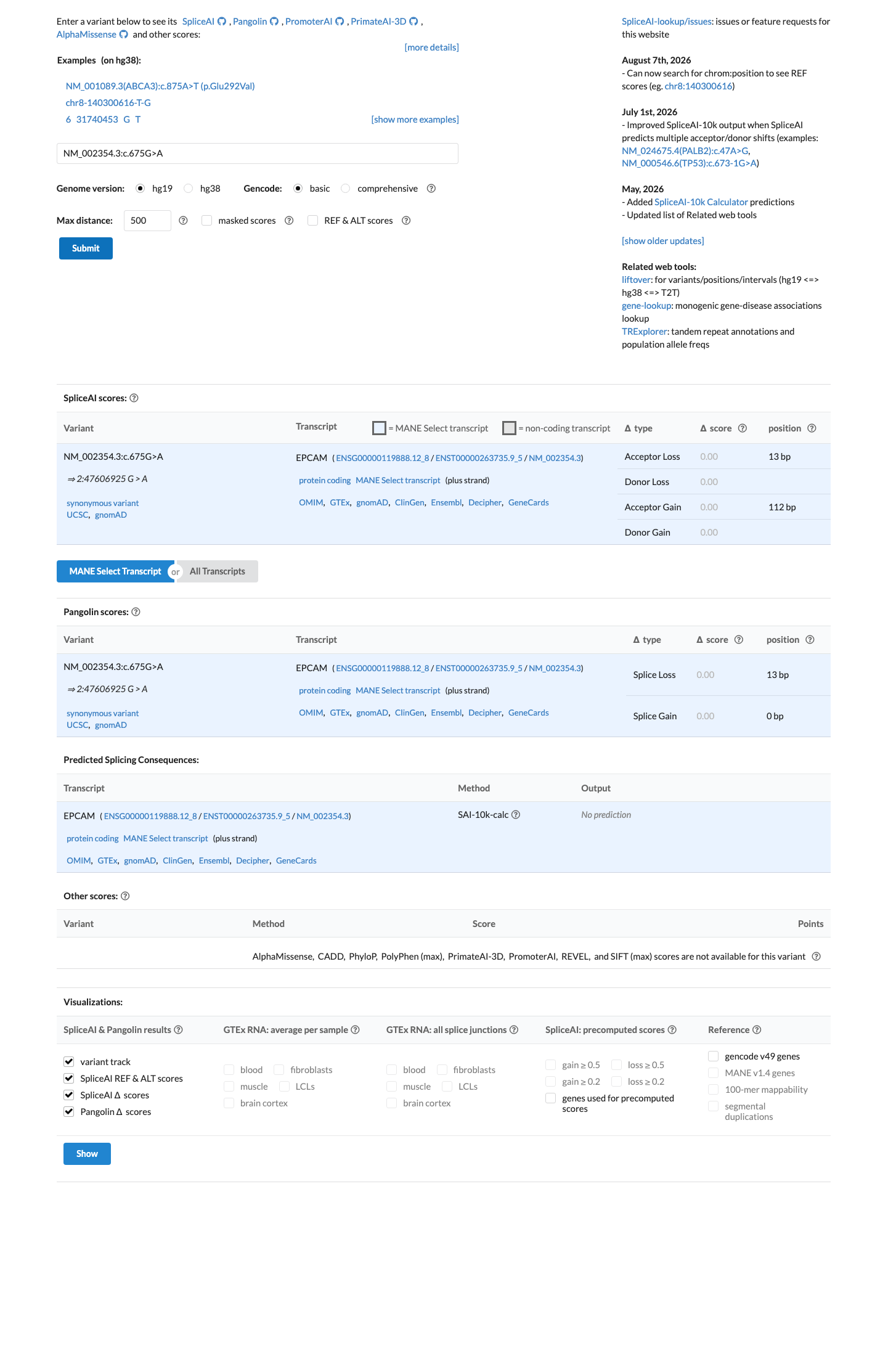
Multiple lines of computational evidence suggest no impact on the gene product: SpliceAI predicts no splicing alteration (max delta = 0.00, all sub-scores at 0.0), and the variant is synonymous with no predicted effect on protein sequence.
SpliceAI max delta = 0.00 (DS_AG=0.0DS_AL=0.0DS_DG=0.0
BP6 supporting Benign
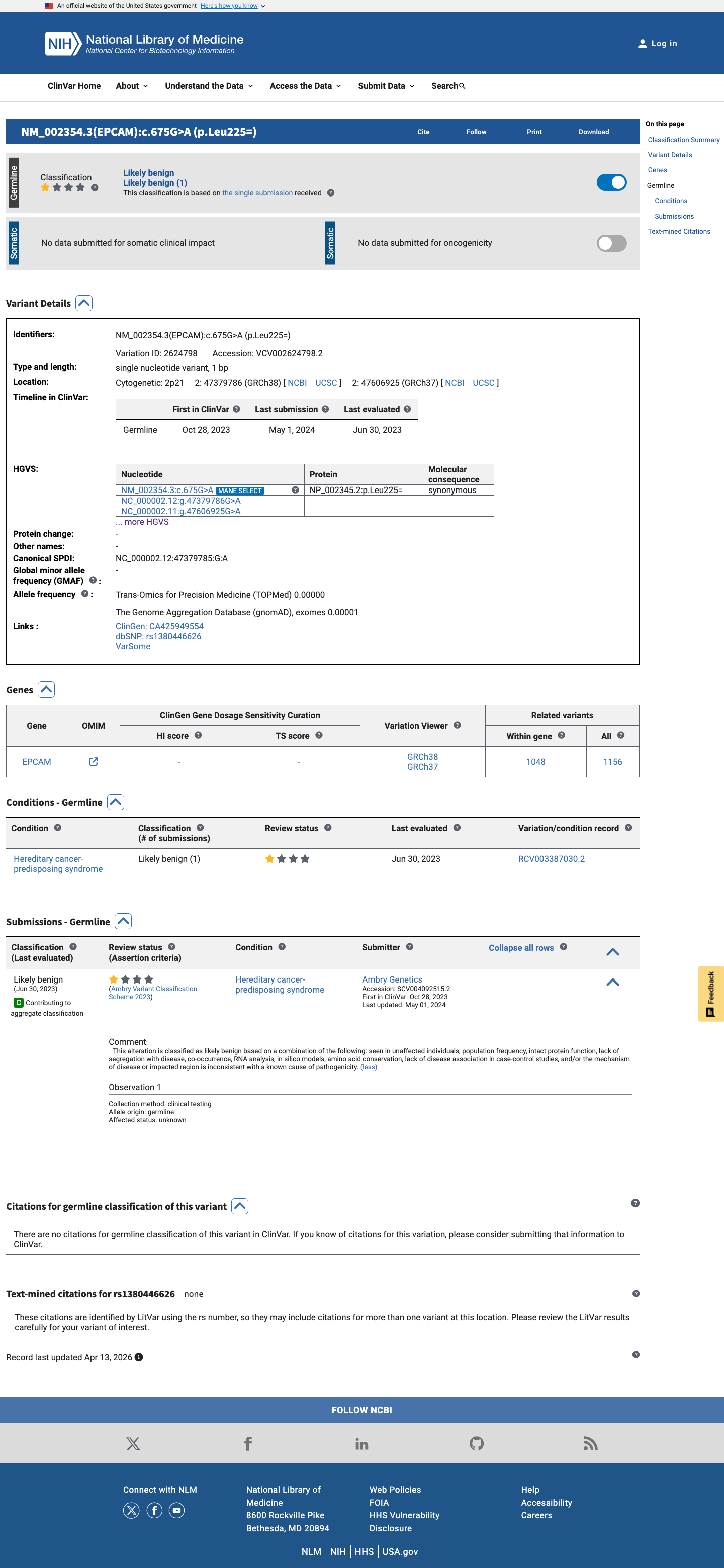
ClinVar reports Likely benign classification by Ambry Genetics (criteria provided, single submitter), a reputable clinical laboratory. The classification is consistent with the synonymous nature of this variant.
ClinVar Variation ID 2624798: Likely benign (Ambry GeneticsSCV004092515)Classification based on clinical testing with ACMG criteria provided
BP7 supporting Benign
Synonymous variant (p.Leu225=) with SpliceAI max delta = 0.00 predicting no splice impact and no creation of a cryptic splice site. The variant lies in exon 7 (c.658-c.858) at position c.675, well within the exon body and not at a canonical splice consensus sequence.
Synonymous variant p.Leu225= — no amino acid changeSpliceAI max delta = 0.00 — no predicted splicing alteration (all delta scores at 0.0)Variant at c.675 within exon 7 (c.658-858)
Assessed · not applied
Pathogenic
PS2 No de novo observation identified for this variant in the available evidence.
PS3 No functional data available for this variant; OncoKB lists unknown oncogenic effect and no publications with variant-specific functional assays were identified.
PS4 No case-control or enrichment data available; the variant is extremely rare in population databases (1-3 alleles) with no disease cohort observations.
PM1 No evidence that this synonymous nucleotide position lies within a critical functional domain specifically disrupted at the nucleotide level; SpliceAI predicts no splicing impact (max delta = 0.00).
PM6 No de novo observation identified for this variant; PM6 requires confirmed de novo status with parental testing.
PP1 No segregation data available for this variant.
PP3 No in silico tools predict a deleterious effect; SpliceAI max delta = 0.00, REVEL and BayesDel scores not available but synonymous variants are not expected to show pathogenic computational predictions.
PP4 No specific patient phenotype or clinical data provided for this variant; PP4 requires phenotype specificity supporting a diagnosis.
PP5 ClinVar classification is Likely benign, not pathogenic; PP5 requires a reputable source to report the variant as pathogenic.
Benign
BA1 Population frequency is extremely low: gnomAD v4.1 AF = 0.000019%, well below the BA1 threshold of 1%.
BS1 Population frequency is extremely low: gnomAD v4.1 AF = 0.000019%, well below the BS1 threshold of 0.3%.
BS2 While this variant is observed in population databases (gnomAD), EPCAM-associated Lynch syndrome is an adult-onset disorder with reduced penetrance; observation in population controls does not exclude late-onset disease.
BS3 No functional data demonstrating no deleterious effect for this variant; OncoKB lists unknown oncogenic effect with no publications supporting a benign functional impact.
BS4 No segregation data available demonstrating lack of cosegregation with disease.
BP2 No phase data available; BP2 requires observation in trans with a pathogenic variant for a dominant disorder or in cis with a pathogenic variant.
BP5 No evidence of an alternate molecular basis for disease in a case carrying this variant.
N/A · 5 PVS1 · PS1 · PM5 · PP2 · BP1
Research & evidence
Population frequency · supports benign
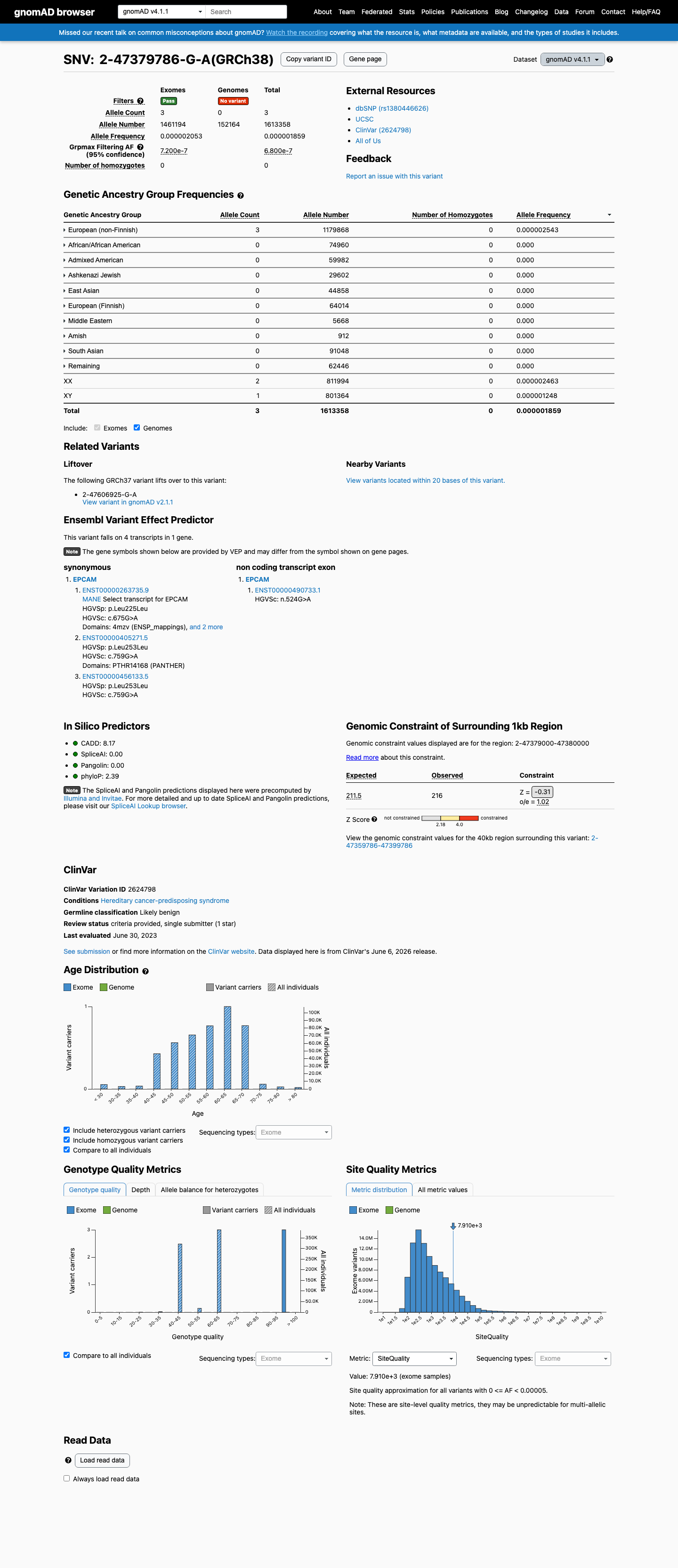
gnomAD v4.1 screenshot
gnomAD v4.1
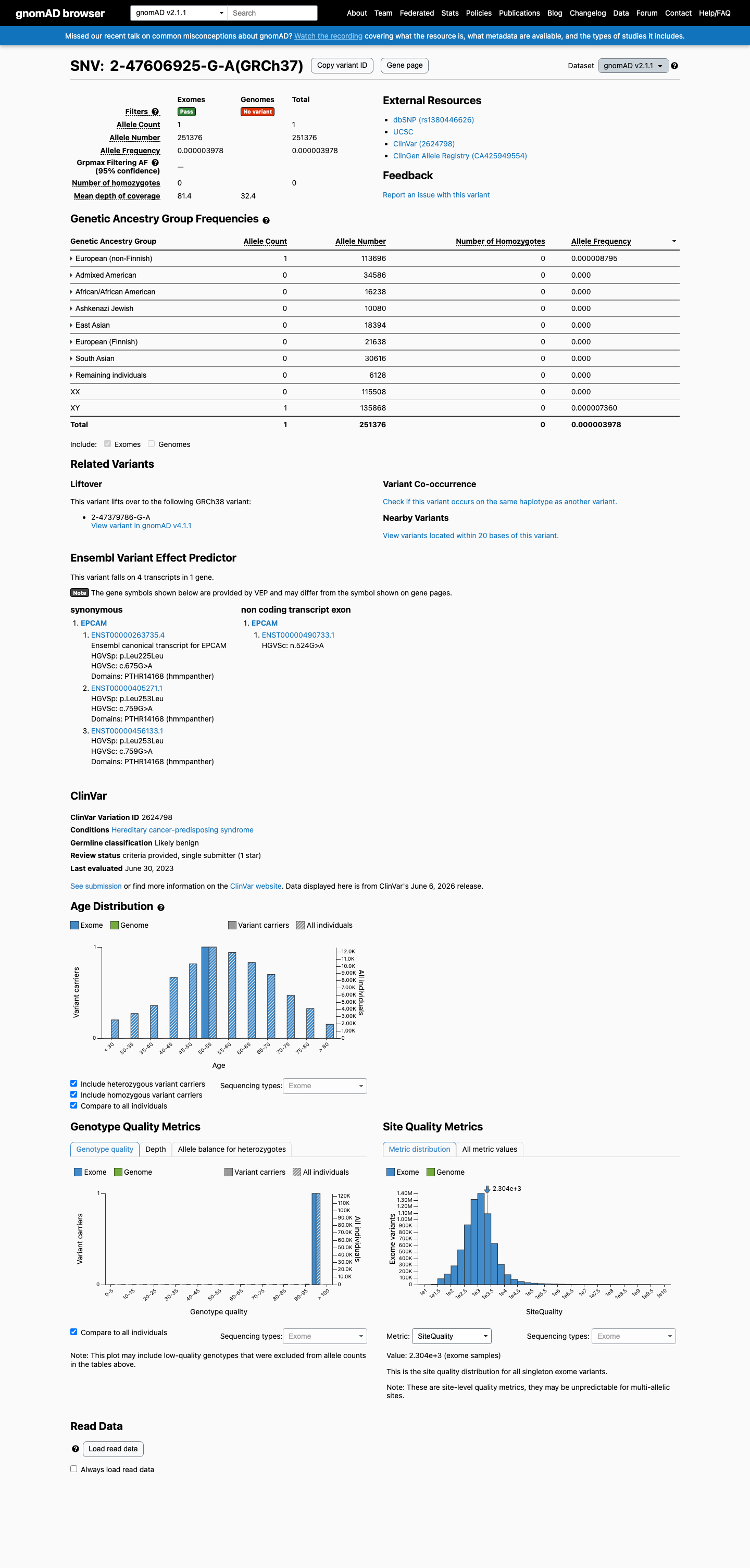
gnomAD v2.1 screenshot
gnomAD v2.1
v4.1
This variant is present in gnomAD v4.1 (AF= 1.85948e-06; MAF= 0.00019%, 3/1613358 alleles, homozygotes = 0) and has highest observed frequency in the European (non-Finnish) population (AF= 2.54266e-06; MAF= 0.00025%, 3/1179868 alleles, homozygotes = 0); grpmax FAF= 6.8e-07.
v2.1
This variant is present in gnomAD v2.1 (AF= 3.9781e-06; MAF= 0.00040%, 1/251376 alleles, homozygotes = 0) and has highest observed frequency in the European (non-Finnish) population (AF= 8.79538e-06; MAF= 0.00088%, 1/113696 alleles, homozygotes = 0).
🇨🇦 CA
Absent from gnomAD-Canada v1.0.
Allele frequency by ancestry
three datasets · side by side
gnomAD v4.1
0.00019% · 3 / 1,613,358
0 hom · FAF 6.8e-05%
European (non-Finnish)
3 / 1,179,868
0.00025%
+ 9 not observed (Remaining individuals, Admixed American, European (Finnish), Amish, East Asian, Middle Eastern, South Asian, Ashkenazi Jewish, African/African American)
gnomAD v2.1
0.0004% · 1 / 251,376
0 hom
European (non-Finnish)
1 / 113,696
0.00088%
+ 7 not observed (African/African American, Admixed American, Ashkenazi Jewish, East Asian, European (Finnish), Remaining individuals, South Asian)
gnomAD Canada 🇨🇦
Absent · 0 / ?
0 hom
Not observed in any ancestry group.
ClinVar screenshot
ClinVar
This variant has been reported in ClinVar as Likely benign (1 clinical laboratory). (ClinVarID = 2624798)
SpliceAI screenshot
In silico
SpliceAI predicts no significant splice impact for this variant (max delta score = 0.00).
Functional / OncoKB screenshot
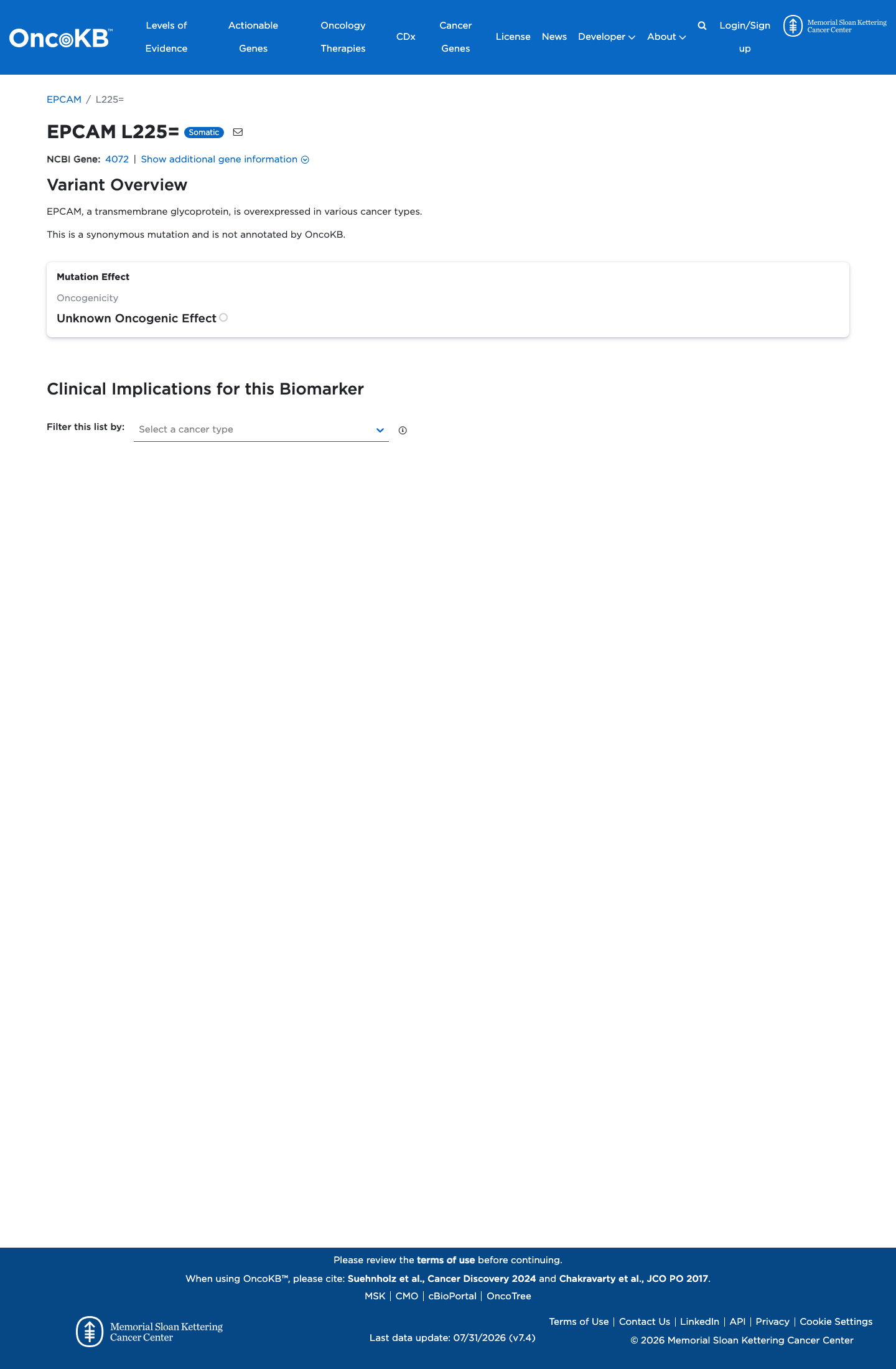
Functional Unknown Oncogenic Effect
OncoKB identified curated literature and non-variant-specific oncogenicity context for review; listed oncogenicity label: Unknown Oncogenic Effect.
OncoKB ↗
COSMIC screenshot
COSMIC
Cancer hotspots screenshot
Cancer hotspots
Somatic evidence Not in COSMIC / hotspots
COSMIC
This variant does not lie in a statistically significant hotspot. This variant has not previously been reported in somatic cancers (COSMIC).
Hotspots
This variant does not lie in a statistically significant hotspot.
Sources & reference links
8Sources
ClinVar
gnomAD v2.1
gnomAD v4.1
gnomAD-Canada
SpliceAI
OncoKB
COSMIC
Cancer hotspots
Triaged references · 1 PMID not cited in assessment
25394175 ↗ A practice guideline from the American College of Medical Genetics and Genomics and the National Society of Genetic Counselors: referral indications for cancer predisposition assessment. CLINVAR