Back
NM_002439.5:c.131C>G
p.Ala44Gly · MSH3
ACMG/AMP
0%
complete
Final classification
VUS
PM2BP4
MSH3
c.131C>G
p.Ala44Gly
missense · exon 1

MSH3 encodes a protein that partners with MSH2 to form MutS beta, a key component of the DNA mismatch repair system that recognizes and corrects errors made during DNA replication. It acts as a tumor suppressor: loss of MSH3 function leads to mismatch repair deficiency, an elevated mutation rate, and increased cancer risk, and the gene is frequently altered in mismatch repair-deficient colorectal cancers. Defects in MSH3 are linked to susceptibility to endometrial cancer, and inherited mutations are associated with an autosomal recessive form of familial adenomatous polyposis, with minimal evidence for a role in Lynch syndrome. Tumors with mismatch repair deficiency, including those involving MSH3, tend to respond well to immune checkpoint inhibitor therapies.

This variant

MSH3 encodes the MSH2-partnering MutS beta mismatch-repair protein, and inherited biallelic MSH3 defects are associated with autosomal recessive familial adenomatous polyposis and mismatch-repair deficiency.

Transcript
NM_002439.5
HGVS · transcript:coding
NM_002439.5:c.131C>G
GRCh38
chr5:80654858 C>G
GRCh37
chr5:79950677 C>G
VUS: PM2 (supporting) and BP4 (moderate) were met, but this evidence combination does not satisfy a generic ACMG/AMP benign or pathogenic classification threshold.
Classification rationale
PM2 BP4 VUS
MSH3 c.131C>G missense · exon 1

PM2 supporting: gnomAD v4.1 shows very low allele frequency and zero homozygotes. BP4 moderate: REVEL 0.138 is below the calibrated moderate benign computational threshold. VUS: PM2 supporting plus BP4 moderate does not meet a generic ACMG/AMP final classification threshold.

PM2 + BP4 → VUS
LYFE Sciences is an AI system, and it can make mistakes. Criteria may be applied incorrectly, sources may be misread, and a confident-looking classification can still be wrong. Double-check every criterion and its underlying evidence before relying on any call.
Gene diagram · NM_002439.5 · variants mapped to exon structure
MSH3 NM_002439.5
Fetching transcript structure from UCSC…
Applied criteria · 2 applied · 22 assessed
MetEvidence satisfies this criterion.
Not metEvaluated against available evidence; threshold not reached.
Not assessedApplies in principle, but no evidence was found to evaluate it.
N/ADoesn't apply to this variant type.
Applied · 2
Strength Supporting Moderate Strong Very strong
PM2 supporting Pathogenic
Met at supporting: gnomAD v4.1 total AF is 7.48893e-06, below the generic PM2 threshold of 0.0001, with zero homozygotes.
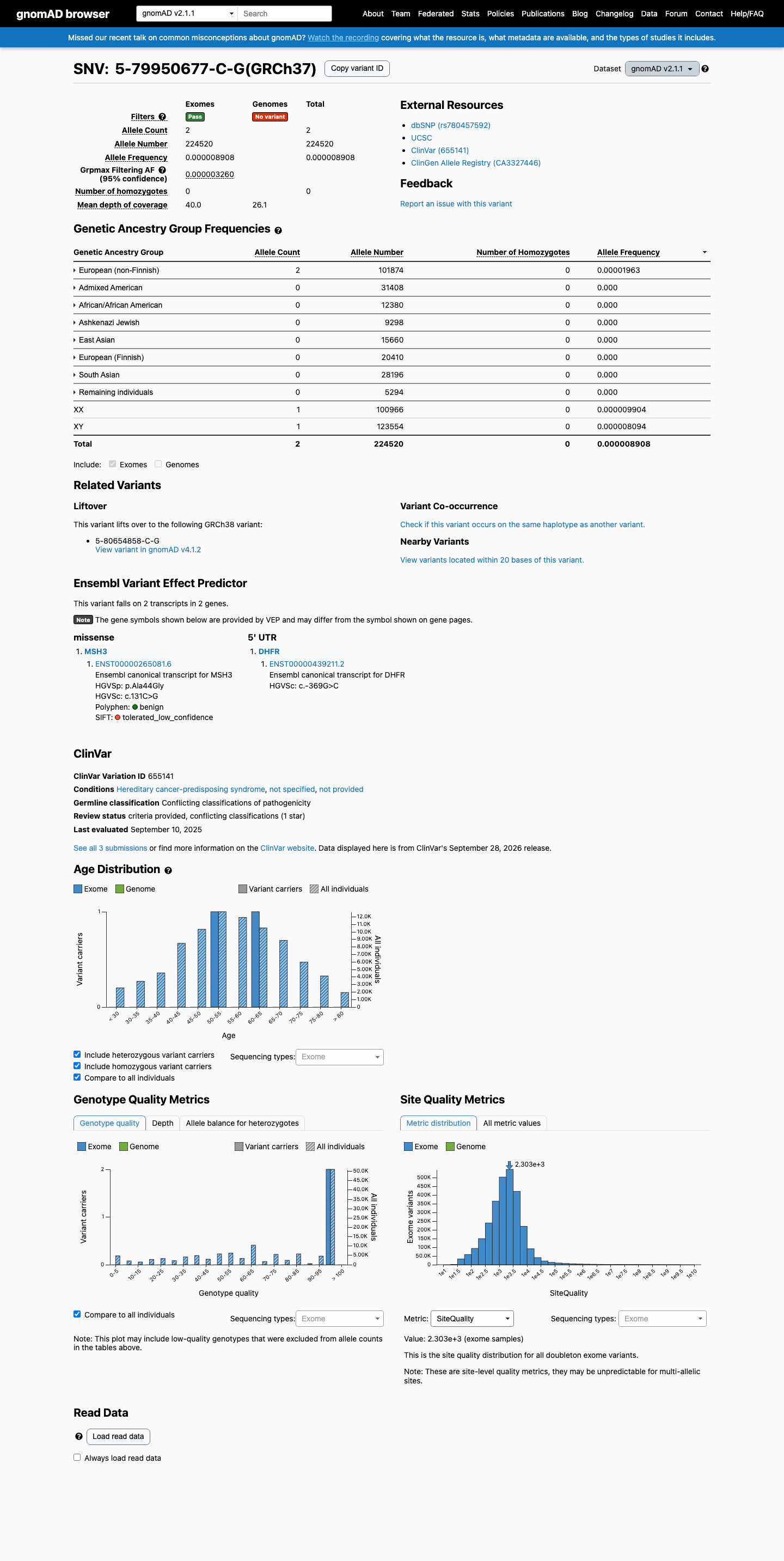
gnomAD v4.1 all-comers data report 12/1,602,366 alleles, total AF 7.488925751045641e-06, highest subgroup AF 1.021347872787718e-05, and zero homozygotes.gnomAD v2.1 all-comers exome data report 2/224,520 alleles, total AF 8.907892392659896e-06, highest subgroup AF 1.9632094548167345e-05, and zero homozygotes.Because no governing VCEP specifies a non-cancer or exome-only source, the default all-comers gnomAD v2.1 and v4.1 entries were used; the available non-cancer subsets do not alter the conclusion.
BP4 moderate Benign
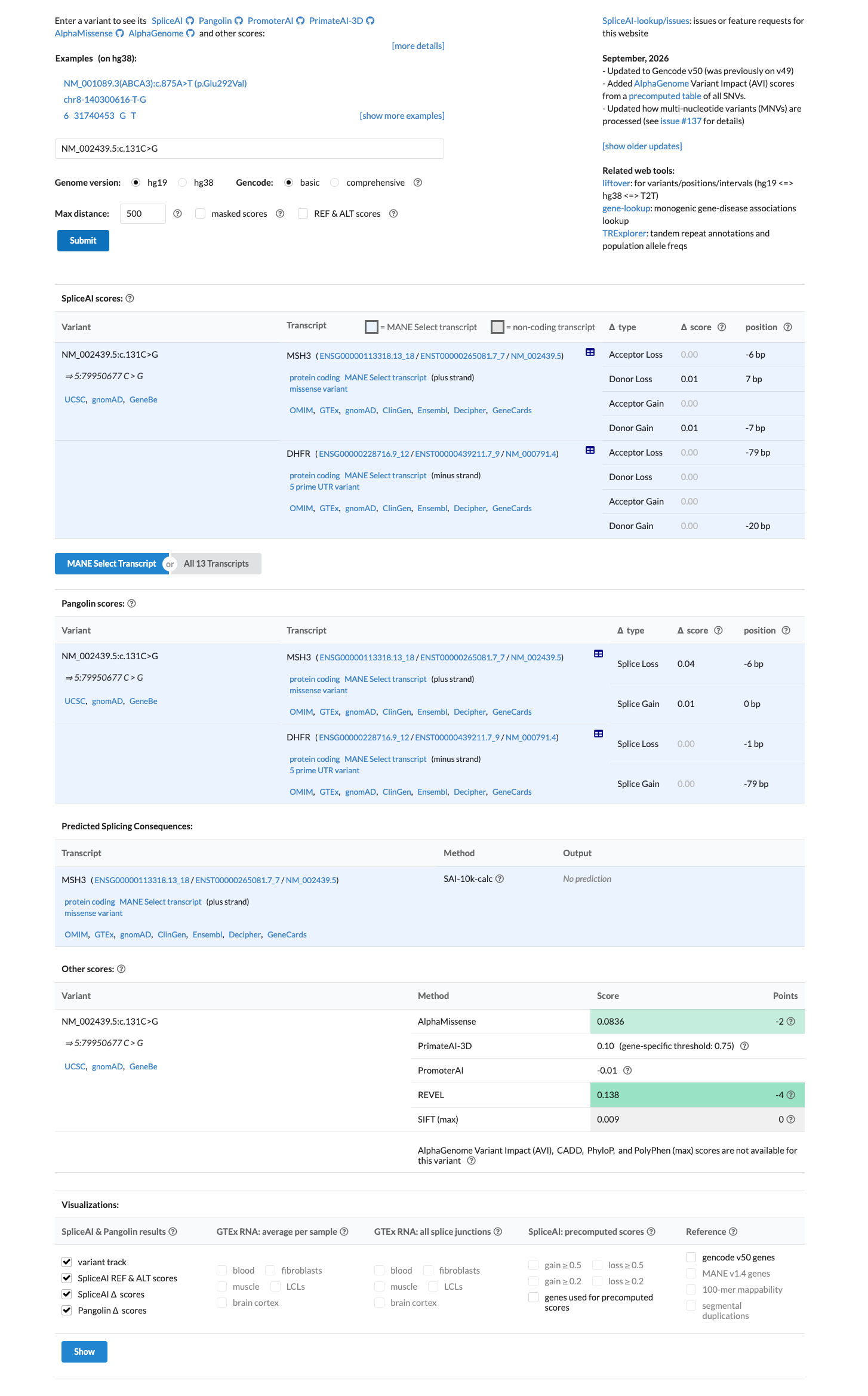
Met at moderate strength: missense REVEL score 0.138 is below the <=0.183 moderate BP4 threshold.
The variant is a missense substitution, NM_002439.5:c.131C>G (NP_002430.3:p.(Ala44Gly)), so REVEL is the applicable BP4 path.REVEL score is 0.138, meeting the published generic ClinGen SVI moderate BP4 threshold of <=0.183 from Pejaver et al. 2022 (PMID:36413997).No governing MSH3 VCEP or gene-specific computational specification was available, so the supplied generic REVEL calibration was applied.
Assessed · not applied · 6 not met · 16 not assessed
Pathogenic
PS1 Not assessed: no validated pathogenic MSH3 comparator producing the same amino-acid change, p.Ala44Gly, was identified.
PS2 Not assessed: no parental genotypes or confirmed de novo observation are documented for the affected proband.
PS3 Not assessed: no variant-specific validated functional assay with appropriate controls was identified for MSH3 p.(Ala44Gly).
PS4 Not assessed: no exact-variant case-control counts, enrichment statistic, or statistically supported affected-case series were available.
PM1 Not assessed: no authoritative MSH3 domain table was retrieved, and the A44 hotspot query found no statistically significant hotspot.
PM3 Not assessed: no affected individual, second pathogenic allele, phase, or biallelic MSH3 observation is documented for c.131C>G.
PM5 Not assessed: zero eligible pathogenic missense comparators were identified at MSH3 residue 44.
PM6 Not assessed: no clinical report or family-history evidence supports a presumed de novo event without parental testing.
PP1 Not assessed: no informative affected relatives, familial variant testing, or meiosis count is documented for segregation analysis.
PP2 Not assessed: MSH3 loss-of-function support does not establish the gene-level missense enrichment required for PP2.
PP3 Not met: missense REVEL score 0.138 is below the >=0.644 supporting PP3 threshold.
PP4 Not assessed: no patient phenotype, family history, or disease-specific clinical presentation was provided to evaluate phenotype specificity.
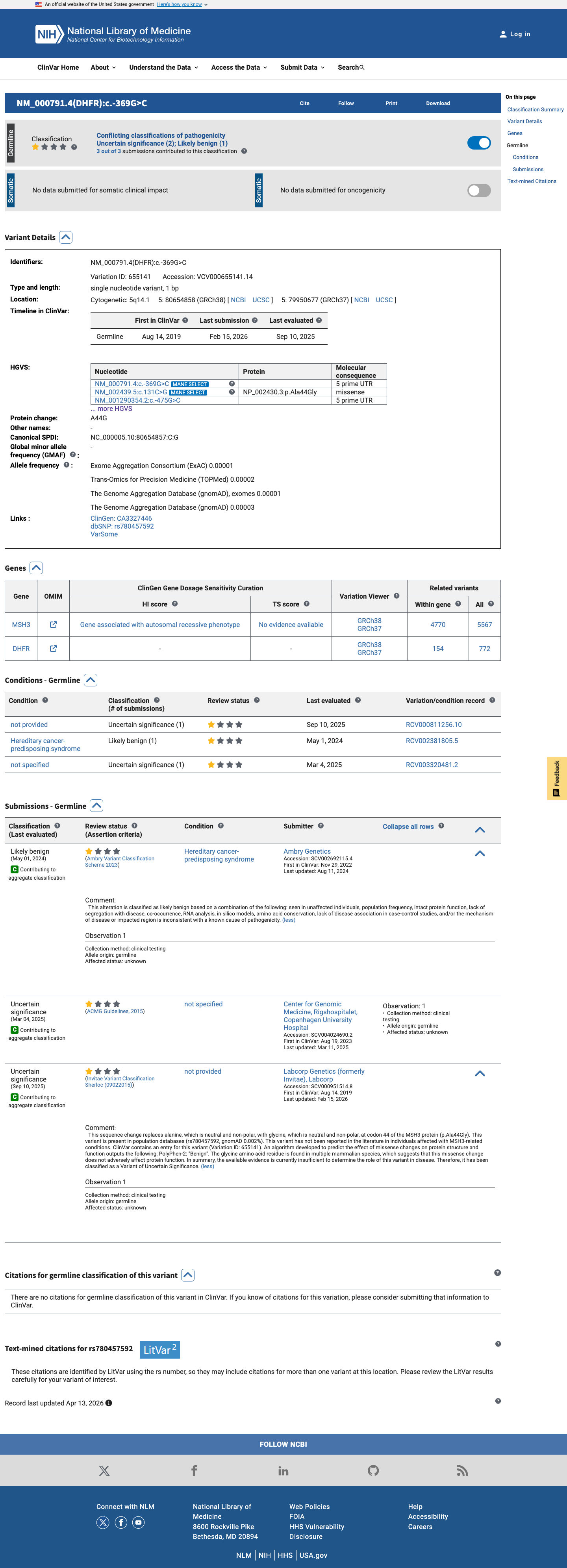
PP5 Not met: ClinVar shows 0 expert-panel submissions for the exact variant, with available laboratory assertions classified as uncertain significance or likely benign.
Benign
BA1 Not met: gnomAD v4.1 maximum reported subgroup AF is 1.02135e-05, far below the generic BA1 threshold of 0.05.
BS1 Not met: gnomAD v4.1 maximum reported subgroup AF is 1.02135e-05, below the generic BS1 threshold of 0.01.
BS2 Not met: gnomAD v2.1 and v4.1 report zero homozygotes for the variant, with no qualifying healthy-individual genotype observation.
BS3 Not assessed: no variant-specific validated assay demonstrated preserved MSH3 function for p.(Ala44Gly).
BS4 Not assessed: no informative unaffected relatives with documented negative familial testing are available to evaluate non-segregation.
BP1 Not assessed: MSH3 loss-of-function support alone does not prove that pathogenic variants are primarily truncating.
BP2 Not assessed: no individual-level cis/trans phase or pathogenic comparator allele is documented for the MSH3 c.131C>G variant.
BP5 Not assessed: no case-level alternative molecular diagnosis was documented for a patient carrying the exact variant.
BP6 Not met: the only Likely benign ClinVar assertion is an ordinary laboratory submission, and exact-variant expert-panel submissions number 0.
N/A · 4 PVS1 · PM4 · BP3 · BP7
Research & evidence
Population frequency
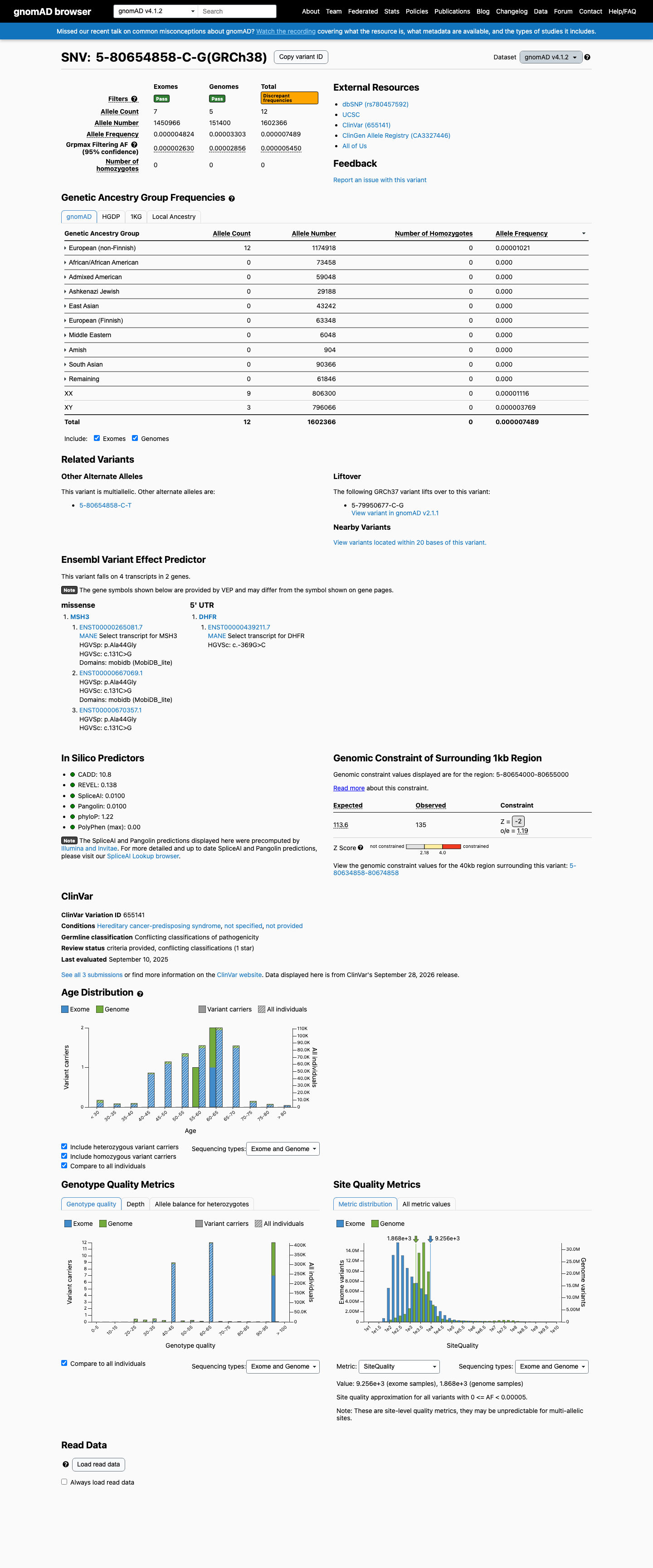
gnomAD v4.1 screenshot
gnomAD v4.1
gnomAD v2.1 screenshot
gnomAD v2.1
v4.1
This variant is present in gnomAD v4.1 (AF= 7.48893e-06; MAF= 0.00075%, 12/1602366 alleles, homozygotes = 0) and has highest observed frequency in the European (non-Finnish) population (AF= 1.02135e-05; MAF= 0.00102%, 12/1174918 alleles, homozygotes = 0); grpmax FAF= 5.45e-06.
v2.1
This variant is present in gnomAD v2.1 (AF= 8.90789e-06; MAF= 0.00089%, 2/224520 alleles, homozygotes = 0) and has highest observed frequency in the European (non-Finnish) population (AF= 1.96321e-05; MAF= 0.00196%, 2/101874 alleles, homozygotes = 0); grpmax FAF= 3.26e-06.
🇨🇦 CA
Not available in gnomAD-Canada v1.0.
Allele frequency by ancestry
three datasets · side by side
gnomAD v4.1
0.00075% · 12 / 1,602,366
0 hom · FAF 0.00055%
European (non-Finnish)
12 / 1,174,918
0.001%
+ 9 not observed (Remaining individuals, Admixed American, European (Finnish), Amish, East Asian, Middle Eastern, South Asian, Ashkenazi Jewish, African/African American)
gnomAD v2.1
0.00089% · 2 / 224,520
0 hom · FAF 0.00033%
European (non-Finnish)
2 / 101,874
0.002%
+ 7 not observed (African/African American, Admixed American, Ashkenazi Jewish, East Asian, European (Finnish), Remaining individuals, South Asian)
gnomAD Canada 🇨🇦
Absent · 0 / ?
0 hom
Not observed in any ancestry group.
ClinVar screenshot
ClinVar
This variant has been reported in ClinVar as Uncertain significance (2 clinical laboratories) and as Likely benign (1 clinical laboratory). (ClinVarID = 655141)
SpliceAI screenshot
In silico
SpliceAI predicts no significant splice impact for this variant (max delta score = 0.00). REVEL score = 0.138. BayesDel score = -0.377777.
Functional / OncoKB screenshot
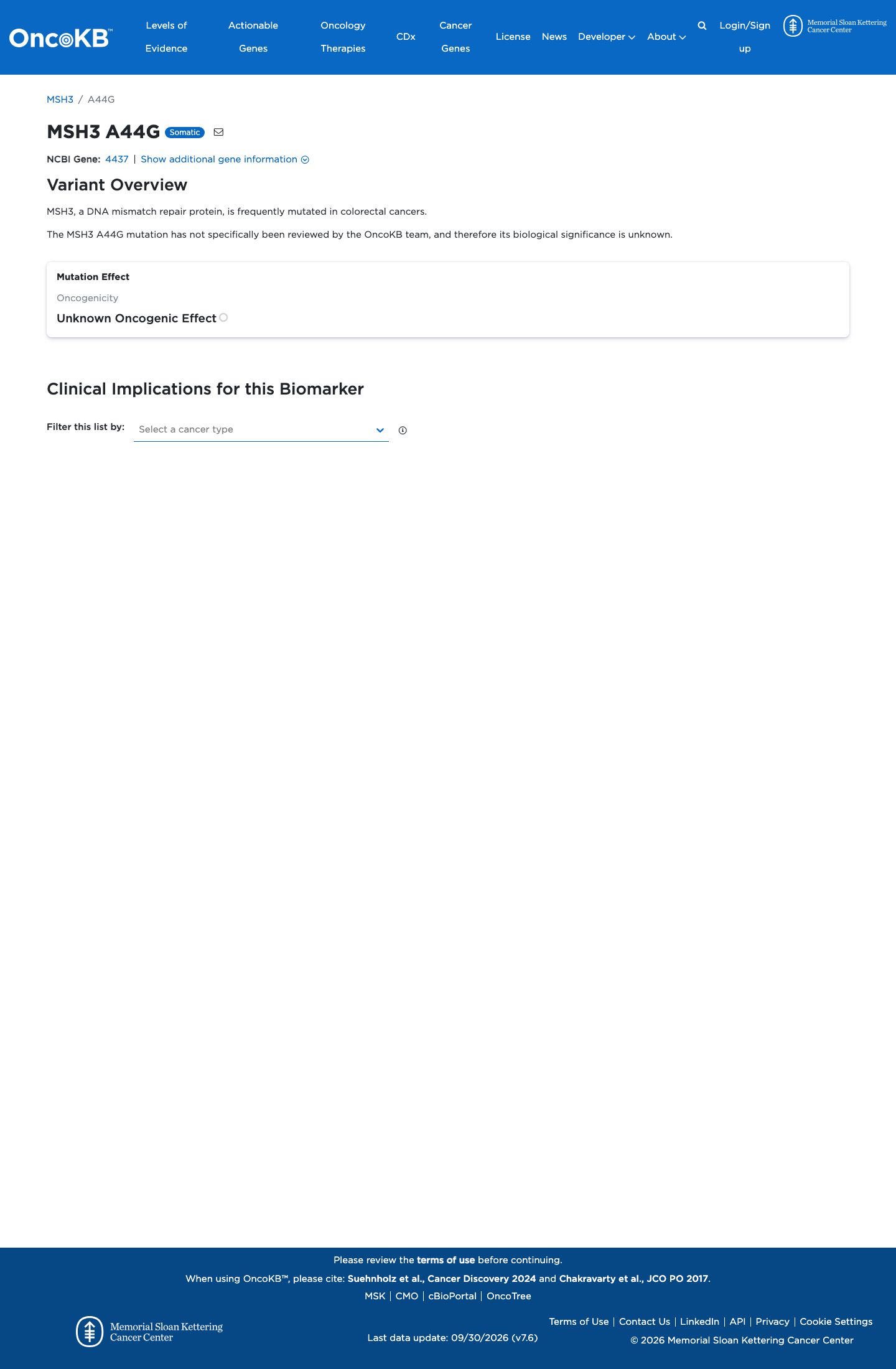
Functional Unknown Oncogenic Effect
OncoKB did not identify variant-specific reviewed functional evidence for this variant; gene-level curated context is available for reviewer follow-up. MSH3, a DNA mismatch repair protein, is frequently mutated in colorectal cancers.
OncoKB ↗
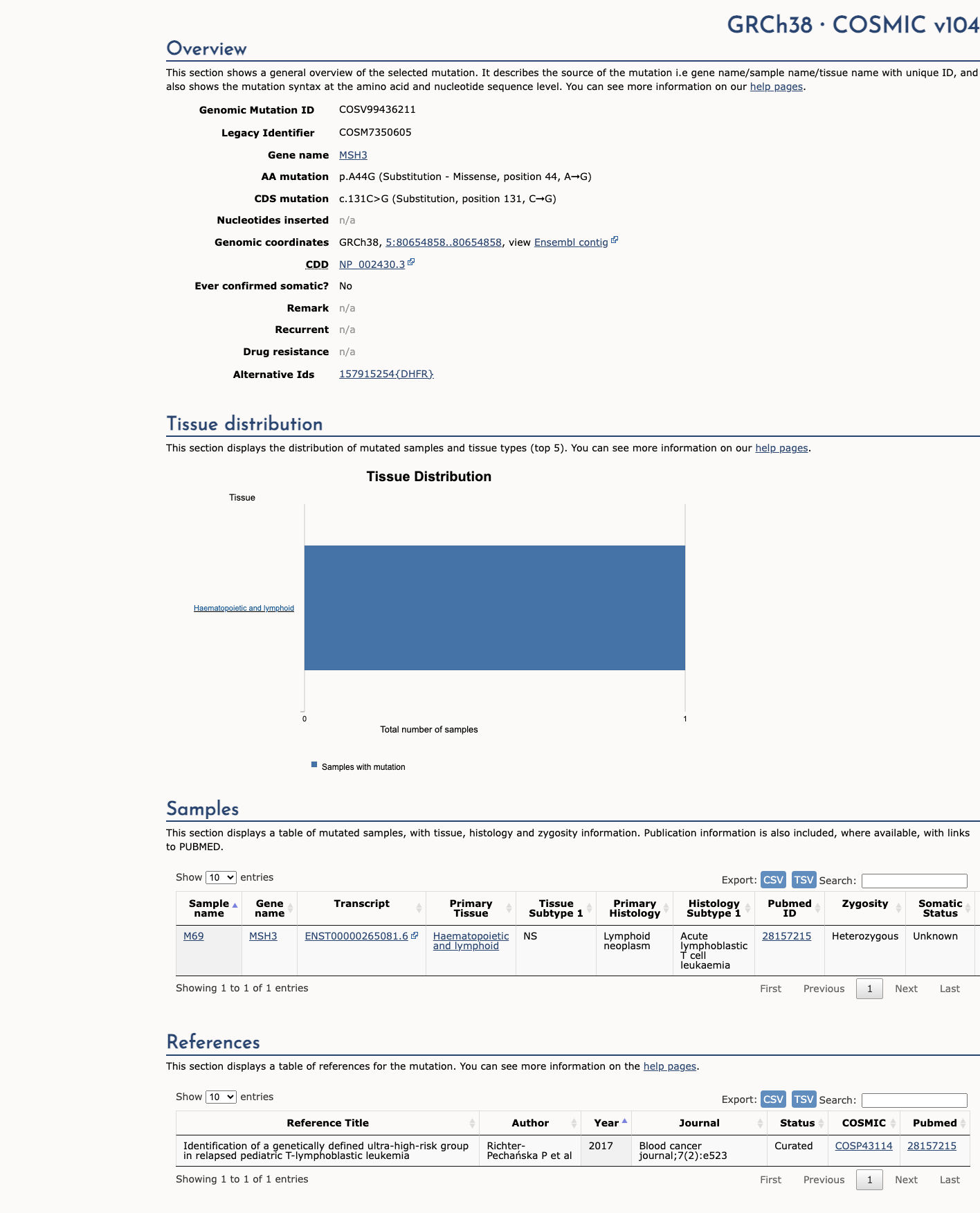
COSMIC screenshot
COSMIC
Cancer hotspots screenshot
Cancer hotspots
Somatic evidence Not in COSMIC / hotspots
COSMIC
This variant does not lie in a statistically significant hotspot. This variant has previously been reported in somatic cancers (COSMIC; COSV99436211, n = 1 times).
Hotspots
This variant does not lie in a statistically significant hotspot.
Literature · how each cited paper was used
1papers cited
Each card is an audit: what was searched, what was found, whether it names the variant, which criteria it fed, and why. 2 further PMIDs triaged but not cited — see Sources & references.
Rule & framework references · cited for criterion definitions, not variant evidence
25741868 ↗ Standards and guidelines for the interpretation of sequence variants: a joint consensus recommendation of the American College of Medical Genetics and Genomics and the Association for Molecular Pathology.
Sources & reference links
8Sources
ClinVar
gnomAD v2.1
gnomAD v4.1
gnomAD-Canada
SpliceAI
OncoKB
COSMIC
Cancer hotspots
Triaged references · 2 PMIDs not cited in assessment
25394175 ↗ A practice guideline from the American College of Medical Genetics and Genomics and the National Society of Genetic Counselors: referral indications for cancer predisposition assessment. CLINVAR
28492532 ↗ Sherloc: a comprehensive refinement of the ACMG-AMP variant classification criteria. CLINVAR