Back
NM_002439.5:c.1567G>A
p.Glu523Lys · MSH3
ACMG/AMP
0%
complete
Final classification
Likely Benign
BS1BP1BP4
MSH3
c.1567G>A
p.Glu523Lys
missense · exon 10

MSH3 encodes a protein that partners with MSH2 to form MutS beta, a key component of the DNA mismatch repair system that recognizes and corrects errors made during DNA replication. It acts as a tumor suppressor: loss of MSH3 function leads to mismatch repair deficiency, an elevated mutation rate, and increased cancer risk, and the gene is frequently altered in mismatch repair-deficient colorectal cancers. Defects in MSH3 are linked to susceptibility to endometrial cancer, and inherited mutations are associated with an autosomal recessive form of familial adenomatous polyposis, with minimal evidence for a role in Lynch syndrome. Tumors with mismatch repair deficiency, including those involving MSH3, tend to respond well to immune checkpoint inhibitor therapies.

This variant

MSH3 encodes the MutS-beta mismatch-repair partner of MSH2, and germline MSH3 disease is an autosomal recessive, loss-of-function-driven attenuated adenomatous polyposis, so this heterozygous missense change is not expected to act through the gene's established biallelic truncating mechanism, although MSH3-related mismatch-repair deficiency remains clinically relevant for colorectal and endometrial cancer risk and for immune checkpoint inhibitor response.

Transcript
NM_002439.5
HGVS · transcript:coding
NM_002439.5:c.1567G>A
GRCh38
chr5:80728964 G>A
GRCh37
chr5:80024783 G>A
Likely Benign: BS1 (strong) at 2.67% African/African American gnomAD frequency plus BP1 and BP4 (supporting) meet the generic ACMG/AMP 2015 Likely Benign rule.
Classification rationale
BS1BP1BP4 Likely Benign
MSH3 c.1567G>A missense · exon 10

Likely Benign: BS1 (strong) is met at 2.67% African/African American gnomAD frequency, about 2.5-fold above the generic 1% threshold, with 7 and 24-25 homozygotes across two gnomAD releases. Likely Benign: BP1 (supporting) is met because MSH3 disease is driven by truncating loss-of-function alleles (ClinVar: 319 frameshift and 161 nonsense versus one missense pathogenic record). Likely Benign: BP4 (supporting) is met because REVEL 0.228 is at or below the 0.29 missense BP4 cutoff, indicating a tolerated amino-acid substitution. Benign drivers: BS1 (strong) plus BP1 and BP4 (supporting) satisfy the generic ACMG/AMP 2015 Likely Benign combination, with no pathogenic criterion met.

BS1 + BP1 + BP4 → Likely Benign
LYFE Sciences is an AI system, and it can make mistakes. Criteria may be applied incorrectly, sources may be misread, and a confident-looking classification can still be wrong. Double-check every criterion and its underlying evidence before relying on any call.
Gene diagram · NM_002439.5 · variants mapped to exon structure
MSH3 NM_002439.5
Fetching transcript structure from UCSC…
Applied criteria · 3 applied · 21 assessed
MetEvidence satisfies this criterion.
Not metEvaluated against available evidence; threshold not reached.
Not assessedApplies in principle, but no evidence was found to evaluate it.
N/ADoesn't apply to this variant type.
Applied · 3
Strength Supporting Moderate Strong Very strong
BS1 strong Benign
Met (strong): African/African American frequency 2.67% (655/24,526 alleles, gnomAD v2.1) exceeds the 1% generic BS1 threshold.
gnomAD v2.1: total AF 0.00254891 (716/280,904 alleles, 7 homozygotes); African/African American AF 0.0267064 = 2.67064% (655/24,526 alleles, 7 homozygotes); grpmax FAF 0.025364.gnomAD v4.1: total AF 0.0013872 (2,131/1,536,188 alleles, 25 homozygotes); African/African American AF 0.0254492 = 2.54492% (1,864/73,244 alleles, 24 homozygotes); grpmax FAF 0.0244867.BS1 threshold 0.01 (1%) taken verbatim from the supplied published calibration (generic SVI default; per-gene derivation preferred, credited to Whiffin et al. 2017, PMID:28518168). The variant exceeds it on the ancestry-maximum frequency in both gnomAD releases.
BP1 supporting Benign
Met at supporting: MSH3 disease is driven by truncating loss-of-function alleles, with ClinVar showing 480 frameshift/nonsense versus one missense pathogenic record.
BP1 is a gene-level mechanism criterion: it asks whether truncating variants are the primary cause of disease in MSH3. It was not inferred from this variant's ClinVar classification; the ClinVar data used here are the gene-level spectrum of MSH3 variants classified pathogenic.pvs1_gene_context.json: germline_disease_context_found = true, lof_mechanism_supported = true, pvs1_gene_gate = 'eligible', mechanism_rationale stating that a targeted germline literature review identified disease-focused publications supporting MSH3 loss of function as a germline disease mechanism; supporting gene-level sources include PMID:37402566 ('MSH3: a confirmed predisposing gene for adenomatous polyposis', J Med Genet 2023), and its caution is that no official CSPEC/VCEP or local explicit PVS1 framework was available.Gene-level literature context (gene-level mechanism only; the variant p.Glu523Lys is not mentioned in these papers, so they are recorded as gene-level context rather than variant-level citations, and PMID:27476653 is not a source_registry key for this case): Adam et al. 2016, Am J Hum Genet (PMID:27476653) found two unrelated individuals with compound-heterozygous loss-of-function MSH3 germline mutations (c.1148delA, c.2319-1G>A, c.2760delC, c.3001-2A>C) with EMAST and complete loss of nuclear MSH3 protein, establishing a recessive subtype of colorectal adenomatous polyposis; Villy et al. 2023 (PMID:37402566) confirms biallelic MSH3 pathogenic variants with EMAST in MSH3-associated polyposis.
BP4 supporting Benign
Met at supporting strength: REVEL 0.228 is at or below the <=0.29 supporting BP4 threshold for this missense variant.
Variant scope: NM_002439.5:c.1567G>A is a missense substitution (NP_002430.3:p.(Glu523Lys), VEP most_severe_consequence = missense_variant), so BP4 is taken from the REVEL missense path; SpliceAI is not used as BP4 support for a missense variant.No MSH3 CSPEC/VCEP specification or gene-specific PP3/BP4 lookup spreadsheet exists for this case (cspec found = false, gene_vcep_dir = null, framework_mode = generic_acmg), so generic ClinGen SVI REVEL calibration applies.Local REVEL v1.3 lookup returned 0.228 for this variant (chr5:80728964 G>A, GRCh38).
Assessed · not applied · 16 not met · 5 not assessed
Pathogenic
PS1 Not met: no established pathogenic variant carries p.Glu523Lys, and the only variant with this amino-acid change (ClinVar VCV000780543) is classified Benign/Likely benign by 15 submitters.
PS2 Not assessed: no proband, parental testing, or pedigree data were provided, so a confirmed de novo occurrence in an affected patient could not be evaluated.
PS3 Not met: no functional assay of MSH3 p.(Glu523Lys) exists; the sole paper reporting it gives no functional data.
PS4 Not met: no case-control enrichment exists for c.1567G>A, which is instead common in gnomAD (popmax 2.5% African/African American).
PM1 Not met: MSH3 E523 is not a significant hotspot (CancerHotspots: no result), lies outside any annotated functional domain, and carries gnomAD v4.1 AF 0.139% with 25 homozygotes.
PM2 Not met: gnomAD v4.1 allele frequency 0.0013872 (2,131/1,536,188 alleles) is about 14-fold above the 0.0001 PM2 supporting threshold.
PM3 Not met: no case pairs this allele in trans with a pathogenic MSH3 variant, and the only reported carrier (tumour NGS, case IBC15) has undetermined phase.
PM5 Not met: residue 523 has no established pathogenic missense, only p.Glu523Val as uncertain significance (single submitter) in ClinVar.
PM6 Not assessed: the record contains no parental or proband data suggesting an assumed de novo occurrence, so PM6 cannot be evaluated.
PP1 Not assessed: no pedigree, affected relatives, or co-segregation data were available for this variant in MSH3.
PP2 Not met: MSH3 tolerates missense variation (gnomAD oe_mis 1.083, mis_z -1.295) and ClinVar pathogenic MSH3 records are 480 truncating versus one missense.
PP3 Not met: REVEL 0.228 is far below the >=0.644 supporting PP3 threshold for this missense variant.
PP4 Not assessed: no proband phenotype, HPO terms, or family history is available to test phenotype specificity.
PP5 Not met: ClinVar VCV000780543 has zero expert-panel submissions and only 2-star laboratory-level review for c.1567G>A.
Benign
BA1 Not met: the highest ancestry-specific frequency, 2.67% in gnomAD v2.1 African/African American, stays below the 5% BA1 stand-alone threshold.
BS2 Not met: 24 gnomAD v4.1 homozygotes are not verifiable as unaffected adults for an adult-onset, incompletely penetrant recessive disorder, as BS2 requires.
BS3 Not met: no functional study shows a non-damaging effect for MSH3 p.(Glu523Lys); no assay of this variant was identified.
BS4 Not assessed: no family or segregation data were available to test for non-segregation of this variant with disease.
BP2 Not met: no pathogenic MSH3 variant is documented in cis or in trans with c.1567G>A, and MSH3 disease is recessive rather than fully penetrant dominant.
BP5 Not met: no case is documented in which c.1567G>A was found alongside an established alternate molecular basis for disease.
BP6 Not met: the Benign/Likely benign ClinVar label is an aggregate of non-expert laboratory submissions, not an expert-panel assertion.
N/A · 4 PVS1 · PM4 · BP3 · BP7
Research & evidence
Population frequency · supports benign
gnomAD v4.1 screenshot
gnomAD v4.1
gnomAD v2.1 screenshot
gnomAD v2.1
v4.1
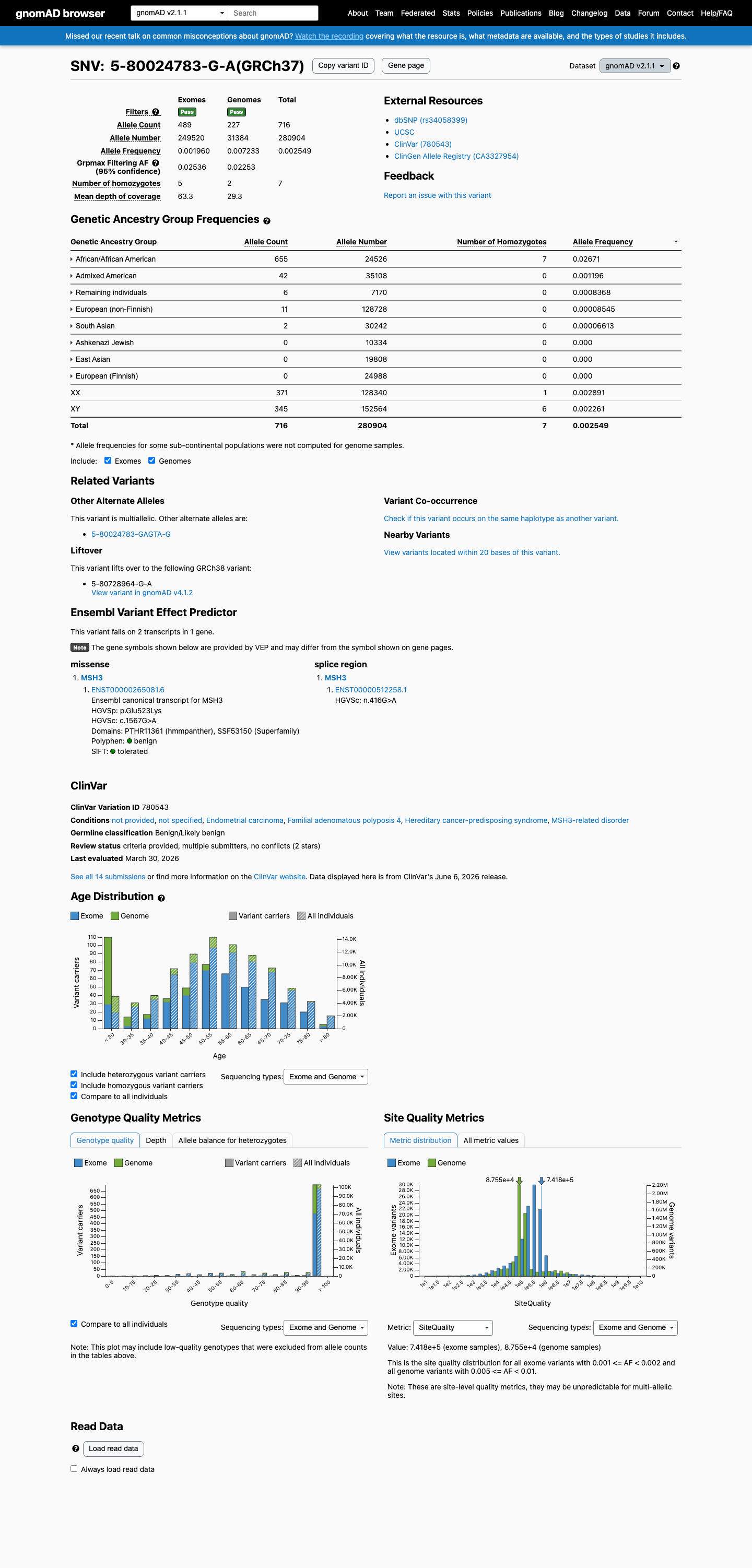
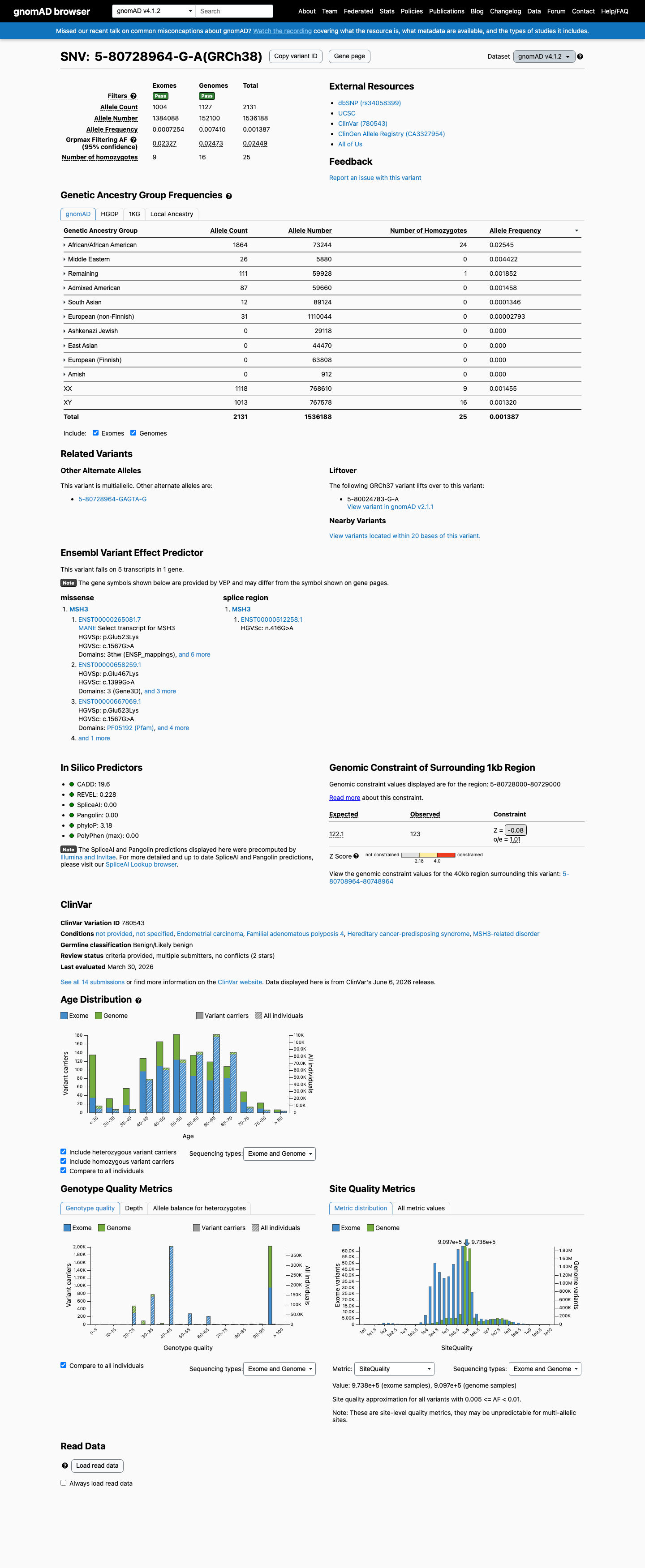
This variant is present in gnomAD v4.1 (AF= 0.0013872; MAF= 0.13872%, 2131/1536188 alleles, homozygotes = 25) and has highest observed frequency in the African/African American population (AF= 0.0254492; MAF= 2.54492%, 1864/73244 alleles, homozygotes = 24); grpmax FAF= 0.0244867.
v2.1
This variant is present in gnomAD v2.1 (AF= 0.00254891; MAF= 0.25489%, 716/280904 alleles, homozygotes = 7) and has highest observed frequency in the African/African American population (AF= 0.0267064; MAF= 2.67064%, 655/24526 alleles, homozygotes = 7); grpmax FAF= 0.025364.
🇨🇦 CA
This variant is present in gnomAD-Canada v1.0 (AF= 0.0018458197611292075, 34/18420 alleles, homozygotes = 0).
Allele frequency by ancestry
three datasets · side by side
gnomAD v4.1
0.14% · 2131 / 1,536,188
25 hom · FAF 2.4%
African/African American
1864 / 73,244
2.5%
24 hom
Middle Eastern
26 / 5,880
0.44%
Remaining individuals
111 / 59,928
0.19%
1 hom
Admixed American
87 / 59,660
0.15%
South Asian
12 / 89,124
0.013%
European (non-Finnish)
31 / 1,110,044
0.0028%
+ 4 not observed (European (Finnish), Amish, East Asian, Ashkenazi Jewish)
gnomAD v2.1
0.25% · 716 / 280,904
7 hom · FAF 2.5%
African/African American
655 / 24,526
2.7%
7 hom
Admixed American
42 / 35,108
0.12%
Remaining individuals
6 / 7,170
0.084%
European (non-Finnish)
11 / 128,728
0.0085%
South Asian
2 / 30,242
0.0066%
+ 3 not observed (Ashkenazi Jewish, East Asian, European (Finnish))
gnomAD Canada 🇨🇦
0.18% · 34 / 18,420
0 hom · FAF 1.9%
African/African American
27 / 1,020
2.6%
Latino/Admixed American
3 / 838
0.36%
Remaining individuals
3 / 1,138
0.26%
European (non-Finnish)
1 / 11,740
0.0085%
+ 5 not observed (Ashkenazi Jewish, East Asian, European (Finnish), Middle Eastern, South Asian)
ClinVar screenshot
ClinVar
This variant has been reported in ClinVar as Likely benign (8 clinical laboratories) and as Benign (4 clinical laboratories) and as Uncertain significance (1 clinical laboratory) and as benign (1 clinical laboratory). (ClinVarID = 780543)
SpliceAI screenshot
In silico
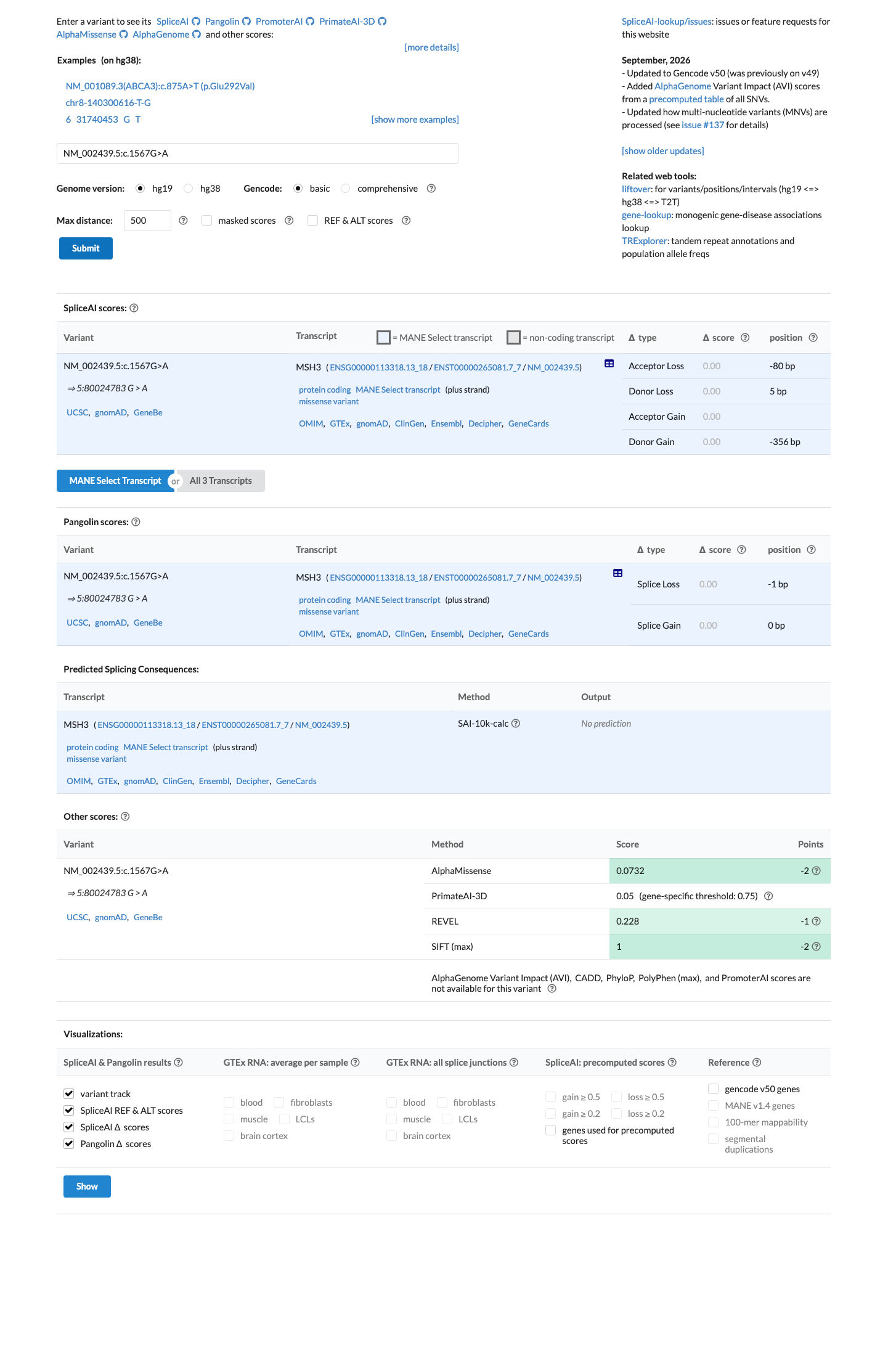
SpliceAI predicts no significant splice impact for this variant (max delta score = 0.00). REVEL score = 0.228. BayesDel score = -0.40543.
Functional / OncoKB screenshot
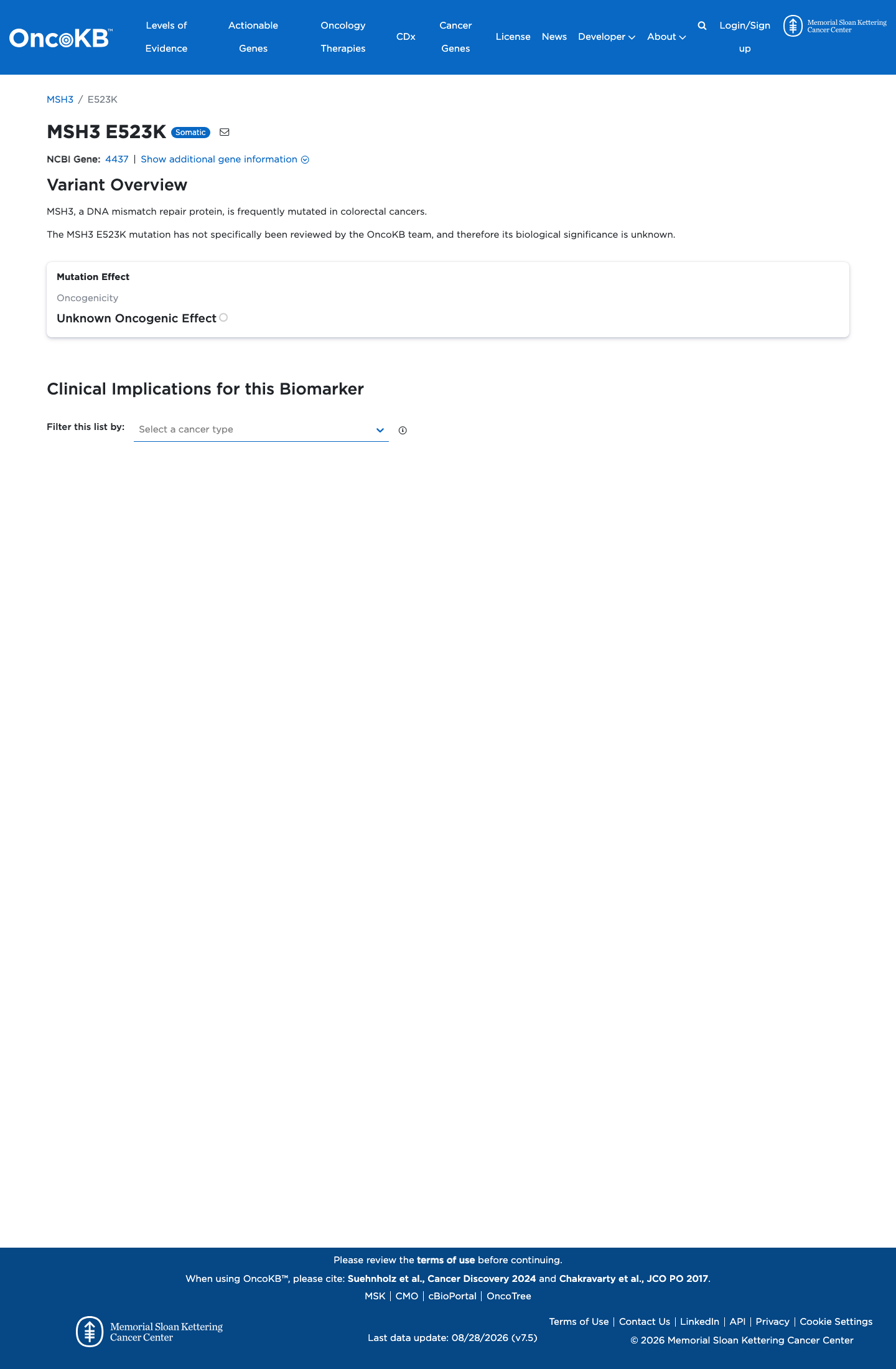
Functional Unknown Oncogenic Effect
OncoKB did not identify variant-specific reviewed functional evidence for this variant; gene-level curated context is available for reviewer follow-up. MSH3, a DNA mismatch repair protein, is frequently mutated in colorectal cancers.
OncoKB ↗
COSMIC screenshot
COSMIC
Cancer hotspots screenshot
Cancer hotspots
Somatic evidence Not in COSMIC / hotspots
COSMIC
This variant does not lie in a statistically significant hotspot. This variant has not previously been reported in somatic cancers (COSMIC).
Hotspots
This variant does not lie in a statistically significant hotspot.
Literature · how each cited paper was used
4papers cited
Each card is an audit: what was searched, what was found, whether it names the variant, which criteria it fed, and why.
Inflammatory Breast Cancer: Clinical Implications of Genomic Alterations and Mut
Searched
c.1567G>Ac.1567G > Ap.(E523K)p.Glu523LysNP_002430.3:p.(E523K)
Found
This paper reports the exact MSH3 c.1567G>A (p.Glu523Lys) variant in a case of inflammatory breast cancer (IBC). It was detected in case IBC15 by targeted next-generation sequencing and is annotated as a potentially germline variant (PG, VAF <0.5); the same IBC15 sample also carried a second MSH3 variant (c.1571A>C; p.Asn524Thr, also PG). No functional assay, segregation, or population-frequency data for this variant is provided, and the variant is not asserted to be pathogenic. For this group the report is relevant in two ways: it is the only retrieved source that documents this exact variant (so it cannot establish a pathogenic same-amino-acid-change precedent for PS1), and the second change in the same sample lies at residue 524, not 523, so it is not a same-residue comparator for PM5. At gene level the study reports MSH3 among the MMR genes mutated in its IBC cases (8/21 cases had variants in at least one MMR gene) and states MSH3 variant frequency was higher in its IBC cohort than in TCGA non-IBC stages III-IV; MMR-gene variants overall were associated with worse overall survival (p = 0.0076) and with the HRD-LOH score (p = 0.0117).
Variant
✓ Names this variant — characterised directly
Applied to
→BP4 supporting
MSH3 (c.1567G > A; p.Glu523Lys) PG
Location Table 2 (Genetic variants found in TP53, PIK3CA, homologous recombination (HR), and mismatch repair (MMR) genes detected in 21 inflammatory breast carcinomas assessed by tNGS), case IBC15, MMR Genes column  ·  Context Targeted next-generation sequencing (tNGS) panel of 105 cancer-related genes performed on 21 treatment-naive inflammatory breast cancer (IBC) biopsies (part of a 34-patient IBC cohort); variant detected in case IBC15. 'PG' denotes potentially germline variant (VAF <0.5).  ·  full text
Rule & framework references · cited for criterion definitions, not variant evidence
25741868 ↗ Standards and guidelines for the interpretation of sequence variants: a joint co
26467025 ↗ A Standardized DNA Variant Scoring System for Pathogenicity Assessments in Mende
28492532 ↗ Sherloc: a comprehensive refinement of the ACMG-AMP variant classification crite
Sources & reference links
8Sources
ClinVar
gnomAD v2.1
gnomAD v4.1
gnomAD-Canada
SpliceAI
OncoKB
COSMIC
Cancer hotspots