Analysis in progress
Initialising…
0%
complete
This report is still being assembled — sections appear as each stage finishes. It isn't final yet.
MYC
Final classification
VUS
PM1PM2PP3
MYC
c.221C>G
p.Pro74Arg
missense · exon 2

MYC is a proto-oncogene that encodes a transcription factor central to cell cycle progression, apoptosis, and cellular transformation. It carries out its role by pairing with the protein MAX, and this complex regulates the expression of thousands of target genes. MYC is a well-established driver of cancer: the gene is frequently amplified in many human cancers, and its activity promotes tumor growth by driving cell proliferation, preventing cells from exiting the cell cycle, stimulating blood vessel formation, and enhancing genomic instability. Translocations involving MYC are also associated with Burkitt lymphoma and multiple myeloma.

This variant

MYC is a cancer driver whose amplification and translocations mark many tumors, and p.Pro74Arg sits in its N-terminal transactivation region, a somatic hotspot near the T58/S62 phosphodegron. Germline evidence, however, is limited to population rarity and a supporting computational prediction, so this variant remains of uncertain significance.

Transcript
NM_002467.6
HGVS · transcript:coding
NM_002467.6:c.221C>G
GRCh38
chr8:127738438 C>G
GRCh37
chr8:128750684 C>G
Basis Uncertain Significance (VUS): 1 moderate (PM2) and 2 supporting (PM1, PP3) criteria meet no Pathogenic or Benign combination rule under the generic ACMG/AMP 2015 framework.
Uncertain Significance (VUS): 1 moderate (PM2) and 2 supporting (PM1, PP3) criteria meet no Pathogenic or Benign combination rule under the generic ACMG/AMP 2015 framework.
Classification rationale
PM1PM2PP3 VUS
MYC c.221C>G missense · exon 2

PM1 (Supporting): curated 'Likely Oncogenic' change at residue 74, a recurrent hotspot in the MYC N-terminal transactivation region near the T58/S62 phosphodegron. PM2 (Moderate): absent from gnomAD v2.1, v4.1, and gnomAD-Canada, indicating rarity in reference populations. PP3 (Supporting): REVEL 0.721 falls in the PP3-supporting band (0.644-0.773), predicting a damaging missense effect. Overall: VUS — 1 moderate + 2 supporting criteria meet no Pathogenic, Likely Pathogenic, Benign, or Likely Benign combination rule.

PM1 + PM2 + PP3 VUS
Gene diagram · NM_002467.6 · variants mapped to exon structure
MYC NM_002467.6
Fetching transcript structure from UCSC…
Applied criteria · 3 applied · 21 assessed
MetEvidence satisfies this criterion.
Not metEvaluated against available evidence; threshold not reached.
Not assessedApplies in principle, but no evidence was found to evaluate it.
N/ADoesn't apply to this variant type.
Applied · 3
Strength Supporting Moderate Strong Very strong
PM1 supporting review Pathogenic
Met (Supporting): OncoKB curation flags p.Pro74Arg as likely oncogenic, a recurrent change in the MYC N-terminal transactivation region near the T58/S62 phosphodegron hotspot.
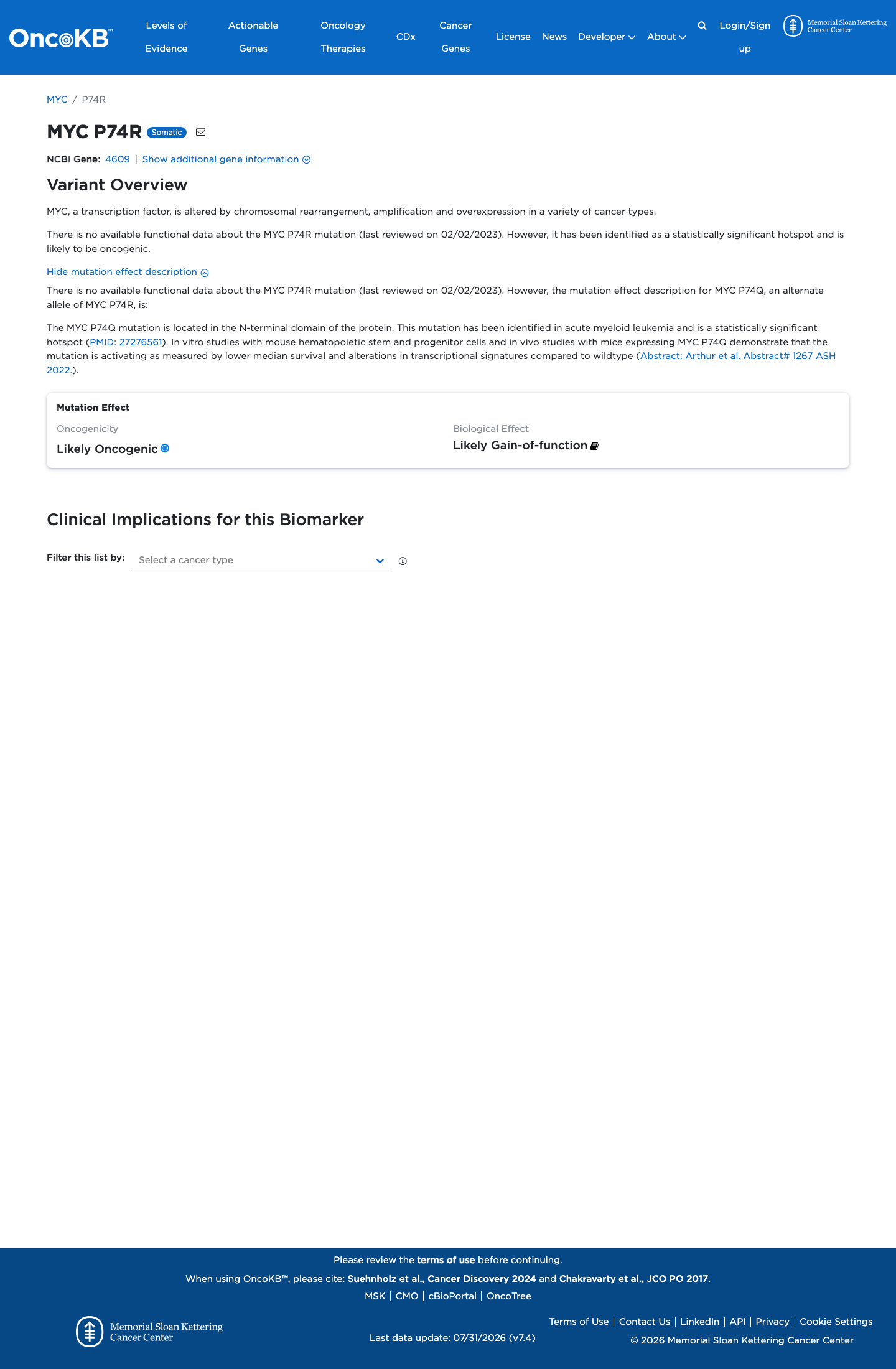
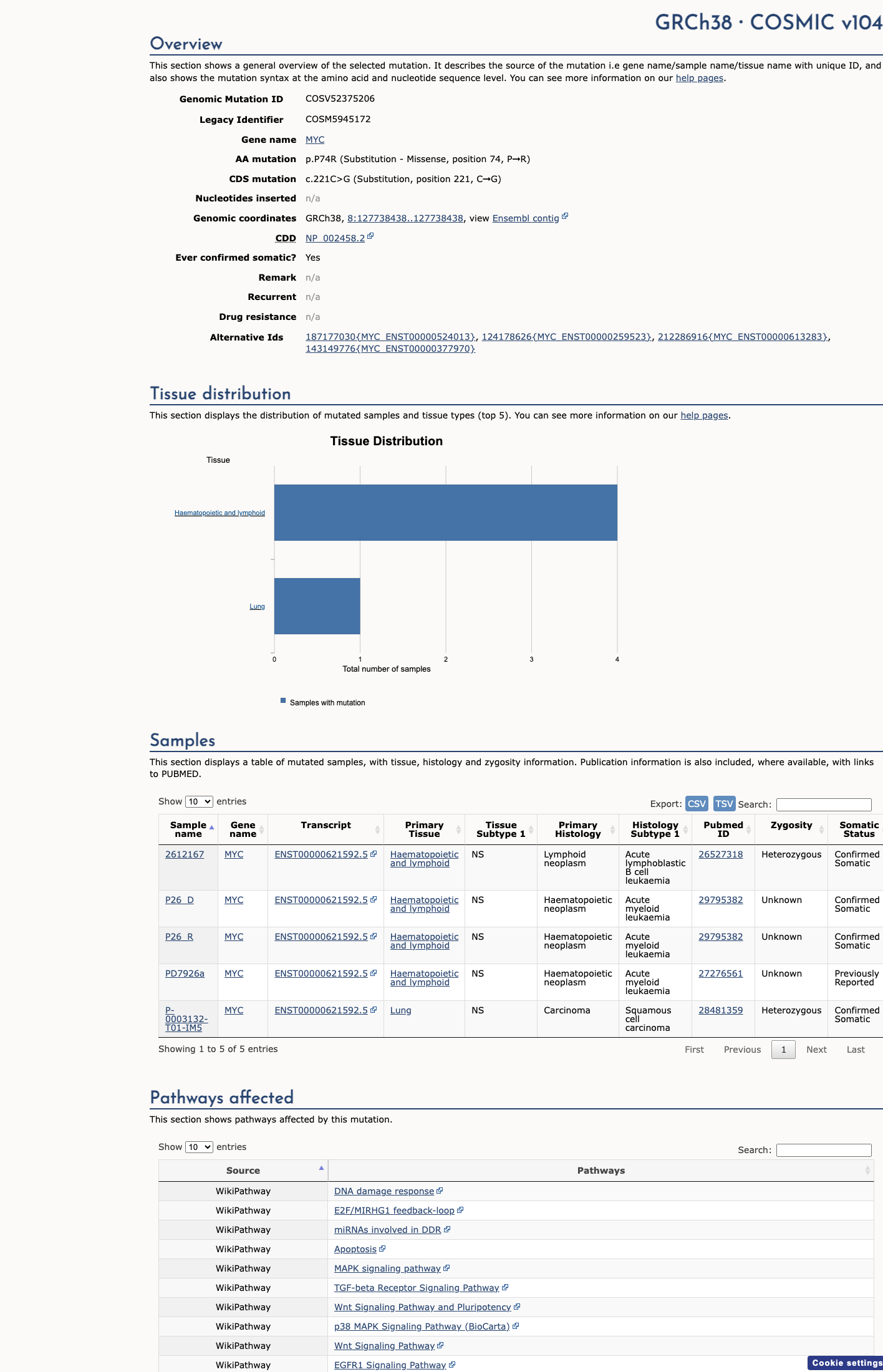
OncoKB variant-specific page for MYC P74R (https://www.oncokb.org/gene/MYC/P74R) reports classification 'Likely Oncogenic' and biological_effect 'Likely Gain-of-function', explicitly is_variant_specific=true (not a gene-level summary).Case evidence.json (not independently citable) additionally records cancerhotspots.org flagging P74 as 'a statistically significant hotspot' and COSMIC recording 5 somatic occurrences of this exact change (COSV52375206) — used only as corroborating context, not as a formal evidence_ref.
PM2 moderate review Pathogenic
Met (Moderate): absent from gnomAD v2.1, v4.1, and gnomAD-Canada, supporting rarity in reference populations.
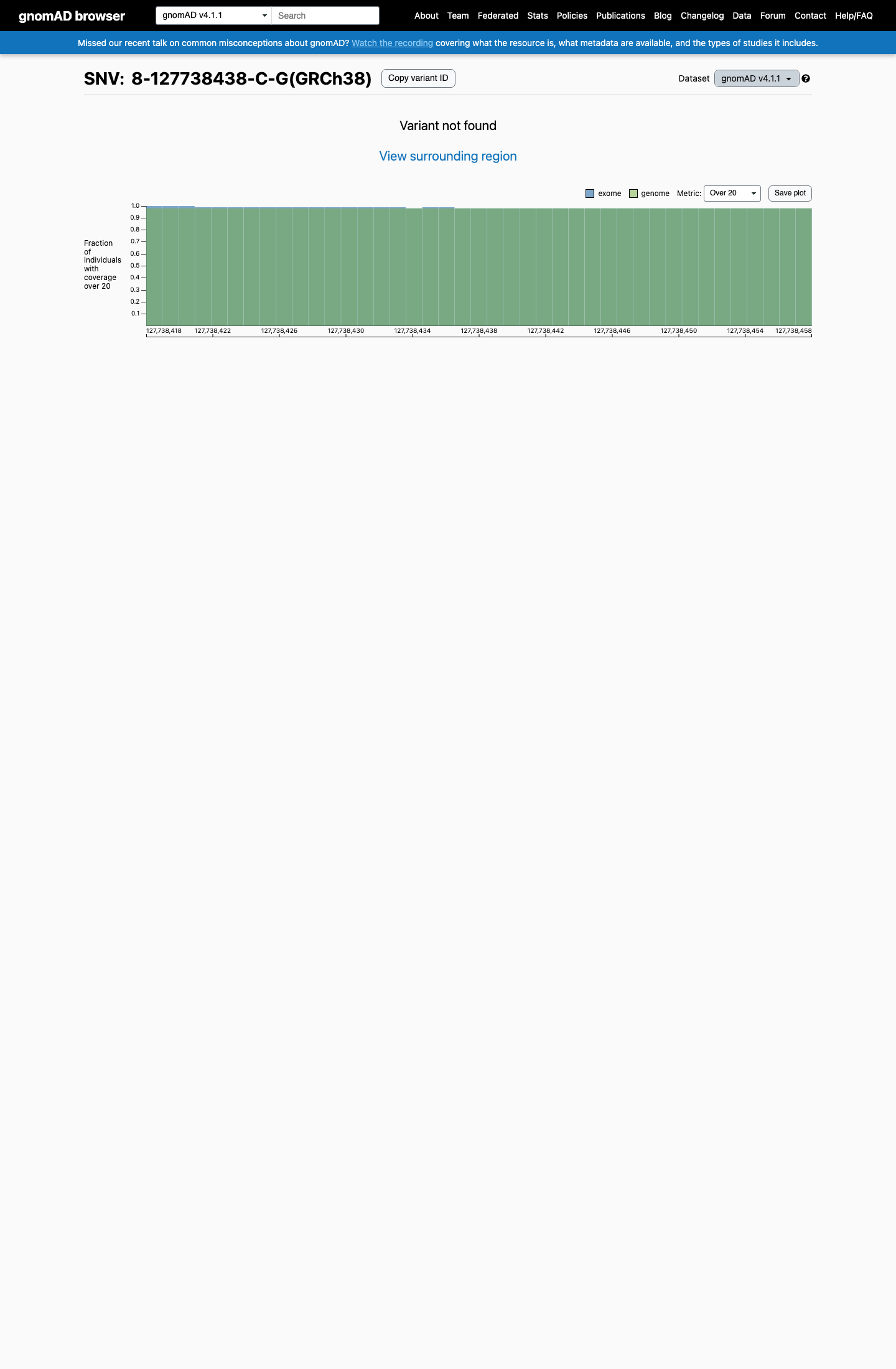
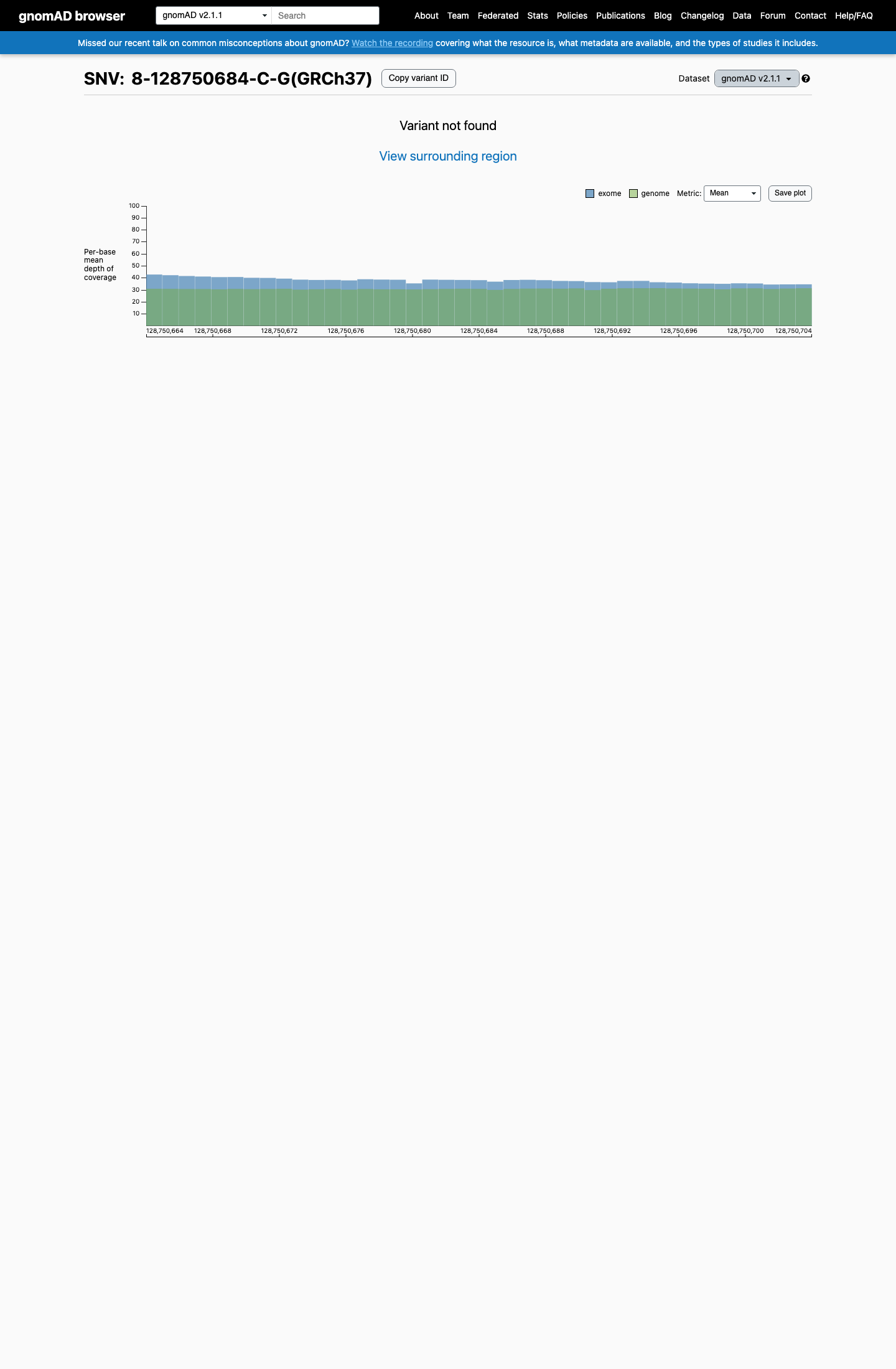
The case bundle reports the exact variant as absent from gnomAD v2.1.The case bundle reports the exact variant as absent from gnomAD v4.1.The case bundle reports the exact variant as absent from gnomAD-Canada v1.0.
PP3 supporting Pathogenic
Met (Supporting): REVEL 0.721 falls in the calibrated PP3-supporting band (0.644-0.773), predicting a damaging missense effect.
REVEL score = 0.721 for NM_002467.6:c.221C>G (local REVEL v1.3 lookup), which falls in the PP3_Supporting range (>=0.644, <0.773) of the ClinGen SVI-recommended calibrated REVEL thresholds published by Pejaver et al. 2022 (PMID 36413997).SpliceAI max delta score = 0.00 (pangolin_SG=0.002, pangolin_SL=-0.004) indicates no predicted splice-altering effect, consistent with the variant acting through a missense mechanism rather than splicing; this observation was not separately counted toward PP3/BP4/BP7 to avoid double counting.No ClinGen MYC VCEP-specific PP3/BP4 lookup table was found (cspec.found=false; vcep_materials.summaries empty), so the generic ACMG/AMP REVEL-based approach was applied.
Assessed · not applied · 4 not met · 17 not assessed
Pathogenic
PS1 Not assessed: no previously classified pathogenic variant producing the identical p.Pro74Arg change was available.
PS2 Not assessed: no parental testing or pedigree evidence of confirmed de novo occurrence was available.
PS3 Not assessed: no validated functional assay data for p.Pro74Arg were available; OncoKB's label is curation, not assay evidence.
PS4 Not assessed: no affected-proband counts or case-control enrichment data were identified.
PM3 Not assessed: no affected-proband observations or evidence of a pathogenic variant in trans were available.
PM5 Not assessed: no different missense change at codon 74 previously established as pathogenic was available.
PM6 Not assessed: no case-level evidence of suspected de novo occurrence without confirmed parentage was available.
PP1 Not assessed: no familial segregation data for this variant were available.
PP2 Not assessed: no MYC missense-constraint metric and no established germline missense disease mechanism.
PP4 Not assessed: no patient phenotype or phenotype-to-gene specificity information was provided.
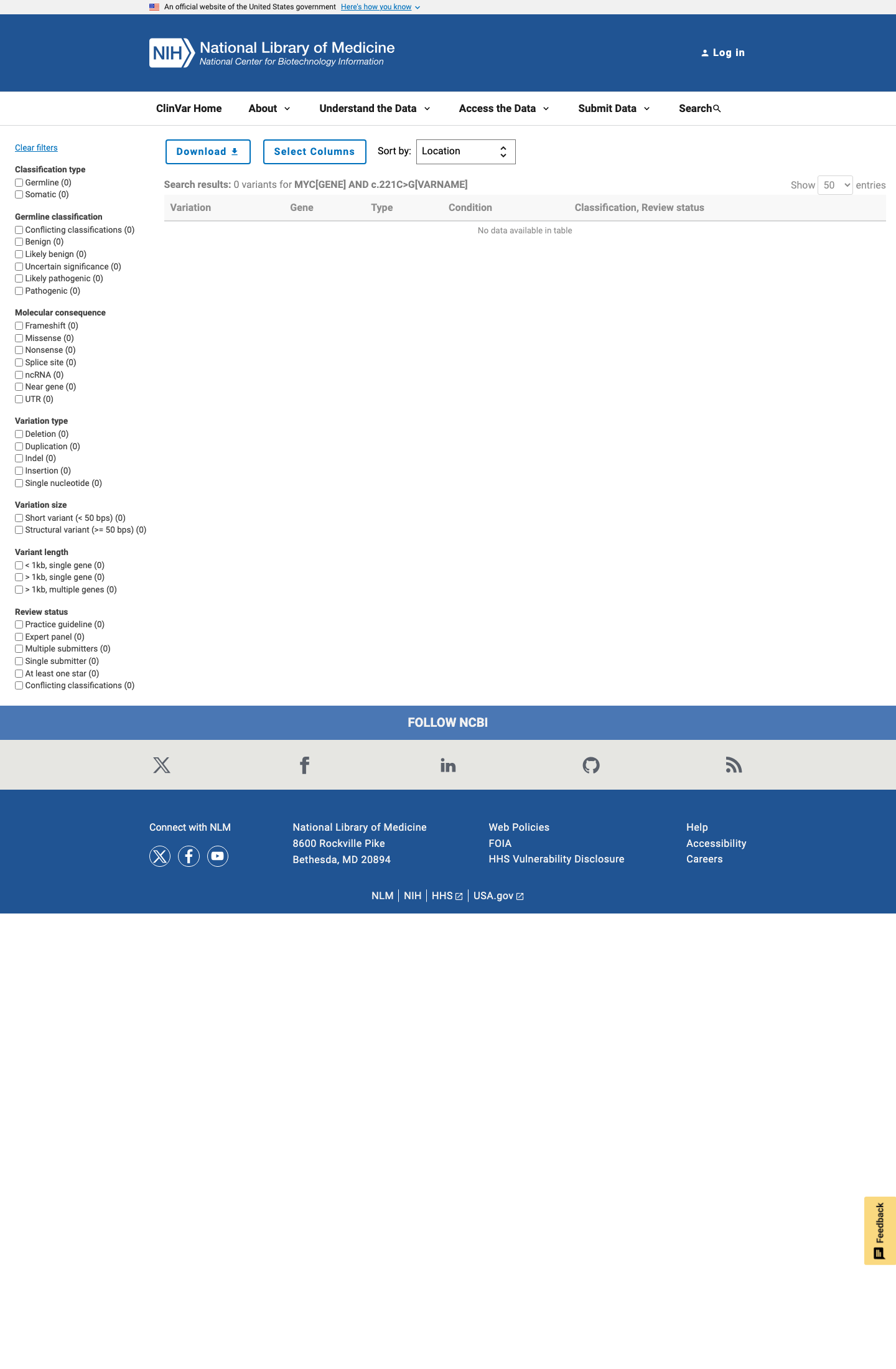
PP5 Not assessed: variant is absent from ClinVar, so no expert-panel pathogenic assertion exists.
Benign
BA1 Not met: variant is absent from gnomAD v2.1, v4.1, and gnomAD-Canada, far below the >1% stand-alone benign threshold.
BS1 Not met: no allele frequency was observed in population databases, so no benign frequency threshold is approached.
BS2 Not assessed: no healthy adult homozygotes or unaffected carriers were observed in population datasets.
BS3 Not assessed: no functional assay data showing normal or wild-type-like behavior for p.Pro74Arg were available.
BS4 Not assessed: no non-segregation evidence from tested unaffected relatives was available.
BP1 Not met: the curated 'Likely Oncogenic' gain-of-function status is inconsistent with a gene whose missense variants are generally benign.
BP2 Not assessed: no evidence of a pathogenic variant in trans or cis was available.
BP4 Not met: REVEL 0.721 falls in the pathogenic-supporting band, so a benign computational prediction cannot also apply.
BP5 Not assessed: no affected patient with an alternative molecular etiology was provided.
BP6 Not assessed: variant is absent from ClinVar, so no expert-panel benign assertion exists.
N/A · 4 PVS1 · PM4 · BP3 · BP7
Research & evidence
Population frequency
gnomAD v4.1 screenshot
gnomAD v4.1
gnomAD v2.1 screenshot
gnomAD v2.1
v4.1
Absent from gnomAD v4.1.
v2.1
Absent from gnomAD v2.1.
🇨🇦 CA
Absent from gnomAD-Canada v1.0.
Allele frequency by ancestry
three datasets · side by side
gnomAD v4.1
Absent · 0 / ?
0 hom
Not observed in any ancestry group.
gnomAD v2.1
Absent · 0 / ?
0 hom
Not observed in any ancestry group.
gnomAD Canada 🇨🇦
Absent · 0 / ?
0 hom
Not observed in any ancestry group.
ClinVar screenshot
ClinVar
This variant is absent from ClinVar.
SpliceAI screenshot
In silico
SpliceAI predicts no significant splice impact for this variant (max delta score = 0.00). REVEL score = 0.721. BayesDel score = 0.210026.
Functional / OncoKB screenshot
Functional Likely Oncogenic
OncoKB identified variant-specific curated literature and context relevant to functional review; biological-effect context: Likely Gain-of-function; curated oncogenicity label: Likely Oncogenic.
OncoKB ↗
COSMIC screenshot
COSMIC
Cancer hotspots screenshot
Cancer hotspots
Somatic evidence Hotspot
COSMIC
This variant lies in a statistically significant hotspot. This variant has previously been reported in somatic cancers (COSMIC; COSV52375206, n = 5 times).
Hotspots
This variant lies in a statistically significant hotspot.
Sources & reference links
8Sources
ClinVar
gnomAD v2.1
gnomAD v4.1
gnomAD-Canada
SpliceAI
OncoKB
COSMIC
Cancer hotspots
Triaged references · 1 PMID not cited in assessment
27276561 ↗ Genomic Classification and Prognosis in Acute Myeloid Leukemia. ONCOKB