Back
NM_002528.7:c.244C>T
p.Gln82Ter · NTHL1
ACMG/AMP
0%
complete
Final classification
Pathogenic
PVS1PS3PS4PM3PP1
NTHL1
c.244C>T
p.Gln82Ter
nonsense · exon 2

NTHL1 encodes a DNA repair enzyme that recognizes and removes oxidized DNA bases, an early step in the base excision repair pathway that protects the genome from oxidative damage. Germline mutations in NTHL1 cause an inherited predisposition to colorectal tumors and other cancers, and the gene acts as a tumor suppressor. Its role in cancer is complex: while it normally guards against DNA damage, it can also generate lethal double-strand breaks in irradiated cells, and the gene is amplified in a subset of breast and pancreatic tumors.

This variant

NTHL1 encodes a base-excision-repair glycosylase that removes oxidized DNA bases, and this premature-termination allele abolishes that repair function, fitting the autosomal-recessive NTHL1 tumor syndrome in which biallelic loss of the gene predisposes to colorectal polyposis, colorectal cancer and other tumours.

Transcript
NM_002528.7
HGVS · transcript:coding
NM_002528.7:c.244C>T
GRCh38
chr16:2046238 G>A
GRCh37
chr16:2096239 G>A
Pathogenic: PVS1 (very strong) plus PS4 (strong) satisfy the generic ACMG/AMP 2015 rule for one very strong and one strong criterion.
Classification rationale
PVS1PS3PS4PM3PP1 Pathogenic
NTHL1 c.244C>T nonsense · exon 2

Pathogenic: PVS1 (very strong) is met because the NMD-competent nonsense p.(Gln82Ter) removes 73% of NTHL1 in a gene where biallelic loss of function causes disease. Pathogenic: PS4 (strong) is met by variant-specific case-control enrichment in homozygous carriers (FinnGen OR 44.7, 95% CI 6.90-290). Pathogenic: PM3 (moderate) is met because the allele occurs in trans with a likely pathogenic NTHL1 variant and homozygously in recessive polyposis patients. Pathogenic: PS3 (supporting) is met because a variant-specific B-lymphocyte assay shows nonsense-mediated decay with about ten-fold reduced NTHL1 RNA. Pathogenic: PP1 (supporting) is met because the equivalent allele co-segregated with adenomatous polyposis in three recessive families.

PVS1 + PS3 + PS4 + PM3 + PP1 → Pathogenic
LYFE Sciences is an AI system, and it can make mistakes. Criteria may be applied incorrectly, sources may be misread, and a confident-looking classification can still be wrong. Double-check every criterion and its underlying evidence before relying on any call.
Gene diagram · NM_002528.7 · variants mapped to exon structure
NTHL1 NM_002528.7
Fetching transcript structure from UCSC…
Applied criteria · 5 applied · 13 assessed
MetEvidence satisfies this criterion.
Not metEvaluated against available evidence; threshold not reached.
Not assessedApplies in principle, but no evidence was found to evaluate it.
N/ADoesn't apply to this variant type.
Applied · 5
Strength Supporting Moderate Strong Very strong
PVS1 very strong Pathogenic
Met at very strong: NMD-competent nonsense p.(Gln82Ter) removes the terminal 224 of 305 residues (73%), in a gene where biallelic loss of function causes disease.
Variant normalization (Mutalyzer / VariantValidator): NM_002528.7:c.244C>T is a single-nucleotide substitution predicting NP_002519.2:p.(Gln82Ter); NM_002528.7 is annotated MANE Select and RefSeq Select (CCDS10457.2), and the reference protein is 305 residues (position_last_original 305, predicted truncation product ending at position 82).Transcript/exon mapping: c.244 falls in exon 2 of 6 (exon 2 = c.116-354); the last exon is c.792-*104 (exon 6) and the CDS spans c.1-915. The variant is therefore neither in the last exon nor in the last 50 bp of the penultimate exon, and the premature stop lies ~108 nt upstream of the exon 2/3 junction (c.354/355), consistent with NMD-competent rather than NMD-escaping.Protein-length change: the codon-82 stop removes residues 82-305, i.e. 224 of 305 residues (~73%) of the protein, which is far above the >10% threshold used by the ClinGen SVI PVS1 framework for retaining full (very strong) strength.
PS3 supporting review Pathogenic
Met at supporting: a variant-specific B-lymphocyte qRT-PCR NMD assay in carriers shows this truncating allele undergoes nonsense-mediated decay with about ten-fold reduced NTHL1 RNA.
PMID:25938944 (Weren et al. 2015), Online Methods 'RNA expression analysis': EBV-transformed B lymphocytes from homozygous carriers were cultured, treated with cycloheximide for 4 h to block nonsense-mediated decay, and analysed by real-time quantitative RT-PCR. In the main text the authors state that the NTHL1 nonsense mutation encoding p.Gln90* (c.268C>T; NM_002528) 'results in nonsense-mediated decay.' This is the variant-specific functional assay that supports PS3.PMID:37727376 establishes the nomenclature bridge: the Weren 2015 allele reported as c.268C>T p.(Gln90Ter) under NM_002528.6 is the same allele as the case variant c.244C>T p.(Gln82Ter) under NM_002528.7 (ClinVar 192319), so the Weren functional data are variant-specific for NM_002528.7:c.244C>T.ClinVar submission SCV004116067 (PreventionGenetics, part of Exact Sciences) states: 'functional studies in b-lymphocytes from homozygous carriers indicate that this variant results in nonsense mediated decay and a ten-fold reduction in nthl1 rna expression in comparison to controls'. (The stored sentence is truncated after '(w' in the source record.)
PS4 strong Pathogenic
Met: variant-specific case-control enrichment in FinnGen, homozygous odds ratio 44.7 (95% CI 6.90-290, P=6.7e-5) versus the PS4 requirement of significantly increased prevalence in affecteds.
PMID:38036545 ('NTHL1 is a recessive cancer susceptibility gene', Nurmi et al. 2023, Scientific Reports): genotyping of candidate variants in 2482-4101 breast-cancer patients vs 1273-3985 controls, plus all coding variants in 18,786 breast-cancer cases and 182,927 controls from FinnGen. Variant-specific result: NTHL1 c.244C>T p.(Gln82Ter), homozygous OR = 44.7 (95% CI 6.90-290, P = 6.7 x 10^-5) and heterozygous OR = 1.39 (95% CI 1.18-1.64, P = 7.8 x 10^-5) for breast cancer, with a suggested high risk of colorectal, urinary-tract and basal-cell skin cancer in homozygotes.Direction check for PS4's own operator: generic ACMG/AMP 2015 PS4 requires prevalence in affecteds to be significantly increased versus controls (enrichment criterion, strengthens as the value rises). No VCEP source text defines a numeric threshold for PS4 in NTHL1 (no CSPEC/VCEP available), so the operator is taken from PS4's own definition only. Explicit inequality as written: '44.7 > 1?' yes; 95% CI 6.90-290 excludes 1; 'P = 6.7 x 10^-5 < 0.05?' yes -> met.PMID:37727376: same allele (c.244C>T p.(Gln82Ter) under NM_002528.7, originally reported as c.268C>T p.(Gln90Ter) under NM_002528.6, ClinVar ID 192319) found in homozygosity in four polyposis patients and in compound heterozygosity with c.435_446del p.(Leu146_Arg149del) (patient #5) or c.503T>C p.(Ile168Thr) (patient #6); homozygous carriers presented colorectal polyposis (<10 to >100 polyps) and colorectal cancer at ages 47-63. Provides case accrual for the same variant; no control group, so not formal case-control enrichment.
PM3 moderate Pathogenic
Met: c.244C>T occurs in trans with a likely-pathogenic NTHL1 deletion and homozygously in multiple autosomal-recessive polyposis families.
NTHL1 tumor syndrome (also described as familial adenomatous polyposis 3 / NTHL1-deficiency tumor predisposition syndrome) is an autosomal-recessive disorder; the ClinVar record for this variant is submitted under these recessive conditions.PMID:37727376, Results 3.1 and Table 1: c.244C>T p.(Gln82Ter) was found in homozygosity in polyposis/CRC patients #1-#4, in compound heterozygosity in patient #5 with c.435_446del p.(Leu146_Arg149del), and in compound heterozygosity in patient #6 with c.503T>C p.(Ile168Thr). Direct quote (patient #5): 'Patient #5 was a compound heterozygous carrier presenting the recurrent variant NM_002528.7:c.244C>T p.(Gln82Ter) in concomitance with the NM_002528.7:c.435_446del p.(Leu146_Arg149del) variant.'PMID:37727376, family analysis of patient #5's family (Figure 1C): trans phase is confirmed by relatives who carry only one of the two variants — 'The fact that there are relatives harboring only one of the variants confirms the biallelic nature of these variants.' The companion variant c.435_446del is classified by the authors as likely pathogenic (PM2+PP1+PM4+PM3); the c.503T>C p.(Ile168Thr) partner in patient #6 is classified as a VUS.
PP1 supporting Pathogenic
Met at supporting: the equivalent truncating allele was homozygous in 7 affected members of 3 recessive NTHL1 families, with an unaffected heterozygous carrier.
PMID:37727376 states that the variant Weren et al. reported as c.268C>T p.(Gln90Ter) under NM_002528.6 is the same variant as NM_002528.7:c.244C>T p.(Gln82Ter), ClinVar ID 192319, which is exactly this case's allele.PMID:25938944 reports the homozygous NTHL1 p.Gln90Ter allele in seven affected individuals from three unrelated families; three additional clinically affected individuals in families B and C were homozygous on Sanger sequencing, a heterozygous carrier in family B was not clinically affected, and all pedigrees were in agreement with a recessively inherited trait with the allele found only heterozygously in controls.NTHL1 is definitively known to cause adenomatous polyposis/CRC: the homozygous loss-of-function germline state is established as causative, so the 'gene definitively known to cause the disease' requirement of PP1 is satisfied.
Assessed · not applied · 11 not met · 2 not assessed
Pathogenic
PS2 Not met: no proband, trio, or confirmed parental testing exists, and the same allele is documented as recessively inherited rather than de novo.
PM2 Not met: gnomAD AF 0.00159 (2568/1613200 alleles), about 16-fold above the 0.0001 PM2 supporting threshold.
PM6 Not met: no proband or assumed de novo occurrence is reported, and the allele is documented as inherited from heterozygous carrier parents.
PP4 Not assessed: no proband phenotype or family history is recorded for this variant-only case, so the patient-specific phenotype PP4 requires cannot be evaluated.
PP5 Not met: ClinVar VCV000192319 has zero expert-panel submissions (review status 'criteria provided, single submitter', 1 star), so no expert-panel classification exists to trigger PP5.
Benign
BA1 Not met: highest population AF 0.00463 (European Finnish) versus the 0.05 stand-alone BA1 threshold.
BS1 Not met: gnomAD AF 0.00159 (v4.1), highest Finnish subpopulation AF 0.00463, all below the 0.01 BS1 threshold.
BS2 Not met: one gnomAD homozygote exists, but NTHL1 tumor syndrome is adult-onset and incompletely penetrant, not the early-onset fully penetrant disorder BS2 requires.
BS3 Not met: the only variant-specific functional assay shows NTHL1 transcript loss via nonsense-mediated decay, a damaging effect rather than the normal function BS3 requires.
BS4 Not met: no non-segregation is reported; the equivalent allele was homozygous in affected members of 3 families and heterozygous in an unaffected carrier.
BP2 Not met: the variant is biallelic (in trans) in autosomal-recessive NTHL1 disease, not in cis with a pathogenic variant.
BP5 Not assessed: no proband genotype, co-occurring variant, or molecular diagnosis is available, so an alternate molecular basis for disease cannot be demonstrated.
BP6 Not met: ClinVar VCV000192319 has zero expert-panel submissions and no Benign/Likely benign assertion, so the BP6 expert-panel trigger is absent.
N/A · 10 PS1 · PM1 · PM4 · PM5 · PP2 · PP3 · BP1 · BP3 · BP4 · BP7
Research & evidence
Population frequency · supports pathogenic
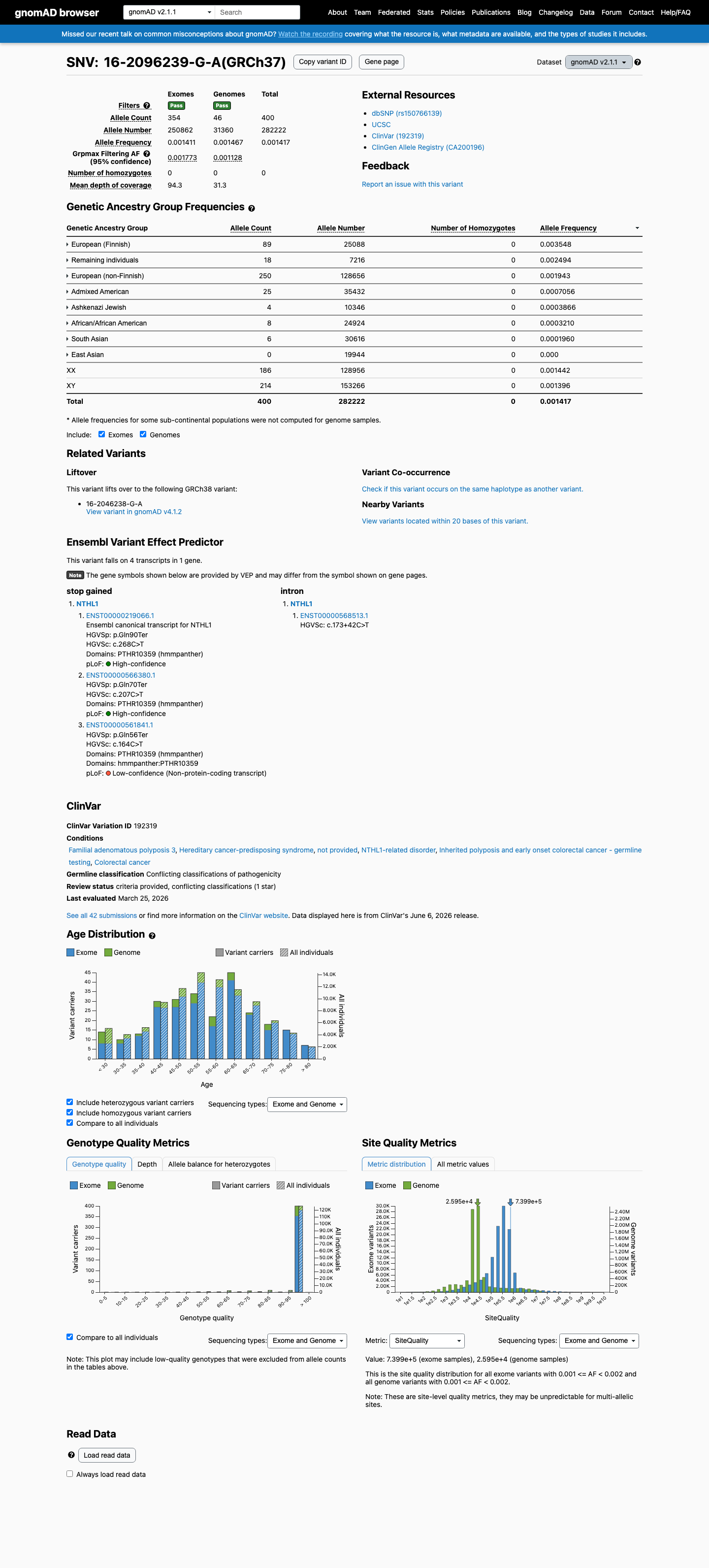
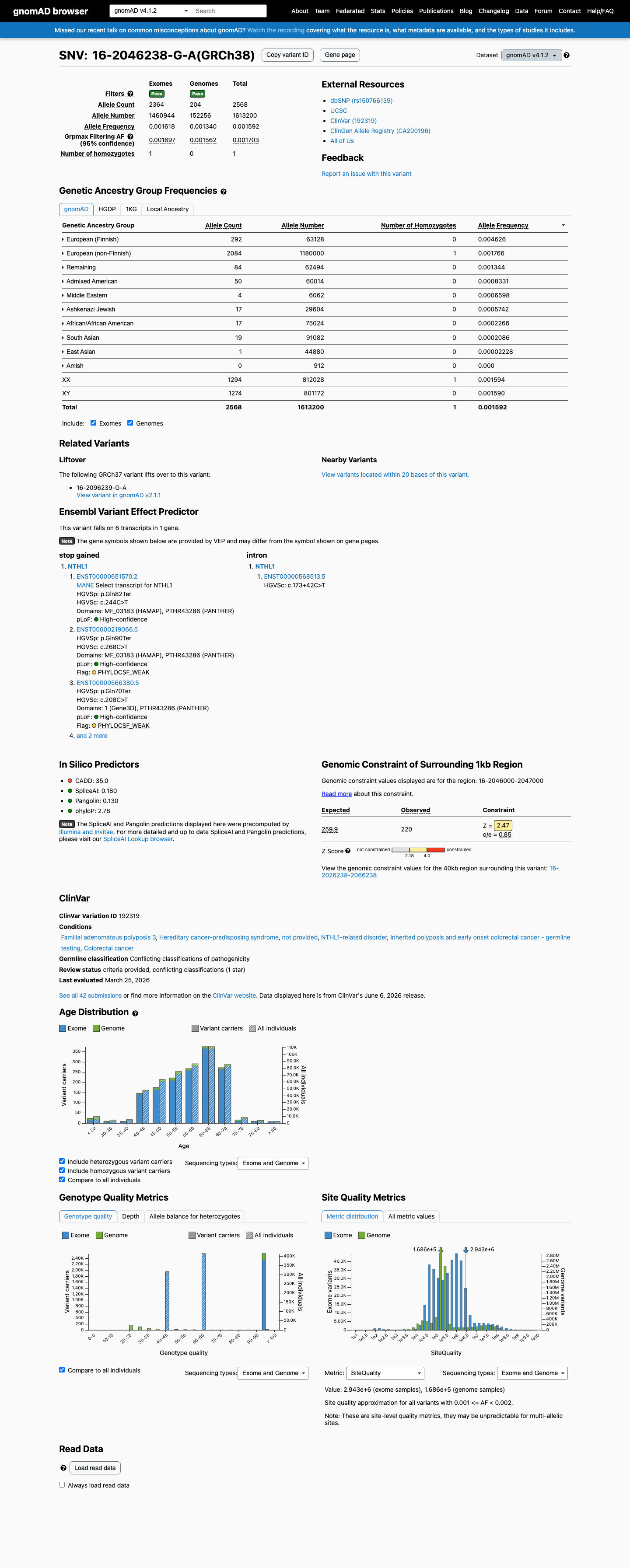
gnomAD v4.1 screenshot
gnomAD v4.1
gnomAD v2.1 screenshot
gnomAD v2.1
v4.1
This variant is present in gnomAD v4.1 (AF= 0.00159187; MAF= 0.15919%, 2568/1613200 alleles, homozygotes = 1) and has highest observed frequency in the European (Finnish) population (AF= 0.00462552; MAF= 0.46255%, 292/63128 alleles, homozygotes = 0); grpmax FAF= 0.00170283.
v2.1
This variant is present in gnomAD v2.1 (AF= 0.00141732; MAF= 0.14173%, 400/282222 alleles, homozygotes = 0) and has highest observed frequency in the European (Finnish) population (AF= 0.00354751; MAF= 0.35475%, 89/25088 alleles, homozygotes = 0); grpmax FAF= 0.00177304.
🇨🇦 CA
Not available in gnomAD-Canada v1.0.
Allele frequency by ancestry
three datasets · side by side
gnomAD v4.1
0.16% · 2568 / 1,613,200
1 hom · FAF 0.17%
European (Finnish)
292 / 63,128
0.46%
European (non-Finnish)
2084 / 1,180,000
0.18%
1 hom
Remaining individuals
84 / 62,494
0.13%
Admixed American
50 / 60,014
0.083%
Middle Eastern
4 / 6,062
0.066%
Ashkenazi Jewish
17 / 29,604
0.057%
African/African American
17 / 75,024
0.023%
South Asian
19 / 91,082
0.021%
East Asian
1 / 44,880
0.0022%
+ 1 not observed (Amish)
gnomAD v2.1
0.14% · 400 / 282,222
0 hom · FAF 0.18%
European (Finnish)
89 / 25,088
0.35%
Remaining individuals
18 / 7,216
0.25%
European (non-Finnish)
250 / 128,656
0.19%
Admixed American
25 / 35,432
0.071%
Ashkenazi Jewish
4 / 10,346
0.039%
African/African American
8 / 24,924
0.032%
South Asian
6 / 30,616
0.02%
+ 1 not observed (East Asian)
gnomAD Canada 🇨🇦
Absent · 0 / ?
0 hom
Not observed in any ancestry group.
ClinVar screenshot
ClinVar
This variant has been reported in ClinVar as Pathogenic (36 clinical laboratories) and as Likely pathogenic (2 clinical laboratories) and as pathogenic (1 clinical laboratory) and as Uncertain significance (1 clinical laboratory). (ClinVarID = 192319)
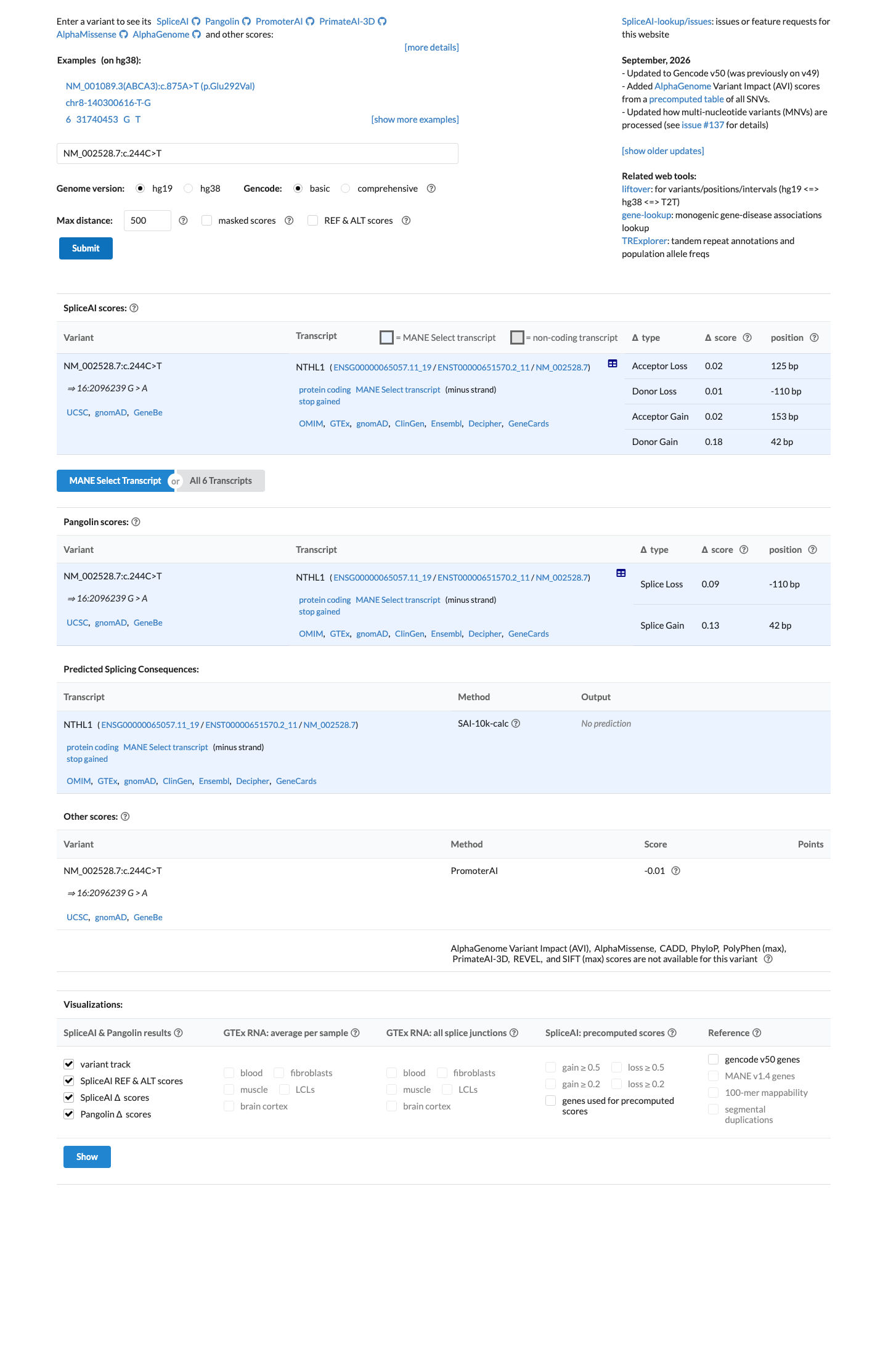
SpliceAI screenshot
In silico
SpliceAI predicts no significant splice impact for this variant (max delta score = 0.18). BayesDel score = 0.66.
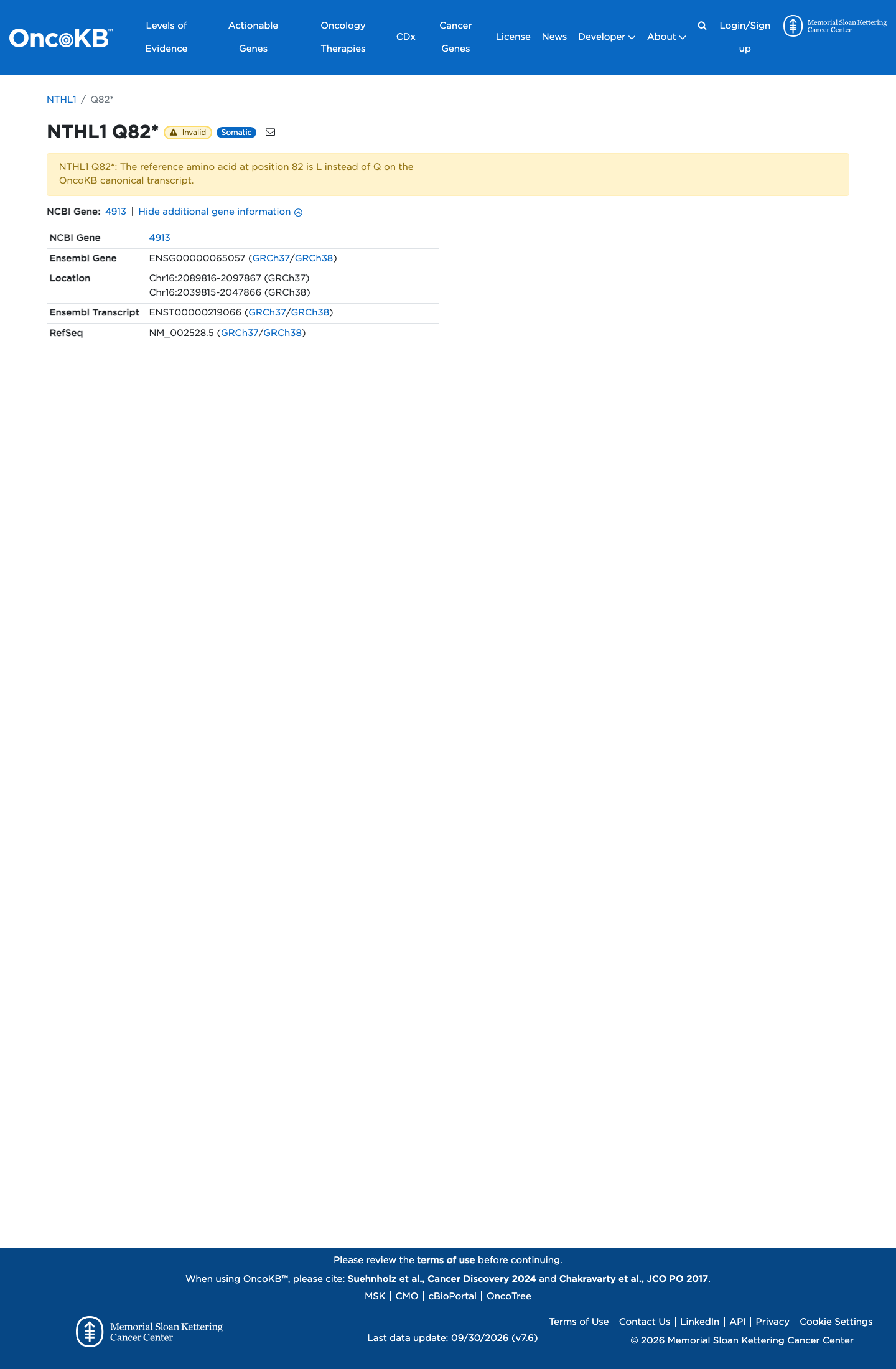
Functional / OncoKB screenshot
Functional
OncoKB identified curated literature and non-variant-specific oncogenicity context for review; listed oncogenicity label: not classified.
OncoKB ↗
COSMIC screenshot
COSMIC
Cancer hotspots screenshot
Cancer hotspots
Somatic evidence Not in COSMIC / hotspots
COSMIC
This variant does not lie in a statistically significant hotspot. This variant has not previously been reported in somatic cancers (COSMIC).
Hotspots
This variant does not lie in a statistically significant hotspot.
Literature · how each cited paper was used
7papers cited
Each card is an audit: what was searched, what was found, whether it names the variant, which criteria it fed, and why. 2 further PMIDs triaged but not cited — see Sources & references.
Inherited predisposition to colorectal adenomas caused by multiple rare alleles of MUTYH but not OGG1, NUDT1, NTH1 or NEIL 1, 2 or 3.
Searched
NTHL1 c.244C>TQ90Xc.268C>TQ82X
Found
This study screened NTH1 (NTHL1) and other base-excision-repair genes in patients with multiple colorectal adenomas. It detected the NTH1 nonsense change Q90X, which corresponds to the same protein change as this case's variant, in 1 of 134 cases and 2 of 359 controls, always heterozygously and with no significant difference, and concluded that these genes do not contribute significantly to autosomal recessive polyposis. No family, trio, or segregation analysis is presented, so the paper contributes no de novo or co-segregation/non-segregation evidence to this group's criteria.
Variant
✓ Names this variant — characterised directly
Applied to
→PS3 supporting
→PS4 strong
→PP1 supporting
We identified no patients with biallelic mutations that were likely to be pathogenic in OGG1, NEIL1, NEIL2, NEIL3, NUDT1 or NTH1, and conclude that these genes do not contribute significantly to polyposis determined by autosomal recessive inheritance.
Location Results ('Variants at the OGG1, NEIL1, NEIL2, NEIL3, NUDT1 and NTH1 loci') and Discussion, paragraph 5  ·  Context 167 unrelated patients with multiple colorectal adenomas (134 screened for the base-excision-repair genes) plus approximately 300 British Caucasian population controls; dHPLC mutation detection with direct sequencing, ARMS/restriction genotyping of controls, and Hardy-Weinberg/association statistics.  ·  full text
A germline homozygous mutation in the base-excision repair gene NTHL1 causes adenomatous polyposis and colorectal cancer.
Searched
c.244C>Tp.(Gln82*)p.(Q82*)c.268C>Tp.(Gln90*)p.Gln90Ter
Found
Weren et al. 2015 established NTHL1 as a recessive adenomatous polyposis/colorectal cancer predisposition gene. They reported a homozygous germline NTHL1 nonsense variant in 7 clinically affected individuals from 3 unrelated families; Sanger sequencing identified three further affected individuals in families B and C who were also homozygous, whereas a heterozygous carrier in family B was not clinically affected, and all pedigrees were in agreement with recessive inheritance. The allele was found in controls only in the heterozygous state. The variant is written in this paper as c.268C>T p.(Gln90*) under the legacy NM_002528.6 transcript; PMID:37727376 establishes that this is the same allele as this case's NM_002528.7:c.244C>T p.(Gln82*) (ClinVar 192319). This is the sole source providing co-segregation evidence for PP1 and, conversely, it shows no lack of segregation (relevant to BS4).
Variant
✓ Names this variant — characterised directly
Applied to
→PVS1 very strong
→PS3 supporting
Variant-specific functional assay: qRT-PCR with a cycloheximide NMD control in carrier-derived B lymphocytes shows the truncating allele results in nonsense-mediated decay, a deleterious effect on the gene product.
→PS4 strong
Original case series of the same allele (7 affected individuals from 3 families, as c.268C>T p.(Gln90Ter) under NM_002528.6) supporting affected-individual occurrence; heterozygous-only finding in controls is frequency context, not case-control enrichment.
→PM3 moderate
Reports the same allele (as c.268C>T p.Gln90*) in the homozygous state with recessive inheritance in three families, supporting biallelic occurrence in a recessive disorder.
→PP1 supporting
Reports the homozygous NTHL1 p.Gln90Ter allele (equated to c.244C>T p.(Gln82Ter) by PMID:37727376) co-segregating with adenomatous polyposis in 7 affected members of 3 recessive families, with an unaffected heterozygous carrier.
All three families showed recessive inheritance of the adenomatous polyposis phenotype and progression to CRC in at least one member.
Location Abstract; Results, paragraphs on the three NTHL1 families and their pedigrees (Figure 1 and Table 1)  ·  Context Whole-exome sequencing of 51 individuals with multiple colonic adenomas from 48 families; 149 additional polyposis patients screened by Sanger sequencing; control exome data from 2,329 in-house samples and 61,486 ExAC exomes; family pedigrees and segregation assessed, with tumor mutational profiling of NTHL1-associated carcinomas and adenomas.  ·  full text
A Standardized DNA Variant Scoring System for Pathogenicity Assessments in Mendelian Disorders.
Found
Structured finding pending for this record — see source link.
Applied to
→PVS1 very strong
Combined germline and tumor mutation signature testing identifies new families with NTHL1 tumor syndrome.
Searched
NM_002528.7:c.244C>Tp.(Gln82Ter)c.268C>Tp.(Gln90Ter)NP_002519.2:p.(Q82*)
Found
Reports the queried variant NM_002528.7:c.244C>T p.(Gln82Ter) as the recurrent truncating NTHL1 variant causing NTHL1 tumor syndrome, noting it was originally described as c.268C>T p.(Gln90Ter) under NM_002528.6 (ClinVar ID 192319). In this cohort it was found in homozygosity in four polyposis patients (patients #1-#4) and in compound heterozygosity with other truncating/likely pathogenic NTHL1 variants in two further patients (#5 and #6). Homozygous carriers presented colorectal polyposis (<10 to >100 polyps) and colorectal cancer (ages 47-63) among other tumours, and tumours from homozygous carriers showed a predominance of C>T transitions at non-CpG sites with the COSMIC SBS30 mutational signature, consistent with defective base excision repair. The authors note heterozygous carriers do not appear to have clinically significant increased risk, consistent with recessive inheritance.
Variant
✓ Names this variant — characterised directly
Applied to
→PVS1 very strong
Confirms this exact nonsense allele (c.244C>T p.(Gln82Ter)) is a true truncating, disease-causing NTHL1 null observed in biallelic carriers with a base-excision-repair-deficient tumour signature, supporting both the null consequence and loss-of-function as the disease mechanism.
→PS3 supporting
Provides the nomenclature bridge that makes the Weren NMD assay variant-specific, and supplies independent in-vivo functional corroboration (defective-BER SBS30/C>T transition tumour signature in homozygous carriers of this exact variant).
→PS4 strong
Independent case accrual for this exact variant: 4 homozygous polyposis patients and 2 compound heterozygotes with a second NTHL1 truncating variant; no control comparison, so it corroborates affected-individual occurrence rather than providing formal enrichment.
→PM3 moderate
Documents c.244C>T in trans with a likely-pathogenic NTHL1 deletion (family-confirmed phase) and homozygous in four patients, supporting the trans/biallelic requirement for a recessive disorder.
→PP1 supporting
Establishes that the c.268C>T p.(Gln90Ter) families in PMID:25938944 carry the same variant as this case's c.244C>T p.(Gln82Ter), making their segregation evidence applicable to this allele.
This syndrome was described for the first time in 2015 by Weren and others, who reported three Dutch families with the same homozygous truncating variant in the NTHL1 gene, which was reported at the time as c.268C>T p.(Gln90Ter) using the NM_002528.6, (Weren et al., 2015), but that is currently described as c.244C>T p.(Gln82Ter) according to NM_002528.7, with ClinVar ID 192319.
Location Introduction, paragraph 2; also Results section 3.1 ('NTHL1 germline variants') and Table 1  ·  Context 467 index patients referred to the Genetics Department of IPO-Porto (228 with colorectal polyposis negative for MUTYH/APC; 239 with familial/personal history of multiple tumours); recurrent variant screened by KASP genotyping (n=429) and a TruSight Hereditary Cancer NGS panel, validated by Sanger sequencing; tumour profiling of three carriers by Illumina TSO500 with COSMIC v3.2 SBS30 mutational-signature analysis.  ·  full text
NTHL1 is a recessive cancer susceptibility gene.
Searched
NTHL1 c.244C>Tc.244C>Tp.(Gln82Ter)NTHL1 p.(Q82*)NTHL1 c.268C>Tp.(Gln90Ter)
Found
Finnish case-control/cohort study ('NTHL1 is a recessive cancer susceptibility gene') that genotyped 41 rare candidate variants in 38 DNA-repair genes in 2482-4101 breast-cancer patients versus 1273-3985 controls, then evaluated all coding variants in the candidate genes in 18,786 breast-cancer patients and 182,927 controls from FinnGen. Although no variant reached significance in the primary breast-cancer series, the FinnGen analysis produced a variant-specific association for NTHL1 c.244C>T p.(Gln82Ter): a high risk of breast cancer in homozygous carriers (OR = 44.7, 95% CI 6.90-290, P = 6.7 x 10^-5) and a low but significant risk in heterozygous women (OR = 1.39, 95% CI 1.18-1.64, P = 7.8 x 10^-5), with a suggested high risk of colorectal, urinary-tract and basal-cell skin cancer in homozygotes. This is the decisive variant-specific case-control enrichment evidence supporting PS4; it also supplies independent population evidence that the allele behaves as a recessive cancer-susceptibility variant.
Variant
✓ Names this variant
Applied to
→PS4 strong
Variant-specific case-control enrichment: homozygous OR 44.7 (95% CI 6.90-290, P = 6.7 x 10^-5) and heterozygous OR 1.39 (1.18-1.64) for c.244C>T p.(Gln82Ter) in FinnGen (18,786 cases vs 182,927 controls); the primary basis for PS4 being met.
None of the variants associated significantly with cancer risk in the primary BC series; however, in the FinnGen data, NTHL1 c.244C>T p.(Gln82Ter) associated with BC with a high risk for homozygous (OR = 44.7 [95% CI 6.90-290], P = 6.7 x 10^-5) and a low risk for heterozygous women (OR = 1.39 [1.18-1.64], P = 7.8 x 10^-5). Furthermore, the results suggested a high risk of colorectal, urinary tract, and basal-cell skin cancer for homozygous in[dividuals].
Location Abstract (structured abstract of Sci Rep 2023;13:15843); full-text not retrievable in this case (screenshot only, publications/38036545.png)  ·  Context Candidate-variant genotyping in 2482-4101 Finnish breast-cancer patients and 1273-3985 controls (validation series), plus whole-exome-derived analysis of all coding variants in candidate genes in 18,786 breast-cancer patients and 182,927 controls from FinnGen; WES of 69 Finnish breast-cancer patients and analysis of loss-of-function variants in DNA-repair genes in Finns from gnomAD.
Rule & framework references · cited for criterion definitions, not variant evidence
25741868 ↗ Standards and guidelines for the interpretation of sequence variants: a joint consensus recommendation of the American College of Medical Genetics and Genomics and the Association for Molecular Pathology.
31285513 ↗ Contribution of New Adenomatous Polyposis Predisposition Genes in an Unexplained Attenuated Spanish Cohort by Multigene Panel Testing.
Sources & reference links
8Sources
ClinVar
gnomAD v2.1
gnomAD v4.1
gnomAD-Canada
SpliceAI
OncoKB
COSMIC
Cancer hotspots
Triaged references · 2 PMIDs not cited in assessment
33193653 ↗ New Pathogenic Germline Variants in Very Early Onset and Familial Colorectal Cancer Patients. CLINVAR
28492532 ↗ Sherloc: a comprehensive refinement of the ACMG-AMP variant classification criteria. CLINVAR