Analysis in progress
Initialising…
0%
complete
This report is still being assembled — sections appear as each stage finishes. It isn't final yet.
NTRK1
Final classification
VUS
PM2BP4
NTRK1
c.655G>A
p.Gly219Arg
missense · exon 6

NTRK1 encodes a transmembrane receptor tyrosine kinase found in neural cells that is activated by nerve growth factor (NGF). Upon activation, it drives signaling pathways (MAPK, PI3K, PLC-γ) that promote cell proliferation, survival, and differentiation, and it helps specify sensory neuron subtypes. Mutations in NTRK1 are associated with congenital insensitivity to pain with anhidrosis, self-mutilating behavior, and cognitive disability. As an oncogene, NTRK1 mutations and fusions occur in various cancers and can be targeted by NTRK-family kinase inhibitors.

This variant

NTRK1-related disease - congenital insensitivity to pain with anhidrosis - is typically recessive, and NTRK1 fusions are targetable oncogenic drivers in cancer. This rare missense change (p.Gly219Arg) is classified as a variant of uncertain significance: the available evidence neither establishes nor excludes pathogenicity, and no second-allele or functional data exist to resolve it.

Transcript
NM_002529.3
HGVS · transcript:coding
NM_002529.3:c.655G>A
GRCh38
chr1:156868585 G>A
GRCh37
chr1:156838377 G>A
Basis VUS: conflicting evidence - one supporting pathogenic criterion (PM2, extreme rarity in gnomAD) and one supporting benign criterion (BP4, REVEL 0.217) - satisfies no ACMG/AMP combination rule, so significance is uncertain.
VUS: conflicting evidence - one supporting pathogenic criterion (PM2, extreme rarity in gnomAD) and one supporting benign criterion (BP4, REVEL 0.217) - satisfies no ACMG/AMP combination rule, so significance is uncertain.
Classification rationale
PM2 BP4 VUS
NTRK1 c.655G>A missense · exon 6

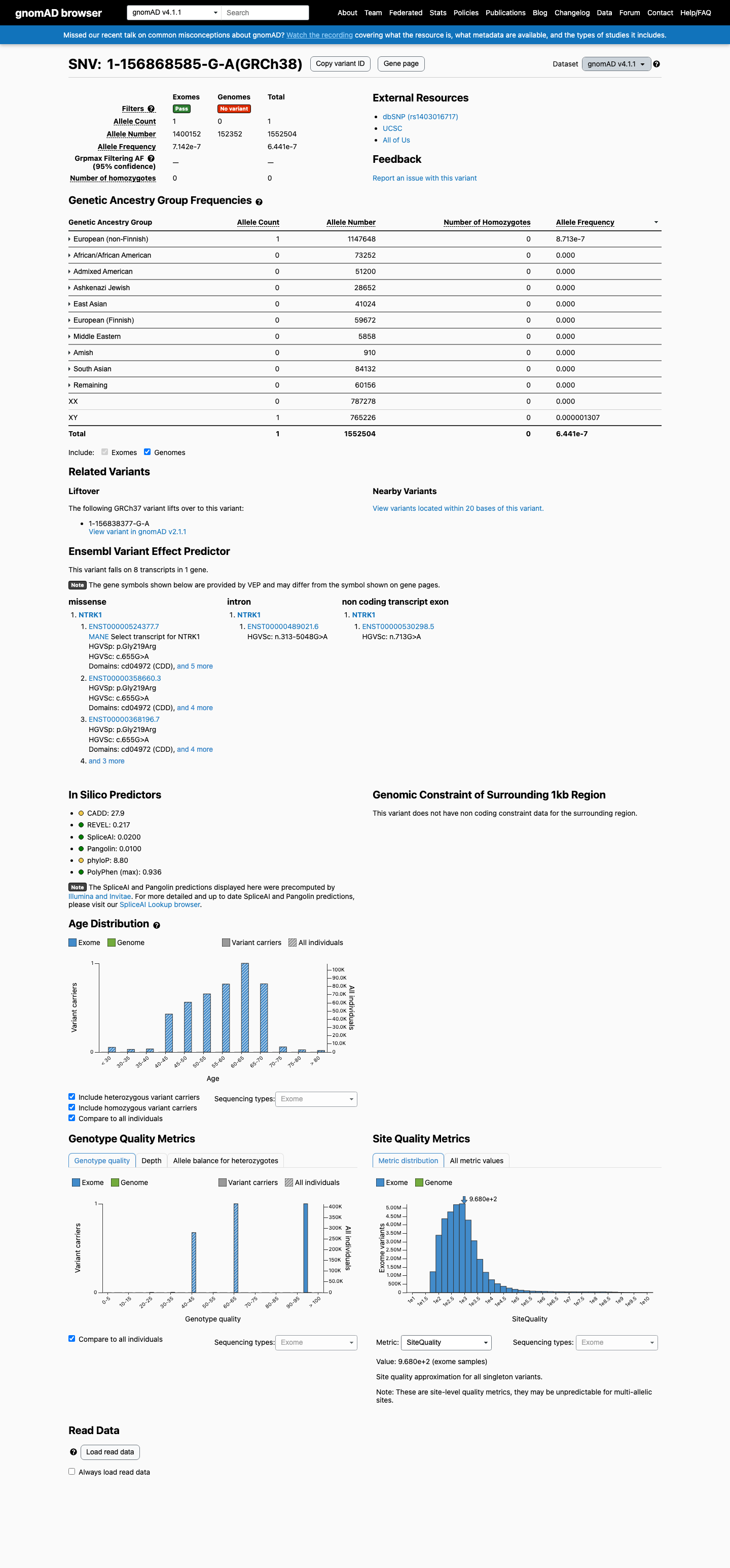
PM2 (Supporting): absent from gnomAD v2.1 and present only once in gnomAD v4.1 (AF 6.4e-07; 1/1,552,504 alleles; 0 homozygotes), an extremely rare population frequency. BP4 (Supporting): REVEL 0.217 falls at or below the <=0.290 benign-supporting threshold (ClinGen SVI calibration, PMID 36413997). Overall classification VUS: the single supporting pathogenic criterion (PM2) and single supporting benign criterion (BP4) constitute conflicting evidence satisfying no ACMG/AMP 2015 combination rule.

PM2 + BP4 VUS
Gene diagram · NM_002529.3 · variants mapped to exon structure
NTRK1 NM_002529.3
Fetching transcript structure from UCSC…
Applied criteria · 2 applied · 22 assessed
MetEvidence satisfies this criterion.
Not metEvaluated against available evidence; threshold not reached.
Not assessedApplies in principle, but no evidence was found to evaluate it.
N/ADoesn't apply to this variant type.
Applied · 2
Strength Supporting Moderate Strong Very strong
PM2 supporting Pathogenic
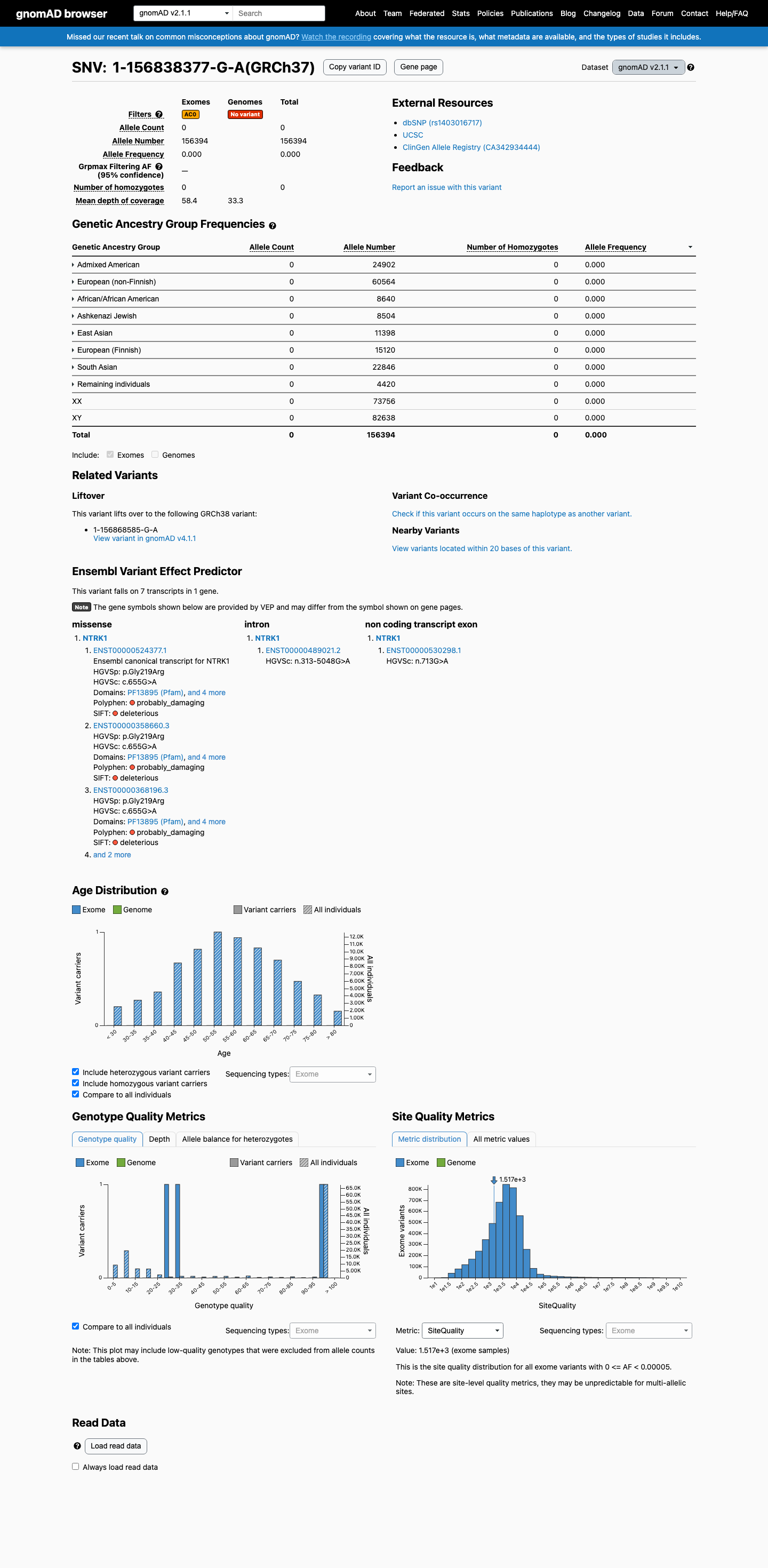
Met (supporting): absent from gnomAD v2.1 and present only once in gnomAD v4.1 (AF 6.4e-07; 1/1,552,504 alleles; 0 homozygotes), an extremely rare population frequency.
gnomAD v2.1 reports AC=0, AN=156,394, AF=0, and 0 homozygotes.gnomAD v4.1 reports AC=1, AN=1,552,504, AF=6.44121e-07, and 0 homozygotes; the highest ancestry-specific AF is 8.71347e-07 in non-Finnish Europeans.gnomAD-Canada v1.0 reports the variant as absent.
BP4 supporting Benign
Met (supporting): REVEL 0.217 falls at or below the <=0.290 benign-supporting threshold (ClinGen SVI calibration, PMID 36413997).
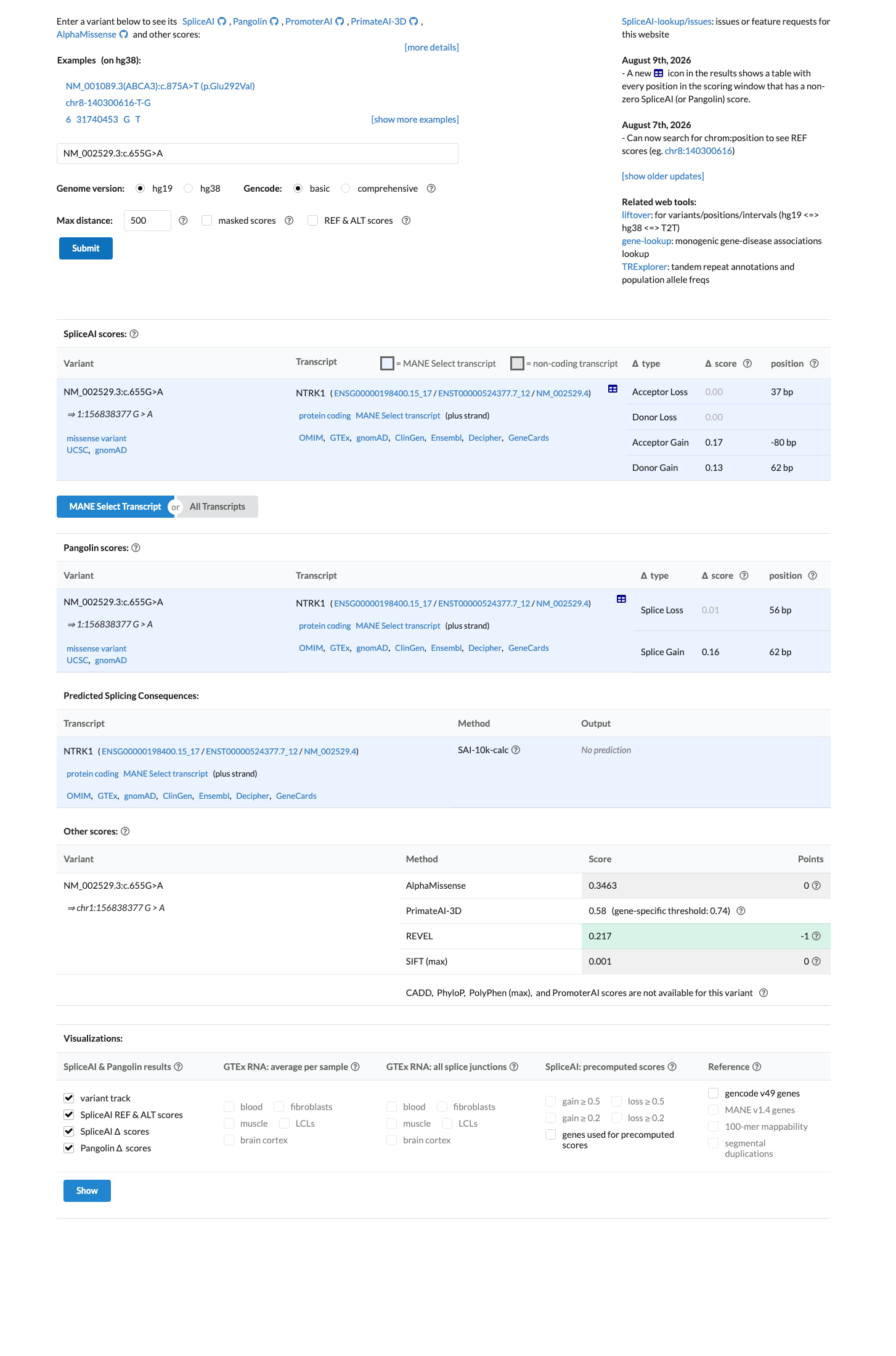
REVEL score = 0.217 for NM_002529.3:c.655G>A (source_registry key 'revel'); ClinGen SVI REVEL calibration (Pejaver et al. 2022, PMID 36413997) sets the benign-supporting threshold at REVEL <=0.290 — 0.217 meets this threshold, supporting BP4 at supporting strength.SpliceAI predicts no significant splice impact for this variant (max delta score = 0.168; source_registry key 'spliceai'); this is qualitatively concordant with the benign computational prediction but is not used to elevate BP4 strength because no named calibration publication for this specific SpliceAI threshold was applied in this evaluation.No ClinGen VCEP cspec or gene-specific PP3/BP4 lookup spreadsheet was located for NTRK1 (cspec.found=false; final_classification_framework source='generic_acmg_fallback'), so no pre-assigned code applies.
Assessed · not applied · 4 not met · 18 not assessed
Pathogenic
PS1 Not assessed: no pathogenic variant producing the identical amino-acid change (p.Gly219Arg) was available for comparison.
PS2 Not assessed: no proband de novo occurrence is documented - no parental testing or maternity/paternity confirmation was available.
PS3 Not assessed: no published functional or biochemical assay evidence for p.Gly219Arg was available.
PS4 Not assessed: no affected-case counts, control counts, or variant-specific case series were available.
PM1 Not assessed: insufficient evidence was available to determine whether the variant lies in a critical functional domain or mutational hotspot.
PM3 Not assessed: no affected proband observations, pathogenic second allele, or phasing/inheritance data were available.
PM5 Not assessed: no pathogenic missense variant at the same codon (p.Gly219) was available for comparison.
PM6 Not assessed: no suspected de novo occurrence without confirmed parentage is documented.
PP1 Not assessed: no affected or unaffected relatives, informative meioses, or co-segregation data were available.
PP2 Not assessed: insufficient evidence was available to apply this criterion.
PP3 Not met: REVEL 0.217 falls below the >=0.644 pathogenic-supporting threshold (SpliceAI max delta 0.168 also below 0.2).
PP4 Not assessed: no patient phenotype, family history, or diagnostic indication was available.
PP5 Not assessed: no ClinVar expert-panel assertion of Pathogenic or Likely pathogenic exists for this exact variant.
Benign
BA1 Not met: gnomAD v4.1 allele frequency 6.4e-07 is far below the >5% stand-alone benign threshold.
BS1 Not met: the gnomAD v4.1 allele frequency of 6.4e-07 is far below the population frequency expected for a benign variant in this disease.
BS2 Not met: no homozygotes were observed in gnomAD (0 in v2.1 and v4.1), providing no unaffected homozygous adult to support a benign effect.
BS3 Not assessed: no functional assay evidence of normal wild-type activity for p.Gly219Arg was available.
BS4 Not assessed: no affected relatives tested for the variant or reliable non-segregation observations were available.
BP1 Not assessed: insufficient evidence was available to apply this criterion.
BP2 Not assessed: no data show the variant in cis with a pathogenic variant or in trans with a benign variant.
BP5 Not assessed: no patient case with an alternative molecular basis for the disease was available.
BP6 Not assessed: no ClinVar expert-panel assertion of Benign or Likely benign exists for this exact variant.
N/A · 4 PVS1 · PM4 · BP3 · BP7
Research & evidence
Population frequency
gnomAD v4.1 screenshot
gnomAD v4.1
gnomAD v2.1 screenshot
gnomAD v2.1
v4.1
This variant is present in gnomAD v4.1 (AF= 6.44121e-07; MAF= 0.00006%, 1/1552504 alleles, homozygotes = 0) and has highest observed frequency in the European (non-Finnish) population (AF= 8.71347e-07; MAF= 0.00009%, 1/1147648 alleles, homozygotes = 0).
v2.1
This variant is present in gnomAD v2.1 (AF= 0; MAF= 0.00000%, 0/156394 alleles, homozygotes = 0) and has highest observed frequency in the African/African American population (AF= 0; MAF= 0.00000%, 0/8640 alleles, homozygotes = 0).
🇨🇦 CA
Absent from gnomAD-Canada v1.0.
Allele frequency by ancestry
three datasets · side by side
gnomAD v4.1
6.4e-05% · 1 / 1,552,504
0 hom
European (non-Finnish)
1 / 1,147,648
8.7e-05%
+ 9 not observed (Remaining individuals, Admixed American, European (Finnish), Amish, East Asian, Middle Eastern, South Asian, Ashkenazi Jewish, African/African American)
gnomAD v2.1
Absent · 0 / 156,394
0 hom
Not observed in any ancestry group.
+ 8 not observed (African/African American, Admixed American, Ashkenazi Jewish, East Asian, European (Finnish), European (non-Finnish), Remaining individuals, South Asian)
gnomAD Canada 🇨🇦
Absent · 0 / ?
0 hom
Not observed in any ancestry group.
ClinVar screenshot
ClinVar
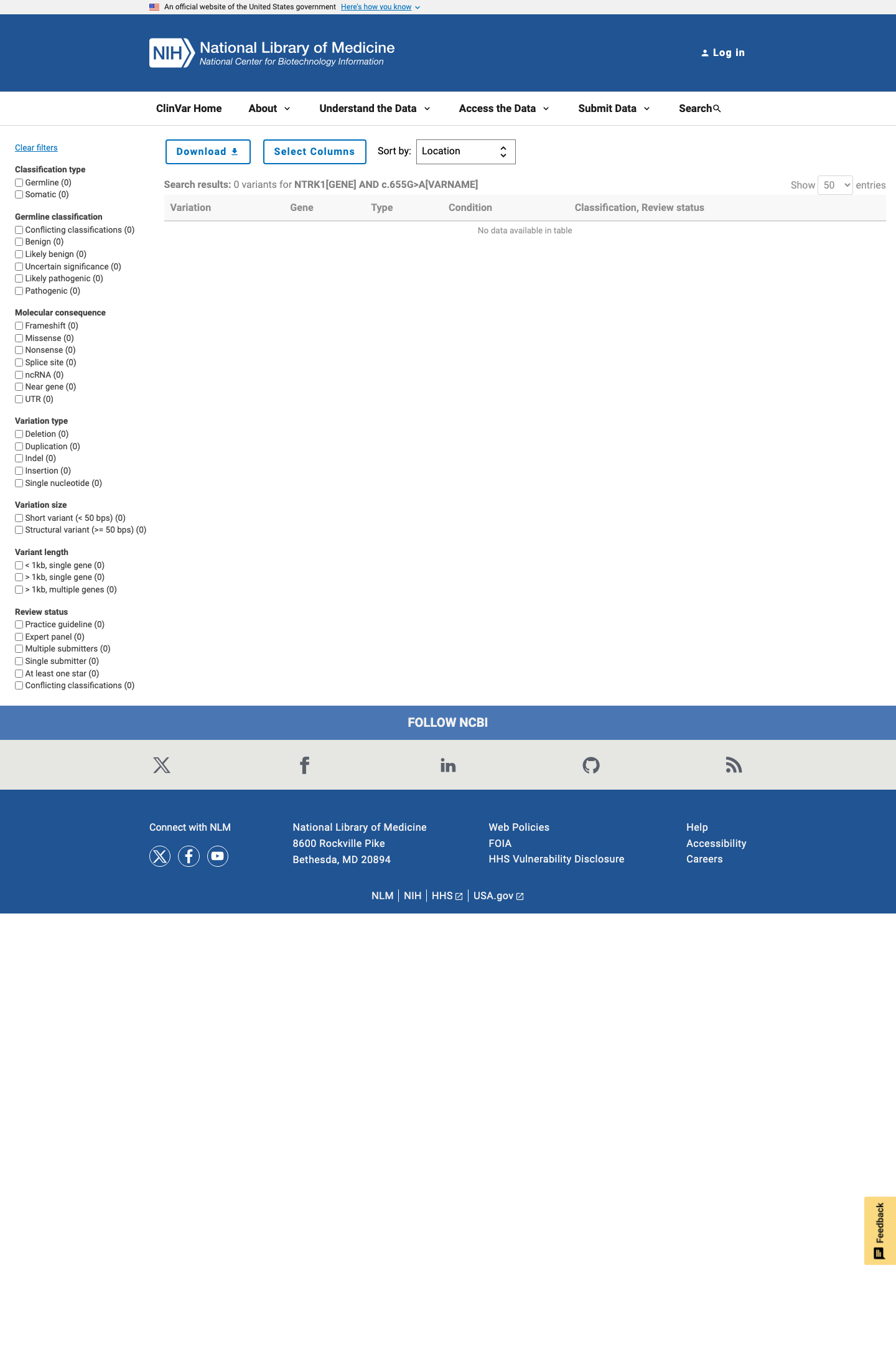
This variant is absent from ClinVar.
SpliceAI screenshot
In silico
SpliceAI predicts no significant splice impact for this variant (max delta score = 0.17). REVEL score = 0.217. BayesDel score = -0.171876.
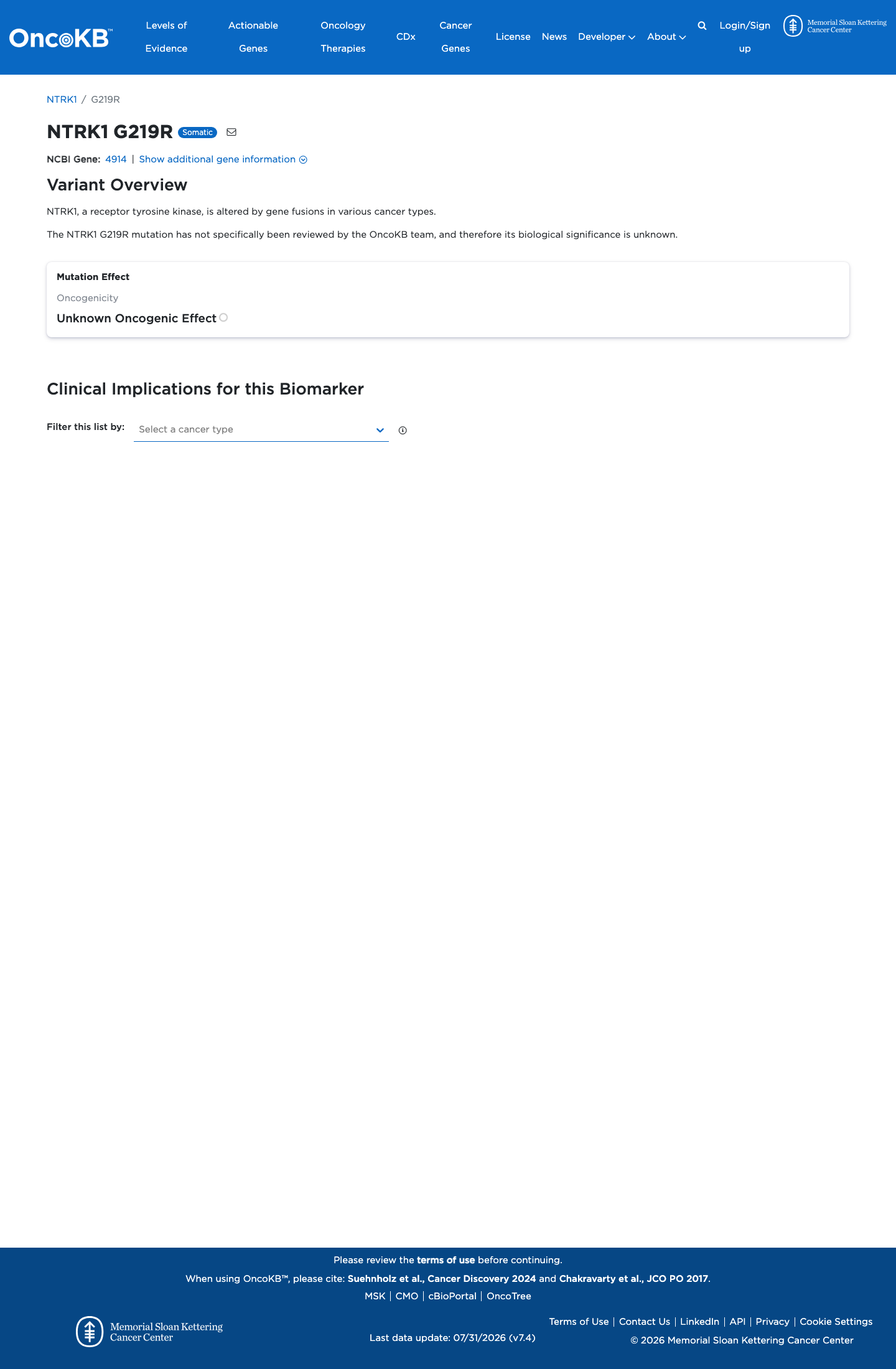
Functional / OncoKB screenshot
Functional Unknown Oncogenic Effect
OncoKB did not identify variant-specific reviewed functional evidence for this variant; gene-level curated context is available for reviewer follow-up. NTRK1, a receptor tyrosine kinase, is altered by gene fusions in various cancer types.
OncoKB ↗
COSMIC screenshot
COSMIC
Cancer hotspots screenshot
Cancer hotspots
Somatic evidence Not in COSMIC / hotspots
COSMIC
This variant does not lie in a statistically significant hotspot. This variant has not previously been reported in somatic cancers (COSMIC).
Hotspots
This variant does not lie in a statistically significant hotspot.
Sources & reference links
8Sources
ClinVar
gnomAD v2.1
gnomAD v4.1
gnomAD-Canada
SpliceAI
OncoKB
COSMIC
Cancer hotspots