Back
NM_002691.4:c.49C>T
p.Arg17Trp · POLD1
ACMG/AMP
0%
complete
Final classification
VUS
PM2PP2BP4
POLD1
c.49C>T
p.Arg17Trp
missense · exon 2

POLD1 encodes the catalytic subunit of DNA polymerase delta, an enzyme that carries both DNA synthesis and proofreading (3' to 5' exonuclease) activities and is essential for accurate DNA replication and repair. Germline mutations in its exonuclease domain cause polyposis and predispose people to colorectal, endometrial, and possibly brain cancers. In cancer, POLD1 defects impair replication fidelity, leading to the accumulation of many mutations (an ultra-mutated phenotype) that may make tumors more responsive to immunotherapy, though somatic POLD1 mutations are rare.

This variant

POLD1 encodes the catalytic subunit of DNA polymerase delta whose exonuclease proofreading function is lost in autosomal dominant polymerase proofreading-associated polyposis, but the p.(Arg17Trp) substitution alters an N-terminal residue outside that disease-critical exonuclease domain, so its contribution to colorectal and endometrial cancer predisposition is not established.

Transcript
NM_002691.4
HGVS · transcript:coding
NM_002691.4:c.49C>T
GRCh38
chr19:50398900 C>T
GRCh37
chr19:50902157 C>T
VUS: PM2 (supporting) and PP2 (supporting) pathogenic evidence is offset by BP4 (supporting) benign evidence, so no ACMG combination threshold is met.
Classification rationale
PM2PP2 BP4 VUS
POLD1 c.49C>T missense · exon 2

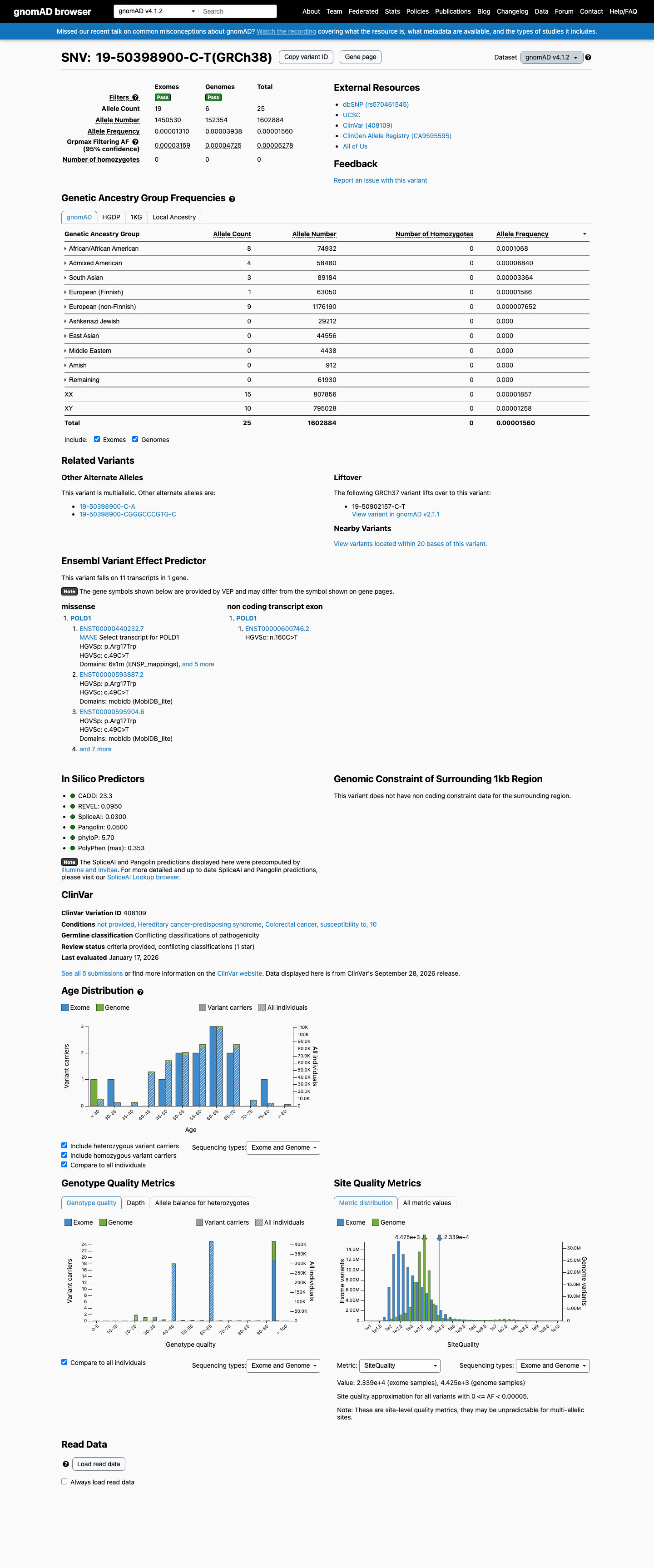
PM2 (supporting): variant is rare in gnomAD (v4.1 grpmax FAF 5.28e-05, below 0.0001) and absent from gnomAD-Canada. PP2 (supporting): POLD1 is a disease gene in which missense change is an established pathogenic mechanism, including germline exonuclease-domain alleles. BP4 (supporting): REVEL 0.095 is below the 0.250 in-silico threshold, indicating the missense substitution is computationally tolerated. VUS: two supporting pathogenic criteria and one supporting benign criterion satisfy no ACMG pathogenic, likely pathogenic, benign or likely benign combination.

PM2 + PP2 + BP4 → VUS
LYFE Sciences is an AI system, and it can make mistakes. Criteria may be applied incorrectly, sources may be misread, and a confident-looking classification can still be wrong. Double-check every criterion and its underlying evidence before relying on any call.
Gene diagram · NM_002691.4 · variants mapped to exon structure
POLD1 NM_002691.4
Fetching transcript structure from UCSC…
Applied criteria · 3 applied · 21 assessed
MetEvidence satisfies this criterion.
Not metEvaluated against available evidence; threshold not reached.
Not assessedApplies in principle, but no evidence was found to evaluate it.
N/ADoesn't apply to this variant type.
Applied · 3
Strength Supporting Moderate Strong Very strong
PM2 supporting Pathogenic
Met at supporting: gnomAD v4.1 grpmax FAF 5.28e-05 is below the <=0.0001 PM2 threshold, with variant absent from gnomAD-Canada.
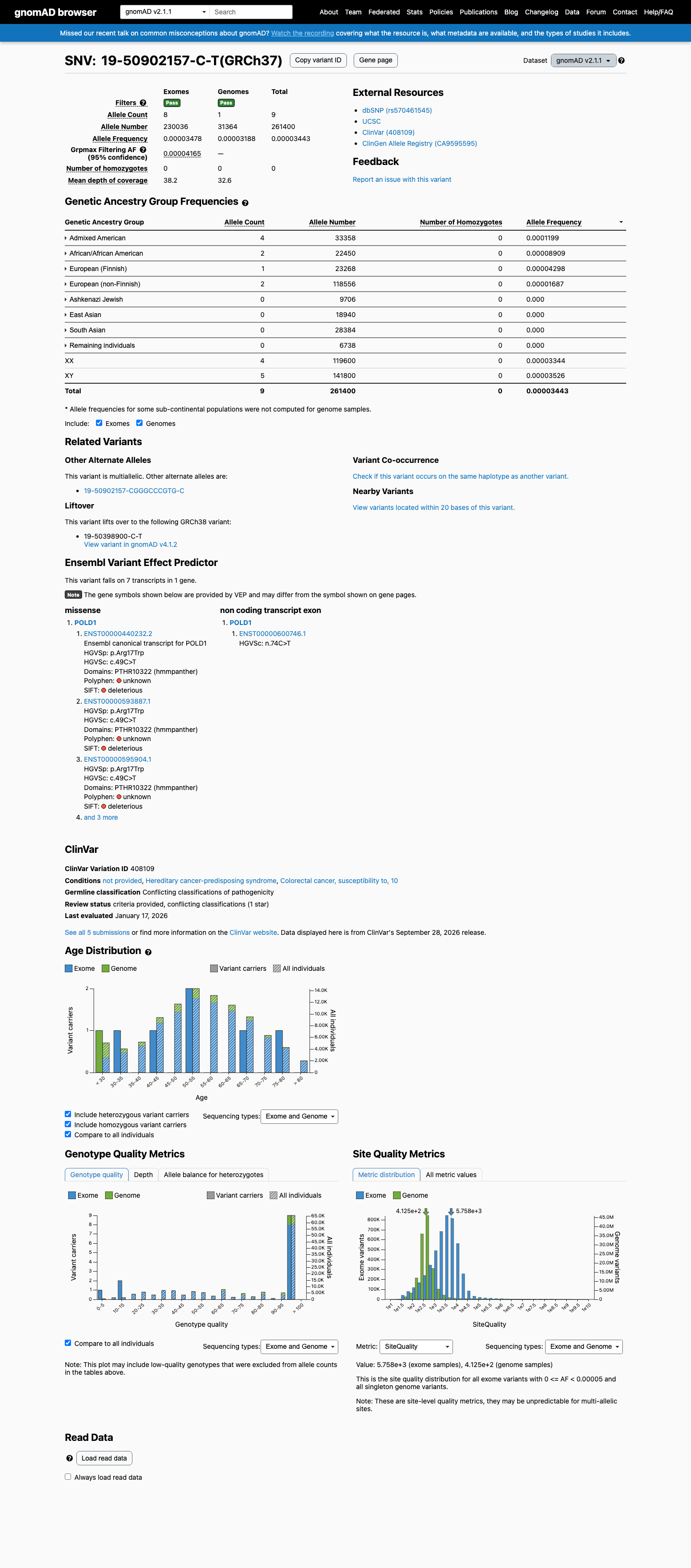
gnomAD v2.1 all-comers: total AF 3.443e-05 (9/261,400), grpmax FAF 4.165e-05 - below the 0.0001 PM2 supporting threshold.gnomAD v4.1 all-comers: total AF 1.560e-05 (25/1,602,884), grpmax FAF 5.278e-05 - below the 0.0001 PM2 supporting threshold.gnomAD v2.1 non-cancer exomes AF 3.652e-05 (8/219,044), grpmax FAF 4.186e-05; gnomAD v3.1 non-cancer genomes AF 4.055e-05 (6/147,974), grpmax FAF 4.737e-05 - both non-cancer subsets also below threshold.
PP2 supporting Pathogenic
Met at supporting: POLD1 is a Mendelian disease gene in which exonuclease-domain missense variants such as p.Asp402Asn are a common pathogenic mechanism, satisfying PP2's missense-mechanism requirement.
POLD1 is the catalytic p125 subunit of DNA polymerase delta, with germline pathogenic variants causing polymerase proofreading-associated polyposis (colorectal, endometrial and possibly brain cancer) (OncoKB gene-level background; MIM 174761).Missense variants are an established pathogenic mechanism in POLD1: the germline likely-pathogenic alleles characterised in PPAP are missense substitutions in the exonuclease domain, c.1204G>A p.(Asp402Asn) and c.1481T>G p.(Ile494Ser) (PMID:41487566); p.Asp316Asn is reported in a digenic POLD1/PMS2 teenage-onset colorectal cancer syndrome (PMID:36291559).Population data: gnomAD v2.1 total AF 3.443e-05 (9/261400 alleles), no homozygotes, highest subpopulation AF 0.00012 (Admixed American) - no common benign POLD1 missense allele at codon 17.
BP4 supporting Benign
Met, supporting: REVEL 0.095 is at or below the <=0.29 BP4 supporting threshold for this missense variant.
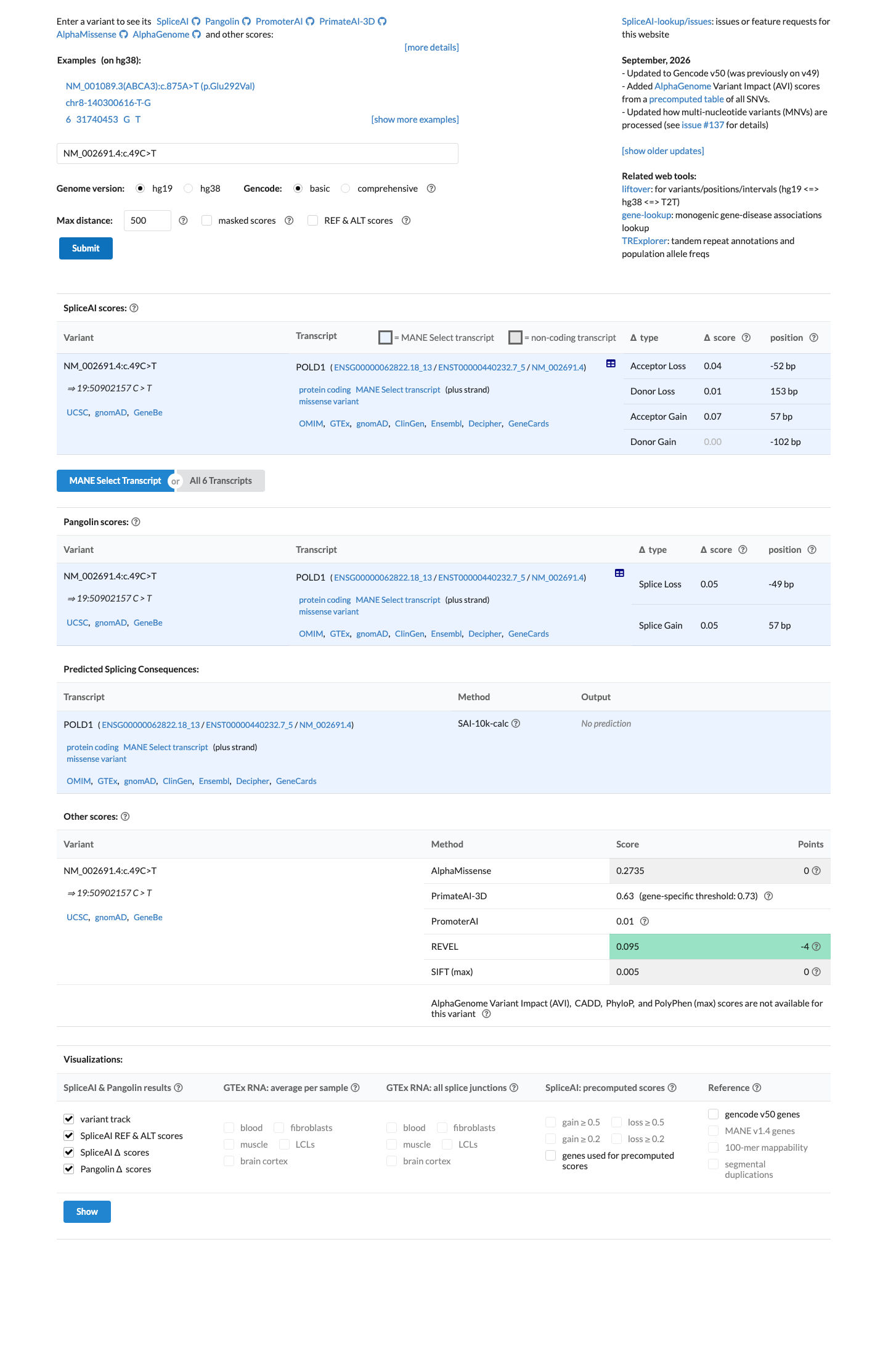
The variant NM_002691.4:c.49C>T normalizes to NP_002682.2:p.(Arg17Trp), a missense substitution; REVEL is the sole applicable BP4 path.The SpliceAI maximum delta of 0.069 was not used for BP4: a missense variant's splice prediction does not address whether the amino-acid substitution is tolerated.Local REVEL v1.3 lookup result: 0.095, at or below the ClinGen SVI BP4 supporting threshold of <=0.29 (Pejaver et al. 2022, PMID:36413997), so BP4 is met at supporting strength.
Assessed · not applied · 13 not met · 8 not assessed
Pathogenic
PS1 Not met: the only p.Arg17Trp record (ClinVar 408109) is conflicting VUS/likely benign at 1 star, so no established pathogenic same-amino-acid comparator exists.
PS2 Not assessed: no proband, parental testing or parentage confirmation exists for c.49C>T, so de novo status cannot be established.
PS3 Not assessed: no functional assay of POLD1 p.Arg17Trp was reported, so the generic ACMG PS3 requirement for a well-established damaging-effect study is unmet.
PS4 Not met: no odds ratio or relative risk exists for this variant to compare against the generic PS4 threshold of OR/RR > 5.0.
PM1 Not met: residue 17 of 1107 lies outside POLD1's exonuclease proofreading domain where pathogenic missense variants cluster, and POLD1 R17 is not a reported hotspot.
PM3 Not assessed: no proband genotype, second POLD1 allele, or phase data exists, with zero homozygotes in gnomAD v4.1 (25/1,602,884 alleles).
PM5 Not met: no pathogenic missense at Arg17 exists; ClinVar's only codon-17 POLD1 record is the variant under assessment (408109, VUS/likely benign) and the same-residue harvest found zero comparators.
PM6 Not assessed: no proband or parent-of-origin information exists, so no assumed de novo occurrence can be documented for c.49C>T.
PP1 Not assessed: no pedigree, affected relatives or meioses are available, so co-segregation of c.49C>T with disease cannot be evaluated.
PP3 Not met: REVEL 0.095 is below the >=0.644 PP3 supporting threshold for this missense variant.
PP4 Not met: no proband phenotype or family history is documented, and the only reported phenotype (breast cancer) is not specific for POLD1-associated disease.
PP5 Not met: VCV000408109 has 0 expert-panel submissions (1-star, conflicting ordinary laboratory assertions), so no exact-variant expert-panel classification exists.
Benign
BA1 Not met: gnomAD total allele frequency 1.6e-05 (25/1.6M, v4.1) is far below the >=0.05 BA1 stand-alone threshold.
BS1 Not met: gnomAD v4.1 total AF 1.6e-05 and grpmax FAF 5.3e-05 both fall far below the >=0.01 BS1 threshold.
BS2 Not met: zero homozygotes in gnomAD and POLD1 PPAP is adult-onset with incomplete penetrance, failing BS2's early-onset full-penetrance premise.
BS3 Not assessed: no functional assay of POLD1 p.Arg17Trp was reported, so the generic ACMG BS3 requirement for a well-established no-damaging-effect study is unmet.
BS4 Not assessed: no family with genotyped affected and unaffected members exists, so non-segregation of c.49C>T cannot be demonstrated.
BP1 Not met: POLD1 disease is not truncating-only, as germline exonuclease-domain missense variants such as p.Asp402Asn and p.Ile494Ser cause polymerase proofreading-associated polyposis.
BP2 Not assessed: no phased pathogenic POLD1 partner allele exists in any source, with zero homozygotes in gnomAD v4.1 (25/1,602,884 alleles).
BP5 Not met: no case with an alternate molecular basis is documented (no proband, co-occurring pathogenic variant, or second diagnosis in any source).
BP6 Not met: VCV000408109 has 0 expert-panel submissions; its single Likely-benign entry is an ordinary single-submitter laboratory assertion that cannot trigger BP6.
N/A · 4 PVS1 · PM4 · BP3 · BP7
Research & evidence
Population frequency
gnomAD v4.1 screenshot
gnomAD v4.1
gnomAD v2.1 screenshot
gnomAD v2.1
v4.1
This variant is present in gnomAD v4.1 (AF= 1.55969e-05; MAF= 0.00156%, 25/1602884 alleles, homozygotes = 0) and has highest observed frequency in the African/African American population (AF= 0.000106763; MAF= 0.01068%, 8/74932 alleles, homozygotes = 0); grpmax FAF= 5.278e-05.
v2.1
This variant is present in gnomAD v2.1 (AF= 3.443e-05; MAF= 0.00344%, 9/261400 alleles, homozygotes = 0) and has highest observed frequency in the Admixed American population (AF= 0.000119911; MAF= 0.01199%, 4/33358 alleles, homozygotes = 0); grpmax FAF= 4.165e-05.
🇨🇦 CA
Not available in gnomAD-Canada v1.0.
Allele frequency by ancestry
three datasets · side by side
gnomAD v4.1
0.0016% · 25 / 1,602,884
0 hom · FAF 0.0053%
African/African American
8 / 74,932
0.011%
Admixed American
4 / 58,480
0.0068%
South Asian
3 / 89,184
0.0034%
European (Finnish)
1 / 63,050
0.0016%
European (non-Finnish)
9 / 1,176,190
0.00077%
+ 5 not observed (Remaining individuals, Amish, East Asian, Middle Eastern, Ashkenazi Jewish)
gnomAD v2.1
0.0034% · 9 / 261,400
0 hom · FAF 0.0042%
Admixed American
4 / 33,358
0.012%
African/African American
2 / 22,450
0.0089%
European (Finnish)
1 / 23,268
0.0043%
European (non-Finnish)
2 / 118,556
0.0017%
+ 4 not observed (Ashkenazi Jewish, East Asian, Remaining individuals, South Asian)
gnomAD Canada 🇨🇦
Absent · 0 / ?
0 hom
Not observed in any ancestry group.
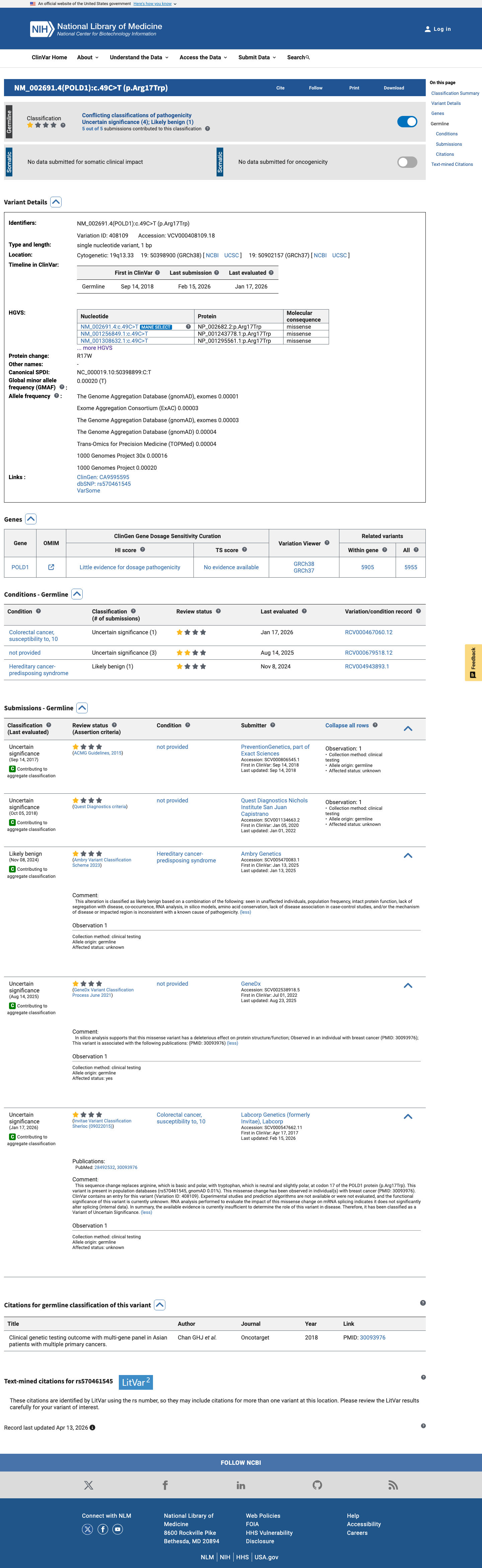
ClinVar screenshot
ClinVar
This variant has been reported in ClinVar as Uncertain significance (4 clinical laboratories) and as Likely benign (1 clinical laboratory). (ClinVarID = 408109)
SpliceAI screenshot
In silico
SpliceAI predicts no significant splice impact for this variant (max delta score = 0.07). REVEL score = 0.095. BayesDel score = -0.405968.
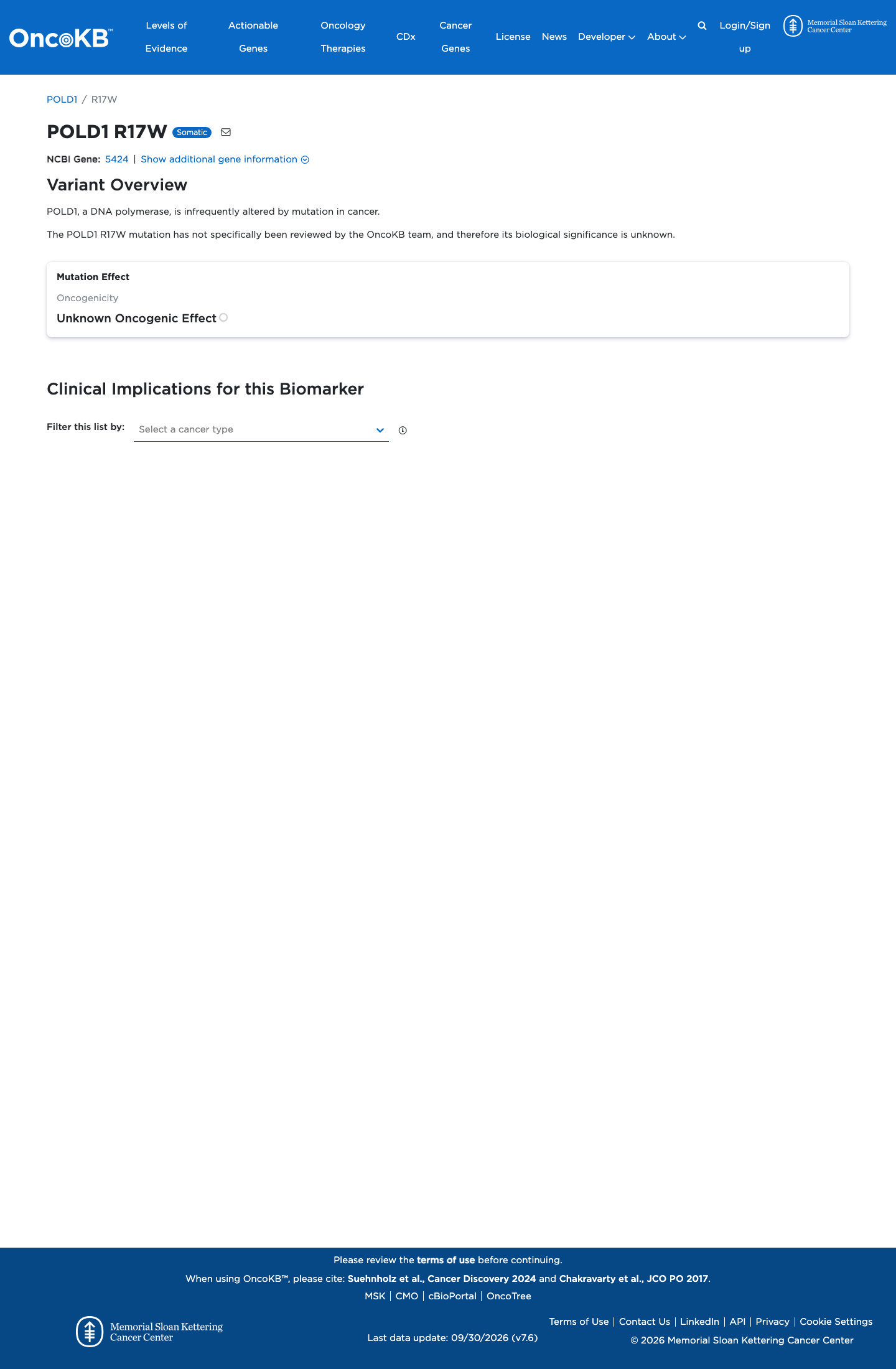
Functional / OncoKB screenshot
Functional Unknown Oncogenic Effect
OncoKB did not identify variant-specific reviewed functional evidence for this variant; gene-level curated context is available for reviewer follow-up. POLD1, a DNA polymerase, is infrequently altered by mutation in cancer.
OncoKB ↗
COSMIC screenshot
COSMIC
Cancer hotspots screenshot
Cancer hotspots
Somatic evidence Not in COSMIC / hotspots
COSMIC
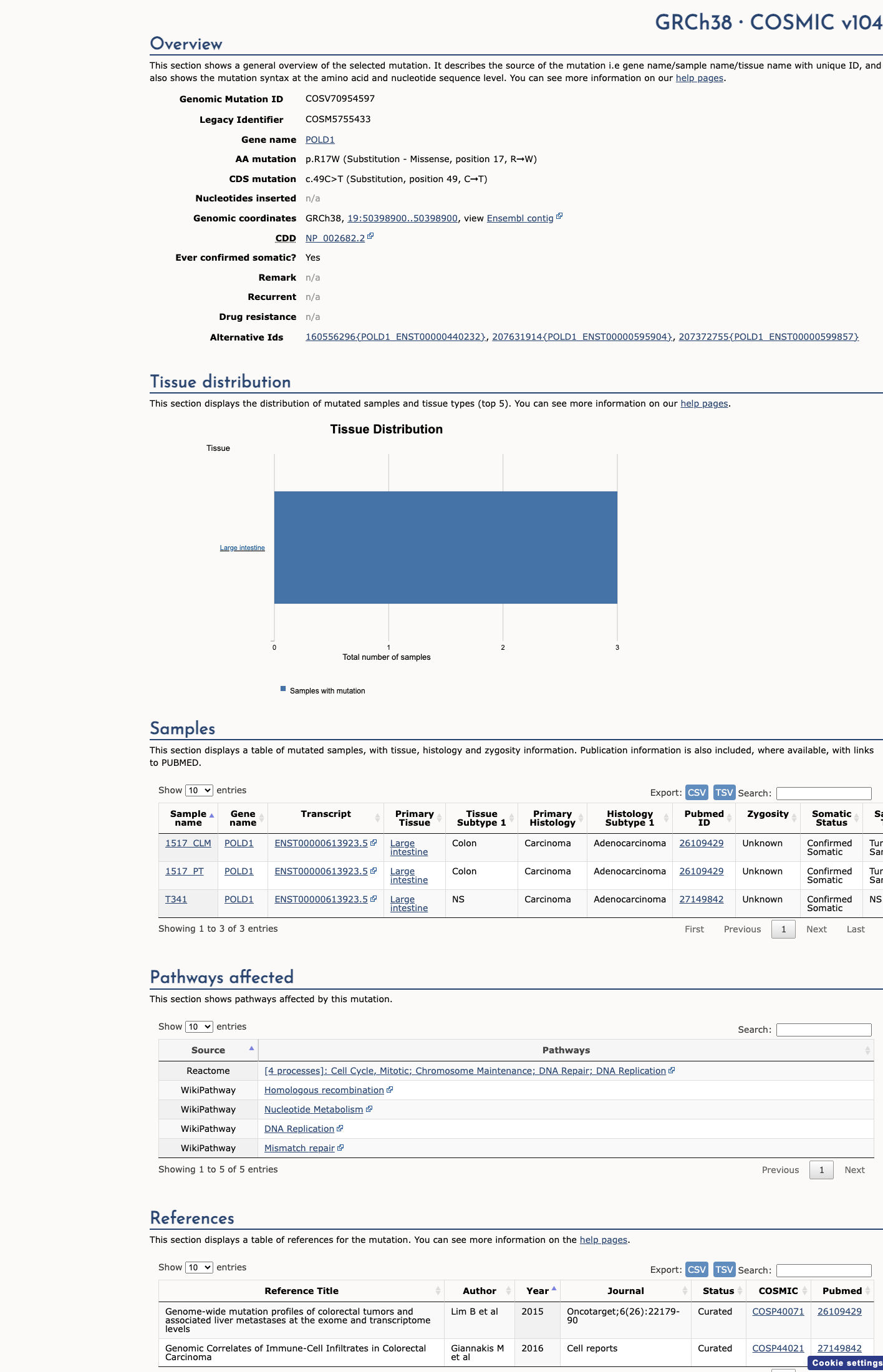
This variant does not lie in a statistically significant hotspot. This variant has previously been reported in somatic cancers (COSMIC; COSV70954597, n = 3 times).
Hotspots
This variant does not lie in a statistically significant hotspot.
Literature · how each cited paper was used
2papers cited
Each card is an audit: what was searched, what was found, whether it names the variant, which criteria it fed, and why. 2 further PMIDs triaged but not cited — see Sources & references.
Rule & framework references · cited for criterion definitions, not variant evidence
25741868 ↗ Standards and guidelines for the interpretation of sequence variants: a joint consensus recommendation of the American College of Medical Genetics and Genomics and the Association for Molecular Pathology.
30093976 ↗ Clinical genetic testing outcome with multi-gene panel in Asian patients with multiple primary cancers.
Sources & reference links
8Sources
ClinVar
gnomAD v2.1
gnomAD v4.1
gnomAD-Canada
SpliceAI
OncoKB
COSMIC
Cancer hotspots
Triaged references · 2 PMIDs not cited in assessment
26467025 ↗ A Standardized DNA Variant Scoring System for Pathogenicity Assessments in Mendelian Disorders. CLINVAR
25394175 ↗ A practice guideline from the American College of Medical Genetics and Genomics and the National Society of Genetic Counselors: referral indications for cancer predisposition assessment. CLINVAR