Back
NM_002691.4:c.961G>A
p.Gly321Ser · POLD1
ACMG/AMP
0%
complete
Final classification
VUS
PM1BS4
POLD1
c.961G>A
p.Gly321Ser
missense · exon 8

POLD1 encodes the catalytic subunit of DNA polymerase delta, an enzyme that carries both DNA synthesis and proofreading (3' to 5' exonuclease) activities and is essential for accurate DNA replication and repair. Germline mutations in its exonuclease domain cause polyposis and predispose people to colorectal, endometrial, and possibly brain cancers. In cancer, POLD1 defects impair replication fidelity, leading to the accumulation of many mutations (an ultra-mutated phenotype) that may make tumors more responsive to immunotherapy, though somatic POLD1 mutations are rare.

This variant

The POLD1 p.Gly321Ser change affects the gene's exonuclease proofreading domain, which is central to replication fidelity and inherited polyposis and cancer susceptibility.

Transcript
NM_002691.4
HGVS · transcript:coding
NM_002691.4:c.961G>A
GRCh38
chr19:50402732 G>A
GRCh37
chr19:50905989 G>A
VUS: PM1 (moderate) plus BS4 (supporting) do not satisfy a generic ACMG/AMP 2015 pathogenic, likely pathogenic, likely benign, or benign combination rule.
Classification rationale
PM1 BS4 VUS
POLD1 c.961G>A missense · exon 8

PM1 moderate: p.Gly321Ser lies in POLD1's critical exonuclease proofreading domain. BS4 supporting: both tested sisters with endometrial cancer lacked the variant, providing non-segregation evidence.

PM1 + BS4 → VUS
LYFE Sciences is an AI system, and it can make mistakes. Criteria may be applied incorrectly, sources may be misread, and a confident-looking classification can still be wrong. Double-check every criterion and its underlying evidence before relying on any call.
Gene diagram · NM_002691.4 · variants mapped to exon structure
POLD1 NM_002691.4
Fetching transcript structure from UCSC…
Applied criteria · 2 applied · 22 assessed
MetEvidence satisfies this criterion.
Not metEvaluated against available evidence; threshold not reached.
Not assessedApplies in principle, but no evidence was found to evaluate it.
N/ADoesn't apply to this variant type.
Applied · 2
Strength Supporting Moderate Strong Very strong
PM1 moderate Pathogenic
Met, moderate: p.Gly321Ser lies in POLD1's exonuclease domain, a critical proofreading region documented for this variant and gene.
Weren et al. report POLD1 c.961G>A, p.Gly321Ser as affecting the exonuclease domain.Elsayed et al. evaluated POLD1 exonuclease-domain exons, report the target Gly321Ser variant, and describe Gly321 as highly conserved.No POLD1-specific VCEP framework or authoritative domain table was available; therefore the generic ACMG/AMP PM1 rule was used.
BS4 supporting review Benign
Met, supporting: both tested sisters with endometrial cancer lacked POLD1 c.961G>A, providing non-segregation evidence.
PMID:30827058 explicitly states that segregation was not supportive in one family and that the patient's two sisters with endometrial cancer did not carry the variant.
Assessed · not applied · 12 not met · 10 not assessed
Pathogenic
PS1 Not assessed: no validated pathogenic or likely pathogenic comparator producing the same p.Gly321Ser amino-acid change was identified.
PS2 Not assessed: no documented parental testing confirms that the POLD1 c.961G>A variant arose de novo.
PS3 Not assessed: the exact variant was reported, but PMID:30827058 states that no functional assay was performed and provides no measured POLD1 activity result.
PS4 Not met: the variant was observed in colorectal polyposis/cancer cases, but no control comparison or statistical enrichment estimate was reported.
PM2 Not met: gnomAD v3.1 non-cancer AF is 0.000250030, exceeding the generic PM2 threshold of 0.0001.
PM3 Not assessed: reports describe heterozygous POLD1 c.961G>A, but no pathogenic POLD1 variant in trans or biallelic affected-proband observation is documented.
PM5 Not assessed: no established pathogenic or likely pathogenic alternate missense change at POLD1 residue 321 was identified.
PM6 Not assessed: the available reports do not describe a presumed de novo POLD1 c.961G>A variant without parental testing.
PP1 Not met: one study found non-supportive segregation, with both tested sisters with endometrial cancer lacking the variant.
PP2 Not assessed: gene-level benign-missense rate and disease-causing missense prevalence needed for PP2 are unavailable.
PP3 Not met: missense REVEL score 0.363 is below the PP3 supporting threshold of 0.644.
PP4 Not met: colorectal polyposis and cancer are nonspecific, and reported cases included alternative explanations such as MUTYH variation or MLH1 promoter hypermethylation.
PP5 Not met: exact-variant ClinVar records show no expert-panel Pathogenic or Likely pathogenic classification for NM_002691.4:c.961G>A.
Benign
BA1 Not met: highest observed allele frequency is 0.000648145, far below the generic BA1 threshold of 0.05.
BS1 Not met: highest observed allele frequency is 0.000648145, below the generic BS1 threshold of 0.01.
BS2 Not assessed: gnomAD v4.1 reports one homozygote, but no individual phenotype or disease-status information establishes the BS2 healthy-person requirement.
BS3 Not assessed: no validated assay demonstrates normal POLD1 function, and PMID:30827058 explicitly states that no functional assay was performed.
BP1 Not met: POLD1 disease-relevant evidence centers on exonuclease-domain missense variants, not a truncating-predominant mechanism.
BP2 Not assessed: a reported heterozygous MUTYH variant lacked phase information, and no qualifying pathogenic POLD1 co-occurrence in cis or trans was documented.
BP4 Not met: missense REVEL score 0.363 exceeds the BP4 supporting threshold of 0.29.
BP5 Not met: alternative MUTYH or MLH1-related findings were reported, but neither is sufficiently established here as the confirmed explanation for the full phenotype.
BP6 Not met: exact-variant ClinVar contains single-submitter Likely benign assertions but no expert-panel Benign or Likely benign classification.
N/A · 4 PVS1 · PM4 · BP3 · BP7
Research & evidence
Population frequency
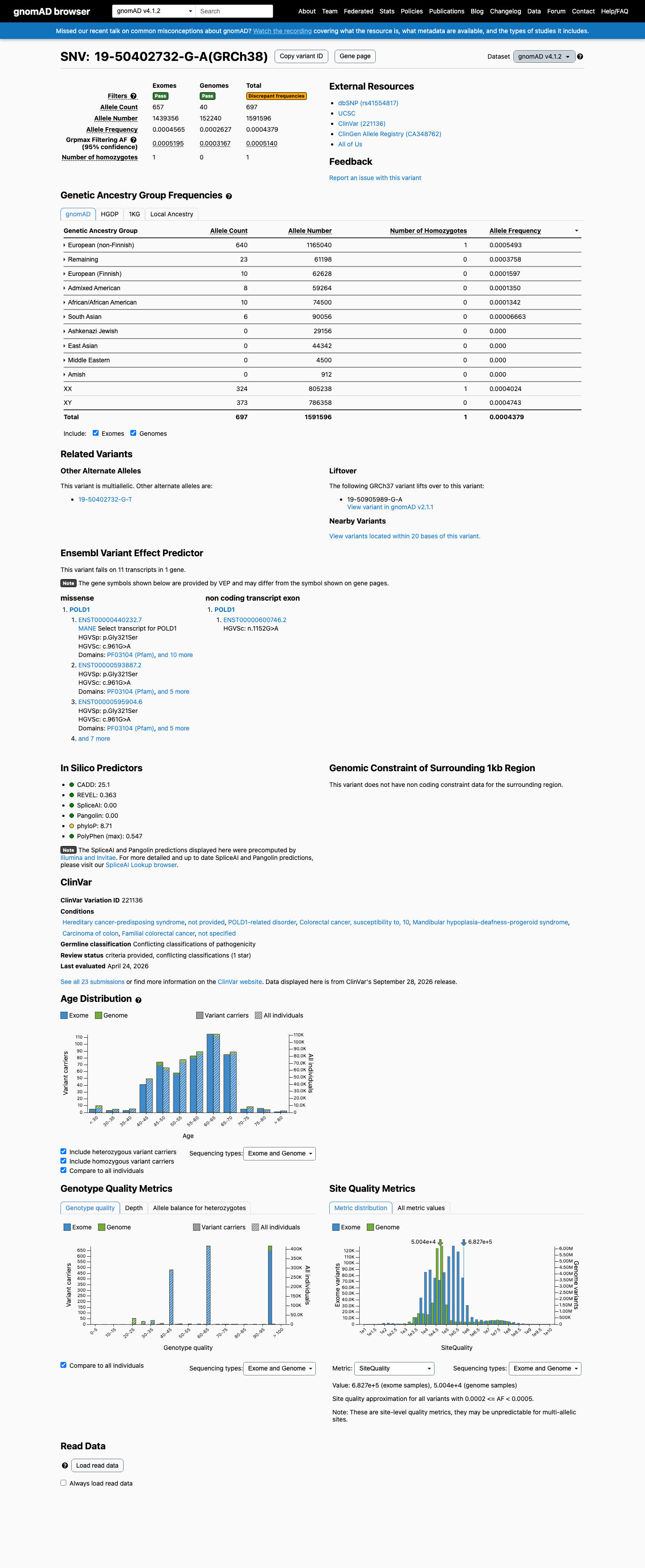
gnomAD v4.1 screenshot
gnomAD v4.1
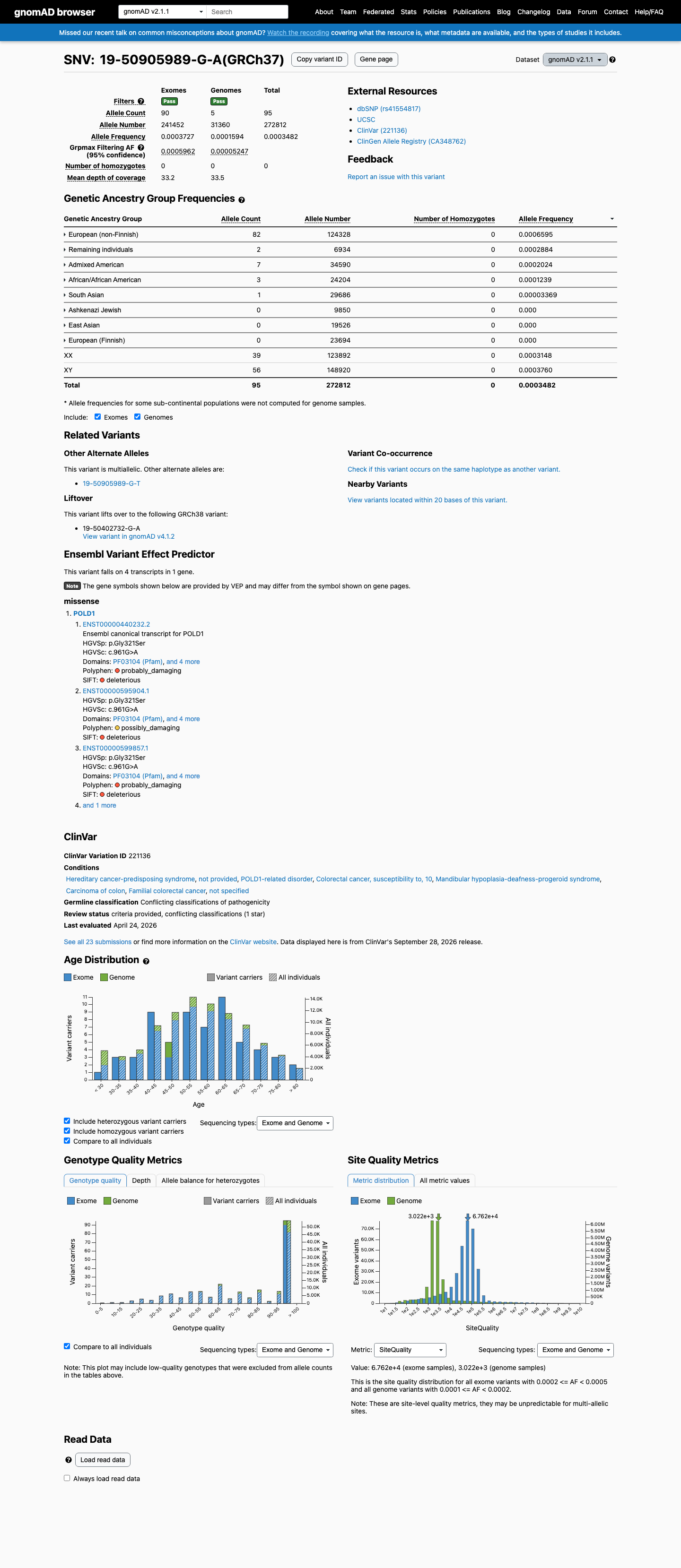
gnomAD v2.1 screenshot
gnomAD v2.1
v4.1
This variant is present in gnomAD v4.1 (AF= 0.000437925; MAF= 0.04379%, 697/1591596 alleles, homozygotes = 1) and has highest observed frequency in the European (non-Finnish) population (AF= 0.000549337; MAF= 0.05493%, 640/1165040 alleles, homozygotes = 1); grpmax FAF= 0.00051403.
v2.1
This variant is present in gnomAD v2.1 (AF= 0.000348225; MAF= 0.03482%, 95/272812 alleles, homozygotes = 0) and has highest observed frequency in the European (non-Finnish) population (AF= 0.000659546; MAF= 0.06595%, 82/124328 alleles, homozygotes = 0); grpmax FAF= 0.0005962.
🇨🇦 CA
This variant is present in gnomAD-Canada v1.0 (AF= 0.0004343576935606472, 8/18418 alleles, homozygotes = 0).
Allele frequency by ancestry
three datasets · side by side
gnomAD v4.1
0.044% · 697 / 1,591,596
1 hom · FAF 0.051%
European (non-Finnish)
640 / 1,165,040
0.055%
1 hom
Remaining individuals
23 / 61,198
0.038%
European (Finnish)
10 / 62,628
0.016%
Admixed American
8 / 59,264
0.013%
African/African American
10 / 74,500
0.013%
South Asian
6 / 90,056
0.0067%
+ 4 not observed (Amish, East Asian, Middle Eastern, Ashkenazi Jewish)
gnomAD v2.1
0.035% · 95 / 272,812
0 hom · FAF 0.06%
European (non-Finnish)
82 / 124,328
0.066%
Remaining individuals
2 / 6,934
0.029%
Admixed American
7 / 34,590
0.02%
African/African American
3 / 24,204
0.012%
South Asian
1 / 29,686
0.0034%
+ 3 not observed (Ashkenazi Jewish, East Asian, European (Finnish))
gnomAD Canada 🇨🇦
0.043% · 8 / 18,418
0 hom · FAF 0.028%
Remaining individuals
1 / 1,138
0.088%
European (non-Finnish)
7 / 11,738
0.06%
+ 7 not observed (African/African American, Latino/Admixed American, Ashkenazi Jewish, East Asian, European (Finnish), Middle Eastern, South Asian)
ClinVar screenshot
ClinVar
This variant has been reported in ClinVar as Uncertain significance (16 clinical laboratories) and as Likely benign (6 clinical laboratories). (ClinVarID = 221136)
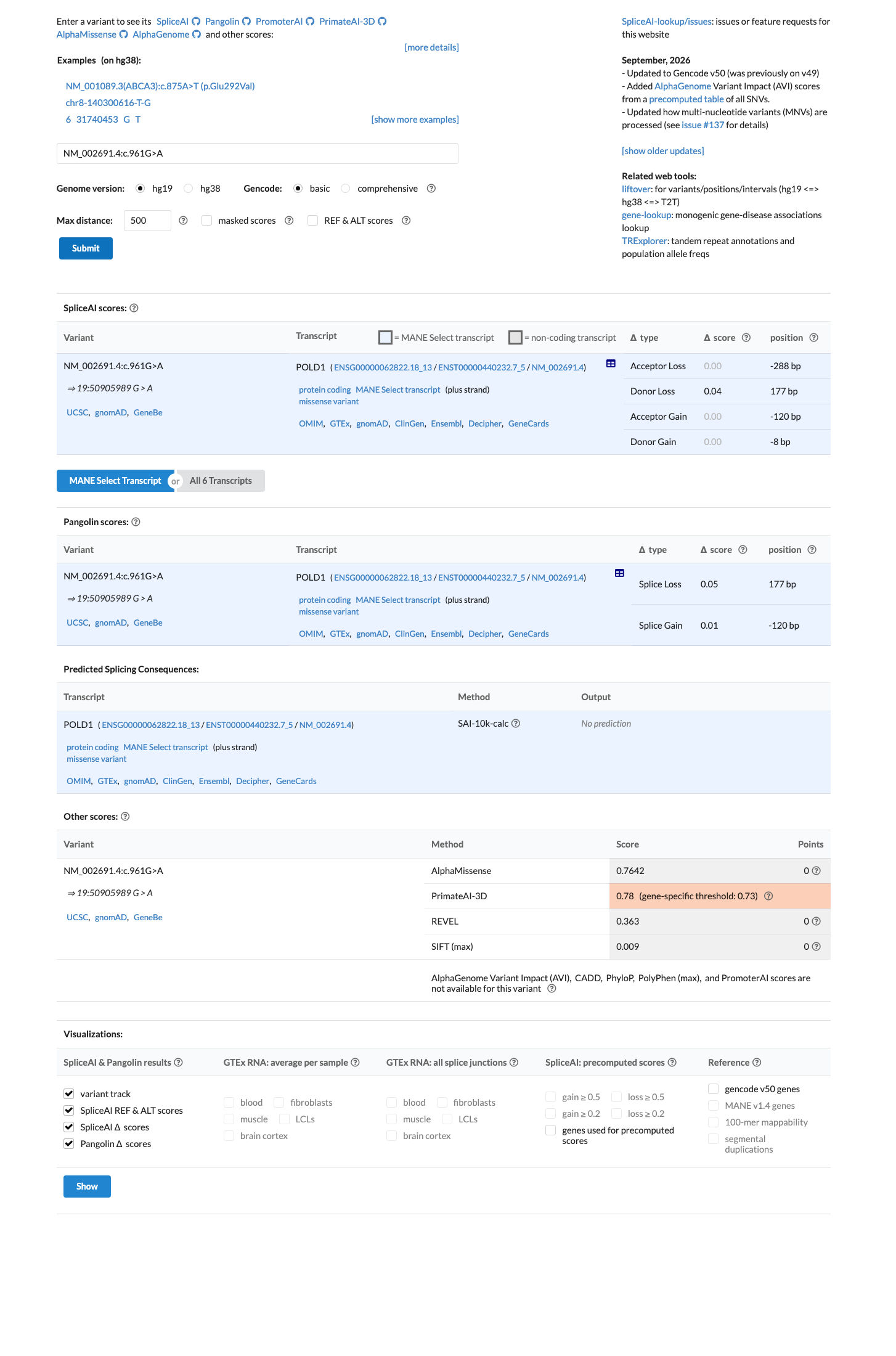
SpliceAI screenshot
In silico
SpliceAI predicts no significant splice impact for this variant (max delta score = 0.04). REVEL score = 0.363. BayesDel score = 0.050619.
Functional / OncoKB screenshot
Functional Unknown Oncogenic Effect
OncoKB did not identify variant-specific reviewed functional evidence for this variant; gene-level curated context is available for reviewer follow-up. POLD1, a DNA polymerase, is infrequently altered by mutation in cancer.
OncoKB ↗
COSMIC screenshot
COSMIC
Cancer hotspots screenshot
Cancer hotspots
Somatic evidence Not in COSMIC / hotspots
COSMIC
This variant does not lie in a statistically significant hotspot. This variant has not previously been reported in somatic cancers (COSMIC).
Hotspots
This variant does not lie in a statistically significant hotspot.
Literature · how each cited paper was used
2papers cited
Each card is an audit: what was searched, what was found, whether it names the variant, which criteria it fed, and why. 6 further PMIDs triaged but not cited — see Sources & references.
A germline homozygous mutation in the base-excision repair gene NTHL1 causes adenomatous polyposis and colorectal cancer.
Searched
POLD1 c.961G>Ap.Gly321SerNP_002682.2:p.(G321S)
Found
The paper identifies POLD1 c.961G>A, p.Gly321Ser in individual P17 and states that the variant affects the POLD1 exonuclease domain.
Variant
✓ Names this variant — characterised directly
Applied to
→PM1 moderate
Places the exact variant in the POLD1 exonuclease domain.
First, we screened for the presence of deleterious variants in known cancer-predisposing genes7 and detected variants in POLD1 (c.961G>A; p.Gly321Ser; NM_002691) and POLE (c.850A>G; p.Lys284Glu; NM_006231) affecting the exonuclease domain in individuals P17 and P35, respectively (Supplementary Table 4).
Location Results, paragraph describing screening for deleterious variants in known cancer-predisposing genes  ·  Context Whole-exome sequencing of 51 individuals with multiple colonic adenomas from 48 families; variants were identified during screening of known cancer-predisposing genes.  ·  full text
Low frequency of POLD1 and POLE exonuclease domain variants in patients with multiple colorectal polyps.
Searched
POLD1 c.961G>Ap.(Gly321Ser)NP_002682.2:p.(G321S)
Found
The paper reports heterozygous germline POLD1 c.961G>A, p.Gly321Ser in two patients from a multiple-colorectal-polyps cohort, evaluates POLD1 exonuclease-domain exons, and describes Gly321 as highly conserved; it states that functional evidence was insufficient and classifies the variant as a VUS.
Variant
✓ Names this variant — characterised directly
Applied to
→PM1 moderate
Documents the target variant in the exonuclease-domain study context and its high conservation.
→BS4 supporting
The paper documents that two sisters with endometrial cancer did not carry the variant, providing variant-specific non-segregation evidence.
The POLD1 c.961G>A, p.(Gly321Ser) variant was identified in two patients with multiple colorectal polyps and CRC. Gly321Ser is highly conserved and predicted to be damaging by in silico analysis. However, the available evidence is currently insufficient to evaluate the effect of this variant on the function of the protein; therefore, the variant is classified as a Variant of Unknown Significance (VUS).
Location Discussion, paragraph 1; Results, POLD1 variant descriptions for patients P1 and P2; Table 2  ·  Context A cohort of 332 patients with multiple colorectal polyps underwent targeted sequencing of POLD1 exonuclease-domain exons, with Sanger validation and available-family-member segregation analysis; no functional assay was performed.  ·  full text
Sources & reference links
8Sources
ClinVar
gnomAD v2.1
gnomAD v4.1
gnomAD-Canada
SpliceAI
OncoKB
COSMIC
Cancer hotspots
Triaged references · 6 PMIDs not cited in assessment
17060676 ↗ ASCO 2006 update of recommendations for the use of tumor markers in gastrointestinal cancer. CLINVAR
22855150 ↗ Guidelines for biomarker testing in colorectal carcinoma (CRC): a national consensus of the Spanish Society of Pathology (SEAP) and the Spanish Society of Medical Oncology (SEOM). CLINVAR
25741868 ↗ Standards and guidelines for the interpretation of sequence variants: a joint consensus recommendation of the American College of Medical Genetics and Genomics and the Association for Molecular Pathology. CLINVAR
26467025 ↗ A Standardized DNA Variant Scoring System for Pathogenicity Assessments in Mendelian Disorders. CLINVAR
26648449 ↗ Combined mismatch repair and POLE/POLD1 defects explain unresolved suspected Lynch syndrome cancers. CLINVAR
33193653 ↗ New Pathogenic Germline Variants in Very Early Onset and Familial Colorectal Cancer Patients. CLINVAR