Back
NM_002691.4:c.2251-23A>G
p.? · POLD1
ACMG/AMP
0%
complete
Final classification
Benign
BS1BS2BP4
POLD1
c.2251-23A>G
p.?
unknown · exon 18i

POLD1 encodes the catalytic subunit of DNA polymerase delta, an enzyme that carries both DNA synthesis and proofreading (3' to 5' exonuclease) activities and is essential for accurate DNA replication and repair. Germline mutations in its exonuclease domain cause polyposis and predispose people to colorectal, endometrial, and possibly brain cancers. In cancer, POLD1 defects impair replication fidelity, leading to the accumulation of many mutations (an ultra-mutated phenotype) that may make tumors more responsive to immunotherapy, though somatic POLD1 mutations are rare.

This variant

POLD1 encodes the catalytic DNA polymerase delta subunit whose proofreading activity maintains replication fidelity, and germline exonuclease-domain disruption is associated with polyposis and cancer predisposition.

Transcript
NM_002691.4
HGVS · transcript:coding
NM_002691.4:c.2251-23A>G
GRCh38
chr19:50413719 A>G
GRCh37
chr19:50916976 A>G
Benign: BS1 (strong) and BS2 (strong) satisfy the generic ACMG/AMP rule for Benign; BP4 (supporting) is additionally met.
Classification rationale
BS1BS2BP4 Benign
POLD1 c.2251-23A>G unknown · exon 18i

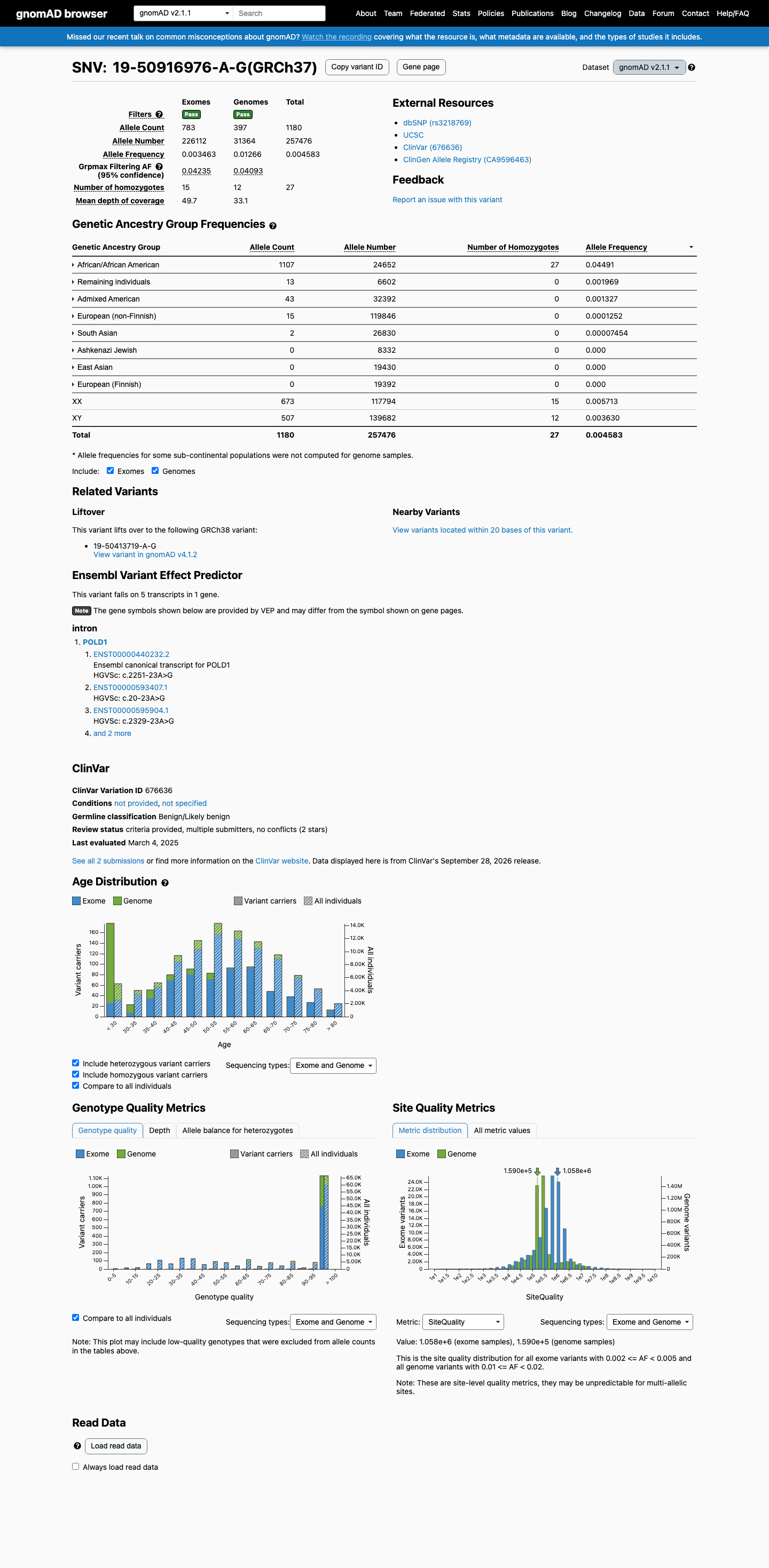
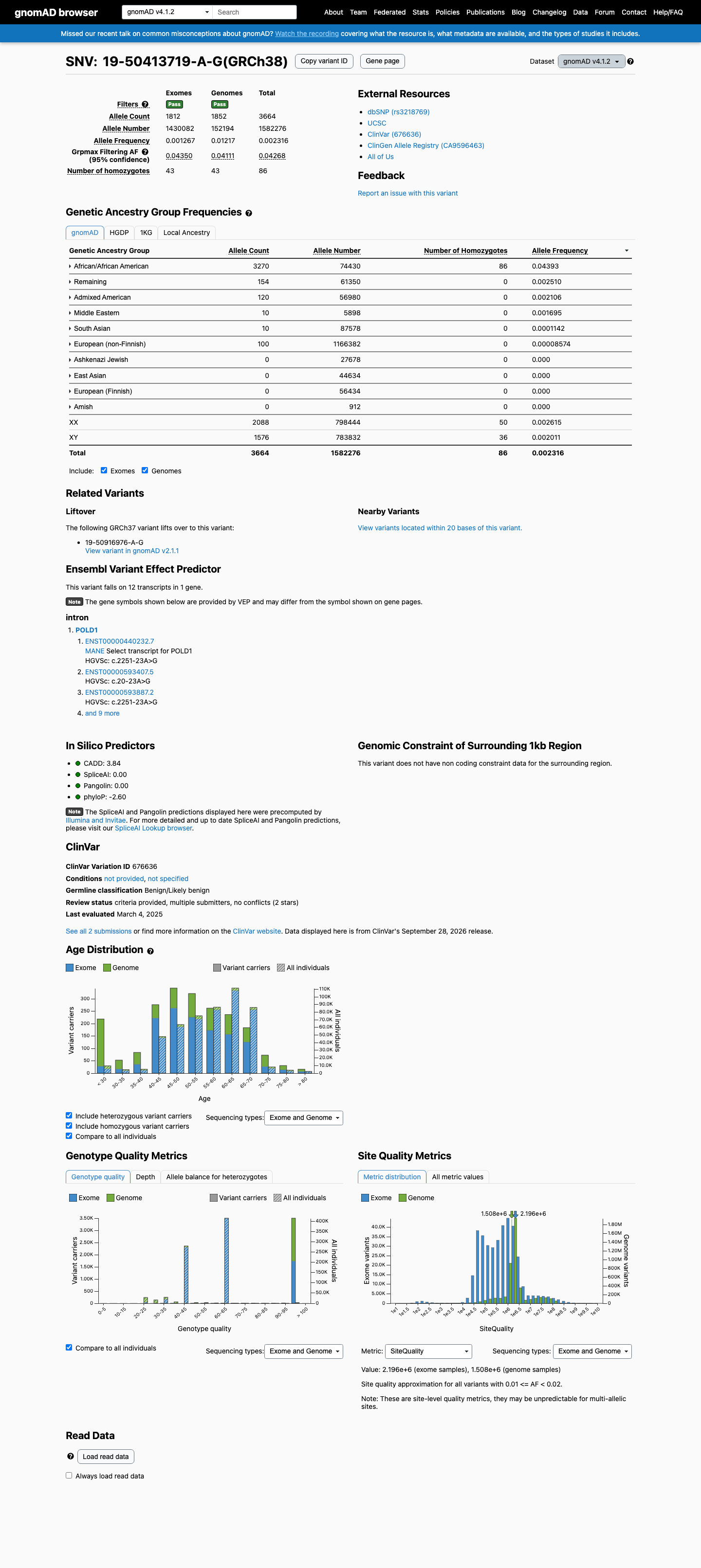
Benign: BS1 (strong) is met because the gnomAD v2.1 genome allele frequency is 0.0126578. Benign: BS2 (strong) is met because gnomAD reports 27 v2.1 and 86 v4.1 homozygotes. Benign: BP4 (supporting) is met because SpliceAI maximum delta is 0.002.

BS1 + BS2 + BP4 → Benign
LYFE Sciences is an AI system, and it can make mistakes. Criteria may be applied incorrectly, sources may be misread, and a confident-looking classification can still be wrong. Double-check every criterion and its underlying evidence before relying on any call.
Gene diagram · NM_002691.4 · variants mapped to exon structure
POLD1 NM_002691.4
Fetching transcript structure from UCSC…
Applied criteria · 3 applied · 16 assessed
MetEvidence satisfies this criterion.
Not metEvaluated against available evidence; threshold not reached.
Not assessedApplies in principle, but no evidence was found to evaluate it.
N/ADoesn't apply to this variant type.
Applied · 3
Strength Supporting Moderate Strong Very strong
BS1 strong Benign
Met at strong: gnomAD v2.1 genome allele frequency is 0.0126578, exceeding the generic BS1 threshold of 0.01.
No governing POLD1-specific VCEP framework was available; the supplied generic BS1 threshold is allele frequency >=0.01.gnomAD v2.1 reports genome AF 0.012657824257110062 and AFR_XX AF 0.047193500738552434; its overall AF is 0.00458295142071494.gnomAD v4.1 reports genome AF 0.012168679448598499 and AFR_XX AF 0.04528421257543313; its overall AF is 0.0023156516309417573.
BS2 strong review Benign
Met at strong: gnomAD v4.1 reports 86 homozygotes, although the all-comers population dataset does not directly verify healthy-adult status.
gnomAD v2.1 reports 27 homozygotes overall, including 15 exome homozygotes and 12 genome homozygotes.gnomAD v4.1 reports 86 homozygotes overall, including 86 in the African/African American subgroup; the v4.1 record reports 43 exome and 43 genome homozygotes.The generic BS2 interpretation requires observation in healthy individuals; the available gnomAD records establish homozygotes in population data but do not provide individual-level phenotype or age ascertainment.
BP4 supporting Benign
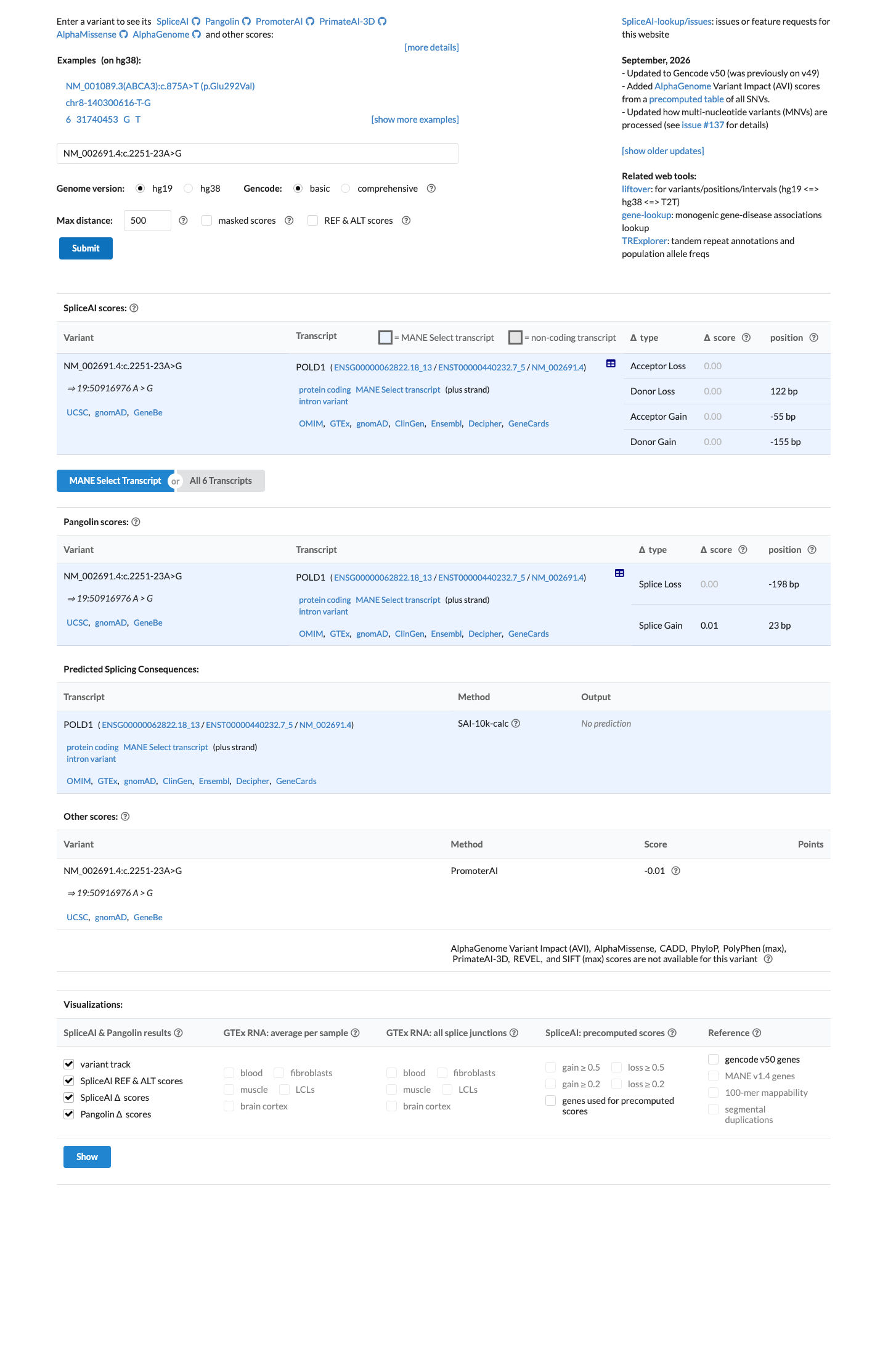
Met at supporting strength: SpliceAI maximum delta 0.002 meets the <=0.1 BP4 supporting threshold.
The variant is intronic, so SpliceAI is the applicable BP4 path and REVEL is not applicable.SpliceAI component scores are DS_AG 0.002, DS_AL 0.000, DS_DG 0.000, and DS_DL 0.001; the maximum delta is 0.002.The generic SpliceAI BP4 supporting threshold is <=0.1, as supplied from Jaganathan et al. 2019 (PMID:30661751).
Assessed · not applied · 5 not met · 11 not assessed
Pathogenic
PS2 Not assessed: no proband genotype, parental testing, confirmed parentage, or documented de novo event is available for this variant.
PS3 Not assessed: no validated RNA, protein, or minigene assay is documented; SpliceAI maximum delta 0.002 is computational, not functional evidence.
PS4 Not assessed: no affected-case series, control comparison, or case-control enrichment metric is available for this exact intronic POLD1 variant.
PM2 Not met: gnomAD v4.1 overall allele frequency is 0.00231565, exceeding the generic PM2 cutoff of 0.0001.
PM3 Not assessed: no affected proband, second pathogenic allele, or phase result documents this variant in trans for a recessive disorder.
PM6 Not assessed: no clinical report supports a presumed de novo occurrence without parental testing for this variant.
PP1 Not assessed: no affected relatives, unaffected tested carriers, informative meioses, or genotype-phenotype segregation data are documented.
PP3 Not met: SpliceAI maximum delta 0.002 is below the >=0.2 PP3 supporting threshold.
PP4 Not assessed: no patient phenotype or disease-specific clinical features are provided to evaluate specificity for a POLD1-associated disorder.
PP5 Not met: ClinVar variation 676636 has zero expert-panel submissions and only exact-variant laboratory classifications of Benign or Likely benign.
Benign
BA1 Not met: the highest observed allele frequency is 0.0471935 in gnomAD v2.1 AFR_XX, below the generic BA1 threshold of 0.05.
BS3 Not assessed: no validated benign-function assay is documented; SpliceAI maximum delta 0.002 cannot establish normal POLD1 function.
BS4 Not assessed: no informative affected non-carrier or unaffected carrier is documented in a family tested for this variant.
BP2 Not assessed: no phase-resolved observation establishes this variant in trans or cis with a pathogenic allele under the generic BP2 rule.
BP5 Not assessed: no patient phenotype or pathogenic variant in another gene is documented to provide an alternative explanation.
BP6 Not met: ClinVar variation 676636 has zero expert-panel submissions, so its exact-variant Benign and Likely benign laboratory labels do not qualify for BP6.
N/A · 9 PVS1 · PS1 · PM1 · PM4 · PM5 · PP2 · BP1 · BP3 · BP7
Research & evidence
Population frequency · supports benign
gnomAD v4.1 screenshot
gnomAD v4.1
gnomAD v2.1 screenshot
gnomAD v2.1
v4.1
This variant is present in gnomAD v4.1 (AF= 0.00231565; MAF= 0.23157%, 3664/1582276 alleles, homozygotes = 86) and has highest observed frequency in the African/African American population (AF= 0.0439339; MAF= 4.39339%, 3270/74430 alleles, homozygotes = 86); grpmax FAF= 0.0426777.
v2.1
This variant is present in gnomAD v2.1 (AF= 0.00458295; MAF= 0.45830%, 1180/257476 alleles, homozygotes = 27) and has highest observed frequency in the African/African American population (AF= 0.0449051; MAF= 4.49051%, 1107/24652 alleles, homozygotes = 27); grpmax FAF= 0.042349.
🇨🇦 CA
Not available in gnomAD-Canada v1.0.
Allele frequency by ancestry
three datasets · side by side
gnomAD v4.1
0.23% · 3664 / 1,582,276
86 hom · FAF 4.3%
African/African American
3270 / 74,430
4.4%
86 hom
Remaining individuals
154 / 61,350
0.25%
Admixed American
120 / 56,980
0.21%
Middle Eastern
10 / 5,898
0.17%
South Asian
10 / 87,578
0.011%
European (non-Finnish)
100 / 1,166,382
0.0086%
+ 4 not observed (European (Finnish), Amish, East Asian, Ashkenazi Jewish)
gnomAD v2.1
0.46% · 1180 / 257,476
27 hom · FAF 4.2%
African/African American
1107 / 24,652
4.5%
27 hom
Remaining individuals
13 / 6,602
0.2%
Admixed American
43 / 32,392
0.13%
European (non-Finnish)
15 / 119,846
0.013%
South Asian
2 / 26,830
0.0075%
+ 3 not observed (Ashkenazi Jewish, East Asian, European (Finnish))
gnomAD Canada 🇨🇦
Absent · 0 / ?
0 hom
Not observed in any ancestry group.
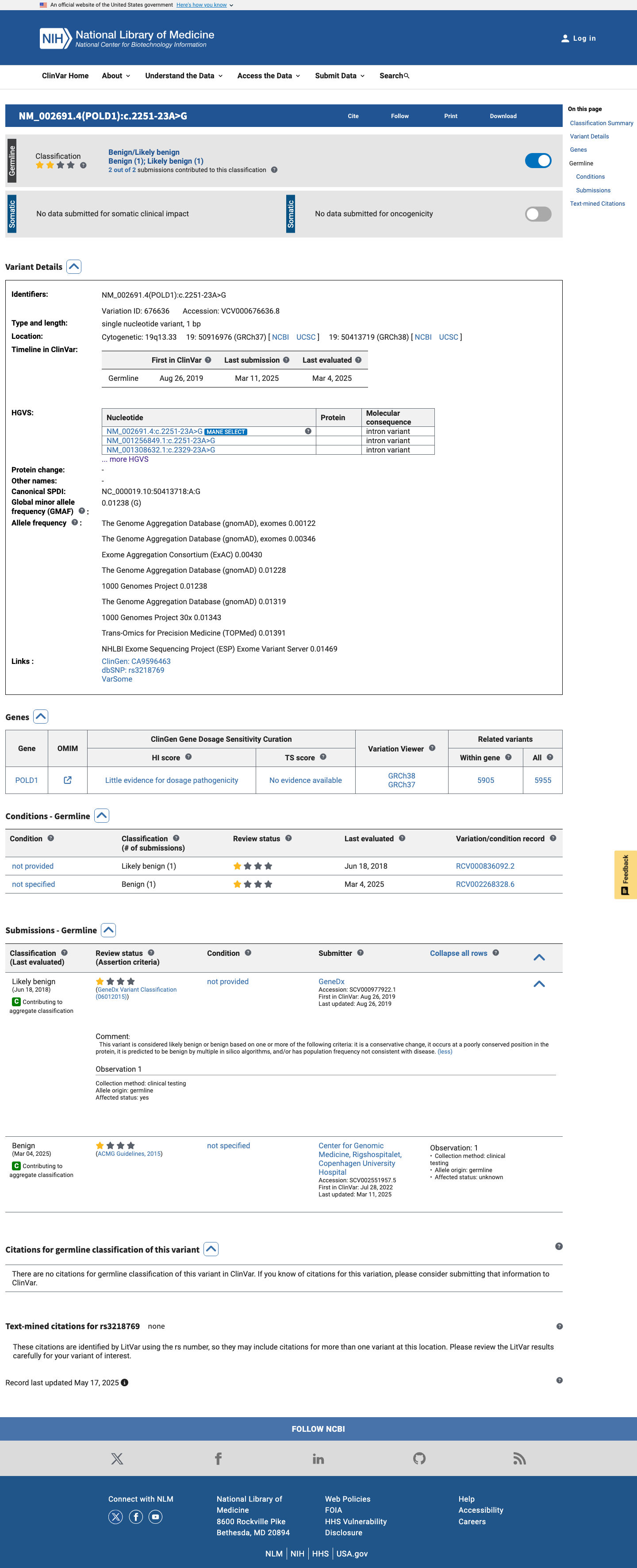
ClinVar screenshot
ClinVar
This variant has been reported in ClinVar as Likely benign (1 clinical laboratory) and as Benign (1 clinical laboratory). (ClinVarID = 676636)
SpliceAI screenshot
In silico
SpliceAI predicts no significant splice impact for this variant (max delta score = 0.00).
Functional No data
No calibrated functional assay or RNA evidence was identified for this variant.
OncoKB ↗
COSMIC screenshot
COSMIC
Somatic evidence
COSMIC
This variant has not previously been reported in somatic cancers (COSMIC).
Hotspots
This variant does not lie in a statistically significant cancer hotspot.
COSMIC ↗
Sources & reference links
7Sources
ClinVar
gnomAD v2.1
gnomAD v4.1
gnomAD-Canada
SpliceAI
OncoKB
COSMIC
Triaged references · 1 PMID not cited in assessment
25741868 ↗ Standards and guidelines for the interpretation of sequence variants: a joint consensus recommendation of the American College of Medical Genetics and Genomics and the Association for Molecular Pathology. CLINVAR