Analysis in progress
Initialising…
0%
complete
This report is still being assembled — sections appear as each stage finishes. It isn't final yet.
POLD1
Final classification
Likely Pathogenic
PVS1PM2
POLD1
c.2959del
p.Asp987ThrfsTer58
frameshift · exon 24

POLD1 encodes the catalytic subunit of DNA polymerase delta, an enzyme that carries both DNA synthesis and proofreading (3' to 5' exonuclease) activities and is essential for accurate DNA replication and repair. Germline mutations in its exonuclease domain cause polyposis and predispose people to colorectal, endometrial, and possibly brain cancers. In cancer, POLD1 defects impair replication fidelity, leading to the accumulation of many mutations (an ultra-mutated phenotype) that may make tumors more responsive to immunotherapy, though somatic POLD1 mutations are rare.

This variant

POLD1 encodes the catalytic, proofreading subunit of DNA polymerase delta, and loss of its function is an established disease mechanism for the gene's cancer predisposition. A Likely Pathogenic classification for this NMD-predicted frameshift therefore places it in that loss-of-function pathway, consistent with the colorectal and endometrial cancer associations described above.

Transcript
NM_002691.4
HGVS · transcript:coding
NM_002691.4:c.2959del
GRCh38
chr19:50416608 AG>A
GRCh37
chr19:50919865 AG>A
Basis Generic ACMG/AMP 2015 rules applied in the absence of a POLD1-specific framework; PVS1 (Very Strong) + PM2 (Supporting) combine to Likely Pathogenic per the ClinGen SVI 2020 PM2-downgrade addendum.
Generic ACMG/AMP 2015 rules applied in the absence of a POLD1-specific framework; PVS1 (Very Strong) + PM2 (Supporting) combine to Likely Pathogenic per the ClinGen SVI 2020 PM2-downgrade addendum.
Classification rationale
PVS1PM2 Likely Pathogenic
POLD1 c.2959del frameshift · exon 24

PVS1 (Very Strong): frameshift p.(Asp987ThrfsTer58) introduces a premature stop 58 codons downstream, predicted to trigger nonsense-mediated decay. PM2 (Supporting): overall allele frequency 5.77e-06 in gnomAD v4.1, far below the 0.1% threshold, with no homozygotes. Overall: Likely Pathogenic — PVS1 (Very Strong) plus PM2 (Supporting) under the ClinGen SVI 2020 PM2-downgrade addendum (PVS1 + 1 supporting).

PVS1 + PM2 Likely Pathogenic
Gene diagram · NM_002691.4 · variants mapped to exon structure
POLD1 NM_002691.4
Fetching transcript structure from UCSC…
Applied criteria · 2 applied · 15 assessed
MetEvidence satisfies this criterion.
Not metEvaluated against available evidence; threshold not reached.
Not assessedApplies in principle, but no evidence was found to evaluate it.
N/ADoesn't apply to this variant type.
Applied · 2
Strength Supporting Moderate Strong Very strong
PVS1 very strong review Pathogenic
Met (Very Strong): frameshift creates a premature stop codon 58 codons downstream, predicted to trigger nonsense-mediated decay.
pvs1_gene_context.json: targeted germline literature review classified POLD1 loss-of-function as an eligible germline disease mechanism ('lof_mechanism_supported': true, 'pvs1_gene_gate': 'eligible'), enabling generic PVS1 framework application in the absence of an official CSPEC/VCEP source.pvs1_variant_assessment.json: classifies NM_002691.4:c.2959del as consequence_class='frameshift'/variant_bucket='frameshift', cites the ClinGen SVI PVS1 recommendations (PMC6185798) as the governing generic framework, and flags downgrade_considerations around confirming transcript relevance, NMD escape, and exon-level biological importance before finalizing full-strength PVS1.case_summary.json normalization block confirms the predicted protein consequence as NP_002682.2:p.(Asp987ThrfsTer58) (single-nucleotide deletion causing a frameshift with a new stop 58 codons downstream), truncating the protein well before its native 1107-residue length.
PM2 supporting review Pathogenic
Met (Supporting): allele frequency 5.77e-06 in gnomAD v4.1, far below the 0.1% threshold. Flagged for human review: a ClinVar submitter noted gnomAD frequency data at this position may be unreliable.
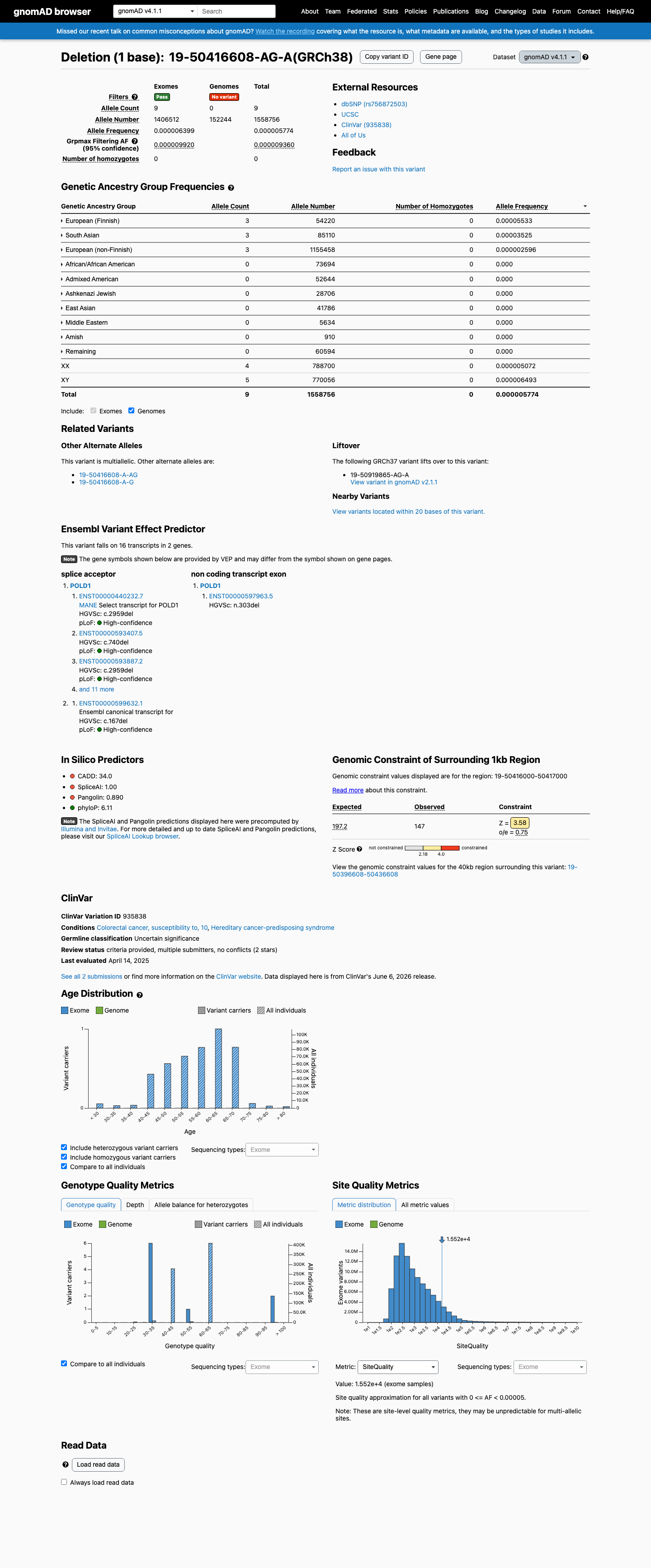
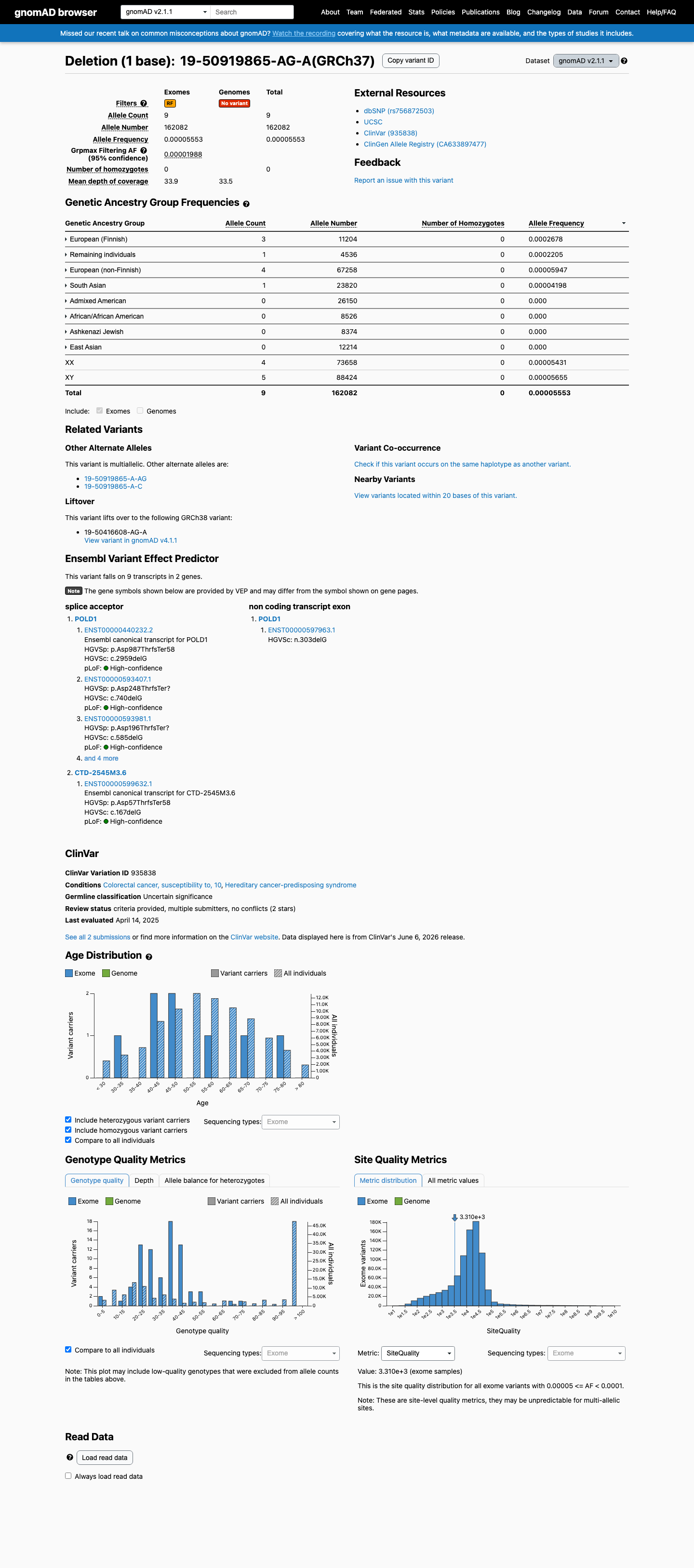
gnomAD v4.1 reports 9/1,558,756 alleles, AF 5.77384e-06, zero homozygotes, and grpmax FAF 9.36e-06; the highest subgroup AF is 5.53301e-05 in Finnish individuals.gnomAD v2.1 reports 9/162,082 alleles, AF 5.55274e-05, zero homozygotes, and grpmax FAF 1.988e-05; the highest subgroup AF is 2.67762e-04 in Finnish individuals.The variant is absent from gnomAD-Canada v1.0.
Assessed · not applied · 4 not met · 11 not assessed
Pathogenic
PS2 Not assessed: no parental testing or de novo confirmation for this variant was documented.
PS3 Not assessed: no functional assay data for this exact variant was available.
PS4 Not assessed: no case-control counts or qualifying case series for this exact variant were available.
PM6 Not assessed: no parental testing or clinical context supporting an assumed de novo occurrence was documented.
PP1 Not assessed: no affected relatives, informative meioses, or segregation data for this variant were documented.
PP4 Not assessed: no patient-level phenotype or family-history data specific to this case was available.
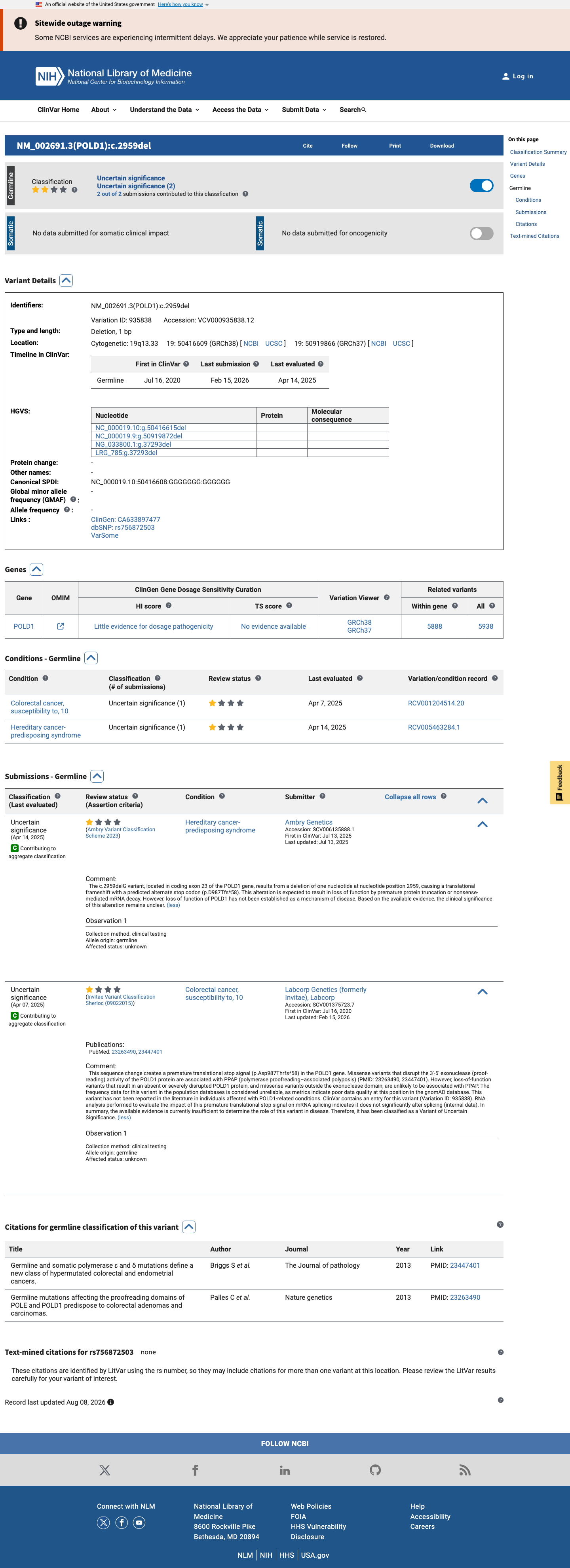
PP5 Not met: ClinVar variation 935838 has only two Uncertain-significance laboratory submissions and no expert-panel classification.
Benign
BA1 Not met: highest observed allele frequency 5.53e-05 is far below the 1% BA1 threshold.
BS1 Not met: highest observed allele frequency 5.53e-05 is far below the 0.3% BS1 threshold.
BS2 Not assessed: no phenotype-confirmed healthy-adult observation exists; zero homozygotes alone are insufficient.
BS3 Not assessed: no functional assay data for this variant was available to demonstrate normal function.
BS4 Not assessed: no tested relatives or non-segregation observations were documented for this variant.
BP2 Not assessed: no data on phase with another variant (trans or cis) was available.
BP5 Not assessed: no alternative molecular cause for the patient's phenotype was documented.
BP6 Not met: ClinVar variation 935838 has only two Uncertain-significance laboratory submissions and no expert-panel classification.
N/A · 11 PS1 · PM1 · PM3 · PM4 · PM5 · PP2 · PP3 · BP1 · BP3 · BP4 · BP7
Research & evidence
Population frequency · supports pathogenic
gnomAD v4.1 screenshot
gnomAD v4.1
gnomAD v2.1 screenshot
gnomAD v2.1
v4.1
This variant is present in gnomAD v4.1 (AF= 5.77384e-06; MAF= 0.00058%, 9/1558756 alleles, homozygotes = 0) and has highest observed frequency in the European (Finnish) population (AF= 5.53301e-05; MAF= 0.00553%, 3/54220 alleles, homozygotes = 0); grpmax FAF= 9.36e-06.
v2.1
This variant is present in gnomAD v2.1 (AF= 5.55274e-05; MAF= 0.00555%, 9/162082 alleles, homozygotes = 0) and has highest observed frequency in the European (Finnish) population (AF= 0.000267762; MAF= 0.02678%, 3/11204 alleles, homozygotes = 0); grpmax FAF= 1.988e-05.
🇨🇦 CA
Absent from gnomAD-Canada v1.0.
Allele frequency by ancestry
three datasets · side by side
gnomAD v4.1
0.00058% · 9 / 1,558,756
0 hom · FAF 0.00094%
European (Finnish)
3 / 54,220
0.0055%
South Asian
3 / 85,110
0.0035%
European (non-Finnish)
3 / 1,155,458
0.00026%
+ 7 not observed (Remaining individuals, Admixed American, Amish, East Asian, Middle Eastern, Ashkenazi Jewish, African/African American)
gnomAD v2.1
0.0056% · 9 / 162,082
0 hom · FAF 0.002%
European (Finnish)
3 / 11,204
0.027%
Remaining individuals
1 / 4,536
0.022%
European (non-Finnish)
4 / 67,258
0.0059%
South Asian
1 / 23,820
0.0042%
+ 4 not observed (African/African American, Admixed American, Ashkenazi Jewish, East Asian)
gnomAD Canada 🇨🇦
Absent · 0 / ?
0 hom
Not observed in any ancestry group.
ClinVar screenshot
ClinVar
This variant has been reported in ClinVar as Uncertain significance (2 clinical laboratories). (ClinVarID = 935838)
SpliceAI screenshot
In silico
SpliceAI predicts no significant splice impact for this variant (max delta score = 0.00).
Functional / OncoKB screenshot
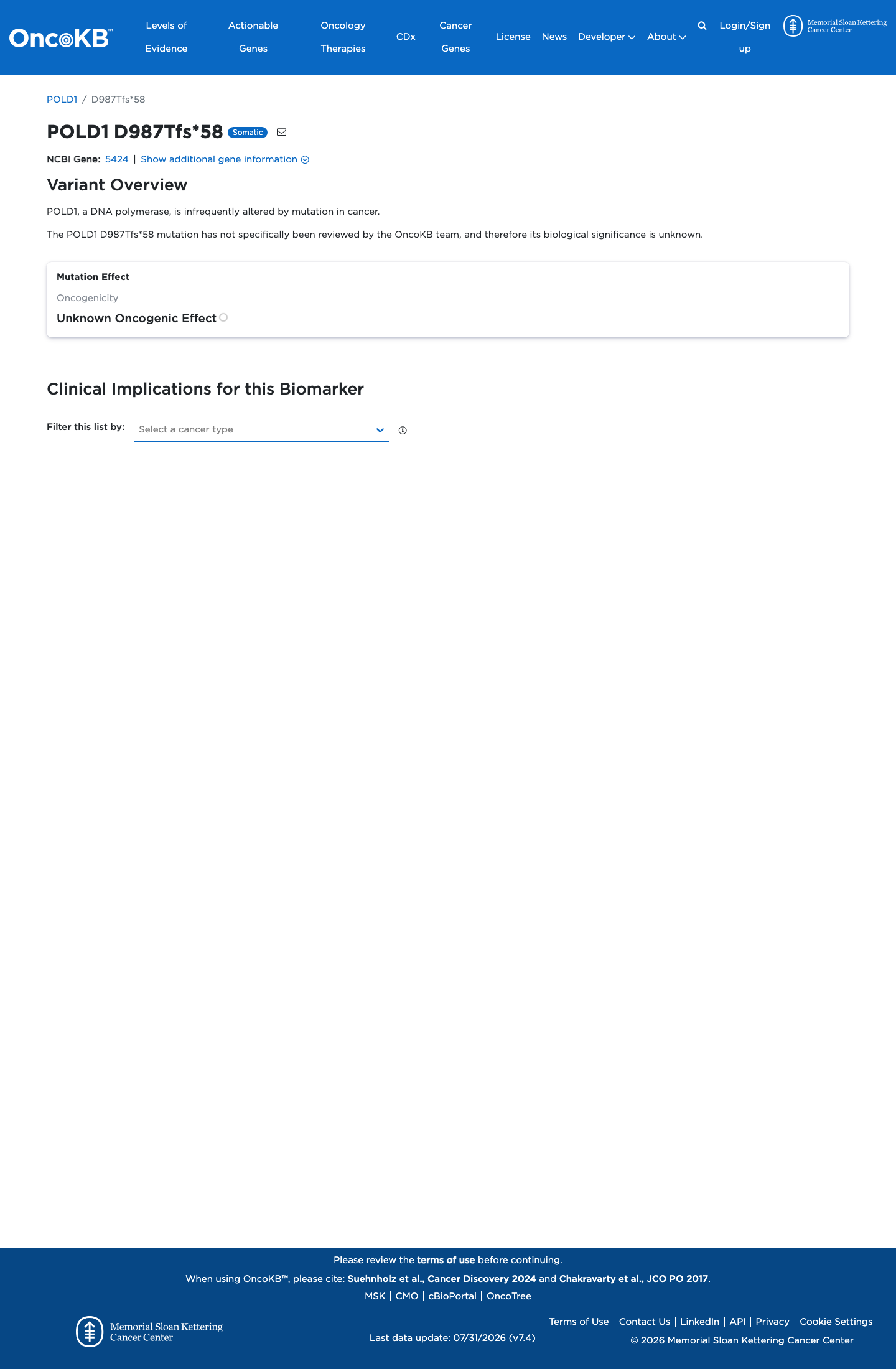
Functional Unknown Oncogenic Effect
OncoKB did not identify variant-specific reviewed functional evidence for this variant; gene-level curated context is available for reviewer follow-up. POLD1, a DNA polymerase, is infrequently altered by mutation in cancer.
OncoKB ↗
COSMIC screenshot
COSMIC
Cancer hotspots screenshot
Cancer hotspots
Somatic evidence Not in COSMIC / hotspots
COSMIC
This variant does not lie in a statistically significant hotspot. This variant has not previously been reported in somatic cancers (COSMIC).
Hotspots
This variant does not lie in a statistically significant hotspot.
Sources & reference links
8Sources
ClinVar
gnomAD v2.1
gnomAD v4.1
gnomAD-Canada
SpliceAI
OncoKB
COSMIC
Cancer hotspots
Triaged references · 3 PMIDs not cited in assessment
23263490 ↗ Germline mutations affecting the proofreading domains of POLE and POLD1 predispose to colorectal adenomas and carcinomas. CLINVAR
23447401 ↗ Germline and somatic polymerase ε and δ mutations define a new class of hypermutated colorectal and endometrial cancers. CLINVAR
25394175 ↗ A practice guideline from the American College of Medical Genetics and Genomics and the National Society of Genetic Counselors: referral indications for cancer predisposition assessment. CLINVAR