NM_002742.3:c.2130A>T (p.Glu710Asp) is a missense variant in exon 15 of PRKD1. This variant is absent from gnomAD v2.1, gnomAD v4.1, and gnomAD-Canada v1.0, meeting PM2 at moderate strength.1 Missense variants in PRKD1 are an established germline disease mechanism (PMID:32817298 reports de novo p.Gly592Arg and p.Arg603His causing syndromic congenital heart disease with ectodermal dysplasia); BP1 does not apply. In silico predictors yield mixed results — REVEL 0.744 (damaging), BayesDel 0.117 (benign-leaning), SpliceAI 0.00 (neutral) — and do not meet the threshold for either PP3 or BP4.2 No variant-specific functional data, de novo reports, cosegregation data, ClinVar classification, or case-control evidence are available for this variant.3 With only one moderate criterion (PM2) met and no supporting or pathogenic moderate criteria, the variant is classified as a Variant of Uncertain Significance (VUS) under generic ACMG/AMP 2015 combination rules.4
Final classification
VUS
PM2
PRKD1
c.2130A>T
p.Glu710Asp
This variant
NM_002742.3:c.2130A>T (p.Glu710Asp) is a missense variant in exon 15 of PRKD1.
gene-specific framework lacked a usable explicit final combination framework, so generic ACMG/AMP 2015 final-combination rules were applied as fallback; applied criteria: PM2 moderate; combination = 1 moderate, which maps to VUS.
Classification rationale
PM2
VUS
PRKD1 c.2130A>T
PM2
→
VUS
2
revelbayesdelspliceai ↗
4
generic_acmg_combination_rules
LYFE Sciences is an AI system, and it can make mistakes. Criteria
may be applied incorrectly, sources may be misread, and a confident-looking
classification can still be wrong. Double-check every criterion and
its underlying evidence before relying on any call.
Gene diagram
· NM_002742.3 · variants mapped to exon structure
PRKD1
NM_002742.3
Fetching transcript structure from UCSC…
Applied criteria · 1 applied · 21 assessed
MetEvidence satisfies this criterion.
Not metEvaluated against available evidence; threshold not reached.
Not assessedApplies in principle, but no evidence was found to evaluate it.
N/ADoesn't apply to this variant type.
Applied · 1
Strength
Supporting
Moderate
Strong
Very strong
PM2
moderate
Pathogenic
NM_002742.3:c.2130A>T is absent from gnomAD v2.1 (exomes), gnomAD v4.1 (exomes), and gnomAD-Canada v1.0 (genomes). The allele frequency in all large population databases is below the 0.1% generic ACMG PM2 threshold.
Absent from gnomAD v2.1Absent from gnomAD v4.1Absent from gnomAD-Canada v1.0
Assessed · not applied
· 7 not met · 14 not assessed
Pathogenic
PS1
No pathogenic or likely pathogenic variant at the same amino acid position (Glu710) with a different nucleotide change has been identified in ClinVar or the literature.
PS2
No de novo testing data available for NM_002742.3:c.2130A>T.
PS3
No variant-specific functional studies have been identified for p.Glu710Asp in PRKD1.
PS4
No case-control or cohort data are available for NM_002742.3:c.2130A>T.
PM1
The variant at codon 710 does not lie within a statistically significant mutational hotspot (Cancer Hotspots database negative).
PM6
No de novo data are available for this specific variant.
PP1
No cosegregation data are available for NM_002742.3:c.2130A>T in affected families.
PP2
HCI prior data is unavailable for PRKD1; the gene is not in the supported gene list for PP2.
PP3
In silico predictors show mixed results.
PP4
No patient phenotype information is available to assess whether this variant is found in an individual with a phenotype specific for PRKD1-related disease (congenital heart disease, ectodermal dysplasia, telangiectasia, brachydactyly).
PP5
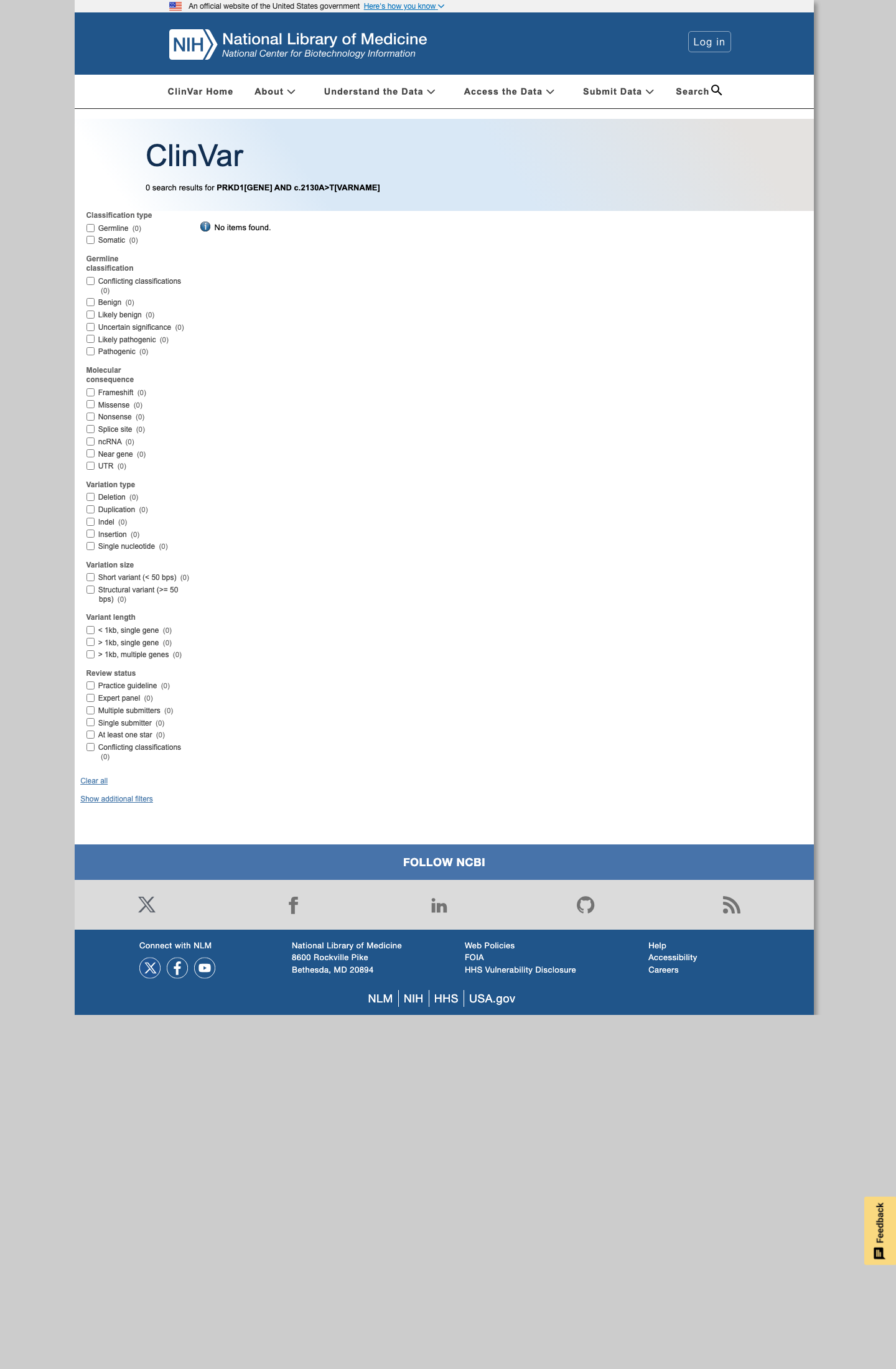
NM_002742.3:c.2130A>T is absent from ClinVar.
Benign
BA1
NM_002742.3:c.2130A>T is absent from gnomAD v2.1 and gnomAD v4.1.
BS1
NM_002742.3:c.2130A>T is absent from all gnomAD datasets.
BS2
No data are available on observation of NM_002742.3:c.2130A>T in healthy adults to exclude full disease penetrance.
BS3
No well-established functional studies demonstrate no deleterious effect for p.Glu710Asp in PRKD1.
BS4
No family segregation data are available to demonstrate lack of cosegregation with PRKD1-related disease.
BP1
PRKD1 missense variants are an established disease mechanism.
BP2
No data are available on observation of NM_002742.3:c.2130A>T in trans with a known pathogenic PRKD1 variant.
BP4
In silico predictors show mixed results.
BP5
No case has been reported in which an alternate molecular basis for disease was identified alongside NM_002742.3:c.2130A>T.
BP6
NM_002742.3:c.2130A>T is absent from ClinVar.
N/A · 3
PVS1 · PM5 · BP7
Research & evidence
Population frequency
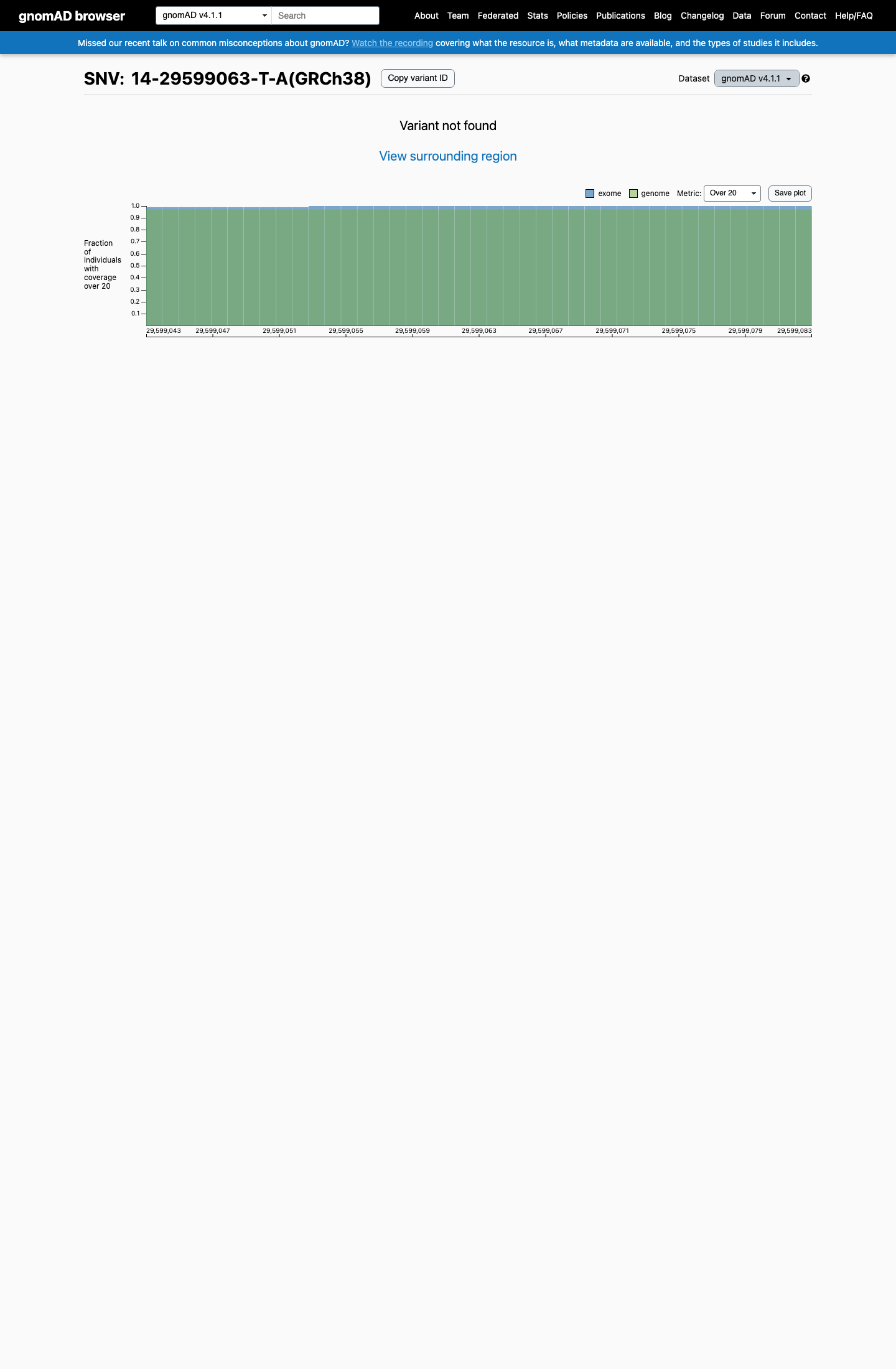
gnomAD v4.1
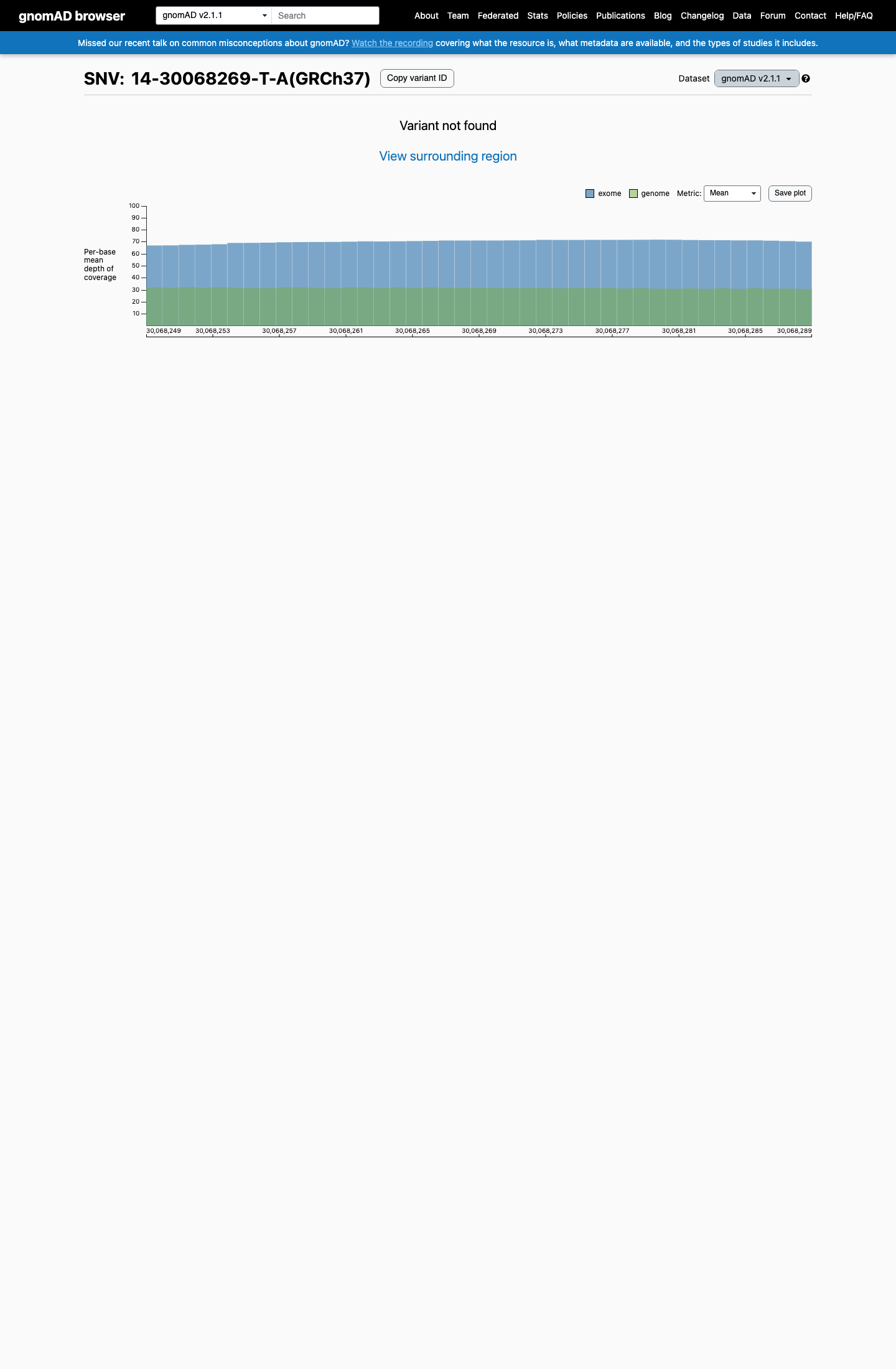
gnomAD v2.1
v4.1
Absent from gnomAD v4.1.
v2.1
Absent from gnomAD v2.1.
🇨🇦 CA
Absent from gnomAD-Canada v1.0.
Allele frequency by ancestry
three datasets · side by side
gnomAD v4.1
Absent
· 0 / ?
0 hom
0 hom
Not observed in any ancestry group.
gnomAD v2.1
Absent
· 0 / ?
0 hom
0 hom
Not observed in any ancestry group.
gnomAD Canada 🇨🇦
Absent
· 0 / ?
0 hom
0 hom
Not observed in any ancestry group.
In silico
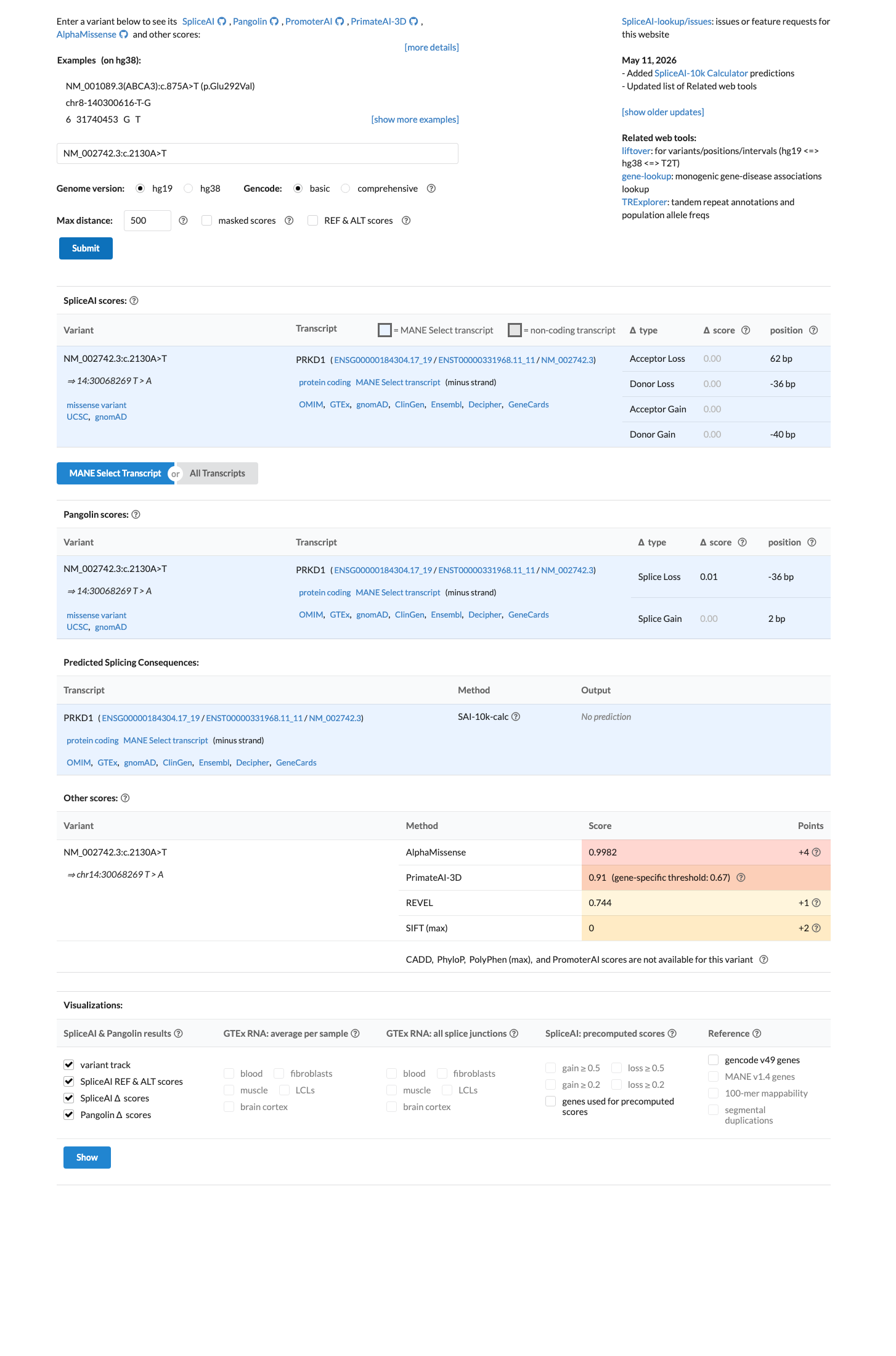
SpliceAI predicts no significant splice impact for this variant (max delta score = 0.00). REVEL score = 0.744. BayesDel score = 0.117429.
Functional
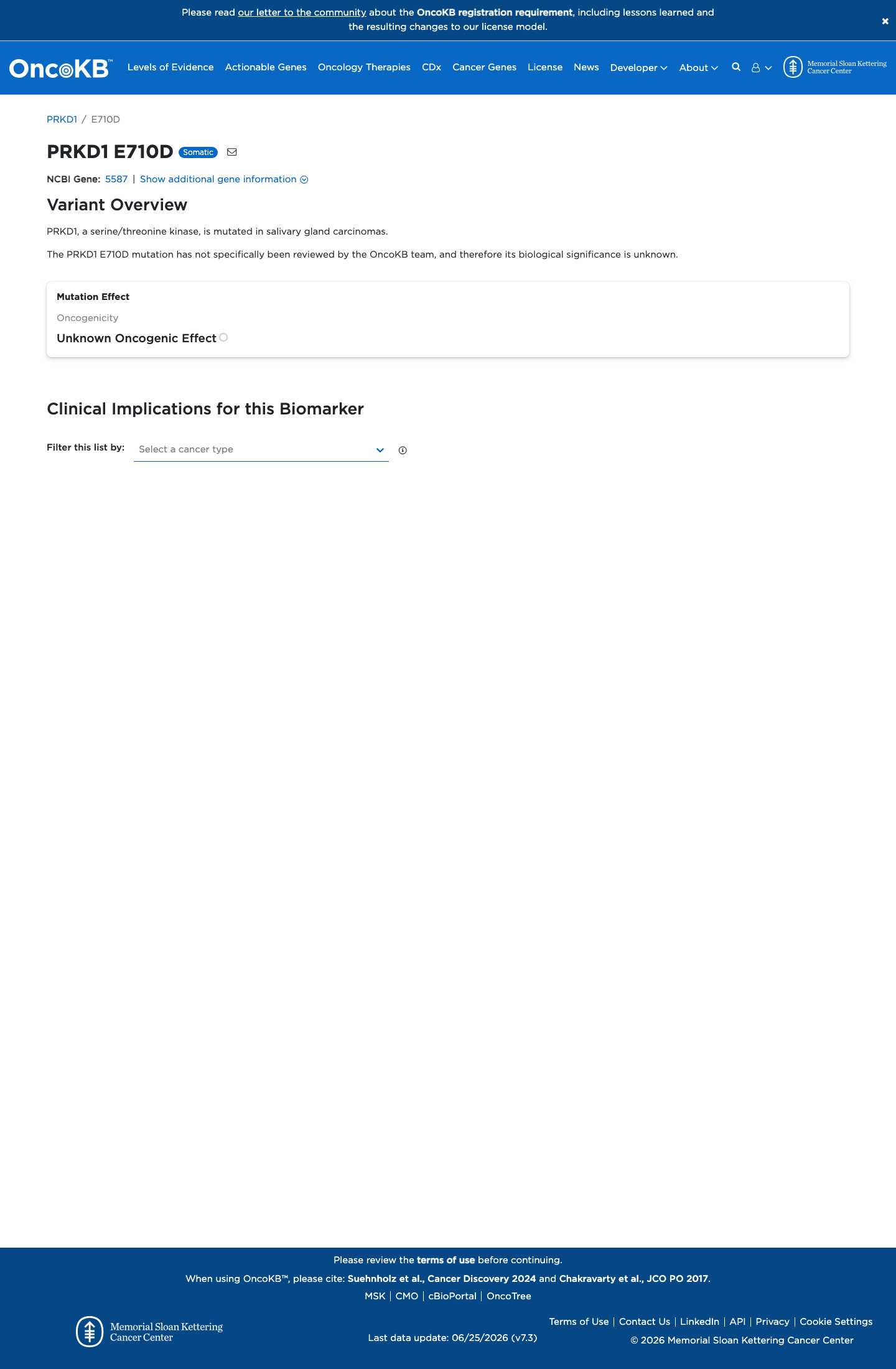
Unknown Oncogenic Effect
OncoKB did not identify variant-specific reviewed functional evidence for this variant; gene-level curated context is available for reviewer follow-up. PRKD1, a serine/threonine kinase, is mutated in salivary gland carcinomas.

COSMIC

Cancer hotspots
Somatic evidence
Not in COSMIC / hotspots
COSMIC
This variant does not lie in a statistically significant hotspot. This variant has not previously been reported in somatic cancers (COSMIC).
Hotspots
This variant does not lie in a statistically significant hotspot.
Sources & reference links