NM_002834.4:c.1508G>T (p.Gly503Val) in PTPN11 is a missense variant in the PTP catalytic domain of SHP-2, located within a statistically significant hotspot. This variant is completely absent from population databases including gnomAD v2.1, v4.1, and gnomAD-Canada (PM2).1 Functional studies using a VCEP-approved SHP-2 phosphatase activity assay demonstrated 1.4-fold increased catalytic activity for G503V compared to wild-type, consistent with the gain-of-function mechanism of RASopathies (PS3).2 The variant resides in the PTP catalytic domain at a residue adjacent to known pathogenic variants (S502, M504) and within a mutational hotspot (PM1).3 PP2 applies per VCEP specification as PTPN11 is a RASopathy gene with missense variants as a common disease mechanism.4 Multiple computational tools predict a deleterious effect: REVEL score 0.989, BayesDel score 0.608, supporting PP3.5 PS3 was applied at strong per VCEP specifications; the variant was directly tested in an approved SHP-2 phosphatase assay and showed increased activity. Modest activation (1.4-fold) compared to other pathogenic PTPN11 variants noted but does not preclude application per VCEP rules.6
Final classification
Pathogenic
PS3PM1PM2PP2PP3
PTPN11
c.1508G>T
p.Gly503Val
missense
This variant
NM_002834.4:c.1508G>T (p.Gly503Val) in PTPN11 is a missense variant in the PTP catalytic domain of SHP-2, located within a statistically significant hotspot.
ClinGen RASopathy Expert Panel Specifications to the ACMG/AMP Variant Interpretation Guidelines Version 1.0 v1.0 lacked a usable explicit final combination framework, so generic ACMG/AMP 2015 final-combination rules were applied as fallback; applied criteria: PS3 strong, PM1 moderate, PM2 moderate, PP2 supporting, PP3 supporting; combination = 1 strong + 2 moderate + 2 supporting, which maps to Pathogenic.
Classification rationale
PS3PM1PM2PP2PP3
Pathogenic
PTPN11 c.1508G>T
missense
PS3 + PM1 + PM2 + PP2 + PP3
→
Pathogenic
2
PMID:15834506 ↗vcep_svi_rasopathy_vcep_v2_approved_functional_studies
3
vcep_svi_rasopathy_vcep_v2_approved_functional_studies
4
cspec ↗
5
revelbayesdel
LYFE Sciences is an AI system, and it can make mistakes. Criteria
may be applied incorrectly, sources may be misread, and a confident-looking
classification can still be wrong. Double-check every criterion and
its underlying evidence before relying on any call.
Gene diagram
· NM_002834.4 · variants mapped to exon structure
PTPN11
NM_002834.4
Fetching transcript structure from UCSC…
Applied criteria · 5 applied · 14 assessed
MetEvidence satisfies this criterion.
Not metEvaluated against available evidence; threshold not reached.
Not assessedApplies in principle, but no evidence was found to evaluate it.
N/ADoesn't apply to this variant type.
Applied · 5
Strength
Supporting
Moderate
Strong
Very strong
PS3
strong
Pathogenic
SHP-2 phosphatase activity assay (VCEP-approved gene-specific functional assay) demonstrated 1.4-fold increased phosphatase activity for G503V compared to wild-type SHP-2 in COS7 cells, consistent with gain-of-function mechanism of RASopathy.
Niihori et al. (2005) directly tested G503V in immune complex phosphatase assaySHP-2 Phosphatase Activity assay is an approved VCEP functional study (gene-specific for PTPN11) at the Strong level.
PM1
moderate
Pathogenic
Variant is located at codon 503 in the PTP catalytic domain of SHP-2, a critical functional domain. Residue is within a statistically significant hotspot; adjacent residues S502 and M504 are listed as pathogenic validation controls in the VCEP functional studies spreadsheet.
Cancerhotspots.org identifies residue as a statistically significant hotspot. VCEP SHP-2 Phosphatase Activity assay lists S502T and M504V as P/LP validation controlsconfirming domain-level functional significance.
PM2
moderate
Pathogenic
Variant is completely absent from all population databases per VCEP requirement (gnomAD v2.1, v4.1, and gnomAD-Canada).
Absent from gnomAD v2.1 (exomes). Absent from gnomAD v4.1. Absent from gnomAD-Canada v1.0.
PP2
supporting
Pathogenic
VCEP specifies PP2 is applicable to all RASopathy genes described and curated. PTPN11 is a RASopathy gene with a low rate of benign missense variation and missense variants are a common disease mechanism.
VCEP criteria: 'PP2 is applicable to all RASopathy genes described and curated herein.'
PP3
supporting
Pathogenic
Multiple lines of computational evidence support a deleterious effect: REVEL score 0.989 (highly deleterious), BayesDel score 0.608, statistically significant hotspot at this residue. SpliceAI predicts no splice impact (max delta 0.19) and does not contribute to PP3.
REVEL 0.989 strongly predicts deleterious effect. BayesDel 0.608 supports deleterious prediction. Residue is a statistically significant hotspot. SpliceAI delta 0.19 is not contributory.
Assessed · not applied
· 14 not met · 0 not assessed
Pathogenic
PS1
No previously established pathogenic variant with the identical amino acid change (p.Gly503Val) has been classified as pathogenic per VCEP criteria in a germline RASopathy context.
PS2
No de novo occurrence with confirmed parentage has been reported for this variant.
PS4
No independent occurrences meeting VCEP proband-counting thresholds (>=1 for supporting, >=3 for moderate, >=5 for strong) are available.
PM5
No pathogenic missense variant at codon 503 has been established per VCEP criteria.
PM6
No confirmed de novo occurrence has been reported for this variant.
PP1
No cosegregation data available.
Benign
BA1
Allele frequency is 0% in gnomAD, well below the VCEP-approved BA1 threshold of >=0.05%.
BS1
Allele frequency is 0% in gnomAD, well below the VCEP-approved BS1 threshold of >=0.025%.
BS2
VCEP requires well-phenotyped family members (>3 instances) for BS2 application; no such data available.
BS3
Functional data demonstrates increased SHP-2 phosphatase activity (1.4-fold, gain-of-function), inconsistent with a benign effect on protein function.
BS4
No segregation data available for this variant.
BP2
No evidence of the variant being observed in trans with a pathogenic variant or in cis with a pathogenic variant.
BP4
Computational evidence does not suggest no impact on gene product.
BP5
No alternate molecular basis for disease has been identified in a case harboring this variant.
N/A · 6
PVS1 · PP4 · PP5 · BP1 · BP6 · BP7
Research & evidence
Population frequency · supports pathogenic
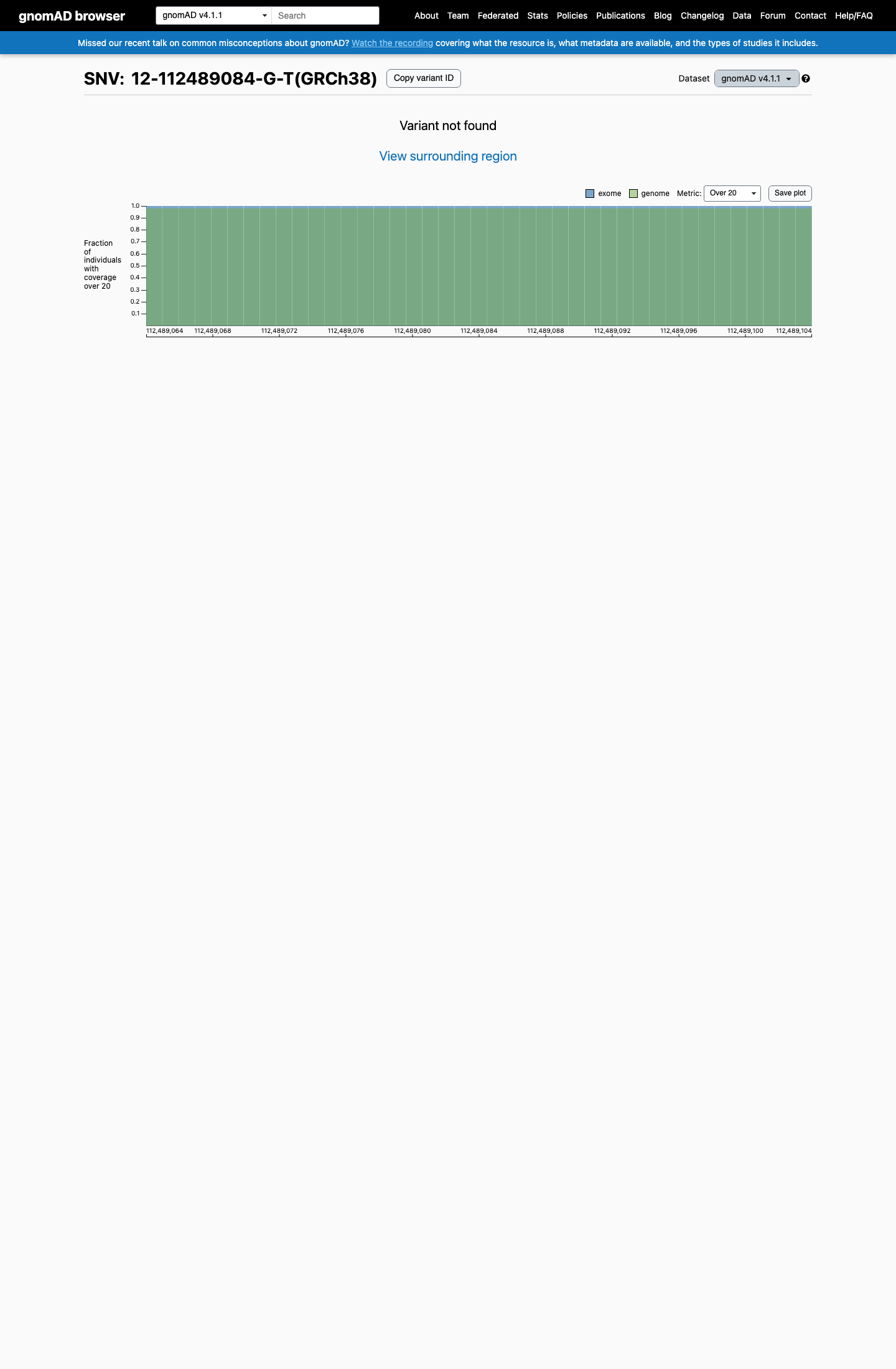
gnomAD v4.1
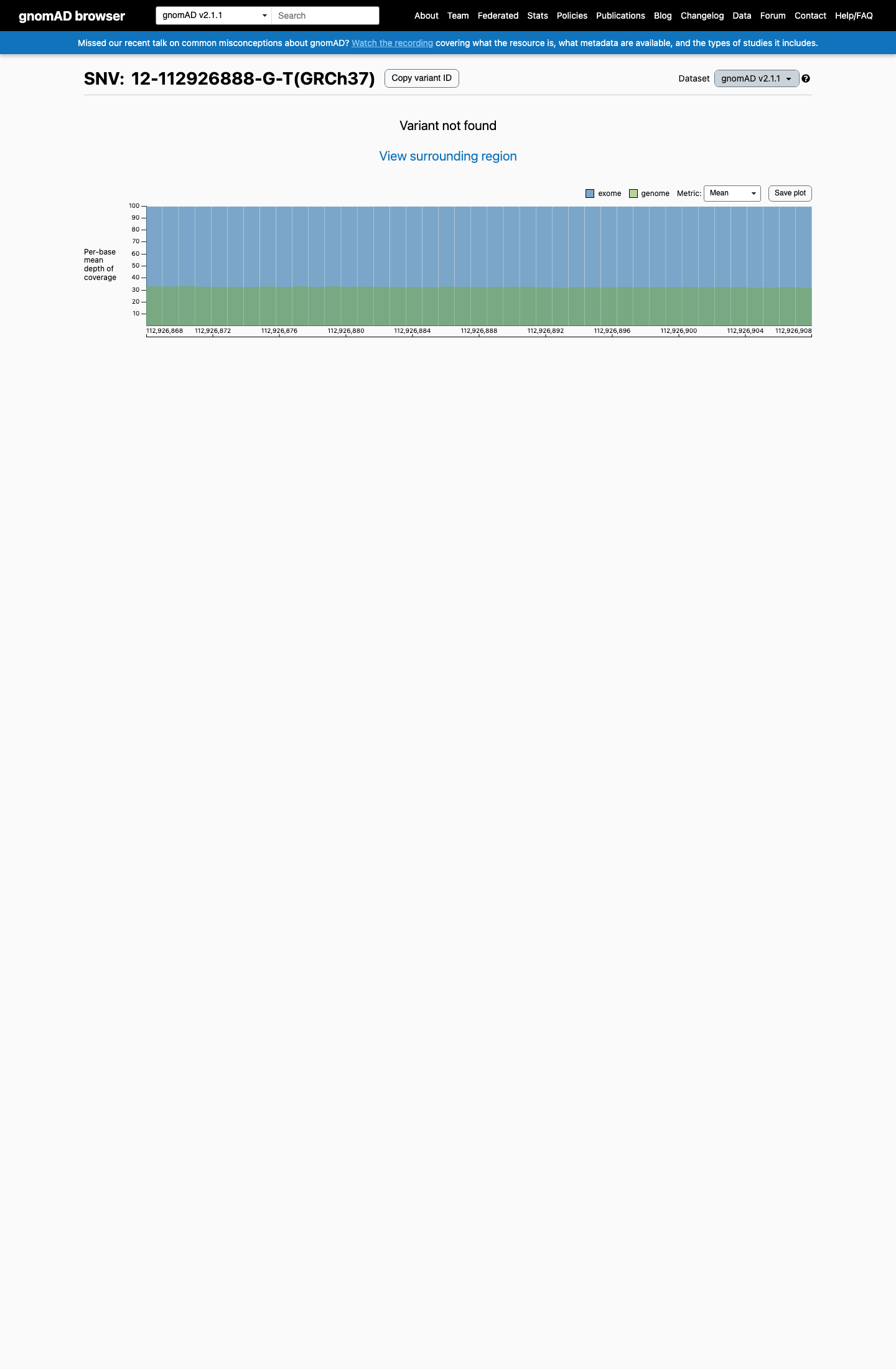
gnomAD v2.1
v4.1
Absent from gnomAD v4.1.
v2.1
Absent from gnomAD v2.1.
🇨🇦 CA
Absent from gnomAD-Canada v1.0.
Allele frequency by ancestry
three datasets · side by side
gnomAD v4.1
Absent
· 0 / ?
0 hom
0 hom
Not observed in any ancestry group.
gnomAD v2.1
Absent
· 0 / ?
0 hom
0 hom
Not observed in any ancestry group.
gnomAD Canada 🇨🇦
Absent
· 0 / ?
0 hom
0 hom
Not observed in any ancestry group.
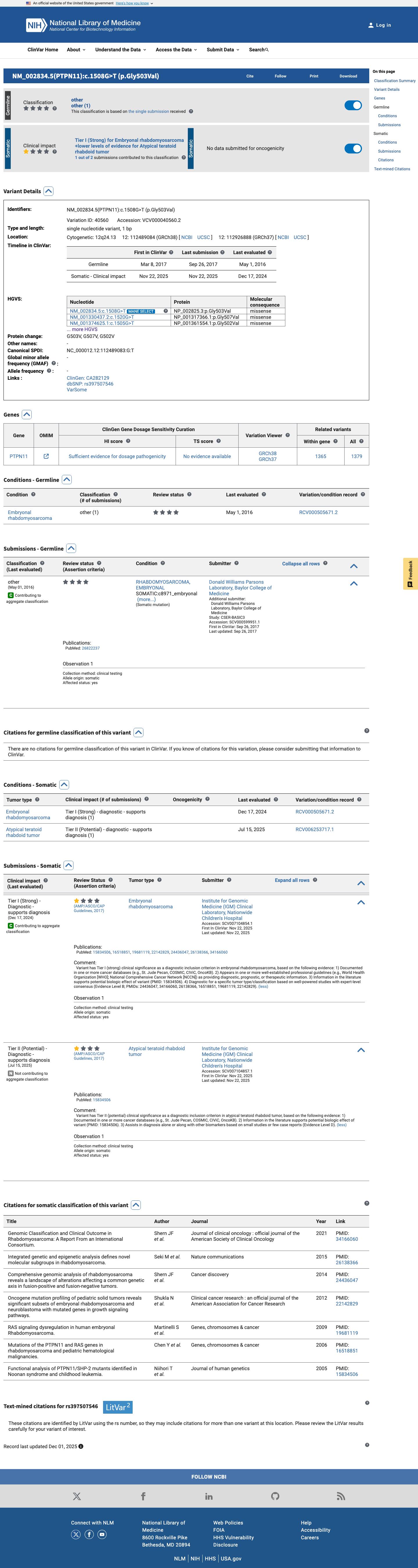
ClinVar
This variant has been reported in ClinVar as other (1 clinical laboratory). (ClinVarID = 40560)

In silico
SpliceAI predicts no significant splice impact for this variant (max delta score = 0.19). REVEL score = 0.989. BayesDel score = 0.607986.
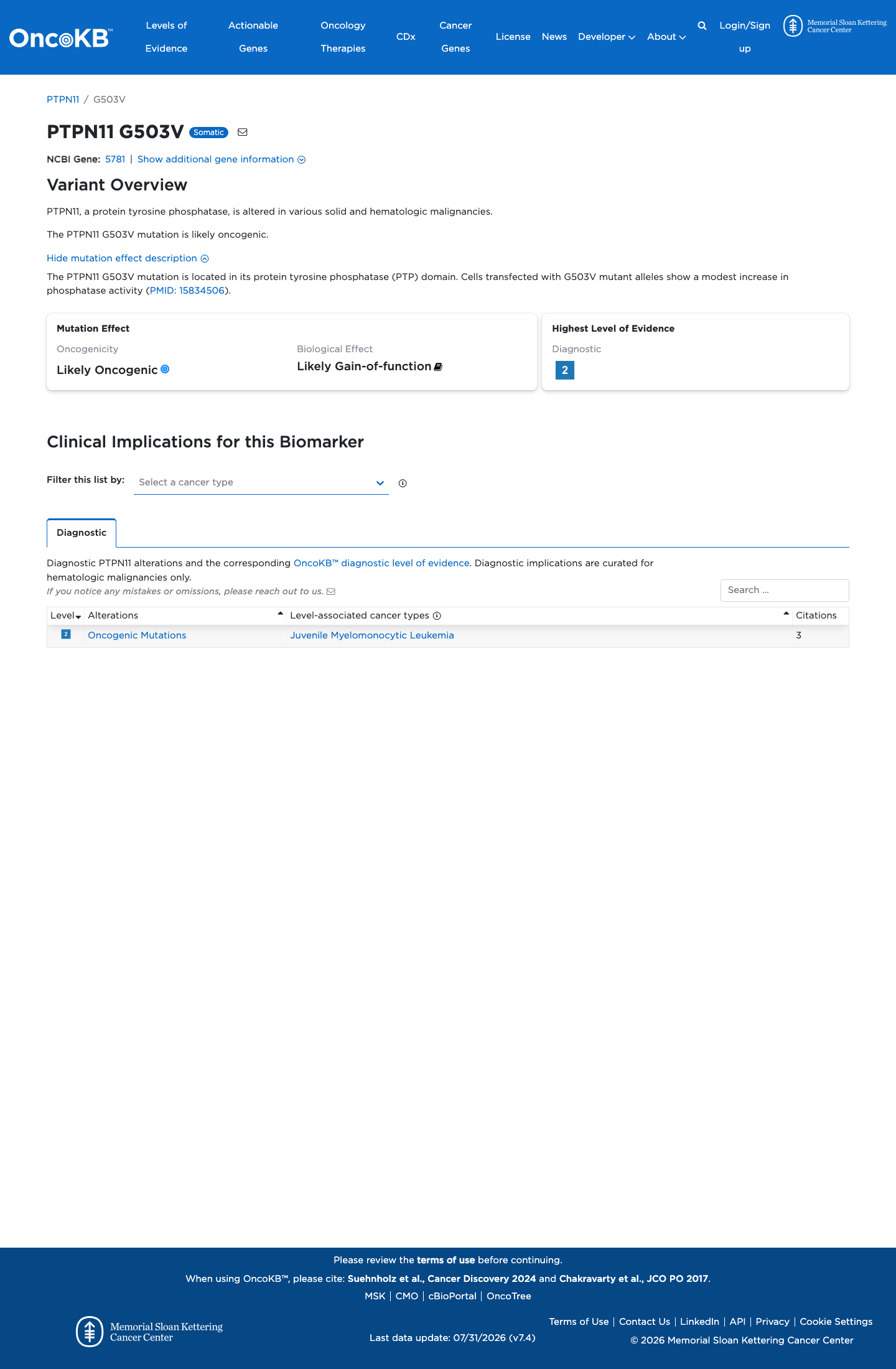
Functional
Likely Oncogenic
OncoKB identified variant-specific curated literature and context relevant to functional review; biological-effect context: Likely Gain-of-function; curated oncogenicity label: Likely Oncogenic.

COSMIC

Cancer hotspots
Somatic evidence
Hotspot
COSMIC
This variant lies in a statistically significant hotspot. This variant has not previously been reported in somatic cancers (COSMIC).
Hotspots
This variant lies in a statistically significant hotspot.
Literature · how each cited paper was used
1papers cited
Each card is an audit: what was searched, what was found, whether it names the variant, which criteria it fed, and why. 5 further PMIDs triaged but not cited — see Sources & references.
Functional analysis of PTPN11/SHP-2 mutants identified in Noonan syndrome and childhood leukemia.
Searched
c.1508G>TG503VGly503Val1508G>T
Found
G503V (c.1508G>T) was identified as a novel somatic mutation in a JMML bone-marrow-derived cell line among 29 pediatric leukemia cases. Immune complex phosphatase assay in COS7 cells demonstrated 1.4-fold increased phosphatase activity compared to wild-type SHP-2, consistent with gain-of-function.
Variant
✓ Names this variant — characterised directly
Applied to
→PS3
met
Why
Direct variant-specific functional data confirmed increased phosphatase activity; cited for PS3 (Strong) per VCEP-approved SHP-2 Phosphatase Activity assay.
The novel G503V (1508G>T) mutation was detected in a bone-marrow-derived cell line from a JMML patient.
Location Results, 'PTPN11 mutation detection and phosphatase assay in childhood leukemia' section · Context Immune complex phosphatase assay; COS7 cells transfected with FLAG-tagged WT or mutant SHP-2 cDNA; Src phosphopeptide substrate; malachite green detection · full text
Sources & reference links
9Sources
Triaged references · 5 PMIDs not cited in assessment
16518851 ↗
Mutations of the PTPN11 and RAS genes in rhabdomyosarcoma and pediatric hematological malignancies.
CLINVAR
24436047 ↗
Comprehensive genomic analysis of rhabdomyosarcoma reveals a landscape of alterations affecting a common genetic axis in fusion-positive and fusion-negative tumors.
CLINVAR
26822237 ↗
Diagnostic Yield of Clinical Tumor and Germline Whole-Exome Sequencing for Children With Solid Tumors.
CLINVAR
27993330 ↗
Standards and Guidelines for the Interpretation and Reporting of Sequence Variants in Cancer: A Joint Consensus Recommendation of the Association for Molecular Pathology, American Society of Clinical Oncology, and College of American Pathologists.
CLINVAR