Back
NM_002878.4:c.270_271dup
p.Lys91IlefsTer13 · RAD51D
ACMG/AMP
0%
complete
Final classification
Pathogenic
PVS1PS3PM2
RAD51D
c.270_271dup
p.Lys91IlefsTer13
frameshift · exon 4

RAD51D encodes a protein that works with other DNA-repair proteins to help accurately repair broken DNA through homologous recombination. Inherited changes in RAD51D increase the risk of ovarian cancer and may also increase breast cancer risk. RAD51D acts as a tumor-suppressor gene, and changes in it can contribute to chromosome instability and, rarely, resistance to chemotherapy in cancer cells.

This variant

This RAD51D frameshift affects a tumor-suppressor gene required for homologous-recombination DNA repair, a mechanism relevant to inherited ovarian and breast cancer risk.

Transcript
NM_002878.4
HGVS · transcript:coding
NM_002878.4:c.270_271dup
GRCh38
chr17:35107439 T>TTA
GRCh37
chr17:33434458 T>TTA
Pathogenic: PVS1 (very strong) plus PS3 (strong) satisfy the generic ACMG/AMP Pathogenic combination; PM2 (supporting) is additionally met.
Classification rationale
PVS1PS3PM2 Pathogenic
RAD51D c.270_271dup frameshift · exon 4

Pathogenic: PVS1 (very strong) is supported by an early exon 4 frameshift expected to trigger nonsense-mediated decay. Pathogenic: PS3 (strong) is supported by replicated orthogonal assays showing loss of RAD51D homologous-recombination function. Pathogenic: PM2 (supporting) is supported by an aggregate gnomAD allele frequency below 0.0001.

PVS1 + PS3 + PM2 Pathogenic
LYFE Sciences is an AI system, and it can make mistakes. Criteria may be applied incorrectly, sources may be misread, and a confident-looking classification can still be wrong. Double-check every criterion and its underlying evidence before relying on any call.
Gene diagram · NM_002878.4 · variants mapped to exon structure
RAD51D NM_002878.4
Fetching transcript structure from UCSC…
Applied criteria · 3 applied · 15 assessed
MetEvidence satisfies this criterion.
Not metEvaluated against available evidence; threshold not reached.
Not assessedApplies in principle, but no evidence was found to evaluate it.
N/ADoesn't apply to this variant type.
Applied · 3
Strength Supporting Moderate Strong Very strong
PVS1 very strong Pathogenic
Met, very strong: exon 4 frameshift Lys91IlefsTer13 truncates RAD51D at amino acid 103 of 329 and is expected to trigger NMD.
The gene-level assessment establishes RAD51D loss of function as a germline disease mechanism and identifies the PVS1 gene gate as eligible.The normalized consequence is NM_002878.4:c.270_271dup, a frameshift producing NP_002869.3:p.(Lys91IlefsTer13).The transcript exon map places c.270_271dup in exon 4, spanning coding c.264-345; the final exon begins at coding c.904, so the premature stop is in an internal exon and far upstream of the terminal exon-exon junction, supporting NMD.
PS3 strong Pathogenic
Met, strong: RAD51D K91fs reduced homologous-recombination repair and RAD51D stability across orthogonal assays with wild-type controls and three biological replicates.
The case variant normalizes to NP_002869.3:p.(Lys91IlefsTer13); PMID:33151324 evaluates RAD51D K91fs reported as 271_272insTA, the equivalent recurrent frameshift allele.In the DR-GFP reporter assay, RAD51D K91fs decreased GFP-positive cells compared with RAD51D wild type, indicating impaired homologous-recombination repair.In cisplatin-treated cells, RAD51D K91fs did not produce the wild-type reduction in gamma-H2AX foci, and mutant cells showed impaired RAD51 recruitment to DNA-damage sites.
PM2 supporting Pathogenic
Met at supporting strength: aggregate allele frequency was 1.35305e-05 in gnomAD v3.1 non-cancer genomes, below the 0.0001 PM2 threshold.
No applicable RAD51D VCEP/CSPEC population rule was available; the supplied generic PM2 threshold is allele frequency <=0.0001 at supporting strength.The relevant non-cancer datasets show aggregate AF 5.90942e-05 in gnomAD v2.1 non-cancer exomes and 1.35305e-05 in gnomAD v3.1 non-cancer genomes; both are below 0.0001.The default gnomAD v4.1 all-comers aggregate AF is 1.67984e-05, also below 0.0001, with zero homozygotes.
Assessed · not applied · 6 not met · 9 not assessed
Pathogenic
PS2 Not assessed: no verified parental testing or confirmed de novo occurrence is documented for the proband.
PS4 Not assessed: available studies report gene-level enrichment or case prevalence, but no qualifying exact-variant case-control comparison establishes PS4.
PM3 Not assessed: no affected-proband observation, second pathogenic RAD51D allele, or confirmed trans phase is documented for this variant.
PM6 Not assessed: no credible apparently de novo case without confirmed parental testing is documented for this variant.
PP1 Not assessed: no affected-family cosegregation data are documented; one cancer-naive control observation is not segregation evidence.
PP4 Not assessed: the available case evidence contains no patient phenotype or disease-specific clinical presentation for evaluating PP4.
PP5 Not met: ClinVar shows laboratory Pathogenic/Likely pathogenic submissions, but zero expert-panel classifications are present for this exact variant.
Benign
BA1 Not met: the highest observed allele frequency was 0.00806452, below the 0.05 BA1 stand-alone threshold.
BS1 Not met: the highest observed allele frequency was 0.00806452, below the 0.01 BS1 threshold.
BS2 Not met: homozygotes were absent from all gnomAD datasets, and the control study reported only one heterozygote among 466 individuals.
BS3 Not met: RAD51D K91fs showed reduced homologous-recombination repair and protein stability rather than preserved function in assays with wild-type controls.
BS4 Not assessed: no informative affected relatives or family non-segregation analysis is documented for this variant.
BP2 Not assessed: no cis or trans phase with another pathogenic RAD51D variant is documented in an affected or unaffected individual.
BP5 Not assessed: no alternate pathogenic molecular explanation or BP5-specific quantitative evidence is documented for this case.
BP6 Not met: no exact-variant ClinVar expert-panel Benign or Likely benign classification is present; available submissions are non-expert laboratory assertions.
N/A · 10 PS1 · PM1 · PM4 · PM5 · PP2 · PP3 · BP1 · BP3 · BP4 · BP7
Research & evidence
Population frequency · supports pathogenic
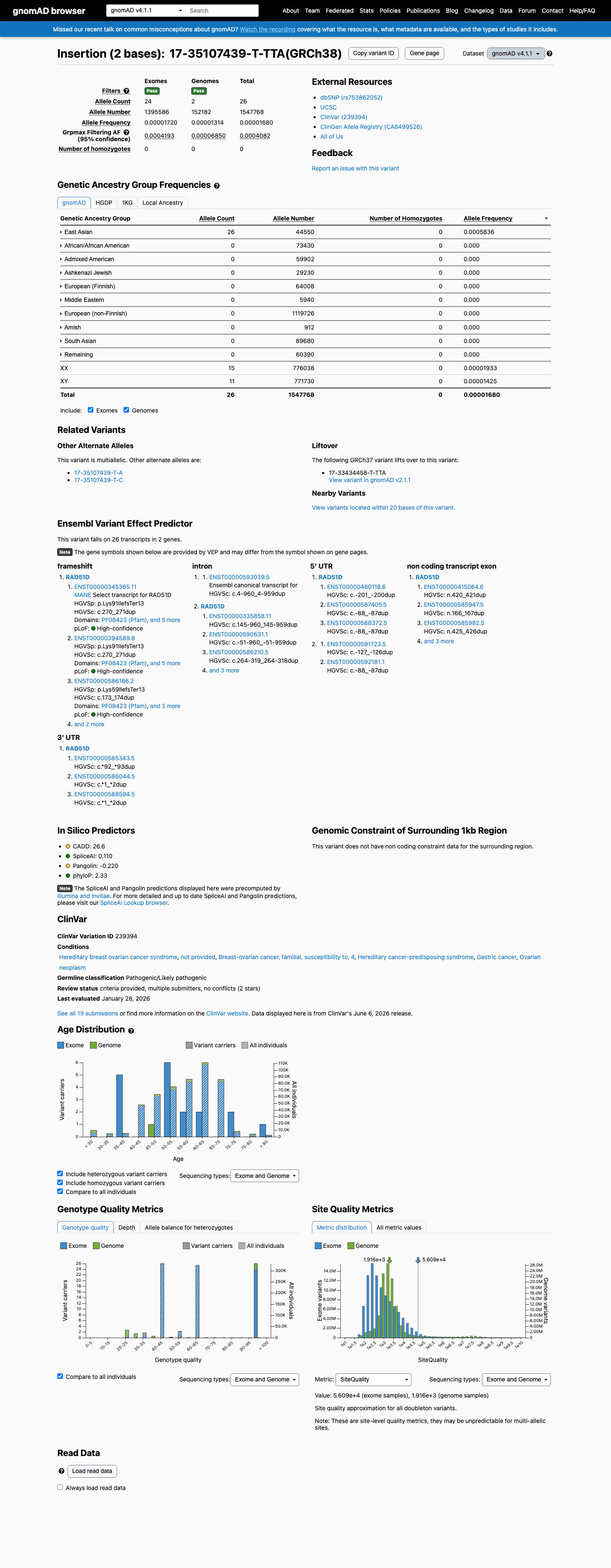
gnomAD v4.1 screenshot
gnomAD v4.1
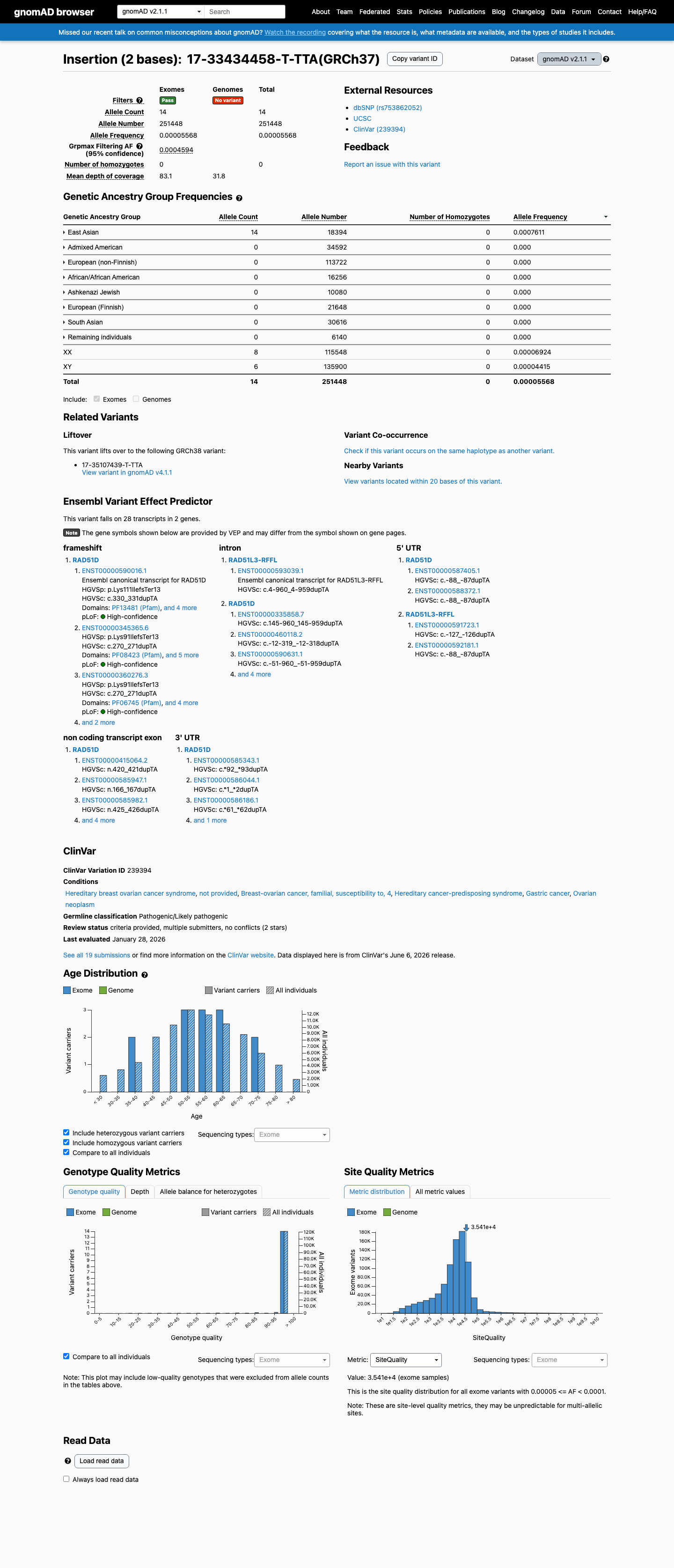
gnomAD v2.1 screenshot
gnomAD v2.1
v4.1
This variant is present in gnomAD v4.1 (AF= 1.67984e-05; MAF= 0.00168%, 26/1547768 alleles, homozygotes = 0) and has highest observed frequency in the East Asian population (AF= 0.000583614; MAF= 0.05836%, 26/44550 alleles, homozygotes = 0); grpmax FAF= 0.00040821.
v2.1
This variant is present in gnomAD v2.1 (AF= 5.56775e-05; MAF= 0.00557%, 14/251448 alleles, homozygotes = 0) and has highest observed frequency in the East Asian population (AF= 0.000761118; MAF= 0.07611%, 14/18394 alleles, homozygotes = 0); grpmax FAF= 0.00045935.
🇨🇦 CA
Not available in gnomAD-Canada v1.0.
Allele frequency by ancestry
three datasets · side by side
gnomAD v4.1
0.0017% · 26 / 1,547,768
0 hom · FAF 0.041%
East Asian
26 / 44,550
0.058%
+ 9 not observed (Remaining individuals, Admixed American, European (Finnish), Amish, Middle Eastern, South Asian, Ashkenazi Jewish, African/African American, European (non-Finnish))
gnomAD v2.1
0.0056% · 14 / 251,448
0 hom · FAF 0.046%
East Asian
14 / 18,394
0.076%
+ 7 not observed (African/African American, Admixed American, Ashkenazi Jewish, European (Finnish), European (non-Finnish), Remaining individuals, South Asian)
gnomAD Canada 🇨🇦
Absent · 0 / ?
0 hom
Not observed in any ancestry group.
ClinVar screenshot
ClinVar
This variant has been reported in ClinVar as Pathogenic (13 clinical laboratories) and as Likely pathogenic (2 clinical laboratories) and as pathogenic (1 clinical laboratory). (ClinVarID = 239394)
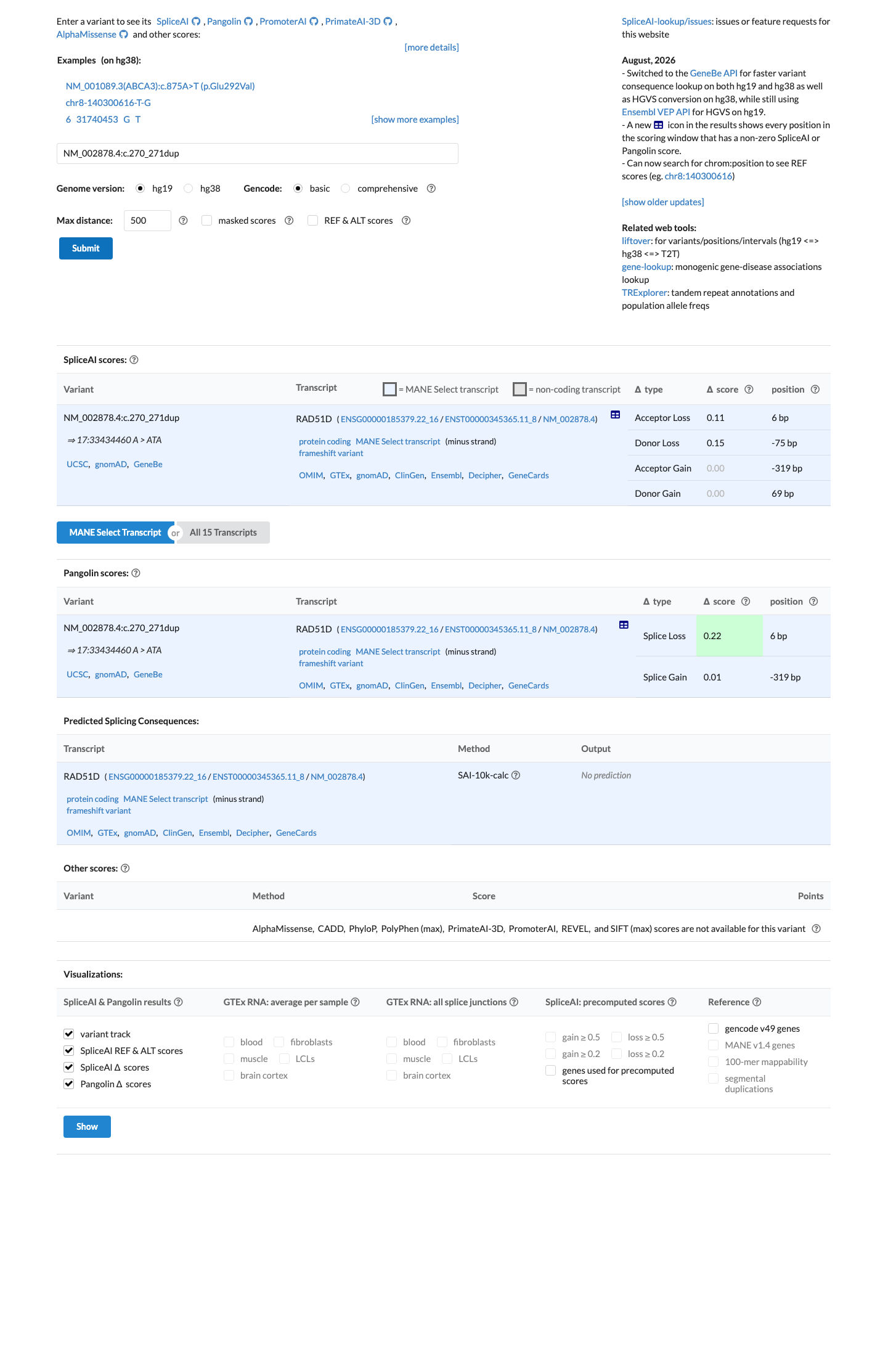
SpliceAI screenshot
In silico
SpliceAI predicts no significant splice impact for this variant (max delta score = 0.15).
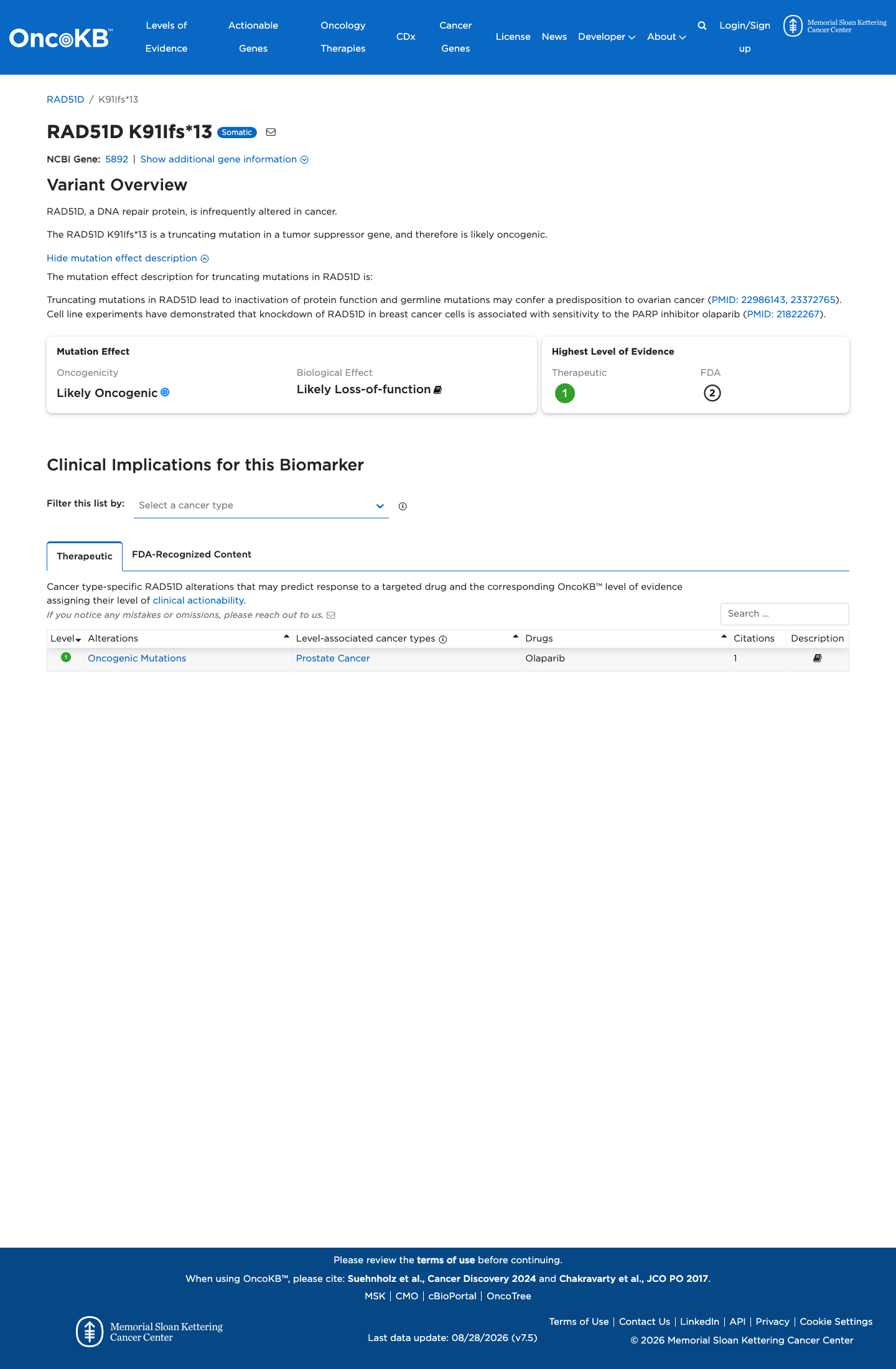
Functional / OncoKB screenshot
Functional Likely Oncogenic
OncoKB identified variant-specific curated literature and context relevant to functional review; biological-effect context: Likely Loss-of-function; curated oncogenicity label: Likely Oncogenic.
OncoKB ↗
COSMIC screenshot
COSMIC
Cancer hotspots screenshot
Cancer hotspots
Somatic evidence Not in COSMIC / hotspots
COSMIC
This variant does not lie in a statistically significant hotspot. This variant has not previously been reported in somatic cancers (COSMIC).
Hotspots
This variant does not lie in a statistically significant hotspot.
Literature · how each cited paper was used
3papers cited
Each card is an audit: what was searched, what was found, whether it names the variant, which criteria it fed, and why. 4 further PMIDs triaged but not cited — see Sources & references.
Analysis of RAD51D in ovarian cancer patients and families with a history of ovarian or breast cancer.
Searched
c.270_271dupNP_002869.3:p.(K91Ifs*13)p.(Lys91Ilefs*13)
Found
The paper explicitly identifies the corresponding RAD51D p.(Lys91Ilefs*13) truncating mutation in one of 466 cancer-naive control samples and places it in exon 4; this directly corroborates the variant's frameshift consequence and transcript context.
Variant
✓ Names this variant — characterised directly
Applied to
PVS1 very strong
Directly documents the corresponding truncating RAD51D p.(Lys91Ilefs*13) variant and its exon 4 location.
A third truncating mutation, p.(Lys91Ilefs*13), was identified in one of 466 control samples (0.21%). All three of these mutations have previously been reported [3,4].
Location Results and Discussion, paragraph 1; Table 2, Exon 4  ·  Context RAD51D mutation screening in 466 cancer-naive control DNA samples, following analysis of 245 unselected ovarian cancer cases and 1,060 familial breast/ovarian cancer index cases; variant positions were referenced to NM_002878.3 and NP_002869.  ·  full text
Standards and guidelines for the interpretation of sequence variants: a joint consensus recommendation of the American College of Medical Genetics and Genomics and the Association for Molecular Pathology.
Found
Structured finding pending for this record — see source link.
Applied to
PM2 supporting
Molecular Features and Functional Implications of Germline Variants in Triple-Negative Breast Cancer.
Searched
c.270_271dupTAp.(Lys91IlefsTer13)K91fs271_272insTA
Found
The study reports that RAD51D K91fs (271_272insTA), corresponding to the case variant's p.Lys91IlefsTer13 allele, impaired homologous-recombination repair, reduced RAD51 recruitment to DNA-damage sites, decreased RAD51D protein stability, and increased sensitivity to olaparib in cell-based assays.
Variant
✓ Names this variant — characterised directly
Applied to
PS3 strong
Multiple replicated, orthogonal functional assays show loss of RAD51D homologous-recombination function for the equivalent K91fs allele.
In a direct repeat GFP (DR-GFP) reporter assay, expression of both RAD51D V200X and K91fs variant resulted in a decrease in GFP-positive cell numbers compared to its WT counterpart. ... In summary, these results unambiguously show that RAD51D recurrent variants negatively impact DNA homologous recombination.
Location Results, 'RAD51D recurrent variants and DNA homologous recombination'; Figure 5C-F; Results, 'Effect of RAD51D recurrent variants on the expression level and stability of the RAD51D protein'; Figure 6A-B  ·  Context FUSCCTNBC cohort of 325 Chinese patients with triple-negative breast cancer; RAD51D K91fs was tested in U2OS DR-GFP homologous-recombination assays, gamma-H2AX and RAD51-recruitment assays in HEK293T-derived systems, cycloheximide protein-stability assays, and olaparib viability assays in MDA-MB-231 and BT549 TNBC cell lines. Quantitative DR-GFP and gamma-H2AX results used three biological replicates with wild-type and empty-vector controls.  ·  full text
Sources & reference links
8Sources
ClinVar
gnomAD v2.1
gnomAD v4.1
gnomAD-Canada
SpliceAI
OncoKB
COSMIC
Cancer hotspots
Triaged references · 4 PMIDs not cited in assessment
21822267 ↗ Germline mutations in RAD51D confer susceptibility to ovarian cancer. ONCOKB
22986143 ↗ Loss of function germline mutations in RAD51D in women with ovarian carcinoma. ONCOKB
32566746 ↗ Prevalence of disease-causing genes in Japanese patients with BRCA1/2-wildtype hereditary breast and ovarian cancer syndrome. CLINVAR
23788249 ↗ ACMG recommendations for reporting of incidental findings in clinical exome and genome sequencing. CLINVAR