PS1
Not assessed: no independent pathogenic p.Arg239Trp variant was documented in the reviewed evidence.
PS2
Not assessed: no documented parental testing proves de novo origin, and all six reported carriers also carried pathogenic c.694C>T in probable cis.
PS3
Not assessed: no validated variant-specific functional assay for RAD51D p.Arg239Trp was identified; available reports describe clinical observations or general RAD51D biology.
PS4
Not met: c.715C>T occurred in two ovarian-cancer patients but also four healthy carriers, without demonstrated variant-specific case-control enrichment.
PM1
Not met: p.Arg239Trp is not documented in an approved RAD51D critical domain or statistically significant hotspot.
PM2
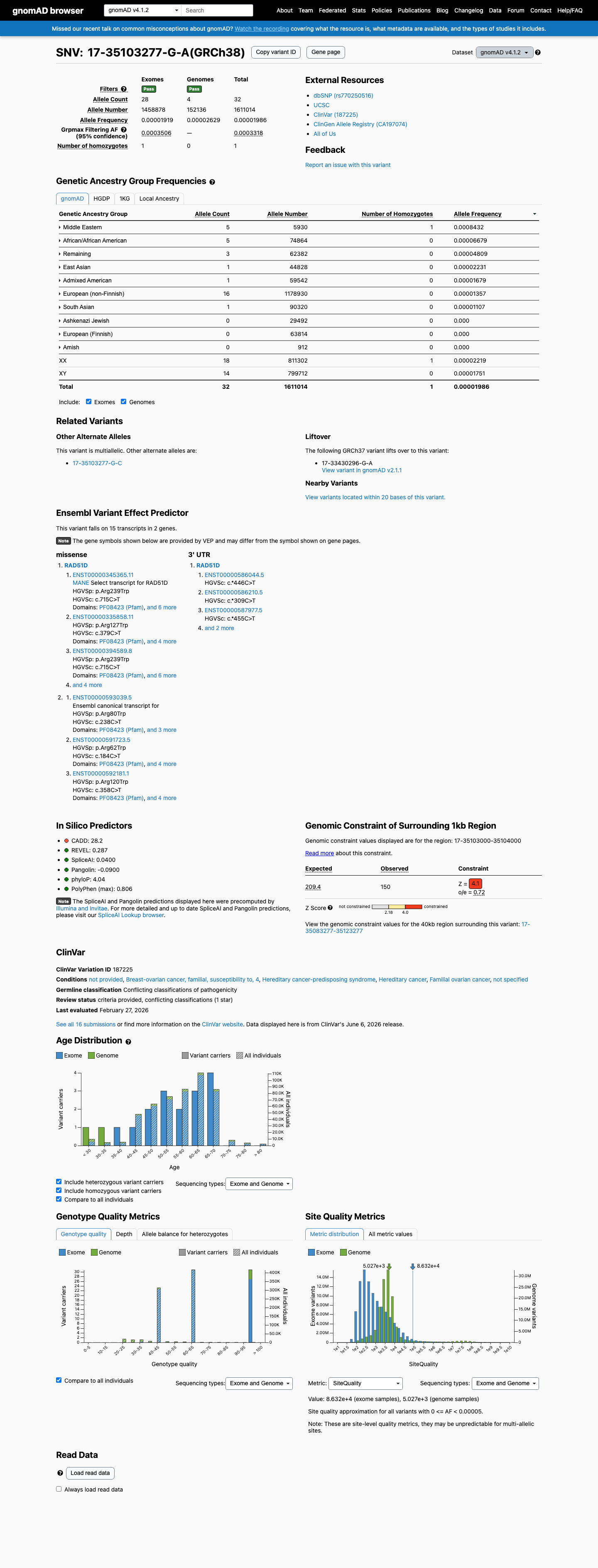
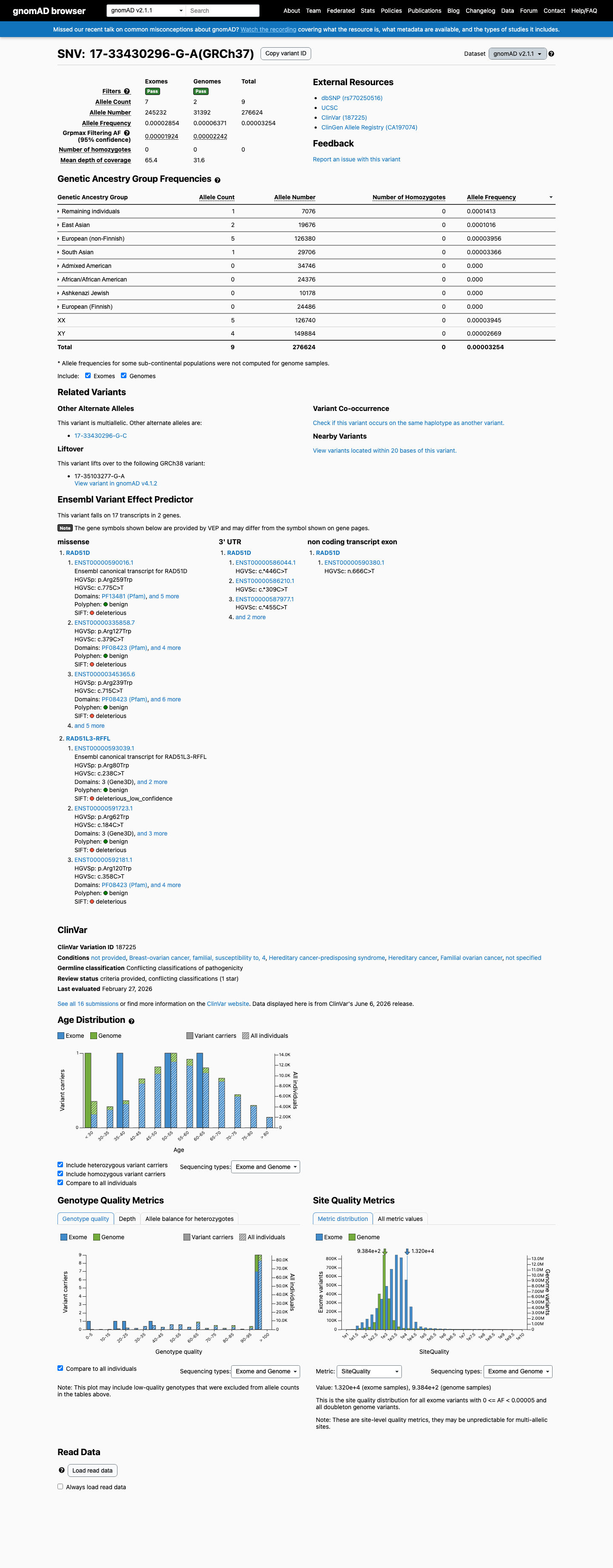
Not met: ancestry-specific AF reaches 0.00084317 in gnomAD v4.1, exceeding the generic PM2 threshold of 0.0001 despite low overall AF.
PM5
Not assessed: no established pathogenic alternate missense variant at RAD51D residue Arg239 was documented.
PM6
Not assessed: the six reported carriers lacked documented parental-origin evidence and all also carried pathogenic c.694C>T, probably in cis.
PP1
Not assessed: six carriers were reported, but no informative meioses or phase-resolved segregation series isolate c.715C>T from pathogenic c.694C>T.
PP2
Not met: RAD51D disease evidence is predominantly loss-of-function, not an established missense mechanism.
PP3
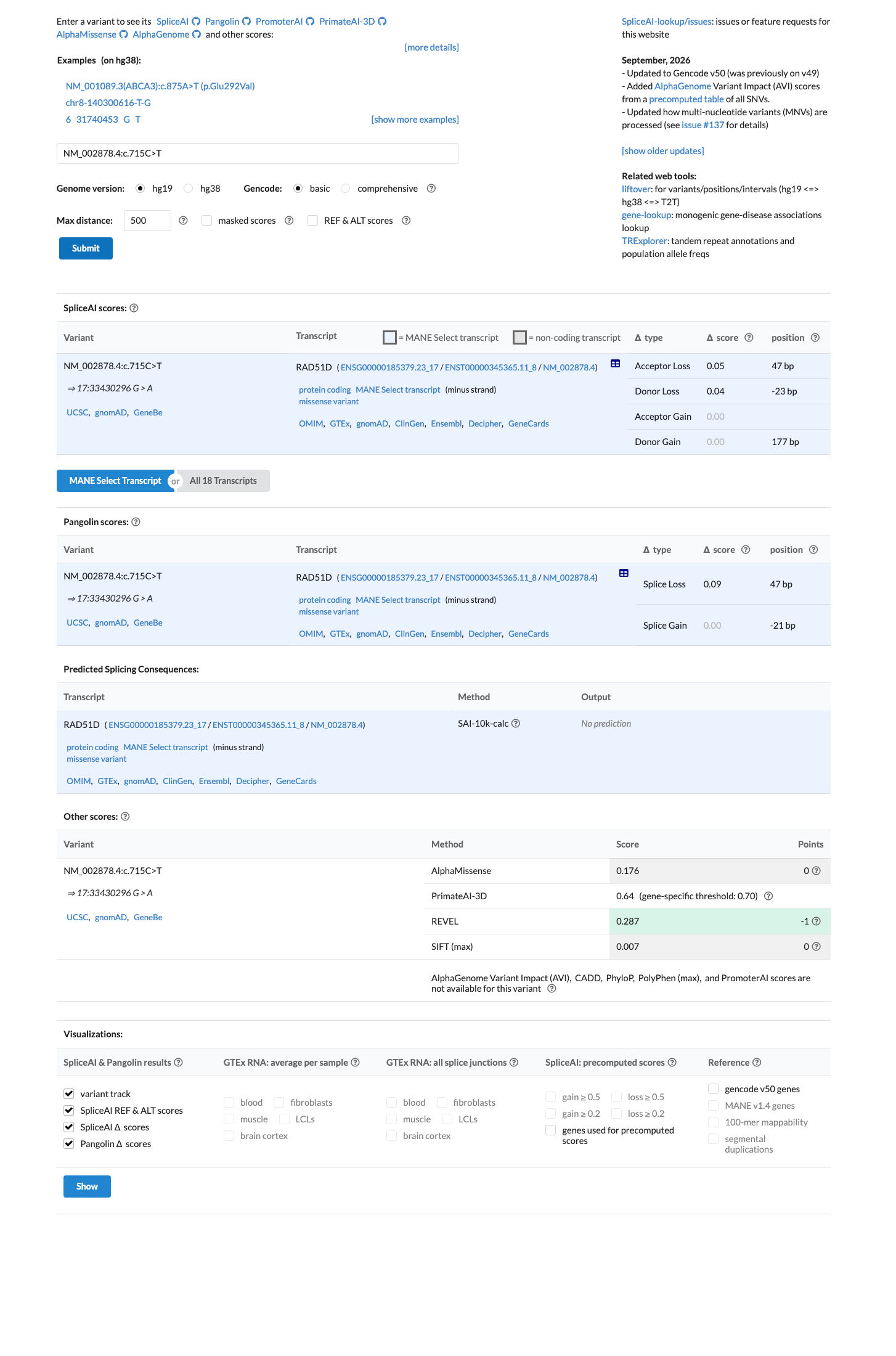
Not met: missense REVEL score 0.287 is below the >=0.644 PP3 supporting threshold.
PP4
Not met: ovarian cancer is compatible with RAD51D disease but is not sufficiently specific, and c.715C>T was also found in four healthy carriers.
PP5
Not met: the exact variant has zero ClinVar expert-panel submissions, so no qualifying Pathogenic or Likely pathogenic classification exists.