Back
NM_002878.4:c.694C>T
p.Arg232Ter · RAD51D
ACMG/AMP
0%
complete
Final classification
Likely Pathogenic
PVS1PM2
RAD51D
c.694C>T
p.Arg232Ter
nonsense · exon 8

RAD51D encodes a protein that works with other DNA-repair proteins to help accurately repair broken DNA through homologous recombination. Inherited changes in RAD51D increase the risk of ovarian cancer and may also increase breast cancer risk. RAD51D acts as a tumor-suppressor gene, and changes in it can contribute to chromosome instability and, rarely, resistance to chemotherapy in cancer cells.

This variant

RAD51D encodes a homologous-recombination DNA-repair protein, and inherited loss-of-function changes increase ovarian cancer risk and may increase breast cancer risk.

Transcript
NM_002878.4
HGVS · transcript:coding
NM_002878.4:c.694C>T
GRCh38
chr17:35103298 G>A
GRCh37
chr17:33430317 G>A
Likely Pathogenic: PVS1 (very strong) plus PM2 (supporting) satisfy the generic ACMG/AMP fallback rule for one very strong and one supporting criterion.
Classification rationale
PVS1PM2 Likely Pathogenic
RAD51D c.694C>T nonsense · exon 8

Likely Pathogenic: PVS1 very strong supports a truncating RAD51D loss-of-function allele with predicted nonsense-mediated decay. Likely Pathogenic: PM2 supporting shows a maximum gnomAD allele frequency of 3.21e-05 and zero homozygotes.

PVS1 + PM2 → Likely Pathogenic
LYFE Sciences is an AI system, and it can make mistakes. Criteria may be applied incorrectly, sources may be misread, and a confident-looking classification can still be wrong. Double-check every criterion and its underlying evidence before relying on any call.
Gene diagram · NM_002878.4 · variants mapped to exon structure
RAD51D NM_002878.4
Fetching transcript structure from UCSC…
Applied criteria · 2 applied · 16 assessed
MetEvidence satisfies this criterion.
Not metEvaluated against available evidence; threshold not reached.
Not assessedApplies in principle, but no evidence was found to evaluate it.
N/ADoesn't apply to this variant type.
Applied · 2
Strength Supporting Moderate Strong Very strong
PVS1 very strong Pathogenic
Met at very strong: c.694C>T creates p.Arg232Ter in exon 8 of 10, predicting nonsense-mediated decay and loss of 98 of 329 amino acids.
The applicable framework is the generic ClinGen SVI PVS1 recommendation (PMC6185798); no RAD51D CSPEC, VCEP, or local gene-specific PVS1 specification is available.NM_002878.4:c.694C>T is normalized as NP_002869.3:p.(Arg232Ter), a nonsense consequence in the MANE Select RAD51D transcript variant 1.Variant Validator places the variant in exon 8; the transcript has 10 exons, with exon 8 spanning coding c.668-c.738 and downstream exons 9 and 10, supporting NMD rather than a terminal-exon escape.
PM2 supporting Pathogenic
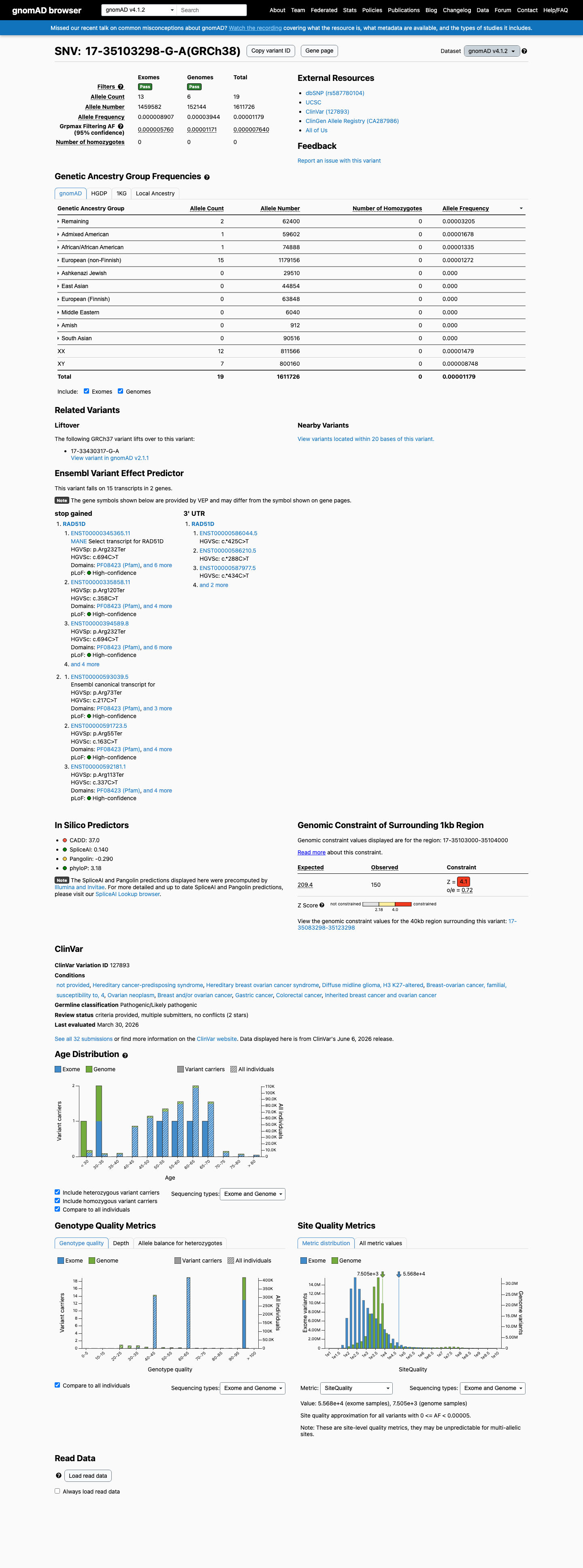
Met at supporting: gnomAD maximum observed allele frequency 3.21e-05 is below the PM2 threshold of <=0.0001, with zero homozygotes.
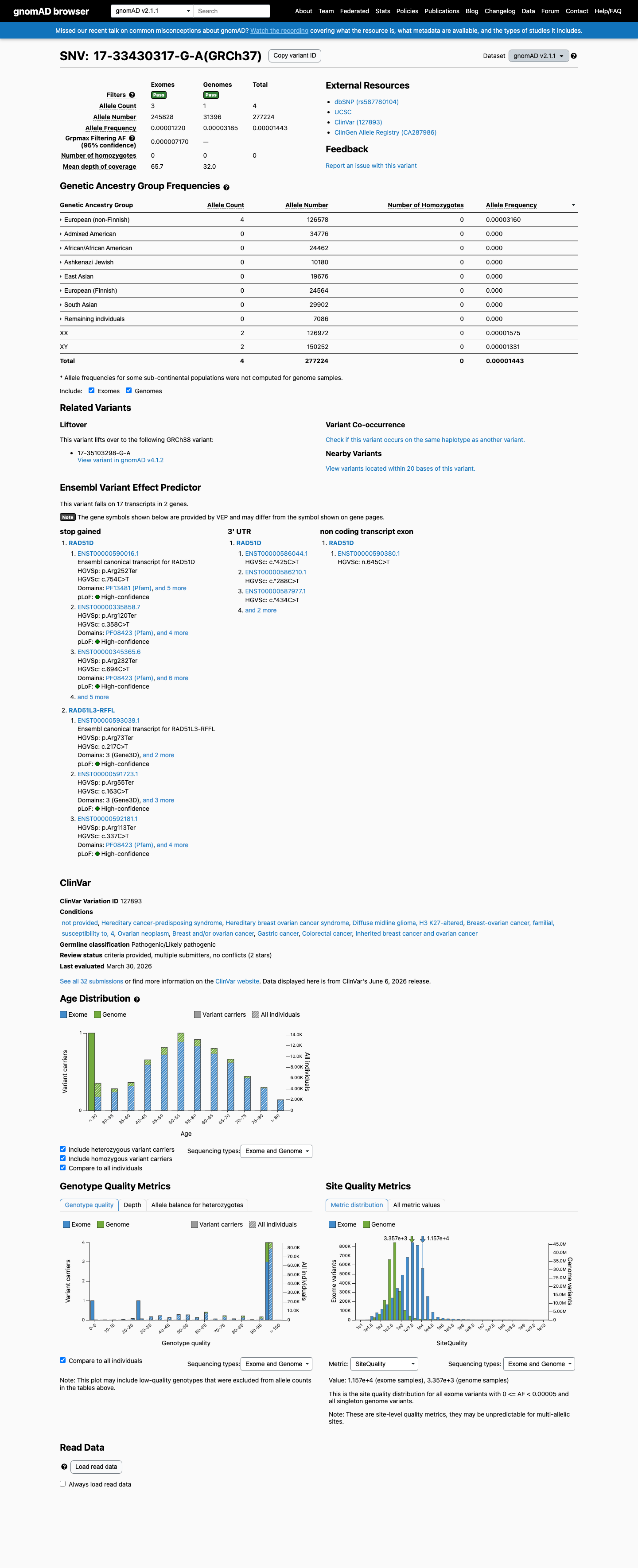
gnomAD v2.1 all-comers: 4/277224 alleles, AF 1.4428765e-05, highest subpopulation AF 3.1601068e-05, and 0 homozygotes.gnomAD v4.1 all-comers: 19/1611726 alleles, AF 1.1788604e-05, highest subpopulation AF 3.2051282e-05, and 0 homozygotes.Generic PM2 calibration supplied for this assessment: supporting allele frequency threshold <=0.0001 (ClinGen SVI recommendation, cited in the supplied calibration block to PMID:25741868).
Assessed · not applied · 5 not met · 11 not assessed
Pathogenic
PS2 Not assessed: no confirmed de novo observation with parental testing is documented for the proband.
PS3 Not assessed: no validated assay tested RAD51D c.694C>T (p.Arg232Ter), while available functional studies evaluated other or unspecified RAD51D loss-of-function variants.
PS4 Not assessed: the exact variant was observed in 1 of 105 tested patients without a variant-specific control comparison, odds ratio, or significant enrichment statistic.
PM3 Not assessed: the reported c.694C>T case has no documented second RAD51D variant or phase information establishing a biallelic affected genotype.
PM6 Not assessed: a patient report exists, but no assumed-de novo pedigree or parental-status evidence is documented.
PP1 Not assessed: zero informative variant-positive affected relatives or meioses are documented for this exact variant.
PP4 Not assessed: the available report lacks a complete individual phenotype and family history sufficiently specific for RAD51D-related disease.
PP5 Not met: the exact variant has zero ClinVar expert-panel submissions, despite multiple laboratory Pathogenic or Likely pathogenic assertions.
Benign
BA1 Not met: gnomAD maximum observed allele frequency 3.21e-05 is far below the generic BA1 stand-alone threshold of >=0.05.
BS1 Not met: gnomAD maximum observed allele frequency 3.21e-05 is below the generic BS1 threshold of >=0.01.
BS2 Not met: gnomAD v2.1 and v4.1 report zero homozygotes, so no BS2 evidence of healthy homozygous occurrence is present.
BS3 Not assessed: no validated assay demonstrated preserved RAD51D function for c.694C>T (p.Arg232Ter), and the exact-variant report supplied no functional result.
BS4 Not assessed: no phenotype-negative relatives with confirmed variant status are documented for non-segregation analysis.
BP2 Not assessed: c.694C>T is reported without a second pathogenic allele or phase result showing cis or trans configuration.
BP5 Not assessed: no confirmed alternative molecular diagnosis or applicable BP5 thresholded evidence was available for this patient.
BP6 Not met: the exact variant has no ClinVar expert-panel Benign or Likely benign classification and instead has laboratory Pathogenic or Likely pathogenic assertions.
N/A · 10 PS1 · PM1 · PM4 · PM5 · PP2 · PP3 · BP1 · BP3 · BP4 · BP7
Research & evidence
Population frequency · supports pathogenic
gnomAD v4.1 screenshot
gnomAD v4.1
gnomAD v2.1 screenshot
gnomAD v2.1
v4.1
This variant is present in gnomAD v4.1 (AF= 1.17886e-05; MAF= 0.00118%, 19/1611726 alleles, homozygotes = 0) and has highest observed frequency in the Remaining individuals population (AF= 3.20513e-05; MAF= 0.00321%, 2/62400 alleles, homozygotes = 0); grpmax FAF= 7.64e-06.
v2.1
This variant is present in gnomAD v2.1 (AF= 1.44288e-05; MAF= 0.00144%, 4/277224 alleles, homozygotes = 0) and has highest observed frequency in the European (non-Finnish) population (AF= 3.16011e-05; MAF= 0.00316%, 4/126578 alleles, homozygotes = 0); grpmax FAF= 7.17e-06.
🇨🇦 CA
Not available in gnomAD-Canada v1.0.
Allele frequency by ancestry
three datasets · side by side
gnomAD v4.1
0.0012% · 19 / 1,611,726
0 hom · FAF 0.00076%
Remaining individuals
2 / 62,400
0.0032%
Admixed American
1 / 59,602
0.0017%
African/African American
1 / 74,888
0.0013%
European (non-Finnish)
15 / 1,179,156
0.0013%
+ 6 not observed (European (Finnish), Amish, East Asian, Middle Eastern, South Asian, Ashkenazi Jewish)
gnomAD v2.1
0.0014% · 4 / 277,224
0 hom · FAF 0.00072%
European (non-Finnish)
4 / 126,578
0.0032%
+ 7 not observed (African/African American, Admixed American, Ashkenazi Jewish, East Asian, European (Finnish), Remaining individuals, South Asian)
gnomAD Canada 🇨🇦
Absent · 0 / ?
0 hom
Not observed in any ancestry group.
ClinVar screenshot
ClinVar
This variant has been reported in ClinVar as Pathogenic (28 clinical laboratories) and as pathogenic (1 clinical laboratory) and as Likely pathogenic (1 clinical laboratory). (ClinVarID = 127893)
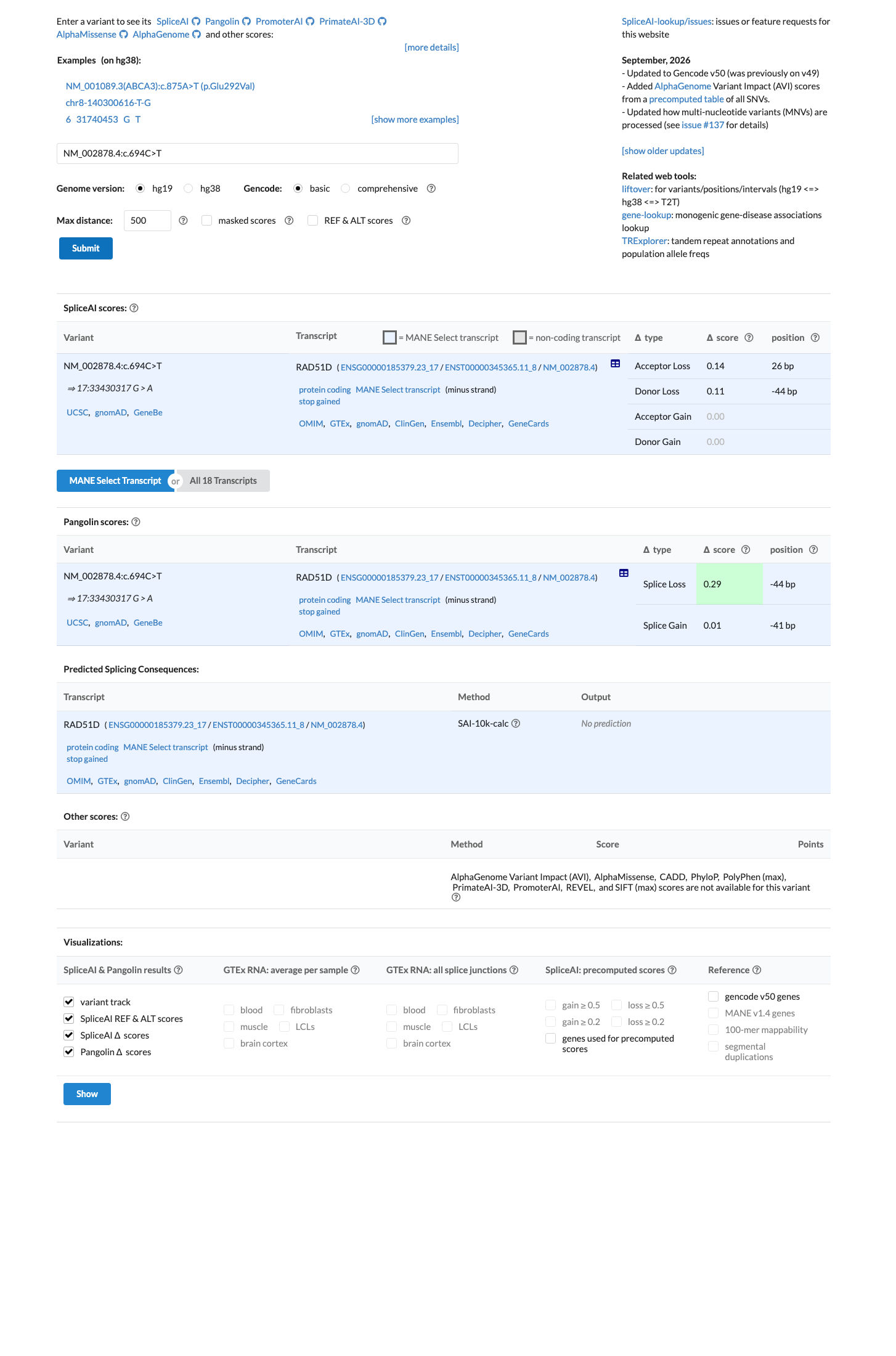
SpliceAI screenshot
In silico
SpliceAI returned NO scores for this variant, so no SpliceAI-based splice prediction is available. This is missing data, NOT evidence of absent splice impact: it must not be used to support BP4 or to argue against PP3/PVS1. Pangolin scores may be present but are not calibrated for PP3/BP4 here. BayesDel score = 0.63.
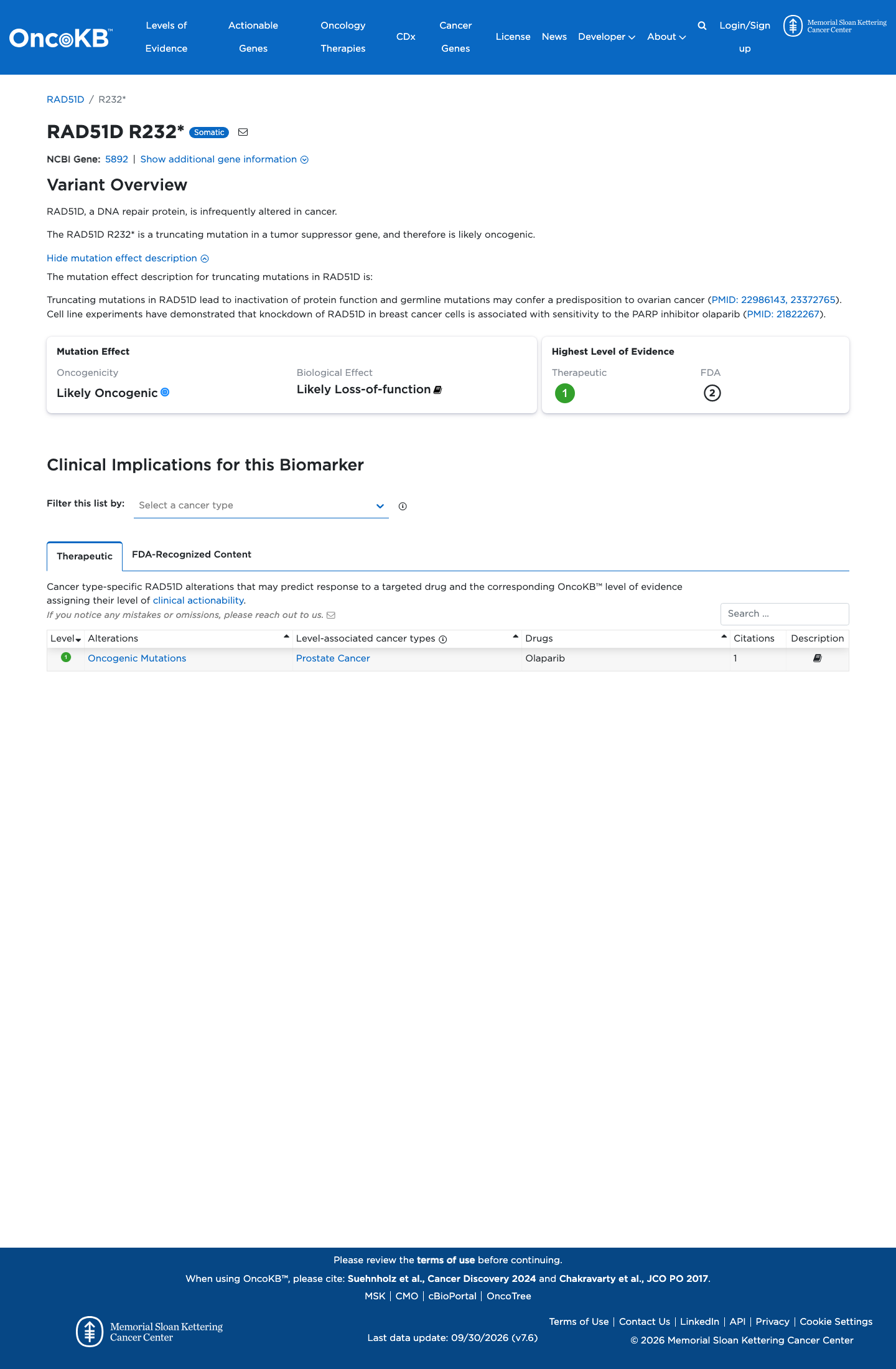
Functional / OncoKB screenshot
Functional Likely Oncogenic
OncoKB identified variant-specific curated literature and context relevant to functional review; biological-effect context: Likely Loss-of-function; curated oncogenicity label: Likely Oncogenic.
OncoKB ↗
COSMIC screenshot
COSMIC
Cancer hotspots screenshot
Cancer hotspots
Somatic evidence Not in COSMIC / hotspots
COSMIC
This variant does not lie in a statistically significant hotspot. This variant has not previously been reported in somatic cancers (COSMIC).
Hotspots
This variant does not lie in a statistically significant hotspot.
Literature · how each cited paper was used
3papers cited
Each card is an audit: what was searched, what was found, whether it names the variant, which criteria it fed, and why. 3 further PMIDs triaged but not cited — see Sources & references.
Standards and guidelines for the interpretation of sequence variants: a joint consensus recommendation of the American College of Medical Genetics and Genomics and the Association for Molecular Pathology.
Found
Generic PM2 calibration supplied for this assessment: supporting allele frequency threshold <=0.0001 (ClinGen SVI recommendation, cited in the supplied calibration block to PMID:25741868).
Applied to
→PM2 supporting
Frequency of germline DNA genetic findings in an unselected prospective cohort of triple-negative breast cancer patients participating in a platinum-based neoadjuvant chemotherapy trial.
Searched
c.694C>TNP_002869.3:p.(R232*)
Found
The paper directly reports RAD51D c.694C>T, p.Arg232* as a nonsense germline variant identified in a prospective triple-negative breast cancer cohort; it does not provide an NMD assay or variant-specific functional assay.
Variant
✓ Names this variant — characterised directly
Applied to
→PVS1 very strong
Confirms the exact case variant as a nonsense allele, consistent with the annotated truncating consequence.
RAD51D | Pathogenic | c.694C[T | p.Arg232* | Nonsense | Not-analyzed
Location Table 2, Description of the deleterious mutations in germinal DNA with the associated tumor Intrinsic Subtype (PAM50)  ·  Context Prospective cohort of 124 unselected patients with triple-negative breast cancer; germline DNA was available and tested for 105 patients using targeted next-generation sequencing with Sanger confirmation of clinically relevant variants.  ·  full text
Rule & framework references · cited for criterion definitions, not variant evidence
21822267 ↗ Germline mutations in RAD51D confer susceptibility to ovarian cancer.
Sources & reference links
8Sources
ClinVar
gnomAD v2.1
gnomAD v4.1
gnomAD-Canada
SpliceAI
OncoKB
COSMIC
Cancer hotspots
Triaged references · 3 PMIDs not cited in assessment
22986143 ↗ Loss of function germline mutations in RAD51D in women with ovarian carcinoma. ONCOKB
23372765 ↗ Analysis of RAD51D in ovarian cancer patients and families with a history of ovarian or breast cancer. ONCOKB
15604628 ↗ Genetic cancer risk assessment and counseling: recommendations of the national society of genetic counselors. CLINVAR