Analysis in progress
Initialising…
0%
complete
This report is still being assembled — sections appear as each stage finishes. It isn't final yet.
SDHB
Final classification
VUS
PM2PP3
SDHB
c.178A>G
p.Thr60Ala
missense · exon 2

SDHB encodes a subunit of the succinate dehydrogenase (SDH) complex, a mitochondrial enzyme that converts succinate to fumarate in the citric acid cycle and transfers electrons to the oxidative phosphorylation pathway. It functions as a tumor suppressor, and loss of its function stabilizes hypoxia-inducible factors, promoting tumor development. Inherited mutations in SDHB cause hereditary paraganglioma and pheochromocytoma, and SDH dysfunction is also linked to gastrointestinal stromal tumors, renal cell carcinoma, and pituitary adenomas. Mutations in this gene are additionally associated with mitochondrial complex II deficiency.

This variant

SDHB is a tumor suppressor whose loss predisposes to hereditary paraganglioma and pheochromocytoma, as well as gastrointestinal stromal tumors and renal cell carcinoma. Classifying c.178A>G (p.Thr60Ala) as a variant of uncertain significance means current evidence neither establishes that it disrupts SDH function nor excludes it as a cause of SDHB-related disease, so it should not be used alone to alter cancer-risk assessment or clinical management.

Transcript
NM_003000.3
HGVS · transcript:coding
NM_003000.3:c.178A>G
GRCh38
chr1:17044783 T>C
GRCh37
chr1:17371278 T>C
Basis Generic ACMG/AMP 2015 rules were applied because the SDHB VCEP specification lacked usable combination rules; only PM2 (supporting) and PP3 (moderate) are met, insufficient for LP/P or B/LB.
Generic ACMG/AMP 2015 rules were applied because the SDHB VCEP specification lacked usable combination rules; only PM2 (supporting) and PP3 (moderate) are met, insufficient for LP/P or B/LB.
Classification rationale
PM2PP3 VUS
SDHB c.178A>G missense · exon 2

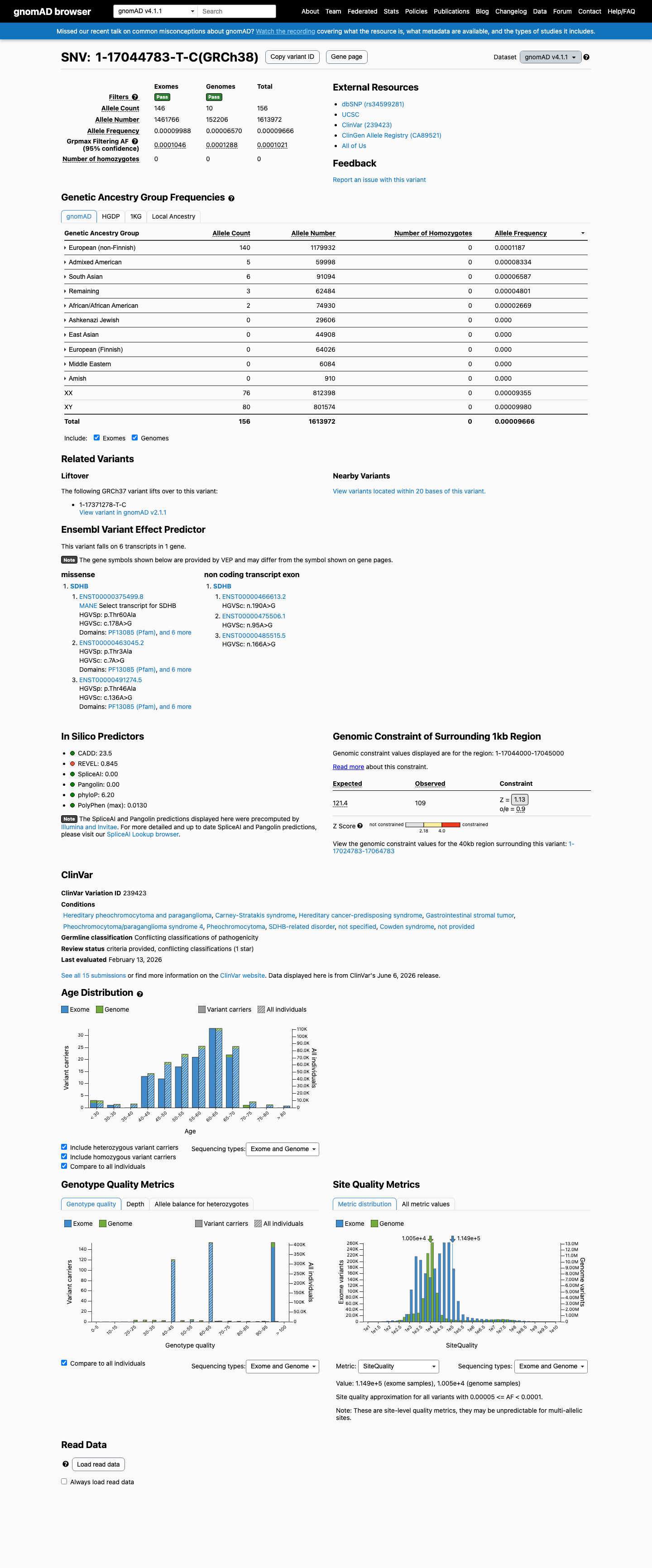
PM2 (Supporting): variant is rare in population databases - gnomAD v4.1 overall AF 0.009666%, zero homozygotes, below the 0.1% threshold. PP3 (Moderate): REVEL 0.845 exceeds the >=0.773 moderate pathogenic-evidence threshold. Synthesis: PM2 (supporting) plus PP3 (moderate) does not meet the ACMG/AMP 2015 combination thresholds for Likely Pathogenic or Likely Benign; the variant is classified as VUS.

PM2 + PP3 VUS
Gene diagram · NM_003000.3 · variants mapped to exon structure
SDHB NM_003000.3
Fetching transcript structure from UCSC…
Applied criteria · 2 applied · 20 assessed
MetEvidence satisfies this criterion.
Not metEvaluated against available evidence; threshold not reached.
Not assessedApplies in principle, but no evidence was found to evaluate it.
N/ADoesn't apply to this variant type.
Applied · 2
Strength Supporting Moderate Strong Very strong
PM2 supporting Pathogenic
Met (supporting): gnomAD v4.1 overall AF 0.009666% (NFE 0.011865%), zero homozygotes, below the 0.1% rarity threshold.
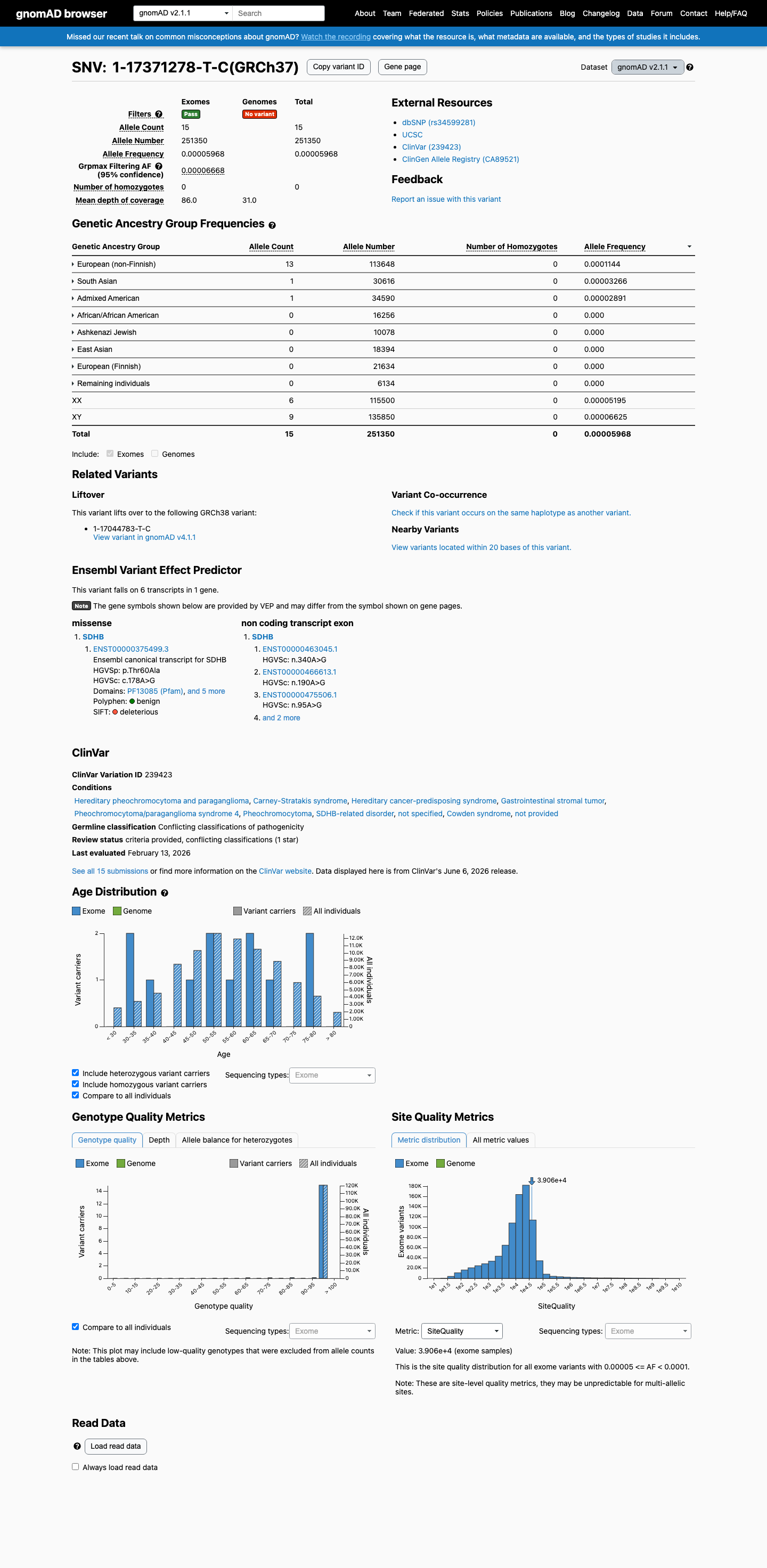
The retrieved SDHB VCEP ruleset has no operational PM2 threshold, so generic ACMG/AMP rarity assessment was used.gnomAD v4.1 reports AF 0.009666% overall (156/1,613,972), 0.011865% in NFE (140/1,179,932), and grpmax FAF 0.01021%, with zero homozygotes. gnomAD v2.1 is concordant (overall AF 0.005968%; NFE AF 0.011439%; grpmax FAF 0.006668%).The gnomAD-Canada NFE point estimate is 0.025558% from 3/11,738 alleles, but its FAF95 is 0.006943%; this small-sample estimate remains below 0.1% and does not represent a frequency threshold artifact that would negate PM2.
PP3 moderate Pathogenic
Met (moderate): REVEL 0.845 meets the ClinGen SVI-calibrated moderate pathogenic-evidence threshold (>=0.773).
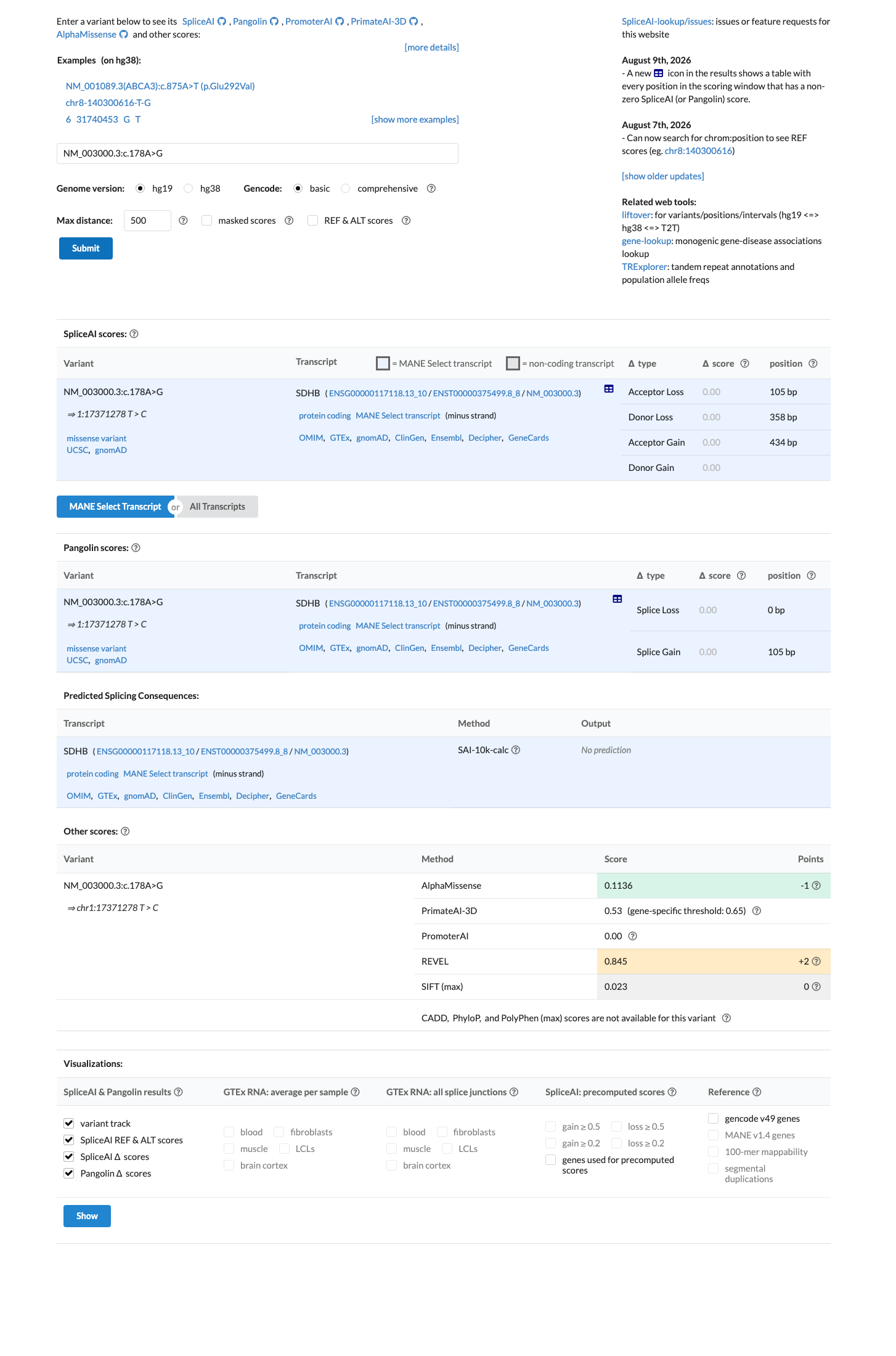
REVEL score = 0.845 for NM_003000.3:c.178A>G (p.Thr60Ala), retrieved from the local REVEL v1.3 predictor lookup.ClinGen SVI-calibrated REVEL thresholds (Pejaver et al. 2022, PMID 36413997): PP3_Moderate applies at REVEL >=0.773 (PP3_Supporting >=0.644, PP3_Strong >=0.932); REVEL 0.845 falls in the moderate pathogenic-evidence band.SpliceAI predicts no significant splice impact for this variant (max delta score = 0.002 across DS_AG/DS_AL/DS_DG/DS_DL), indicating no competing splice-disruption mechanism that would need separate PP3 consideration.
Assessed · not applied · 8 not met · 12 not assessed
Pathogenic
PS1 Not met: no independent pathogenic classification of the same amino-acid change (p.Thr60Ala) from a different nucleotide substitution.
PS2 Not assessed: no documented de novo occurrence; the maternal-origin ClinVar submission lacks parental genotypes and identity testing.
PS3 Not assessed: no functional assay data for p.Thr60Ala; the large SDHB functional study (PMID:41252211) does not report this variant.
PS4 Not assessed: no case-control enrichment analysis or series of unrelated affected individuals with this exact variant.
PM1 Not met: residue Thr60 is not among SDHB's Fe-S cluster-coordinating cysteines or other residues flagged as structurally critical.
PM5 Not met: the only alternate residue-60 variant (p.Thr60Ile) was functionally reclassified as Likely Benign, not pathogenic.
PM6 Not assessed: no presumed de novo occurrence; reported maternal origin argues against a de novo event.
PP1 Not assessed: no pedigree, affected-relative genotypes, or informative meioses are provided.
PP2 Not assessed: no missense constraint statistics or benign-missense-rate data were available to establish both PP2 requirements.
PP4 Not assessed: no proband phenotype or family-history information supplied, so phenotype specificity cannot be evaluated.
PP5 Not met: no ClinVar expert-panel Pathogenic or Likely pathogenic classification exists for this exact variant.
Benign
BA1 Not met: highest population frequency NFE AF 0.011865% (140/1,179,932 alleles), far below the 1% BA1 threshold.
BS1 Not met: highest robust population frequency NFE AF 0.011865%, below the 0.3% BS1 threshold.
BS2 Not assessed: zero homozygotes in population databases, but no phenotype-verified unaffected adult carriers were available.
BS3 Not assessed: no functional assay evidence of normal SDHB activity for p.Thr60Ala was identified.
BS4 Not assessed: no affected family member documented to lack the variant; maternal origin alone does not establish non-segregation.
BP2 Not assessed: no qualifying co-occurrence with an established pathogenic SDHB variant is documented.
BP4 Not met: REVEL 0.845 far exceeds the <=0.290 BP4 benign threshold, supporting a pathogenic direction.
BP5 Not assessed: no molecular testing result documents an alternate molecular basis for disease.
BP6 Not met: no ClinVar expert-panel Benign or Likely benign classification exists for this exact variant.
N/A · 6 PVS1 · PM3 · PM4 · BP1 · BP3 · BP7
Research & evidence
Population frequency
gnomAD v4.1 screenshot
gnomAD v4.1
gnomAD v2.1 screenshot
gnomAD v2.1
v4.1
This variant is present in gnomAD v4.1 (AF= 9.6656e-05; MAF= 0.00967%, 156/1613972 alleles, homozygotes = 0) and has highest observed frequency in the European (non-Finnish) population (AF= 0.000118651; MAF= 0.01187%, 140/1179932 alleles, homozygotes = 0); grpmax FAF= 0.0001021.
v2.1
This variant is present in gnomAD v2.1 (AF= 5.96777e-05; MAF= 0.00597%, 15/251350 alleles, homozygotes = 0) and has highest observed frequency in the European (non-Finnish) population (AF= 0.000114388; MAF= 0.01144%, 13/113648 alleles, homozygotes = 0); grpmax FAF= 6.668e-05.
🇨🇦 CA
This variant is present in gnomAD-Canada v1.0 (AF= 0.0001628841350852427, 3/18418 alleles, homozygotes = 0).
Allele frequency by ancestry
three datasets · side by side
gnomAD v4.1
0.0097% · 156 / 1,613,972
0 hom · FAF 0.01%
European (non-Finnish)
140 / 1,179,932
0.012%
Admixed American
5 / 59,998
0.0083%
South Asian
6 / 91,094
0.0066%
Remaining individuals
3 / 62,484
0.0048%
African/African American
2 / 74,930
0.0027%
+ 5 not observed (European (Finnish), Amish, East Asian, Middle Eastern, Ashkenazi Jewish)
gnomAD v2.1
0.006% · 15 / 251,350
0 hom · FAF 0.0067%
European (non-Finnish)
13 / 113,648
0.011%
South Asian
1 / 30,616
0.0033%
Admixed American
1 / 34,590
0.0029%
+ 5 not observed (African/African American, Ashkenazi Jewish, East Asian, European (Finnish), Remaining individuals)
gnomAD Canada 🇨🇦
0.016% · 3 / 18,418
0 hom · FAF 0.0069%
European (non-Finnish)
3 / 11,738
0.026%
+ 8 not observed (African/African American, Latino/Admixed American, Ashkenazi Jewish, East Asian, European (Finnish), Middle Eastern, Remaining individuals, South Asian)
ClinVar screenshot
ClinVar
This variant has been reported in ClinVar as Uncertain significance (11 clinical laboratories) and as Benign (2 clinical laboratories) and as Likely benign (1 clinical laboratory). (ClinVarID = 239423)
SpliceAI screenshot
In silico
SpliceAI predicts no significant splice impact for this variant (max delta score = 0.00). REVEL score = 0.845. BayesDel score = 0.307627.
Functional / OncoKB screenshot
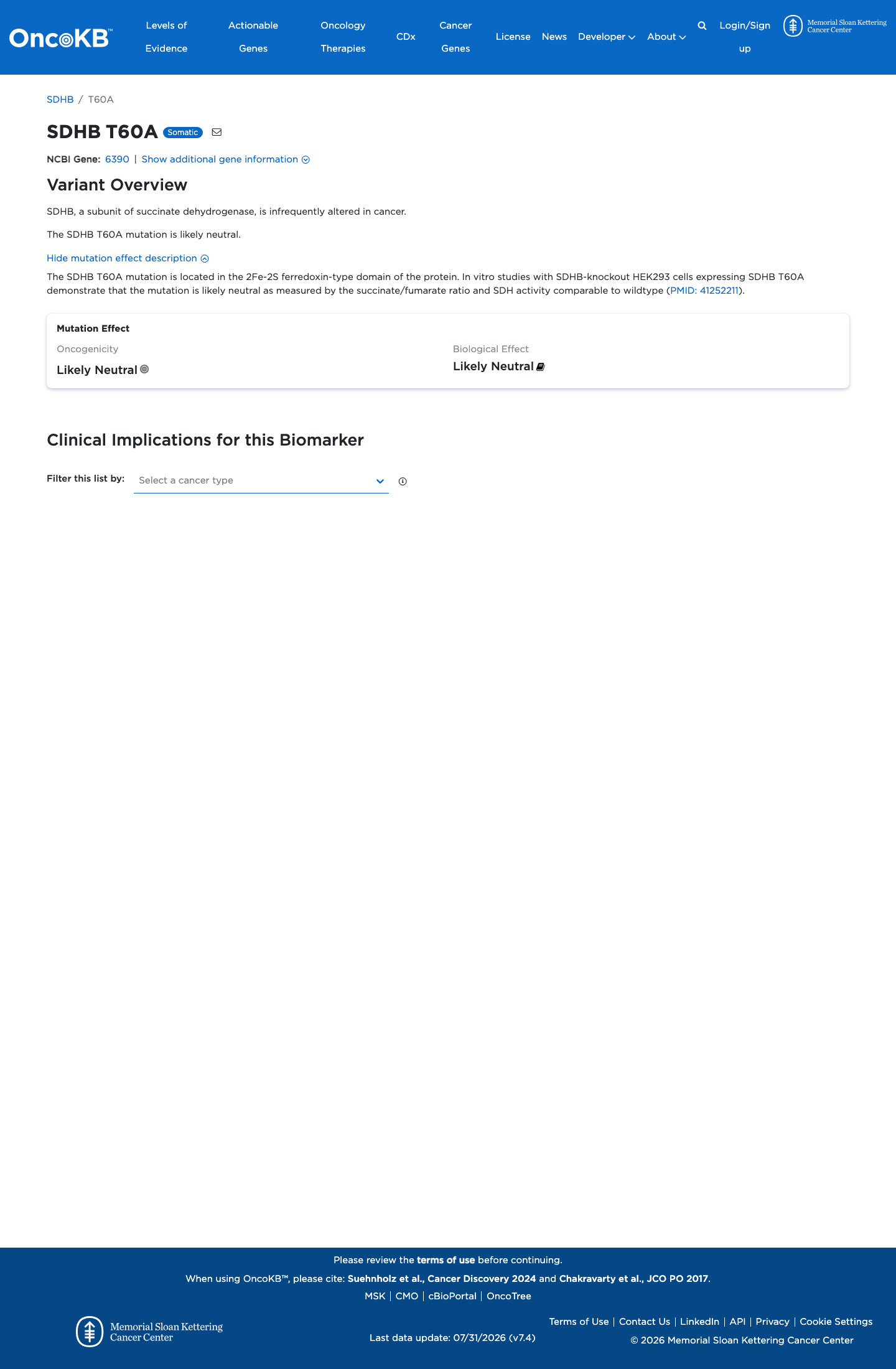
Functional Likely Neutral
OncoKB identified variant-specific curated literature and context relevant to functional review; biological-effect context: Likely Neutral; curated oncogenicity label: Likely Neutral.
OncoKB ↗
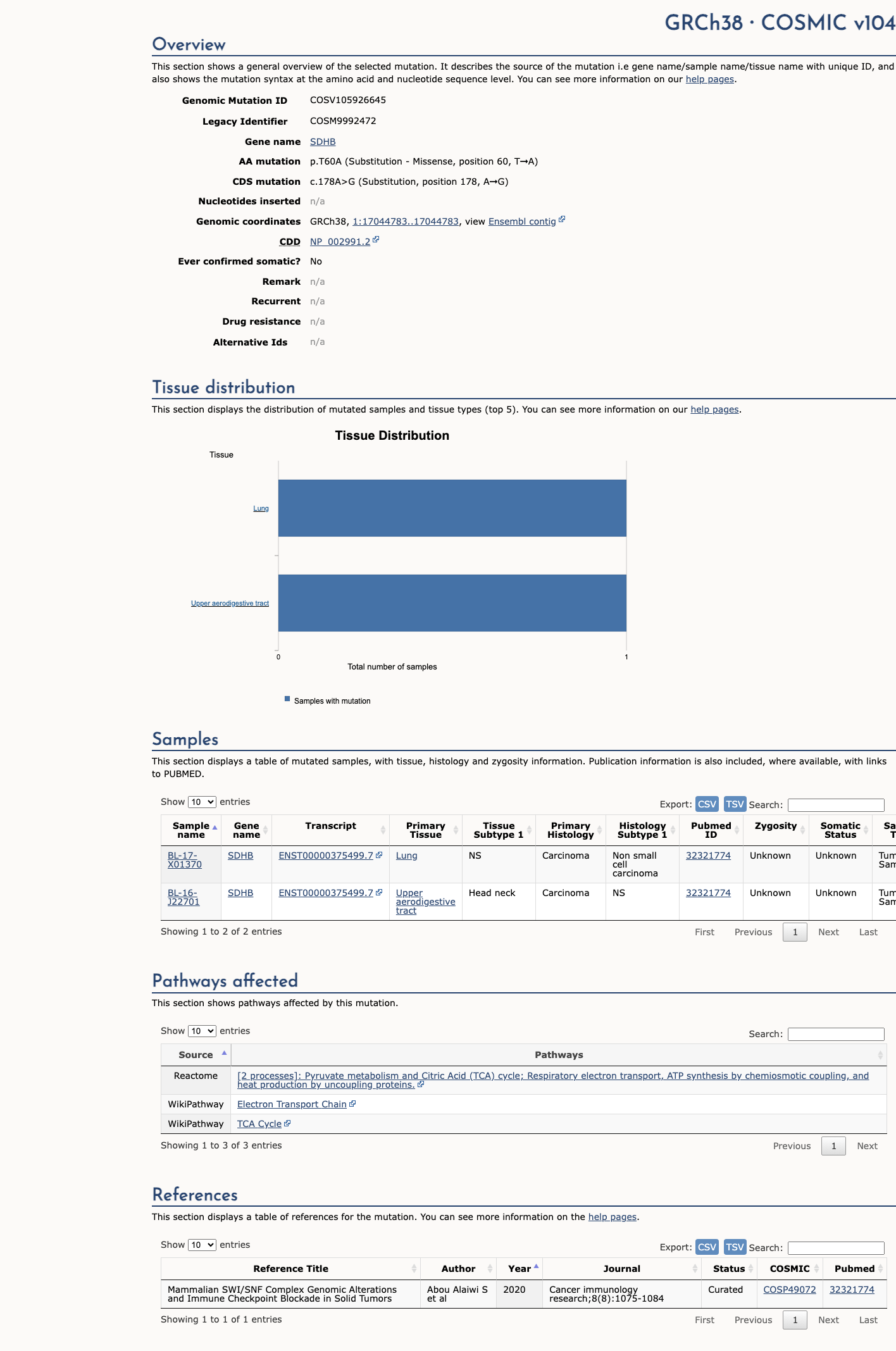
COSMIC screenshot
COSMIC
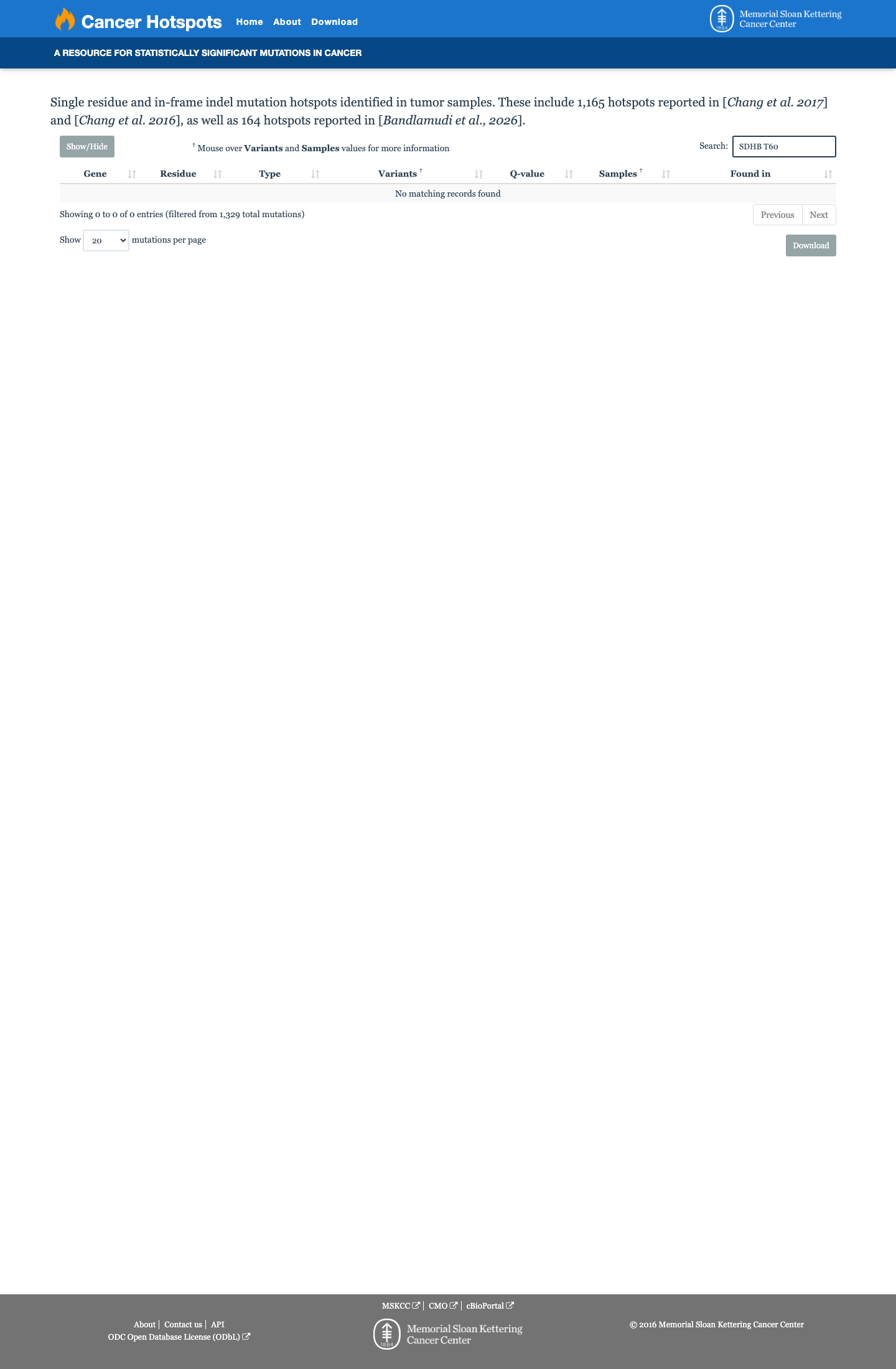
Cancer hotspots screenshot
Cancer hotspots
Somatic evidence Not in COSMIC / hotspots
COSMIC
This variant does not lie in a statistically significant hotspot. This variant has previously been reported in somatic cancers (COSMIC; COSV105926645, n = 2 times).
Hotspots
This variant does not lie in a statistically significant hotspot.
Sources & reference links
9Sources
CSpec VCEP
ClinVar
gnomAD v2.1
gnomAD v4.1
gnomAD-Canada
SpliceAI
OncoKB
COSMIC
Cancer hotspots
Triaged references · 8 PMIDs not cited in assessment
41252211 ↗ Functional characterization of SDHB variants clarifies hereditary pheochromocytoma and paraganglioma risk and genotype-phenotype relationships. ONCOKB
25694510 ↗ Germline and somatic SDHx alterations in apparently sporadic differentiated thyroid cancer. CLINVAR
25741868 ↗ Standards and guidelines for the interpretation of sequence variants: a joint consensus recommendation of the American College of Medical Genetics and Genomics and the Association for Molecular Pathology. CLINVAR
26467025 ↗ A Standardized DNA Variant Scoring System for Pathogenicity Assessments in Mendelian Disorders. CLINVAR
28819017 ↗ Adrenocortical carcinoma and succinate dehydrogenase gene mutations: an observational case series. CLINVAR
20301715 ↗ Hereditary Paraganglioma-Pheochromocytoma Syndromes. CLINVAR
20664475 ↗ The North American Neuroendocrine Tumor Society consensus guideline for the diagnosis and management of neuroendocrine tumors: pheochromocytoma, paraganglioma, and medullary thyroid cancer. CLINVAR
26324357 ↗ American Society of Clinical Oncology Policy Statement Update: Genetic and Genomic Testing for Cancer Susceptibility. CLINVAR