NM_003002.4:c.110A>T (p.Asp37Val) in SDHD is absent from all gnomAD population databases (v2.1, v4.1, gnomAD-Canada), supporting PM2 at supporting strength.1 In silico predictions support a deleterious effect: REVEL score 0.701 and SpliceAI max delta 0.30 suggest possible functional and splice impact, meeting PP3 at supporting strength.2 No variant-specific functional studies, case reports, segregation data, or expert panel classifications are available. ClinVar contains two single-submitter classifications (Uncertain significance, Likely pathogenic), neither from an expert panel.3 With only PM2 (supporting) and PP3 (supporting) met, the evidence is insufficient to classify this variant as pathogenic or likely pathogenic under the generic ACMG/AMP 2015 framework. The variant is classified as a Variant of Uncertain Significance (VUS).4
Final classification
VUS
PM2PP3
SDHD
c.110A>T
p.Asp37Val
missense
This variant
NM_003002.4:c.110A>T (p.Asp37Val) in SDHD is absent from all gnomAD population databases (v2.1, v4.1, gnomAD-Canada), supporting PM2 at supporting strength.
gene-specific framework lacked a usable explicit final combination framework, so generic ACMG/AMP 2015 final-combination rules were applied as fallback; applied criteria: PM2 supporting, PP3 supporting; combination = 2 supporting, which maps to VUS.
Classification rationale
PM2PP3
VUS
SDHD c.110A>T
missense
PM2 + PP3
→
VUS
2
revelspliceai ↗
4
generic_acmg_combination_rules
LYFE Sciences is an AI system, and it can make mistakes. Criteria
may be applied incorrectly, sources may be misread, and a confident-looking
classification can still be wrong. Double-check every criterion and
its underlying evidence before relying on any call.
Gene diagram
· NM_003002.4 · variants mapped to exon structure
SDHD
NM_003002.4
Fetching transcript structure from UCSC…
Applied criteria · 2 applied · 21 assessed
MetEvidence satisfies this criterion.
Not metEvaluated against available evidence; threshold not reached.
Not assessedApplies in principle, but no evidence was found to evaluate it.
N/ADoesn't apply to this variant type.
Applied · 2
Strength
Supporting
Moderate
Strong
Very strong
PM2
supporting
Pathogenic
NM_003002.4:c.110A>T is absent from gnomAD v2.1, gnomAD v4.1, and gnomAD-Canada v1.0, with allele frequency well below the 0.1% threshold for PM2 under the generic ACMG framework.
Absent from all gnomAD population databases (v2.1 exomesv4.1 exomesgnomAD-Canada genomes).
PP3
supporting
Pathogenic
Multiple in silico tools support a deleterious effect. REVEL score of 0.701 exceeds the typical 0.5 threshold for pathogenicity prediction. SpliceAI predicts a possible splice alteration with a maximum delta score of 0.30 (DS_AL=0.30, DS_DL=0.27). BayesDel score of 0.257 is not independently supportive but does not contradict.
REVEL score: 0.701 (deleterious).SpliceAI max delta: 0.30 (possible splice alterationacceptor loss 0.30
Assessed · not applied
· 12 not met · 9 not assessed
Pathogenic
PS1
No evidence that the same amino acid change (p.Asp37Val) arising from a different nucleotide substitution has been previously established as pathogenic.
PS2
No de novo testing data available.
PS3
No variant-specific functional studies were identified for NM_003002.4:c.110A>T (p.Asp37Val).
PS4
No case reports or patient observations documenting this specific variant were identified in the literature.
PM1
Position 37 of SDHD is not within a statistically significant mutational hotspot per cancerhotspots.org, and no literature evidence in the case materials establishes this N-terminal region as a well-characterized critical functional domain with demonstrated variant-level impact at this residue.
PM5
No pathogenic missense comparators at the same residue (position 37) with a different amino acid change were identified.
PM6
No de novo confirmation data available for this variant.
PP1
No segregation data available.
PP2
No gene-specific missense constraint metric is available for SDHD.
PP4
Patient phenotype information was not provided in the case materials.
PP5
ClinVar review status for variation 940748 is 'criteria provided, single submitter' — not a 3-star expert panel classification.
Benign
BA1
The variant is absent from all gnomAD population databases.
BS1
The variant is absent from all gnomAD population databases.
BS2
No data on observation of this variant in healthy adult controls is available.
BS3
No functional studies demonstrating no damaging effect on protein function or splicing are available for this variant.
BS4
No segregation data available to evaluate lack of co-segregation with disease.
BP1
Although SDHD is a tumor suppressor gene where loss-of-function is the primary disease mechanism, pathogenic missense variants in SDHD are well-established in hereditary paraganglioma-pheochromocytoma syndromes.
BP2
No data on observation of this variant in trans with a known pathogenic variant in SDHD.
BP4
Multiple in silico tools predict a deleterious rather than benign effect.
BP5
No evidence of an alternate molecular basis for disease in a case where this variant was observed.
BP6
No expert panel has classified this variant as benign or likely benign.
N/A · 5
PVS1 · PM3 · PM4 · BP3 · BP7
Research & evidence
Population frequency
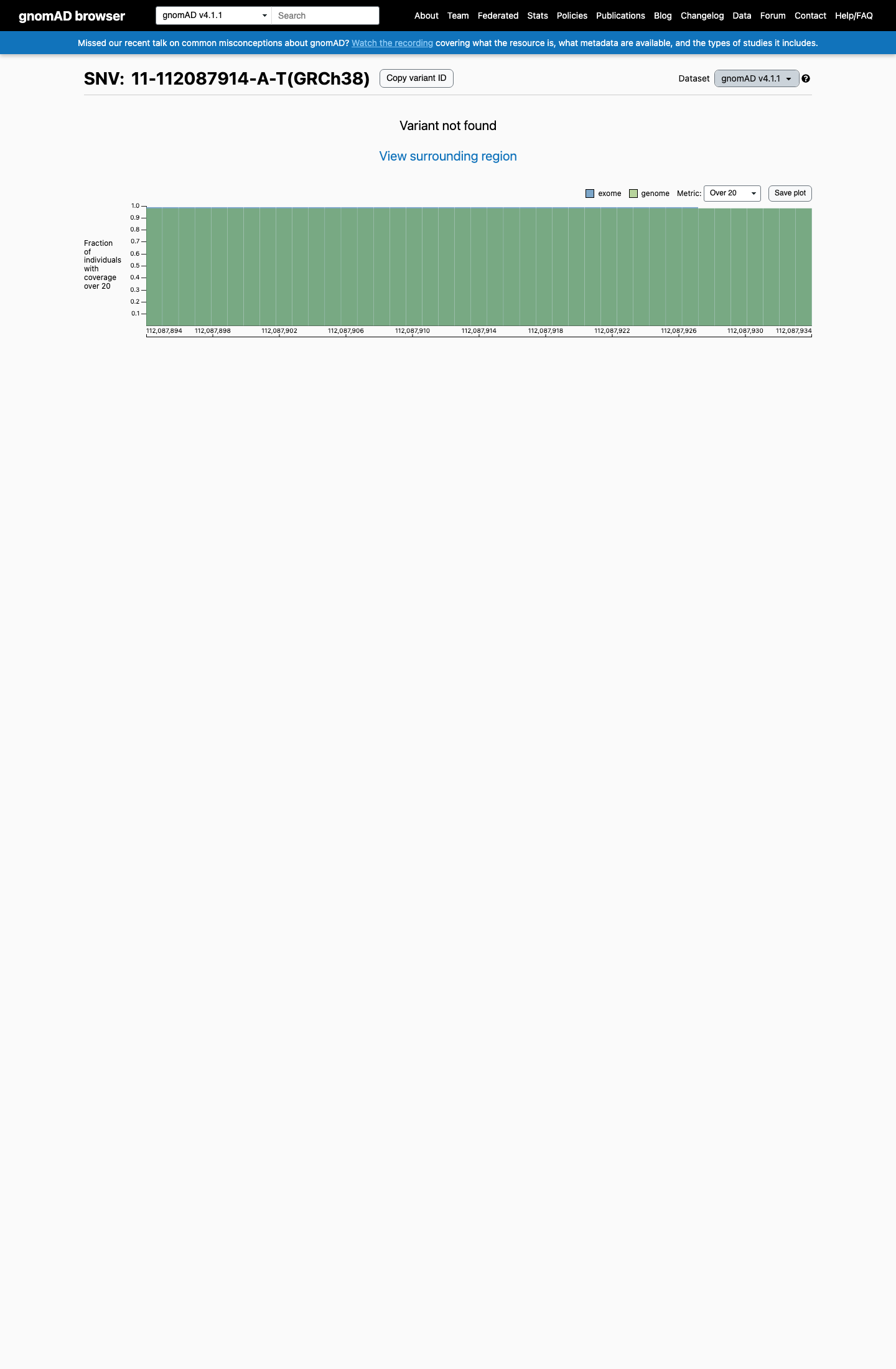
gnomAD v4.1
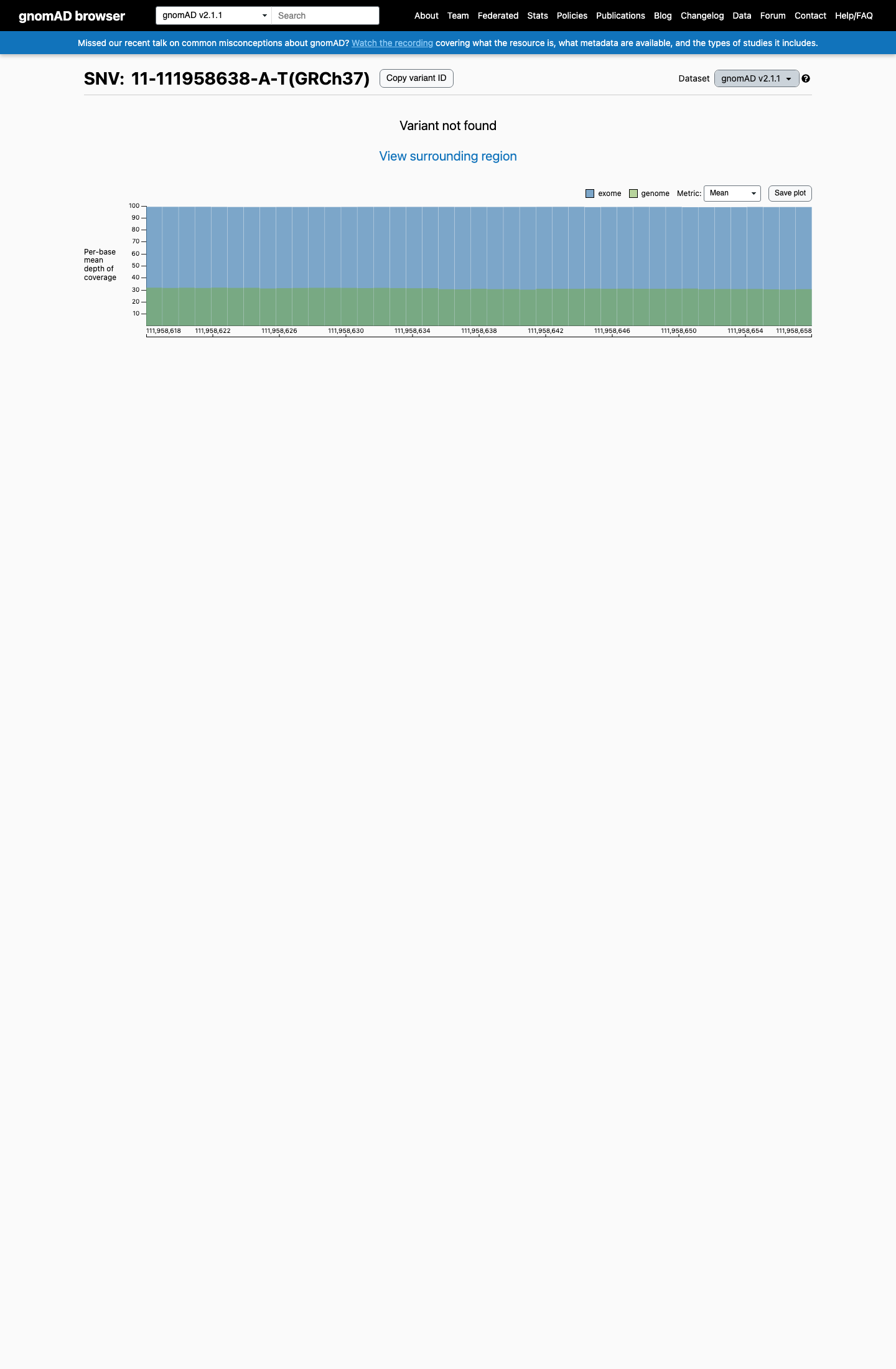
gnomAD v2.1
v4.1
Absent from gnomAD v4.1.
v2.1
Absent from gnomAD v2.1.
🇨🇦 CA
Absent from gnomAD-Canada v1.0.
Allele frequency by ancestry
three datasets · side by side
gnomAD v4.1
Absent
· 0 / ?
0 hom
0 hom
Not observed in any ancestry group.
gnomAD v2.1
Absent
· 0 / ?
0 hom
0 hom
Not observed in any ancestry group.
gnomAD Canada 🇨🇦
Absent
· 0 / ?
0 hom
0 hom
Not observed in any ancestry group.
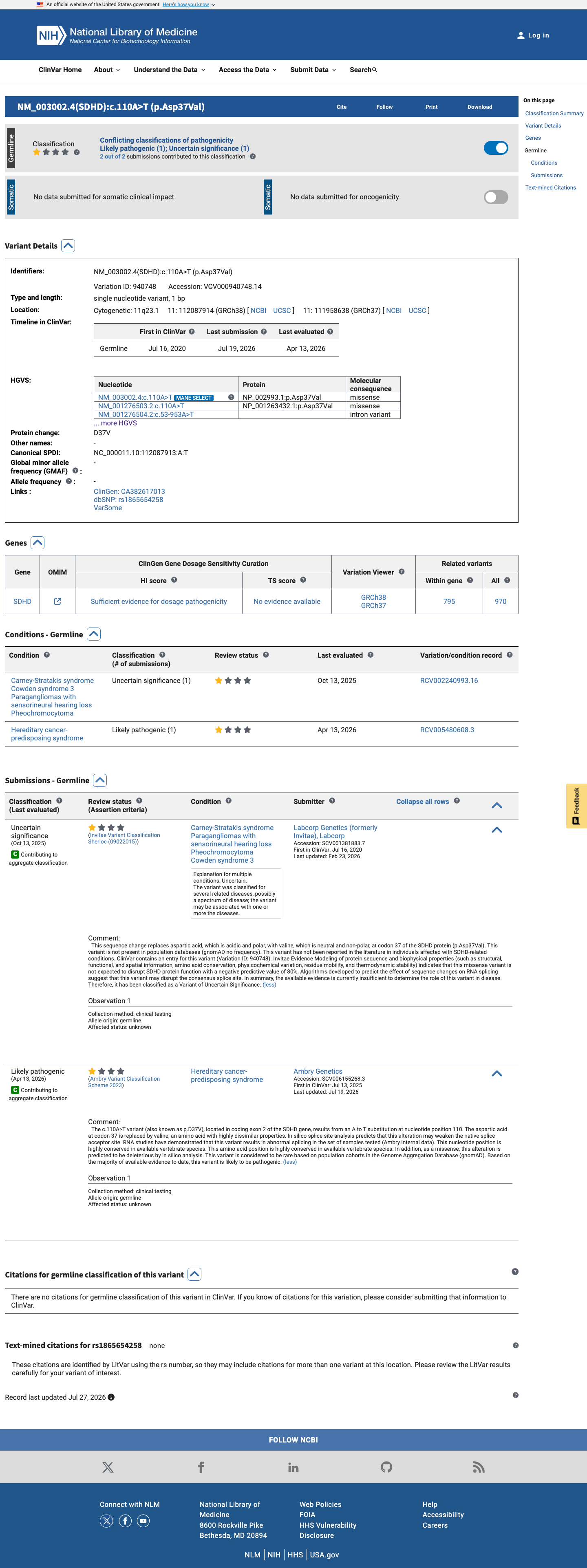
ClinVar
This variant has been reported in ClinVar as Uncertain significance (1 clinical laboratory) and as Likely pathogenic (1 clinical laboratory). (ClinVarID = 940748)
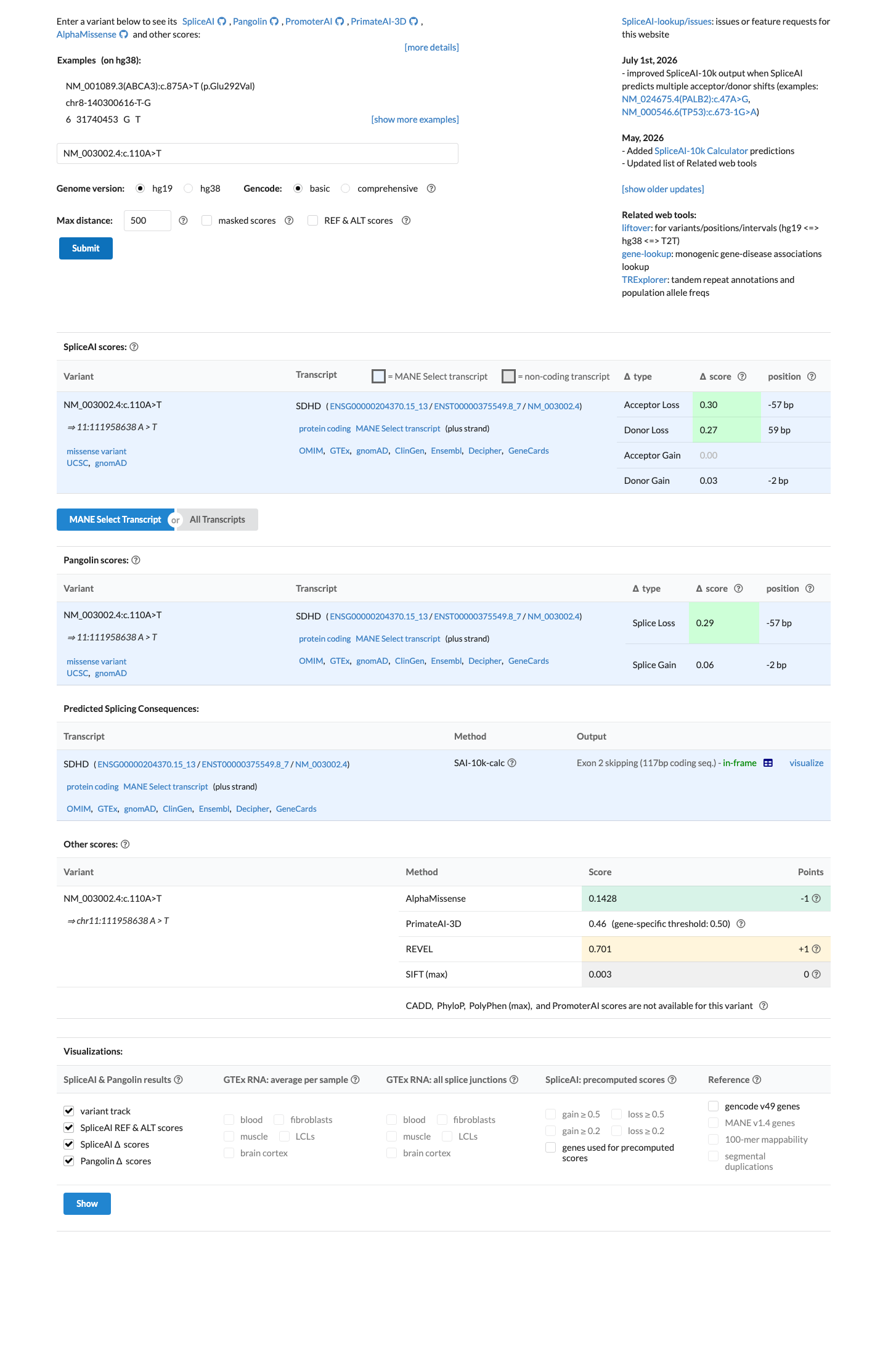
In silico
SpliceAI predicts possible splice impact for this variant (max delta score = 0.30). REVEL score = 0.701. BayesDel score = 0.256688.
Functional
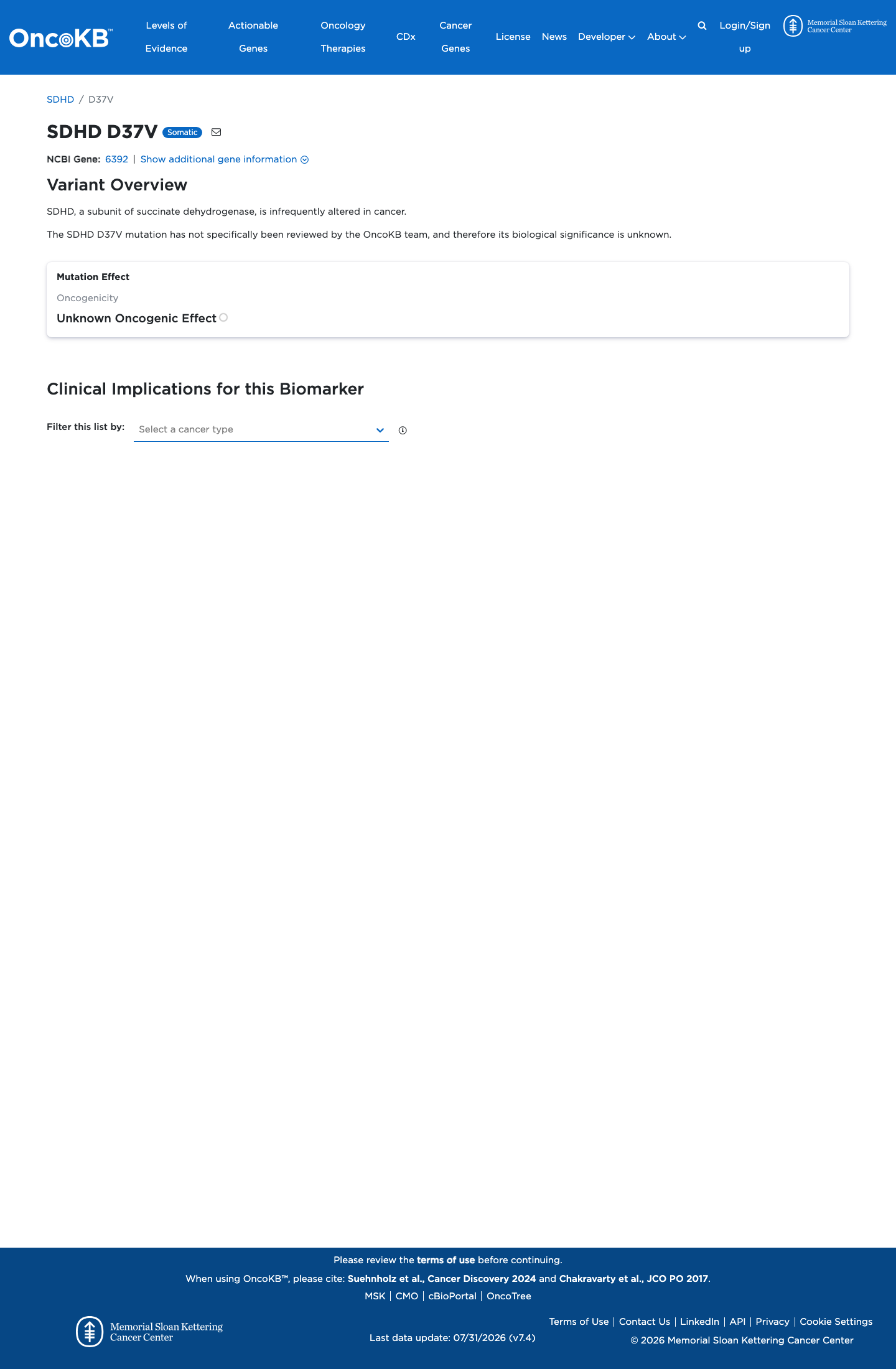
Unknown Oncogenic Effect
OncoKB did not identify variant-specific reviewed functional evidence for this variant; gene-level curated context is available for reviewer follow-up. SDHD, a subunit of succinate dehydrogenase, is infrequently altered in cancer.

COSMIC

Cancer hotspots
Somatic evidence
Not in COSMIC / hotspots
COSMIC
This variant does not lie in a statistically significant hotspot. This variant has not previously been reported in somatic cancers (COSMIC).
Hotspots
This variant does not lie in a statistically significant hotspot.
Sources & reference links
Triaged references · 5 PMIDs not cited in assessment
25394175 ↗
A practice guideline from the American College of Medical Genetics and Genomics and the National Society of Genetic Counselors: referral indications for cancer predisposition assessment.
CLINVAR
26389258 ↗
Cancer Genetics Risk Assessment and Counseling (PDQ®): Health Professional Version.
CLINVAR
35802134 ↗
ACMG SF v3.1 list for reporting of secondary findings in clinical exome and genome sequencing: A policy statement of the American College of Medical Genetics and Genomics (ACMG).
CLINVAR
24893135 ↗
Pheochromocytoma and paraganglioma: an endocrine society clinical practice guideline.
CLINVAR