Back
NM_003925.3:c.1231_1234del
p.Arg411GlyfsTer79 · MBD4
ACMG/AMP
0%
complete
Final classification
VUS
PM2
MBD4
c.1231_1234del
p.Arg411GlyfsTer79
frameshift

MBD4 encodes a DNA glycosylase that detects and repairs deaminated methyl-cytosines in DNA, using a methyl-CpG binding domain to anchor to methylated DNA and a glycosylase domain to carry out mismatch repair in CpG-rich regions. The protein also helps repress transcription from methylated gene promoters. MBD4 acts as a tumor suppressor, and its loss has been linked to colorectal cancer, acute myeloid leukemia, and uveal melanoma.

This variant

MBD4 is a tumor-suppressor DNA glycosylase whose biallelic loss of function causes MBD4-associated neoplasia syndrome, predisposing to colorectal cancer, acute myeloid leukemia, and uveal melanoma. This frameshift is biologically consistent with that mechanism, as it removes the entire C-terminal glycosylase catalytic domain, but it remains a VUS because only population-frequency evidence (PM2, supporting) was met. Variant-specific functional or clinical data would be needed to confirm its pathogenicity.

Transcript
NM_003925.3
HGVS · transcript:coding
NM_003925.3:c.1231_1234del
GRCh38
chr3:129434103 CTTCT>C
GRCh37
chr3:129152946 CTTCT>C
No ClinGen or custom gene-specific framework exists for MBD4, so generic ACMG/AMP 2015 rules applied; with only PM2 (supporting) met, no combination threshold is reached and the variant is classified as VUS.
Classification rationale
PM2 VUS
MBD4 c.1231_1234del frameshift

PM2 (Supporting): gnomAD allele frequency 0.00124-0.00159%, far below the 0.1% threshold, with zero homozygotes. Overall: VUS — the single supporting criterion (PM2) does not meet any ACMG/AMP 2015 Pathogenic, Likely Pathogenic, Benign, or Likely Benign combination threshold.

PM2 VUS
LYFE Sciences is an AI system, and it can make mistakes. Criteria may be applied incorrectly, sources may be misread, and a confident-looking classification can still be wrong. Double-check every criterion and its underlying evidence before relying on any call.
Gene diagram · NM_003925.3 · variants mapped to exon structure
MBD4 NM_003925.3
Fetching transcript structure from UCSC…
Applied criteria · 1 applied · 19 assessed
MetEvidence satisfies this criterion.
Not metEvaluated against available evidence; threshold not reached.
Not assessedApplies in principle, but no evidence was found to evaluate it.
N/ADoesn't apply to this variant type.
Applied · 1
Strength Supporting Moderate Strong Very strong
PM2 supporting Pathogenic
Met (supporting): gnomAD allele frequency 0.00124-0.00159% is far below the 0.1% threshold, with zero homozygotes.
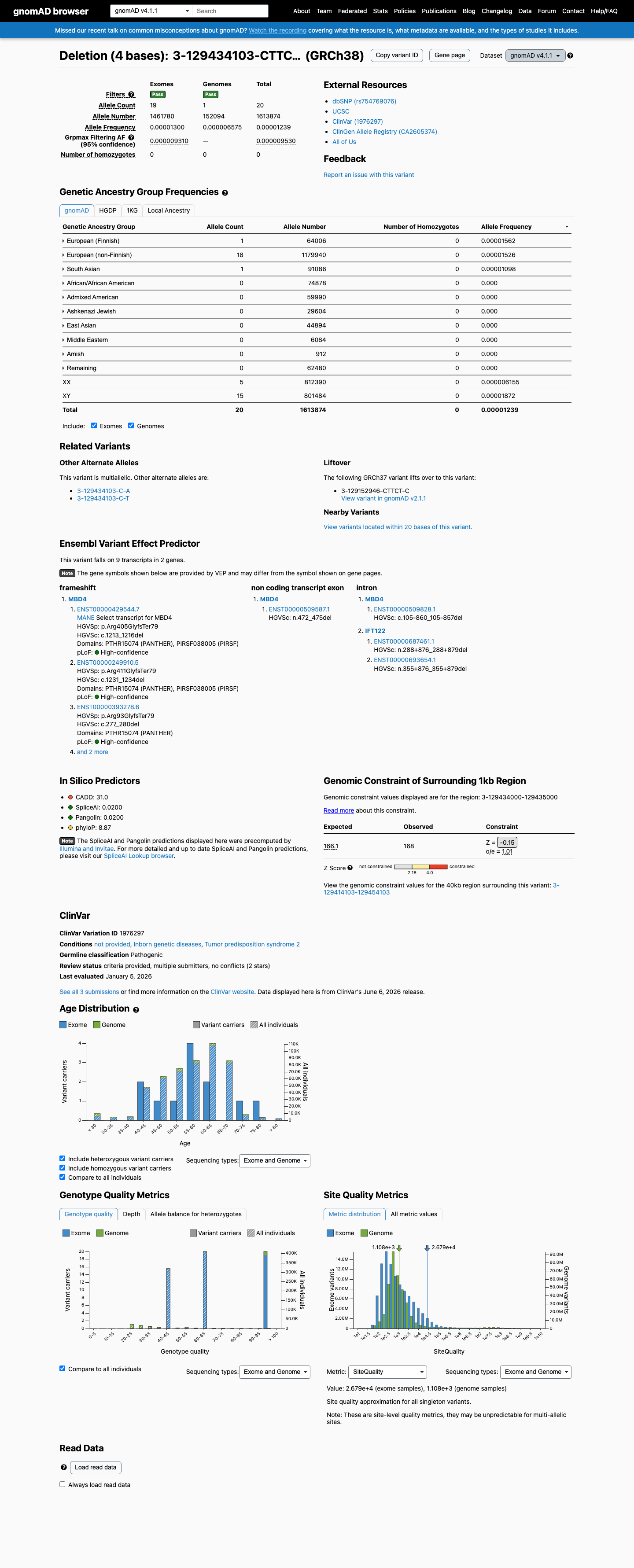
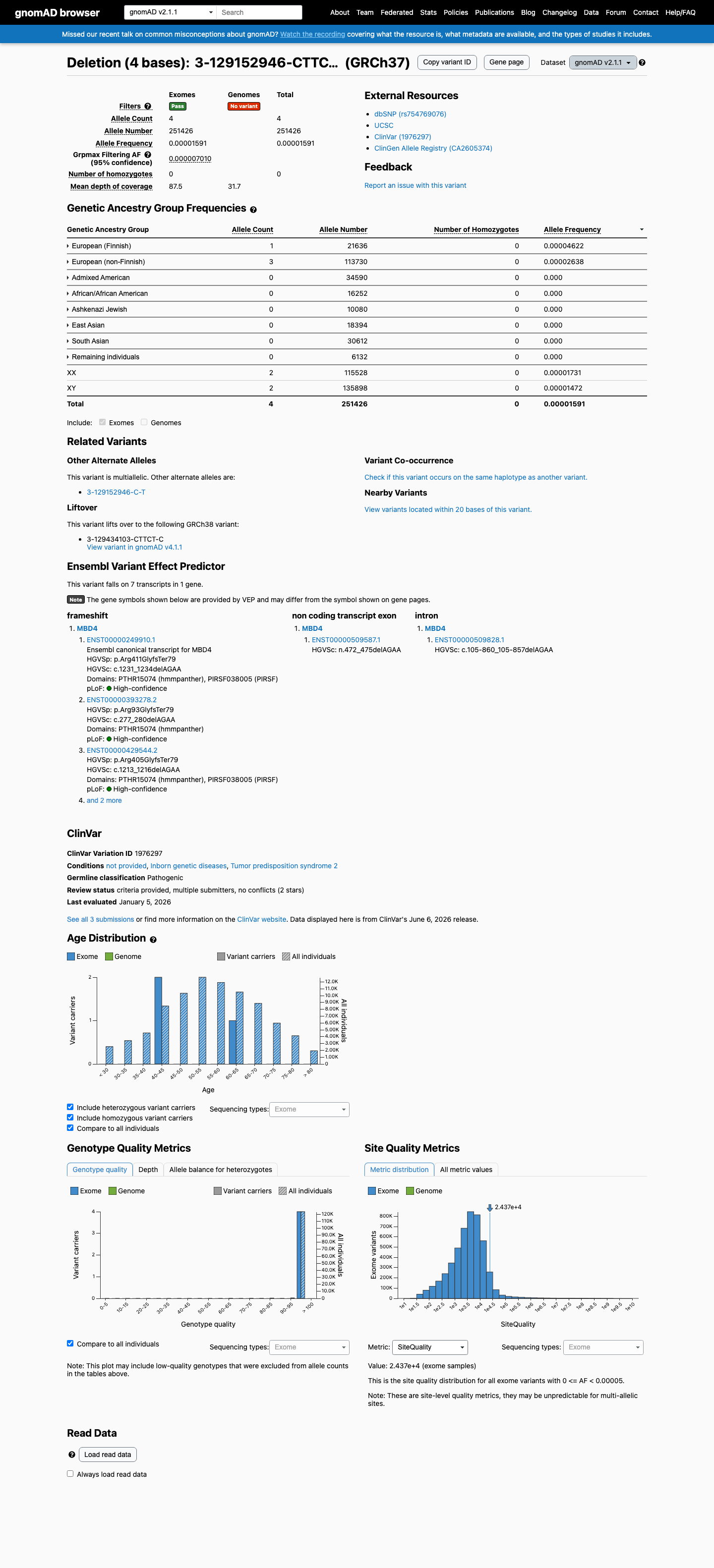
gnomAD v2.1: AF 1.59093e-05 (0.00159%, 4/251426), 0 homozygotes, grpmax FAF 7.01e-06gnomAD v4.1: AF 1.23925e-05 (0.00124%, 20/1613874), 0 homozygotes, joint grpmax FAF 9.53e-06gnomAD v4.1 highest subpopulation FIN AF 1.56235e-05; gnomAD v2.1 highest subpopulation NFE_SEU AF 1.73883e-04 (0.0174%)
Assessed · not applied · 12 not met · 7 not assessed
Pathogenic
PVS1 Insufficient evidence was available to assess PVS1 (loss-of-function mechanism).
PS2 Not assessed: no proband, family-history, or parental-testing data were available to evaluate a de novo occurrence.
PS3 Not assessed: no validated functional assay of this exact variant was available; functional data concern other MBD4 truncations only.
PS4 Not met: no case-control or prevalence study reports this exact variant, and gene-level disease association does not qualify.
PM3 Not met: no source documents this variant in trans with a pathogenic variant, and no homozygotes are observed.
PM6 Not assessed: no de novo occurrence of this variant is documented, and no proband data exist to assess one.
PP1 Not assessed: no family segregation data exist for this variant; segregation of other MBD4 alleles does not apply.
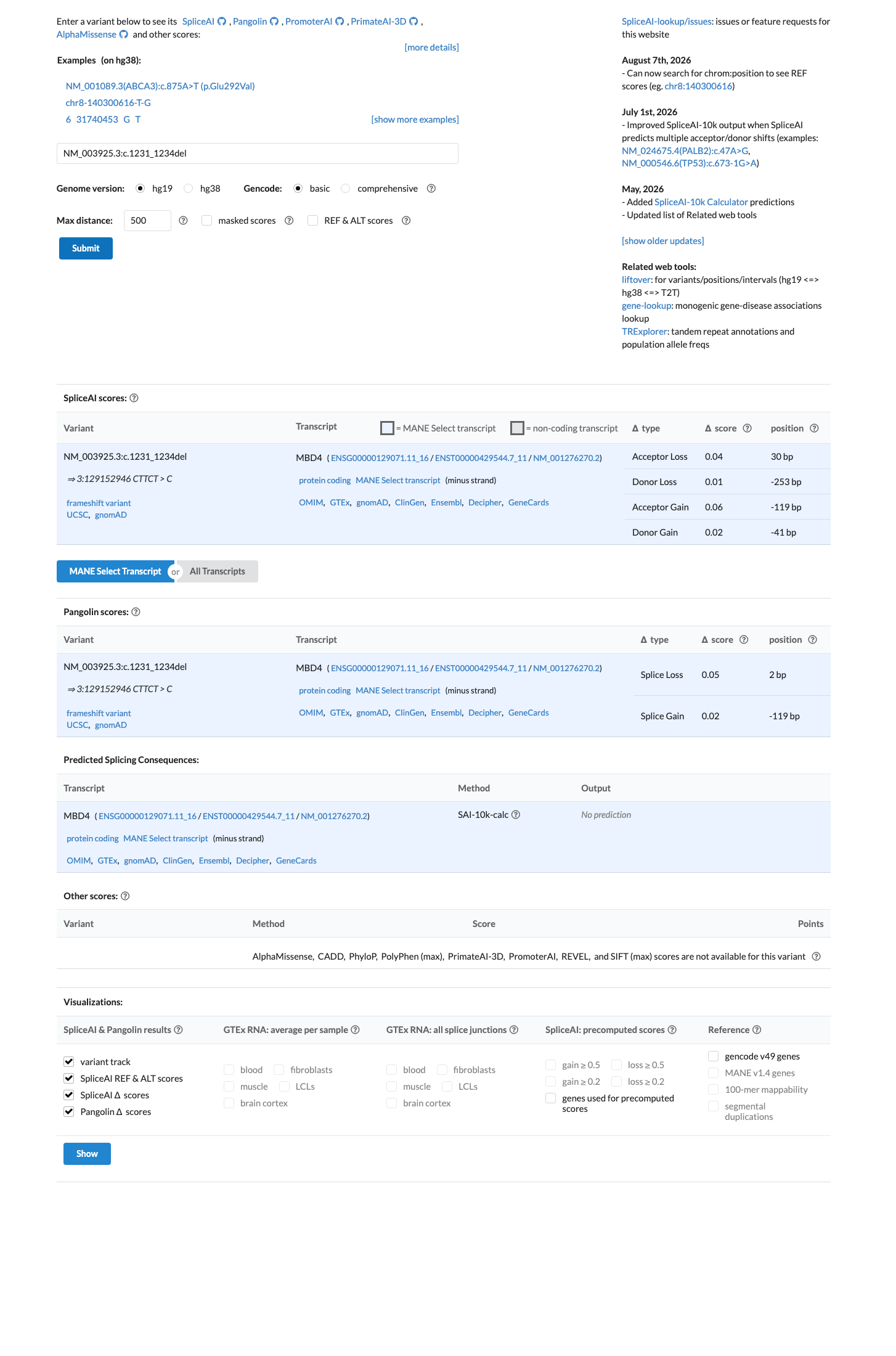
PP3 Not met: SpliceAI max delta 0.06 is below the 0.2 splice-disruption threshold, and missense scores do not apply to a frameshift.
PP4 Not assessed: no proband phenotype or family-history information was available to judge phenotype specificity.
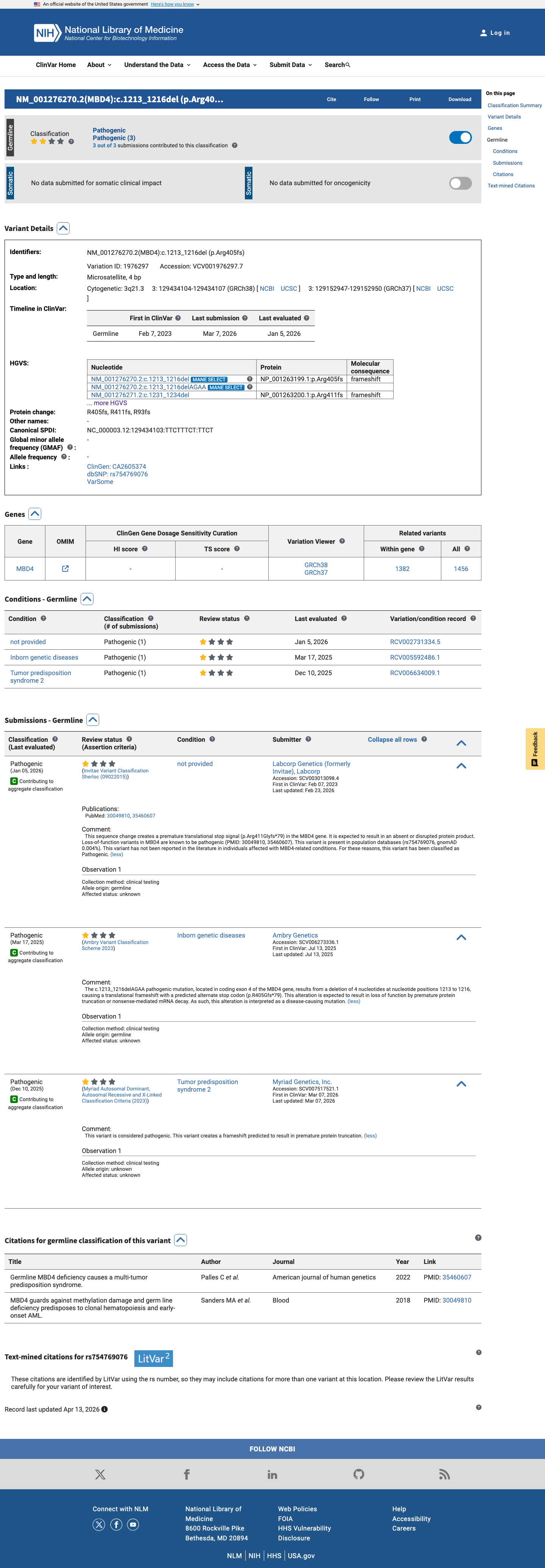
PP5 Not met: no ClinGen expert-panel classification exists; three clinical-laboratory Pathogenic submissions do not trigger PP5.
Benign
BA1 Not met: the highest allele frequency, 0.0174%, is far below the 1% BA1 threshold.
BS1 Not met: the highest allele frequency, 0.0174%, is about 17-fold below the 0.3% BS1 threshold.
BS2 Not met: zero homozygotes are observed in gnomAD v2.1 and v4.1, covering over 930,000 individuals.
BS3 Not met: no functional study shows preserved function, and all evidence points to loss of the glycosylase catalytic domain.
BS4 Not assessed: no family testing data exist to demonstrate non-segregation with disease.
BP2 Not met: MBD4 deficiency is recessive, and no source reports this variant in cis with a pathogenic variant.
BP4 Not met: the frameshift definitively alters the protein regardless of the low SpliceAI score (max delta 0.06).
BP5 Not met: no alternative molecular cause is documented in the available clinical information.
BP6 Not met: no expert-panel benign classification exists; ClinVar submissions classify the variant Pathogenic.
N/A · 8 PS1 · PM1 · PM4 · PM5 · PP2 · BP1 · BP3 · BP7
Research & evidence
Population frequency
gnomAD v4.1 screenshot
gnomAD v4.1
gnomAD v2.1 screenshot
gnomAD v2.1
v4.1
This variant is present in gnomAD v4.1 (AF= 1.23925e-05; MAF= 0.00124%, 20/1613874 alleles, homozygotes = 0) and has highest observed frequency in the European (Finnish) population (AF= 1.56235e-05; MAF= 0.00156%, 1/64006 alleles, homozygotes = 0); grpmax FAF= 9.53e-06.
v2.1
This variant is present in gnomAD v2.1 (AF= 1.59093e-05; MAF= 0.00159%, 4/251426 alleles, homozygotes = 0) and has highest observed frequency in the European (Finnish) population (AF= 4.62193e-05; MAF= 0.00462%, 1/21636 alleles, homozygotes = 0); grpmax FAF= 7.01e-06.
🇨🇦 CA
Absent from gnomAD-Canada v1.0.
Allele frequency by ancestry
three datasets · side by side
gnomAD v4.1
0.0012% · 20 / 1,613,874
0 hom · FAF 0.00095%
European (Finnish)
1 / 64,006
0.0016%
European (non-Finnish)
18 / 1,179,940
0.0015%
South Asian
1 / 91,086
0.0011%
+ 7 not observed (Remaining individuals, Admixed American, Amish, East Asian, Middle Eastern, Ashkenazi Jewish, African/African American)
gnomAD v2.1
0.0016% · 4 / 251,426
0 hom · FAF 0.0007%
European (Finnish)
1 / 21,636
0.0046%
European (non-Finnish)
3 / 113,730
0.0026%
+ 6 not observed (African/African American, Admixed American, Ashkenazi Jewish, East Asian, Remaining individuals, South Asian)
gnomAD Canada 🇨🇦
Absent · 0 / ?
0 hom
Not observed in any ancestry group.
ClinVar screenshot
ClinVar
This variant has been reported in ClinVar as Pathogenic (3 clinical laboratories). (ClinVarID = 1976297)
SpliceAI screenshot
In silico
SpliceAI predicts no significant splice impact for this variant (max delta score = 0.06).
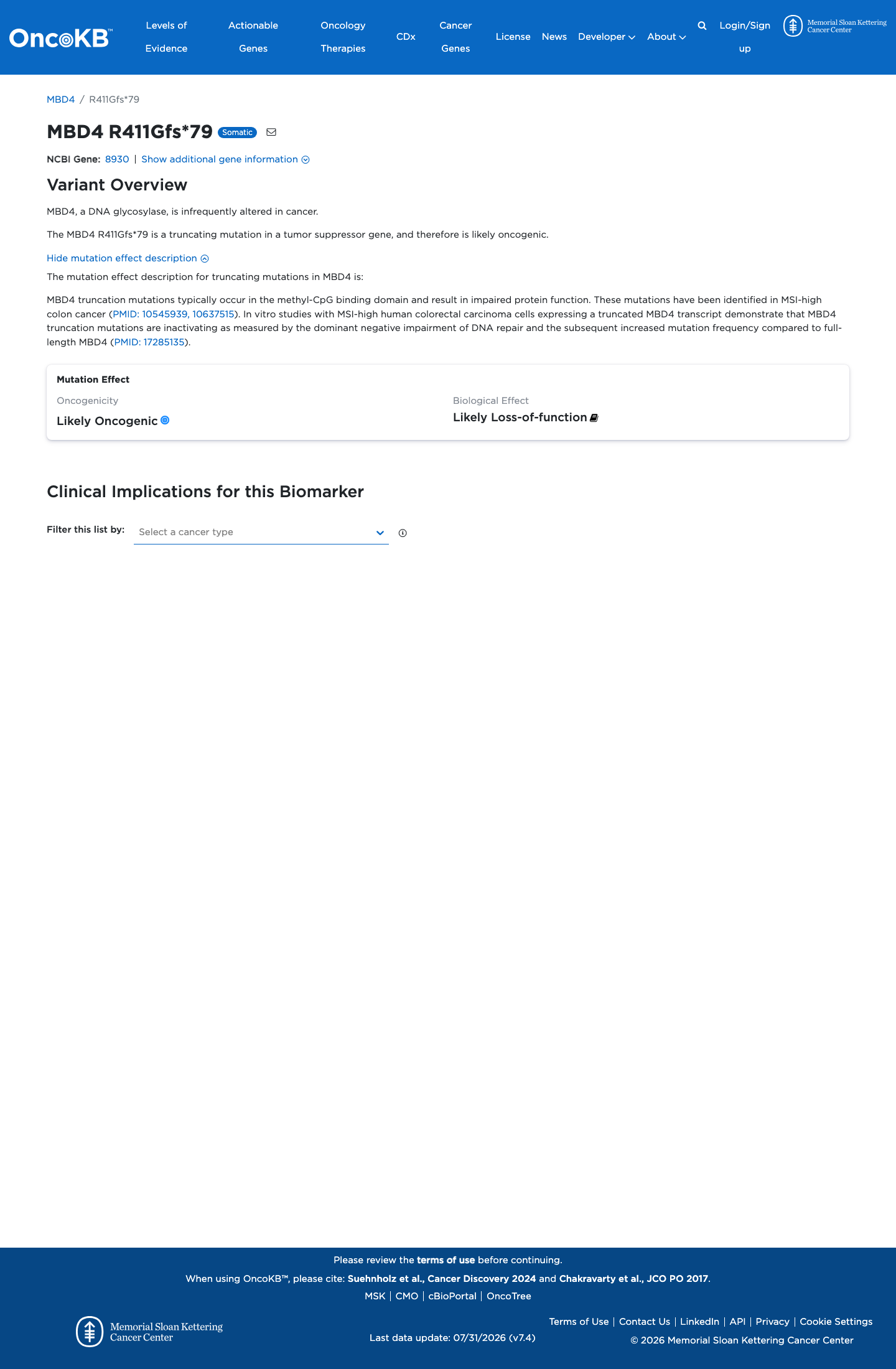
Functional / OncoKB screenshot
Functional Likely Oncogenic
OncoKB identified variant-specific curated literature and context relevant to functional review; biological-effect context: Likely Loss-of-function; curated oncogenicity label: Likely Oncogenic.
OncoKB ↗
COSMIC screenshot
COSMIC
Cancer hotspots screenshot
Cancer hotspots
Somatic evidence Not in COSMIC / hotspots
COSMIC
This variant does not lie in a statistically significant hotspot. This variant has not previously been reported in somatic cancers (COSMIC).
Hotspots
This variant does not lie in a statistically significant hotspot.
Literature · how each cited paper was used
1papers cited
Each card is an audit: what was searched, what was found, whether it names the variant, which criteria it fed, and why. 9 further PMIDs triaged but not cited — see Sources & references.
Rule & framework references · cited for criterion definitions, not variant evidence
35460607 ↗ Germline MBD4 deficiency causes a multi-tumor predisposition syndrome.
Sources & reference links
8Sources
ClinVar
gnomAD v2.1
gnomAD v4.1
gnomAD-Canada
SpliceAI
OncoKB
COSMIC
Cancer hotspots
Triaged references · 9 PMIDs not cited in assessment
10545939 ↗ The DNA repair gene MBD4 (MED1) is mutated in human carcinomas with microsatellite instability. ONCOKB
10637515 ↗ Somatic frameshift mutations in the MBD4 gene of sporadic colon cancers with mismatch repair deficiency. ONCOKB
17285135 ↗ A human cancer-associated truncation of MBD4 causes dominant negative impairment of DNA repair in colon cancer cells. ONCOKB
25626707 ↗ Whole-genome sequencing in newborn screening? A statement on the continued importance of targeted approaches in newborn screening programmes. CLINVAR
30049810 ↗ MBD4 guards against methylation damage and germ line deficiency predisposes to clonal hematopoiesis and early-onset AML. CLINVAR
22947299 ↗ Specific guidelines for assessing and improving the methodological quality of economic evaluations of newborn screening. CLINVAR
23037933 ↗ Including the initial newborn screening bloodspot collection device serial number on birth certificates: basis and recommendations from the Secretary of Health and Human Services' Advisory Committee on Heritable Disorders in Newborns and Children. CLINVAR
23881473 ↗ Newborn screening: education, consent, and the residual blood spot. The position of the national society of genetic counselors. CLINVAR
24394680 ↗ Parental permission for pilot newborn screening research: guidelines from the NBSTRN. CLINVAR