This variant was interpreted by pipeline
7.1.0.
The current version is
8.0.0.
Re-running queues a fresh interpretation; the result replaces this page when complete.
Re-runs are not free. Blank = draws on today's public interpretation allowance.
With a code = uses 1 of that code's uses.
MBD4 encodes a DNA glycosylase that detects and repairs deaminated methyl-cytosines in DNA, using a methyl-CpG binding domain to anchor to methylated DNA and a glycosylase domain to carry out mismatch repair in CpG-rich regions. The protein also helps repress transcription from methylated gene promoters. MBD4 acts as a tumor suppressor, and its loss has been linked to colorectal cancer, acute myeloid leukemia, and uveal melanoma.
This variant
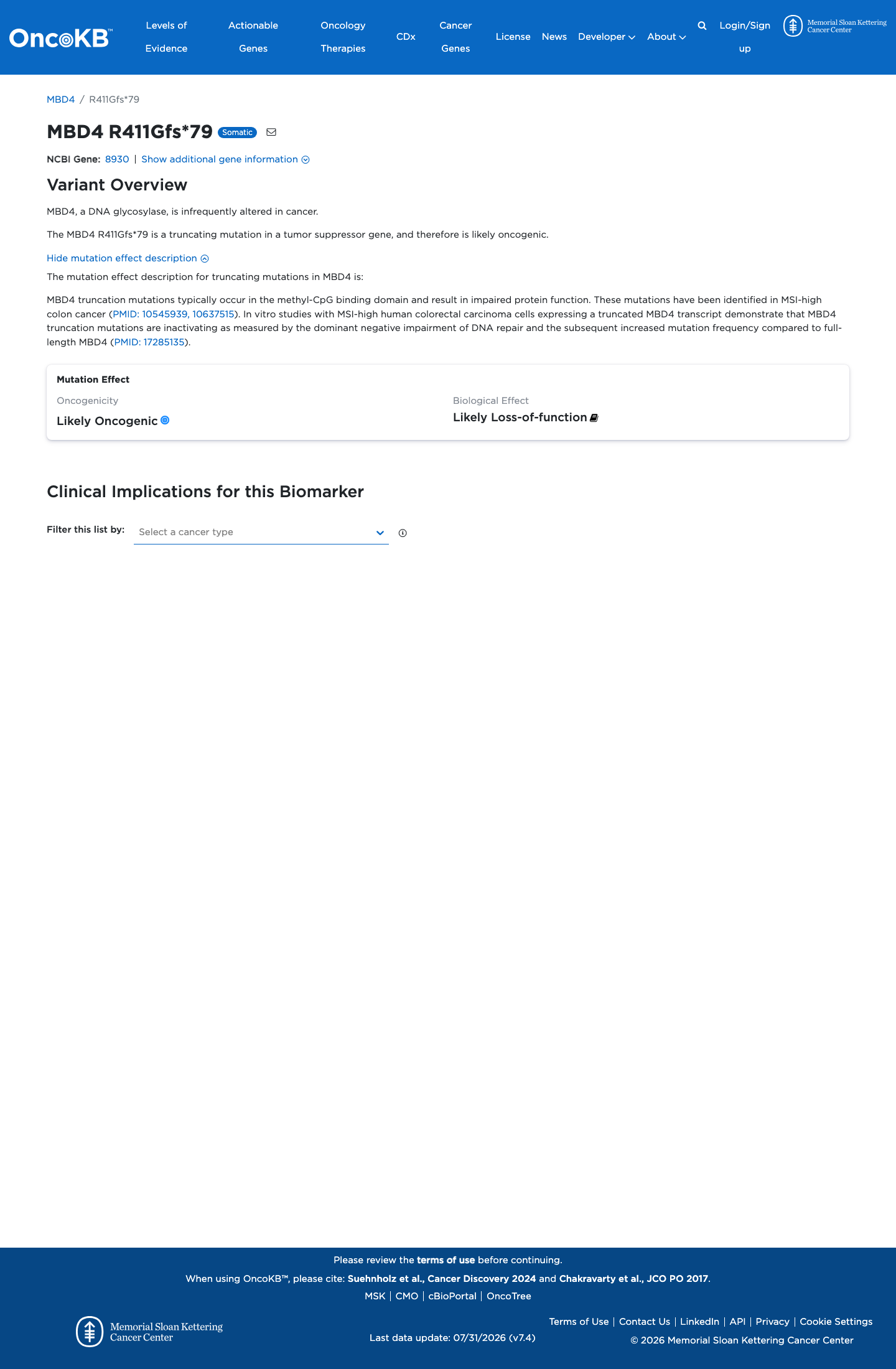
MBD4 is a tumor-suppressor DNA glycosylase whose biallelic loss of function causes MBD4-associated neoplasia syndrome, predisposing to colorectal cancer, acute myeloid leukemia, and uveal melanoma. This frameshift is biologically consistent with that mechanism, as it removes the entire C-terminal glycosylase catalytic domain, but it remains a VUS because only population-frequency evidence (PM2, supporting) was met. Variant-specific functional or clinical data would be needed to confirm its pathogenicity.
Transcript
NM_003925.3
HGVS · transcript:coding
NM_003925.3:c.1231_1234del
GRCh38
chr3:129434103 CTTCT>C
GRCh37
chr3:129152946 CTTCT>C
No ClinGen or custom gene-specific framework exists for MBD4, so generic ACMG/AMP 2015 rules applied; with only PM2 (supporting) met, no combination threshold is reached and the variant is classified as VUS.
Classification rationale
PM2VUS
MBD4 c.1231_1234delframeshift
PM2 (Supporting): gnomAD allele frequency 0.00124-0.00159%, far below the 0.1% threshold, with zero homozygotes. Overall: VUS — the single supporting criterion (PM2) does not meet any ACMG/AMP 2015 Pathogenic, Likely Pathogenic, Benign, or Likely Benign combination threshold.
PM2→VUS
LYFE Sciences is an AI system, and it can make mistakes. Criteria
may be applied incorrectly, sources may be misread, and a confident-looking
classification can still be wrong. Double-check every criterion and
its underlying evidence before relying on any call.
Gene diagram
· NM_003925.3 · variants mapped to exon structure
MBD4NM_003925.3
Fetching transcript structure from UCSC…
Exons
—
Transcript span
—
Strand
—
Variants mapped
—
Source
UCSC ncbiRefSeqCurated
All variants in MBD4—click a row to locate it on the plot · use the link column to open its page
Protein
Location
Classification
Link
Applied criteria · 1 applied · 19 assessed
MetEvidence satisfies this criterion.
Not metEvaluated against available evidence; threshold not reached.
Not assessedApplies in principle, but no evidence was found to evaluate it.
N/ADoesn't apply to this variant type.
Applied · 1
Strength Supporting Moderate Strong Very strong
✓
PM2supportingPathogenic
Met (supporting): gnomAD allele frequency 0.00124-0.00159% is far below the 0.1% threshold, with zero homozygotes.
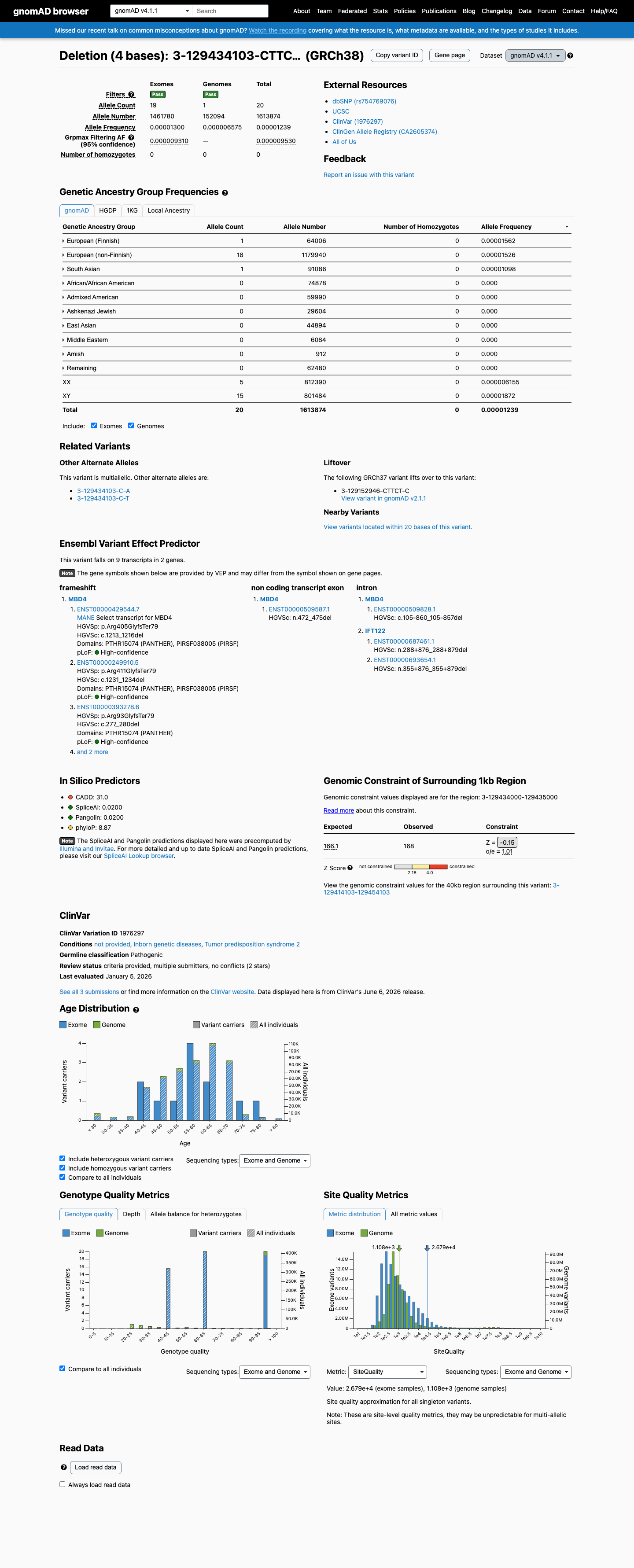
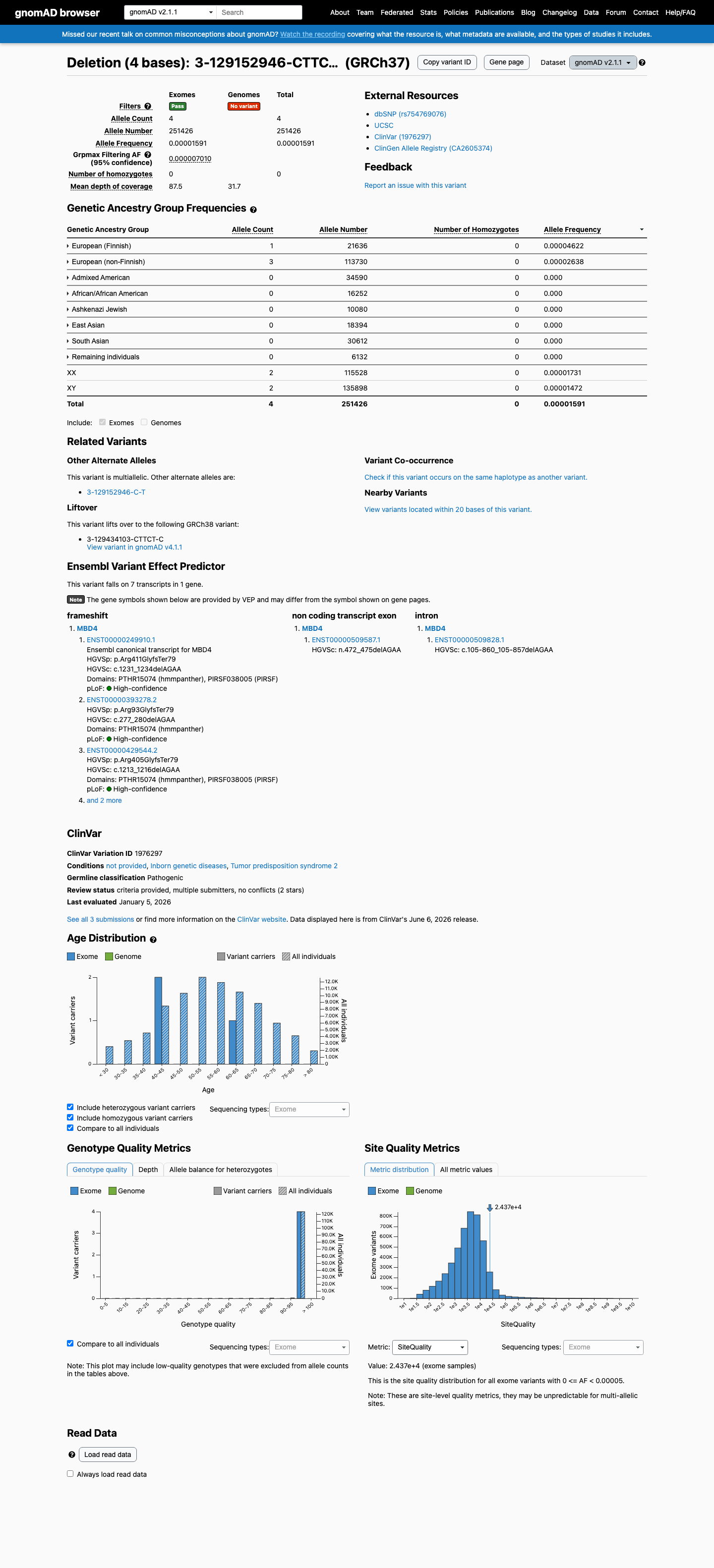
gnomAD v2.1: AF 1.59093e-05 (0.00159%, 4/251426), 0 homozygotes, grpmax FAF 7.01e-06gnomAD v4.1: AF 1.23925e-05 (0.00124%, 20/1613874), 0 homozygotes, joint grpmax FAF 9.53e-06gnomAD v4.1 highest subpopulation FIN AF 1.56235e-05; gnomAD v2.1 highest subpopulation NFE_SEU AF 1.73883e-04 (0.0174%)
This variant is present in gnomAD v4.1 (AF= 1.23925e-05; MAF= 0.00124%, 20/1613874 alleles, homozygotes = 0) and has highest observed frequency in the European (Finnish) population (AF= 1.56235e-05; MAF= 0.00156%, 1/64006 alleles, homozygotes = 0); grpmax FAF= 9.53e-06.
v2.1
This variant is present in gnomAD v2.1 (AF= 1.59093e-05; MAF= 0.00159%, 4/251426 alleles, homozygotes = 0) and has highest observed frequency in the European (Finnish) population (AF= 4.62193e-05; MAF= 0.00462%, 1/21636 alleles, homozygotes = 0); grpmax FAF= 7.01e-06.
🇨🇦 CA
Absent from gnomAD-Canada v1.0.
Allele frequency by ancestry
three datasets · side by side
gnomAD v4.1
0.0012%
· 20 / 1,613,874
0 hom · FAF 0.00095%
European (Finnish)
1 / 64,006
0.0016%
European (non-Finnish)
18 / 1,179,940
0.0015%
South Asian
1 / 91,086
0.0011%
+ 7 not observed (Remaining individuals, Admixed American, Amish, East Asian, Middle Eastern, Ashkenazi Jewish, African/African American)
gnomAD v2.1
0.0016%
· 4 / 251,426
0 hom · FAF 0.0007%
European (Finnish)
1 / 21,636
0.0046%
European (non-Finnish)
3 / 113,730
0.0026%
+ 6 not observed (African/African American, Admixed American, Ashkenazi Jewish, East Asian, Remaining individuals, South Asian)
Each card is an audit: what was searched, what was found, whether it names the variant, which criteria it fed, and why. 9 further PMIDs triaged but not cited — see Sources & references.
Rule & framework references · cited for criterion definitions, not variant evidence
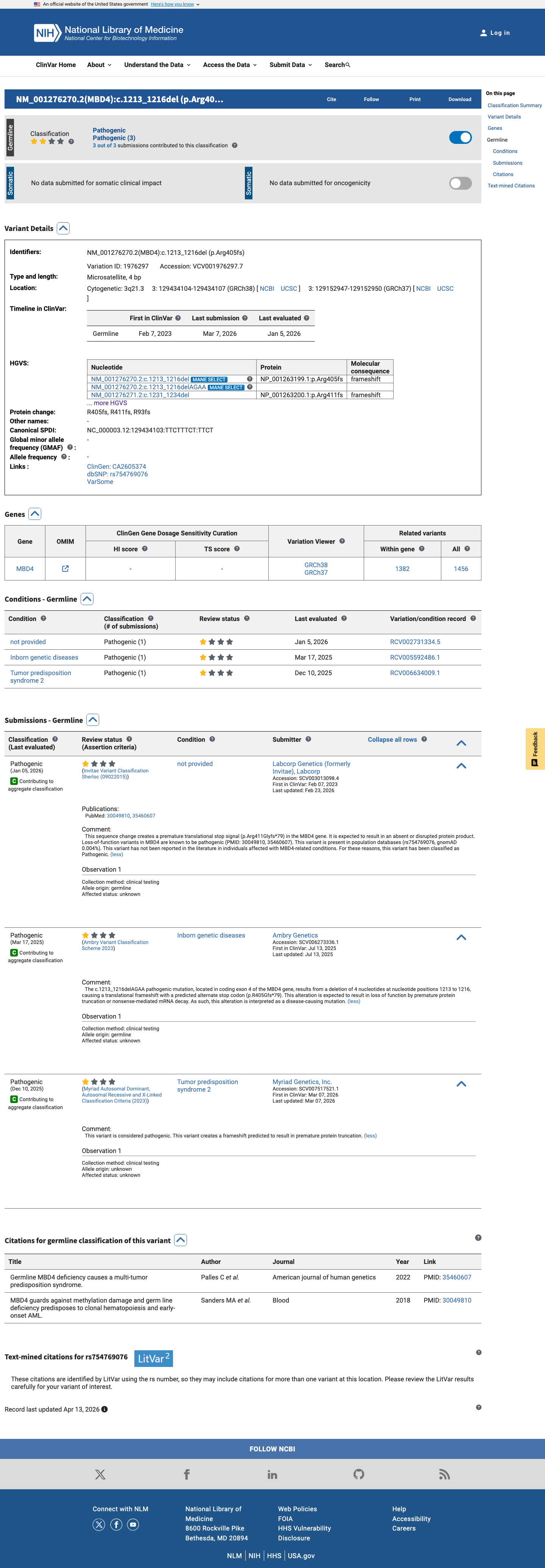
35460607 ↗Germline MBD4 deficiency causes a multi-tumor predisposition syndrome.
Sources & reference links
8Sources
ClinVar
gnomAD v2.1
gnomAD v4.1
gnomAD-Canada
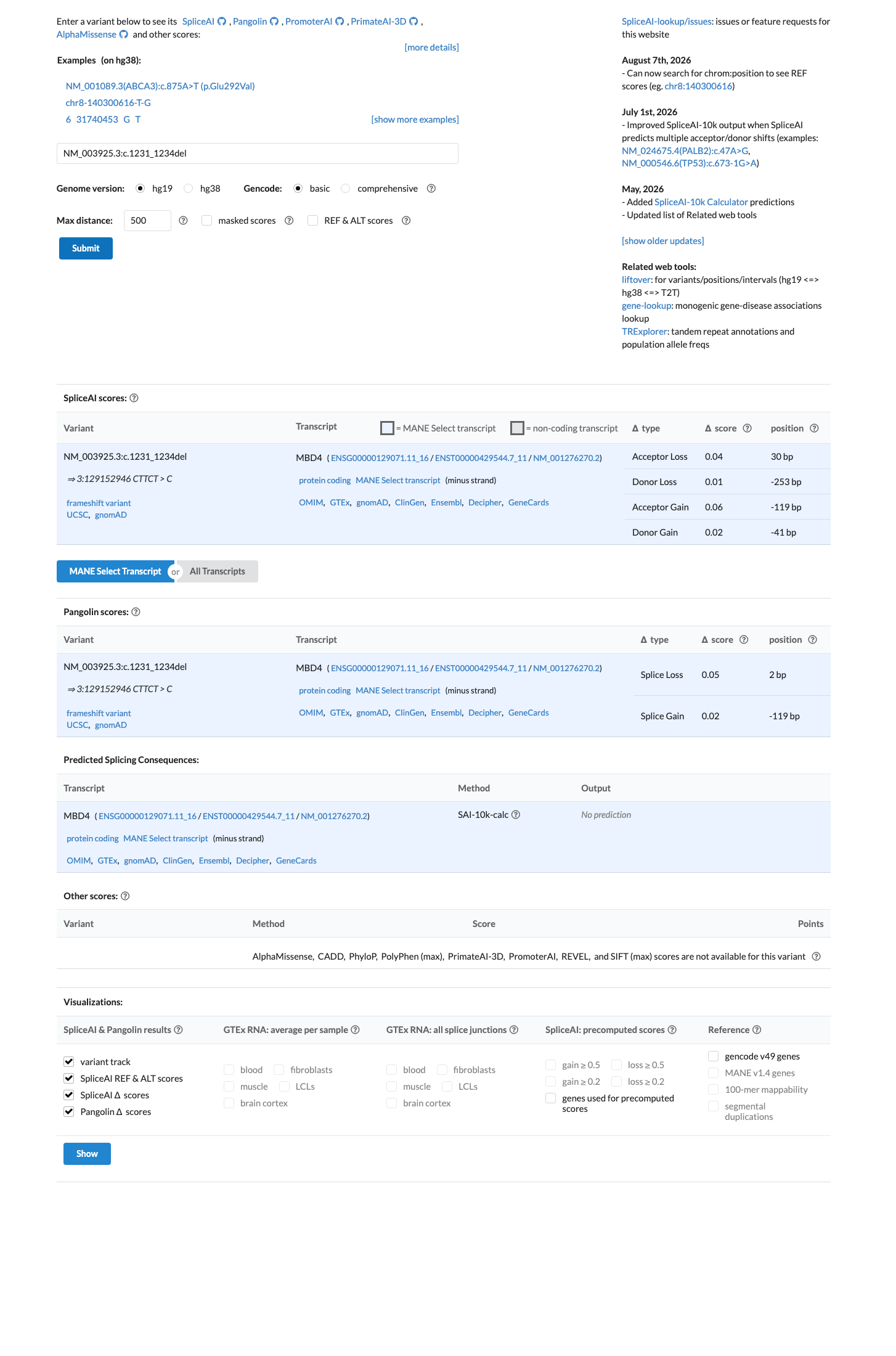
SpliceAI
OncoKB
COSMIC
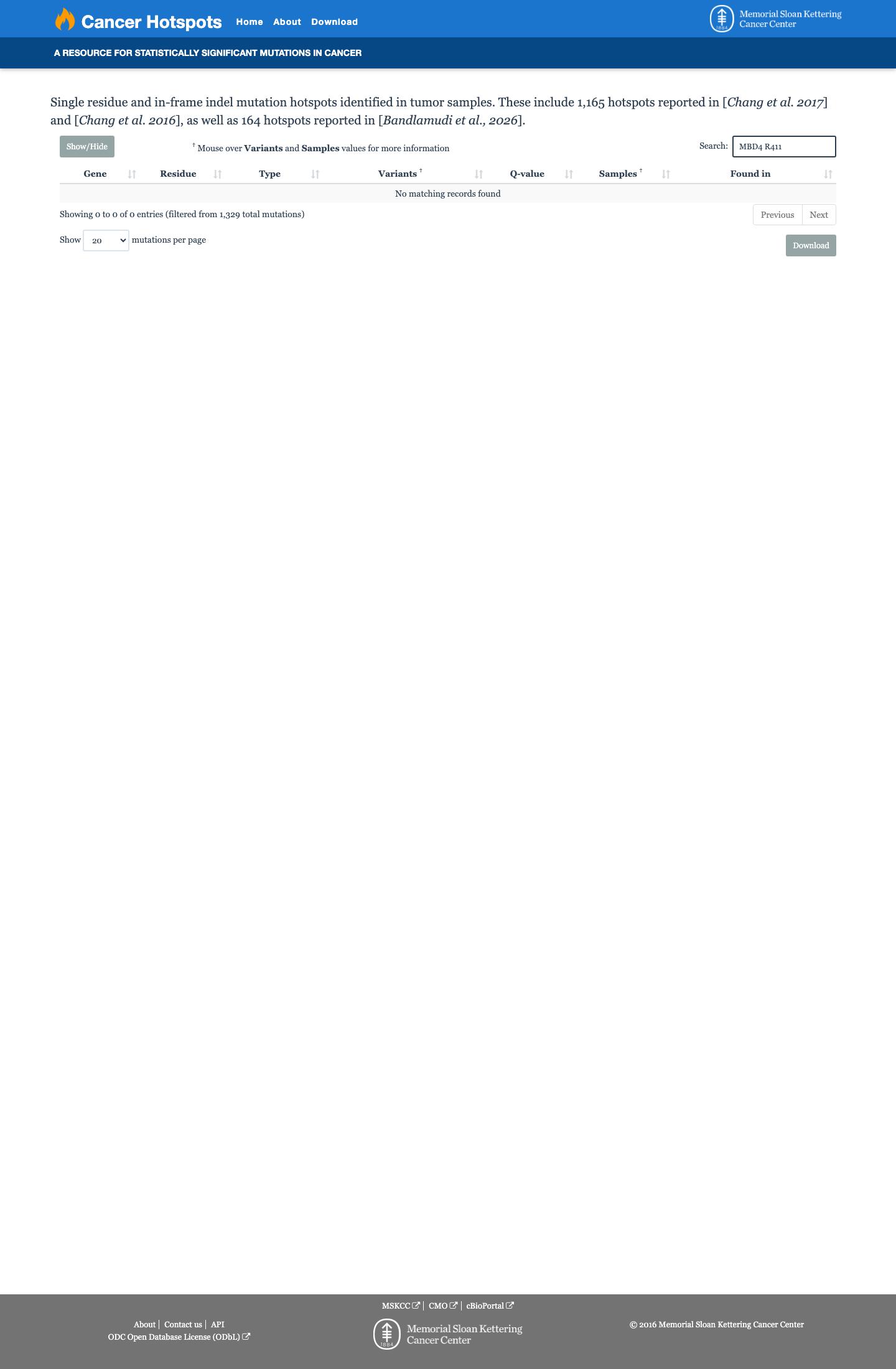
Cancer hotspots
Triaged references · 9 PMIDs not cited in assessment
10545939 ↗The DNA repair gene MBD4 (MED1) is mutated in human carcinomas with microsatellite instability.ONCOKB
10637515 ↗Somatic frameshift mutations in the MBD4 gene of sporadic colon cancers with mismatch repair deficiency.ONCOKB
17285135 ↗A human cancer-associated truncation of MBD4 causes dominant negative impairment of DNA repair in colon cancer cells.ONCOKB
25626707 ↗Whole-genome sequencing in newborn screening? A statement on the continued importance of targeted approaches in newborn screening programmes.CLINVAR
30049810 ↗MBD4 guards against methylation damage and germ line deficiency predisposes to clonal hematopoiesis and early-onset AML.CLINVAR
22947299 ↗Specific guidelines for assessing and improving the methodological quality of economic evaluations of newborn screening.CLINVAR
23037933 ↗Including the initial newborn screening bloodspot collection device serial number on birth certificates: basis and recommendations from the Secretary of Health and Human Services' Advisory Committee on Heritable Disorders in Newborns and Children.CLINVAR
23881473 ↗Newborn screening: education, consent, and the residual blood spot. The position of the national society of genetic counselors.CLINVAR
24394680 ↗Parental permission for pilot newborn screening research: guidelines from the NBSTRN.CLINVAR