NM_004119.3:c.1792_1793insACCTTCCTGTGACCGGCTCCTCAGATAATGAGTACTTCTACGTTGATTTCAGAGAATATG (p.Tyr597_Glu598insAspLeuProValThrGlySerSerAspAsnGluTyrPheTyrValAspPheArgGluTyr) is a novel 20-amino-acid in-frame internal tandem duplication (ITD) in the FLT3 juxtamembrane domain at codons 597-598, within the well-established ITD activating hotspot (codons 589-599).1 PM1_Moderate is met because the variant maps to the FLT3 juxtamembrane ITD hotspot (codons 589-599), a critical functional domain where recurrent activating ITDs have been established and where no benign population variation is observed in gnomAD. PMID:9737679 documented 47 of 51 FLT3 ITDs in this same codon cluster with constitutive kinase activation.2 PM5_Moderate is met per the local FLT3 custom framework extension: this is a novel ITD in the same established activating juxtamembrane hotspot class as prior pathogenic FLT3 ITDs. The exact inserted sequence need not have been previously characterized; the event is clearly an ITD analogue in the same hotspot mechanism as established activating FLT3 mutations.3 PS3_Supporting is met because OncoKB reports exact-variant Likely Oncogenic with Likely Gain-of-function for p.(Y597_E598insDLPVTGSSDNEYFYVDFREY), and the broader FLT3 ITD literature (PMID:9737679, PMID:11090077, PMID:11756186) establishes constitutive kinase activation as the canonical mechanism for juxtamembrane ITDs.4 PM2_Supporting is met because the variant is absent from gnomAD v2.1 and v4.1 (allele frequency 0.0% in all populations).5 The variant is absent from ClinVar and COSMIC. SpliceAI predicts an acceptor gain (delta 0.45), but this is of uncertain clinical significance for an in-frame ITD with an established gain-of-function mechanism.6 Applying the local FLT3 ITD / activating length-mutation framework with generic ACMG/AMP 2015 final combination rules: 2 Moderate criteria (PM1, PM5) plus 2 Supporting criteria (PS3, PM2) meets the threshold for Likely Pathogenic (2 Moderate + >=2 Supporting).7
Final classification
Likely Pathogenic
PS3PM1PM2PM5
FLT3
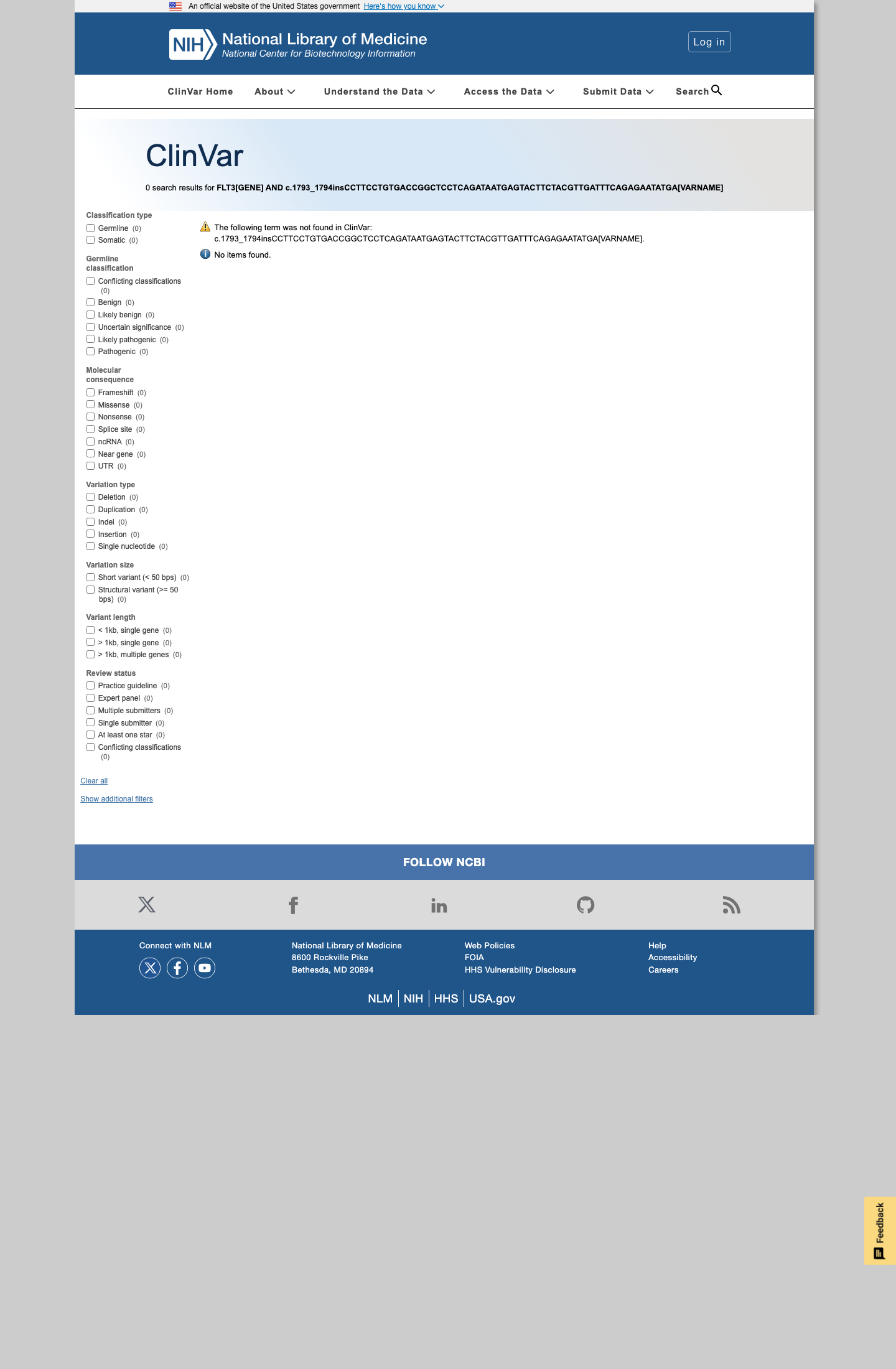
c.1793_1794insCCTTCCTGTGACCGGCTCCTCAGATAATGAGTACTTCTACGTTGATTTCAGAGAATATGA
p.Tyr597_Glu598insAspLeuProValThrGlySerSerAspAsnGluTyrPheTyrValAspPheArgGluTyr
This variant
NM_004119.3:c.1792_1793insACCTTCCTGTGACCGGCTCCTCAGATAATGAGTACTTCTACGTTGATTTCAGAGAATATG (p.Tyr597_Glu598insAspLeuProValThrGlySerSerAspAsnGluTyrPheTyrValAspPheArgGluTyr) is a novel 20-amino-acid in-frame internal tandem duplication (ITD) in the FLT3 juxtamembrane domain at codons 597-598, within the well-established ITD activating hotspot (codons 589-599).
Two Moderate criteria (PM1, PM5) plus two Supporting criteria (PS3, PM2) are met. The local FLT3 ITD custom framework classifies '2 Moderate + >=2 Supporting' as Likely Pathogenic. No benign criteria are met.
Classification rationale
PS3PM1PM2PM5
Likely Pathogenic
FLT3 c.1793_1794insCCTTCCTGTGACCGGCTCCTCAGATAATGAGTACTTCTACGTTGATTTCAGAGAATATGA
PS3 + PM1 + PM2 + PM5
→
Likely Pathogenic
1
PMID:9737679 ↗vcep_flt3_itd_hotspot_and_function
2
PMID:9737679 ↗gnomad_v2 ↗gnomad_v4 ↗vcep_flt3_itd_hotspot_and_function
3
PMID:9737679 ↗PMID:12384447 ↗vcep_flt3_itd_hotspot_and_functionvcep_flt3_oncokb_guidance
7
final_classification_framework
LYFE Sciences is an AI system, and it can make mistakes. Criteria
may be applied incorrectly, sources may be misread, and a confident-looking
classification can still be wrong. Double-check every criterion and
its underlying evidence before relying on any call.
Gene diagram
· NM_004119.3 · variants mapped to exon structure
FLT3
NM_004119.3
Fetching transcript structure from UCSC…
Applied criteria · 4 applied · 3 assessed
MetEvidence satisfies this criterion.
Not metEvaluated against available evidence; threshold not reached.
Not assessedApplies in principle, but no evidence was found to evaluate it.
N/ADoesn't apply to this variant type.
Applied · 4
Strength
Supporting
Moderate
Strong
Very strong
PS3
supporting
Pathogenic
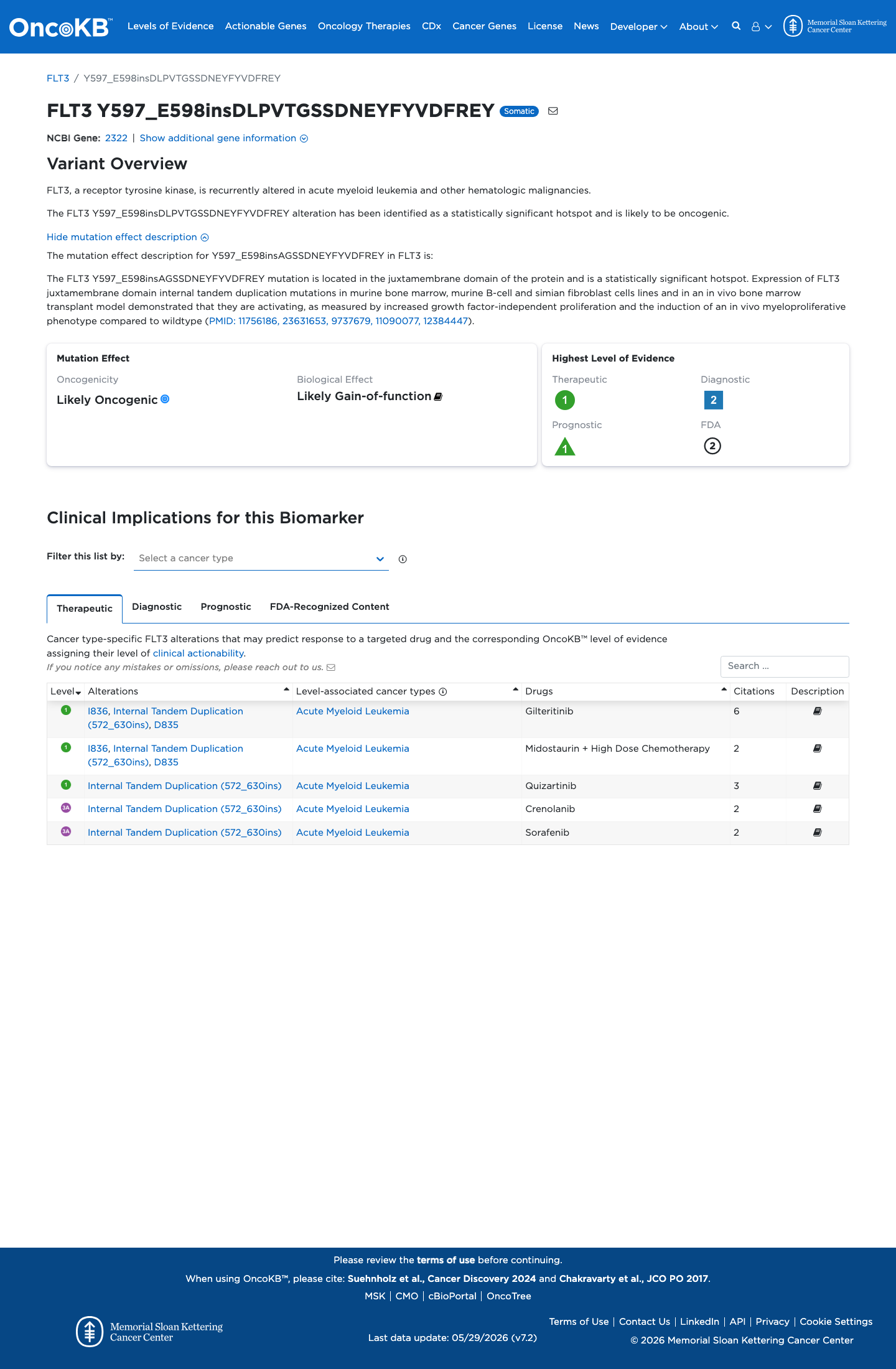
OncoKB reports exact-variant Likely Oncogenic with Likely Gain-of-function for p.(Y597_E598insDLPVTGSSDNEYFYVDFREY). The broader FLT3 ITD literature (PMID:9737679, PMID:11090077, PMID:11756186) establishes constitutive activation of the FLT3 kinase as the canonical mechanism for juxtamembrane ITDs. Per the local FLT3 custom framework, this exact-variant OncoKB functional/mechanistic annotation together with class-level FLT3 ITD activation literature is sufficient for PS3_Supporting.
OncoKB exact-variant annotation: Likely Oncogenic / Likely Gain-of-function.Class-level literature establishes gain-of-function as the canonical mechanism for FLT3 juxtamembrane ITDs.
PM1
moderate
Pathogenic
The variant maps to codons 597-598 in the FLT3 juxtamembrane domain, which lies within the well-established ITD activating hotspot cluster at codons 589-599. Mutalyzer normalization (NM_004119.3:c.1793_1794ins[CCTTCCT;1741_1793]) confirms this is a tandem duplication event producing an in-frame ITD in the canonical juxtamembrane region. This region is a critical functional domain where no benign population variation is observed (absent from gnomAD v2.1 and v4.1). The literature consistently identifies this region as a recurrent mutational hotspot in AML where ITDs constitutively activate FLT3 kinase (PMID:9737679 reported 47/51 FLT3 ITDs in codons 589-599). Per the local FLT3 custom framework, PM1_Moderate is applicable.
Variant maps to codon 597-598 within the FLT3 juxtamembrane ITD hotspot (codons 589-599).Mutalyzer normalization confirms tandem duplication mechanism consistent with ITD.Absent from gnomAD v2.1 and v4.1
PM2
supporting
Pathogenic
The variant is absent from gnomAD v2.1 and v4.1 (population databases encompassing >250,000 alleles), meeting the PM2 threshold of allele frequency <0.1% in all populations. This variant has not been observed in any healthy population cohort.
Absent from gnomAD v2.1 (exomes).Absent from gnomAD v4.1 (exomes + genomes).Allele frequency 0.0% in all populations.
PM5
moderate
Pathogenic
Per the local FLT3 custom framework extension of PM5 beyond missense-only wording: this is a novel in-frame ITD at codons 597-598 that falls within the established activating juxtamembrane ITD hotspot class (codons 589-599). Multiple prior pathogenic/oncogenic FLT3 ITDs are established for this hotspot (PMID:9737679 documented 47/51 ITDs in this region). The exact inserted sequence need not have been previously characterized; the event is clearly an ITD / activating length-mutation analogue in the same hotspot mechanism as prior established pathogenic FLT3 ITDs.
Novel in-frame ITD in the established juxtamembrane hotspot (codons 589-599).PMID:9737679: 47/51 FLT3 ITDs cluster in codons 589-599 with constitutive activation.PMID:12384447: demonstrates that activating FLT3 length mutations are not restricted to one exact sequence.
Assessed · not applied
· 3 not met · 0 not assessed
Pathogenic
None assessed.
Benign
BA1
The variant is absent from gnomAD (v2.1 and v4.1).
BS1
The variant is absent from gnomAD.
BP3
Per the local FLT3 custom framework, BP3 is not applied to FLT3 in-frame ITDs or activating length mutations in the juxtamembrane hotspot region because this region has a known activating disease mechanism and recurrent pathogenic/oncogenic variation.
N/A · 21
PVS1 · PS1 · PS2 · PS4 · PM3 · PM4 · PM6 · PP1 · PP2 · PP3 · PP4 · PP5 · BS2 · BS3 · BS4 · BP1 · BP2 · BP4 · BP5 · BP6 · BP7
Research & evidence
Population frequency · supports pathogenic
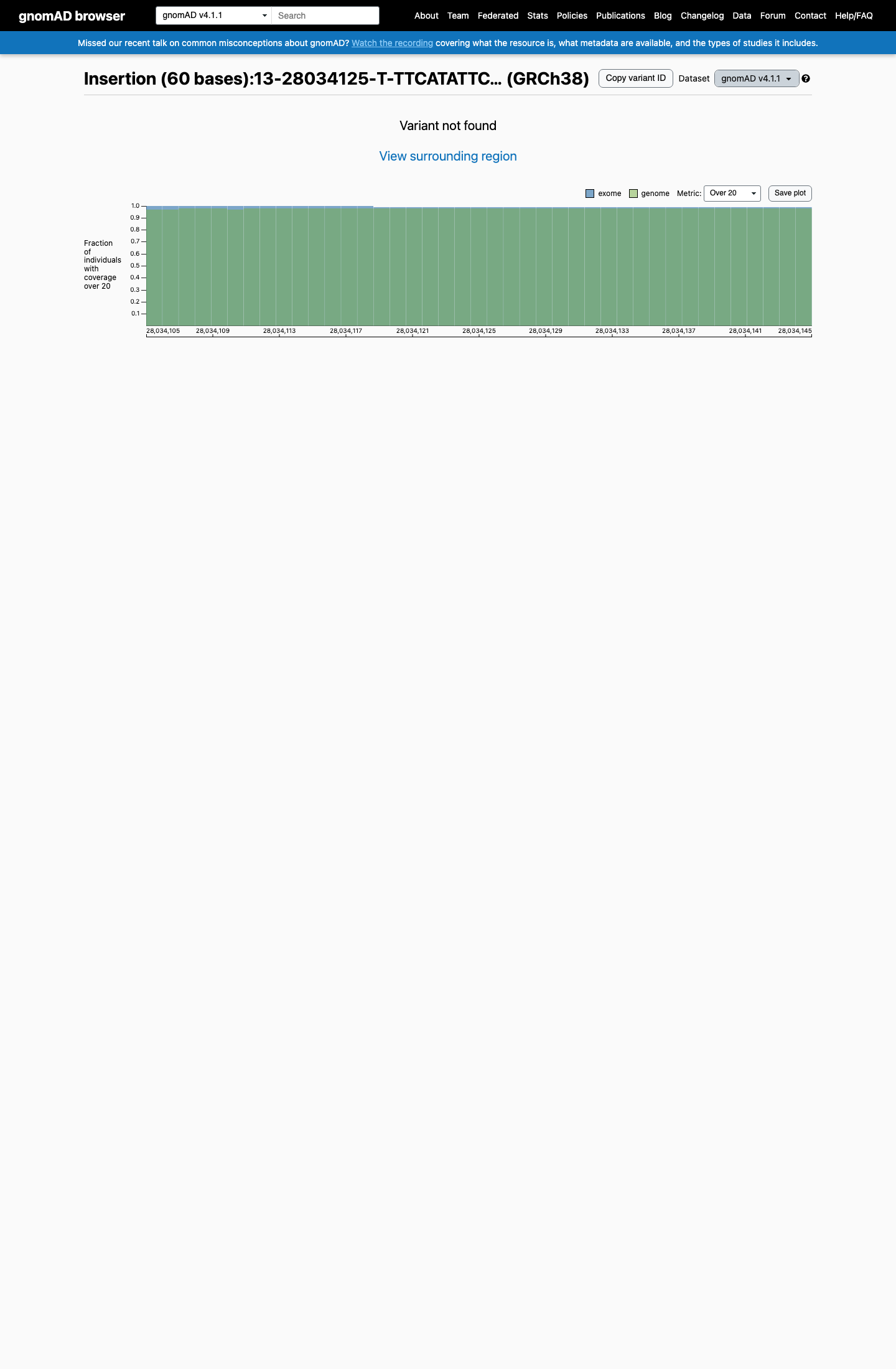
gnomAD v4.1
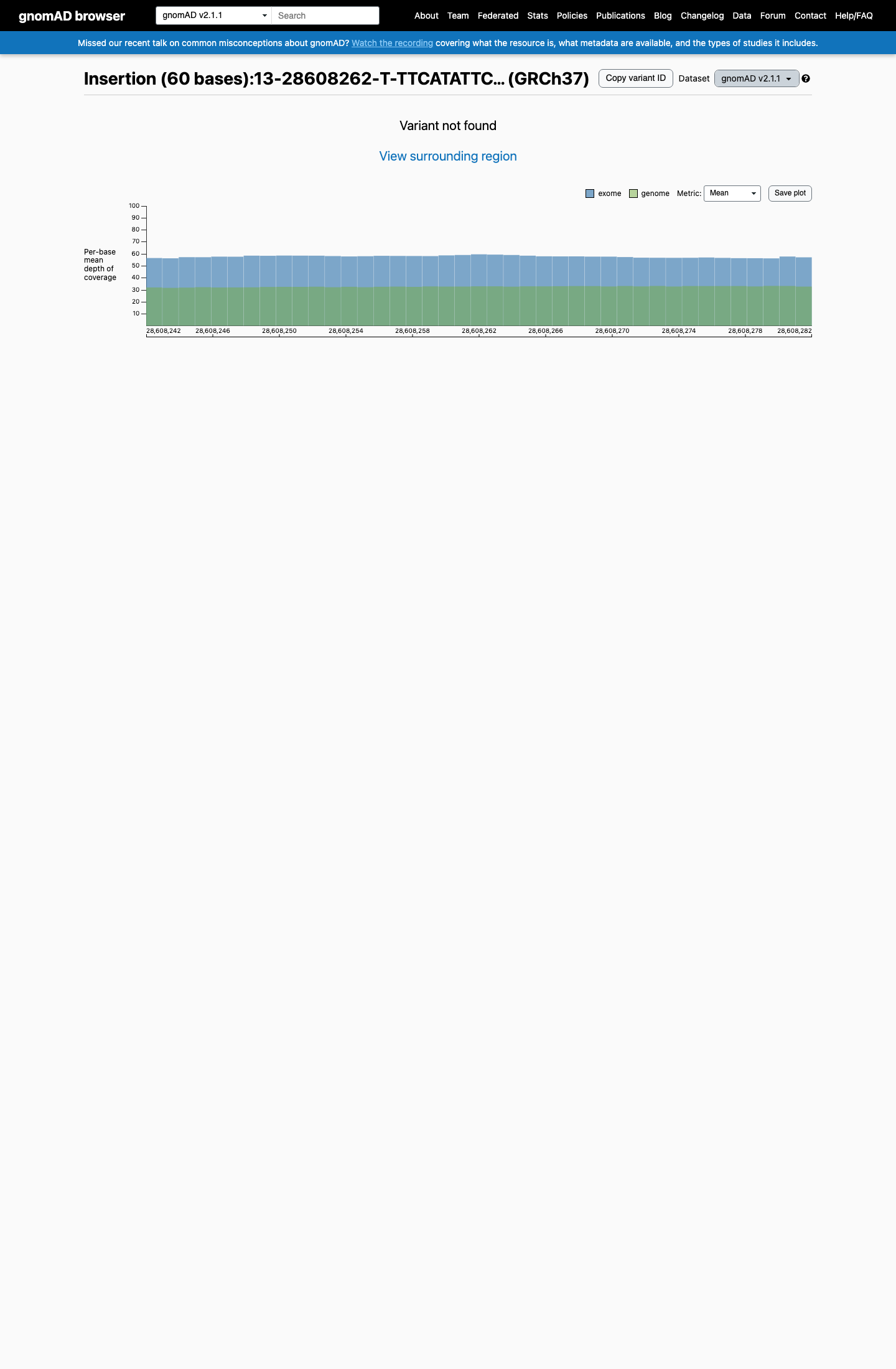
gnomAD v2.1
v4.1
Absent from gnomAD v4.1.
v2.1
Absent from gnomAD v2.1.
🇨🇦 CA
This variant is absent from gnomAD-Canada.
Allele frequency by ancestry
three datasets · side by side
gnomAD v4.1
Absent
· 0 / ?
0 hom
0 hom
Not observed in any ancestry group.
gnomAD v2.1
Absent
· 0 / ?
0 hom
0 hom
Not observed in any ancestry group.
gnomAD Canada 🇨🇦
Absent
· 0 / ?
0 hom
0 hom
Not observed in any ancestry group.
In silico
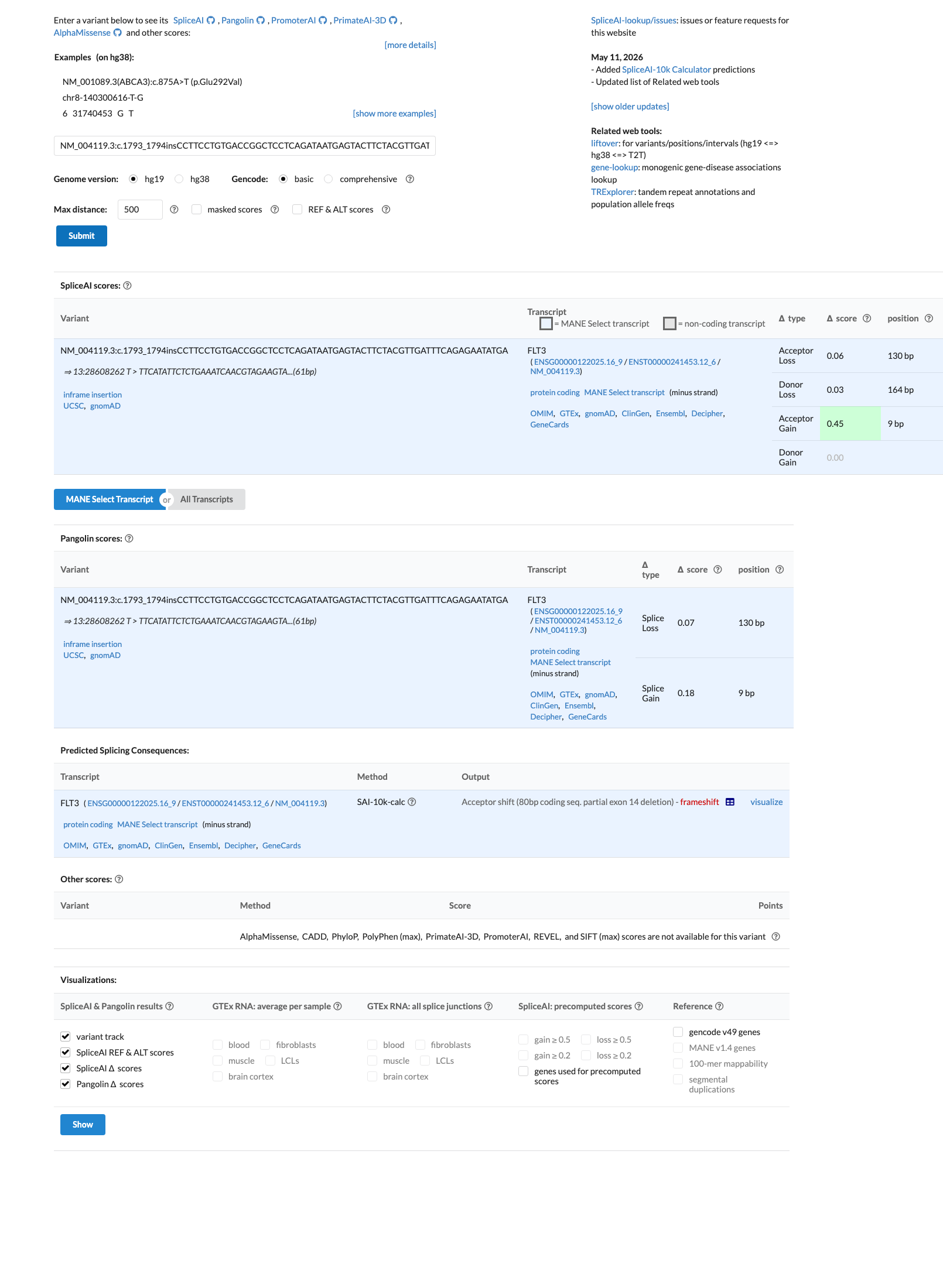
SpliceAI predicts possible splice impact for this variant (max delta score = 0.45).
Functional
Likely Oncogenic
OncoKB identified variant-specific curated literature and context relevant to functional review; biological-effect context: Likely Gain-of-function; curated oncogenicity label: Likely Oncogenic.

COSMIC

Cancer hotspots
Somatic evidence
Not in COSMIC / hotspots
COSMIC
This variant does not lie in a statistically significant hotspot. This variant has not previously been reported in somatic cancers (COSMIC).
Hotspots
This variant does not lie in a statistically significant hotspot.
Literature · how each cited paper was used
4papers cited
Each card is an audit: what was searched, what was found, whether it names the variant, which criteria it fed, and why. 1 further PMID triaged but not cited — see Sources & references.
Flt3 mutations from patients with acute myeloid leukemia induce transformation of 32D cells mediated by the Ras and STAT5 pathways.
Found
Structured finding pending for this record — see source link.
Applied to
→PS3
supporting
→PM1
moderate
→PM5
moderate
FLT3 internal tandem duplication mutations associated with human acute myeloid leukemias induce myeloproliferative disease in a murine bone marrow transplant model.
Found
Structured finding pending for this record — see source link.
Applied to
→PS3
supporting
→PM1
moderate
→PM5
moderate
A new and recurrent activating length mutation in exon 20 of the FLT3 gene in acute myeloid leukemia.
Found
demonstrates that activating FLT3 length mutations are not restricted to one exact sequence.
Applied to
→PM5
moderate
Internal tandem duplication of the FLT3 gene is a novel modality of elongation mutation which causes constitutive activation of the product.
Found
reported 47/51 FLT3 ITDs localize to codon 589-599 with constitutive kinase activation.
Applied to
→PS3
supporting
→PM1
moderate
→PM5
moderate
Sources & reference links
Triaged references · 1 PMID not cited in assessment
23631653 ↗
FLT3 tyrosine kinase inhibitors in acute myeloid leukemia: clinical implications and limitations.
ONCOKB