PM1 (Moderate) is met: variant c.1330C>T (p.Arg444Trp) is located in exon 11, a VCEP-designated critical functional domain for BRAF per RASopathy VCEP v2.3.0.1 PP2 (Supporting) is met: BRAF gnomAD missense Z-score exceeds 3.09, indicating strong purifying selection against missense variation, consistent with a gene where missense variants are a common mechanism of RASopathy disease.2 PM2 is not met: the variant is present in gnomAD v2.1 (1/251,378) and v4.1 (1/1,613,628), which precludes application under the VCEP rule requiring absence from controls.3 PP3 is not met: REVEL score (0.637) falls below the VCEP PP3 threshold of ≥0.7, and SpliceAI (max delta 0.09) predicts no splicing impact.4 No benign criteria are met. BA1 and BS1 are not met (allele frequency far below population thresholds). BP4 is not met (REVEL 0.637 > 0.3 threshold).5 Under RASopathy VCEP v2.3.0 combination rules, PM1_Moderate + PP2_Supporting does not satisfy any Pathogenic, Likely Pathogenic, Benign, or Likely Benign rule. The minimum for Likely Pathogenic requires either 1 Strong + 1 Moderate, or ≥3 Moderate, or 1 Moderate + ≥4 Supporting criteria. Final classification: Variant of Uncertain Significance (VUS).6 PVS1, PS5, PP4, PP5, BS3, BP6 are not applicable under the VCEP framework. PS1, PS2, PS3, PS4, PM5, PM6, PP1, BS2, BS4, BP2, BP5 are not assessed due to absence of data. PM2, PP3, BA1, BS1, BP1, BP4, BP7 were assessed and not met.7 Three ClinVar-attached PMIDs (25394175, 31829902, 35924163) were reviewed in full text; none mention NM_004333.5:c.1330C>T or p.Arg444Trp. These papers are clinical practice guidelines or consensus statements on cancer genetics referral and prostate cancer biomarkers and do not provide variant-specific evidence.8
Final classification
VUS
PM1PP2
BRAF
c.1330C>T
p.Arg444Trp
This variant
PM1 (Moderate) is met: variant c.1330C>T (p.Arg444Trp) is located in exon 11, a VCEP-designated critical functional domain for BRAF per RASopathy VCEP v2.3.0.
ClinGen RASopathy Expert Panel Specifications to the ACMG/AMP Variant Interpretation Guidelines for BRAF Version 2.3.0 v2.3.0 criteria-combination framework was evaluated deterministically with applied criteria: PM1 moderate, PP2 supporting; no rule matched the adjudicated criteria.
Classification rationale
PM1PP2
VUS
BRAF c.1330C>T
PM1 + PP2
→
VUS
LYFE Sciences is an AI system, and it can make mistakes. Criteria
may be applied incorrectly, sources may be misread, and a confident-looking
classification can still be wrong. Double-check every criterion and
its underlying evidence before relying on any call.
Gene diagram
· NM_004333.5 · variants mapped to exon structure
BRAF
NM_004333.5
Fetching transcript structure from UCSC…
Applied criteria · 2 applied · 18 assessed
MetEvidence satisfies this criterion.
Not metEvaluated against available evidence; threshold not reached.
Not assessedApplies in principle, but no evidence was found to evaluate it.
N/ADoesn't apply to this variant type.
Applied · 2
Strength
Supporting
Moderate
Strong
Very strong
PM1
moderate
Pathogenic
Variant c.1330C>T (p.Arg444Trp) is located in exon 11 (c.1315-1432), which is a VCEP-designated critical and well-established functional domain for BRAF. PM1 applied at Moderate strength per RASopathy VCEP v2.3.0 rule: 'Applicable only to critical and well-established functional domains available in the supplementary table (exon 6, exon 11, P-loop [AA 459-474], CR3 activation segment [AA 594-627]).'
c.1330C>T falls within exon 11 (c.1315-1432 per Mutalyzer exon coordinates)exon 11 is a VCEP-specified critical domain.
PP2
supporting
Pathogenic
BRAF gnomAD missense Z-score is well above 3.09, meeting VCEP PP2 criteria at Supporting strength. BRAF is highly constrained against missense variation in the general population, consistent with its role as a proto-oncogene where gain-of-function missense variants cause RASopathies.
BRAF gnomAD v2.1 missense Z-score exceeds 3.09 threshold (BRAF is highly missense-constrained per gnomAD constraint metrics).
Assessed · not applied
· 8 not met · 10 not assessed
Pathogenic
PS1
No evidence that Arg444Trp has been previously established as pathogenic via a different nucleotide change at the same residue.
PS2
No de novo data available for this variant.
PS3
Variant not tested in any VCEP-approved functional assays.
PS4
No proband case counts or case-control data available.
PM2
VCEP PM2 rule requires the variant to be absent from gnomAD.
PM5
VCEP PM5 requires at least one [likely] pathogenic residue change at the same codon (444).
PM6
No de novo data available.
PP1
No cosegregation data available.
PP3
VCEP PP3 requires REVEL score ≥ 0.7 for missense variants.
Benign
BA1
VCEP BA1 requires gnomAD filtering allele frequency ≥ 0.05%.
BS1
VCEP BS1 requires gnomAD filtering allele frequency ≥ 0.025%.
BS2
VCEP BS2 uses a point-based scoring system requiring observation in a healthy adult for a fully penetrant disorder.
BS4
VCEP BS4 assesses lack of segregation in affected family members.
BP1
VCEP BP1 applies only to truncating variants (nonsense, frameshift, canonical splice, initiation codon, whole/multi-exon deletion) in genes where primarily missense GOF variants cause disease.
BP2
VCEP BP2 uses point-based scoring for an alternative molecular cause of a RASopathy in the same gene.
BP4
VCEP BP4 requires REVEL ≤ 0.3 for missense variants.
BP5
VCEP BP5 uses point-based scoring for an alternative molecular cause of a RASopathy in a different gene.
BP7
VCEP BP7 applies to synonymous (silent) variants with no predicted splice impact and low nucleotide conservation.
N/A · 5
PVS1 · PP4 · PP5 · BS3 · BP6
Research & evidence
Population frequency
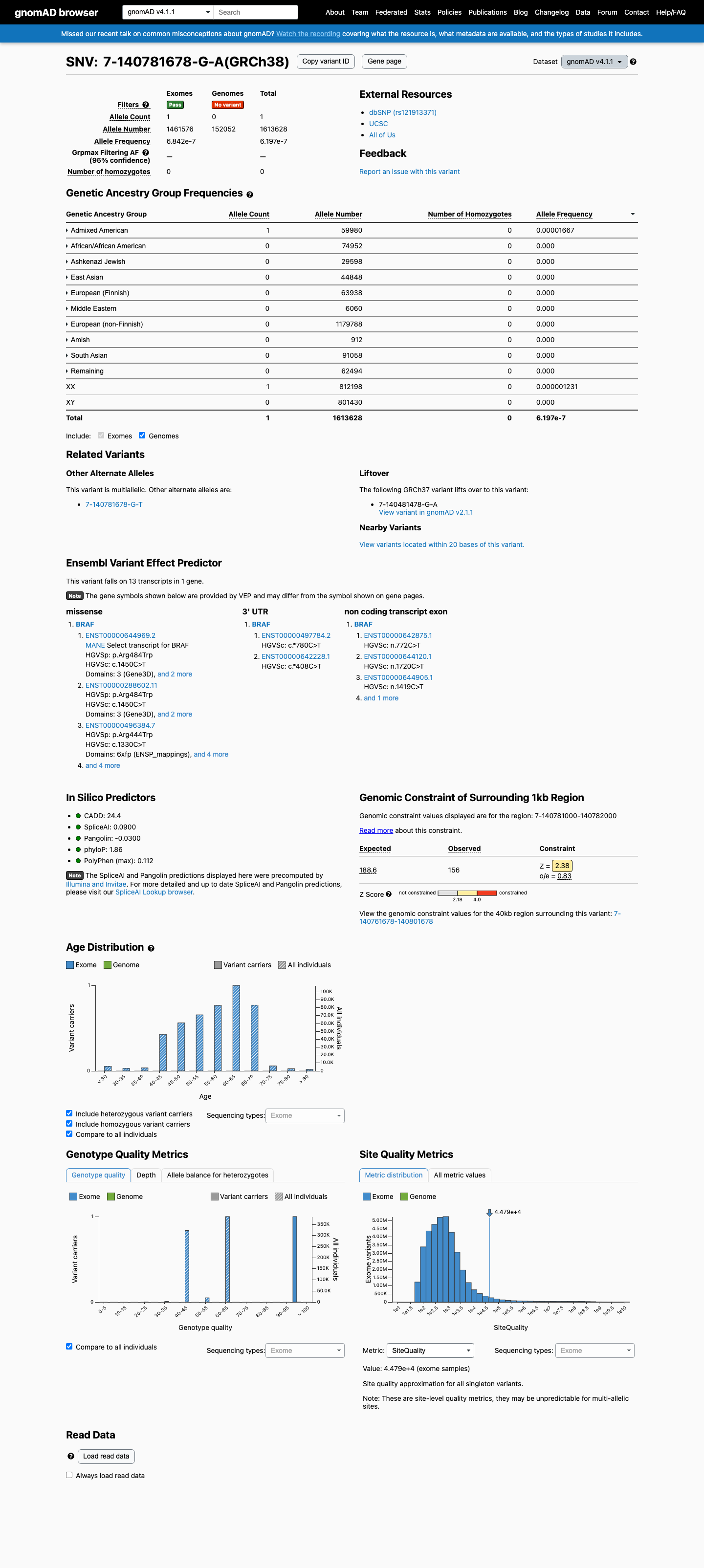
gnomAD v4.1
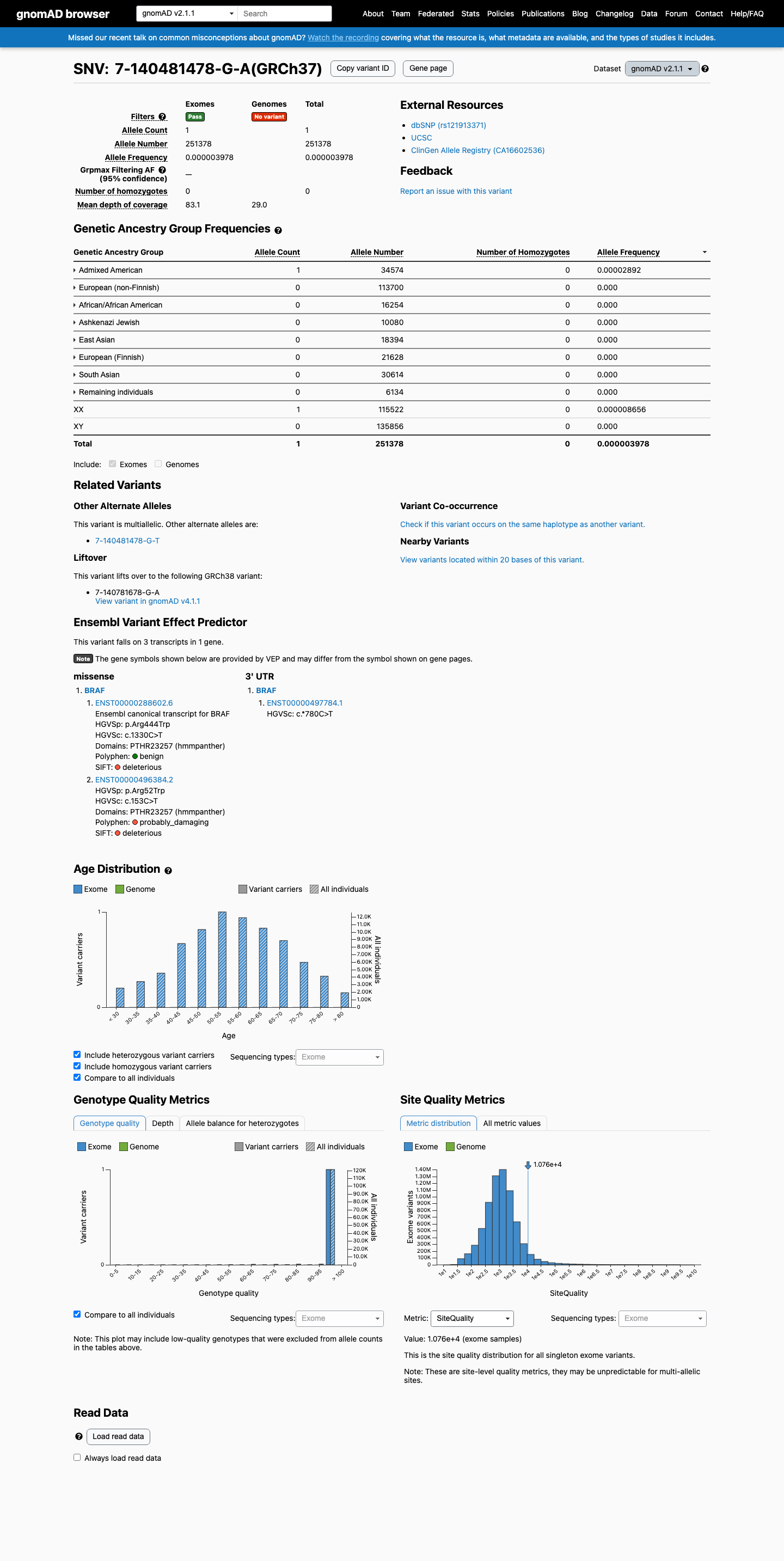
gnomAD v2.1
v4.1
This variant is present in gnomAD v4.1 (AF= 6.19722e-07; MAF= 0.00006%, 1/1613628 alleles, homozygotes = 0) and has highest observed frequency in the Admixed American population (AF= 1.66722e-05; MAF= 0.00167%, 1/59980 alleles, homozygotes = 0).
v2.1
This variant is present in gnomAD v2.1 (AF= 3.97807e-06; MAF= 0.00040%, 1/251378 alleles, homozygotes = 0) and has highest observed frequency in the Admixed American population (AF= 2.89235e-05; MAF= 0.00289%, 1/34574 alleles, homozygotes = 0).
🇨🇦 CA
Absent from gnomAD-Canada v1.0.
Allele frequency by ancestry
three datasets · side by side
gnomAD v4.1
6.2e-05%
· 1 / 1,613,628
0 hom
0 hom
Admixed American 1 / 59,980 |
0.0017% |
+ 9 not observed (Remaining individuals, European (Finnish), Amish, East Asian, Middle Eastern, South Asian, Ashkenazi Jewish, African/African American, European (non-Finnish))
gnomAD v2.1
0.0004%
· 1 / 251,378
0 hom
0 hom
Admixed American 1 / 34,574 |
0.0029% |
+ 7 not observed (African/African American, Ashkenazi Jewish, East Asian, European (Finnish), European (non-Finnish), Remaining individuals, South Asian)
gnomAD Canada 🇨🇦
Absent
· 0 / ?
0 hom
0 hom
Not observed in any ancestry group.
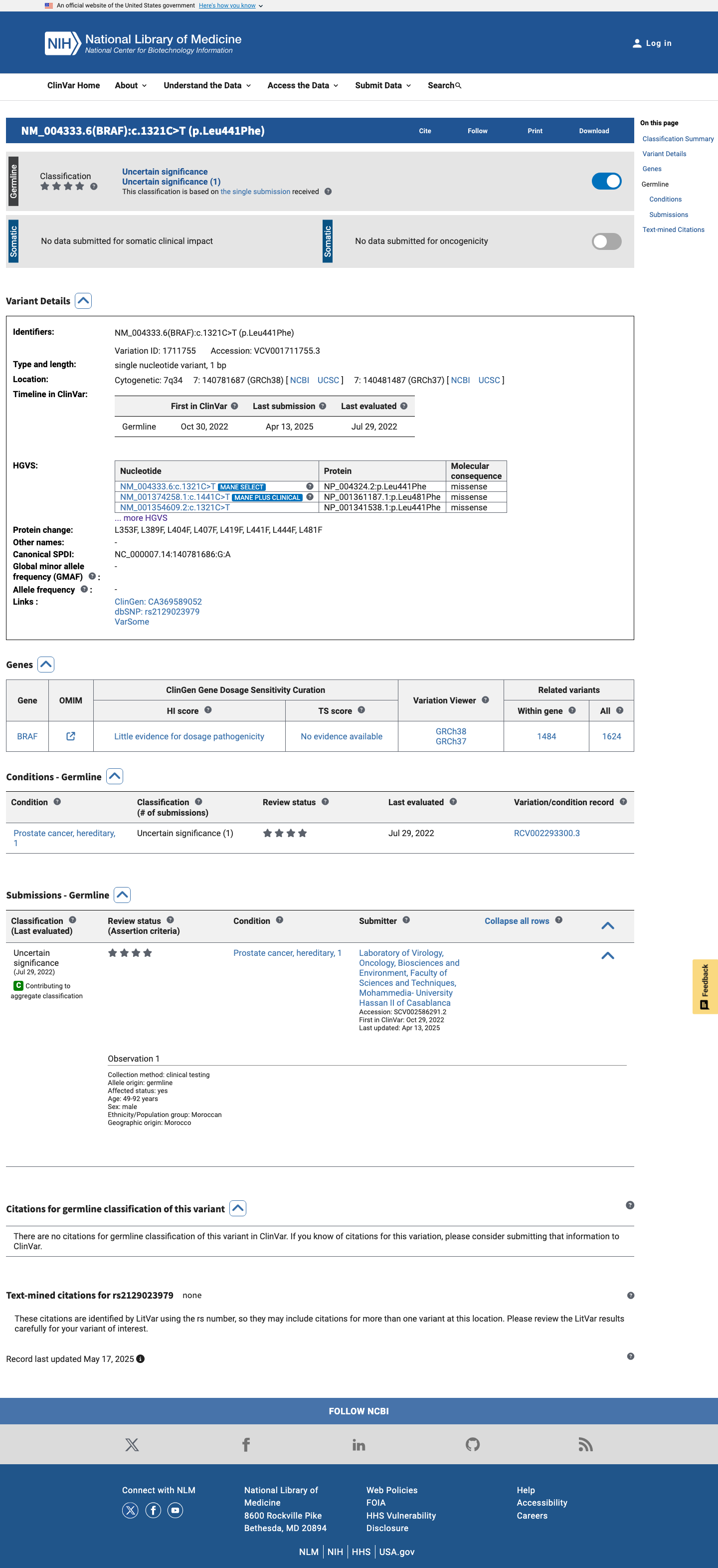
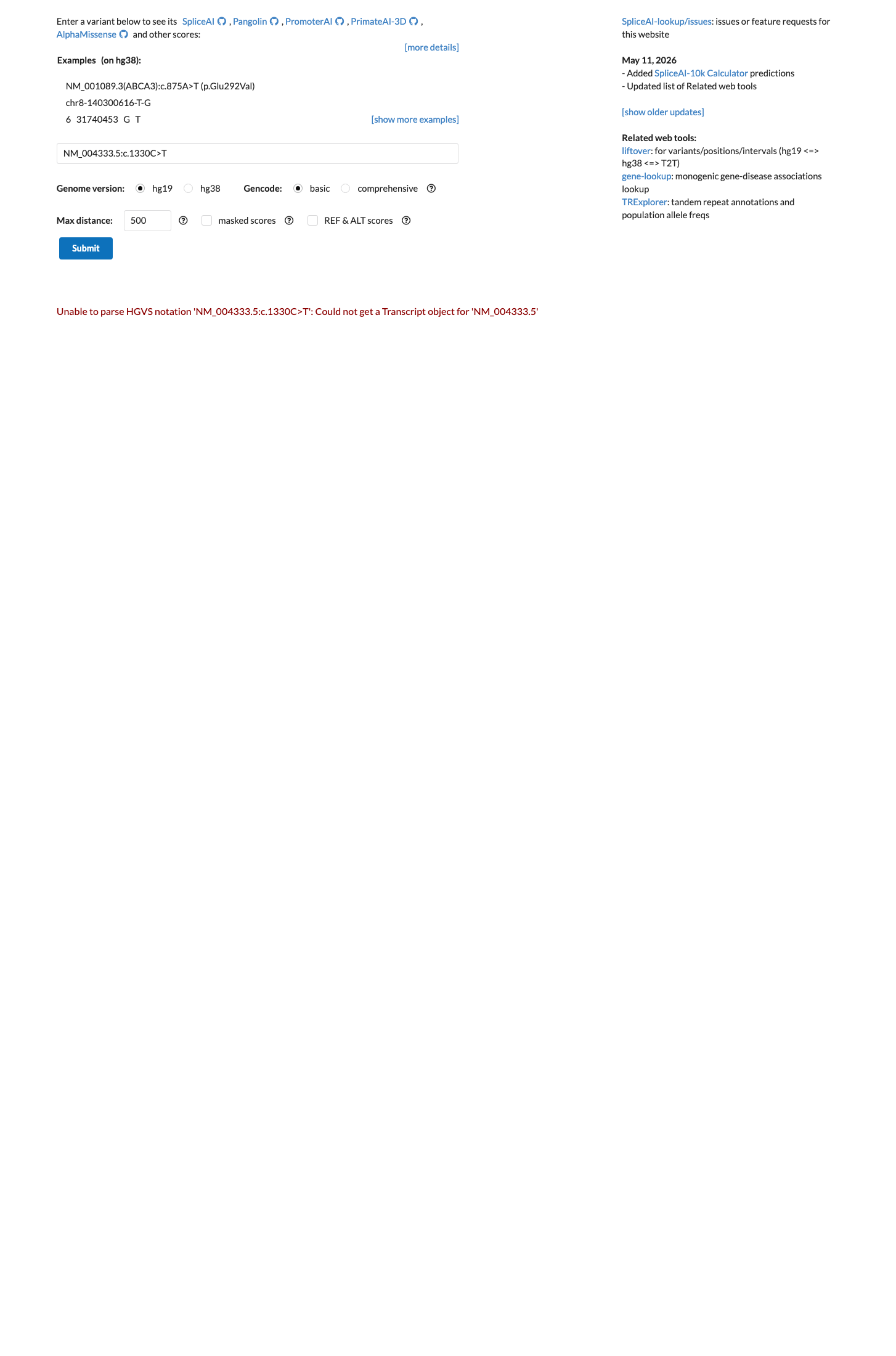
In silico
SpliceAI predicts no significant splice impact for this variant (max delta score = 0.09). REVEL score = 0.637. BayesDel score = 0.25761.
Functional
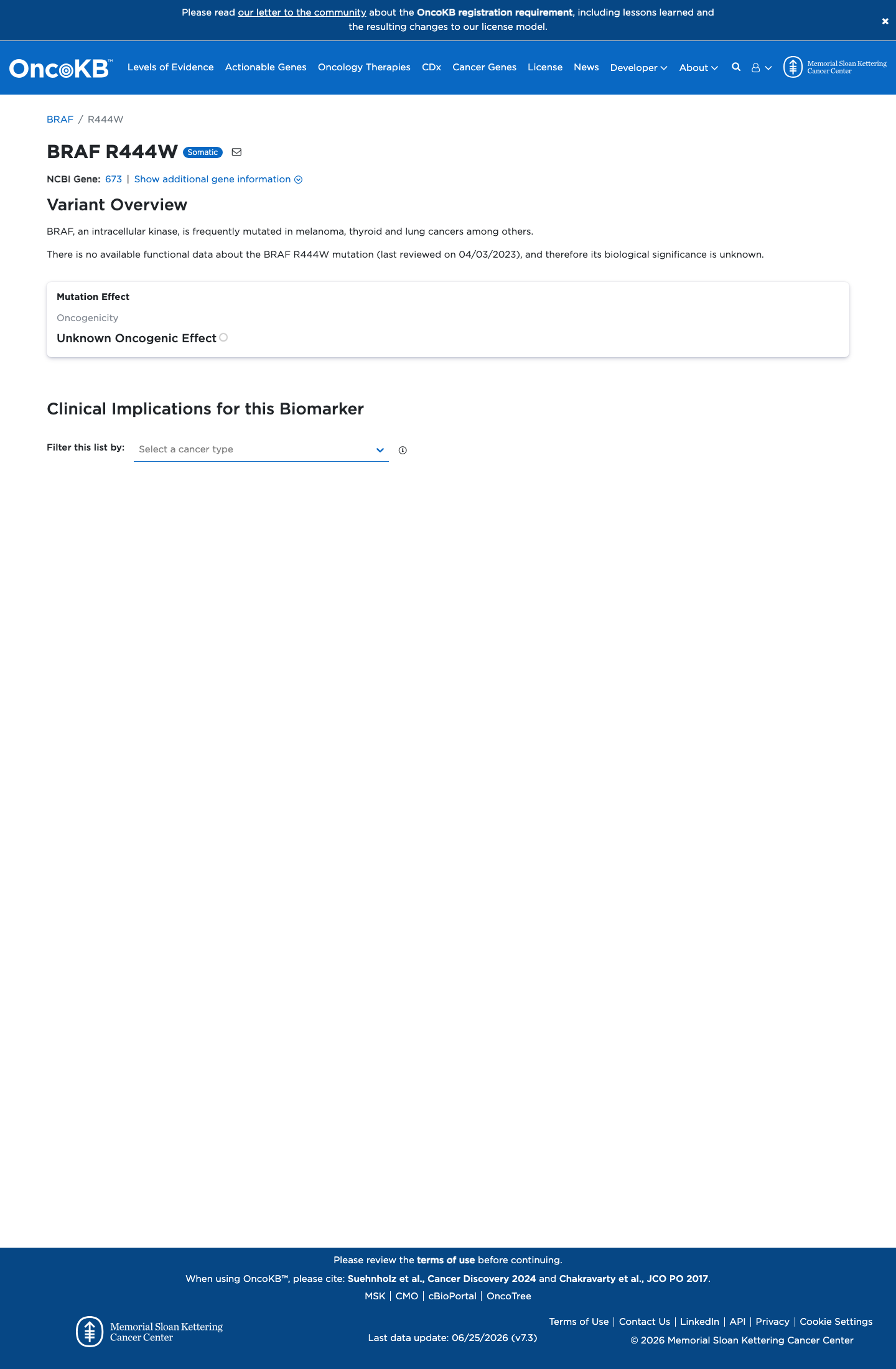
Unknown Oncogenic Effect
OncoKB did not identify variant-specific reviewed functional evidence for this variant; gene-level curated context is available for reviewer follow-up. BRAF, an intracellular kinase, is frequently mutated in melanoma, thyroid and lung cancers among others.
COSMIC

Cancer hotspots
Somatic evidence
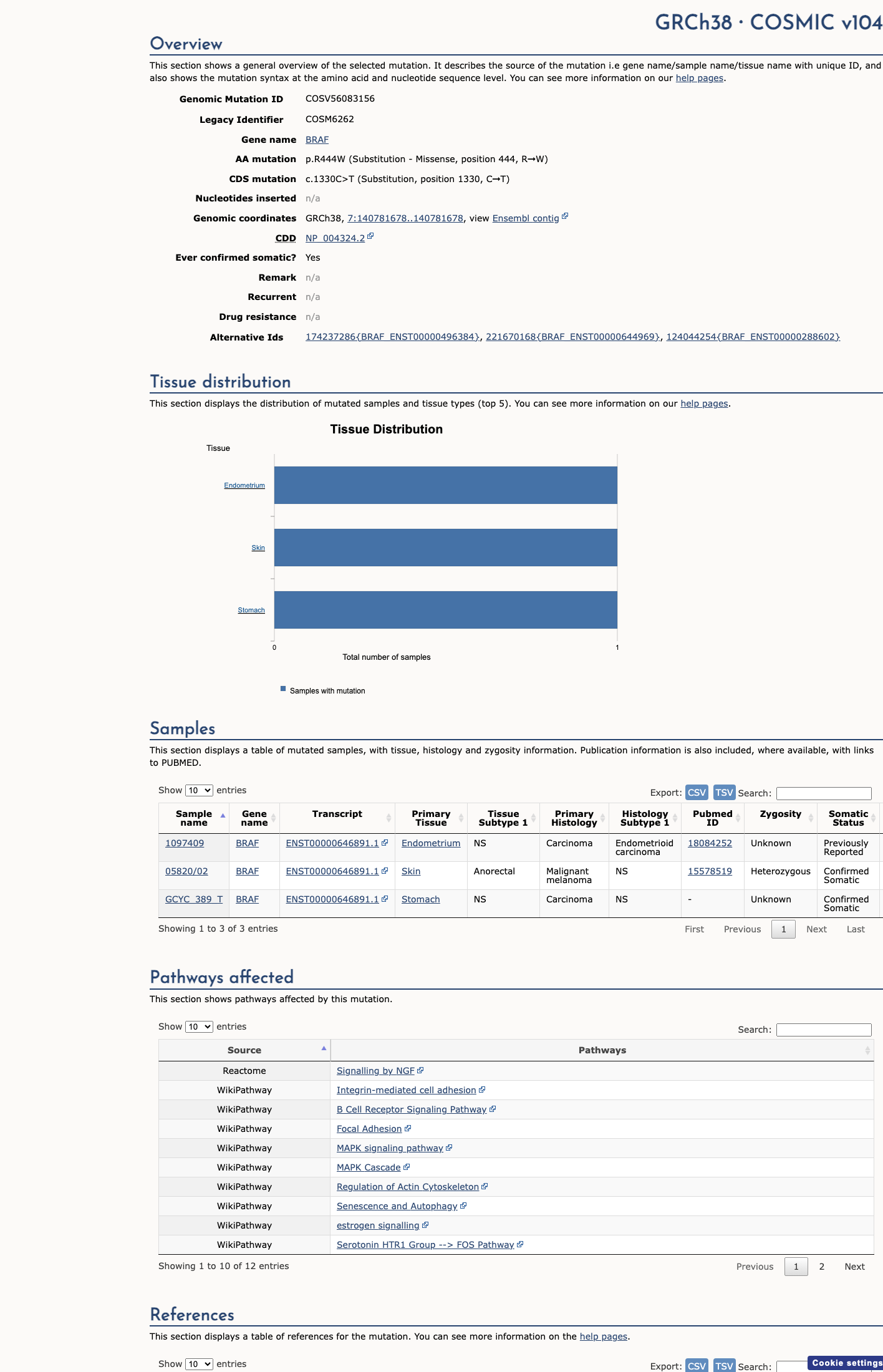
Not in COSMIC / hotspots
COSMIC
This variant does not lie in a statistically significant hotspot. This variant has previously been reported in somatic cancers (COSMIC; COSV56083156, n = 3 times).
Hotspots
This variant does not lie in a statistically significant hotspot.
Sources & reference links
9Sources
Triaged references · 3 PMIDs not cited in assessment
25394175 ↗
A practice guideline from the American College of Medical Genetics and Genomics and the National Society of Genetic Counselors: referral indications for cancer predisposition assessment.
CLINVAR
35924163 ↗
Genetic Testing and Its Clinical Application in Prostate Cancer Management: Consensus Statements from the Hong Kong Urological Association and Hong Kong Society of Uro-Oncology.
CLINVAR