Analysis in progress
Initialising…
0%
complete
This report is still being assembled — sections appear as each stage finishes. It isn't final yet.
CALR
Final classification
VUS
PM2BP4
CALR
c.1066C>G
p.Gln356Glu
missense · exon 9

Calreticulin (CALR) is a calcium-binding chaperone protein that resides primarily in the endoplasmic reticulum, where it helps ensure proper protein folding and maintain calcium balance within the cell. It also works in the nucleus, where it influences gene regulation, and in the immune system, where it supports antigen presentation and helps mark damaged cells for removal. Autoantibodies against calreticulin are associated with systemic lupus erythematosus, and acquired mutations in the gene are strongly linked to myeloproliferative neoplasms, blood disorders in which the bone marrow produces too many blood cells.

This variant

CALR mutations drive myeloproliferative neoplasms through exon 9 frameshift indels that remove the KDEL retention signal; this germline missense at codon 356 lies in the C-terminal acidic tail, outside that hotspot and its disease mechanism. The VUS classification reflects that current evidence supports neither a pathogenic nor a benign conclusion for this variant.

Transcript
NM_004343.3
HGVS · transcript:coding
NM_004343.3:c.1066C>G
GRCh38
chr19:12943725 C>G
GRCh37
chr19:13054539 C>G
Basis Uncertain Significance: only PM2 (supporting) and BP4 (supporting) are met, satisfying no pathogenic or benign combination rule.
Uncertain Significance: only PM2 (supporting) and BP4 (supporting) are met, satisfying no pathogenic or benign combination rule.
Classification rationale
PM2 BP4 VUS
CALR c.1066C>G missense · exon 9

PM2 (Supporting): gnomAD v4.1 total AF 9.30e-06 (maximum 0.0154%), below the 0.1% rare-variant threshold. BP4 (Supporting): REVEL 0.095, below the 0.290 benign-supporting threshold, with no predicted splice impact (SpliceAI 0.065). Final: VUS, because one supporting pathogenic and one supporting benign criterion satisfy no ACMG/AMP 2015 combination rule.

PM2 + BP4 VUS
Gene diagram · NM_004343.3 · variants mapped to exon structure
CALR NM_004343.3
Fetching transcript structure from UCSC…
Applied criteria · 2 applied · 21 assessed
MetEvidence satisfies this criterion.
Not metEvaluated against available evidence; threshold not reached.
Not assessedApplies in principle, but no evidence was found to evaluate it.
N/ADoesn't apply to this variant type.
Applied · 2
Strength Supporting Moderate Strong Very strong
PM2 supporting Pathogenic
Met (supporting): gnomAD v4.1 total AF 9.30e-06 (max 0.0154%), below the 0.1% PM2 threshold.
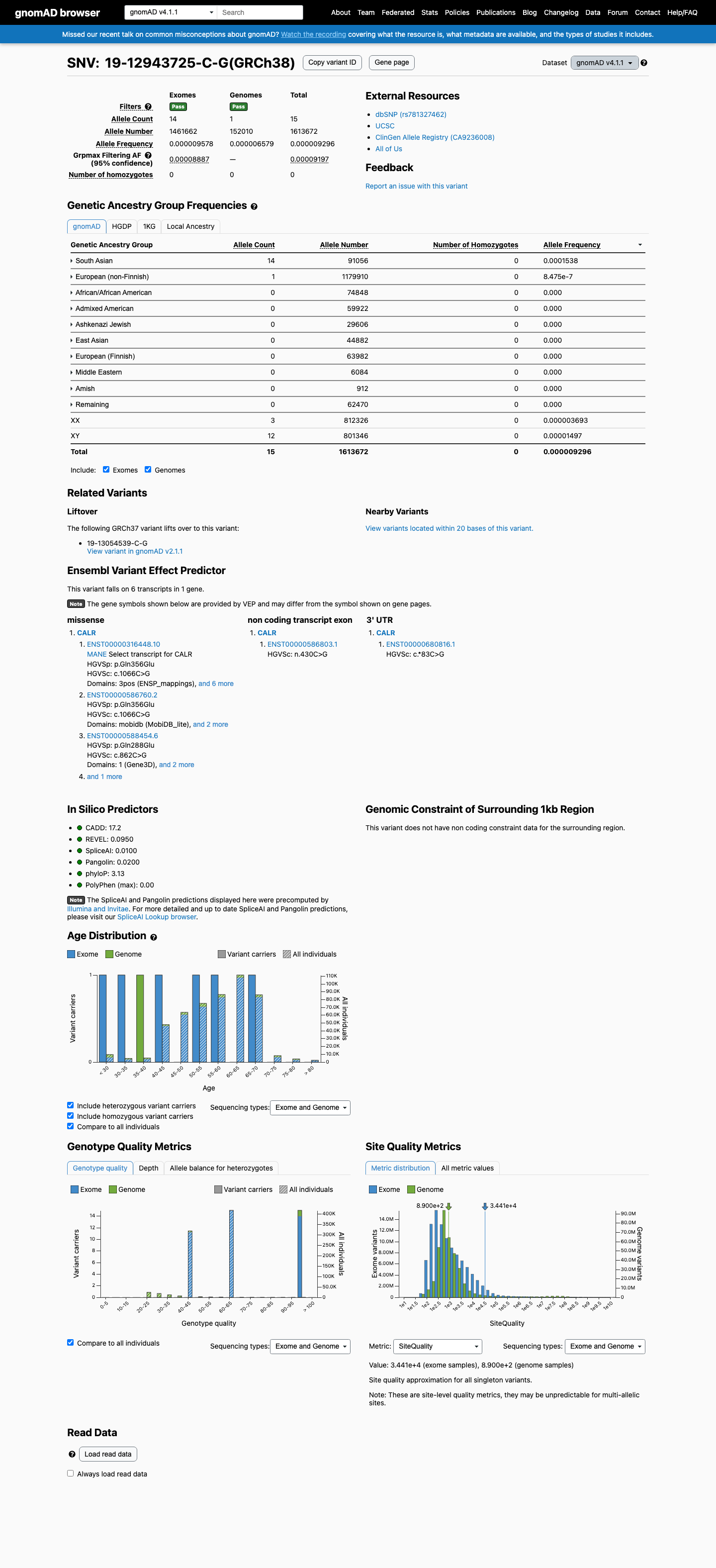
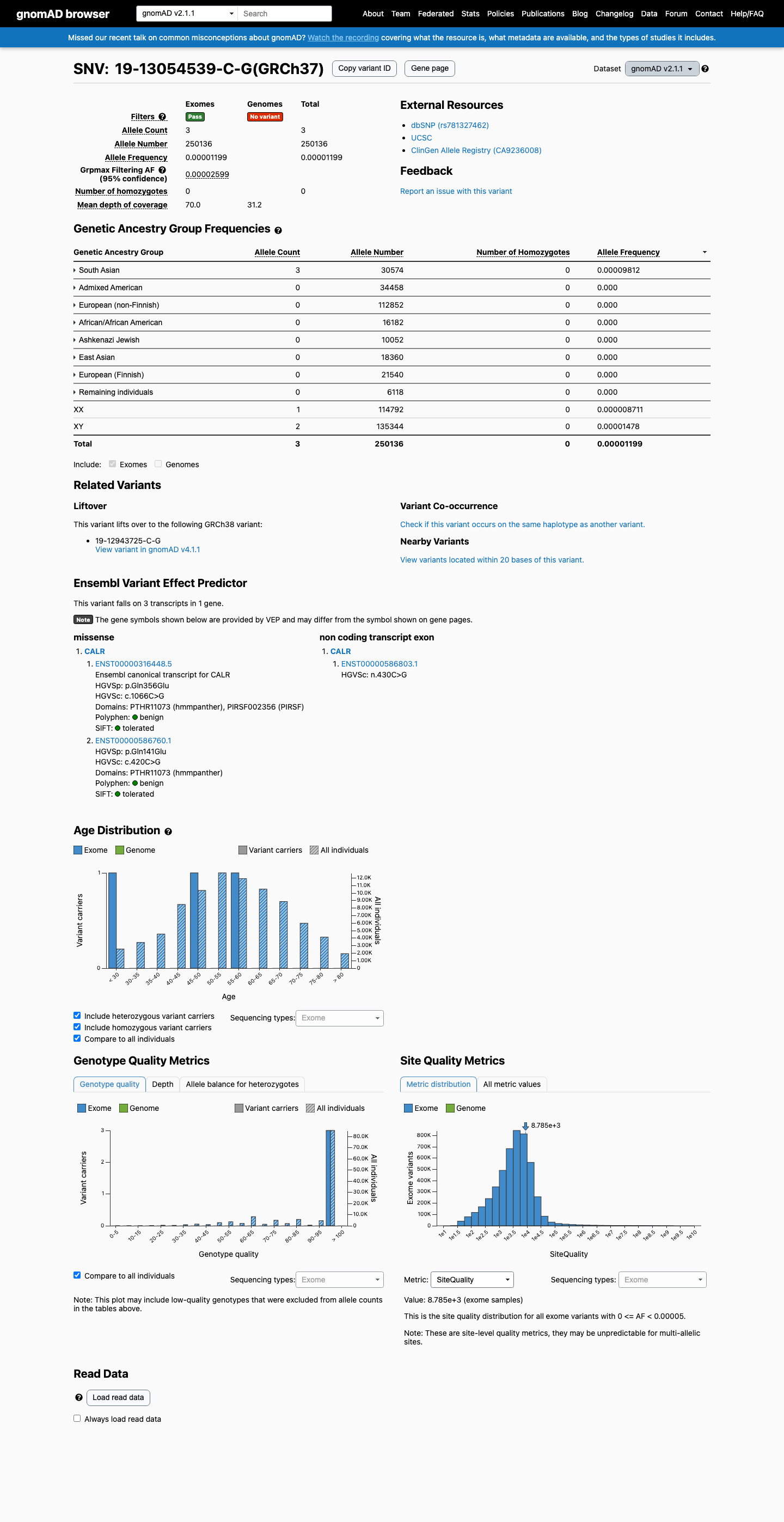
gnomAD v4.1 reports 15/1,613,672 total alleles (AF 9.29557e-06), group maximum FAF 9.197e-05, highest population AF 0.0001537515 in South Asians, and 0 homozygotes.gnomAD v2.1 reports 3/250,136 total alleles (AF 1.19935e-05), group maximum FAF 2.599e-05, highest population AF 9.81226e-05 in South Asians, and 0 homozygotes.gnomAD-Canada v1.0 reports the variant absent; this is concordant with extreme rarity but is not required for PM2 because the variant is already below the rare-variant cutoff in gnomAD v4.1 and v2.1.
BP4 supporting Benign
Met (supporting): REVEL 0.095 is below the 0.290 benign-supporting threshold, with no predicted splice impact.
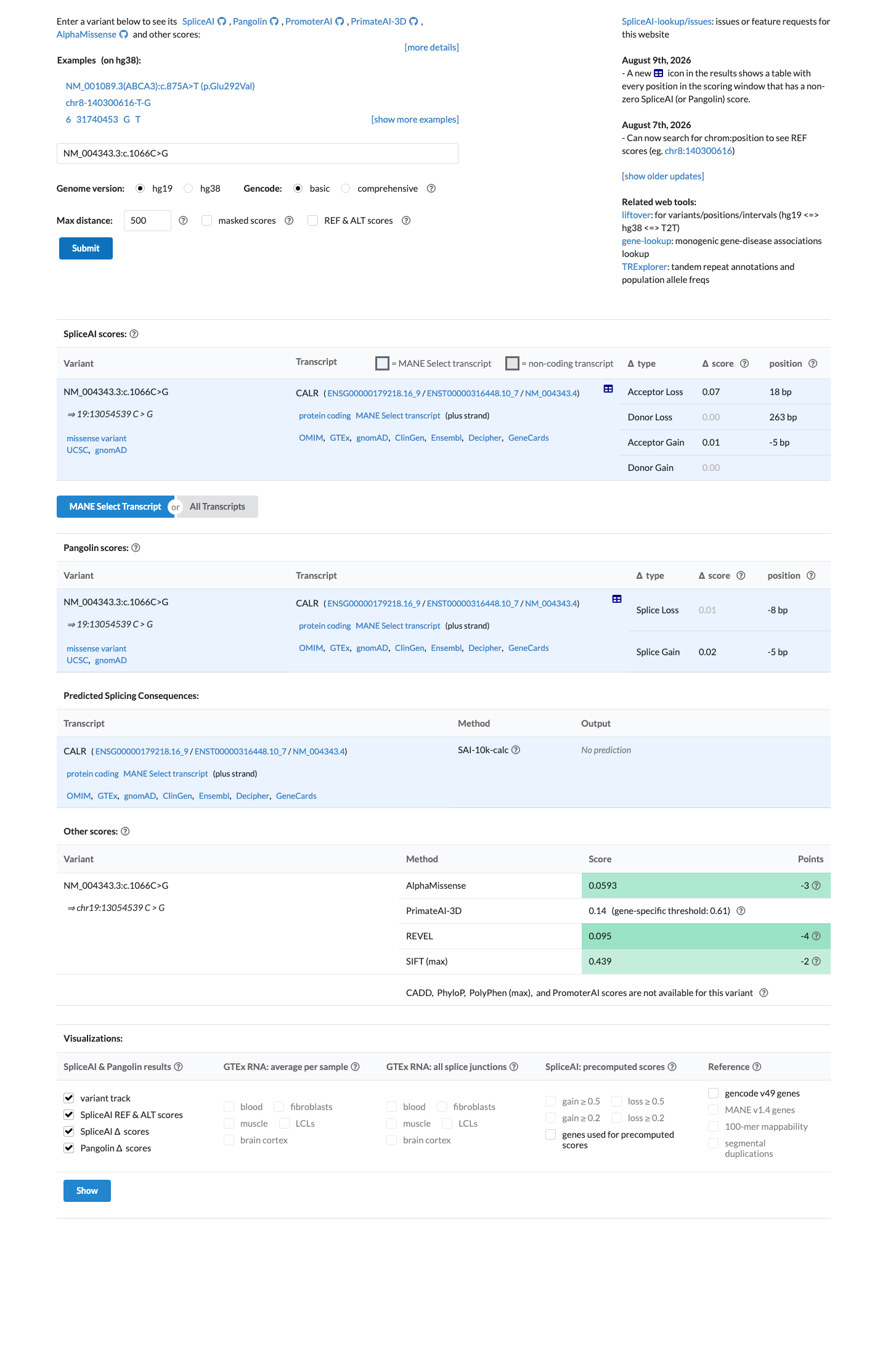
REVEL score = 0.095, below the calibrated benign-supporting threshold of ~0.290 (Pejaver et al. calibration, PMID 36413997), supporting a benign missense prediction.SpliceAI max delta score = 0.065, below the 0.2 splice-altering threshold (Jaganathan et al. 2019, PMID 30661751), indicating no predicted splice disruption and no conflicting evidence against BP4.
Assessed · not applied · 7 not met · 14 not assessed
Pathogenic
PS1 Not met: no other nucleotide change producing p.Gln356Glu is established as pathogenic.
PS2 Not assessed: no proband phenotype or de novo/parental-testing data were available.
PS3 Not assessed: no functional assay evidence for p.Gln356Glu was available.
PS4 Not assessed: no case-series or case-control prevalence data for this variant were available.
PM1 Not met: residue 356 lies in the C-terminal acidic tail, outside the exon 9 frameshift hotspot.
PM3 Not assessed: no second pathogenic variant, biallelic genotype, or phase data were available.
PM6 Not assessed: no evidence of de novo occurrence was available.
PP1 Not assessed: no segregation or pedigree data were available.
PP2 Not met: CALR disease mechanism is exon 9 frameshift indels, not missense substitution.
PP3 Not met: REVEL 0.095 is far below the 0.644 pathogenic-supporting threshold, and SpliceAI predicts no splice impact (0.065).
PP4 Not assessed: no patient phenotype or clinical diagnosis data were available.
PP5 Not assessed: no ClinVar expert-panel pathogenic assertion exists for this variant.
Benign
BA1 Not met: highest observed population frequency 0.0154% is far below the 1% BA1 threshold.
BS1 Not met: gnomAD v4.1 group max FAF 9.20e-05, below the 0.3% BS1 threshold.
BS2 Not met: zero homozygotes observed, which does not meet the BS2 benign-frequency expectation.
BS3 Not assessed: no functional assay evidence of a benign effect was available.
BS4 Not assessed: no unaffected-relative data were available to evaluate non-segregation.
BP1 Not assessed: CALR's gain-of-function frameshift mechanism does not fit BP1's truncating-disease premise.
BP2 Not assessed: no data on a second pathogenic variant or allele phase were available.
BP5 Not assessed: no alternate-gene explanation for the phenotype was available.
BP6 Not assessed: no ClinVar expert-panel benign assertion exists for this variant.
N/A · 5 PVS1 · PM4 · PM5 · BP3 · BP7
Research & evidence
Population frequency
gnomAD v4.1 screenshot
gnomAD v4.1
gnomAD v2.1 screenshot
gnomAD v2.1
v4.1
This variant is present in gnomAD v4.1 (AF= 9.29557e-06; MAF= 0.00093%, 15/1613672 alleles, homozygotes = 0) and has highest observed frequency in the South Asian population (AF= 0.000153752; MAF= 0.01538%, 14/91056 alleles, homozygotes = 0); grpmax FAF= 9.197e-05.
v2.1
This variant is present in gnomAD v2.1 (AF= 1.19935e-05; MAF= 0.00120%, 3/250136 alleles, homozygotes = 0) and has highest observed frequency in the South Asian population (AF= 9.81226e-05; MAF= 0.00981%, 3/30574 alleles, homozygotes = 0); grpmax FAF= 2.599e-05.
🇨🇦 CA
Absent from gnomAD-Canada v1.0.
Allele frequency by ancestry
three datasets · side by side
gnomAD v4.1
0.00093% · 15 / 1,613,672
0 hom · FAF 0.0092%
South Asian
14 / 91,056
0.015%
European (non-Finnish)
1 / 1,179,910
8.5e-05%
+ 8 not observed (Remaining individuals, Admixed American, European (Finnish), Amish, East Asian, Middle Eastern, Ashkenazi Jewish, African/African American)
gnomAD v2.1
0.0012% · 3 / 250,136
0 hom · FAF 0.0026%
South Asian
3 / 30,574
0.0098%
+ 7 not observed (African/African American, Admixed American, Ashkenazi Jewish, East Asian, European (Finnish), European (non-Finnish), Remaining individuals)
gnomAD Canada 🇨🇦
Absent · 0 / ?
0 hom
Not observed in any ancestry group.
ClinVar screenshot
ClinVar
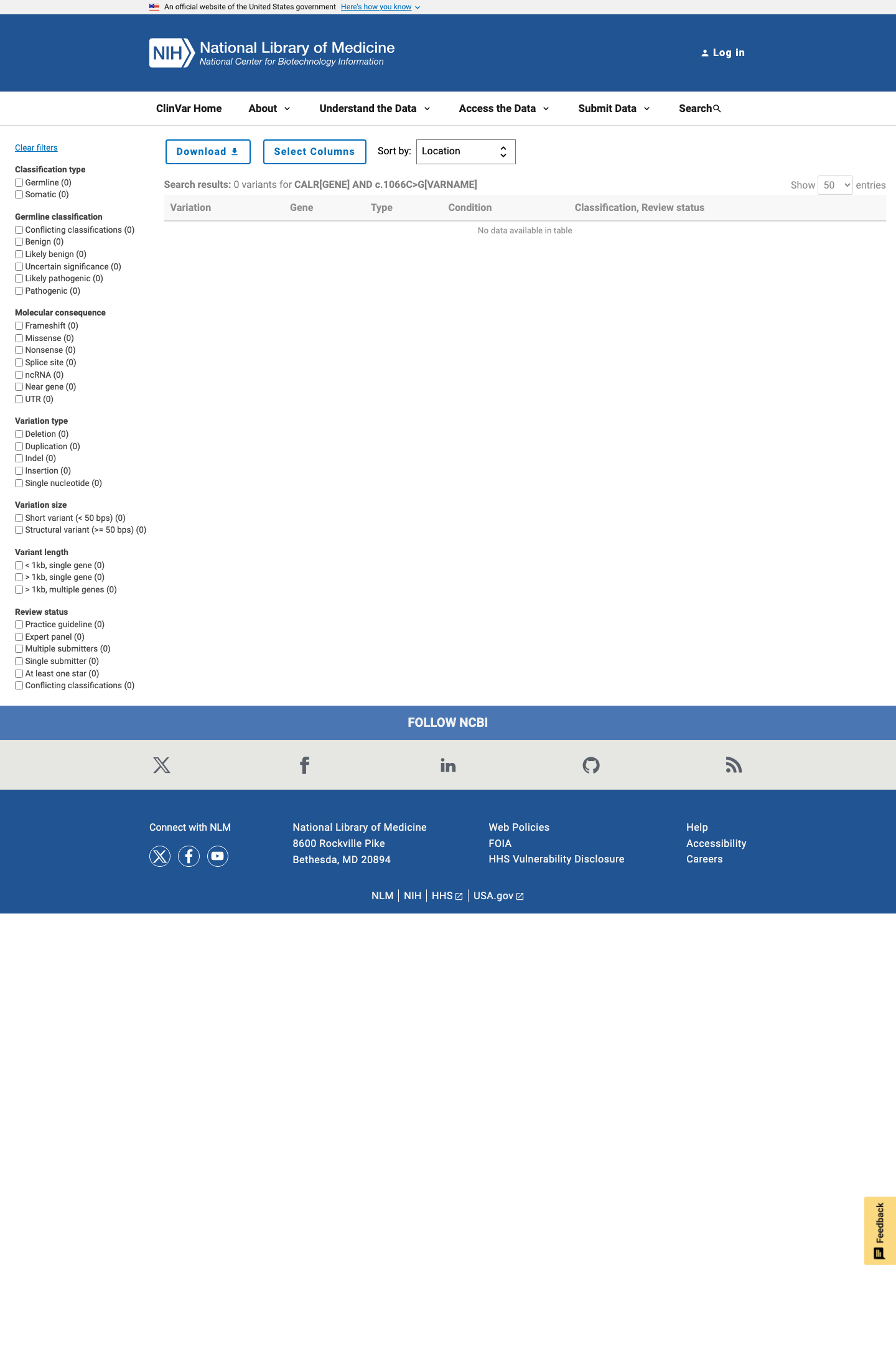
This variant is absent from ClinVar.
SpliceAI screenshot
In silico
SpliceAI predicts no significant splice impact for this variant (max delta score = 0.07). REVEL score = 0.095. BayesDel score = -0.728488.
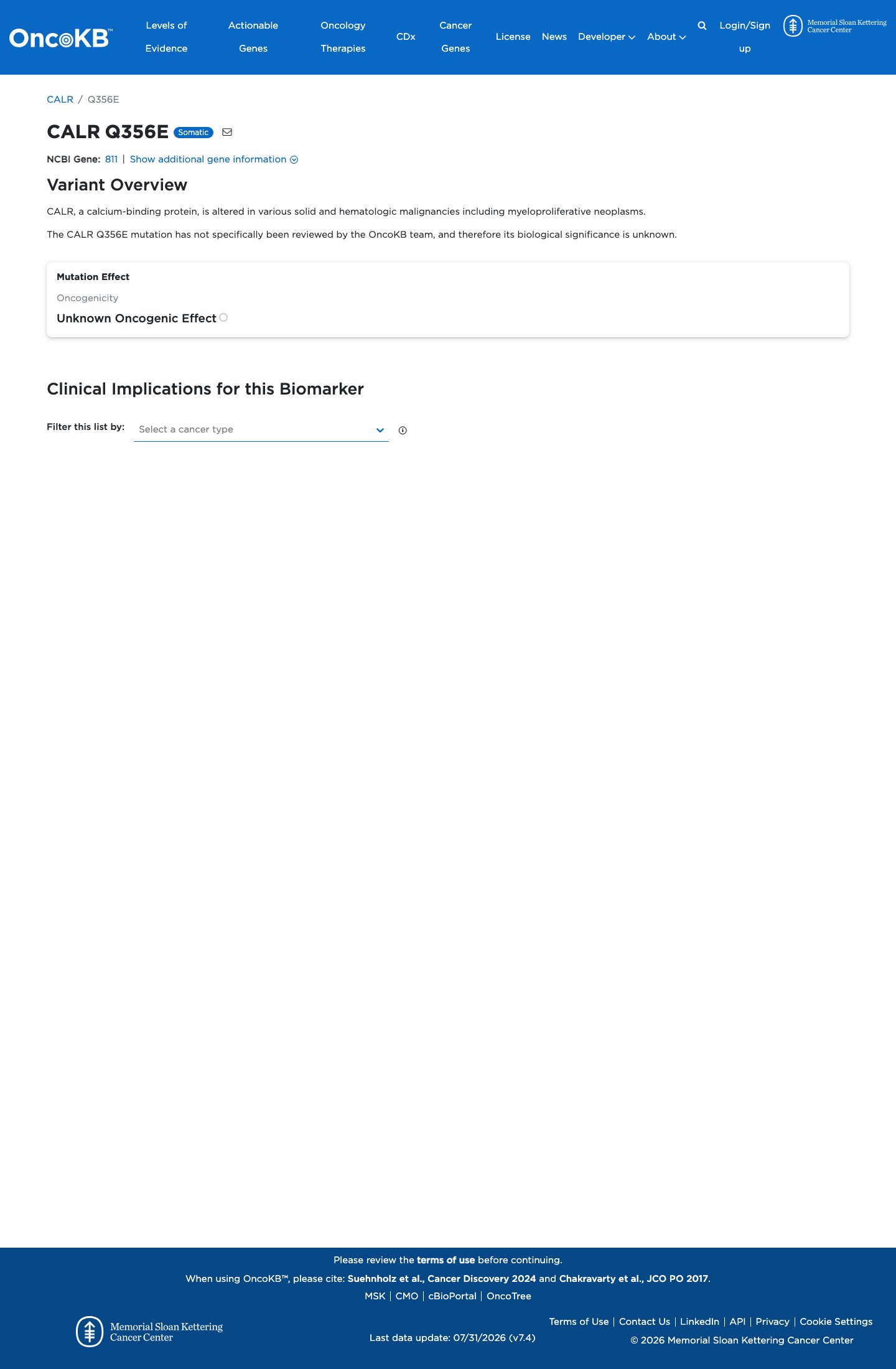
Functional / OncoKB screenshot
Functional Unknown Oncogenic Effect
OncoKB did not identify variant-specific reviewed functional evidence for this variant; gene-level curated context is available for reviewer follow-up. CALR, a calcium-binding protein, is altered in various solid and hematologic malignancies including myeloproliferative neoplasms.
OncoKB ↗
COSMIC screenshot
COSMIC
Cancer hotspots screenshot
Cancer hotspots
Somatic evidence Not in COSMIC / hotspots
COSMIC
This variant does not lie in a statistically significant hotspot. This variant has not previously been reported in somatic cancers (COSMIC).
Hotspots
This variant does not lie in a statistically significant hotspot.
Sources & reference links
8Sources
ClinVar
gnomAD v2.1
gnomAD v4.1
gnomAD-Canada
SpliceAI
OncoKB
COSMIC
Cancer hotspots