Analysis in progress
Initialising…
0%
complete
This report is still being assembled — sections appear as each stage finishes. It isn't final yet.
PRKN
Final classification
Likely Benign
PRKN c.1204C>T · p.Arg402Cys
PRKN

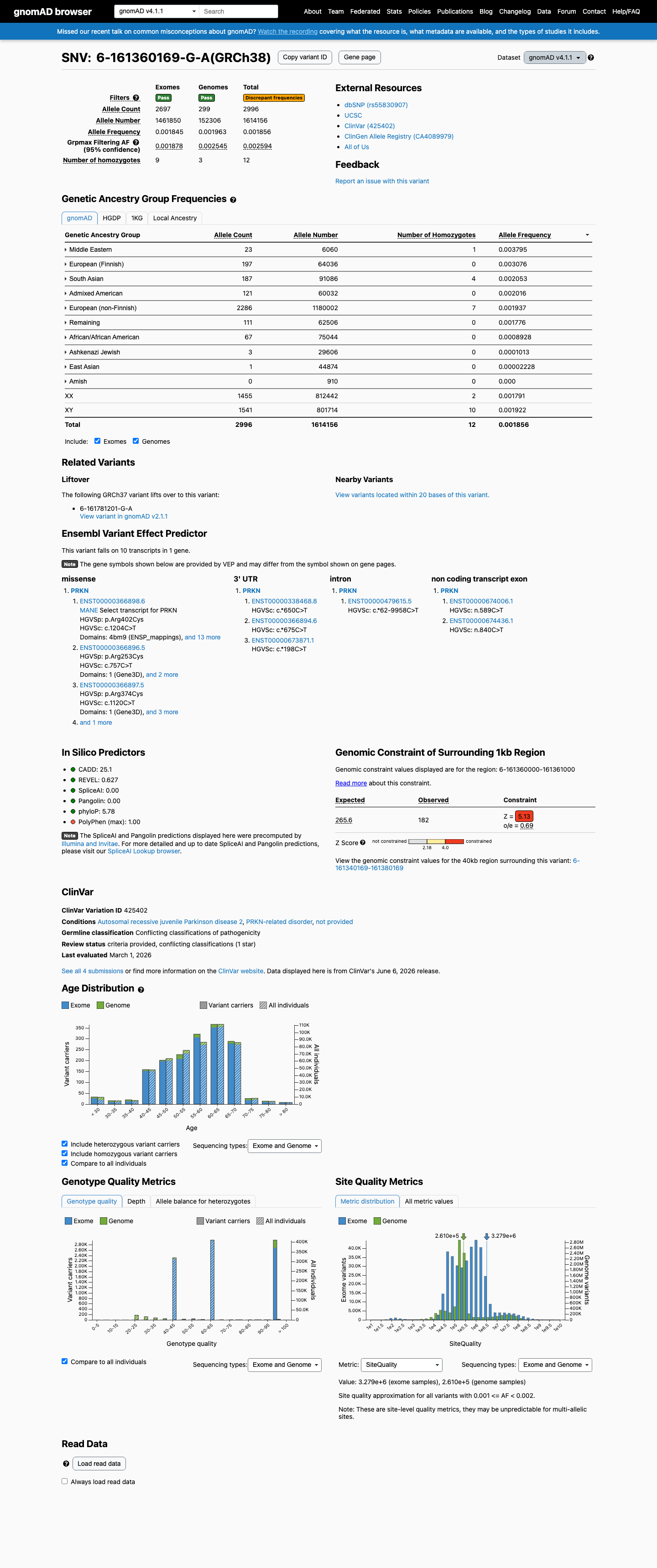
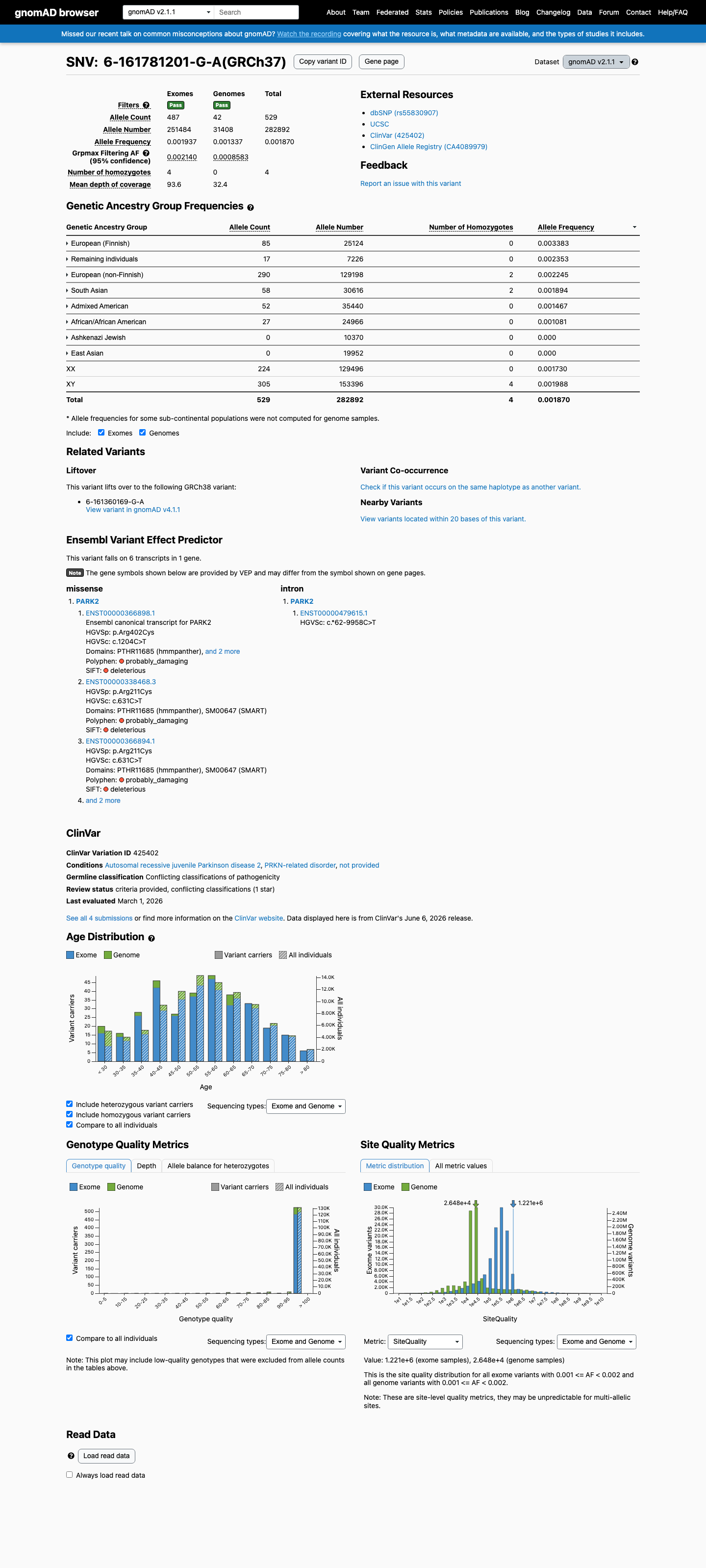
This variant has been observed in the homozygous state in population databases (4 homozygotes in gnomAD v2.1, 12 homozygotes in gnomAD v4.1), meeting BS2 (strong benign) for an autosomal recessive early-onset Parkinson disease with full penetrance.

Gene
PRKN
Transcript
NM_004562.2
HGVS · transcript:coding
NM_004562.2:c.1204C>T
Consequence
N/A
GRCh38
chr6:161360169 G>A
GRCh37
chr6:161781201 G>A
Basis gene-specific framework lacked a usable explicit final combination framework, so generic ACMG/AMP 2015 final-combination rules were applied as fallback; applied criteria: BS2 strong benign, BP4 supporting benign; combination = 1 strong benign + 1 supporting benign, which maps to Likely Benign.
gene-specific framework lacked a usable explicit final combination framework, so generic ACMG/AMP 2015 final-combination rules were applied as fallback; applied criteria: BS2 strong benign, BP4 supporting benign; combination = 1 strong benign + 1 supporting benign, which maps to Likely Benign.
Classification rationale
BS2BP4 Likely Benign
PRKN c.1204C>T

This variant has been observed in the homozygous state in population databases (4 homozygotes in gnomAD v2.1, 12 homozygotes in gnomAD v4.1), meeting BS2 (strong benign) for an autosomal recessive early-onset Parkinson disease with full penetrance.1 Multiple lines of computational evidence suggest no deleterious impact: BayesDel score 0.144 is in the benign range, SpliceAI predicts no splicing effect (max delta 0.0), and REVEL score 0.627 is indeterminate. Meeting BP4 at supporting benign level.2 Combination of BS2 (strong benign) and BP4 (supporting benign) meets the generic ACMG/AMP 2015 threshold for Likely Benign (1 Strong benign + 1 Supporting benign).3

BS2 + BP4 Likely Benign
2 revelbayesdelspliceai ↗
3 generic_acmg_combination_rules
Gene diagram · NM_004562.2 · variants mapped to exon structure
PRKN NM_004562.2
Fetching transcript structure from UCSC…
Applied criteria · 2 applied · 20 assessed
Applied · 2
Strength Supporting Moderate Strong Very strong
BS2 strong Benign
This variant has been observed in the homozygous state in population databases: 4 homozygotes in gnomAD v2.1 and 12 homozygotes in gnomAD v4.1. For autosomal recessive early-onset Parkinson disease (ARJP) caused by biallelic PRKN pathogenic variants, the presence of multiple homozygous individuals in general population databases constitutes strong evidence for a benign classification.
gnomAD v2.1: 4 homozygotes (529/282892 allelesAF=0.187%). gnomAD v4.1: 12 homozygotes (2996/1614156 allelesAF=0.186%). Multiple homozygotes in population databases for a fully penetrant recessive disorder indicate the variant is likely benign.
BP4 supporting Benign
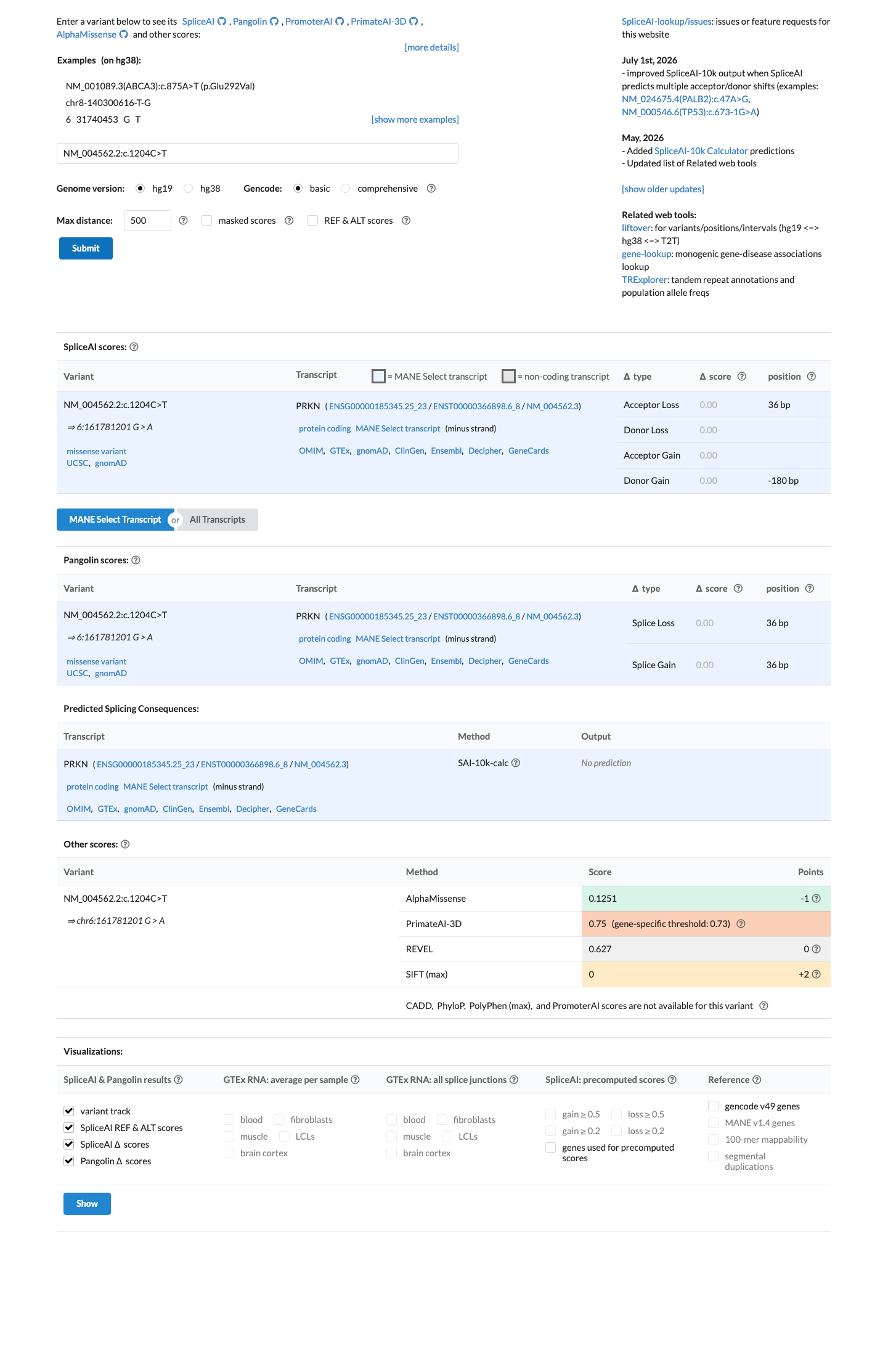
Multiple lines of computational evidence suggest no impact on the gene product. BayesDel score 0.144 is in the clearly benign range. SpliceAI predicts no splicing impact (max delta = 0.0). REVEL score 0.627 is in the indeterminate zone but does not reach a pathogenic threshold. Preponderance of in silico evidence supports a benign interpretation.
BayesDel=0.144 (benign range)SpliceAI max delta=0.0 (no splicing impact)REVEL=0.627 (indeterminate). Two of three predictors support benign
Assessed · not applied
Pathogenic
PS1 No evidence of a different nucleotide change at c.1204 resulting in the same amino acid change (p.Arg402Cys) that has been independently classified as pathogenic.
PS2 No de novo observation reported for this variant.
PS3 No variant-specific functional studies identified.
PS4 No case-control or enrichment data demonstrating increased prevalence of this variant in affected individuals versus controls.
PM1 Residue Arg402 is not located in a statistically significant mutational hotspot per cancerhotspots.org.
PM2 Variant allele frequency in gnomAD v2.1 is 0.187% (529/282892 alleles), which exceeds the 0.1% threshold for PM2 under generic ACMG framework.
PM5 No same-residue comparator variants identified.
PM6 No de novo observation reported.
PP1 No segregation data available.
PP2 PRKN missense variants can be pathogenic (loss-of-function) via the ubiquitin-proteasome pathway, and this variant has high population frequency with multiple homozygotes, indicating the gene tolerates benign missense variation.
PP3 Multiple lines of computational evidence do not support a deleterious effect.
PP4 No patient phenotype data available to assess whether the individual's clinical presentation is highly specific for PRKN-related disease.
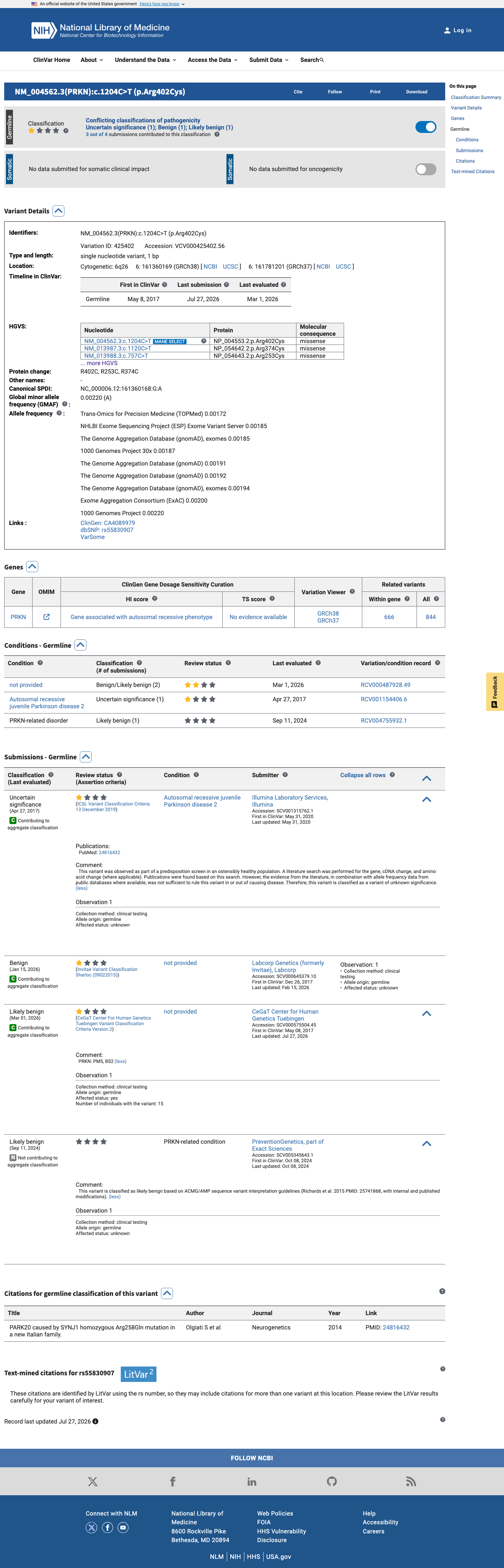
PP5 ClinVar classification is Likely benign (2 clinical laboratories), Benign (1), and Uncertain significance (1), with 1-star review status ('criteria provided, conflicting classifications').
Benign
BA1 Overall allele frequency in gnomAD v2.1 is 0.187%, which is below the 1% threshold for BA1 under generic ACMG framework.
BS1 Overall allele frequency in gnomAD v2.1 is 0.187% (grpmax FAF 0.214%), which is below the 0.3% threshold for BS1 under generic ACMG framework.
BS3 No in vitro or in vivo functional studies demonstrating no damaging effect on protein function or splicing were identified for this variant.
BS4 No segregation data demonstrating lack of cosegregation with disease.
BP2 No evidence of this variant observed in trans with a known dominant pathogenic variant.
BP5 No evidence of an alternate molecular basis for disease in a case harboring this variant.
BP6 ClinVar classification for this variant is Likely benign (2 labs) / Benign (1 lab) / VUS (1 lab) with 1-star review status ('criteria provided, conflicting classifications').
N/A · 3 PVS1 · BP1 · BP7
Research & evidence
Population frequency · supports benign
gnomAD v4.1 screenshot
gnomAD v4.1
gnomAD v2.1 screenshot
gnomAD v2.1
v4.1
This variant is present in gnomAD v4.1 (AF= 0.00185608; MAF= 0.18561%, 2996/1614156 alleles, homozygotes = 12) and has highest observed frequency in the Middle Eastern population (AF= 0.00379538; MAF= 0.37954%, 23/6060 alleles, homozygotes = 1); grpmax FAF= 0.00259375.
v2.1
This variant is present in gnomAD v2.1 (AF= 0.00186997; MAF= 0.18700%, 529/282892 alleles, homozygotes = 4) and has highest observed frequency in the European (Finnish) population (AF= 0.00338322; MAF= 0.33832%, 85/25124 alleles, homozygotes = 0); grpmax FAF= 0.00214045.
🇨🇦 CA
This variant is present in gnomAD-Canada v1.0 (AF= 0.0020086862106406082, 37/18420 alleles, homozygotes = 0).
Allele frequency by ancestry
three datasets · side by side
gnomAD v4.1
0.19% · 2996 / 1,614,156
12 hom · FAF 0.26%
Middle Eastern
23 / 6,060
0.38%
1 hom
European (Finnish)
197 / 64,036
0.31%
South Asian
187 / 91,086
0.21%
4 hom
Admixed American
121 / 60,032
0.2%
European (non-Finnish)
2286 / 1,180,002
0.19%
7 hom
Remaining individuals
111 / 62,506
0.18%
African/African American
67 / 75,044
0.089%
Ashkenazi Jewish
3 / 29,606
0.01%
East Asian
1 / 44,874
0.0022%
+ 1 not observed (Amish)
gnomAD v2.1
0.19% · 529 / 282,892
4 hom · FAF 0.21%
European (Finnish)
85 / 25,124
0.34%
Remaining individuals
17 / 7,226
0.24%
European (non-Finnish)
290 / 129,198
0.22%
2 hom
South Asian
58 / 30,616
0.19%
2 hom
Admixed American
52 / 35,440
0.15%
African/African American
27 / 24,966
0.11%
+ 2 not observed (Ashkenazi Jewish, East Asian)
gnomAD Canada 🇨🇦
0.2% · 37 / 18,420
0 hom · FAF 0.19%
European (non-Finnish)
31 / 11,742
0.26%
Remaining individuals
3 / 1,138
0.26%
South Asian
3 / 1,362
0.22%
+ 6 not observed (African/African American, Latino/Admixed American, Ashkenazi Jewish, East Asian, European (Finnish), Middle Eastern)
ClinVar screenshot
ClinVar
This variant has been reported in ClinVar as Likely benign (2 clinical laboratories) and as Uncertain significance (1 clinical laboratory) and as Benign (1 clinical laboratory). (ClinVarID = 425402)
SpliceAI screenshot
In silico
SpliceAI predicts no significant splice impact for this variant (max delta score = 0.00). REVEL score = 0.627. BayesDel score = 0.143758.
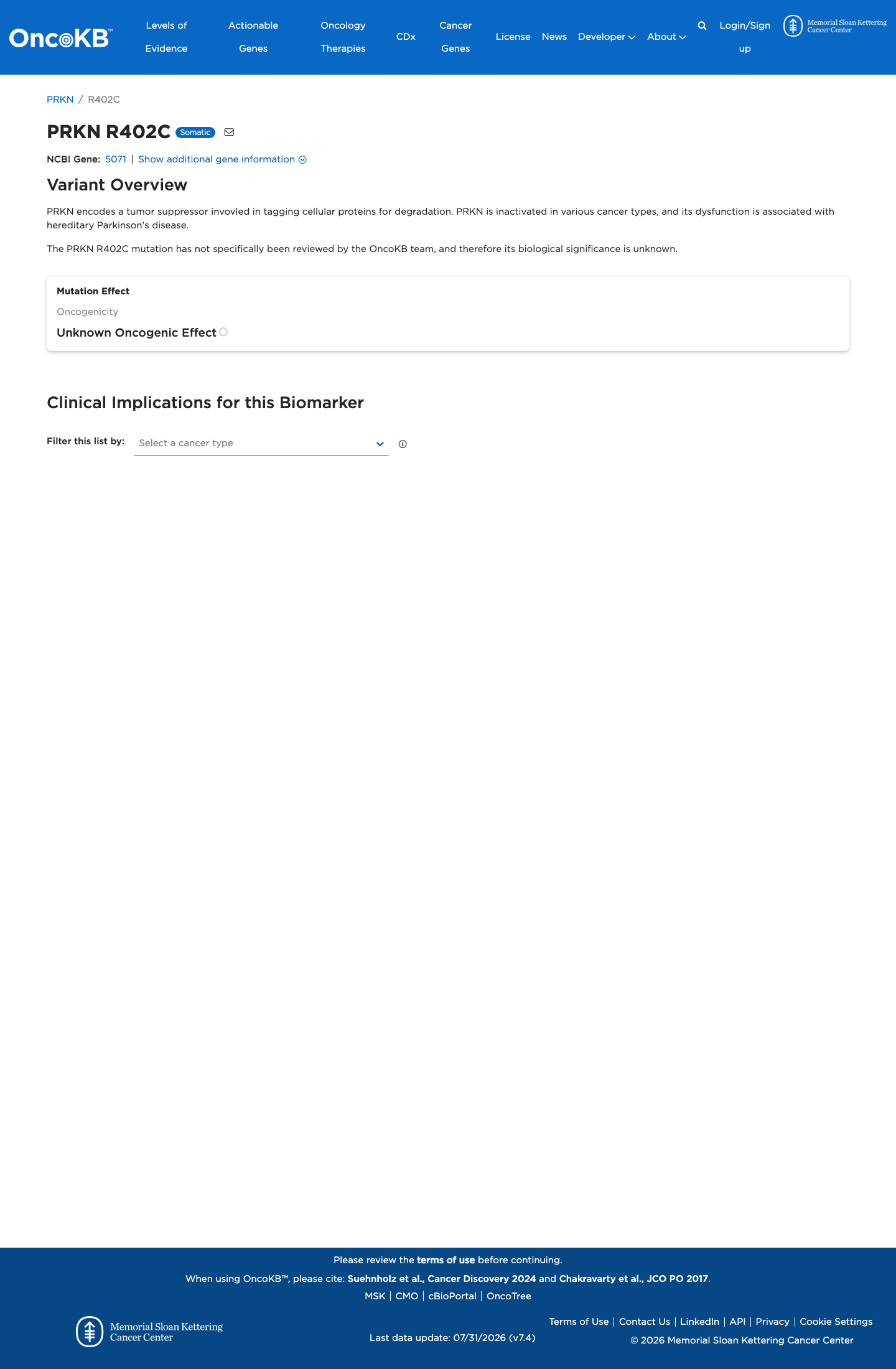
Functional / OncoKB screenshot
Functional Unknown Oncogenic Effect
OncoKB did not identify variant-specific reviewed functional evidence for this variant; gene-level curated context is available for reviewer follow-up. PRKN encodes a tumor suppressor invovled in tagging cellular proteins for degradation. PRKN is inactivated in various cancer types, and its dysfunctio
OncoKB ↗
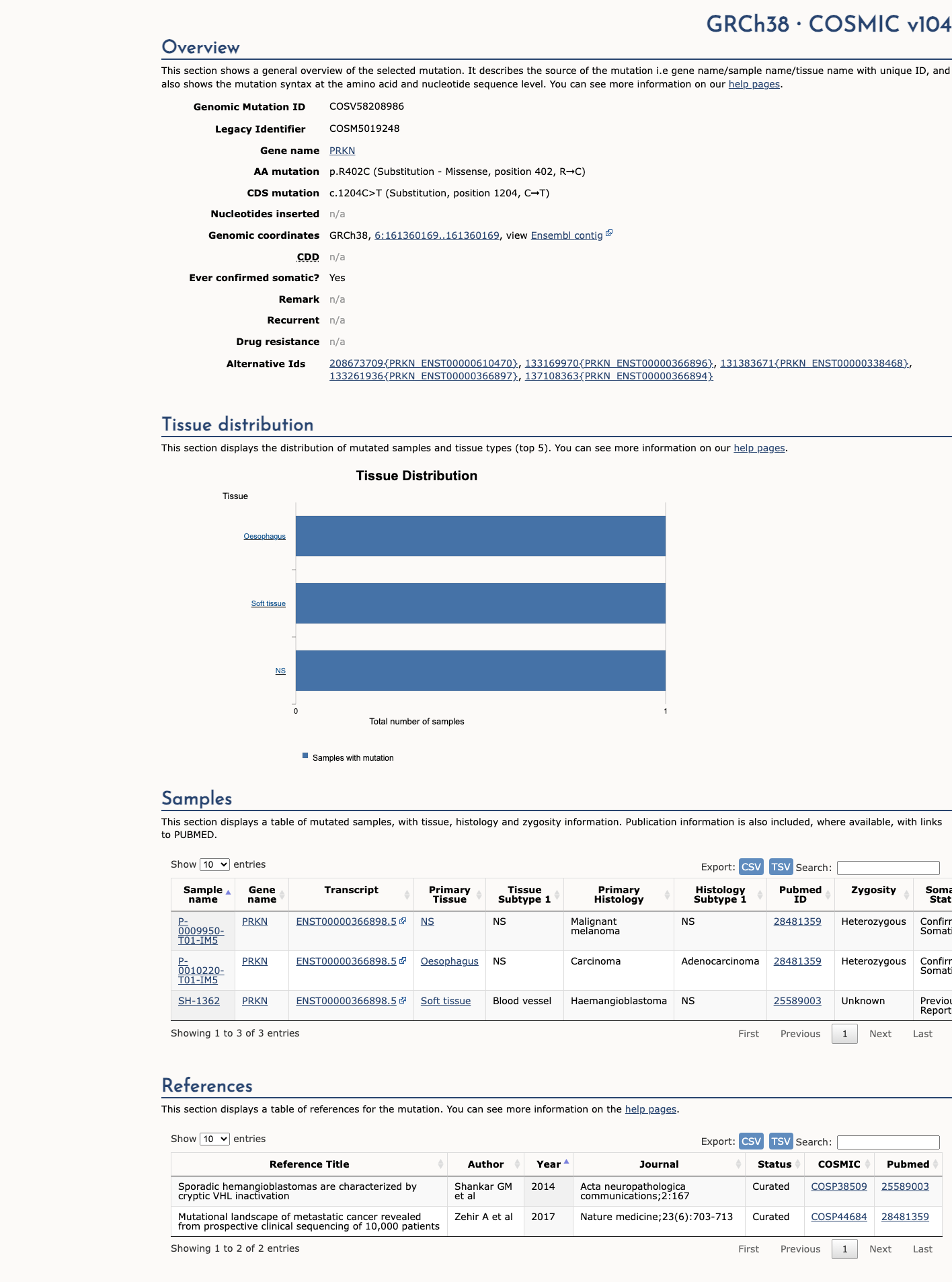
COSMIC screenshot
COSMIC
Cancer hotspots screenshot
Cancer hotspots
Somatic evidence Not in COSMIC / hotspots
COSMIC
This variant does not lie in a statistically significant hotspot. This variant has previously been reported in somatic cancers (COSMIC; COSV58208986, n = 3 times).
Hotspots
This variant does not lie in a statistically significant hotspot.
Sources & reference links
8Sources
ClinVar
gnomAD v2.1
gnomAD v4.1
gnomAD-Canada
SpliceAI
OncoKB
COSMIC
Cancer hotspots
Triaged references · 5 PMIDs not cited in assessment
23279440 ↗ EFNS/MDS-ES/ENS [corrected] recommendations for the diagnosis of Parkinson's disease. CLINVAR
24816432 ↗ PARK20 caused by SYNJ1 homozygous Arg258Gln mutation in a new Italian family. CLINVAR
20301402 ↗ Monogenic Parkinson Disease Overview. CLINVAR
20301651 ↗ PRKN-Related Early-Onset Parkinson Disease. CLINVAR
28492532 ↗ Sherloc: a comprehensive refinement of the ACMG-AMP variant classification criteria. CLINVAR