PM1 (Moderate): missense change within the RING1 zinc-binding domain of parkin, a critical functional region containing a cluster of established pathogenic missense variants and no documented benign variation at the residue. PM3 (Moderate): the variant is homozygous in an affected early-onset Parkinson disease proband, consistent with the autosomal recessive inheritance of PRKN-related parkinsonism. PM2 (Supporting): extremely rare in population databases, with gnomAD allele frequencies near 0.001% and zero homozygotes. PP1 (Supporting): co-segregates with disease in two affected family members carrying the variant in trans with a pathogenic exon 2-4 deletion. PP3 (Supporting): two independent in silico predictors (REVEL 0.818, BayesDel 0.395) support a deleterious effect, with no predicted splice impact. Overall: PM1 and PM3 at Moderate combined with PM2, PP1, and PP3 at Supporting satisfies the '2 Moderate + 2 Supporting' rule, yielding a final classification of Likely Pathogenic.
Final classification
Likely Pathogenic
PM1PM2PM3PP1PP3
PRKN
c.758G>A
p.Cys253Tyr
missense
This variant
PM1 (Moderate): missense change within the RING1 zinc-binding domain of parkin, a critical functional region containing a cluster of established pathogenic missense variants and no documented benign variation at the residue.
No PRKN ClinGen CSPEC/VCEP or local gene framework exists, so the generic ACMG/AMP 2015 criteria (PMID:25741868) were applied. Five criteria are met: PM1 (Moderate) — missense change within the RING1 zinc-binding domain, a known pathogenic mutation cluster with no benign variation at the residue; PM3 (Moderate) — homozygous in an affected proband with an autosomal recessive disorder; PM2 (Supporting) — extremely low population frequency; PP1 (Supporting) — co-segregation in two affected family members; and PP3 (Supporting) — two independent in silico predictors of a deleterious effect. No PVS1 or PS criterion is met, so Pathogenic is not reached.
Classification rationale
PM1PM2PM3PP1PP3
Likely Pathogenic
PRKN c.758G>A
missense
PM1 + PM2 + PM3 + PP1 + PP3
→
Likely Pathogenic
LYFE Sciences is an AI system, and it can make mistakes. Criteria
may be applied incorrectly, sources may be misread, and a confident-looking
classification can still be wrong. Double-check every criterion and
its underlying evidence before relying on any call.
Gene diagram
· NM_004562.2 · variants mapped to exon structure
PRKN
NM_004562.2
Fetching transcript structure from UCSC…
Applied criteria · 5 applied · 18 assessed
MetEvidence satisfies this criterion.
Not metEvaluated against available evidence; threshold not reached.
Not assessedApplies in principle, but no evidence was found to evaluate it.
N/ADoesn't apply to this variant type.
Applied · 5
Strength
Supporting
Moderate
Strong
Very strong
PM1
moderate
review
Pathogenic
PM1 (Moderate): p.Cys253Tyr lies in exon 7 within the RING1 zinc-binding domain of parkin, the critical region for the protein's E3 ubiquitin ligase activity. Multiple independent pathogenic missense variants cluster in this domain (e.g., p.Cys238Trp, p.Thr240Met, p.Arg275Trp), and no benign variation is documented at residue 253.
PMID:18519021 - Discussion (p.330): RING1 domain is a cysteine/histidine-rich domain binding two zinc ions via Cys3HisCys4 motif; TRIAD (RING1-IBR-RING2) is the critical zone for parkin E3 ubiquitin ligase activity; p.R275W located 'in exon 7 in the RING1 domain'; p.C238W affects 'the first cysteine of the RING1 domain'PMID:18519021 - Results 3.1 and Table 1/2: pathogenic missense clustering in RING1 region (p.C238W, p.T240M, p.C253Y, p.R275W)PMID:16769863 - Figure 1 gene map marks the ubiquitin-like domain and RING-finger motifs; c.758G>A placed on the map (Table 1 Family 4: p.Cys253Tyr)
PM2
supporting
Pathogenic
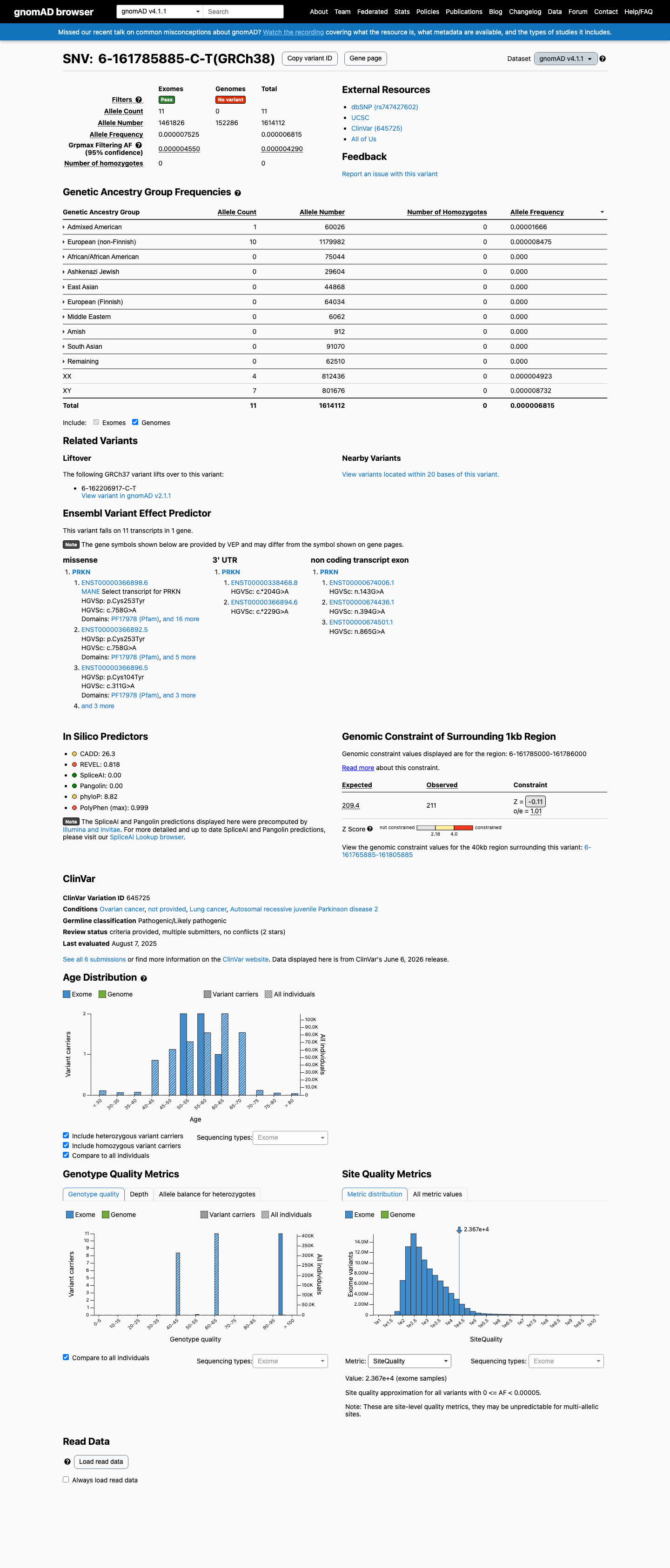
PM2 (Supporting): the variant is extremely rare in population databases, with gnomAD allele frequencies of 0.0016% (v2.1) and 0.0007% (v4.1) and zero homozygotes, far below the 0.1% threshold. It is absent from gnomAD-Canada, and the single elevated subpopulation frequency (Bulgarian, v2.1) is a small-sample artifact not seen in v4.1.
gnomad_v2 - gnomAD v2.1 exome: total AF 1.592e-05 (0.00159%, 4/251,238), 0 homozygotes, grpmax FAF 7.02e-06gnomad_v4 - gnomAD v4.1 exome: total AF 6.815e-06 (0.00068%, 11/1,614,112), 0 homozygotes, joint grpmax FAF 4.29e-06gnomad_canada - variant absent from gnomAD-Canada v1.0
PM3
moderate
Pathogenic
PM3 (Moderate): PRKN-related parkinsonism is autosomal recessive, and the variant is documented homozygous (in trans with itself) in an affected early-onset Parkinson disease proband with onset at age 20. A single affected homozygous proband supports moderate strength; additional in-trans observations would be needed to upgrade.
PMID:18519021 - Table 1: c.G859A p.C253Y / c.G859A p.C253Y, Homozygous, n=1 (affected EOPD proband); Table 2: patient K-0010, proband, 1st parkin mutation p.C253Y / 2nd parkin mutation idem, age at onset 20 years, positive family history for PDclinvar - record VCV000645725 submission SCV000939555 (Labcorp) cites PMID:18519021 for this exact variant (exact genomic HGVS match, validated PMID trail), anchoring variant identity
PP1
supporting
Pathogenic
PP1 (Supporting): the variant co-segregates with disease, with two affected family members in a GenePD family (onset ages 28 and 37) both carrying c.758G>A in trans with a large pathogenic exon 2-4 deletion. Two affected individuals in one family support supporting strength.
GenePD study Table 1, Family 3: 2 affected members, onset ages 28 and 37, mutations Ex2-4del + c.758G>A (p.Cys253Tyr), zygosity Compound HetClinVar SCV000939555 (Labcorp) PP1 evidence signal 'it has also been observed to segregate with disease in related individuals' (used only as a lead; primary support from PMID:16769863 Table 1)
PP3
supporting
Pathogenic
PP3 (Supporting): two independent calibrated missense predictors support a deleterious effect, with REVEL 0.818 and BayesDel 0.395 both above the SVI-calibrated supporting thresholds. SpliceAI predicts no splice impact (score 0.00), consistent with a protein-level effect.
REVEL v1.3 score 0.818 (source_registry 'revel'; prefetch steps.revel, GRCh38 6-161785885-C-T) - exceeds SVI PP3 supporting threshold >= 0.644; within moderate band [0.773, 0.932)BayesDel noAF score 0.395385 (source_registry 'bayesdel'; prefetch steps.bayesdel, GRCh37 6-162206917-C-T) - exceeds SVI PP3 supporting threshold >= 0.13; within moderate band [0.27, 0.50)SpliceAI max delta 0.00 (DS_AG 0.0, DS_AL 0.0, DS_DG 0.0, DS_DL 0.0) - splice-impact path negative; does not contribute to PP3
Assessed · not applied
· 11 not met · 7 not assessed
Pathogenic
PS1
PS1 could not be assessed: no different nucleotide change at position c.758 producing the same p.Cys253Tyr amino acid change was found in any source, so there is no documented alternate-nucleotide variant established as pathogenic.
PS2
Not met: no de novo occurrence of c.758G>A is documented.
PS3
PS3 could not be assessed: no variant-specific functional assay for p.Cys253Tyr exists in the reviewed literature.
PS4
Not met: no case-control study shows enrichment of this variant in affected individuals.
PM5
Not met: p.Cys253Tyr is itself the established pathogenic change at this residue, so the novel-missense prerequisite fails, and no different pathogenic missense at residue 253 (e.g., p.Cys253Phe or p.Cys253Trp) is documented in any source.
PM6
Not met: no source reports the variant as de novo, whether assumed or confirmed.
PP2
PP2 could not be fully assessed: missense variants are an established disease mechanism in PRKN, but no gene-level missense constraint data (e.g., a gnomAD missense Z-score) were available to evaluate the gene's rate of benign missense variation.
PP4
PP4 could not be assessed: no proband-level clinical phenotype data (onset age, family history, inheritance pattern) were available to evaluate whether the phenotype is highly specific for PRKN-related disease.
PP5
Not met: PP5 applies only to an exact-variant ClinVar expert-panel classification, and no expert-panel classification of this variant exists; all submissions come from clinical laboratories without expert-panel review.
Benign
BA1
Not met: the variant's allele frequency is orders of magnitude below the >1% threshold, at 0.0016% (gnomAD v2.1) and 0.0007% (v4.1) with zero homozygotes; even the highest subpopulation frequency (0.112%) is roughly tenfold below threshold.
BS1
Not met: the observed allele frequency (0.0016% and 0.0007%) is roughly 200-400-fold below the 0.3% threshold appropriate for this rare recessive disorder, and even the highest subpopulation frequency (0.112%) remains below it.
BS2
Not met: no healthy adult homozygous or biallelic carrier has been reported.
BS3
BS3 could not be assessed: no functional study demonstrates that p.Cys253Tyr preserves parkin function, and the absence of functional characterization cannot be used as benign evidence.
BS4
BS4 could not be assessed: no affected family member who lacks the variant has been reported, so there is no non-segregation evidence.
BP2
Not met: PRKN disease is autosomal recessive rather than fully dominant, and the only phase-defining observation shows the variant in trans (homozygous), the opposite of the cis configuration BP2 addresses.
BP4
Not met: both calibrated missense predictors indicate a deleterious effect (REVEL 0.818, BayesDel 0.395), the opposite of the no-impact direction BP4 requires; the single no-impact signal (SpliceAI 0.00) concerns splicing only and is not sufficient.
BP5
BP5 could not be assessed: no proband-level data were available to determine whether an alternate molecular basis for disease exists.
BP6
Not met: BP6 applies only to an exact-variant ClinVar expert-panel Benign/Likely benign classification, and none exists; all six submissions are Pathogenic or Likely pathogenic from clinical laboratories.
N/A · 5
PVS1 · PM4 · BP1 · BP3 · BP7
Research & evidence
Population frequency · supports pathogenic
gnomAD v4.1

gnomAD v2.1
v4.1
This variant is present in gnomAD v4.1 (AF= 6.81489e-06; MAF= 0.00068%, 11/1614112 alleles, homozygotes = 0) and has highest observed frequency in the Admixed American population (AF= 1.66594e-05; MAF= 0.00167%, 1/60026 alleles, homozygotes = 0); grpmax FAF= 4.29e-06.
v2.1
This variant is present in gnomAD v2.1 (AF= 1.59212e-05; MAF= 0.00159%, 4/251238 alleles, homozygotes = 0) and has highest observed frequency in the Admixed American population (AF= 2.89302e-05; MAF= 0.00289%, 1/34566 alleles, homozygotes = 0); grpmax FAF= 7.02e-06.
🇨🇦 CA
Absent from gnomAD-Canada v1.0.
Allele frequency by ancestry
three datasets · side by side
gnomAD v4.1
0.00068%
· 11 / 1,614,112
0 hom · FAF 0.00043%
0 hom · FAF 0.00043%
Admixed American 1 / 60,026 |
0.0017% |
European (non-Finnish) 10 / 1,179,982 |
0.00085% |
+ 8 not observed (Remaining individuals, European (Finnish), Amish, East Asian, Middle Eastern, South Asian, Ashkenazi Jewish, African/African American)
gnomAD v2.1
0.0016%
· 4 / 251,238
0 hom · FAF 0.0007%
0 hom · FAF 0.0007%
Admixed American 1 / 34,566 |
0.0029% |
European (non-Finnish) 3 / 113,604 |
0.0026% |
+ 6 not observed (African/African American, Ashkenazi Jewish, East Asian, European (Finnish), Remaining individuals, South Asian)
gnomAD Canada 🇨🇦
Absent
· 0 / ?
0 hom
0 hom
Not observed in any ancestry group.

ClinVar
This variant has been reported in ClinVar as Pathogenic (4 clinical laboratories) and as Likely pathogenic (1 clinical laboratory). (ClinVarID = 645725)

In silico
SpliceAI predicts no significant splice impact for this variant (max delta score = 0.00). REVEL score = 0.818. BayesDel score = 0.395385.

Functional
Unknown Oncogenic Effect
OncoKB did not identify variant-specific reviewed functional evidence for this variant; gene-level curated context is available for reviewer follow-up. PRKN encodes a tumor suppressor invovled in tagging cellular proteins for degradation. PRKN is inactivated in various cancer types, and its dysfunctio

COSMIC

Cancer hotspots
Somatic evidence
Not in COSMIC / hotspots
COSMIC
This variant does not lie in a statistically significant hotspot. This variant has not previously been reported in somatic cancers (COSMIC).
Hotspots
This variant does not lie in a statistically significant hotspot.
Literature · how each cited paper was used
4papers cited
Each card is an audit: what was searched, what was found, whether it names the variant, which criteria it fed, and why. 4 further PMIDs triaged but not cited — see Sources & references.
Influence of heterozygosity for parkin mutation on onset age in familial Parkinson disease: the GenePD study.
Searched
c.758G>Ap.Cys253TyrCys253C253Y758
Found
Sun et al. (2006), the GenePD study, screened all 12 coding exons of parkin in 183 familial PD families. Table 1, Family 4 documents the exact variant NM_004562.2:c.758G>A (p.Cys253Tyr) as a compound heterozygous mutation in trans with an exon-3 deletion in two affected family members (onset ages 34 and 32 years); the paper's footnote confirms nucleotides are numbered per GenBank NM_004562 with the A of the initiator ATG as +1, i.e., c.758G>A = p.Cys253Tyr. The variant is also placed on the Figure 1 parkin mutation map ('e. 758G>A') alongside the ubiquitin-like domain and RING-finger motif annotations. This paper demonstrates that the p.Cys253Tyr missense contributes to biallelic disease and that only this single change is reported at codon 253 in this cohort.
Variant
✓ Names this variant — characterised directly
Applied to
→PM1
moderate
Variant placed on the parkin gene map with RING-finger motif annotations; corroborates exon-7/RING region context for the domain argument.
→PM2
supporting
Observation of the exact variant in affected patients only, with no population/control frequency data, is consistent with a rare recessive disease allele and the low gnomAD AF supporting PM2.
→PM3
moderate
→PP1
supporting
c.758G>A (p.Cys253Tyr) present in 2 affected siblings (onset ages 28, 37) of Family 3, compound heterozygous with Ex2-4del - co-segregation with disease in affected family members
'c.758G>A / p.Cys253Tyr / Compound Het ... 4 / 2 / 34, 32 / Ex3del' (Table 1, Family 4 row; the arrow glyph renders as 'G→A' in the PDF text layer); 'Nucleotides are numbered according to GenBank NM_004562 (parkin, human) with the A of the initiator ATG numbered as 1' (Table 1 footnote); 'The ubiquitinlike domain, in-between RING (really interesting new gene), and RING-finger motifs in the predicted protein are marked' (Figure 1 legend).
Location Table 1 'Parkin Mutations Identified in This Study' (Family 4 row); Table 1 footnote; Figure 1 schematic of parkin mutation distribution (gene map showing 'e. 758G>A') · Context GenePD multi-centre study; 183 families with affected sibling pairs sharing both alleles IBS at PARK2 or >=1 member with onset before age 54; SSCP plus sequencing for point mutations and quantitative PCR/gene-dosage for exon rearrangements. · full text
Parkin analysis in early onset Parkinson's disease.
Searched
c.758G>Ap.Cys253Tyrp.C253YC253YCys253RING1RING
Found
Sironi et al. (2008) screened parkin in 146 consecutive unrelated Italian early-onset PD patients (onset <=40 y). p.C253Y (written c.G859A under the authors' transcript numbering, which is offset +101 nt from NM_004562.2) is listed among seven point mutations 'previously reported and... known as pathogenic changes' (p.R42P, p.M192L, p.T240M, p.C253Y, p.R275W, p.E409X, p.R402C). Table 1 documents one affected proband homozygous for p.C253Y. The Discussion characterizes the RING1 domain (containing the first cysteine Cys238, with Cys253 15 residues C-terminal in the same exon-7 cluster) as a cysteine/histidine-rich domain binding two zinc ions via a Cys3HisCys4 motif, and the TRIAD (RING1-IBR-RING2) as the critical zone for parkin E3 ubiquitin ligase topology and activity; p.R275W is placed 'in exon 7 in the RING1 domain'. This paper is the key domain/hotspot source for PM1 and confirms the variant is an established pathogenic missense.
Variant
✓ Names this variant — characterised directly
Applied to
→PM1
moderate
Cys253 lies in exon 7 within the RING1 cysteine/histidine-rich zinc-binding (Cys3HisCys4) domain, part of the TRIAD critical zone for parkin E3 ligase activity; pathogenic missense cluster in the domain (p.C238W, p.T240M, p.C253Y, p.R275W) supports PM1 at moderate.
→PM2
supporting
Confirms the variant is a genuine rare disease allele observed homozygous in an affected proband (not a common polymorphism), consistent with the extremely low gnomAD frequency supporting PM2.
→PM3
moderate
Homozygous p.C253Y in an affected EOPD proband demonstrates the variant in trans (biallelic) with a pathogenic allele in the autosomal recessive PRKN disorder - the core PM3 observation; supports PM3 at moderate strength.
→PP1
supporting
'Seven of these have been previously reported and are known as pathogenic changes (p.R42P, p.M192L, p.T240M, p.C253Y, p.R275W, p.E409X, p.R402C)' (Results 3.1); 'c.G859A p.C253Y / c.G859A p.C253Y / Homozygous' (Table 1); 'It affects the first cysteine of the RING1 domain. This is a cysteine and histidine rich domain, and it is expected to bind two zinc ions in a cross-brace way using a Cys3HisCys4 motif and forming zinc-finger structures' and 'the three domains together represent the critical zone for topology- and E3 ubiquitin ligase activity of the parkin protein' (Discussion); 'p.R275W (exon 7), occurring in exon 7 in the RING1 domain is the most frequent amino acid change' (Discussion).
Location Results section 3.1 'Description of parkin mutations' (p.327); Table 1 'Parkin mutations and genotypes identified in this study' (homozygous p.C253Y row); Table 2 patient listing (p.C253Y); Discussion, paragraphs on p.R275W and the novel p.C238W (p.330) · Context Consecutive series of 146 unrelated early-onset PD patients (onset <=40 y) from a single Italian centre; DHPLC heteroduplex point-mutation screening with confirmatory Sanger sequencing and gene-dosage analysis (real-time PCR) for exon rearrangements; novel variants checked in 50 controls (100 chromosomes). · full text
Rule & framework references · cited for criterion definitions, not variant evidence
25741868 ↗
Standards and guidelines for the interpretation of sequence variants: a joint consensus recommendation of the American College of Medical Genetics and Genomics and the Association for Molecular Pathology.
39825153 ↗
Genomic reanalysis of a pan-European rare-disease resource yields new diagnoses.
Sources & reference links
Triaged references · 4 PMIDs not cited in assessment
23279440 ↗
EFNS/MDS-ES/ENS [corrected] recommendations for the diagnosis of Parkinson's disease.
CLINVAR
29398453 ↗
Updated Molecular Testing Guideline for the Selection of Lung Cancer Patients for Treatment With Targeted Tyrosine Kinase Inhibitors: Guideline From the College of American Pathologists, the International Association for the Study of Lung Cancer, and the Association for Molecular Pathology.
CLINVAR
24493721 ↗
American Society of Clinical Oncology Expert Statement: collection and use of a cancer family history for oncology providers.
CLINVAR