Back
NM_004655.4:c.1235A>G
p.Asn412Ser · AXIN2
ACMG/AMP
0%
complete
Final classification
Likely Benign
BS1BP1BP4
AXIN2
c.1235A>G
p.Asn412Ser
missense · exon 6

AXIN2 is a scaffolding protein that helps regulate the Wnt signaling pathway, a key developmental pathway controlling cell growth and fate. It is part of the beta-catenin destruction complex, where it helps mark beta-catenin for degradation when Wnt signaling is off, and it also assists in relaying Wnt signals to the nucleus when the pathway is active. AXIN2 acts as a tumor suppressor, and mutations in the gene have been linked to colorectal cancer as well as familial tooth agenesis with predisposition to colorectal cancer. Its expression has also been associated with prostate cancer recurrence.

This variant

AXIN2 encodes a Wnt-pathway scaffold and tumour suppressor in which loss-of-function variants cause dominantly inherited oligodontia-colorectal cancer predisposition, so a common, non-truncating missense change such as p.Asn412Ser is not expected to carry that gene-level disease risk.

Transcript
NM_004655.4
HGVS · transcript:coding
NM_004655.4:c.1235A>G
GRCh38
chr17:65537801 T>C
GRCh37
chr17:63533919 T>C
Likely Benign: BS1 (strong; South Asian frequency 4.11%) with BP1 (supporting) and BP4 (moderate) satisfies the generic ACMG/AMP combination rule.
Classification rationale
BS1BP1BP4 Likely Benign
AXIN2 c.1235A>G missense · exon 6

Likely Benign: BS1 (strong) — ancestry-specific filtering frequency 4.11% in South Asians is above the 1% benign threshold. BP1 (supporting) — this missense change does not fit AXIN2's truncating disease mechanism. BP4 (moderate) — REVEL 0.119 predicts a tolerated amino-acid substitution. No pathogenic criterion met — all 15 pathogenic-direction criteria are not met, not applicable, or unassessed.

BS1 + BP1 + BP4 Likely Benign
LYFE Sciences is an AI system, and it can make mistakes. Criteria may be applied incorrectly, sources may be misread, and a confident-looking classification can still be wrong. Double-check every criterion and its underlying evidence before relying on any call.
Gene diagram · NM_004655.4 · variants mapped to exon structure
AXIN2 NM_004655.4
Fetching transcript structure from UCSC…
Applied criteria · 3 applied · 21 assessed
MetEvidence satisfies this criterion.
Not metEvaluated against available evidence; threshold not reached.
Not assessedApplies in principle, but no evidence was found to evaluate it.
N/ADoesn't apply to this variant type.
Applied · 3
Strength Supporting Moderate Strong Very strong
BS1 strong Benign
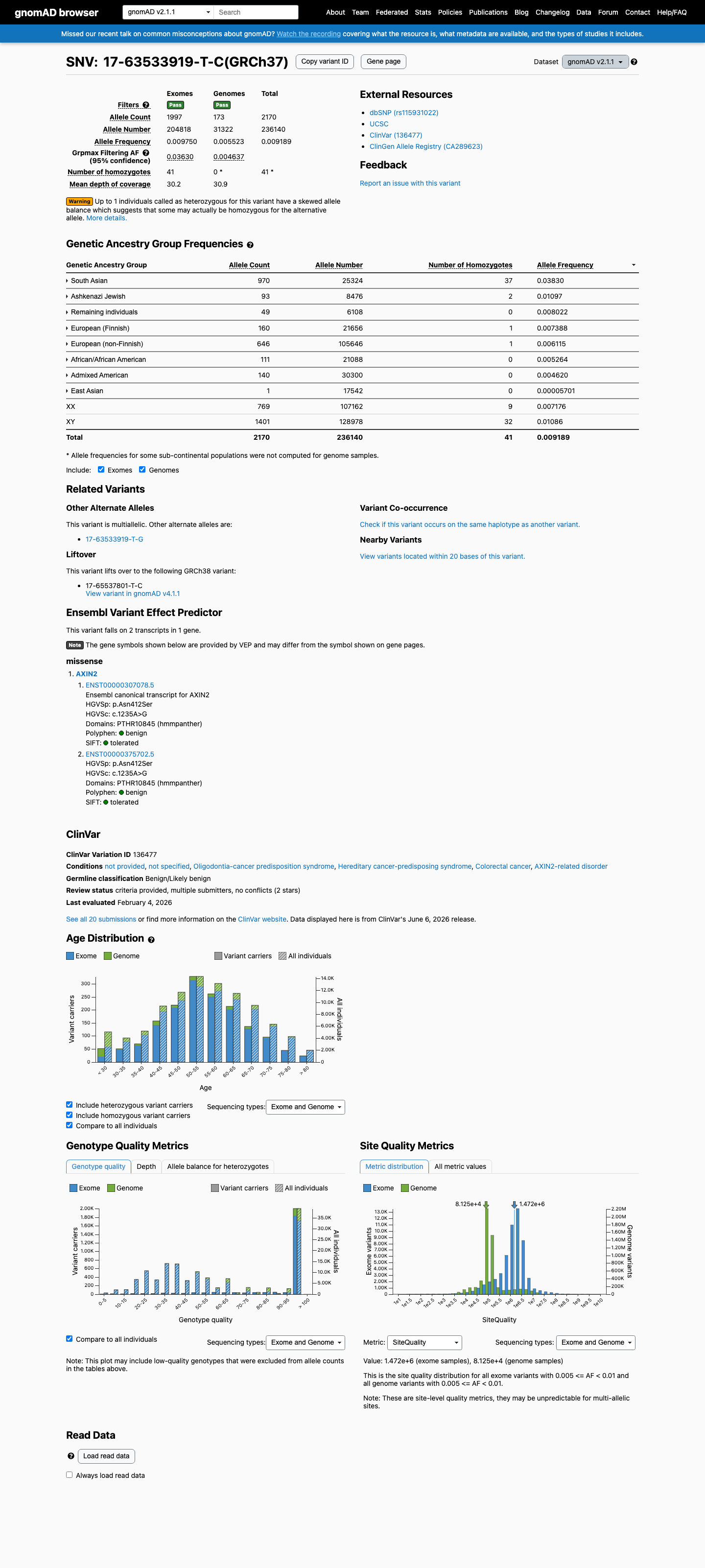
Met (strong): South Asian frequency 4.11% (3,565/86,704 alleles; 132 homozygotes) exceeds the 1% BS1 threshold, with a global frequency of 0.79% just below it.
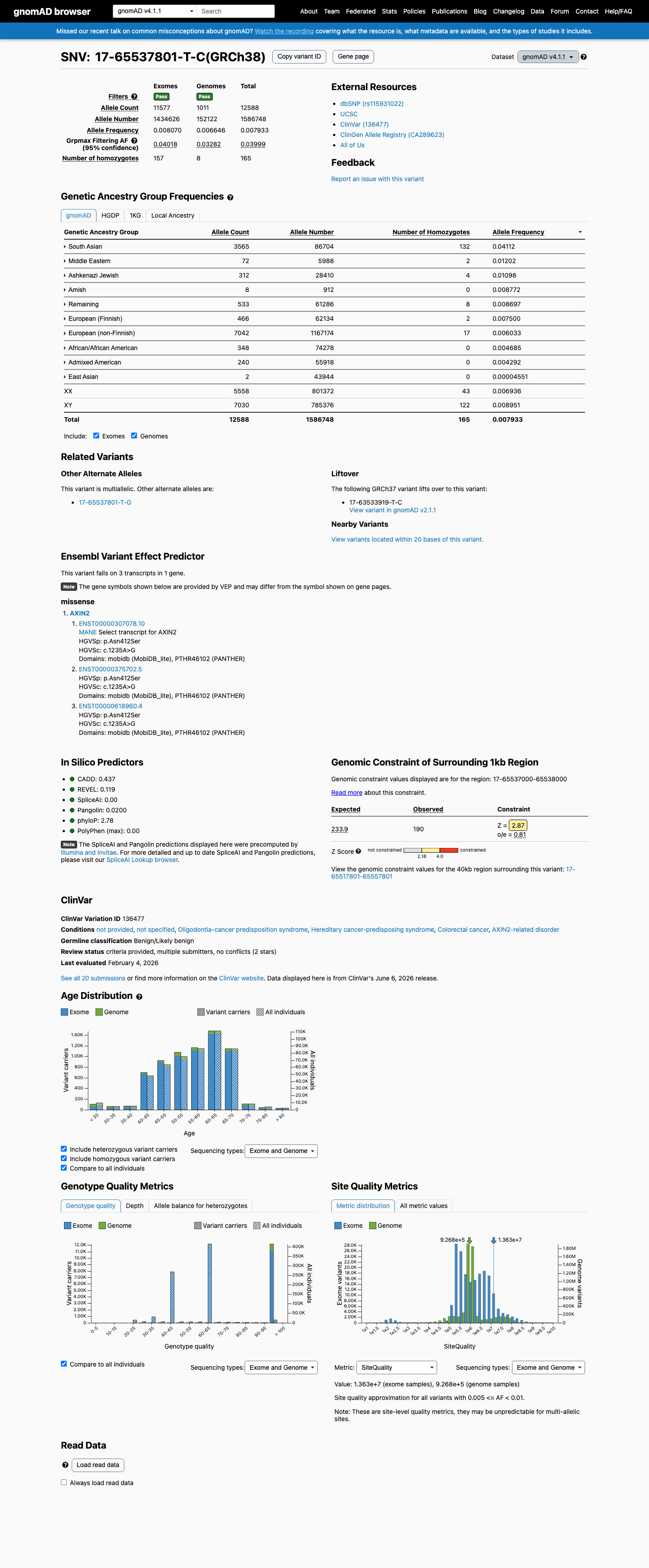
gnomAD v4.1: highest ancestry frequency South Asian AF 0.04112 (3,565/86,704 alleles; 132 homozygotes); grpmax filtering AF 0.03999 (exome grpmax 0.04018; genome grpmax 0.03282).gnomAD v2.1: highest ancestry frequency South Asian AF 0.03830 (970/25,324 alleles; 37 homozygotes); grpmax filtering AF 0.03630.gnomAD v3.1 non-cancer genomes-only subset: total AF 0.00672 (993/147,760 alleles; 8 homozygotes); grpmax filtering AF 0.03279.
BP1 supporting Benign
Met (supporting): AXIN2 pathogenic variants are predominantly truncating (169 nonsense/frameshift vs 2 weak pathogenic-type missense records among 2,347 missense entries).
BP1 definition used: missense variant in a gene for which primarily truncating variants are known to cause disease (ACMG/AMP 2015, PMID:25741868), applied at supporting strength.ClinVar composition, all 4,370 AXIN2 records retrieved: 186 records carry a pathogenic-type classification and are all loss-of-function (169 nonsense/frameshift, 3 canonical splice-site, 14 copy-number losses); among 2,347 single-amino-acid substitutions, only p.Val105Gly (c.314T>G, Pathogenic, no assertion criteria provided) and p.Glu66Gly (c.197A>G, Likely pathogenic, single submitter) carry a pathogenic-type classification, with 2,087 VUS, 226 conflicting and 30 Benign/Likely benign.gnomAD v4 gene constraint for AXIN2: LoF-constrained (pLI 0.99998, lof_z 5.27) while missense-tolerant (o/e missense 1.030, mis_z -0.42), consistent with a truncating-driven disease mechanism.
BP4 moderate Benign
Met at moderate strength: missense REVEL score 0.119 is at or below the 0.183 moderate BP4 threshold.
REVEL score 0.119 (local REVEL v1.3 lookup, GRCh38 chr17:65537801 T>C, matching the normalized case variant) - satisfies the BP4 moderate threshold of <=0.183 (and supporting <=0.29).BP4 thresholds <=0.29 (supporting), <=0.183 (moderate), <=0.016 (strong) from the ClinGen SVI REVEL calibration (Pejaver et al. 2022, Am J Hum Genet, PMID:36413997); moderate is the highest bin satisfied by 0.119.Applicable path selected by consequence type: missense variant -> REVEL only; SpliceAI max delta 0.014 was not used as BP4 support, since absence of a predicted splice effect says nothing about tolerance of an amino-acid substitution.
Assessed · not applied · 16 not met · 5 not assessed
Pathogenic
PS1 Not met: the same amino-acid change p.Asn412Ser is an established Benign/Likely benign allele in ClinVar, not a previously established pathogenic variant.
PS2 Not assessed: the sole reported carrier had no family history, but zero parental genotypes were reported, so confirmed de novo status is undetermined.
PS3 Not met: no assay shows a damaging effect; the only exact-variant experiment found no splicing alteration.
PS4 Not met: the variant showed no significant case-control enrichment (1/25 cases vs 4/275 controls, OR ~2.8, Fisher p=0.355; p<=0.05? no).
PM1 Not met: residue 412 lies outside AXIN2's RGS (81-200) and DIX (761-843) domains, is not a hot spot, and gnomAD v4.1 0.79% with 165 homozygotes shows benign variation there.
PM2 Not met: allele frequency 0.79% (gnomAD v4.1) is about 79-fold above the 0.0001 PM2 supporting threshold, with 165 homozygotes observed.
PM3 Not met: no pathogenic AXIN2 variant in trans with c.1235A>G has been reported, and its only co-inherited allele (c.1530G>A) is a non-pathogenic silent change.
PM5 Not met: no pathogenic variant exists at residue Asn412; the only comparators are p.Asn412His (VUS), p.Asn412Thr and p.Asn412Ile (both conflicting).
PM6 Not assessed: no source documents an apparently de novo occurrence for this variant, and zero parental genotypes exist to support even unconfirmed de novo status.
PP1 Not assessed: zero informative meioses or genotyped affected relatives are reported for this variant, so co-segregation cannot be evaluated.
PP2 Not met: AXIN2 shows no missense constraint (gnomAD o/e missense 1.03, mis_z -0.42) and its pathogenic variants are truncating, not missense.
PP3 Not met: missense REVEL score 0.119 falls below the 0.644 supporting PP3 threshold.
PP4 Not assessed: no proband phenotype or family history is recorded anywhere in this case, so PP4's single required input is unavailable.
PP5 Not met: ClinVar variation 136477 has zero expert-panel submissions (0 of 20; all is_expert_panel=false), so no expert-panel pathogenic assertion exists.
Benign
BA1 Not met: the highest ancestry frequency, 4.11% in South Asians (gnomAD v4.1), and popmax filtering AF 4.0%, both stay below the 5% BA1 threshold.
BS2 Not met: AXIN2-related disease is not fully penetrant at an early age, so healthy-adult carriers (4/275 controls) and 165 gnomAD homozygotes do not satisfy BS2's precondition.
BS3 Not met: the sole exact-variant test showed normal transcript proportions but is an n=1 splicing assay, not a validated test of AXIN2 protein function.
BS4 Not assessed: no genotyped pedigree exists for a non-segregation test; 4/275 healthy carrier controls are population-level, not family-based, evidence.
BP2 Not met: the only variant co-inherited in cis with c.1235A>G is the non-pathogenic silent c.1530G>A, and no pathogenic allele in trans was reported.
BP5 Not met: no carrier of c.1235A>G has a documented alternate molecular basis for disease; the only worked-up carrier was APC/MMR-negative with no alternative cause reported.
BP6 Not met: no ClinVar expert-panel Benign/Likely benign classification exists for this variant (0 of 20 submissions expert-panel; all is_expert_panel=false).
N/A · 4 PVS1 · PM4 · BP3 · BP7
Research & evidence
Population frequency · supports benign
gnomAD v4.1 screenshot
gnomAD v4.1
gnomAD v2.1 screenshot
gnomAD v2.1
v4.1
This variant is present in gnomAD v4.1 (AF= 0.00793321; MAF= 0.79332%, 12588/1586748 alleles, homozygotes = 165) and has highest observed frequency in the South Asian population (AF= 0.0411169; MAF= 4.11169%, 3565/86704 alleles, homozygotes = 132); grpmax FAF= 0.0399903.
v2.1
This variant is present in gnomAD v2.1 (AF= 0.00918946; MAF= 0.91895%, 2170/236140 alleles, homozygotes = 41) and has highest observed frequency in the South Asian population (AF= 0.0383036; MAF= 3.83036%, 970/25324 alleles, homozygotes = 37); grpmax FAF= 0.0363033.
🇨🇦 CA
This variant is present in gnomAD-Canada v1.0 (AF= 0.007985658409387223, 147/18408 alleles, homozygotes = 1).
Allele frequency by ancestry
three datasets · side by side
gnomAD v4.1
0.79% · 12588 / 1,586,748
165 hom · FAF 4%
South Asian
3565 / 86,704
4.1%
132 hom
Middle Eastern
72 / 5,988
1.2%
2 hom
Ashkenazi Jewish
312 / 28,410
1.1%
4 hom
Amish
8 / 912
0.88%
Remaining individuals
533 / 61,286
0.87%
8 hom
European (Finnish)
466 / 62,134
0.75%
2 hom
European (non-Finnish)
7042 / 1,167,174
0.6%
17 hom
African/African American
348 / 74,278
0.47%
Admixed American
240 / 55,918
0.43%
East Asian
2 / 43,944
0.0046%
gnomAD v2.1
0.92% · 2170 / 236,140
41 hom · FAF 3.6%
South Asian
970 / 25,324
3.8%
37 hom
Ashkenazi Jewish
93 / 8,476
1.1%
2 hom
Remaining individuals
49 / 6,108
0.8%
European (Finnish)
160 / 21,656
0.74%
1 hom
European (non-Finnish)
646 / 105,646
0.61%
1 hom
African/African American
111 / 21,088
0.53%
Admixed American
140 / 30,300
0.46%
East Asian
1 / 17,542
0.0057%
gnomAD Canada 🇨🇦
0.8% · 147 / 18,408
1 hom · FAF 2.5%
indel · split
European (Finnish)
1 / 8
12%
South Asian
44 / 1,360
3.2%
1 hom
Remaining individuals
13 / 1,138
1.1%
Latino/Admixed American
6 / 838
0.72%
African/African American
7 / 1,020
0.69%
European (non-Finnish)
72 / 11,732
0.61%
Ashkenazi Jewish
4 / 830
0.48%
+ 2 not observed (East Asian, Middle Eastern)
ClinVar screenshot
ClinVar
This variant has been reported in ClinVar as Benign (12 clinical laboratories) and as Likely benign (6 clinical laboratories) and as benign (1 clinical laboratory). (ClinVarID = 136477)
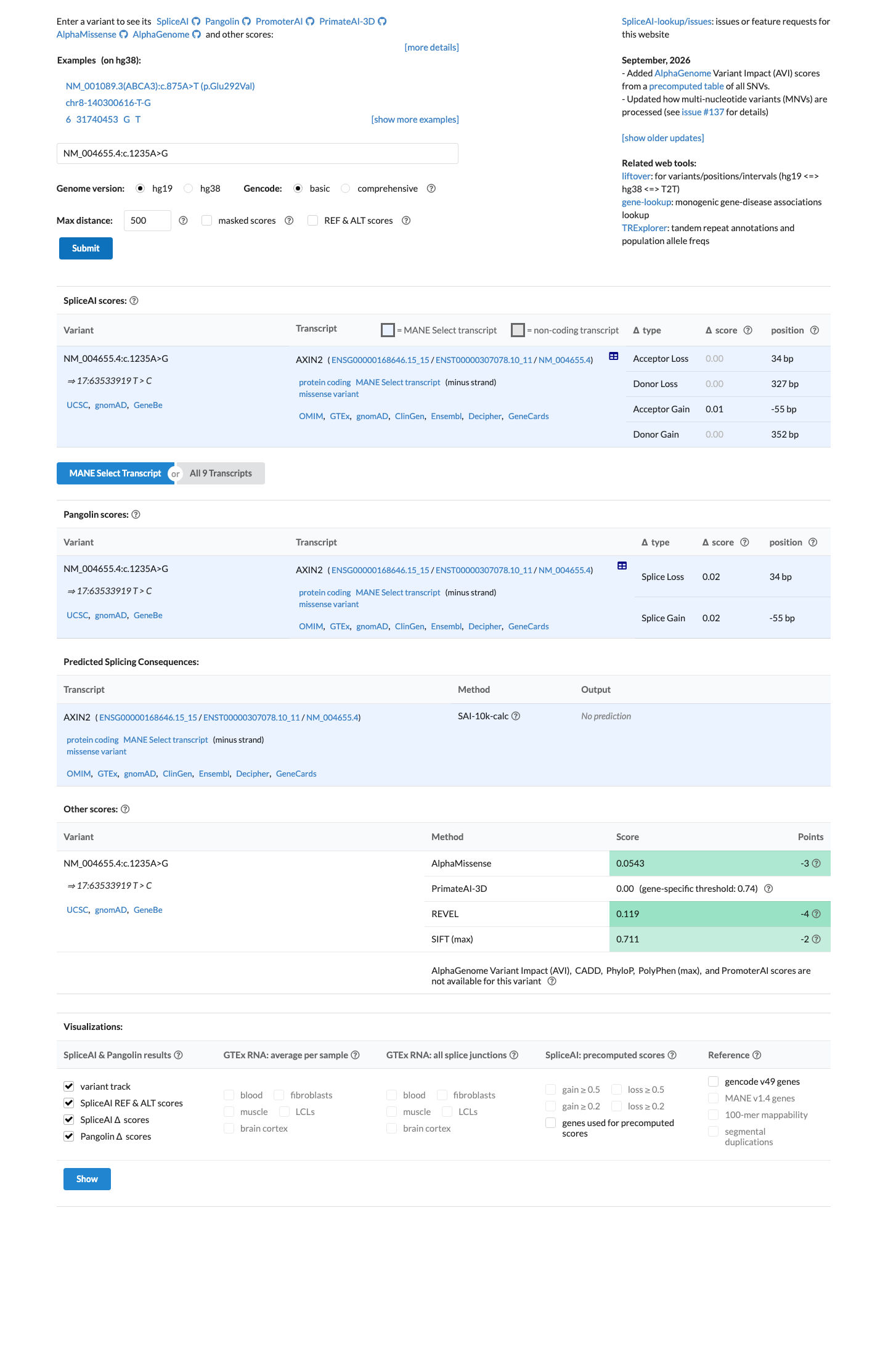
SpliceAI screenshot
In silico
SpliceAI predicts no significant splice impact for this variant (max delta score = 0.01). REVEL score = 0.119. BayesDel score = -0.590929.
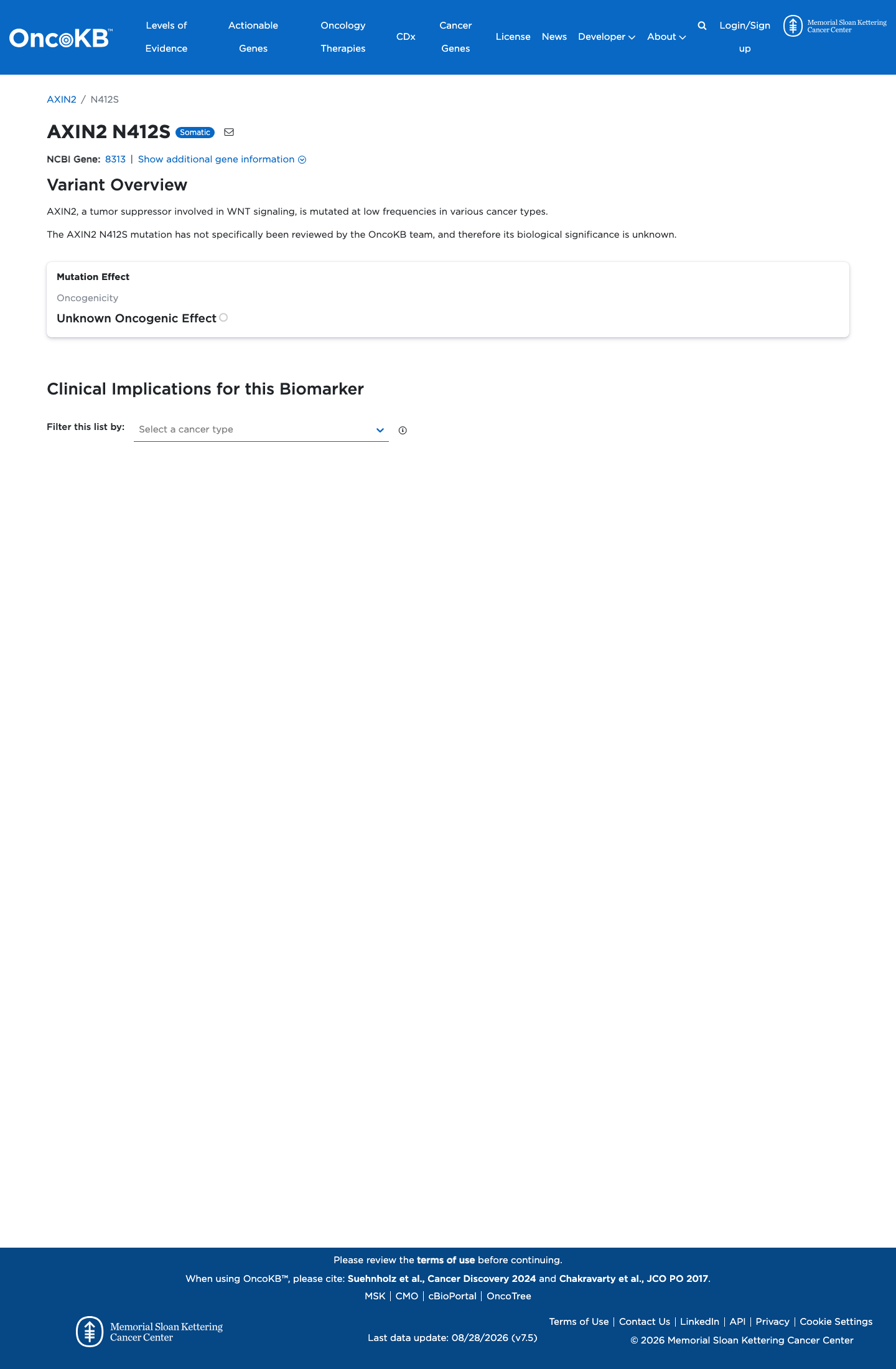
Functional / OncoKB screenshot
Functional Unknown Oncogenic Effect
OncoKB did not identify variant-specific reviewed functional evidence for this variant; gene-level curated context is available for reviewer follow-up. AXIN2, a tumor suppressor involved in WNT signaling, is mutated at low frequencies in various cancer types.
OncoKB ↗
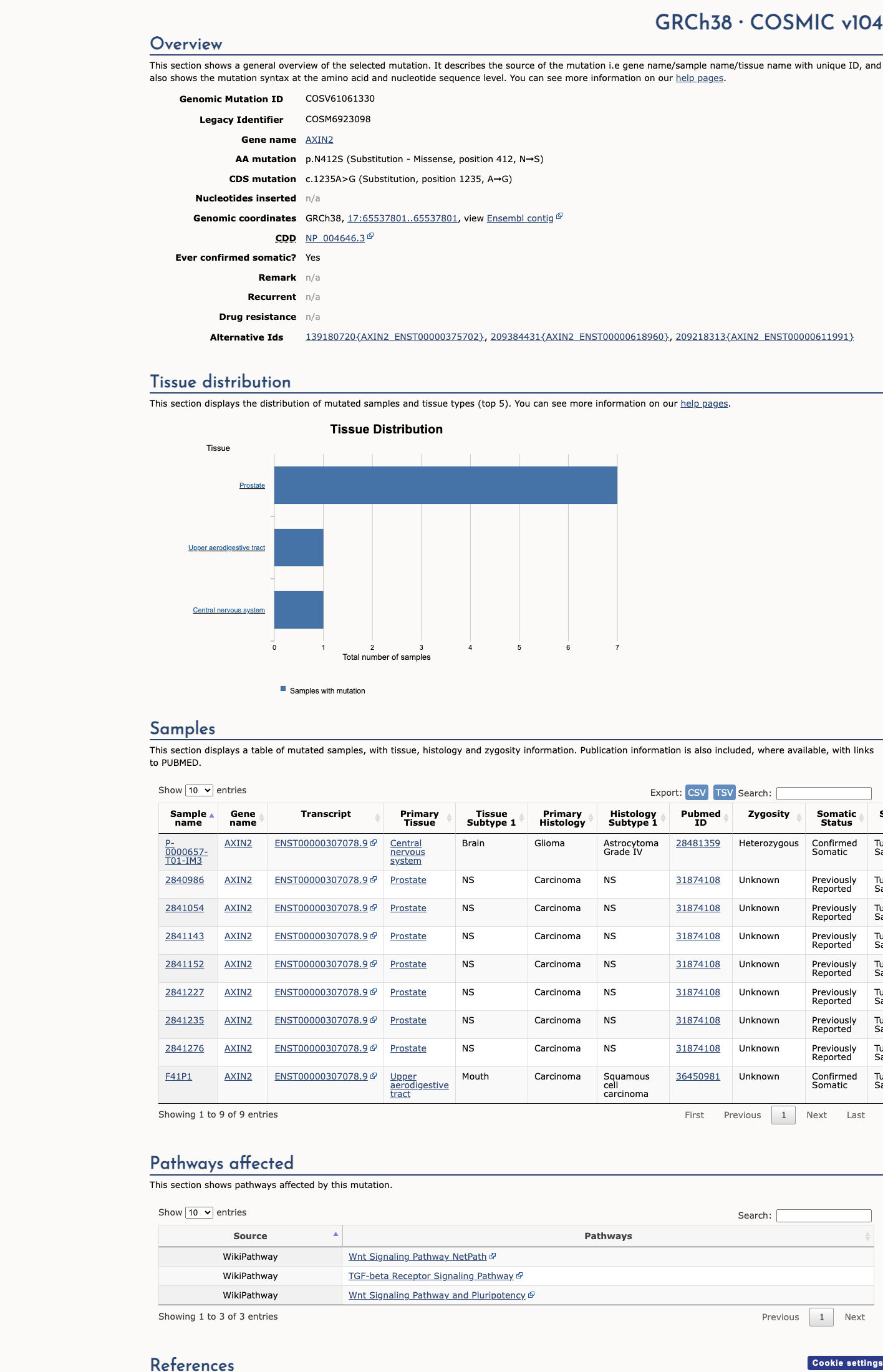
COSMIC screenshot
COSMIC
Cancer hotspots screenshot
Cancer hotspots
Somatic evidence Not in COSMIC / hotspots
COSMIC
This variant does not lie in a statistically significant hotspot. This variant has previously been reported in somatic cancers (COSMIC; COSV61061330, n = 9 times).
Hotspots
This variant does not lie in a statistically significant hotspot.
Literature · how each cited paper was used
4papers cited
Each card is an audit: what was searched, what was found, whether it names the variant, which criteria it fed, and why. 5 further PMIDs triaged but not cited — see Sources & references.
Low frequency of AXIN2 mutations and high frequency of MUTYH mutations in patients with multiple polyposis.
Searched
c.1235A>GNP_004646.3:p.(N412S)p.Asn412Ser
Found
The paper explicitly reports the AXIN2 variant c.1235A>G (p.Asn412Ser) as one of two novel sequence variations found in exon 5 of AXIN2 in a single 18-year-old patient (Li-10 in text, listed as Li-9 in Table 2) presenting with 30 adenomatous polyps and no family history of polyposis or colorectal cancer. The variant co-occurred with an apparently silent change c.1530G>A (p.Thr510Thr). RT-PCR/sequencing of transcripts using primers within exons 3 and 7 showed both variants present at similar proportions as in genomic DNA, indicating no splicing alteration. Polyphen predicted p.Asn412Ser as benign based on limited conservation of the Asn residue across species. The variants were absent in 30 other patients and in 50 healthy control subjects and had not been previously reported; the authors state they are likely to be polymorphisms with no functional effect. The authors concluded that AXIN2 germline mutations are rare in AFAP patients without APC mutations, and no clearly pathogenic AXIN2 mutation (frameshift or nonsense) was found in any patient, including one with multiple polyps and severe tooth agenesis.
Variant
✓ Names this variant — characterised directly
Applied to
BS1 strong
BP1 supporting
in this AFAP cohort no clearly pathogenic AXIN2 mutation of truncating type was found and the missense change studied was deemed non-functional
We found however two novel sequence variations in exon 5 of AXIN2 in one patient aged 18 presenting with 30 adenomatous polyps (Li-10): one apparently missense mutation c.1235A>G (p.Asn412Ser) and one apparently silent mutation c.1530G>A (p.Thr510Thr). ... RT-PCR and sequencing of the product showed the presence of the two variants at a similar proportion as observed in the genomic DNA, indicating no splicing alteration. Moreover, Polyphen software predicted the missense mutation p.Asn412Ser as benign based on the limited conservation of Asn residue across species. Although these variations were not found neither in 30 other patients nor in 50 healthy control subjects, they are likely to be polymorphisms.
Location Results, AXIN2 Gene Analysis, paragraph 1; also Table 2 (AXIN2, patient Li-9: c.[1235A>G (+) 1530G>A] / p.[Asn412Ser (+) Thr510Thr])  ·  Context Cohort of 39 unrelated patients with multiple adenomas or colorectal cancer without APC mutation or MMR defect; AXIN2 (NM_004655.2, exons 1-10) screened by PCR and direct sequencing in 31 patients. Missense variants assessed by cross-species amino-acid alignment and Polyphen, with prevalence evaluated in 50 healthy control subjects; RT-PCR on blood-derived RNA used to test for splicing effects.  ·  full text
Unexplained polyposis: a challenge for geneticists, pathologists and gastroenterologists.
Searched
c.1235A>Gp.Asn412Serp.(N412S)NP_004646.3:p.(N412S)
Found
The AXIN2 c.1235A>G (p.Asn412Ser) variant was found as a rare germline variant in the screening of the Wnt pathway genes (AXIN2, PPP2R1B, WIF1, SFRP1) in 25 patients with unexplained adenomatous polyposis; no deleterious mutation was identified in any of these four genes. The authors tested this variant in 275 healthy control subjects using HRM and sequencing and identified it in four healthy subjects (allele frequency = 0.72%), concluding that c.1235A>G is a polymorphism rather than a deleterious/pathogenic mutation. They further note the variant had previously been identified in a patient with unknown adenomatous polyposis and classified as non-pathogenic by other authors on conservation and physicochemical grounds, and that the carrier patient did not have the dental abnormalities associated with AXIN2-related polyposis. The paper states that germline AXIN2 mutation is probably a rare event responsible for polyposis associated with severe tooth agenesis.
Variant
✓ Names this variant — characterised directly
Applied to
BS1 strong
independent healthy-control cohort shows the variant at 0.72% in 275 controls and calls it a polymorphism, supporting a frequency greater than expected for the disorder
BP1 supporting
no causative AXIN2 mutation was identified in this polyposis cohort and the missense change was classed a polymorphism
Sequencing of AXIN2 found a rare variant c.1235A>G (p.Asn412Ser) that we classed as polymorphism by studying a control healthy population.
Location Discussion, paragraph on Wnt pathway candidate genes (p. 44); results also reported under 'Mutational analysis of four Wnt pathway genes' (Results, p. 44)  ·  Context Cohort of 25 patients with unexplained adenomatous polyposis (part of 38 unexplained polyposis patients), screened by direct sequencing of the complete coding sequence of AXIN2 and other Wnt pathway genes (PPP2R1B, WIF1, SFRP1); variant also genotyped in 275 healthy control subjects by high-resolution melting (HRM) and sequencing.  ·  full text
Rule & framework references · cited for criterion definitions, not variant evidence
25741868 ↗ Standards and guidelines for the interpretation of sequence variants: a joint consensus recommendation of the American College of Medical Genetics and Genomics and the Association for Molecular Pathology.
26467025 ↗ A Standardized DNA Variant Scoring System for Pathogenicity Assessments in Mendelian Disorders.
Sources & reference links
8Sources
ClinVar
gnomAD v2.1
gnomAD v4.1
gnomAD-Canada
SpliceAI
OncoKB
COSMIC
Cancer hotspots
Triaged references · 5 PMIDs not cited in assessment
20301390 ↗ Lynch Syndrome. CLINVAR
25394175 ↗ A practice guideline from the American College of Medical Genetics and Genomics and the National Society of Genetic Counselors: referral indications for cancer predisposition assessment. CLINVAR
26389258 ↗ Cancer Genetics Risk Assessment and Counseling (PDQ®): Health Professional Version. CLINVAR
26389505 ↗ Genetics of Colorectal Cancer (PDQ®): Health Professional Version. CLINVAR
28492532 ↗ Sherloc: a comprehensive refinement of the ACMG-AMP variant classification criteria. CLINVAR