Back
NM_004655.4:c.2051C>T
p.Ala684Val · AXIN2
ACMG/AMP
0%
complete
Final classification
VUS
PP4BP4
AXIN2
c.2051C>T
p.Ala684Val
missense · exon 8

AXIN2 is a scaffolding protein that helps regulate the Wnt signaling pathway, a key developmental pathway controlling cell growth and fate. It is part of the beta-catenin destruction complex, where it helps mark beta-catenin for degradation when Wnt signaling is off, and it also assists in relaying Wnt signals to the nucleus when the pathway is active. AXIN2 acts as a tumor suppressor, and mutations in the gene have been linked to colorectal cancer as well as familial tooth agenesis with predisposition to colorectal cancer. Its expression has also been associated with prostate cancer recurrence.

This variant

AXIN2 encodes a Wnt-pathway scaffolding tumor suppressor involved in beta-catenin regulation, and pathogenic variation has been associated with familial tooth agenesis and colorectal-cancer predisposition.

Transcript
NM_004655.4
HGVS · transcript:coding
NM_004655.4:c.2051C>T
GRCh38
chr17:65536410 G>A
GRCh37
chr17:63532528 G>A
VUS: PP4 supporting for AXIN2-associated oligodontia conflicts with BP4 supporting from REVEL 0.157, so generic ACMG/AMP rules yield an uncertain classification.
Classification rationale
PP4 BP4 VUS
AXIN2 c.2051C>T missense · exon 8

PP4 supporting: the exact variant occurred in a proband with isolated oligodontia and 10 missing teeth, an AXIN2-associated phenotype. BP4 supporting: REVEL 0.157 meets the generic missense benign-effect threshold. VUS: the applied supporting pathogenic and benign criteria conflict under the generic ACMG/AMP fallback.

PP4 + BP4 → VUS
LYFE Sciences is an AI system, and it can make mistakes. Criteria may be applied incorrectly, sources may be misread, and a confident-looking classification can still be wrong. Double-check every criterion and its underlying evidence before relying on any call.
Gene diagram · NM_004655.4 · variants mapped to exon structure
AXIN2 NM_004655.4
Fetching transcript structure from UCSC…
Applied criteria · 2 applied · 21 assessed
MetEvidence satisfies this criterion.
Not metEvaluated against available evidence; threshold not reached.
Not assessedApplies in principle, but no evidence was found to evaluate it.
N/ADoesn't apply to this variant type.
Applied · 2
Strength Supporting Moderate Strong Very strong
PP4 supporting Pathogenic
Met supporting: the exact variant occurred in an AXIN2 proband with isolated oligodontia and 10 missing teeth, a phenotype associated with AXIN2.
PMID:21626677 reports the exact variant in a male with isolated oligodontia and 10 absent teeth, and describes oligodontia as a heritable condition associated with AXIN2.PMID:27696107 reports the exact variant in a colorectal-cancer-panel patient and states that oligodontia was not present in any study patient; this limits phenotype uniformity but does not negate the documented AXIN2 oligodontia presentation.
BP4 supporting Benign
Met, supporting: missense REVEL score 0.157 meets the BP4 supporting threshold of <=0.29.
The variant is an exonic missense substitution, NM_004655.4:c.2051C>T (p.Ala684Val), establishing REVEL as the sole applicable PP3/BP4 path.Local REVEL lookup reports a score of 0.157, meeting the generic BP4 supporting cutoff of <=0.29 from the ClinGen SVI REVEL calibration (Pejaver et al. 2022, PMID:36413997).SpliceAI was not used because a missense variant must be evaluated through the REVEL path only; BayesDel was not used because no generic ACMG-strength calibration is established.
Assessed · not applied · 8 not met · 13 not assessed
Pathogenic
PS1 Not met: reviewed reports describe c.2051C>T p.Ala684Val itself, but no alternate nucleotide change producing the same amino-acid substitution was identified.
PS2 Not assessed: two reported probands are described, but neither publication documents parental testing confirming the variant was absent in both parents.
PS3 Not assessed: no reviewed publication reports a validated functional assay result for AXIN2 c.2051C>T (p.Ala684Val).
PS4 Not assessed: one oligodontia proband and 200 control chromosomes were reported, but no exact-variant case-control enrichment statistic was provided.
PM1 Not assessed: no AXIN2 VCEP domain table or validated critical-domain evidence covers residue 684, and the hotspot search found no statistically significant hotspot.
PM2 Not met: gnomAD v4.1 overall AF is 0.00170591, exceeding the PM2 threshold of 0.0001.
PM5 Not met: no independently documented pathogenic or likely pathogenic alternate missense change at AXIN2 residue 684 was identified in the reviewed evidence.
PM6 Not assessed: patient reports identify the variant, but neither publication states presumed de novo inheritance or supplies parental-genotype evidence.
PP1 Not assessed: reports identify individual patients, but provide no affected-relative genotypes, pedigree, or informative meioses demonstrating cosegregation.
PP2 Not assessed: available AXIN2 sources do not establish the required gene-wide pattern of common pathogenic and rare benign missense variation.
PP3 Not met: missense REVEL score 0.157 is below the PP3 supporting threshold of >=0.644.
PP5 Not met: ClinVar has zero expert-panel submissions for the exact variant, and available assertions are non-expert submissions.
Benign
BA1 Not met: gnomAD v4.1 maximum population AF is 0.00888994, below the generic BA1 threshold of 0.05.
BS1 Not met: gnomAD v4.1 maximum population AF is 0.00888994, below the generic BS1 threshold of 0.01.
BS2 Not assessed: gnomAD v4.1 has six homozygotes, but their health status, age, and AXIN2 phenotype ascertainment are unavailable.
BS3 Not assessed: no reviewed publication reports a validated normal-function assay result for AXIN2 c.2051C>T (p.Ala684Val).
BS4 Not assessed: no clinically informative unaffected relatives with variant-positive testing or pedigree-level non-segregation are reported.
BP1 Not assessed: truncating-versus-missense AXIN2 evidence is suggestive but not a validated gene-specific mechanism sufficient for BP1.
BP2 Not assessed: no report documents c.2051C>T in cis with a pathogenic variant or in trans with another pathogenic variant in an affected individual.
BP5 Not assessed: no documented alternate pathogenic variant explains a relevant phenotype in an individual carrying c.2051C>T.
BP6 Not met: ClinVar has zero expert-panel submissions for the exact variant, so non-expert Benign and Likely benign labels cannot trigger BP6.
N/A · 5 PVS1 · PM3 · PM4 · BP3 · BP7
Research & evidence
Population frequency
gnomAD v4.1 screenshot
gnomAD v4.1
gnomAD v2.1 screenshot
gnomAD v2.1
v4.1
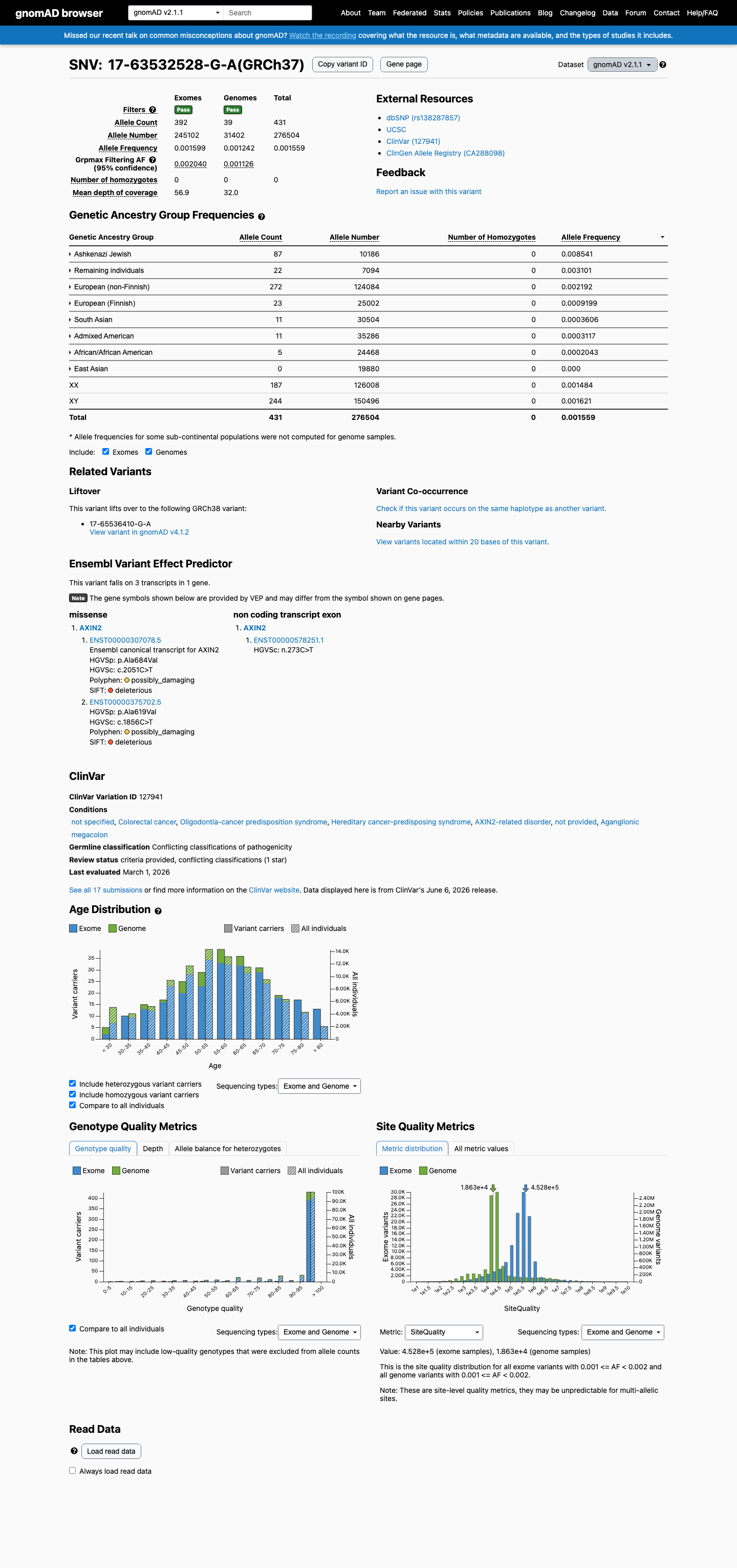
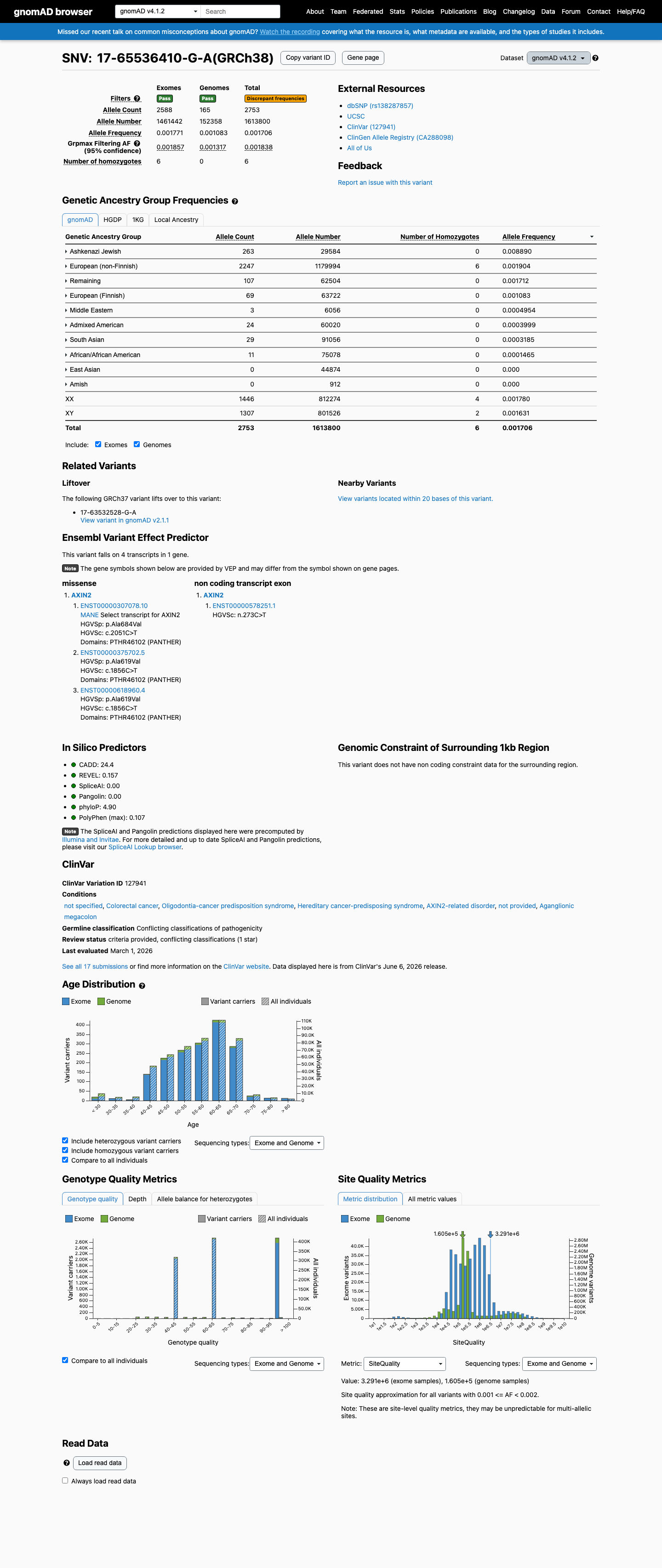
This variant is present in gnomAD v4.1 (AF= 0.00170591; MAF= 0.17059%, 2753/1613800 alleles, homozygotes = 6) and has highest observed frequency in the Ashkenazi Jewish population (AF= 0.00888994; MAF= 0.88899%, 263/29584 alleles, homozygotes = 0); grpmax FAF= 0.0018383.
v2.1
This variant is present in gnomAD v2.1 (AF= 0.00155875; MAF= 0.15587%, 431/276504 alleles, homozygotes = 0) and has highest observed frequency in the Ashkenazi Jewish population (AF= 0.00854113; MAF= 0.85411%, 87/10186 alleles, homozygotes = 0); grpmax FAF= 0.00204034.
🇨🇦 CA
This variant is present in gnomAD-Canada v1.0 (AF= 0.001954397394136808, 36/18420 alleles, homozygotes = 0).
Allele frequency by ancestry
three datasets · side by side
gnomAD v4.1
0.17% · 2753 / 1,613,800
6 hom · FAF 0.18%
Ashkenazi Jewish
263 / 29,584
0.89%
European (non-Finnish)
2247 / 1,179,994
0.19%
6 hom
Remaining individuals
107 / 62,504
0.17%
European (Finnish)
69 / 63,722
0.11%
Middle Eastern
3 / 6,056
0.05%
Admixed American
24 / 60,020
0.04%
South Asian
29 / 91,056
0.032%
African/African American
11 / 75,078
0.015%
+ 2 not observed (Amish, East Asian)
gnomAD v2.1
0.16% · 431 / 276,504
0 hom · FAF 0.2%
Ashkenazi Jewish
87 / 10,186
0.85%
Remaining individuals
22 / 7,094
0.31%
European (non-Finnish)
272 / 124,084
0.22%
European (Finnish)
23 / 25,002
0.092%
South Asian
11 / 30,504
0.036%
Admixed American
11 / 35,286
0.031%
African/African American
5 / 24,468
0.02%
+ 1 not observed (East Asian)
gnomAD Canada 🇨🇦
0.2% · 36 / 18,420
0 hom · FAF 0.14%
Ashkenazi Jewish
9 / 832
1.1%
European (non-Finnish)
24 / 11,742
0.2%
Latino/Admixed American
1 / 838
0.12%
Remaining individuals
1 / 1,136
0.088%
South Asian
1 / 1,362
0.073%
+ 4 not observed (African/African American, East Asian, European (Finnish), Middle Eastern)
ClinVar screenshot
ClinVar
This variant has been reported in ClinVar as Likely benign (11 clinical laboratories) and as Benign (2 clinical laboratories) and as benign (1 clinical laboratory) and as Likely Benign (1 clinical laboratory) and as Uncertain significance (1 clinical laboratory). (ClinVarID = 127941)
SpliceAI screenshot
In silico
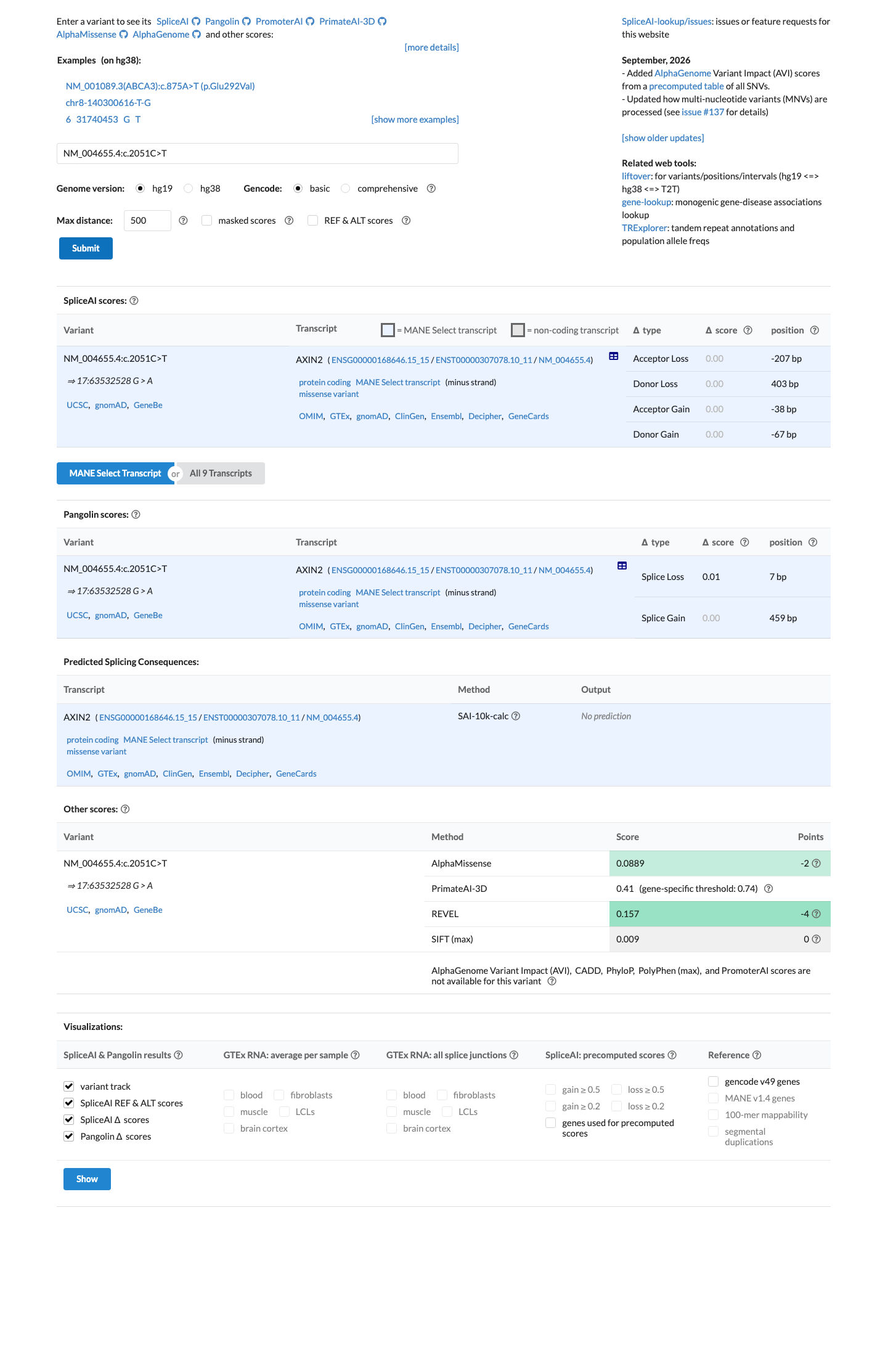
SpliceAI predicts no significant splice impact for this variant (max delta score = 0.00). REVEL score = 0.157. BayesDel score = -0.195763.
Functional / OncoKB screenshot
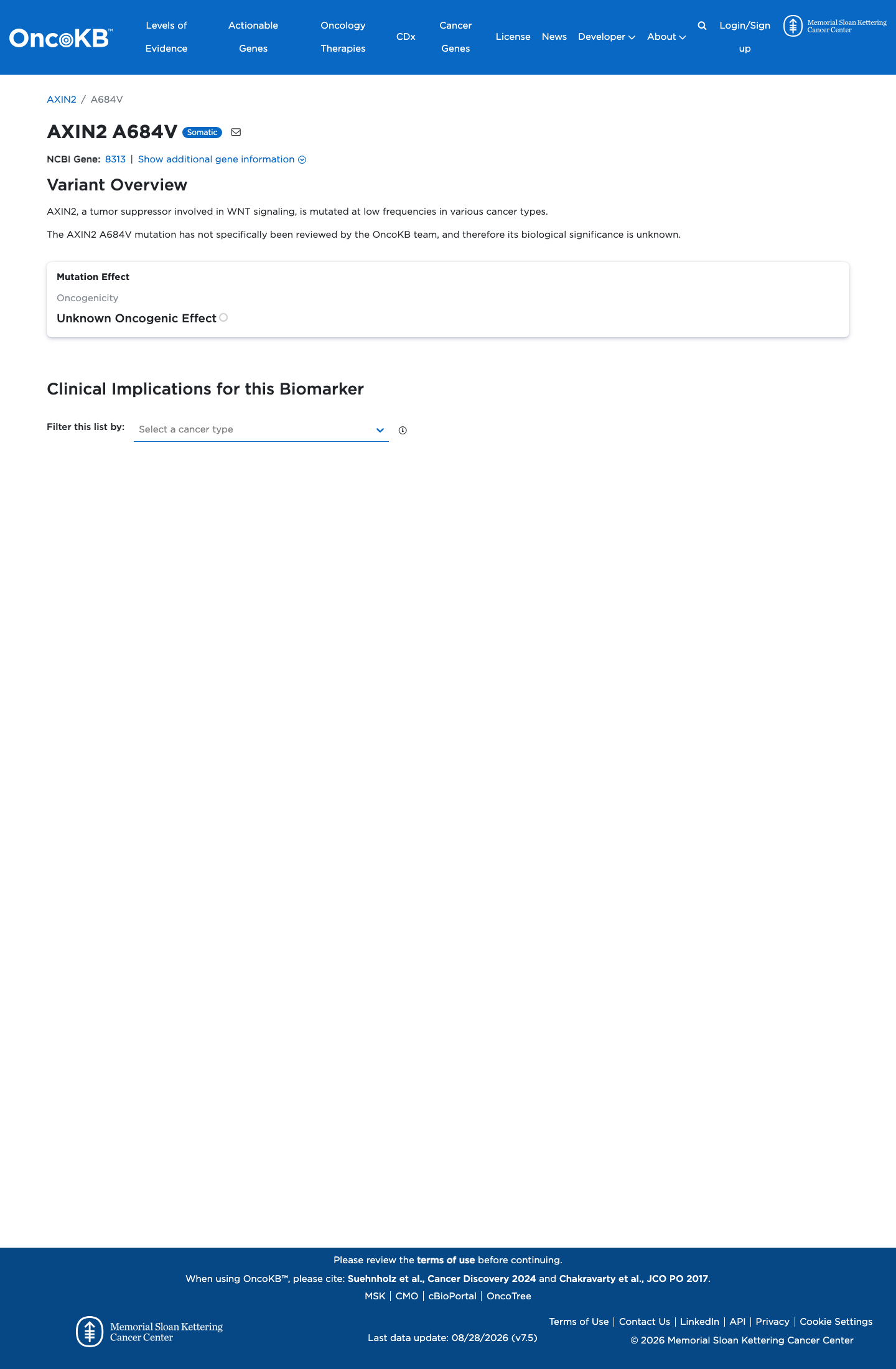
Functional Unknown Oncogenic Effect
OncoKB did not identify variant-specific reviewed functional evidence for this variant; gene-level curated context is available for reviewer follow-up. AXIN2, a tumor suppressor involved in WNT signaling, is mutated at low frequencies in various cancer types.
OncoKB ↗
COSMIC screenshot
COSMIC
Cancer hotspots screenshot
Cancer hotspots
Somatic evidence Not in COSMIC / hotspots
COSMIC
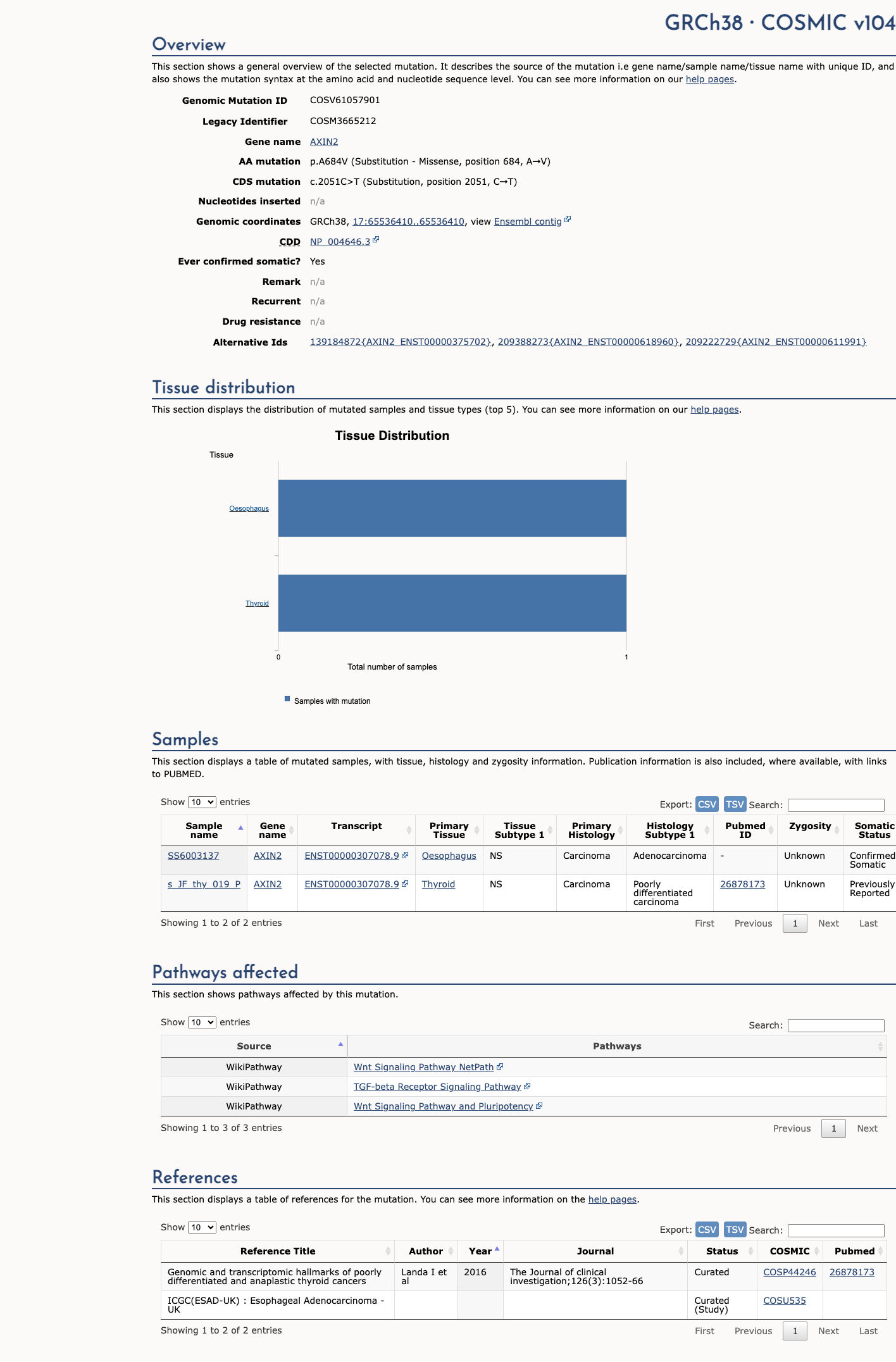
This variant does not lie in a statistically significant hotspot. This variant has previously been reported in somatic cancers (COSMIC; COSV61057901, n = 2 times).
Hotspots
This variant does not lie in a statistically significant hotspot.
Literature · how each cited paper was used
2papers cited
Each card is an audit: what was searched, what was found, whether it names the variant, which criteria it fed, and why. 7 further PMIDs triaged but not cited — see Sources & references.
Isolated oligodontia associated with mutations in EDARADD, AXIN2, MSX1, and PAX9 genes.
Searched
c.2051C>Tp.Ala684ValNP_004646.3:p.(A684V)
Found
This study reports AXIN2 c.2051C>T, resulting in p.Ala684Val, in a male proband with isolated oligodontia; the variant was among three AXIN2 variants identified in 93 Swedish probands, was predicted potentially damaging by PolyPhen, and was absent from 200 Swedish control chromosomes. It documents the queried variant itself, not an alternate same-codon or same-residue comparator.
Variant
✓ Names this variant — characterised directly
Applied to
→PP4 supporting
The exact variant is reported in an isolated oligodontia proband with 10 missing teeth, a disease-relevant AXIN2 phenotype.
AXIN2 c.2051C>T p.Ala684Val* M 10
Location Table I; Results, Mutation Analysis  ·  Context Screening of coding sequences in 93 Swedish individuals with isolated oligodontia using denaturing gradient gel electrophoresis and direct DNA sequencing; predicted missense effects were evaluated with PolyPhen and Clustal alignment and compared with 200 Swedish control chromosomes.  ·  full text
Expanding the genotype-phenotype spectrum in hereditary colorectal cancer by gene panel testing.
Searched
c.2051C>Tc.2051C > Tp.(A684V)p.Ala684ValNP_004646.3:p.(A684V)
Found
This study reports AXIN2 c.2051C>T p.Ala684Val in patient I:11 from a 91-patient colorectal-cancer multigene-panel study; Table 2 gives an ExAC frequency of 0.19%, SIFT prediction as deleterious, PolyPhen-2 as possibly damaging, and CADD 22.6. The discussion states that truncating AXIN2 variants have been suggested to confer greater predisposition to syndromic oligodontia and colorectal cancer than missense variants, but presents this as a suggestion rather than a validated gene-specific mechanism rule.
Variant
✓ Names this variant — characterised directly
Applied to
→PP4 supporting
The exact-variant colorectal-cancer observation without oligodontia was directly considered when limiting PP4 confidence and strength.
The second patient (I:11) presented with an AXIN2 missense variant c.2051C > T, p.Ala684Val. Variants in AXIN2 have been reported in patients with CRC and oligodentia and in patients with oligodentia solely [21, 52]. It is suggested that truncating pathogenic variants in AXIN2 are more likely to predispose carriers to syndromic oligodontia and colorectal cancer compared to missense variants [25]. To our knowledge oligodonita was not present in any of our patients.
Location Table 2, patient I:11; Discussion, paragraph beginning ‘Two patients from Group I’  ·  Context Ninety-one-patient hereditary colorectal-cancer multigene-panel study; variants were detected by targeted next-generation sequencing and confirmed by Sanger sequencing, with population frequency and in-silico predictions reported in Table 2.  ·  full text
Sources & reference links
8Sources
ClinVar
gnomAD v2.1
gnomAD v4.1
gnomAD-Canada
SpliceAI
OncoKB
COSMIC
Cancer hotspots
Triaged references · 7 PMIDs not cited in assessment
25741868 ↗ Standards and guidelines for the interpretation of sequence variants: a joint consensus recommendation of the American College of Medical Genetics and Genomics and the Association for Molecular Pathology. CLINVAR
26467025 ↗ A Standardized DNA Variant Scoring System for Pathogenicity Assessments in Mendelian Disorders. CLINVAR
20301390 ↗ Lynch Syndrome. CLINVAR
24581859 ↗ Novel missense mutations in the AXIN2 gene associated with non-syndromic oligodontia. CLINVAR
25260786 ↗ Use of a targeted, combinatorial next-generation sequencing approach for the study of bicuspid aortic valve. CLINVAR
25394175 ↗ A practice guideline from the American College of Medical Genetics and Genomics and the National Society of Genetic Counselors: referral indications for cancer predisposition assessment. CLINVAR
28492532 ↗ Sherloc: a comprehensive refinement of the ACMG-AMP variant classification criteria. CLINVAR