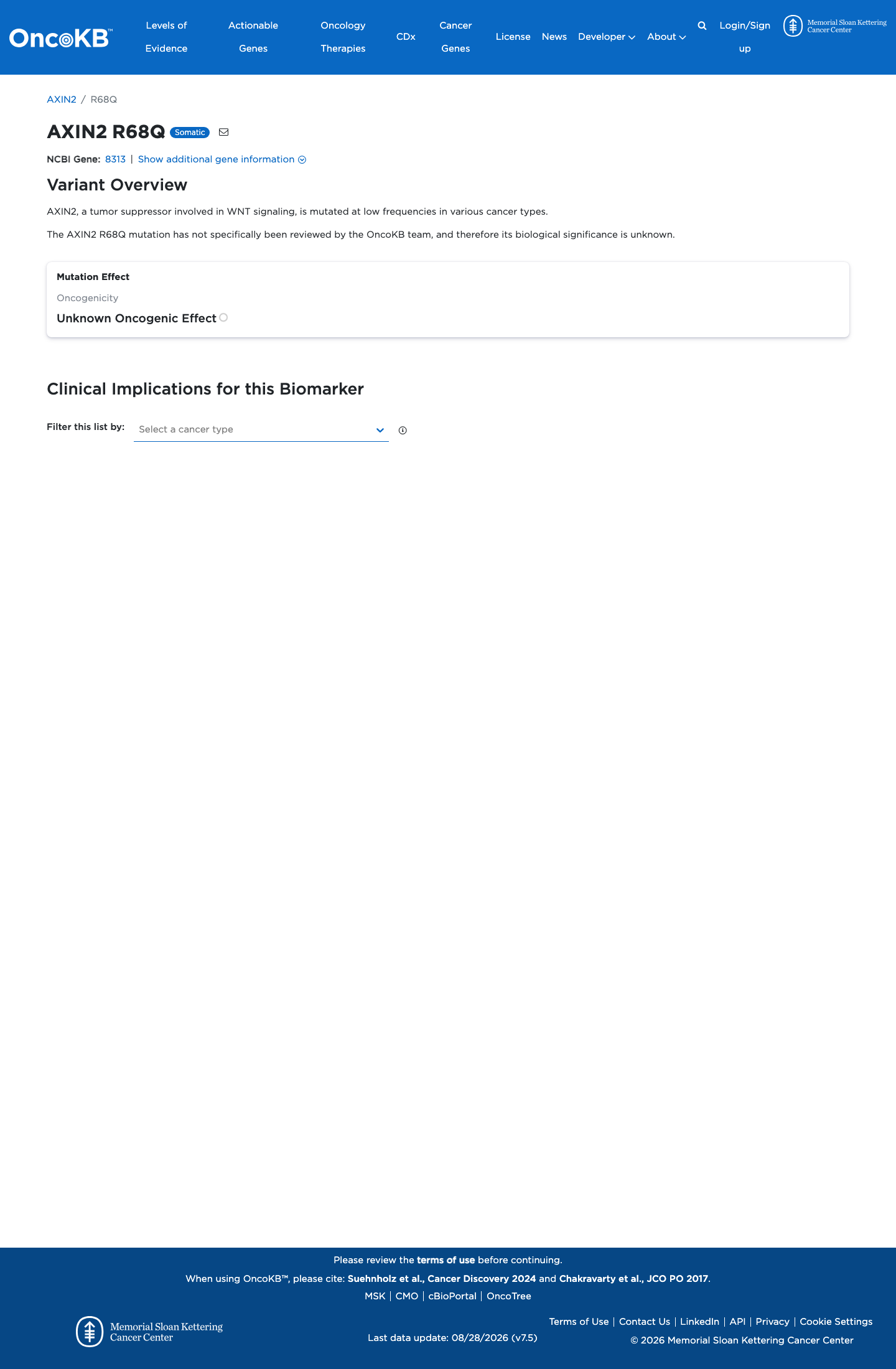
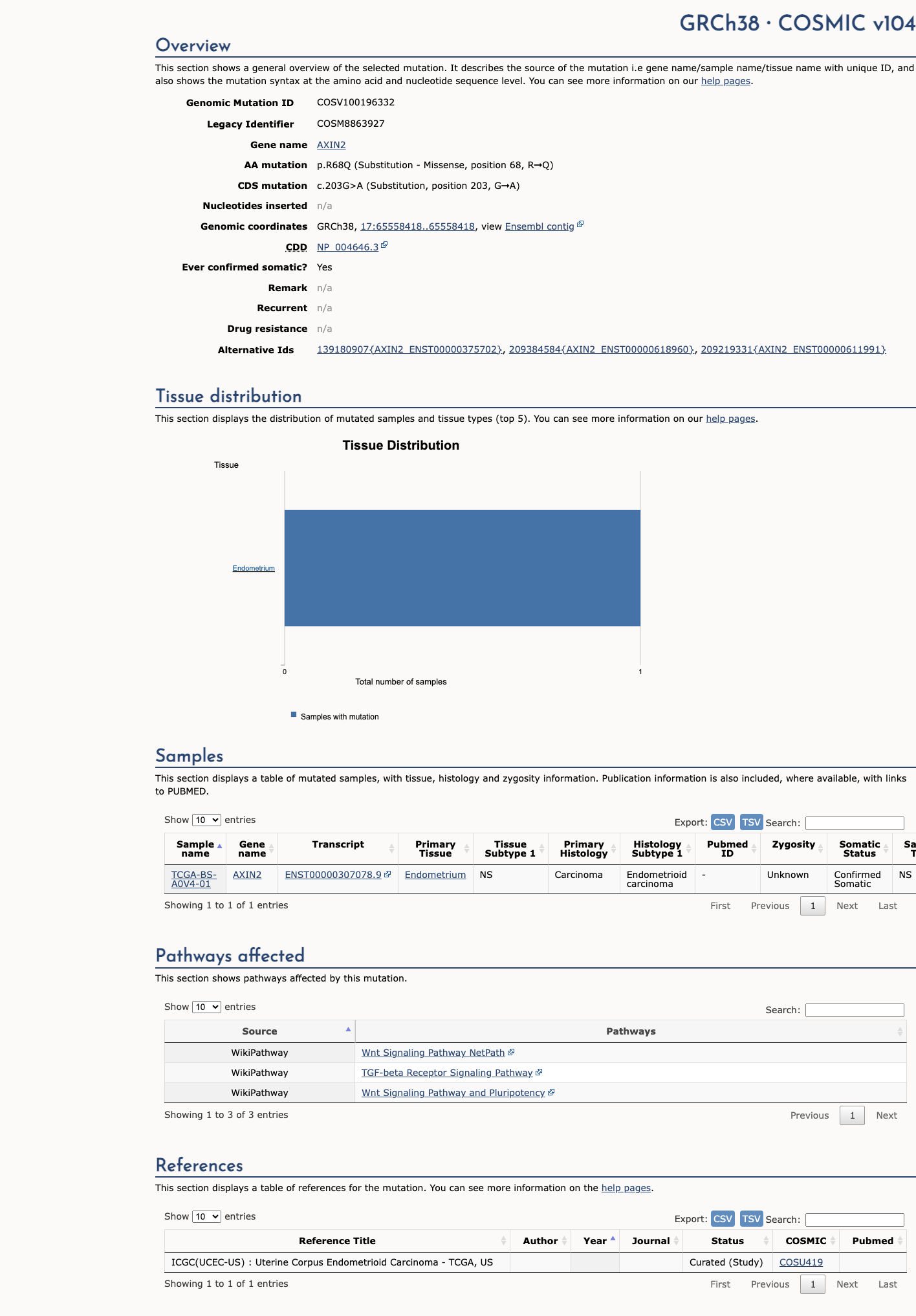
PS1
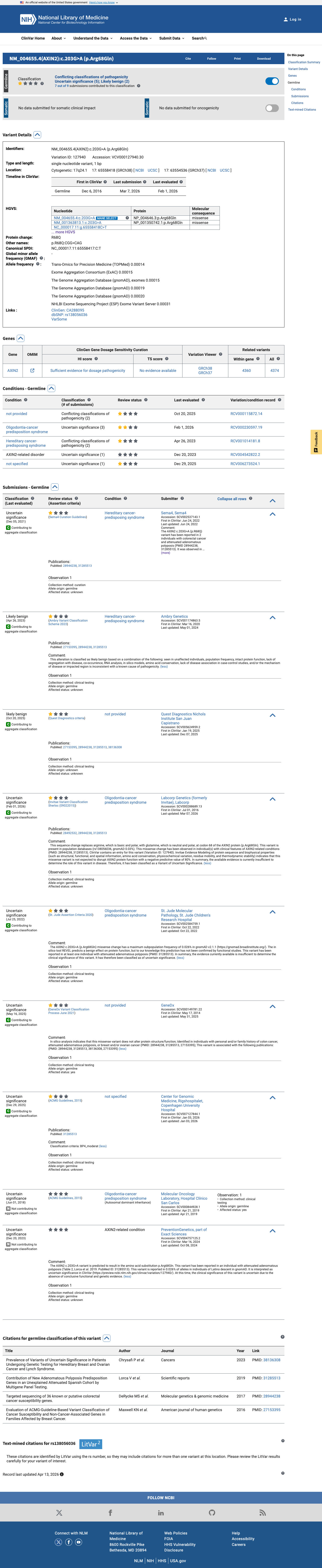
Not met: no report of the p.Arg68Gln amino-acid change established as pathogenic - the only record is ClinVar 127940, classified uncertain significance.
PS2
Not assessed: no proband or parental testing exists in any source, and the sole variant report (PMID:31285513) provides no parental genotype data.
PS3
Not met: no functional assay exists for AXIN2 p.Arg68Gln - the only paper naming the variant (PMID:31285513) reports it as a class-3 VUS with zero functional testing.
PS4
Not met: the only case observation is 1 carrier among 158 attenuated-polyposis patients, with no control group or odds ratio establishing enrichment.
PM1
Not met: CancerHotspots is negative at AXIN2 R68 and the variant itself sits in gnomAD at 0.013% with no homozygotes, so no hotspot or variation-free critical domain is established.
PM2
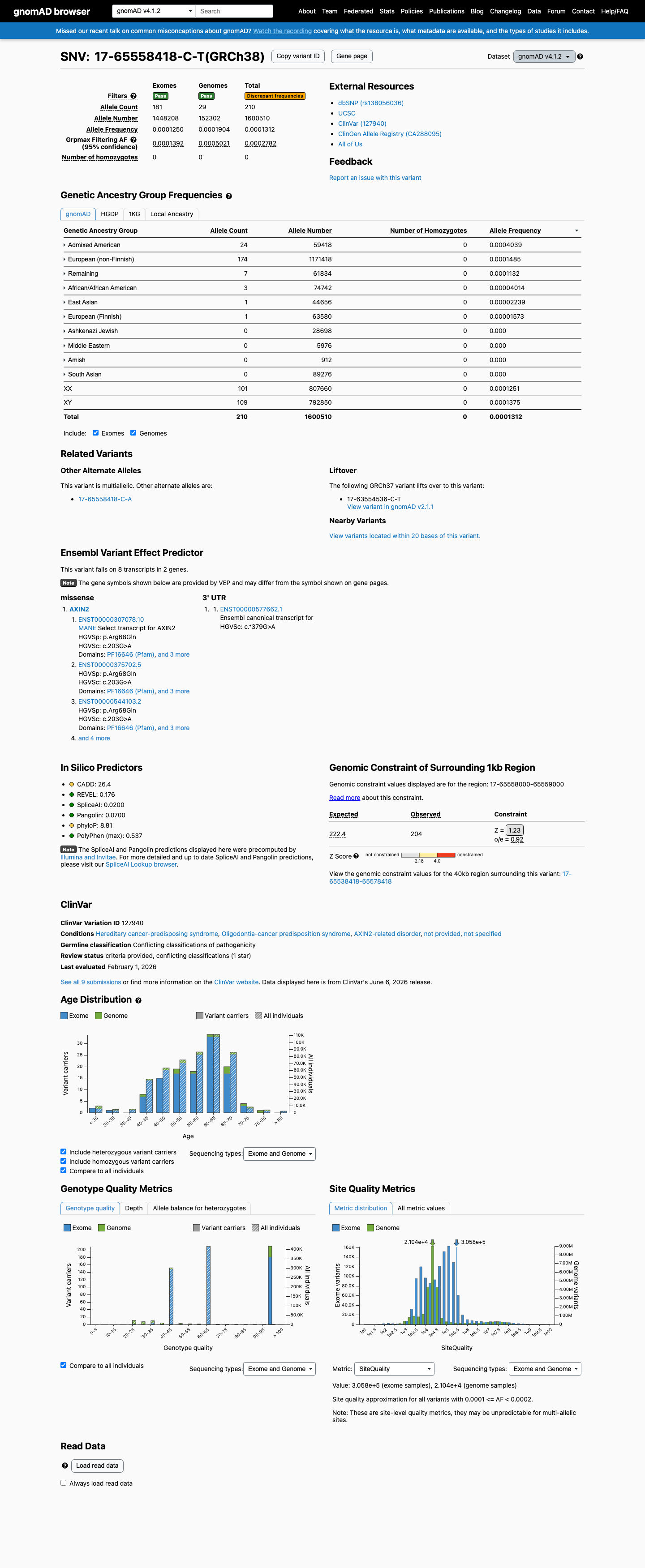
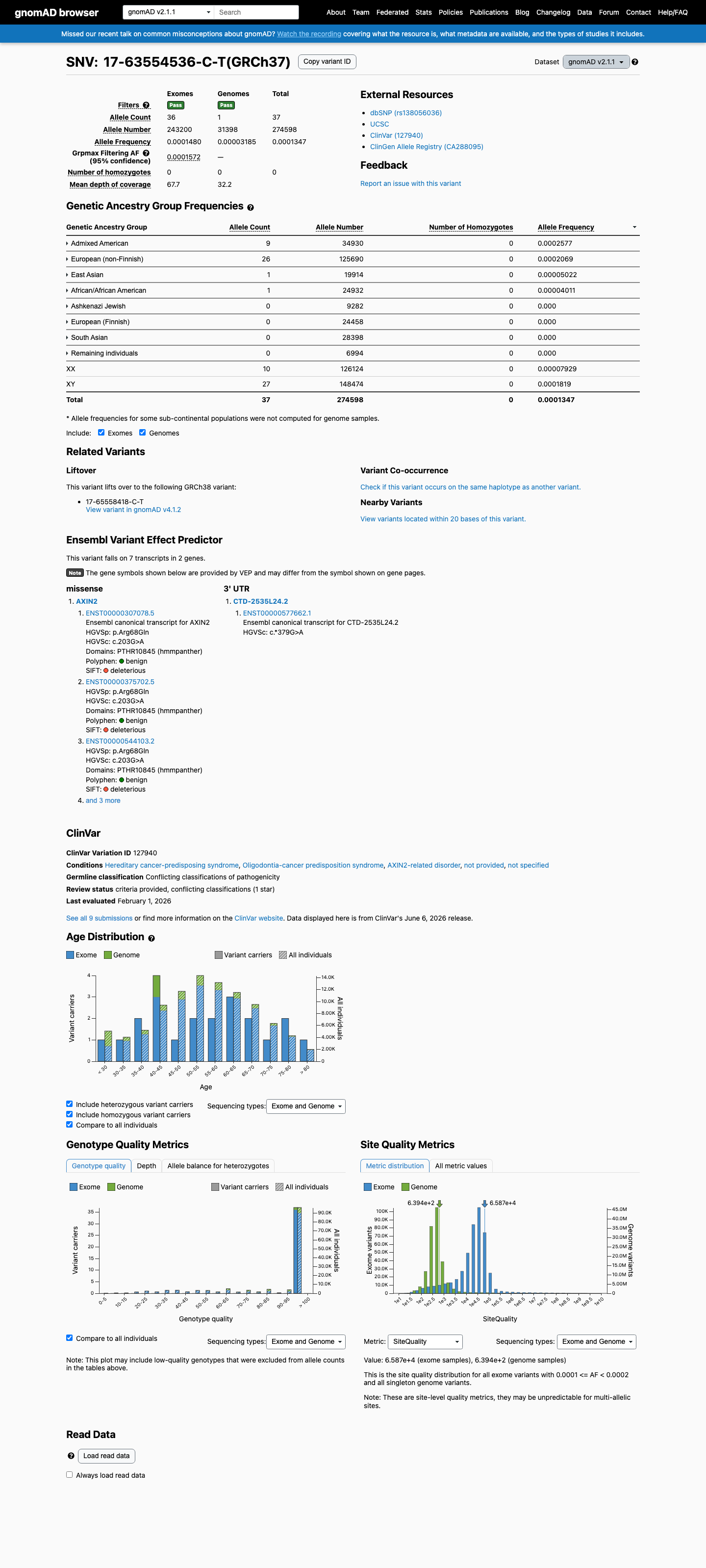
Not met: gnomAD AF 0.000131 (v4.1) and 0.000135 (v2.1), corroborated by a published European frequency of 2e-04, exceed the <=0.0001 PM2 threshold.
PM3
Not met: no pathogenic AXIN2 allele in trans, and 0 homozygotes among 37/274,598 gnomAD v2.1 alleles.
PM5
Not met: no missense change other than p.Arg68Gln is reported at codon 68, so the required pathogenic same-residue comparator does not exist.
PM6
Not assessed: no parental testing or family data exist anywhere, and the sole variant report (PMID:31285513) documents no assumed de novo event.
PP1
Not assessed: no pedigree or genotyped affected relative exists in any source, so zero informative co-segregation meioses can be counted for c.203G>A.
PP2
Not met: AXIN2 disease is driven by truncating loss-of-function variants rather than missense, and no low benign-missense-rate constraint is established for the gene.
PP3
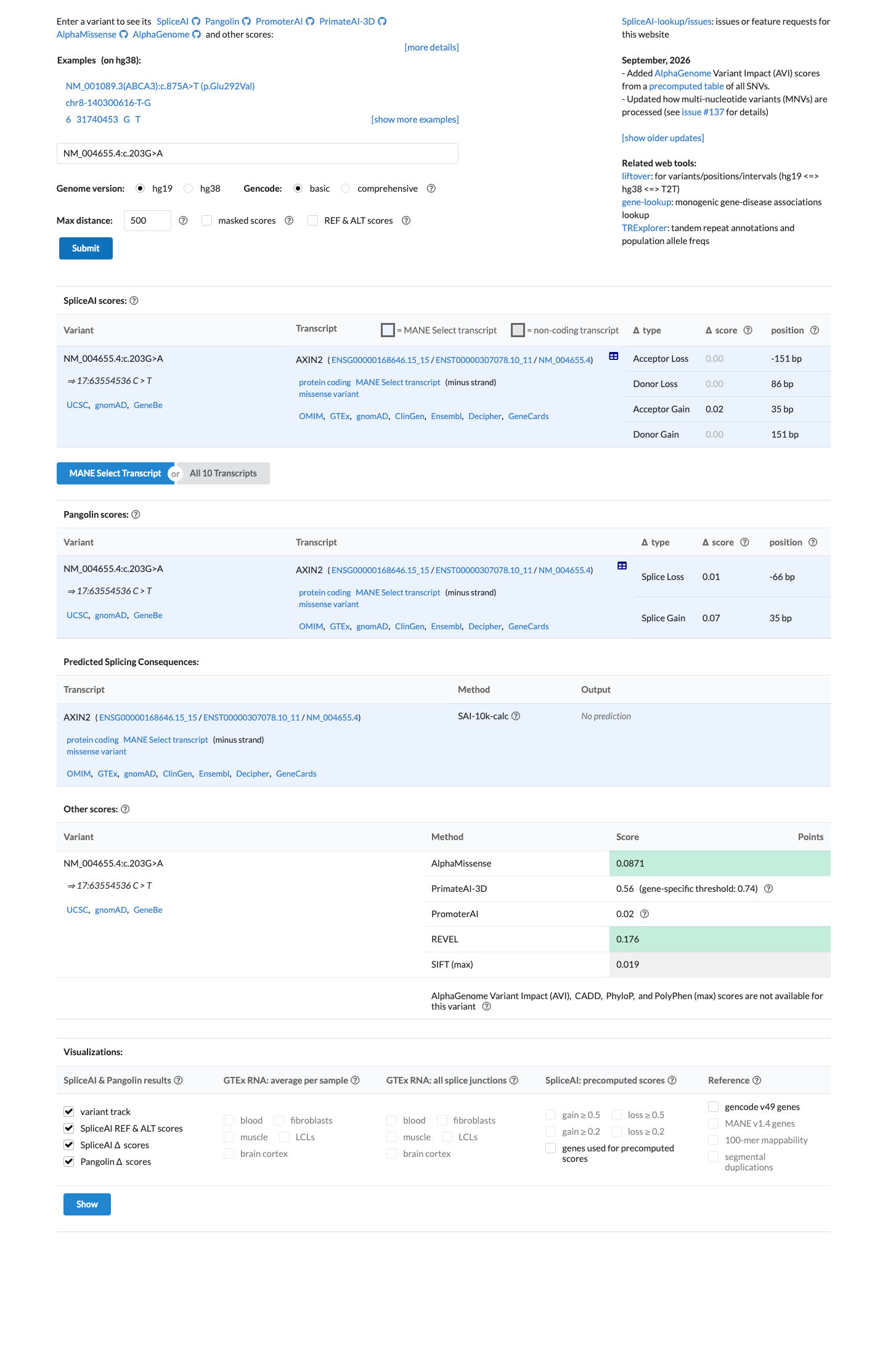
Not met: REVEL 0.176 for p.(Arg68Gln) sits far below the >= 0.644 supporting PP3 threshold.
PP4
Not assessed: no proband phenotype or family history is documented, and the only disease context (adenomatous polyposis) is genetically heterogeneous across APC, MUTYH and other genes.
PP5
Not met: ClinVar record 127940 has zero expert-panel submissions and no Pathogenic or Likely pathogenic assertion for this exact variant.