Analysis in progress
Initialising…
0%
complete
This report is still being assembled — sections appear as each stage finishes. It isn't final yet.
AXIN2
Final classification
VUS
PM2BP4
AXIN2
c.405C>T
p.Tyr135=
synonymous · exon 2

AXIN2 is a scaffolding protein that helps regulate the Wnt signaling pathway, a key developmental pathway controlling cell growth and fate. It is part of the beta-catenin destruction complex, where it helps mark beta-catenin for degradation when Wnt signaling is off, and it also assists in relaying Wnt signals to the nucleus when the pathway is active. AXIN2 acts as a tumor suppressor, and mutations in the gene have been linked to colorectal cancer as well as familial tooth agenesis with predisposition to colorectal cancer. Its expression has also been associated with prostate cancer recurrence.

This variant

AXIN2 is a tumor suppressor in the Wnt/beta-catenin pathway, with mutations linked to colorectal cancer and familial tooth agenesis. This synonymous change (p.Tyr135=) has no predicted splice impact yet is too rare to be benign on frequency grounds alone, so it remains a VUS - clinical significance for AXIN2-associated disease is currently uncertain.

Transcript
NM_004655.4
HGVS · transcript:coding
NM_004655.4:c.405C>T
GRCh38
chr17:65558216 G>A
GRCh37
chr17:63554334 G>A
Basis Generic ACMG/AMP 2015 rules were applied (no AXIN2-specific framework available); PM2-supporting plus BP4-supporting reaches no pathogenic or benign threshold, so the variant is classified VUS.
Generic ACMG/AMP 2015 rules were applied (no AXIN2-specific framework available); PM2-supporting plus BP4-supporting reaches no pathogenic or benign threshold, so the variant is classified VUS.
Classification rationale
PM2 BP4 VUS
AXIN2 c.405C>T synonymous · exon 2

PM2 (Supporting): extremely rare in population databases - gnomAD v4.1 allele frequency 0.00719% with zero homozygotes. BP4 (Supporting): SpliceAI max delta 0.00, below the 0.10 benign threshold, indicating no splice impact. Final: VUS - the supporting pathogenic PM2 and supporting benign BP4 offset each other under the generic ACMG/AMP 2015 rule, meeting no classification threshold.

PM2 + BP4 VUS
Gene diagram · NM_004655.4 · variants mapped to exon structure
AXIN2 NM_004655.4
Fetching transcript structure from UCSC…
Applied criteria · 2 applied · 17 assessed
MetEvidence satisfies this criterion.
Not metEvaluated against available evidence; threshold not reached.
Not assessedApplies in principle, but no evidence was found to evaluate it.
N/ADoesn't apply to this variant type.
Applied · 2
Strength Supporting Moderate Strong Very strong
PM2 supporting Pathogenic
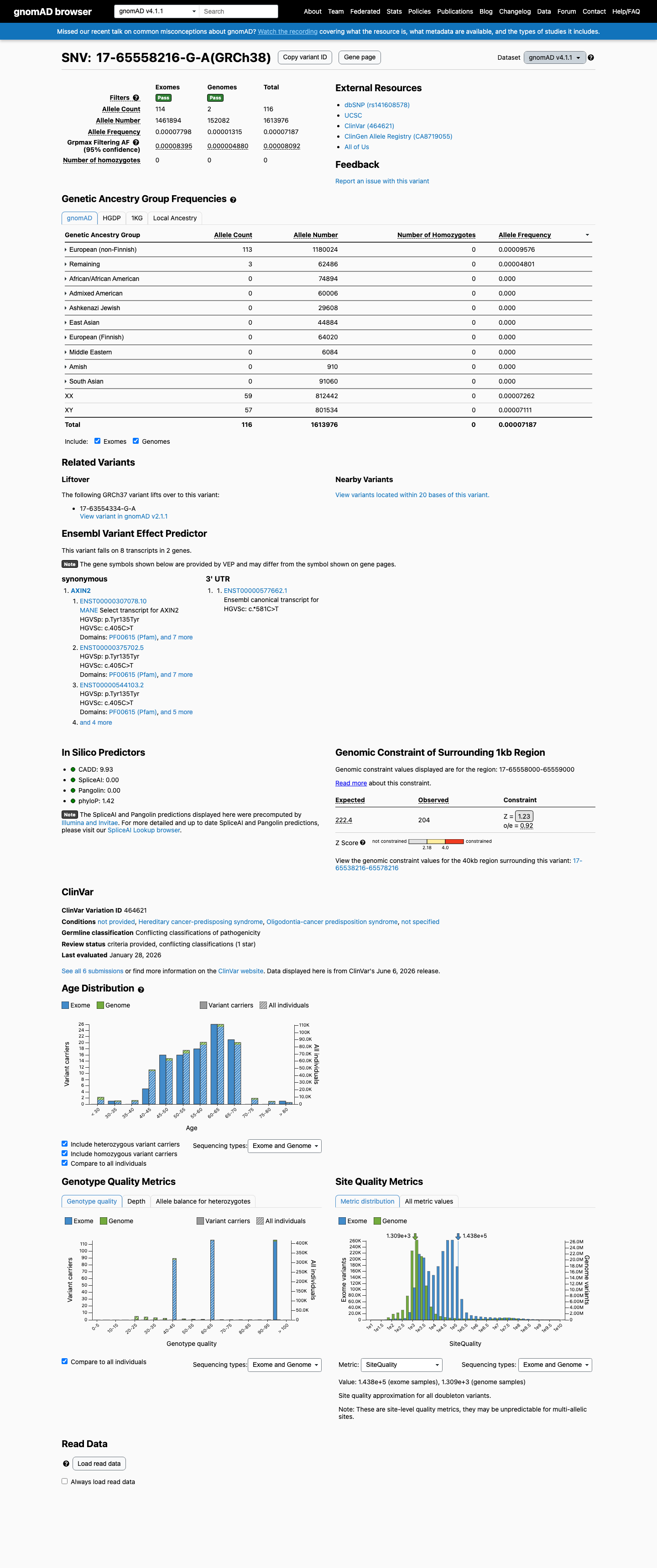
Met (supporting): extremely rare in gnomAD v4.1 at 0.00719% allele frequency (116/1,613,976 alleles) with zero homozygotes.
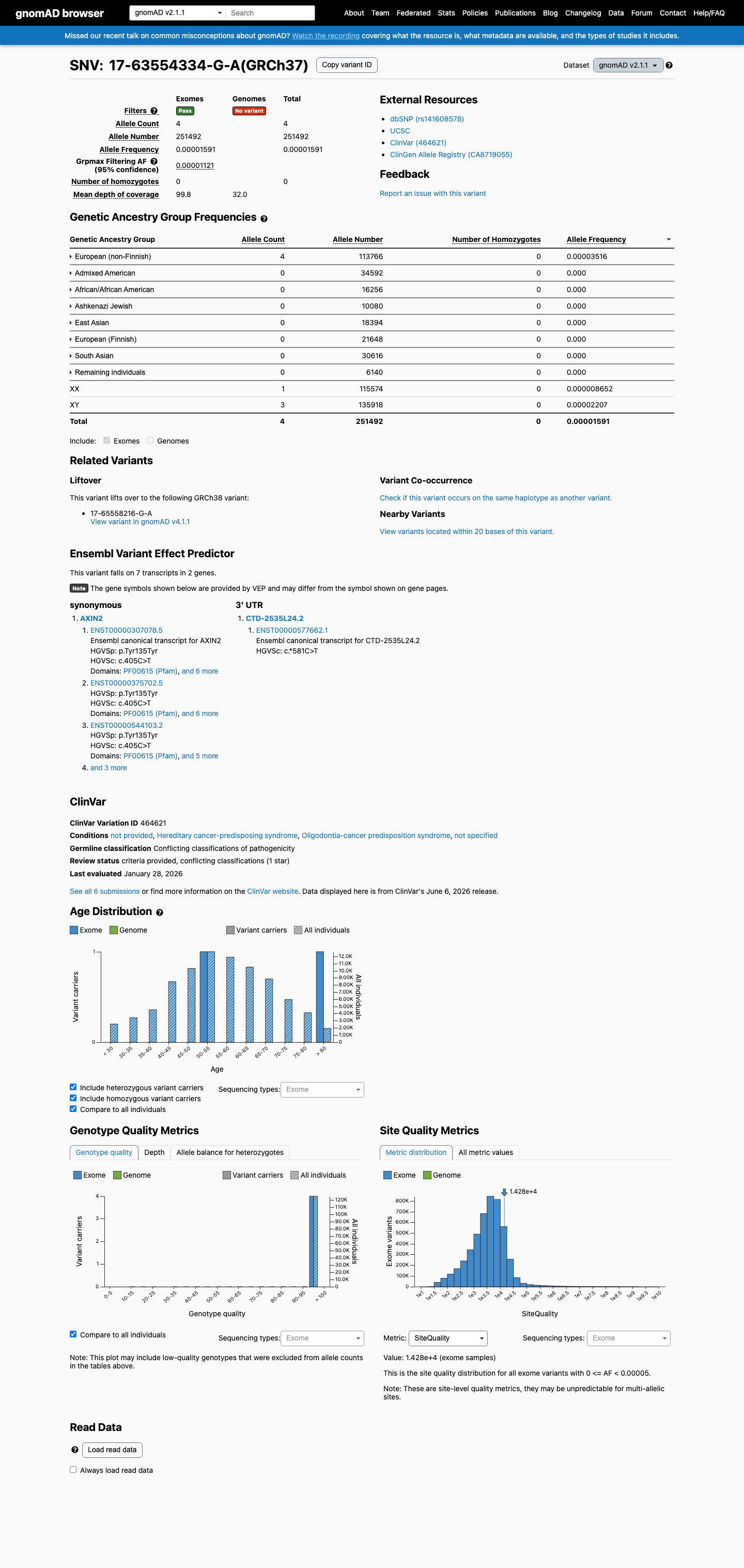
gnomAD v4.1 reports 116/1,613,976 alleles (AF 0.00719%), zero homozygotes, European (non-Finnish) maximum 113/1,180,024 alleles (AF 0.00958%), and joint grpmax FAF 0.00809%.gnomAD v2.1 reports 4/251,492 alleles (AF 0.00159%), zero homozygotes, European (non-Finnish) maximum 4/113,766 alleles (AF 0.00352%), and grpmax FAF 0.00112%.The variant is absent from gnomAD-Canada v1.0.
BP4 supporting Benign
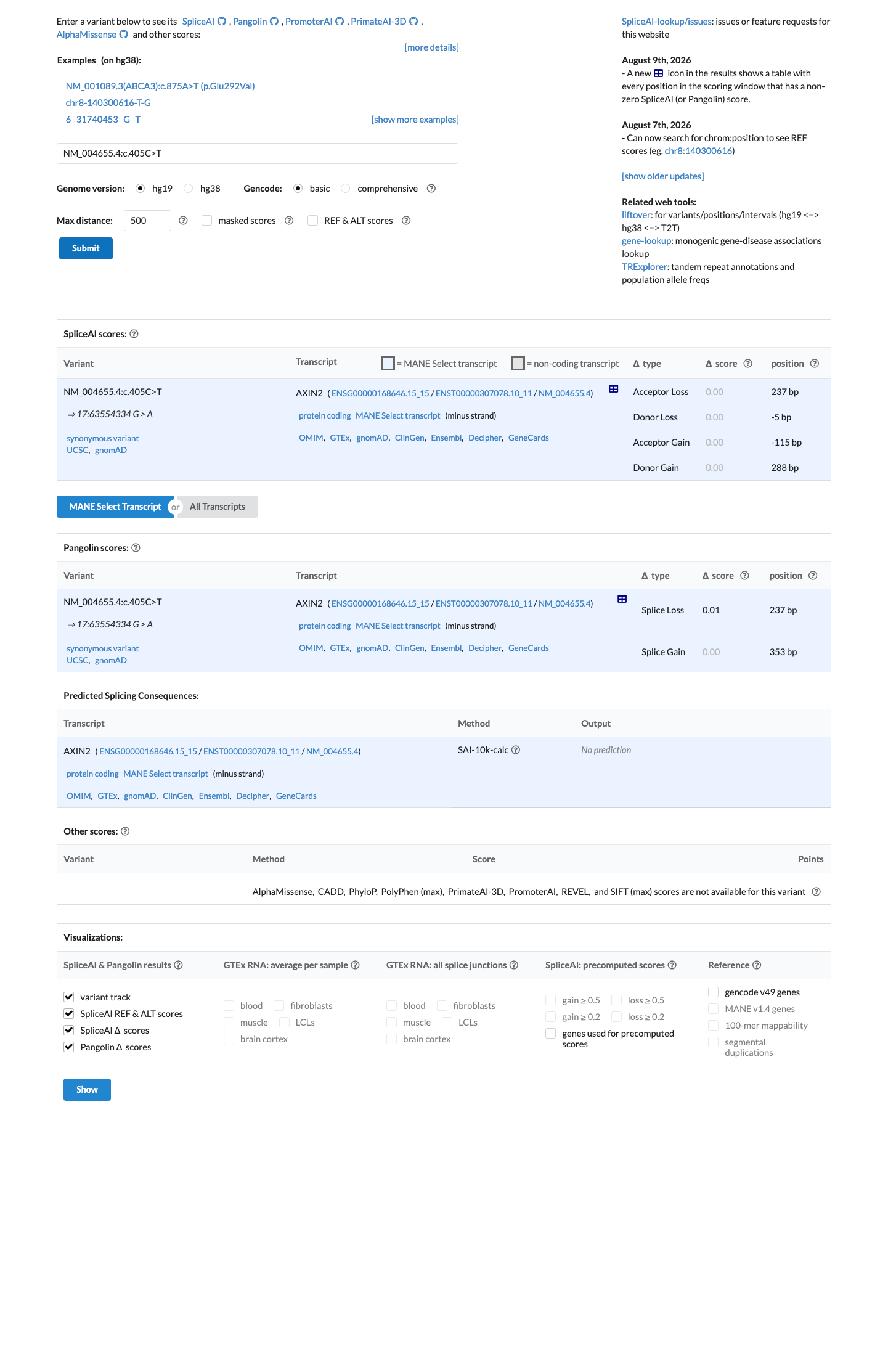
Met (supporting): SpliceAI max delta 0.00 is below the 0.10 benign threshold, indicating no splice impact.
No governing AXIN2 CSPEC, VCEP material, or gene-specific PP3/BP4 lookup was retrieved; generic ACMG/AMP fallback is therefore applicable.SpliceAI Lookup reports no significant splice impact and max delta score 0.00 for NM_004655.4:c.405C>T. The generic fallback assigns non-missense variants to the SpliceAI path and defines BP4 at max delta <0.10.Published computational-evidence calibration: PMID 36413997 supports use of SpliceAI <=0.10 for supporting benign computational evidence and >=0.20 for supporting pathogenic computational evidence; the observed score supports BP4.
Assessed · not applied · 5 not met · 12 not assessed
Pathogenic
PS2 Not assessed: no de novo occurrence with confirmed parentage was documented.
PS3 Not assessed: no functional assay demonstrating a disease-relevant effect of this variant was available.
PS4 Not assessed: no affected-case series or case-control data for this variant were provided.
PM3 Not assessed: no second pathogenic variant in trans or other inheritance data were documented.
PM6 Not assessed: no suspected de novo occurrence with parental testing was reported.
PP1 Not assessed: no family segregation or co-segregation analysis was documented.
PP3 Not met: SpliceAI max delta 0.00 vs the >0.20 pathogenic-evidence threshold.
PP4 Not assessed: no individual-level phenotype or diagnostic workup was provided.
PP5 Not met: no ClinVar expert-panel pathogenic or likely pathogenic assertion exists for this exact variant.
Benign
BA1 Not met: highest population frequency 0.00958% (gnomAD v4.1) is far below a stand-alone benign threshold.
BS1 Not met: allele frequency 0.00719% does not exceed expected levels for a rare AXIN2-associated disorder.
BS2 Not assessed: no phenotype-verified healthy adult carriers were documented.
BS3 Not assessed: no functional assay evidence of no damaging effect was available.
BS4 Not assessed: no tested unaffected carriers or non-segregation data were documented.
BP2 Not assessed: no phase information or co-occurrence with a pathogenic variant was documented.
BP5 Not assessed: no alternate molecular diagnosis was documented in the variant carrier.
BP6 Not met: no ClinVar expert-panel benign or likely benign assertion exists for this exact variant.
N/A · 9 PVS1 · PS1 · PM1 · PM4 · PM5 · PP2 · BP1 · BP3 · BP7
Research & evidence
Population frequency
gnomAD v4.1 screenshot
gnomAD v4.1
gnomAD v2.1 screenshot
gnomAD v2.1
v4.1
This variant is present in gnomAD v4.1 (AF= 7.18722e-05; MAF= 0.00719%, 116/1613976 alleles, homozygotes = 0) and has highest observed frequency in the European (non-Finnish) population (AF= 9.57608e-05; MAF= 0.00958%, 113/1180024 alleles, homozygotes = 0); grpmax FAF= 8.092e-05.
v2.1
This variant is present in gnomAD v2.1 (AF= 1.59051e-05; MAF= 0.00159%, 4/251492 alleles, homozygotes = 0) and has highest observed frequency in the European (non-Finnish) population (AF= 3.51599e-05; MAF= 0.00352%, 4/113766 alleles, homozygotes = 0); grpmax FAF= 1.121e-05.
🇨🇦 CA
Absent from gnomAD-Canada v1.0.
Allele frequency by ancestry
three datasets · side by side
gnomAD v4.1
0.0072% · 116 / 1,613,976
0 hom · FAF 0.0081%
European (non-Finnish)
113 / 1,180,024
0.0096%
Remaining individuals
3 / 62,486
0.0048%
+ 8 not observed (Admixed American, European (Finnish), Amish, East Asian, Middle Eastern, South Asian, Ashkenazi Jewish, African/African American)
gnomAD v2.1
0.0016% · 4 / 251,492
0 hom · FAF 0.0011%
European (non-Finnish)
4 / 113,766
0.0035%
+ 7 not observed (African/African American, Admixed American, Ashkenazi Jewish, East Asian, European (Finnish), Remaining individuals, South Asian)
gnomAD Canada 🇨🇦
Absent · 0 / ?
0 hom
Not observed in any ancestry group.
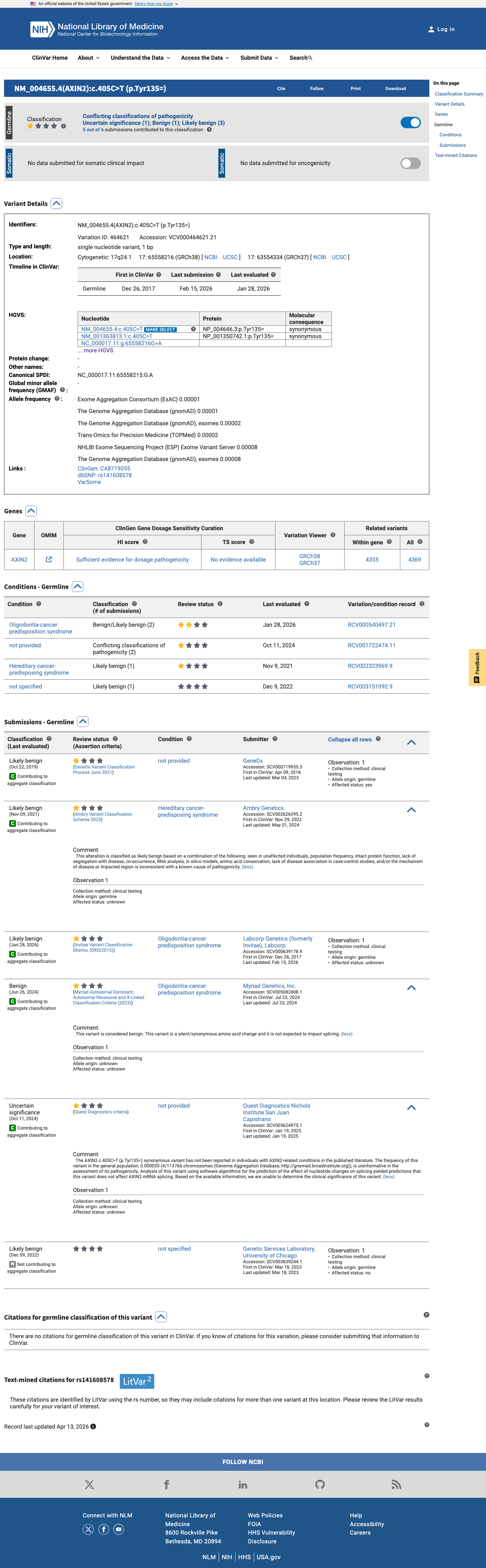
ClinVar screenshot
ClinVar
This variant has been reported in ClinVar as Likely benign (4 clinical laboratories) and as Benign (1 clinical laboratory) and as Uncertain significance (1 clinical laboratory). (ClinVarID = 464621)
SpliceAI screenshot
In silico
SpliceAI predicts no significant splice impact for this variant (max delta score = 0.00).
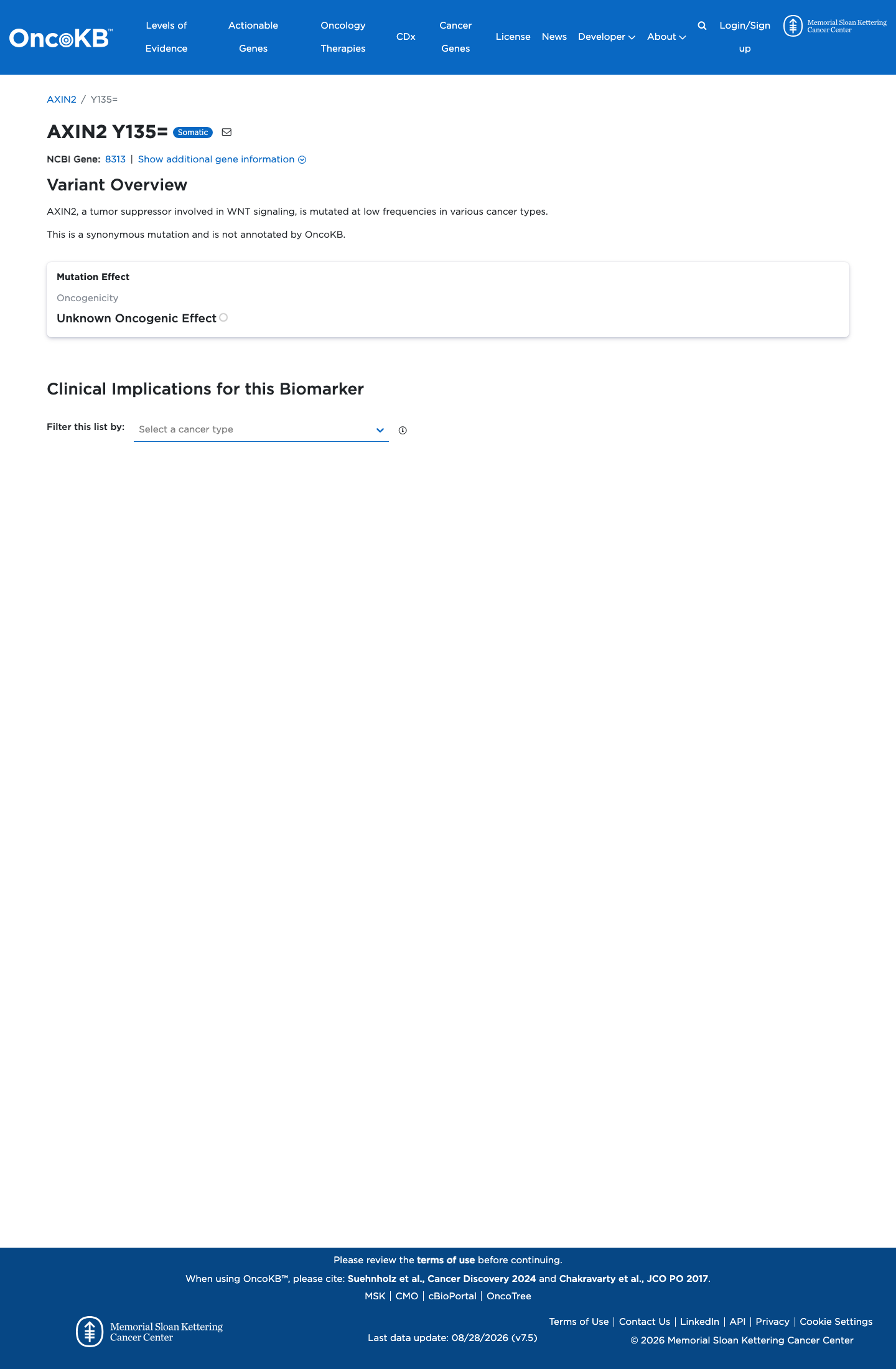
Functional / OncoKB screenshot
Functional Unknown Oncogenic Effect
OncoKB identified curated literature and non-variant-specific oncogenicity context for review; listed oncogenicity label: Unknown Oncogenic Effect.
OncoKB ↗
COSMIC screenshot
COSMIC
Cancer hotspots screenshot
Cancer hotspots
Somatic evidence Not in COSMIC / hotspots
COSMIC
This variant does not lie in a statistically significant hotspot. This variant has not previously been reported in somatic cancers (COSMIC).
Hotspots
This variant does not lie in a statistically significant hotspot.
Sources & reference links
8Sources
ClinVar
gnomAD v2.1
gnomAD v4.1
gnomAD-Canada
SpliceAI
OncoKB
COSMIC
Cancer hotspots
Triaged references · 3 PMIDs not cited in assessment
26467025 ↗ A Standardized DNA Variant Scoring System for Pathogenicity Assessments in Mendelian Disorders. CLINVAR
25394175 ↗ A practice guideline from the American College of Medical Genetics and Genomics and the National Society of Genetic Counselors: referral indications for cancer predisposition assessment. CLINVAR
28492532 ↗ Sherloc: a comprehensive refinement of the ACMG-AMP variant classification criteria. CLINVAR