Back
NM_004656.4:c.1120G>A
p.Glu374Lys · BAP1
Generic ACMG/AMP 2015 with ClinGen SVI recommendations
0%
complete
Final classification
VUS
PM2BP4
BAP1
c.1120G>A
p.Glu374Lys
missense · exon 12

BAP1 encodes a nuclear deubiquitinating enzyme that removes ubiquitin from proteins and helps regulate cell proliferation, DNA repair, chromatin remodeling, gene expression, and cell cycle progression. It acts as a tumor suppressor, in part through its interaction with BRCA1. Germline mutations in BAP1 cause a hereditary tumor predisposition syndrome associated with increased risk of malignant mesothelioma, uveal melanoma, cutaneous melanoma, and renal cell carcinoma. Somatic BAP1 mutations are also common in these tumor types, highlighting its key role in cancer.

This variant

This BAP1 missense variant occurs in a tumor-suppressor gene associated with hereditary predisposition to malignant mesothelioma, uveal and cutaneous melanoma, and renal cell carcinoma.

Transcript
NM_004656.4
HGVS · transcript:coding
NM_004656.4:c.1120G>A
GRCh38
chr3:52404583 C>T
GRCh37
chr3:52438599 C>T
VUS: PM2 supporting and BP4 supporting were applied, but no generic ACMG/AMP combination threshold for Pathogenic, Likely Pathogenic, Likely Benign, or Benign was met.
Classification rationale
PM2 BP4 VUS
BAP1 c.1120G>A missense · exon 12

PM2 supporting: the variant is absent from available gnomAD datasets. BP4 supporting: the missense REVEL score is 0.202, below the generic BP4 threshold of 0.29.

PM2 + BP4 → VUS
LYFE Sciences is an AI system, and it can make mistakes. Criteria may be applied incorrectly, sources may be misread, and a confident-looking classification can still be wrong. Double-check every criterion and its underlying evidence before relying on any call.
Gene diagram · NM_004656.4 · variants mapped to exon structure
BAP1 NM_004656.4
Fetching transcript structure from UCSC…
Applied criteria · 2 applied · 21 assessed
MetEvidence satisfies this criterion.
Not metEvaluated against available evidence; threshold not reached.
Not assessedApplies in principle, but no evidence was found to evaluate it.
N/ADoesn't apply to this variant type.
Applied · 2
Strength Supporting Moderate Strong Very strong
PM2 supporting Pathogenic
Met at supporting: the variant is absent from gnomAD v2.1 and v4.1, giving observed frequency 0 versus the <=0.0001 PM2 threshold.
gnomAD v2.1 all-comers: NM_004656.4:c.1120G>A was absent.gnomAD v4.1 all-comers: NM_004656.4:c.1120G>A was absent.gnomAD v2.1 non-cancer and v3.1 non-cancer records also reported the variant as absent; no governing VCEP population-source override exists.
BP4 supporting Benign
Met at supporting: missense REVEL score 0.202 is at or below the generic BP4 threshold of 0.29.
Variant consequence: missense, NM_004656.4:c.1120G>A, NP_004647.1:p.(Glu374Lys); therefore the generic missense REVEL path applies and the SpliceAI score is not used.Local REVEL lookup: score 0.202.Generic ClinGen SVI REVEL calibration: BP4 supporting requires <=0.29; threshold supplied in the governing case instructions and attributed to Pejaver et al. 2022, PMID:36413997.
Assessed · not applied · 5 not met · 16 not assessed
Pathogenic
PS1 Not assessed: no previously established pathogenic BAP1 variant with the same p.Glu374Lys amino-acid change is documented.
PS2 Not assessed: no proband phenotype, parental maternity/paternity confirmation, or family-history evidence establishes a de novo variant.
PS3 Not assessed: no variant-specific functional assay or validated evidence supporting a damaging effect was reported for BAP1 p.Glu374Lys.
PS4 Not assessed: no affected-versus-control prevalence, odds ratio, relative risk, or confidence interval is available for this variant.
PM1 Not assessed: no authoritative complete BAP1 domain table or qualifying hotspot/domain evidence is supplied for evaluating PM1.
PM5 Not assessed: no different missense variant at BAP1 residue 374 has been determined pathogenic in the supplied evidence.
PM6 Not assessed: no affected proband or parental testing shows an assumed de novo variant without confirmed maternity and paternity.
PP1 Not assessed: no affected relatives, variant results, phenotype assessments, or informative meioses are documented for co-segregation.
PP2 Not assessed: variant absence from gnomAD does not establish BAP1's gene-level benign-missense rate or a common missense disease mechanism.
PP3 Not met: missense REVEL score 0.202 is below the generic PP3 supporting threshold of 0.644.
PP4 Not assessed: no patient phenotype or family-history description is available to establish a highly specific single-gene disease presentation.
PP5 Not met: ClinVar reports this exact variant as uncertain significance, with zero expert-panel submissions and no Pathogenic or Likely pathogenic classification.

Benign
BA1 Not met: the variant is absent from gnomAD v2.1 and v4.1, giving observed frequency 0 versus the >=0.05 BA1 threshold.
BS1 Not met: the variant is absent from gnomAD v2.1 and v4.1, with observed frequency 0 versus the generic >=0.01 BS1 threshold.
BS2 Not assessed: no evidence documents the variant in a healthy adult homozygote, heterozygote, or hemizygote.
BS3 Not assessed: no variant-specific functional assay or validated evidence showing no damaging effect on BAP1 p.Glu374Lys was reported.
BS4 Not assessed: no tested affected relatives are documented as lacking the variant, so lack of segregation cannot be established.
BP1 Not assessed: BAP1 loss-of-function is supported, but the supplied evidence does not establish a primarily truncating disease-variant spectrum.
BP2 Not assessed: no pathogenic second variant or cis/trans phase result is documented for the required BP2 observation.
BP5 Not assessed: no case report documents this exact variant together with an alternate molecular basis for the disease.
BP6 Not met: ClinVar reports this exact variant as uncertain significance, with zero expert-panel submissions and no Benign or Likely benign classification.
N/A · 5 PVS1 · PM3 · PM4 · BP3 · BP7
Research & evidence
Population frequency
gnomAD v4.1 screenshot
gnomAD v4.1
gnomAD v2.1 screenshot
gnomAD v2.1
v4.1
Absent from gnomAD v4.1.
v2.1
Absent from gnomAD v2.1.
🇨🇦 CA
Absent from gnomAD-Canada v1.0.
Allele frequency by ancestry
three datasets · side by side
gnomAD v4.1
Absent · 0 / ?
0 hom
Not observed in any ancestry group.
gnomAD v2.1
Absent · 0 / ?
0 hom
Not observed in any ancestry group.
gnomAD Canada 🇨🇦
Absent · 0 / ?
0 hom
Not observed in any ancestry group.
ClinVar screenshot
ClinVar
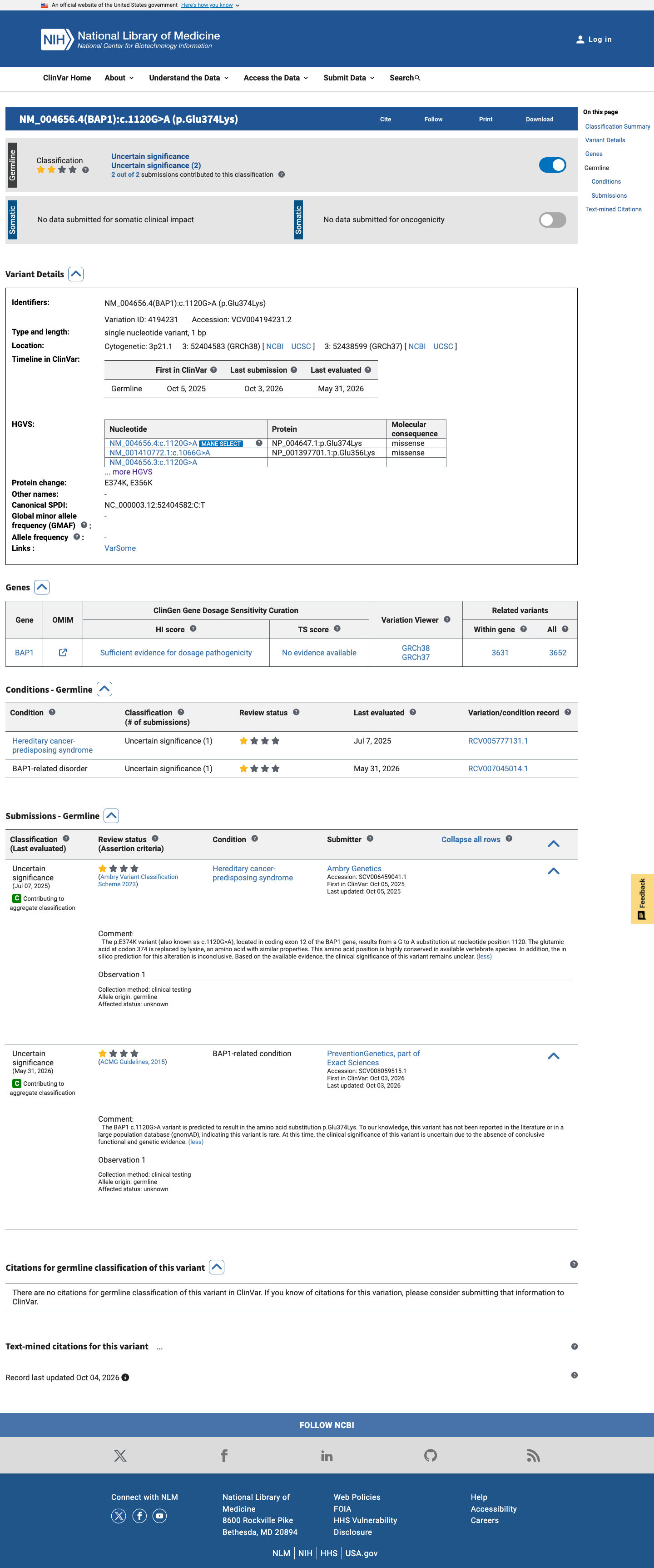
This variant has been reported in ClinVar as Uncertain significance (2 clinical laboratories). (ClinVarID = 4194231)
SpliceAI screenshot
In silico
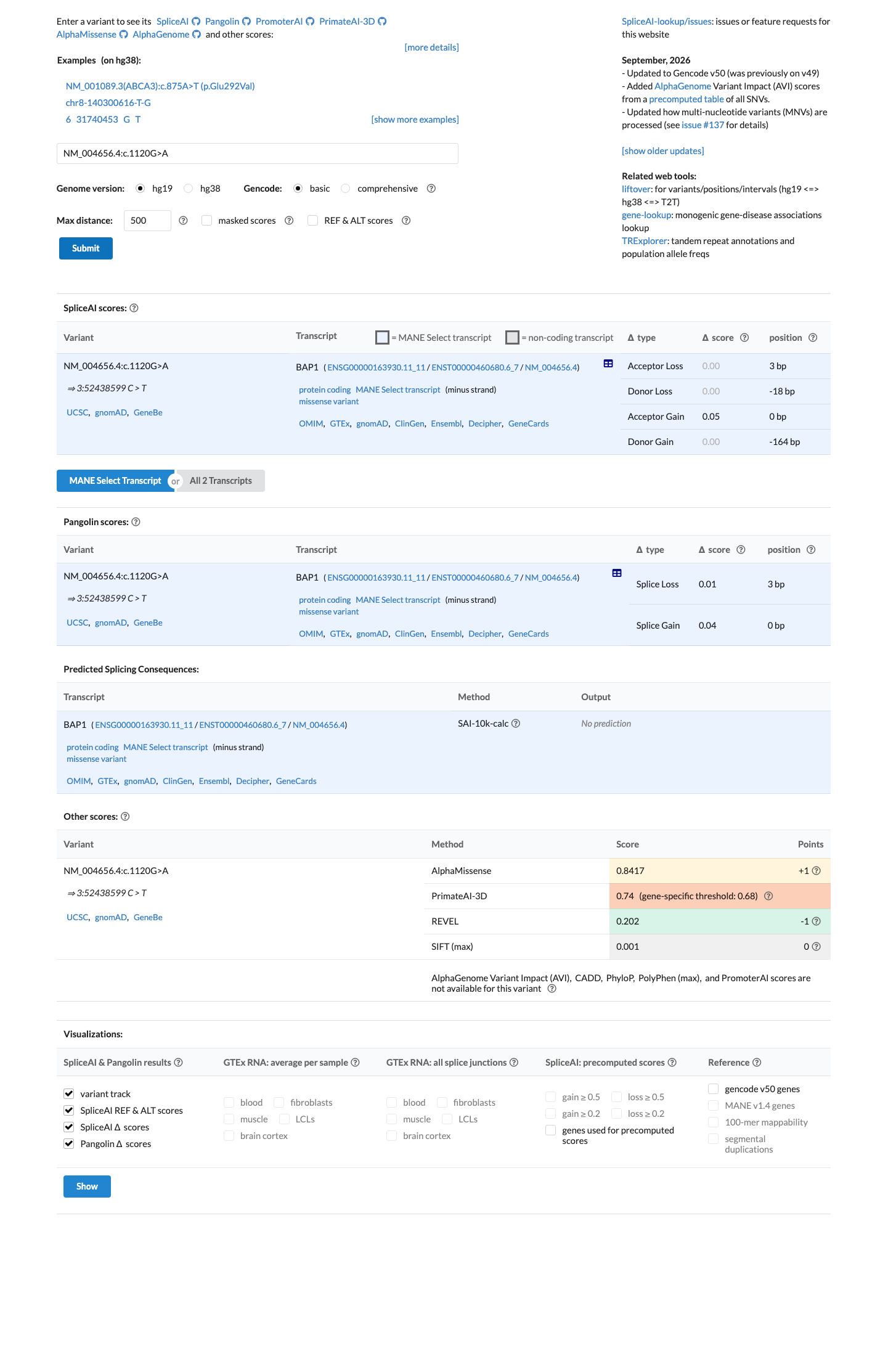
SpliceAI predicts no significant splice impact for this variant (max delta score = 0.05). REVEL score = 0.202. BayesDel score = -0.131441.
Functional / OncoKB screenshot
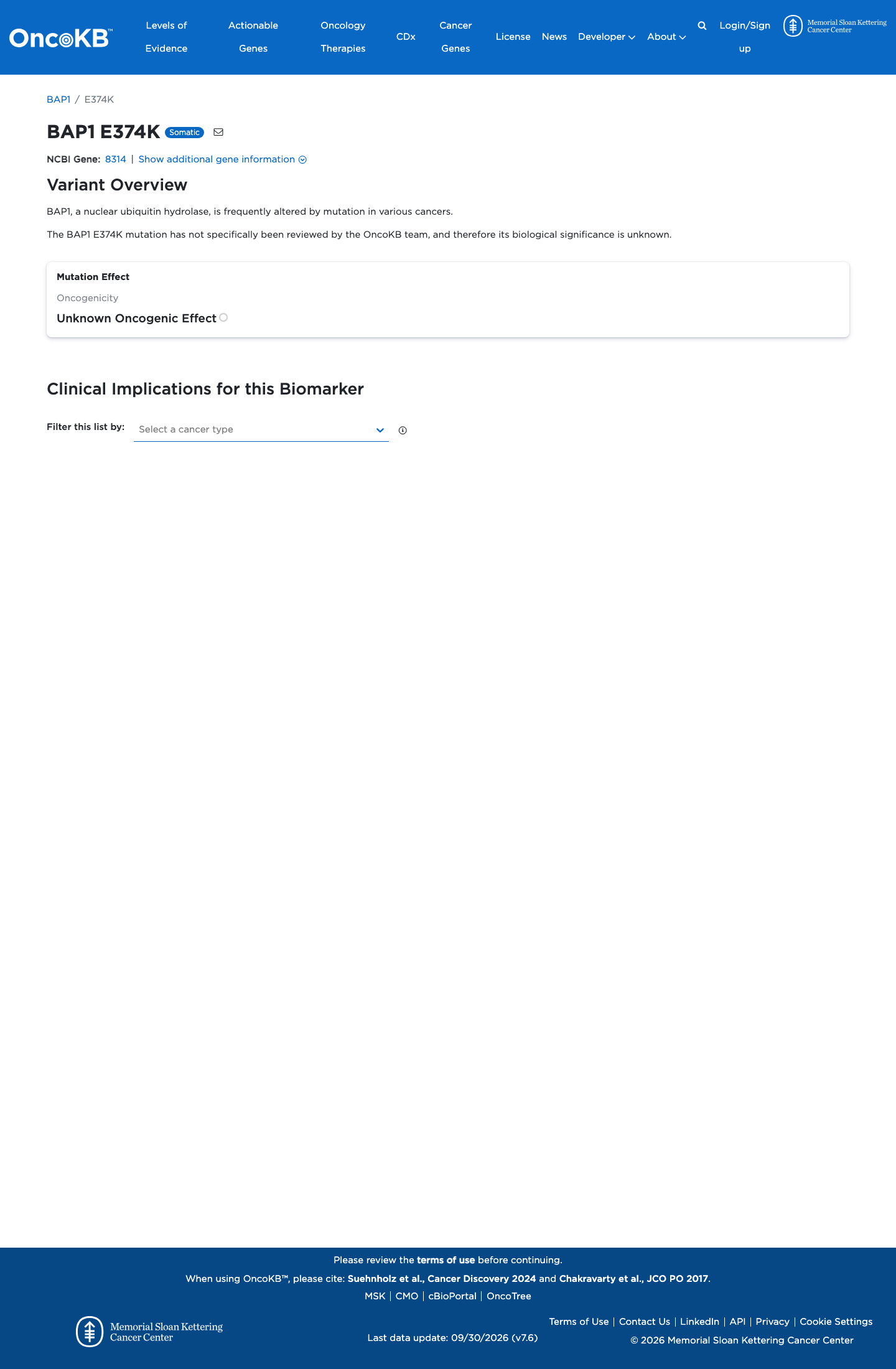
Functional Unknown Oncogenic Effect
OncoKB did not identify variant-specific reviewed functional evidence for this variant; gene-level curated context is available for reviewer follow-up. BAP1, a nuclear ubiquitin hydrolase, is frequently altered by mutation in various cancers.
OncoKB ↗
COSMIC screenshot
COSMIC
Cancer hotspots screenshot
Cancer hotspots
Somatic evidence Not in COSMIC / hotspots
COSMIC
This variant does not lie in a statistically significant hotspot. This variant has not previously been reported in somatic cancers (COSMIC).
Hotspots
This variant does not lie in a statistically significant hotspot.
Literature · how each cited paper was used
1papers cited
Each card is an audit: what was searched, what was found, whether it names the variant, which criteria it fed, and why. 1 further PMID triaged but not cited — see Sources & references.
Rule & framework references · cited for criterion definitions, not variant evidence
25741868 ↗ Standards and guidelines for the interpretation of sequence variants: a joint consensus recommendation of the American College of Medical Genetics and Genomics and the Association for Molecular Pathology.
Sources & reference links
8Sources
ClinVar
gnomAD v2.1
gnomAD v4.1
gnomAD-Canada
SpliceAI
OncoKB
COSMIC
Cancer hotspots
Triaged references · 1 PMID not cited in assessment
25394175 ↗ A practice guideline from the American College of Medical Genetics and Genomics and the National Society of Genetic Counselors: referral indications for cancer predisposition assessment. CLINVAR