Back
NM_004656.4:c.121G>A
p.Gly41Ser · BAP1
ACMG/AMP
0%
complete
Final classification
Likely Benign
BS4BP4
BAP1
c.121G>A
p.Gly41Ser
missense · exon 3

BAP1 encodes a nuclear deubiquitinating enzyme that removes ubiquitin from proteins and helps regulate cell proliferation, DNA repair, chromatin remodeling, gene expression, and cell cycle progression. It acts as a tumor suppressor, in part through its interaction with BRCA1. Germline mutations in BAP1 cause a hereditary tumor predisposition syndrome associated with increased risk of malignant mesothelioma, uveal melanoma, cutaneous melanoma, and renal cell carcinoma. Somatic BAP1 mutations are also common in these tumor types, highlighting its key role in cancer.

This variant

BAP1 is a tumor-suppressor gene involved in deubiquitination, DNA repair, chromatin regulation, and hereditary predisposition to mesothelioma, melanomas, and renal cell carcinoma.

Transcript
NM_004656.4
HGVS · transcript:coding
NM_004656.4:c.121G>A
GRCh38
chr3:52409555 C>T
GRCh37
chr3:52443571 C>T
Likely Benign: BS4 (supporting) plus BP4 (supporting) provide two supporting benign criteria under the generic ACMG/AMP fallback.
Classification rationale
BS4BP4 Likely Benign
BAP1 c.121G>A missense · exon 3

Likely Benign: BS4 supporting from discordant cosegregation in the reported family. Likely Benign: BP4 supporting from REVEL 0.072 and SpliceAI max delta 0.009 below benign-evidence thresholds.

BS4 + BP4 Likely Benign
LYFE Sciences is an AI system, and it can make mistakes. Criteria may be applied incorrectly, sources may be misread, and a confident-looking classification can still be wrong. Double-check every criterion and its underlying evidence before relying on any call.
Gene diagram · NM_004656.4 · variants mapped to exon structure
BAP1 NM_004656.4
Fetching transcript structure from UCSC…
Applied criteria · 2 applied · 21 assessed
MetEvidence satisfies this criterion.
Not metEvaluated against available evidence; threshold not reached.
Not assessedApplies in principle, but no evidence was found to evaluate it.
N/ADoesn't apply to this variant type.
Applied · 2
Strength Supporting Moderate Strong Very strong
BS4 supporting review Benign
Met, supporting: cosegregation studies suggested c.121G>A (p.G41S) did not track with the family's cancer predisposition.
PMID:23709298 reports the exact variant in individual II:1 in a family with two first-degree and one second-degree relatives with renal cell carcinoma.PMID:23709298 states that cosegregation studies suggested the variant was not responsible for the family's cancer predisposition, which is consistent with lack of segregation in affected relatives and supports BS4.
BP4 supporting Benign
Met at supporting: REVEL 0.072 is <=0.29 and SpliceAI max delta 0.009 is <=0.1, meeting calibrated BP4 thresholds.
Variant scope: NM_004656.4:c.121G>A is a missense substitution producing NP_004647.1:p.(Gly41Ser), so BP4 is applicable.REVEL score 0.072 meets the generic BP4 supporting threshold of <=0.29; threshold from the ClinGen SVI REVEL calibration (Pejaver et al. 2022, PMID:36413997).SpliceAI max delta 0.009 meets the generic BP4 supporting threshold of <=0.1; threshold from the SpliceAI recommended cutoff (Jaganathan et al. 2019, PMID:30661751).
Assessed · not applied · 11 not met · 10 not assessed
Pathogenic
PS1 Not met: the exact p.Gly41Ser change is reported as benign or probably benign, with no established pathogenic same-amino-acid comparator.
PS2 Not assessed: no parental testing or confirmed de novo status is documented for NM_004656.4:c.121G>A.
PS3 Not assessed: no validated functional assay with controls or quantitative activity result was reported for BAP1 p.Gly41Ser.
PS4 Not met: the exact variant was reported in one RCC-family individual, but cosegregation did not support causality and no case-control enrichment statistic is available.
PM1 Not assessed: the available review places BAP1 catalytic activity near the N-terminus but gives no precise validated boundary confirming residue 41 as a critical domain site.
PM2 Not met: gnomAD v4.1 all-comers AF 0.0003679932596520791 exceeds the generic PM2 threshold of 0.0001.
PM5 Not met: no established pathogenic alternate missense change at residue 41 was identified, and the cited Leu14His comparator is at residue 14.
PM6 Not assessed: the exact variant is reported without parental testing or a stated presumed de novo event.
PP1 Not met: cosegregation studies suggested c.121G>A (p.Gly41Ser) was not responsible for the family's cancer predisposition.
PP2 Not assessed: BAP1 missense biology is documented, but no validated gene-level benign-missense depletion metric or threshold is available for PP2.
PP3 Not met: REVEL 0.072 and SpliceAI max delta 0.009 are below PP3 supporting thresholds of 0.644 and 0.2, respectively.
PP4 Not assessed: a renal cell carcinoma family history is reported, but the patient's phenotype is not sufficiently documented to establish disease specificity.
PP5 Not met: ClinVar has no exact-variant expert-panel Pathogenic or Likely pathogenic classification; available submissions are laboratory Benign or Likely benign.
Benign
BA1 Not met: the highest observed population frequency was 0.004442121766396656, below the generic BA1 threshold of 0.05.
BS1 Not met: the highest observed population frequency was 0.004442121766396656, below the generic BS1 threshold of 0.01.
BS2 Not assessed: gnomAD reports six homozygotes, but their health status, age, and BAP1-specific phenotype are unavailable for the generic BS2 requirement.
BS3 Not assessed: no validated functional assay with controls demonstrated normal BAP1 function for p.Gly41Ser.
BP1 Not met: truncating variants account for 36% of reported BAP1 tumor mutations, while functional effects are documented for multiple missense variants.
BP2 Not assessed: the reported c.121G>A family study provides no identified pathogenic partner variant or confirmed cis/trans phase required for BP2.
BP5 Not assessed: the report notes negative germline VHL testing, but provides no alternative pathogenic molecular cause explaining an affected patient's phenotype.
BP6 Not met: ClinVar has no exact-variant expert-panel Benign or Likely benign classification; available benign labels are ordinary laboratory submissions.
N/A · 5 PVS1 · PM3 · PM4 · BP3 · BP7
Research & evidence
Population frequency · supports benign
gnomAD v4.1 screenshot
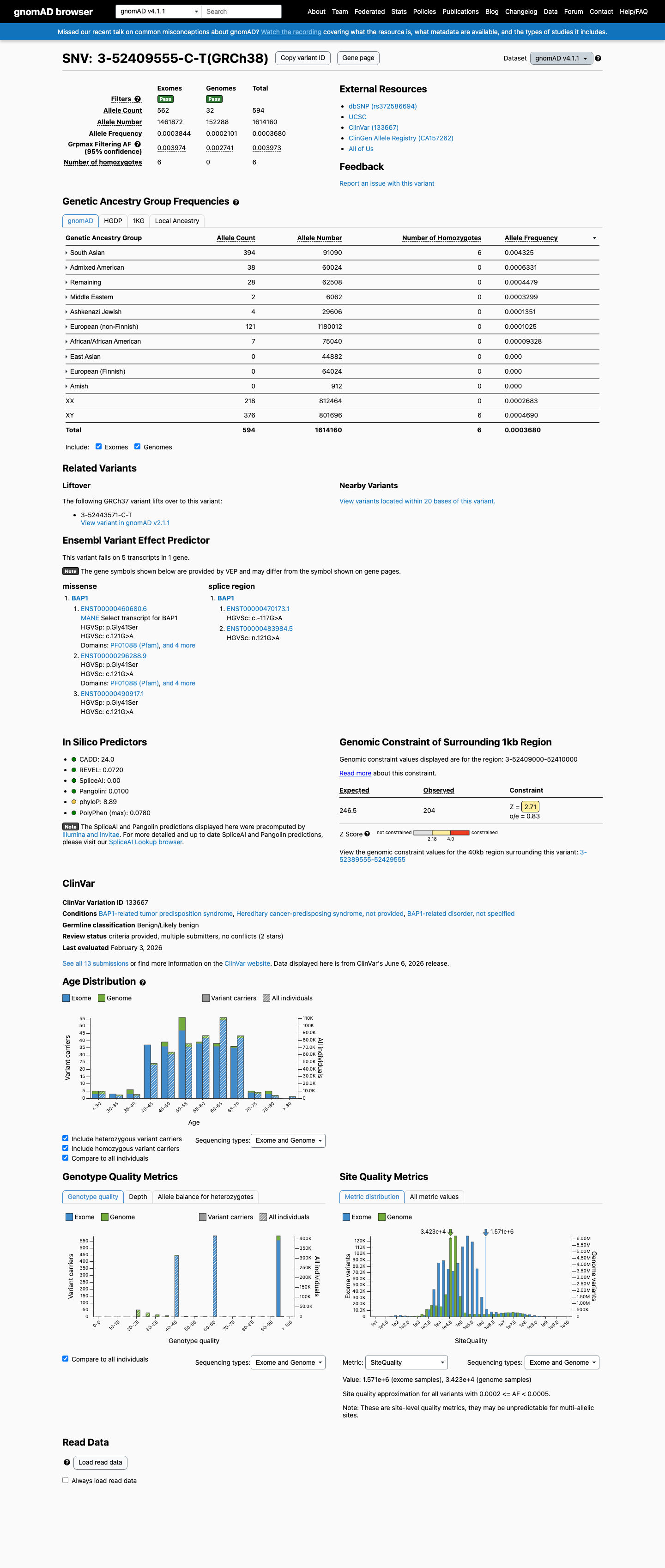
gnomAD v4.1
gnomAD v2.1 screenshot
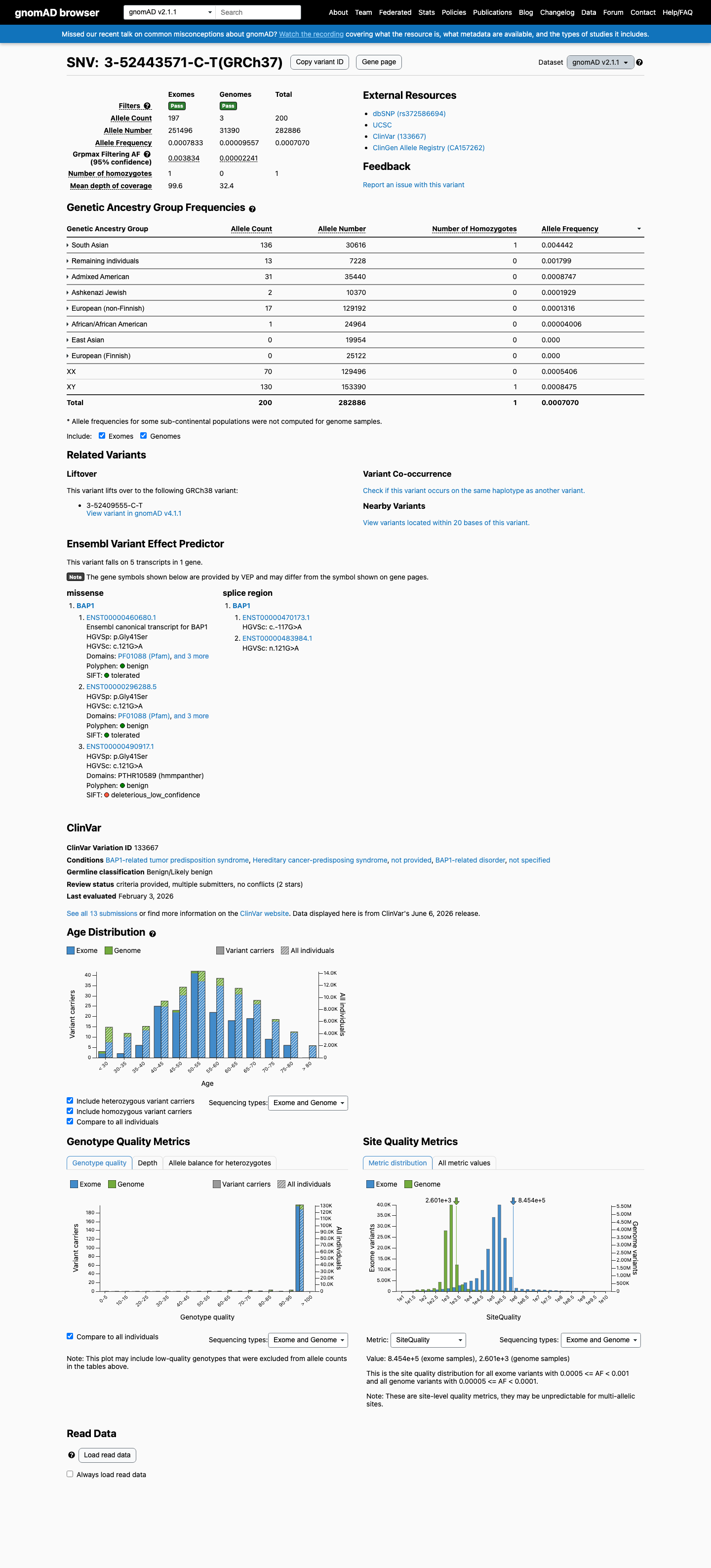
gnomAD v2.1
v4.1
This variant is present in gnomAD v4.1 (AF= 0.000367993; MAF= 0.03680%, 594/1614160 alleles, homozygotes = 6) and has highest observed frequency in the South Asian population (AF= 0.00432539; MAF= 0.43254%, 394/91090 alleles, homozygotes = 6); grpmax FAF= 0.00397315.
v2.1
This variant is present in gnomAD v2.1 (AF= 0.000706999; MAF= 0.07070%, 200/282886 alleles, homozygotes = 1) and has highest observed frequency in the South Asian population (AF= 0.00444212; MAF= 0.44421%, 136/30616 alleles, homozygotes = 1); grpmax FAF= 0.00383396.
🇨🇦 CA
Not available in gnomAD-Canada v1.0.
Allele frequency by ancestry
three datasets · side by side
gnomAD v4.1
0.037% · 594 / 1,614,160
6 hom · FAF 0.4%
South Asian
394 / 91,090
0.43%
6 hom
Admixed American
38 / 60,024
0.063%
Remaining individuals
28 / 62,508
0.045%
Middle Eastern
2 / 6,062
0.033%
Ashkenazi Jewish
4 / 29,606
0.014%
European (non-Finnish)
121 / 1,180,012
0.01%
African/African American
7 / 75,040
0.0093%
+ 3 not observed (European (Finnish), Amish, East Asian)
gnomAD v2.1
0.071% · 200 / 282,886
1 hom · FAF 0.38%
South Asian
136 / 30,616
0.44%
1 hom
Remaining individuals
13 / 7,228
0.18%
Admixed American
31 / 35,440
0.087%
Ashkenazi Jewish
2 / 10,370
0.019%
European (non-Finnish)
17 / 129,192
0.013%
African/African American
1 / 24,964
0.004%
+ 2 not observed (East Asian, European (Finnish))
gnomAD Canada 🇨🇦
Absent · 0 / ?
0 hom
Not observed in any ancestry group.
ClinVar screenshot
ClinVar
This variant has been reported in ClinVar as Benign (6 clinical laboratories) and as Likely benign (5 clinical laboratories). (ClinVarID = 133667)
SpliceAI screenshot
In silico
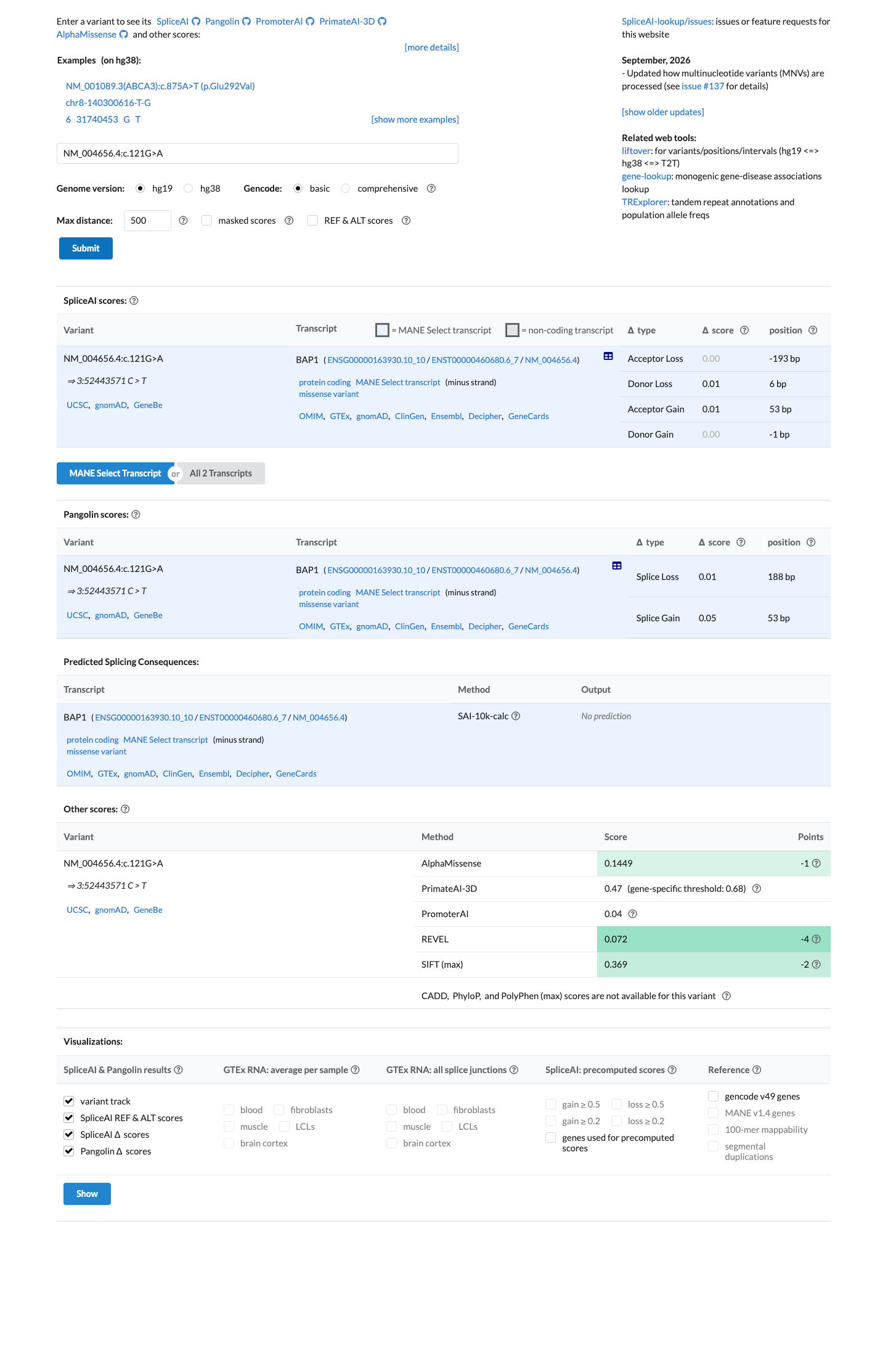
SpliceAI predicts no significant splice impact for this variant (max delta score = 0.01). REVEL score = 0.072. BayesDel score = -0.479536.
Functional / OncoKB screenshot
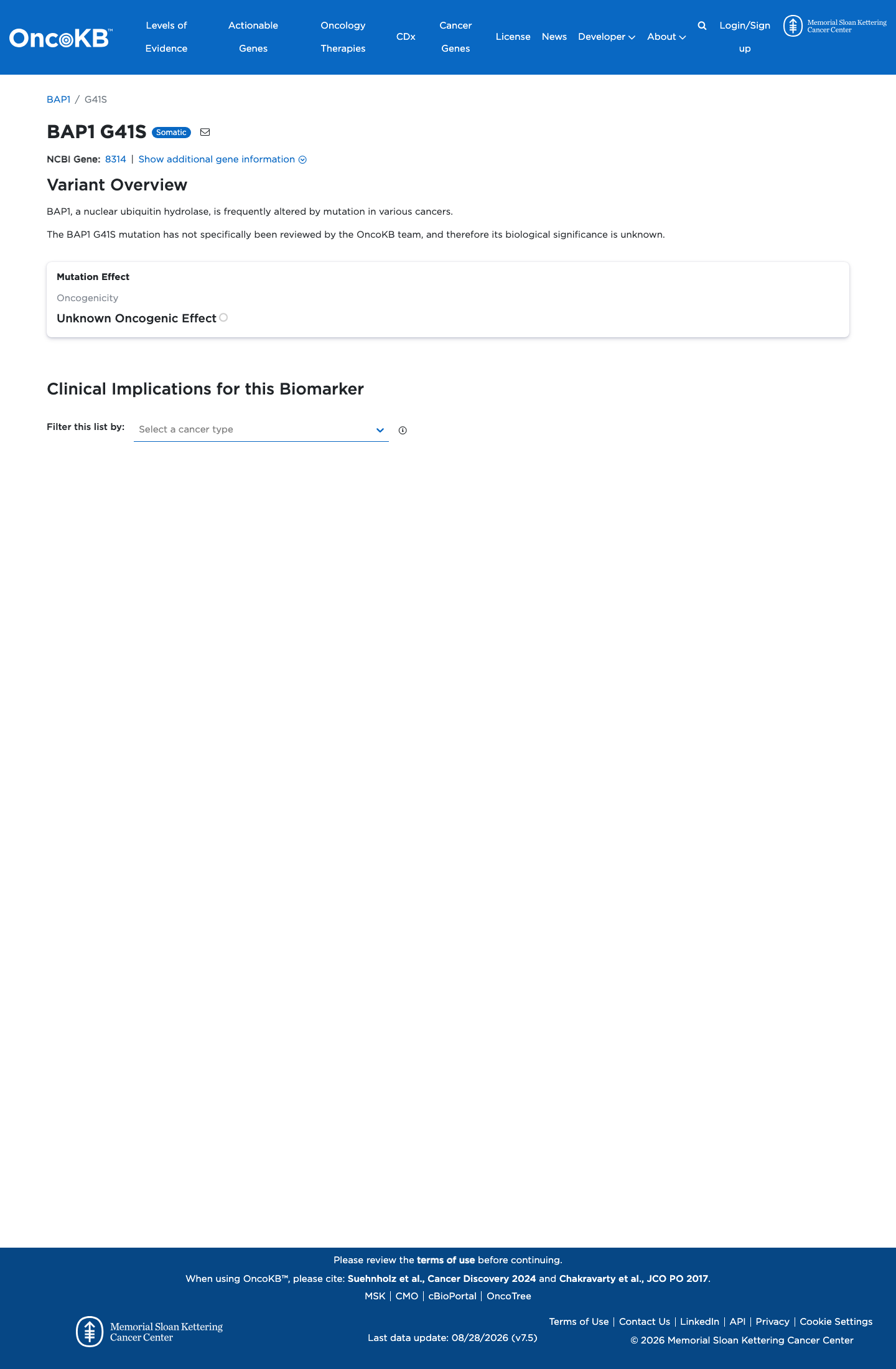
Functional Unknown Oncogenic Effect
OncoKB did not identify variant-specific reviewed functional evidence for this variant; gene-level curated context is available for reviewer follow-up. BAP1, a nuclear ubiquitin hydrolase, is frequently altered by mutation in various cancers.
OncoKB ↗
COSMIC screenshot
COSMIC
Cancer hotspots screenshot
Cancer hotspots
Somatic evidence Not in COSMIC / hotspots
COSMIC
This variant does not lie in a statistically significant hotspot. This variant has not previously been reported in somatic cancers (COSMIC).
Hotspots
This variant does not lie in a statistically significant hotspot.
Literature · how each cited paper was used
1papers cited
Each card is an audit: what was searched, what was found, whether it names the variant, which criteria it fed, and why. 8 further PMIDs triaged but not cited — see Sources & references.
A novel germline mutation in BAP1 predisposes to familial clear-cell renal cell carcinoma.
Searched
c.121G>Ap.G41SNP_004647.1:p.(G41S)
Found
The paper reports the exact germline BAP1 c.121G>A (p.G41S) variant, notes its absence from 1000 Genomes, and reports that cosegregation suggested it was not responsible for the family's cancer predisposition; no functional assay is reported.
Variant
✓ Names this variant — characterised directly
Applied to
BS4 supporting
The reported cosegregation analysis suggested the variant did not account for the family's cancer predisposition, supporting lack of segregation.
However, cosegregation studies suggested that it was not responsible for the cancer predisposition in this family.
Location Results and Discussion, opening paragraph describing the germline c.121G>A (p.G41S) finding  ·  Context Germline BAP1 sequencing in 83 unrelated individuals with familial or otherwise suspected predisposition to renal cell carcinoma, with comparison to 1000 Genomes and family cosegregation analysis.  ·  full text
Sources & reference links
8Sources
ClinVar
gnomAD v2.1
gnomAD v4.1
gnomAD-Canada
SpliceAI
OncoKB
COSMIC
Cancer hotspots
Triaged references · 8 PMIDs not cited in assessment
22683710 ↗ BAP1 loss defines a new class of renal cell carcinoma. CLINVAR
25741868 ↗ Standards and guidelines for the interpretation of sequence variants: a joint consensus recommendation of the American College of Medical Genetics and Genomics and the Association for Molecular Pathology. CLINVAR
26467025 ↗ A Standardized DNA Variant Scoring System for Pathogenicity Assessments in Mendelian Disorders. CLINVAR
24728327 ↗ Germline variation in cancer-susceptibility genes in a healthy, ancestrally diverse cohort: implications for individual genome sequencing. CLINVAR
25394175 ↗ A practice guideline from the American College of Medical Genetics and Genomics and the National Society of Genetic Counselors: referral indications for cancer predisposition assessment. CLINVAR
26166446 ↗ BAP1, PBRM1 and SETD2 in clear-cell renal cell carcinoma: molecular diagnostics and possible targets for personalized therapies. CLINVAR
26554828 ↗ Gender-Specific Molecular and Clinical Features Underlie Malignant Pleural Mesothelioma. CLINVAR
28492532 ↗ Sherloc: a comprehensive refinement of the ACMG-AMP variant classification criteria. CLINVAR