This variant was interpreted by pipeline
7.1.0.
The current version is
8.0.0.
Re-running queues a fresh interpretation; the result replaces this page when complete.
Re-runs are not free. Blank = draws on today's public interpretation allowance.
With a code = uses 1 of that code's uses.
BAP1 encodes a nuclear deubiquitinating enzyme that removes ubiquitin from proteins and helps regulate cell proliferation, DNA repair, chromatin remodeling, gene expression, and cell cycle progression. It acts as a tumor suppressor, in part through its interaction with BRCA1. Germline mutations in BAP1 cause a hereditary tumor predisposition syndrome associated with increased risk of malignant mesothelioma, uveal melanoma, cutaneous melanoma, and renal cell carcinoma. Somatic BAP1 mutations are also common in these tumor types, highlighting its key role in cancer.
This variant
BAP1 is a tumor suppressor whose germline mutations predispose to mesothelioma, uveal and cutaneous melanoma, and renal cell carcinoma. This synonymous variant (p.Pro42=) is classified as a Variant of Uncertain Significance: its extremely low population frequency is consistent with a possible disease role, but no functional, segregation, or de novo evidence establishes whether it disrupts BAP1's tumor-suppressor function.
Transcript
NM_004656.4
HGVS · transcript:coding
NM_004656.4:c.126T>C
GRCh38
chr3:52408603 A>G
GRCh37
chr3:52442619 A>G
VUS: only PM2 (Supporting) is met - gnomAD v4.1 total AF 3.10757e-06, absent from gnomAD v2.1 - and a single supporting criterion reaches no ACMG/AMP 2015 Pathogenic or Benign combination threshold.
Classification rationale
PM2VUS
BAP1 c.126T>C
PM2 (Supporting): gnomAD v4.1 total AF 3.10757e-06 (5/1,608,972 alleles) with zero homozygotes, absent from gnomAD v2.1, more than 30-fold below the 0.1% pathogenic-support threshold. Variant of Uncertain Significance: the single supporting pathogenic criterion (PM2) satisfies no ACMG/AMP 2015 Pathogenic or Benign combination threshold.
PM2→VUS
LYFE Sciences is an AI system, and it can make mistakes. Criteria
may be applied incorrectly, sources may be misread, and a confident-looking
classification can still be wrong. Double-check every criterion and
its underlying evidence before relying on any call.
Gene diagram
· NM_004656.4 · variants mapped to exon structure
BAP1NM_004656.4
Fetching transcript structure from UCSC…
Exons
—
Transcript span
—
Strand
—
Variants mapped
—
Source
UCSC ncbiRefSeqCurated
All variants in BAP1—click a row to locate it on the plot · use the link column to open its page
Protein
Location
Classification
Link
Applied criteria · 1 applied · 18 assessed
MetEvidence satisfies this criterion.
Not metEvaluated against available evidence; threshold not reached.
Not assessedApplies in principle, but no evidence was found to evaluate it.
N/ADoesn't apply to this variant type.
Applied · 1
Strength Supporting Moderate Strong Very strong
✓
PM2supportingPathogenic
Met (Supporting): present in gnomAD v4.1 at total AF 3.10757e-06 (5/1,608,972 alleles) and absent from gnomAD v2.1, more than 30-fold below the 0.1% threshold.
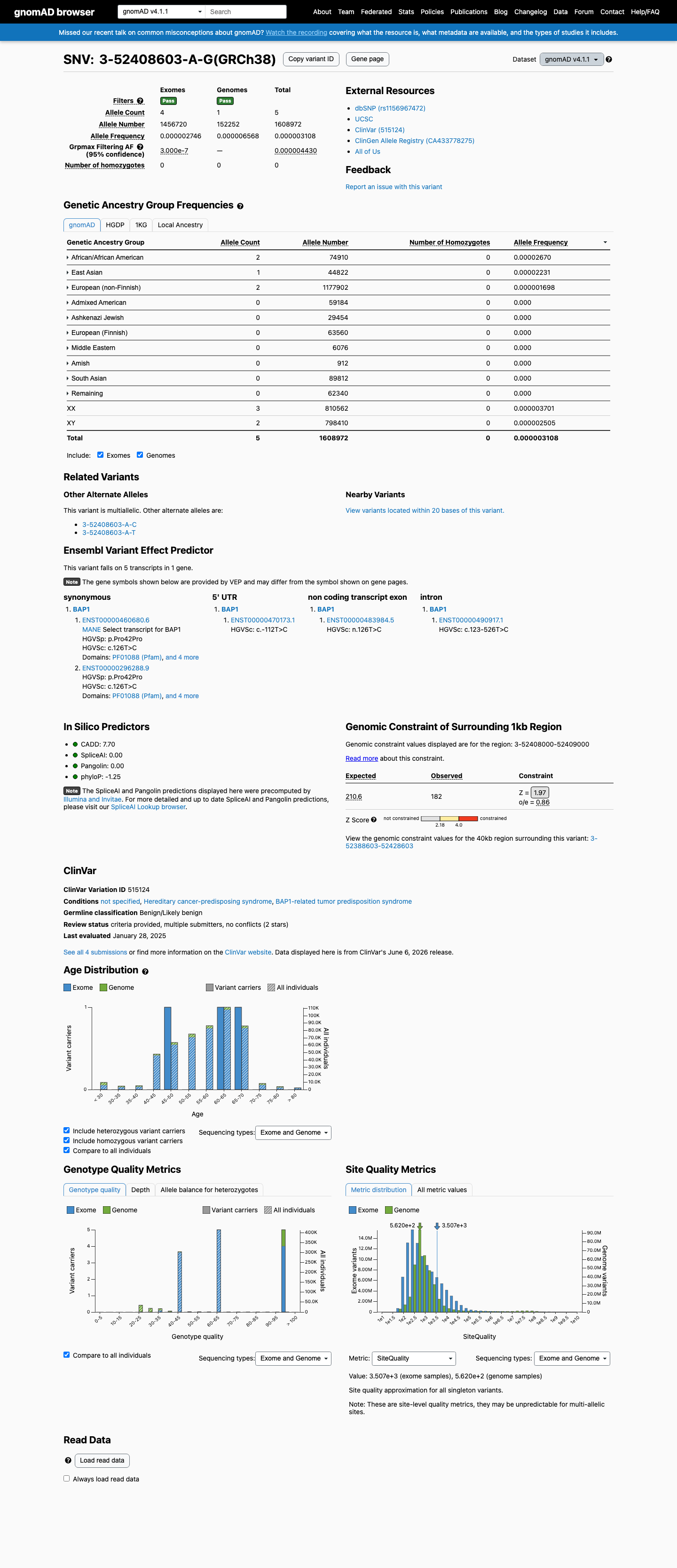
gnomAD v4.1 (gnomad_v4): total AF 3.10757e-06 (0.00031%; 5/1,608,972 alleles), exome AF 2.74589e-06, genome AF 6.56806e-06, grpmax FAF 4.43e-06, 0 homozygotes; highest subpopulation AF 2.66987e-05 (AFR, 0.00267%)gnomAD v2.1 (gnomad_v2): variant absentPM2 per ACMG/AMP 2015 (PMID 25741868): absent in controls or at extremely low frequency; pipeline non-VCEP operating threshold PM2 < 0.1% — all observed frequencies are >30-fold below the threshold
Assessed · not applied
· 8 not met · 10 not assessed
Pathogenic
PS2Not assessed: no de novo occurrence or parental testing for this variant is reported in any ClinVar submission or publication.
PS3Not assessed: no functional assay evidence for this variant was available in any source.
PS4Not assessed: no case-control or cohort prevalence data for this variant exists; only population frequencies were available.
PM6Not assessed: no de novo occurrence of this variant is reported in any source, with or without confirmed parentage.
PP1Not assessed: no co-segregation data in affected family members exists for this variant in any ClinVar submission or publication.
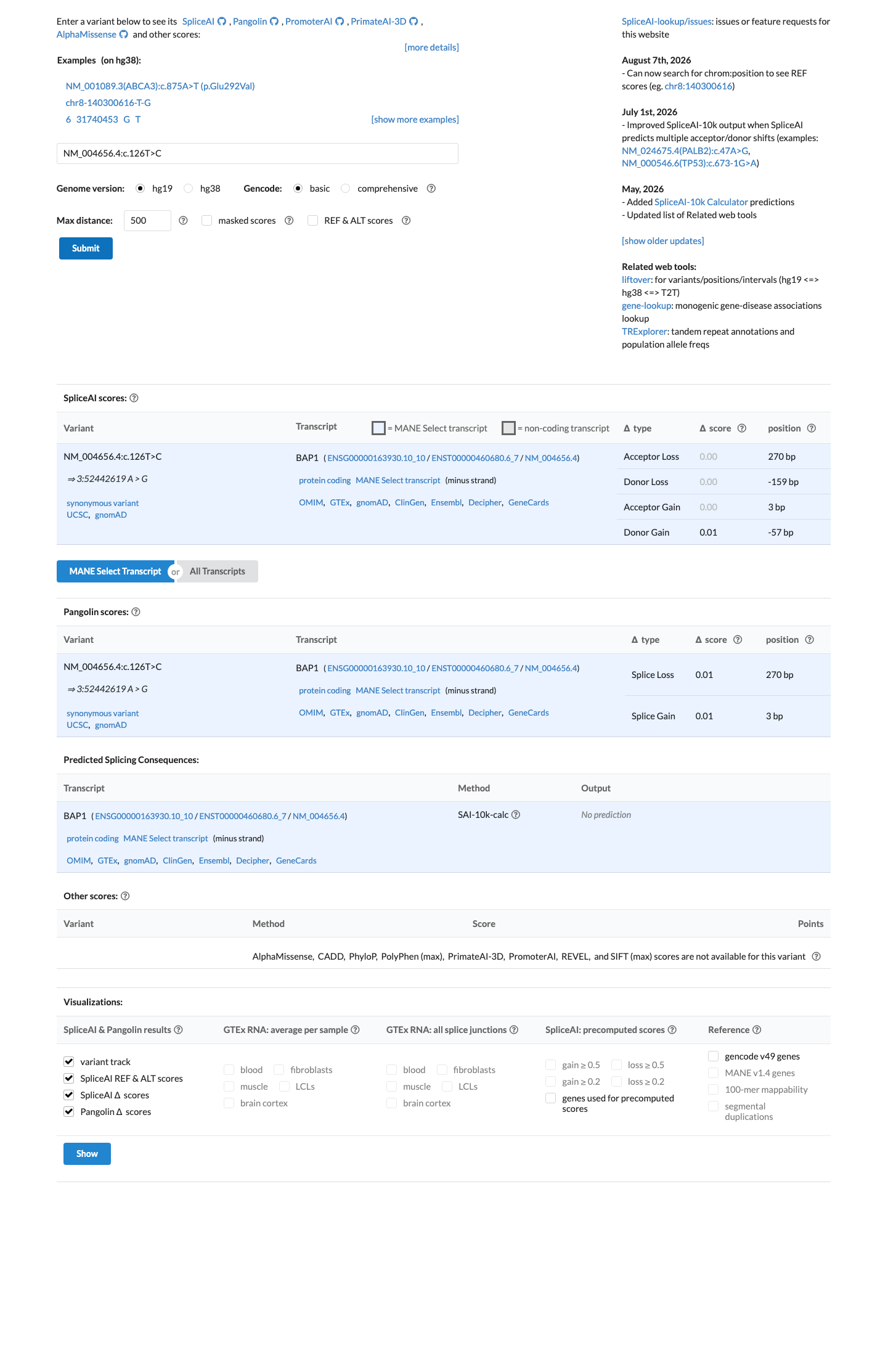
PP3Not met: SpliceAI max delta score 0.01 versus the 0.2 recommended splice-impact threshold, and no other predictor indicates a deleterious effect.
PP4Not assessed: no proband phenotype or family history data was available to evaluate phenotype specificity.
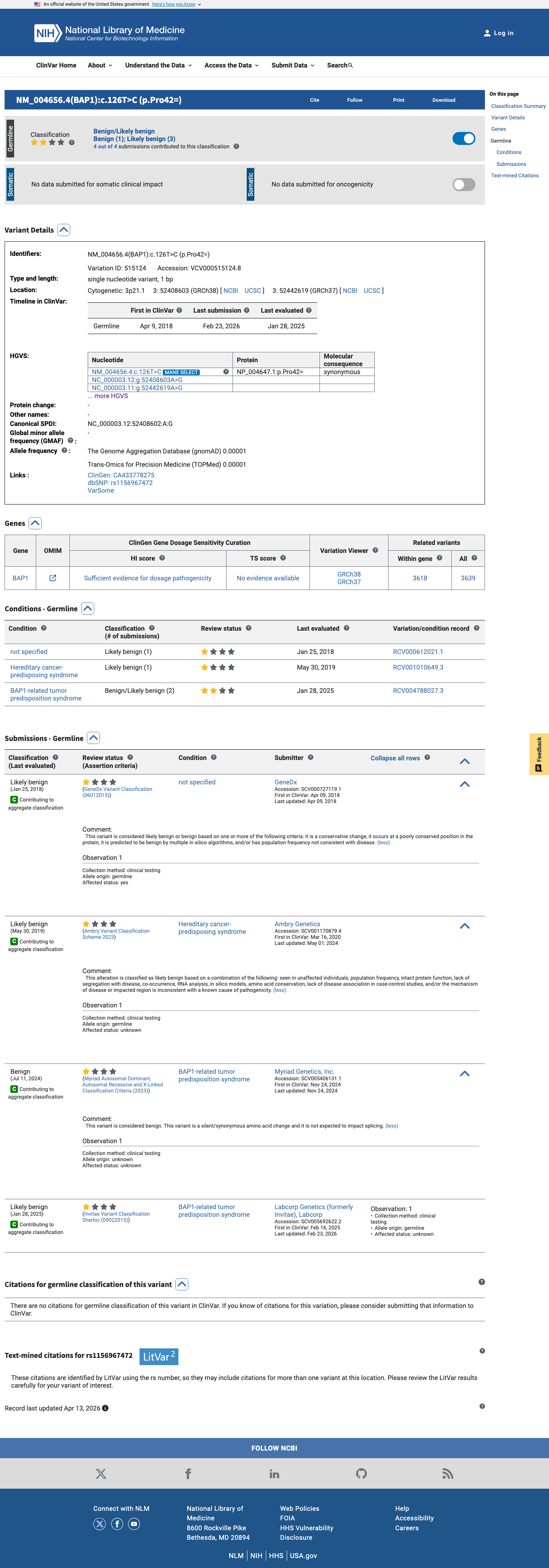
PP5Not met: the ClinVar record has zero expert-panel submissions, so no expert-panel Pathogenic/Likely pathogenic classification exists for this variant.
Benign
BA1Not met: highest observed allele frequency 0.00267% (African/African American) versus the 1% stand-alone benign threshold.
BS1Not met: maximum allele frequency 0.00267% versus the 0.3% threshold for this rare dominant cancer predisposition syndrome.
BS2Not met: gnomAD v4.1 reports zero homozygotes (0/1,608,972 alleles) and no healthy-adult enrichment was observed.
BS3Not assessed: no well-established functional study of this variant was available; the SpliceAI prediction is in-silico, not a functional assay.
BS4Not assessed: no family segregation data of any kind exists to evaluate non-segregation.
BP2Not met: no source reports this variant in trans or cis with a pathogenic variant.
BP4Not met: only one line of computational evidence is available (SpliceAI delta 0.01), while BP4 requires multiple concordant lines.
BP5Not assessed: no case-level data exists to identify an alternate molecular basis for disease.
BP6Not met: the ClinVar record has zero expert-panel submissions, so no expert-panel Benign/Likely benign classification exists for this variant.
BP7Not assessed: no splice impact is predicted (SpliceAI delta 0.01), but the required nucleotide-conservation data was unavailable.
This variant is present in gnomAD v4.1 (AF= 3.10757e-06; MAF= 0.00031%, 5/1608972 alleles, homozygotes = 0) and has highest observed frequency in the African/African American population (AF= 2.66987e-05; MAF= 0.00267%, 2/74910 alleles, homozygotes = 0); grpmax FAF= 4.43e-06.
v2.1
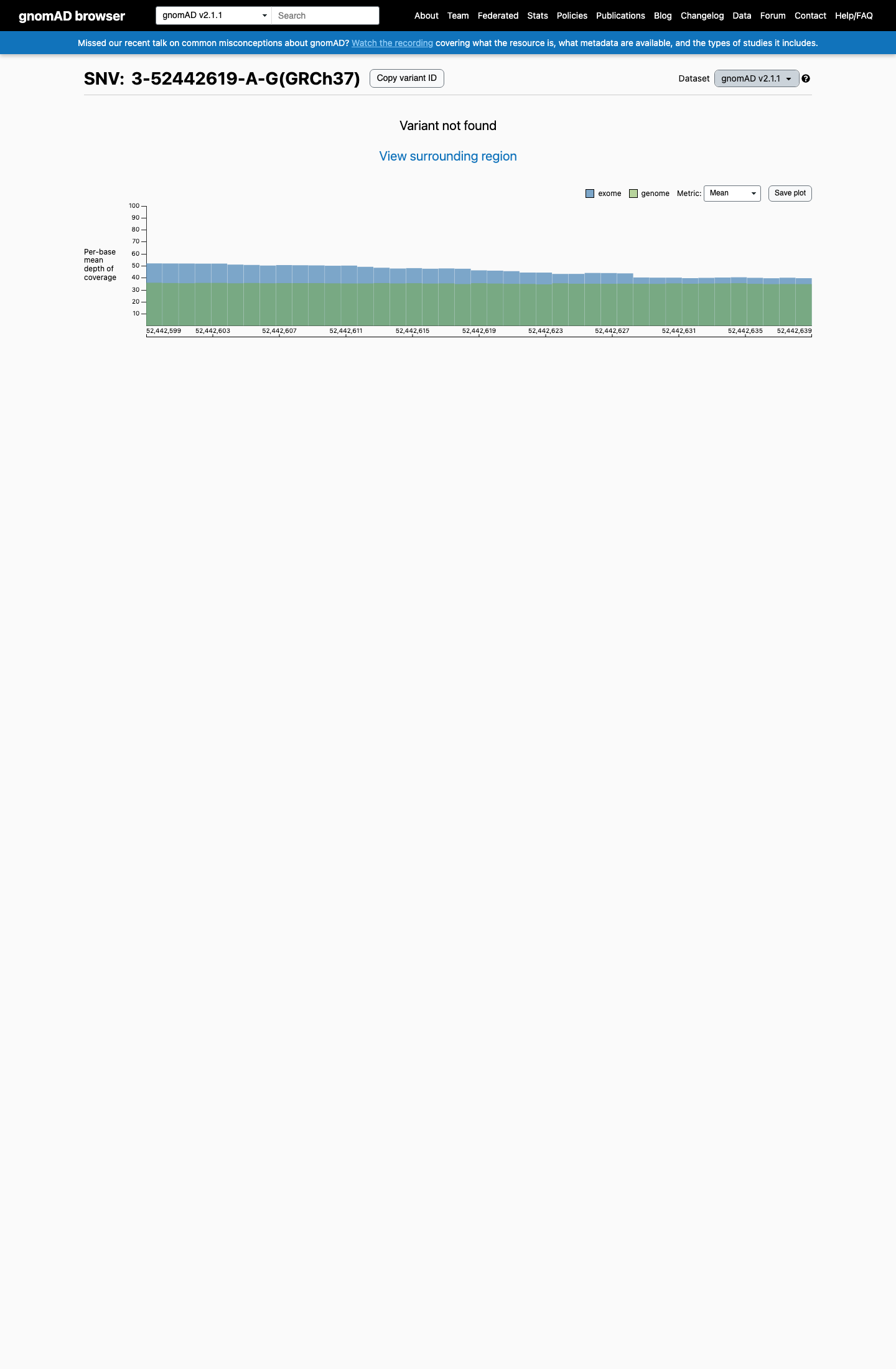
Absent from gnomAD v2.1.
🇨🇦 CA
Not available in gnomAD-Canada v1.0.
Allele frequency by ancestry
three datasets · side by side
gnomAD v4.1
0.00031%
· 5 / 1,608,972
0 hom · FAF 0.00044%
African/African American
2 / 74,910
0.0027%
East Asian
1 / 44,822
0.0022%
European (non-Finnish)
2 / 1,177,902
0.00017%
+ 7 not observed (Remaining individuals, Admixed American, European (Finnish), Amish, Middle Eastern, South Asian, Ashkenazi Jewish)
Triaged references · 3 PMIDs not cited in assessment
25394175 ↗A practice guideline from the American College of Medical Genetics and Genomics and the National Society of Genetic Counselors: referral indications for cancer predisposition assessment.CLINVAR