Back
NM_005228.5:c.2573T>G
p.Leu858Arg · EGFR
ACMG/AMP
0%
complete
Final classification
Pathogenic
PS3PM1PM2PP3BP4
EGFR
c.2573T>G
p.Leu858Arg
missense · exon 21

The EGFR gene encodes the epidermal growth factor receptor, a cell-surface protein that binds growth factors of the EGF family and, upon activation, dimerizes and triggers signaling pathways that drive cell proliferation, migration, and differentiation. EGFR is an oncogene: normally expressed at low levels in adult tissues, it becomes hyperactivated through mutation or gene amplification in many cancer types, including lung, brain, colorectal, and head and neck cancers. In non-small cell lung cancer, such activation can make tumors responsive to EGFR tyrosine kinase inhibitor drugs, although resistance can develop during treatment. EGFR has also been implicated in the excessive inflammatory response (cytokine storm) associated with severe COVID-19.

This variant

EGFR encodes a receptor tyrosine kinase whose activating alterations drive proliferative signaling and can confer sensitivity to EGFR tyrosine-kinase inhibitors in non-small-cell lung cancer.

Transcript
NM_005228.5
HGVS · transcript:coding
NM_005228.5:c.2573T>G
GRCh38
chr7:55191822 T>G
GRCh37
chr7:55259515 T>G
Pathogenic: PS3 (strong) and PP3 (strong), with PM1 (moderate) and PM2 (supporting), meet generic ACMG/AMP criteria despite BP4 (supporting).
Classification rationale
PS3PM1PM2PP3 BP4 Pathogenic
EGFR c.2573T>G missense · exon 21

Pathogenic: independent functional studies show altered EGFR signaling and substantially increased TKI sensitivity for L858R. Pathogenic: L858R lies in the EGFR tyrosine-kinase domain and a statistically significant cancer hotspot. Pathogenic: the variant is absent from gnomAD v2.1 and v4.1, supporting extreme rarity. Pathogenic: REVEL 0.961 exceeds the calibrated PP3 strong threshold of 0.932. Applied benign evidence: SpliceAI max delta 0.013 supports BP4, but does not override two strong pathogenic criteria.

PS3 + PM1 + PM2 + PP3 + BP4 Pathogenic
LYFE Sciences is an AI system, and it can make mistakes. Criteria may be applied incorrectly, sources may be misread, and a confident-looking classification can still be wrong. Double-check every criterion and its underlying evidence before relying on any call.
Gene diagram · NM_005228.5 · variants mapped to exon structure
EGFR NM_005228.5
Fetching transcript structure from UCSC…
Applied criteria · 5 applied · 19 assessed
MetEvidence satisfies this criterion.
Not metEvaluated against available evidence; threshold not reached.
Not assessedApplies in principle, but no evidence was found to evaluate it.
N/ADoesn't apply to this variant type.
Applied · 5
Strength Supporting Moderate Strong Very strong
PS3 strong Pathogenic
Met at strong: EGFR L858R showed altered phosphorylation and approximately 10-fold greater TKI sensitivity than wild type in one study, with independent signaling inhibition in another.
PMID:15329413 reports variant-specific testing of EGFR L858R and wild type in transiently transfected 293T cells, with distinct cellular protein tyrosine phosphorylation and inhibition by gefitinib and erlotinib at approximately 10-fold lower concentrations for L858R than wild type.PMID:15118125 reports an EGFR L858R-bearing H3255 lung adenocarcinoma cell line that was approximately 50 times more sensitive to gefitinib than three wild-type-EGFR cell lines; 100 nM gefitinib completely inhibited EGFR autophosphorylation and downstream ERK1/2 and AKT phosphorylation.The generic ACMG/AMP fallback was used because no EGFR-specific VCEP/CSPEC specification was available; the strength reflects concordant variant-specific assays, wild-type controls, orthogonal signaling readouts, and biologically relevant lung-cancer cellular models.
PM1 moderate Pathogenic
Met, moderate: EGFR L858R is residue 858 in the tyrosine kinase domain and lies in a statistically significant hotspot.
Cancer Hotspots reports that EGFR L858 lies in a statistically significant hotspot.PMID:15897572 identifies L858R as a mutation in the EGFR tyrosine kinase domain.PMID:34526717 describes L858R as a classical EGFR mutation with characteristic sensitivity to EGFR tyrosine kinase inhibitors.
PM2 supporting Pathogenic
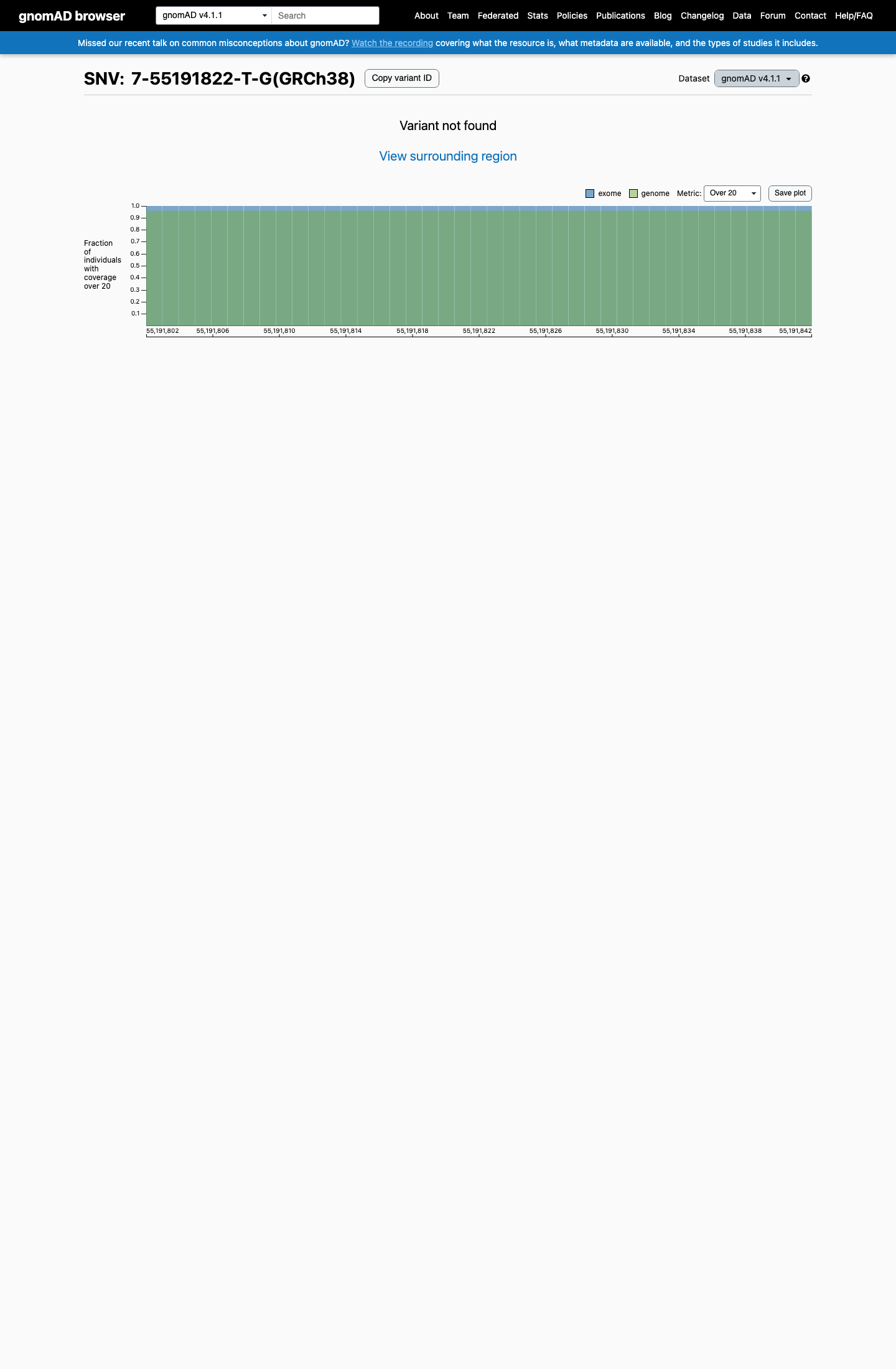
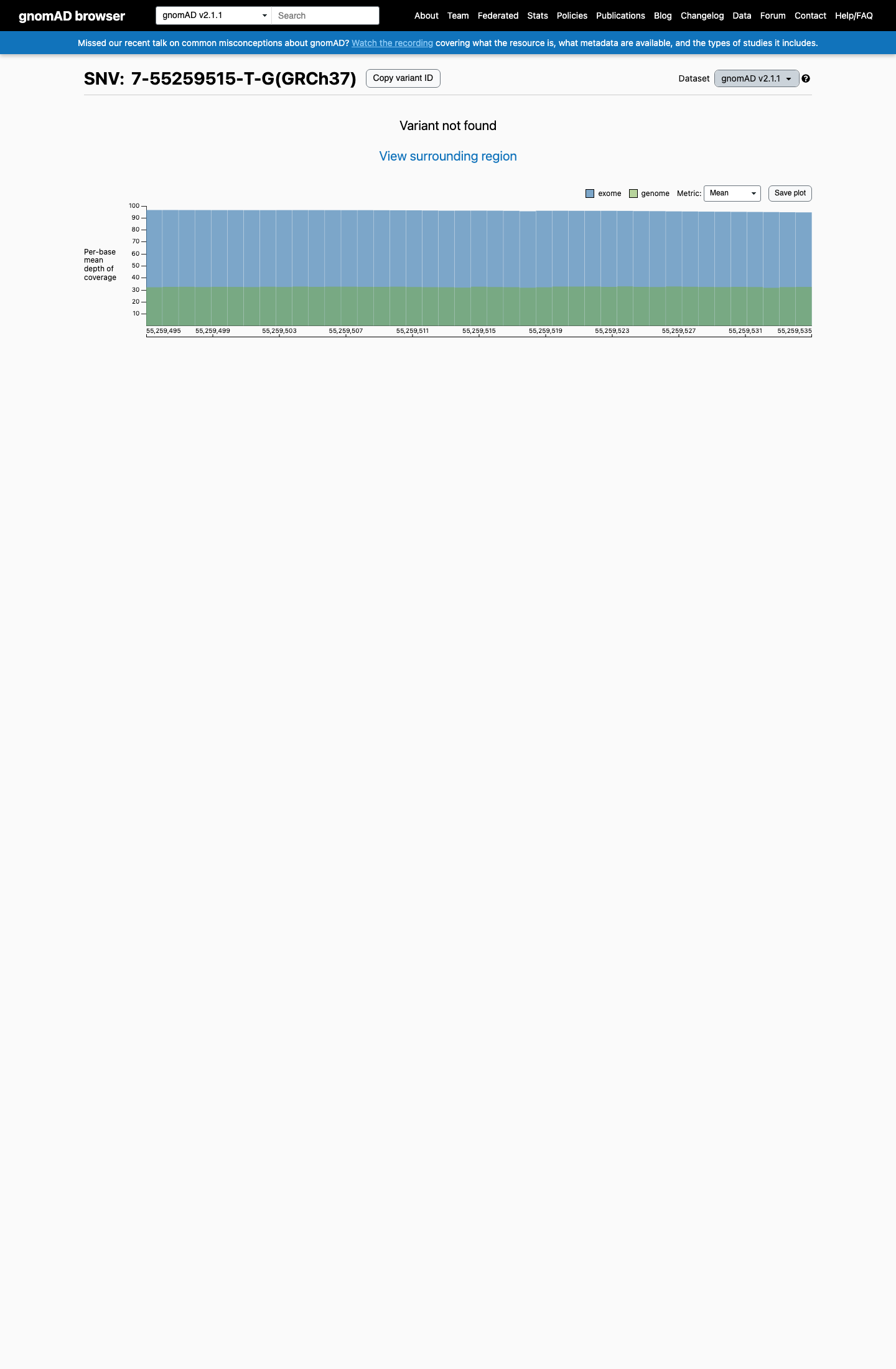
Met at supporting: the variant is absent from gnomAD v2.1 and v4.1, consistent with an allele frequency <=0.0001 for PM2.
gnomAD v2.1 all-comers reports the variant as absent.gnomAD v4.1 all-comers reports the variant as absent.The reported gnomAD v2.1 non-cancer and v3.1 non-cancer subset results are also absent.
PP3 strong Pathogenic
Met, strong: REVEL 0.961 exceeds the calibrated PP3 strong threshold of 0.932 for missense variants.
NM_005228.5:c.2573T>G is a missense variant encoding p.Leu858Arg, placing PP3 within scope.REVEL score 0.961 meets the supplied generic ClinGen SVI PP3 strong cutoff of >=0.932; the cutoff is from Pejaver et al. 2022 (PMID:36413997).SpliceAI max delta 0.013 does not meet the supplied PP3 supporting cutoff of >=0.2 or moderate cutoff of >=0.5; the SpliceAI result is not used to increase PP3 strength.
BP4 supporting Benign
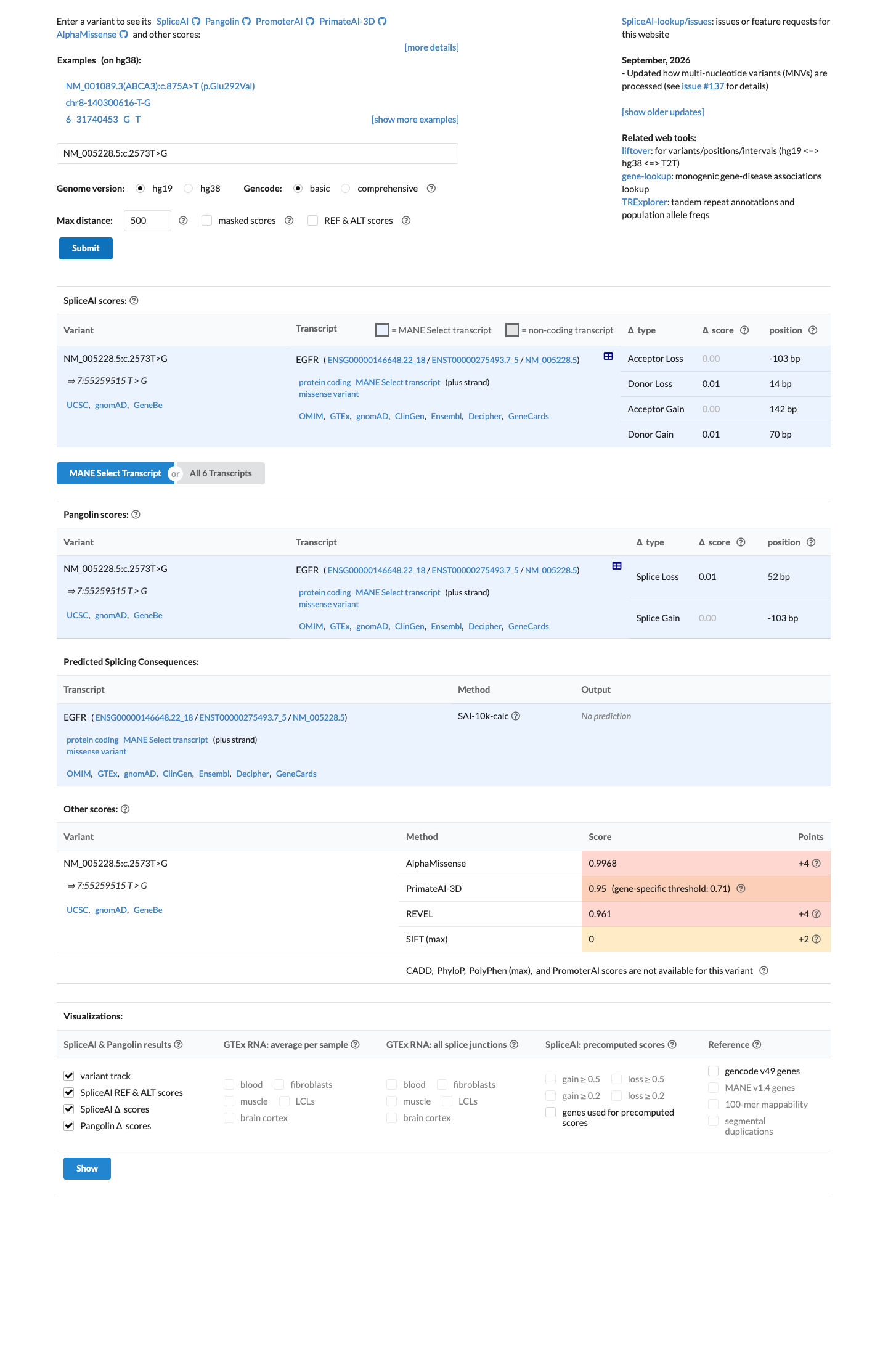
Met, supporting: SpliceAI max delta 0.013 is below the calibrated BP4 supporting threshold of 0.1 for predicted splice neutrality.
NM_005228.5:c.2573T>G is a missense variant, and BP4 permits evaluation through the SpliceAI path for this case.SpliceAI maximum delta score is 0.013, meeting the supplied generic BP4 supporting cutoff of <=0.1; the cutoff is from Jaganathan et al. 2019 (PMID:30661751).REVEL score 0.961 is discordant with benign missense impact and therefore is not used to support BP4; it is not double-counted across PP3 and BP4.
Assessed · not applied · 6 not met · 13 not assessed
Pathogenic
PS1 Not assessed: published reports confirm EGFR p.Leu858Arg but do not establish an independent nucleotide change producing the same amino-acid substitution.
PS2 Not assessed: no documented proband variant with confirmed absence in both parents or verified maternity, paternity, and de novo observations.
PS4 Not assessed: the exact variant appears in lung-cancer cohorts, but no case-control enrichment statistic or validated prevalence comparison is reported.
PM3 Not assessed: no affected-proband observation documents EGFR p.Leu858Arg with a pathogenic variant in trans or establishes recessive inheritance.
PM5 Not assessed: no validated pathogenic or likely pathogenic alternate missense change at EGFR residue 858 is documented.
PM6 Not assessed: no proband phenotype and no suspected de novo occurrence without parental testing are documented for this variant.
PP1 Not assessed: no affected relatives, informative meioses, or phenotype-concordant co-segregation data are provided.
PP2 Not assessed: EGFR missense predominance and rarity of benign missense variation are not established by the available gene-level evidence.
PP4 Not met: the available phenotype is broad NSCLC and drug response, not a highly specific phenotype for a defined Mendelian disorder.
PP5 Not met: the exact-variant ClinVar expert-panel classification is drug response, while Pathogenic and Likely pathogenic labels are non-expert submissions.
Benign
BA1 Not met: the variant is absent from gnomAD v2.1 and v4.1, rather than having the >=0.05 allele frequency required for BA1.
BS1 Not met: gnomAD v2.1 and v4.1 show no variant observations, so the allele frequency does not reach the >=0.01 BS1 threshold.
BS2 Not met: the variant is absent from the available gnomAD datasets, with no healthy-adult or homozygote observations supporting BS2.
BS3 Not assessed: no validated benign-function assay was identified, while available experiments show altered EGFR signaling and increased inhibitor sensitivity.
BS4 Not assessed: no reliably phenotyped affected individual or family series demonstrates absence of the variant despite an informative segregation opportunity.
BP1 Not assessed: a predominantly truncating EGFR disease mechanism has not been established for this interpretation.
BP2 Not assessed: no affected-proband observation documents this variant in trans with a pathogenic variant or in cis with a benign variant.
BP5 Not assessed: no pathogenic variant in an alternative gene is reported to explain the phenotype instead of EGFR L858R.
BP6 Not met: no exact-variant ClinVar expert-panel classification of Benign or Likely benign is present; the expert-panel label is drug response.
N/A · 4 PVS1 · PM4 · BP3 · BP7
Research & evidence
Population frequency · supports pathogenic
gnomAD v4.1 screenshot
gnomAD v4.1
gnomAD v2.1 screenshot
gnomAD v2.1
v4.1
Absent from gnomAD v4.1.
v2.1
Absent from gnomAD v2.1.
🇨🇦 CA
Not available in gnomAD-Canada v1.0.
Allele frequency by ancestry
three datasets · side by side
gnomAD v4.1
Absent · 0 / ?
0 hom
Not observed in any ancestry group.
gnomAD v2.1
Absent · 0 / ?
0 hom
Not observed in any ancestry group.
gnomAD Canada 🇨🇦
Absent · 0 / ?
0 hom
Not observed in any ancestry group.
ClinVar screenshot
ClinVar
This variant has been reported in ClinVar as Pathogenic (1 clinical laboratory) and as drug response (1 clinical laboratory) and as Likely pathogenic (1 clinical laboratory) and as Uncertain significance (1 clinical laboratory) and as drug response by ClinPGx (expert panel). (ClinVarID = 16609)
SpliceAI screenshot
In silico
SpliceAI predicts no significant splice impact for this variant (max delta score = 0.01). REVEL score = 0.961. BayesDel score = 0.488788.
Functional / OncoKB screenshot
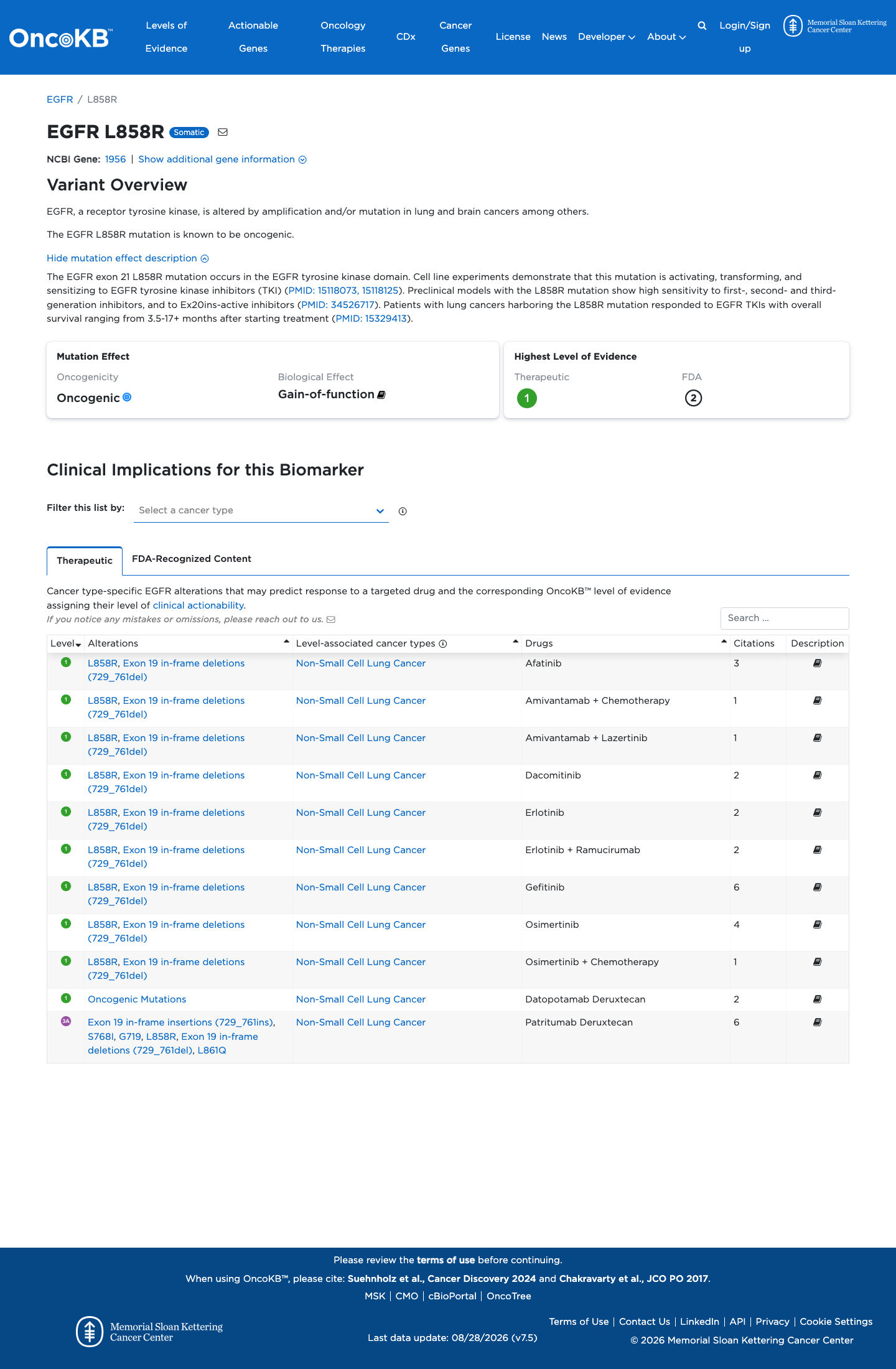
Functional Oncogenic
OncoKB identified variant-specific curated literature and context relevant to functional review; biological-effect context: Gain-of-function; curated oncogenicity label: Oncogenic.
OncoKB ↗
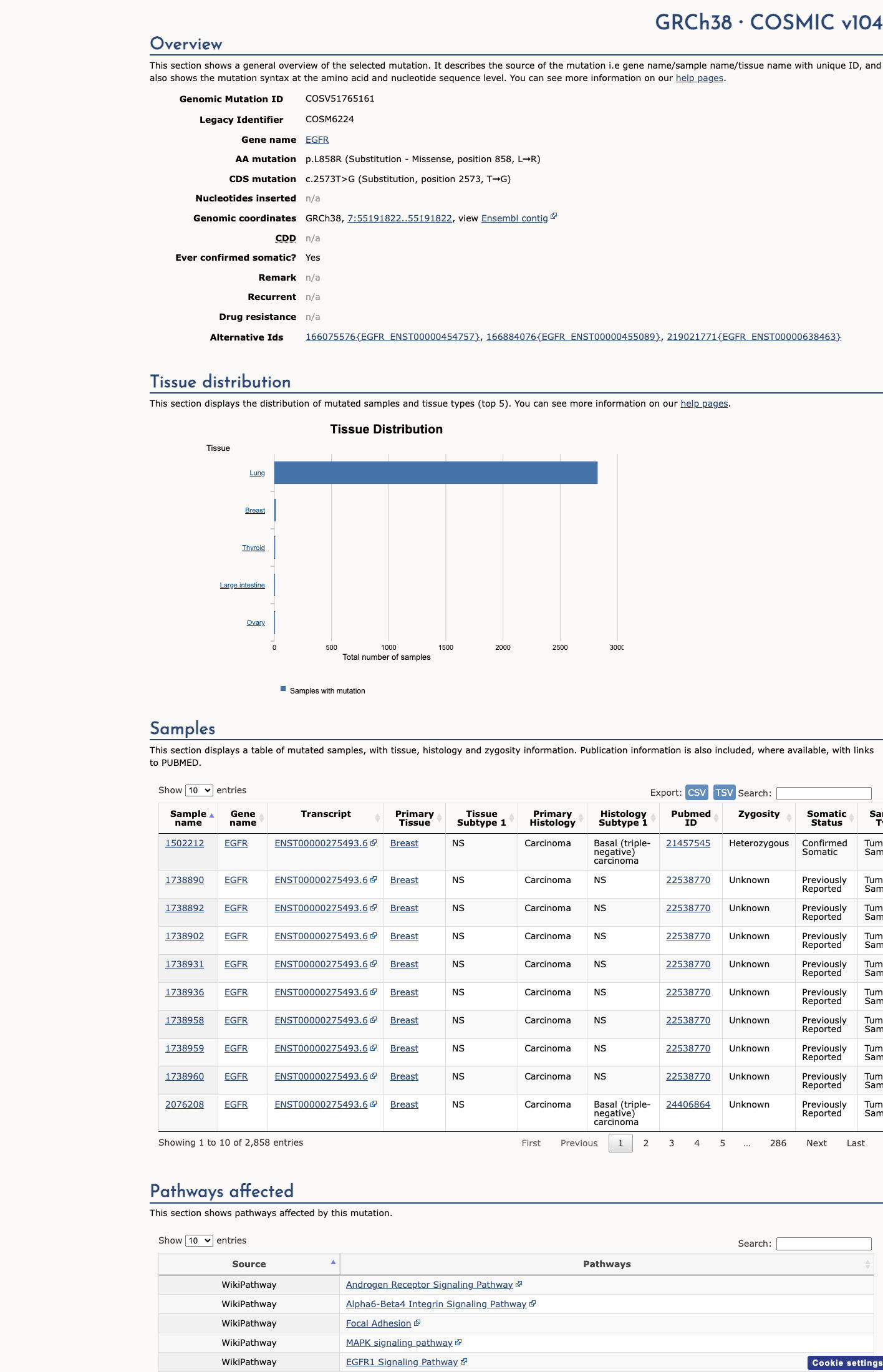
COSMIC screenshot
COSMIC
Cancer hotspots screenshot
Cancer hotspots
Somatic evidence Hotspot
COSMIC
This variant lies in a statistically significant hotspot. This variant has previously been reported in somatic cancers (COSMIC; COSV51765161, n = 2857 times).
Hotspots
This variant lies in a statistically significant hotspot.
Literature · how each cited paper was used
4papers cited
Each card is an audit: what was searched, what was found, whether it names the variant, which criteria it fed, and why. 1 further PMID triaged but not cited — see Sources & references.
EGFR mutations in lung cancer: correlation with clinical response to gefitinib therapy.
Searched
c.2573T>GNP_005219.2:p.(L858R)
Found
The paper reports EGFR L858R in three NSCLC tumors and in the H3255 cell line, with markedly increased gefitinib sensitivity and inhibition of downstream signaling compared with wild-type EGFR.
Variant
✓ Names this variant — characterised directly
Applied to
PS3 strong
Independent lung-cancer cellular assays with wild-type-EGFR comparators demonstrate increased inhibitor sensitivity and downstream signaling inhibition for L858R.
All three tumors had the same EGFR mutation, predicted to change leucine-858 to arginine (Fig. 1A; CTG3CGG; L858R).
Location Results describing EGFR mutation screening and gefitinib-sensitive tumors/cell lines; Fig. 1A; Fig. 3; Table S3  ·  Context EGFR exons were sequenced in 119 primary NSCLC tumors, followed by gefitinib-response analysis and in-vitro sensitivity/signaling assays in lung cancer cell lines including H3255.  ·  full text
EGF receptor gene mutations are common in lung cancers from "never smokers" and are associated with sensitivity of tumors to gefitinib and erlotinib.
Searched
EGFR c.2573T>GNP_005219.2:p.(L858R)
Found
The paper explicitly reports EGFR c.2573T>G resulting in p.L858R and provides tumor cohort and biochemical evidence for the activating behavior of L858R.
Variant
✓ Names this variant — characterised directly
Applied to
PS3 strong
Variant-specific cellular assays with wild-type comparison demonstrate altered phosphorylation and increased gefitinib/erlotinib sensitivity.
A seventh patient had a nonsynonymous mutation at nucleotide 2573 (T 3 G) in exon 21, resulting in a substitution of arginine for leucine at position 858 (L858R).
Location Results, “Mutations in EGFR Are Commonly Found in Lung Tumors Sensitive to Gefitinib”; Table 1; Table 2; “Biochemical Properties of EGFR Mutants”  ·  Context EGFR exons 18–24 were sequenced in gefitinib- and erlotinib-treated lung tumors; L858R was tested in transiently transfected 293T cells with immunoblotting and drug-treatment assays.  ·  full text
Mutation in the tyrosine kinase domain of epidermal growth factor receptor is a predictive and prognostic factor for gefitinib treatment in patients with non-small cell lung cancer.
Searched
c.2573T>GNP_005219.2:p.(L858R)
Found
The paper reports nine EGFR exon 21 L858R cases and identifies the mutation as occurring in the EGFR tyrosine kinase domain.
Variant
✓ Names this variant — characterised directly
Applied to
PM1 moderate
Supports location of L858R in the EGFR tyrosine kinase domain and its recurrent occurrence.
Substitution mutation of L858R (n = 9) in exon 21 were the two most common types of mutations, representing 61% of total cases.
Location Results, “Epidermal growth factor receptor mutations”; Table 2; Discussion  ·  Context Retrospective cohort of 54 Taiwanese patients with advanced NSCLC treated with gefitinib; EGFR exons 18–21 were sequenced from pretreatment tumor tissue.  ·  full text
Structure-based classification predicts drug response in EGFR-mutant NSCLC.
Searched
EGFR c.2573T>GNP_005219.2:p.(L858R)L858Rc.2573T>G
Found
The paper identifies L858R as a classical EGFR mutation and reports characteristic clinical and experimental sensitivity of classical EGFR mutations to tyrosine kinase inhibitors.
Variant
✓ Names this variant — characterised directly
Applied to
PM1 moderate
Supports the recurrent classical activating/hotspot context of EGFR L858R.
Patients with classical EGFR mutations (L858R or exon 19 deletions (Ex19del)) show marked improvements in clinical outcomes when treated with first-, second- or third-generation tyrosine kinase inhibitors (TKIs)4–6,11.
Location Main, opening paragraph; Results, “Clinical outcomes for atypical mutations” and “Structural groups predict drug response”  ·  Context Retrospective clinical outcome analyses of EGFR-mutant NSCLC treated with EGFR TKIs plus in-vitro and in-vivo drug-sensitivity studies using EGFR-mutant Ba/F3 cells and xenografts.  ·  full text
Sources & reference links
8Sources
ClinVar
gnomAD v2.1
gnomAD v4.1
gnomAD-Canada
SpliceAI
OncoKB
COSMIC
Cancer hotspots
Triaged references · 1 PMID not cited in assessment
15118073 ↗ Activating mutations in the epidermal growth factor receptor underlying responsiveness of non-small-cell lung cancer to gefitinib. ONCOKB