The EGFR gene encodes the epidermal growth factor receptor, a cell-surface protein that binds growth factors of the EGF family and, upon activation, dimerizes and triggers signaling pathways that drive cell proliferation, migration, and differentiation. EGFR is an oncogene: normally expressed at low levels in adult tissues, it becomes hyperactivated through mutation or gene amplification in many cancer types, including lung, brain, colorectal, and head and neck cancers. In non-small cell lung cancer, such activation can make tumors responsive to EGFR tyrosine kinase inhibitor drugs, although resistance can develop during treatment. EGFR has also been implicated in the excessive inflammatory response (cytokine storm) associated with severe COVID-19.
This variant
EGFR encodes a growth-factor receptor whose activating mutations can drive oncogenic signaling and influence response to tyrosine kinase inhibitors in cancers such as non-small cell lung cancer.
Transcript
NM_005228.5
HGVS · transcript:coding
NM_005228.5:c.2369C>T
GRCh38
chr7:55181378 C>T
GRCh37
chr7:55249071 C>T
VUS: PS3 (strong), PM1 (moderate), and PM2 (supporting) are opposed by BP4 (supporting), so conflicting evidence prevents a pathogenic or benign call.
Classification rationale
PS3PM1PM2BP4VUS
EGFR c.2369C>Tmissense · exon 20
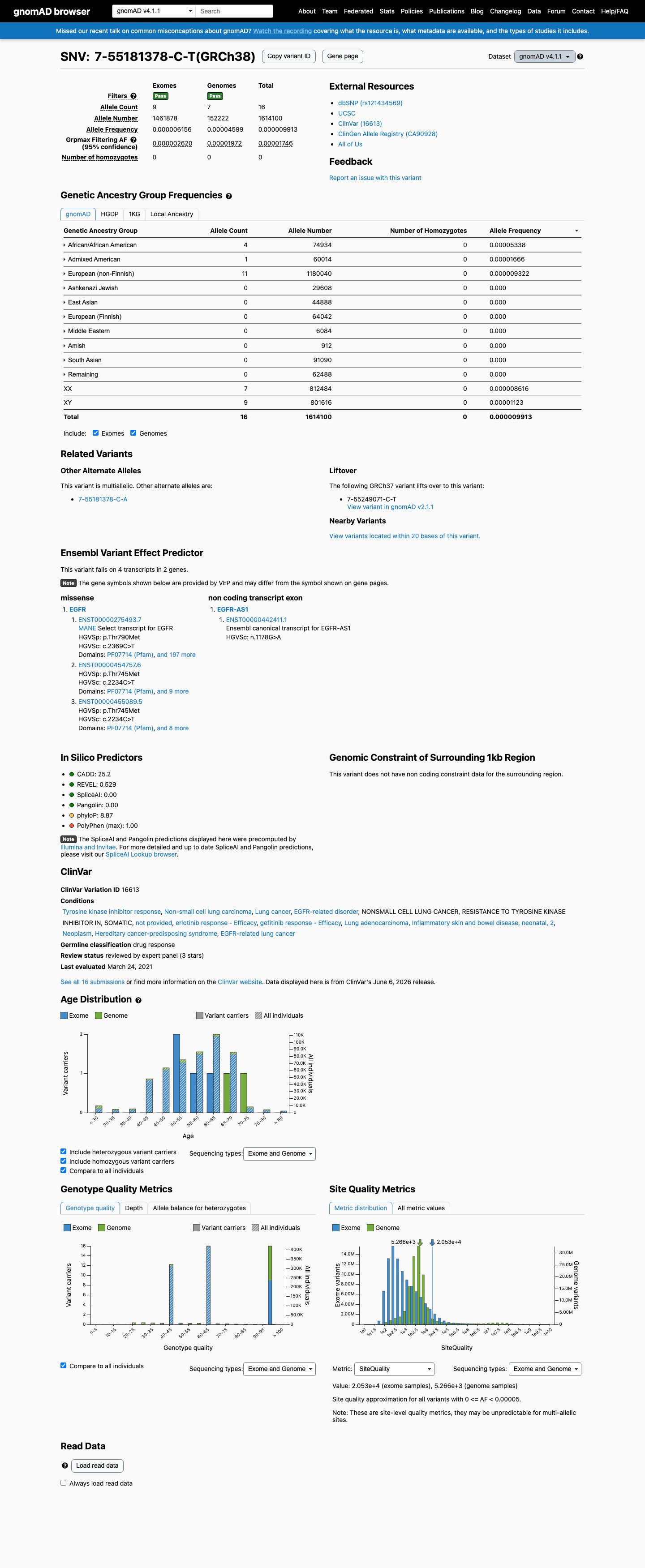
PS3 strong: T790M showed increased EGFR catalytic activity and inhibitor resistance in concordant functional studies. PM1 moderate: p.Thr790Met is located in the EGFR kinase catalytic cleft. PM2 supporting: gnomAD v4.1 allele frequency is 9.91264e-06 with zero homozygotes. BP4 supporting: SpliceAI max delta 0.002 meets the adjudicated BP4 threshold.
PS3 + PM1 + PM2 + BP4→VUS
LYFE Sciences is an AI system, and it can make mistakes. Criteria
may be applied incorrectly, sources may be misread, and a confident-looking
classification can still be wrong. Double-check every criterion and
its underlying evidence before relying on any call.
Gene diagram
· NM_005228.5 · variants mapped to exon structure
EGFRNM_005228.5
Fetching transcript structure from UCSC…
Exons
—
Transcript span
—
Strand
—
Variants mapped
—
Source
UCSC ncbiRefSeqCurated
All variants in EGFR—click a row to locate it on the plot · use the link column to open its page
Protein
Location
Classification
Link
Applied criteria · 4 applied · 20 assessed
MetEvidence satisfies this criterion.
Not metEvaluated against available evidence; threshold not reached.
Not assessedApplies in principle, but no evidence was found to evaluate it.
N/ADoesn't apply to this variant type.
Applied · 4
Strength Supporting Moderate Strong Very strong
✓
PS3strongPathogenic
Met, strong: EGFR T790M showed approximately fivefold higher catalytic activity than wild type and persistent phosphorylation despite gefitinib up to 2 µM.
PMID:15728811 directly tested EGFR T790M in transiently transfected COS-7 and NIH-3T3 cell systems; constructs carrying T790M retained phosphorylated EGFR at gefitinib concentrations up to 2 µM, whereas comparator constructs were fully inhibited at 20 nM.PMID:15737014 confirmed the exact c.2369C>T/T790M change in progressing NSCLC lesions and showed lack of significant gefitinib or erlotinib inhibition in EGFR expression and cell-viability assays, including in combination with sensitizing EGFR mutations.PMID:18227510 used purified human EGFR kinase-domain proteins and reported approximately fivefold higher catalytic activity for T790M than wild type; in the L858R/T790M context, ATP Km decreased from 148 µM to 8.4 µM, supporting increased ATP affinity as the resistance mechanism.
Met at moderate strength: p.Thr790Met is in the EGFR kinase catalytic cleft, with demonstrated effects on ATP affinity and kinase activity.
PMID:15728811 states that T790M is in the catalytic cleft of the EGFR tyrosine-kinase domain.PMID:18227510 reports that T790M increases ATP affinity and that the mutant has approximately fivefold higher catalytic activity than wild-type EGFR, supporting functional criticality of the affected kinase-domain residue.
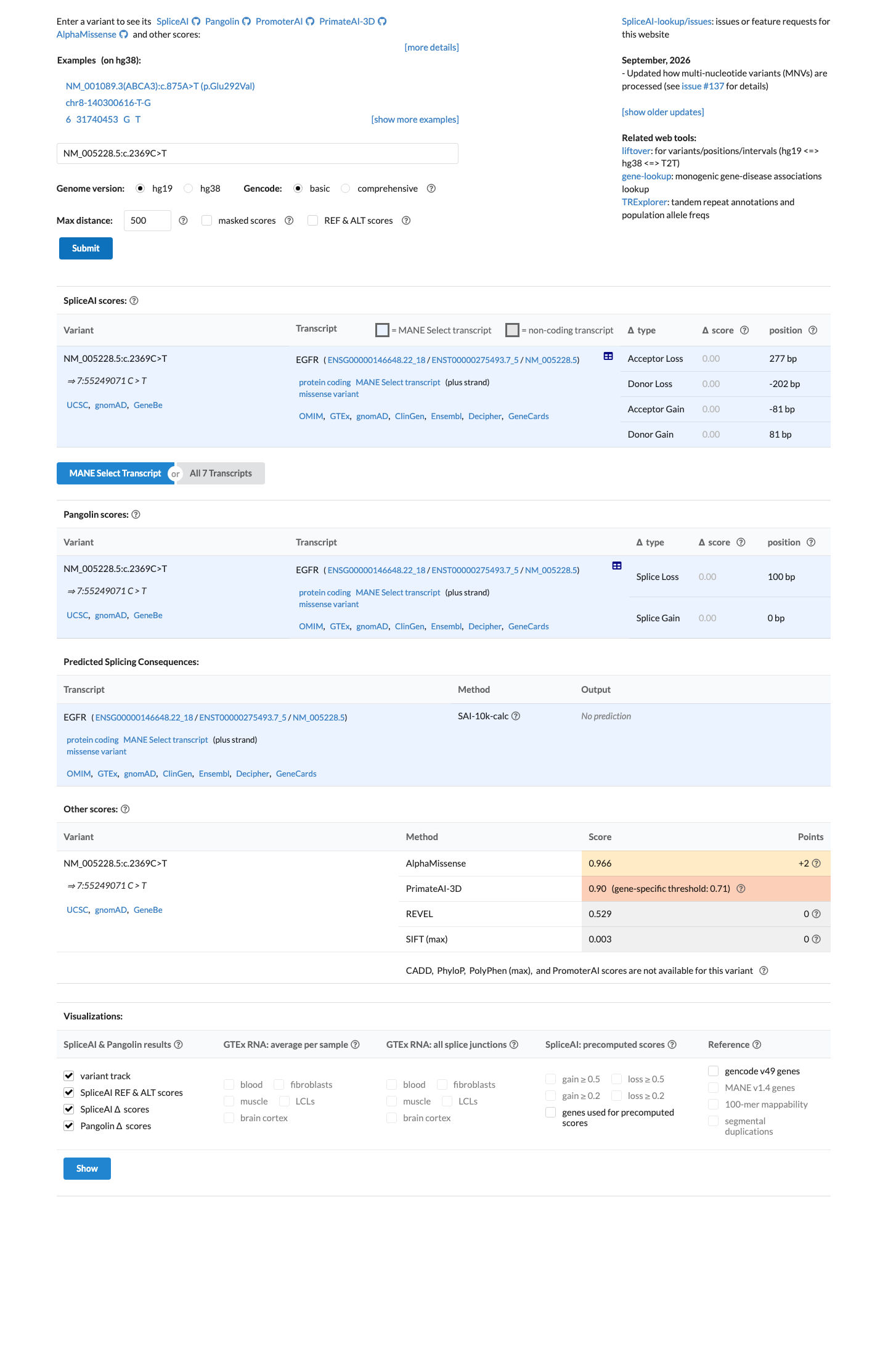
Met at supporting: SpliceAI max delta 0.002 meets the generic BP4 threshold of <=0.1, while REVEL 0.529 does not.
The case variant is the missense change NM_005228.5:c.2369C>T, NP_005219.2:p.(Thr790Met), so BP4 is applicable.SpliceAI max delta is 0.002, meeting the supplied generic BP4 supporting threshold of <=0.1 from Jaganathan et al. 2019 (PMID:30661751).REVEL is 0.529, above the supplied generic BP4 supporting threshold of <=0.29, moderate threshold of <=0.183, and strong threshold of <=0.016 from the ClinGen SVI calibration by Pejaver et al. 2022 (PMID:36413997).
Assessed · not applied
· 9 not met · 11 not assessed
Pathogenic
PS1Not met: no alternate nucleotide substitution producing the same p.Thr790Met change was identified, although the submitted variant itself is well documented.
PS2Not assessed: no confirmed germline proband and no parental testing or de novo result are documented.
PS4Not met: available reports describe acquired drug resistance, not statistically enriched germline disease cases versus controls for PS4.
PM3Not assessed: no affected proband with a second pathogenic allele in trans or validated recessive EGFR inheritance was documented.
PM5Not assessed: no verified different pathogenic missense variant at EGFR residue 790 was available for comparison.
PM6Not assessed: no phenotype-consistent presumed de novo germline observation without parental testing is documented.
PP1Not assessed: zero informative germline meioses or family genotype-phenotype observations are documented.
PP2Not assessed: no validated EGFR germline missense-mechanism and benign-variation framework was available to support PP2.
PP3Not met: SpliceAI max delta 0.002 and REVEL 0.529 are below their generic PP3 supporting thresholds of 0.2 and 0.644.
PP4Not assessed: no individual clinical phenotype or disease-specific specificity rule is available to evaluate PP4.
PP5Not met: the exact-variant ClinVar expert panel reports drug response, not Pathogenic or Likely pathogenic.
Benign
BA1Not met: gnomAD v4.1 all-comers AF 9.91264e-06 is far below the >=0.05 BA1 threshold.
BS1Not met: the highest observed ancestry AF, 5.33803e-05 in gnomAD v4.1, is below the >=0.01 BS1 threshold.
BS2Not met: gnomAD v4.1 and v2.1 each report 0 homozygotes, so no healthy-homozygote evidence supports BS2.
BS3Not met: T790M increased EGFR catalytic activity approximately fivefold rather than demonstrating normal function in validated cellular and biochemical assays.
BS4Not assessed: no informative unaffected carriers or family non-segregation observations are documented.
BP1Not assessed: no validated EGFR germline framework shows that truncating variants predominate and missense disease variants are uncommon.
BP2Not assessed: the only phase observation places T790M in cis with L858R in a somatic tumor, not a validated germline affected-proband context.
BP5Not assessed: no affected-individual diagnostic context or alternate pathogenic molecular explanation is documented.
BP6Not met: no exact-variant ClinVar expert-panel Benign or Likely benign classification is present.
N/A · 4PVS1 · PM4 · BP3 · BP7
Research & evidence
Population frequency
gnomAD v4.1
gnomAD v2.1
v4.1
This variant is present in gnomAD v4.1 (AF= 9.91264e-06; MAF= 0.00099%, 16/1614100 alleles, homozygotes = 0) and has highest observed frequency in the African/African American population (AF= 5.33803e-05; MAF= 0.00534%, 4/74934 alleles, homozygotes = 0); grpmax FAF= 1.746e-05.
v2.1
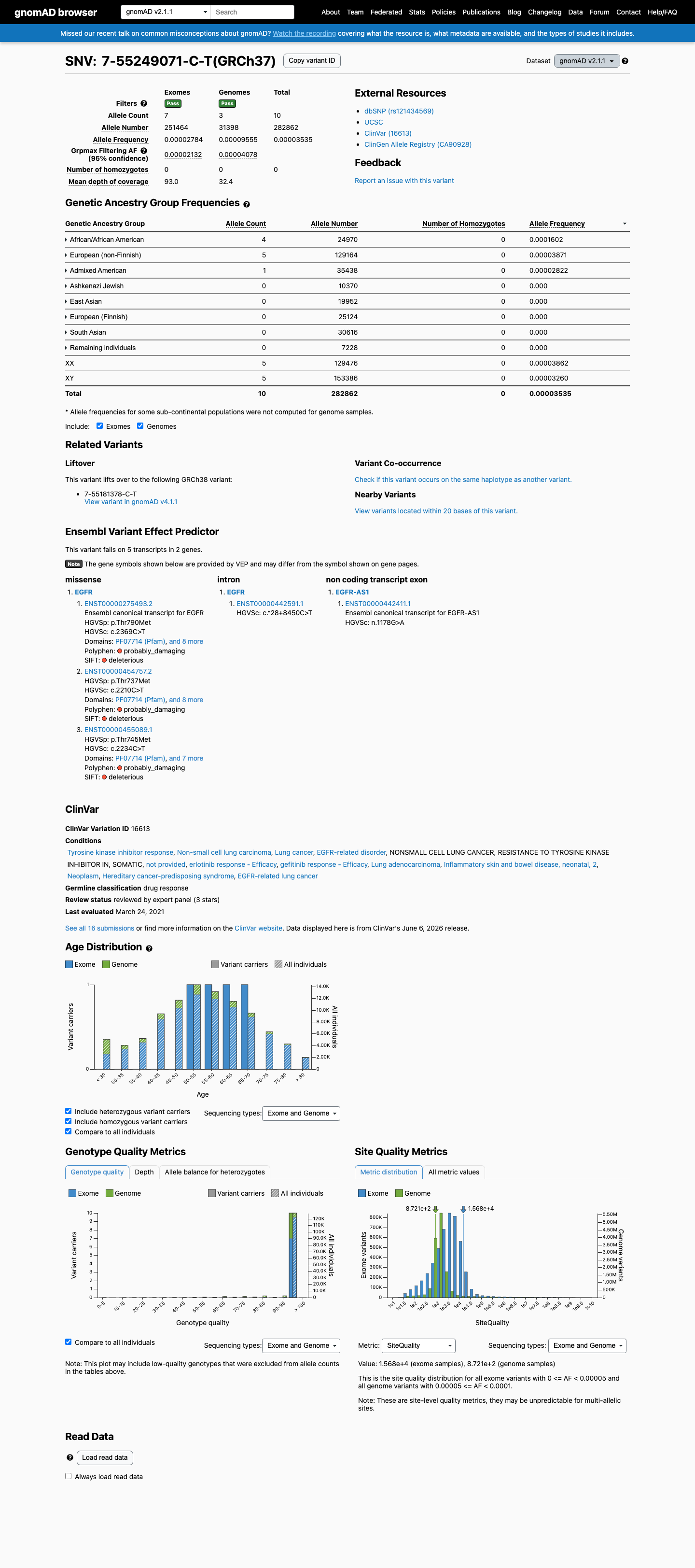
This variant is present in gnomAD v2.1 (AF= 3.53529e-05; MAF= 0.00354%, 10/282862 alleles, homozygotes = 0) and has highest observed frequency in the African/African American population (AF= 0.000160192; MAF= 0.01602%, 4/24970 alleles, homozygotes = 0); grpmax FAF= 4.078e-05.
🇨🇦 CA
Not available in gnomAD-Canada v1.0.
Allele frequency by ancestry
three datasets · side by side
gnomAD v4.1
0.00099%
· 16 / 1,614,100
0 hom · FAF 0.0017%
African/African American
4 / 74,934
0.0053%
Admixed American
1 / 60,014
0.0017%
European (non-Finnish)
11 / 1,180,040
0.00093%
+ 7 not observed (Remaining individuals, European (Finnish), Amish, East Asian, Middle Eastern, South Asian, Ashkenazi Jewish)
gnomAD v2.1
0.0035%
· 10 / 282,862
0 hom · FAF 0.0041%
African/African American
4 / 24,970
0.016%
European (non-Finnish)
5 / 129,164
0.0039%
Admixed American
1 / 35,438
0.0028%
+ 5 not observed (Ashkenazi Jewish, East Asian, European (Finnish), Remaining individuals, South Asian)
This variant has been reported in ClinVar as Likely pathogenic (5 clinical laboratories) and as Pathogenic (3 clinical laboratories) and as drug response (1 clinical laboratory) and as likely pathogenic (1 clinical laboratory) and as drug response by ClinPGx (expert panel). (ClinVarID = 16613)
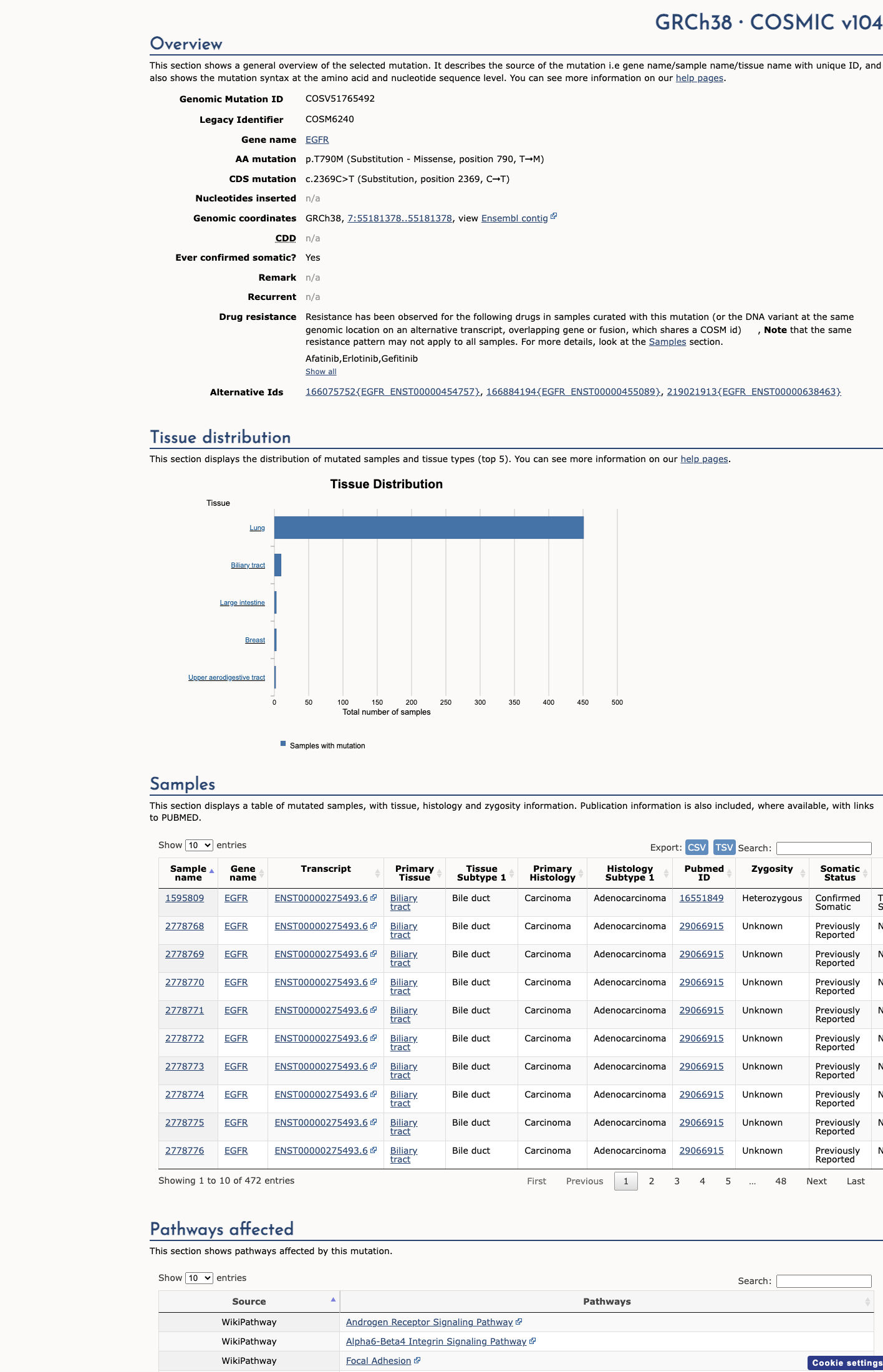
This variant lies in a statistically significant hotspot. This variant has previously been reported in somatic cancers (COSMIC; COSV51765492, n = 472 times).
Hotspots
This variant lies in a statistically significant hotspot.
Each card is an audit: what was searched, what was found, whether it names the variant, which criteria it fed, and why. 1 further PMID triaged but not cited — see Sources & references.
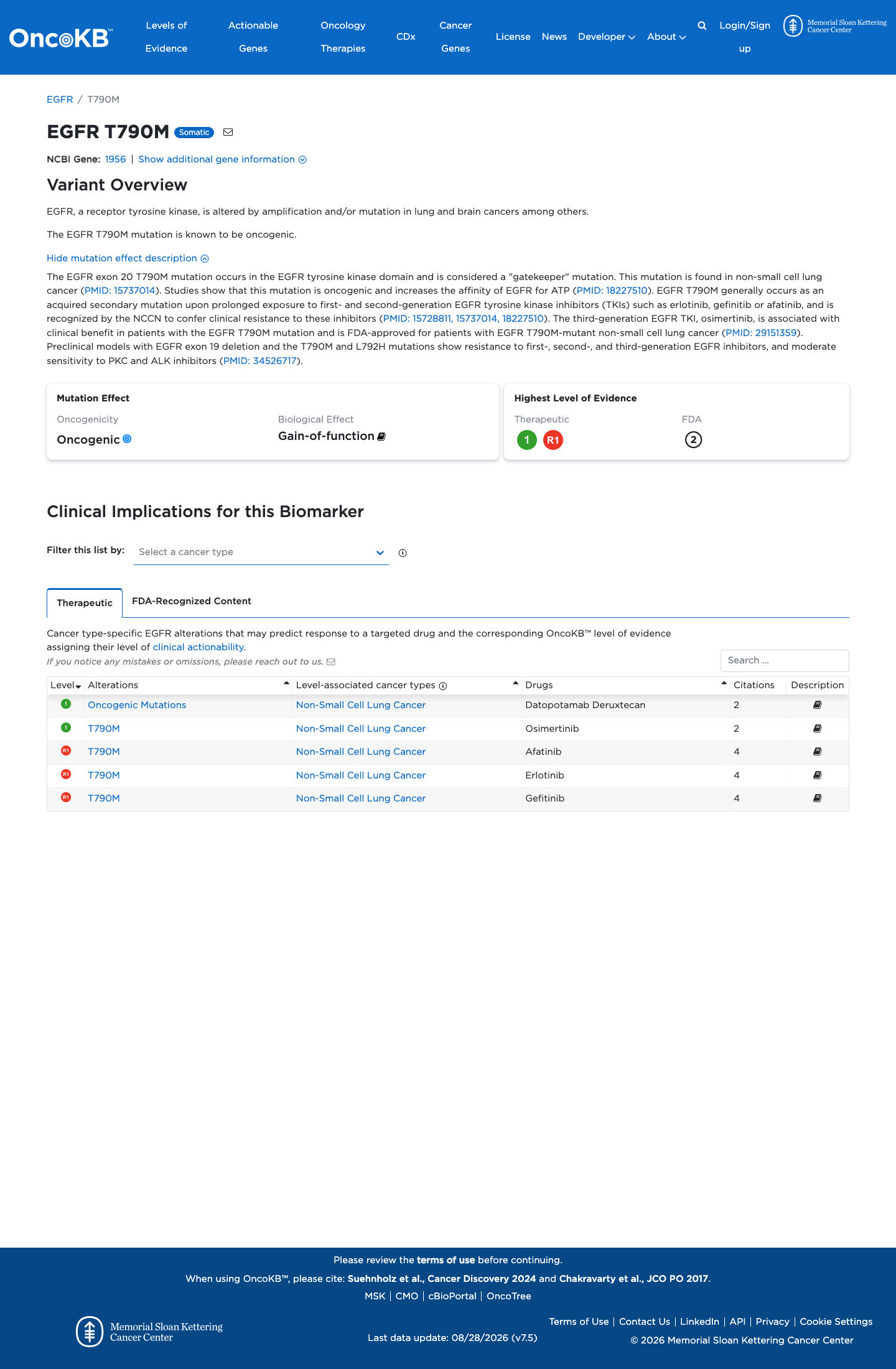
EGFR mutation and resistance of non-small-cell lung cancer to gefitinib.
PMID 15728811 ↗· Kobayashi S et al.
· 2005 Feb 24
ONCOKB· functional
Searched
c.2369C>Tp.(T790M)T790M
Found
The paper identifies EGFR T790M as a secondary exon 20 mutation and places it in the catalytic cleft of the EGFR tyrosine-kinase domain. Transfected-cell assays showed persistent EGFR phosphorylation under gefitinib concentrations up to 2 µM for T790M constructs, while control constructs were inhibited at 20 nM.
Variant
✓ Names this variant — characterised directly
Applied to
→PS3
strong
Exact T790M constructs showed persistent phosphorylation and high-level inhibitor resistance in controlled transfected-cell assays.
→PM1
moderate
Places T790M in the EGFR tyrosine-kinase catalytic cleft/domain.
The C-to-T base-pair change is predicted to change threonine to methionine at position 790 (T790M) in the catalytic cleft of the EGFR tyrosine kinase domain. ... all four constructs carrying the T790M amino acid substitution demonstrated high-level resistance, with persistent generation of phosphorylated EGFR at concentrations of gefitinib as high as 2 µM.
Location Results, pages 788–790; Figure 3A–B · Context Paired tumor sequencing, cDNA confirmation and subcloning, followed by transient EGFR-construct transfection into COS-7 and NIH-3T3 cells with EGF stimulation and inhibitor-response assays. · full text
Acquired resistance of lung adenocarcinomas to gefitinib or erlotinib is associated with a second mutation in the EGFR kinase domain.
The paper reports EGFR c.2369C>T (T790M) in progressing lesions from patients whose lung cancers had initially responded to EGFR tyrosine-kinase inhibitors. T790M was absent from pretreatment specimens and detected after progression; constructs containing T790M were resistant to gefitinib or erlotinib.
Variant
✓ Names this variant — characterised directly
Applied to
→PS3
strong
Exact T790M constructs and NSCLC cell models showed resistance to EGFR inhibitors in cellular functional assays.
This nucleotide change leads to substitution of methionine for threonine at position 790 (T790M).
Location Results, section on a secondary missense mutation in the EGFR kinase domain detected after treatment progression; patient 1 paragraph · Context EGFR exon sequencing and PCR-RFLP confirmation in NSCLC tumor specimens, transiently transfected 293T-cell assays, and viability assays in NSCLC cell lines. · full text
The T790M mutation in EGFR kinase causes drug resistance by increasing the affin
The paper functionally studies EGFR T790M and reports increased ATP affinity and approximately fivefold higher catalytic activity than wild-type EGFR. In L858R/T790M, the ATP Km was reduced from 148 µM for L858R to 8.4 µM, supporting a direct functional effect of the kinase-domain residue.
Variant
✓ Names this variant — characterised directly
Applied to
→PS3
strong
Purified-protein enzymology directly demonstrated increased EGFR catalytic activity and ATP affinity for T790M-containing proteins.
→PM1
moderate
Demonstrates that the kinase-domain residue has a direct effect on ATP affinity and catalytic activity.
The T790M mutation activates WT EGFR and that introduction of the T790M mutation increases the ATP affinity of the oncogenic L858R mutant by more than an order of magnitude. The increased ATP affinity is the primary mechanism by which the T790M mutation confers drug resistance.
Location Abstract; Results sections on T790M inhibitor binding and increased ATP affinity; Tables 1 and 2 · Context Purified EGFR kinase-domain proteins assessed with inhibitor-binding assays, ATP/NADH-coupled enzyme kinetics, gefitinib inhibition assays, and X-ray crystallography. · full text
Structure-based classification predicts drug response in EGFR-mutant NSCLC.
The paper discusses EGFR T790M as a classical resistance mutation and reports that it is sensitive to third-generation but not first- or second-generation EGFR tyrosine-kinase inhibitors; complex T790M resistance mutants were also evaluated.
Variant
✓ Names this variant — characterised directly
Applied to
→PS3
strong
Cell-based inhibitor-response testing provides independent functional evidence of the characteristic T790M drug-response phenotype.
The T790M mutation was sensitive to third- but not first- or second-generation TKIs.
Location Results, subsection "Exon 20 mutations are heterogenous" · Context EGFR-mutant Ba/F3 cell-line inhibitor screening with additional in vivo and retrospective clinical analyses. · full text
Sources & reference links
8Sources
ClinVar
gnomAD v2.1
gnomAD v4.1
gnomAD-Canada
SpliceAI
OncoKB
COSMIC
Cancer hotspots
Triaged references · 1 PMID not cited in assessment
29151359 ↗Osimertinib in Untreated EGFR-Mutated Advanced Non-Small-Cell Lung Cancer.ONCOKB