Analysis in progress
Initialising…
0%
complete
This report is still being assembled — sections appear as each stage finishes. It isn't final yet.
FGF3
Final classification
Likely Pathogenic
FGF3 c.310C>T · p.Arg104Ter
FGF3

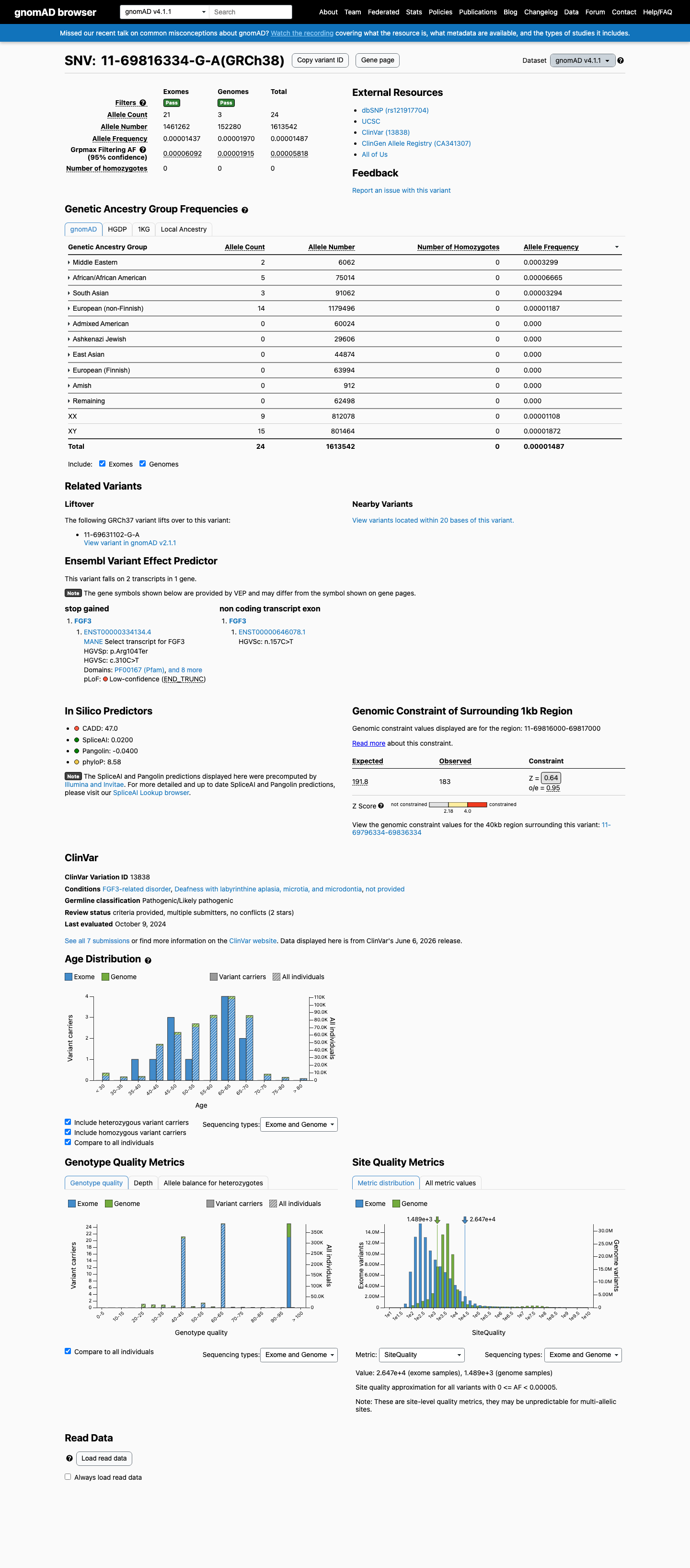
PM2 (Moderate): ultra-rare population frequency (0.0015% in gnomAD v4.1, zero homozygotes), far below the 0.1% cutoff.

Gene
FGF3
Transcript
NM_005247.2
HGVS · transcript:coding
NM_005247.2:c.310C>T
Consequence
N/A
GRCh38
chr11:69816334 G>A
GRCh37
chr11:69631102 G>A
Basis Likely Pathogenic: two moderate (PM2 ultra-rare frequency, PM3 in trans) plus two supporting (PP1 cosegregation, PP4 specific phenotype) criteria map to Likely Pathogenic under ACMG/AMP 2015 with no conflicting benign evidence.
Likely Pathogenic: two moderate (PM2 ultra-rare frequency, PM3 in trans) plus two supporting (PP1 cosegregation, PP4 specific phenotype) criteria map to Likely Pathogenic under ACMG/AMP 2015 with no conflicting benign evidence.
Classification rationale
PM2PM3PP1PP4 Likely Pathogenic
FGF3 c.310C>T

PM2 (Moderate): ultra-rare population frequency (0.0015% in gnomAD v4.1, zero homozygotes), far below the 0.1% cutoff. PM3 (Moderate): in trans with p.Y49C in an affected compound-heterozygous proband and homozygous in additional affected individuals across two families. PP1 (Supporting): cosegregation with LAMM syndrome in 7 or more affected individuals across 3 unrelated families. PP4 (Supporting): highly specific single-etiology LAMM phenotype (labyrinthine aplasia, microtia, microdontia) in carriers of this exact variant. Combination of 2 moderate + 2 supporting criteria yields Likely Pathogenic under the generic ACMG/AMP 2015 rules.

PM2 + PM3 + PP1 + PP4 Likely Pathogenic
Gene diagram · NM_005247.2 · variants mapped to exon structure
FGF3 NM_005247.2
Fetching transcript structure from UCSC…
Applied criteria · 4 applied · 12 assessed
Applied · 4
Strength Supporting Moderate Strong Very strong
PM2 moderate Pathogenic
Met (moderate): gnomAD v4.1 allele frequency 0.0015% (zero homozygotes) is far below the 0.1% recessive-disorder cutoff.
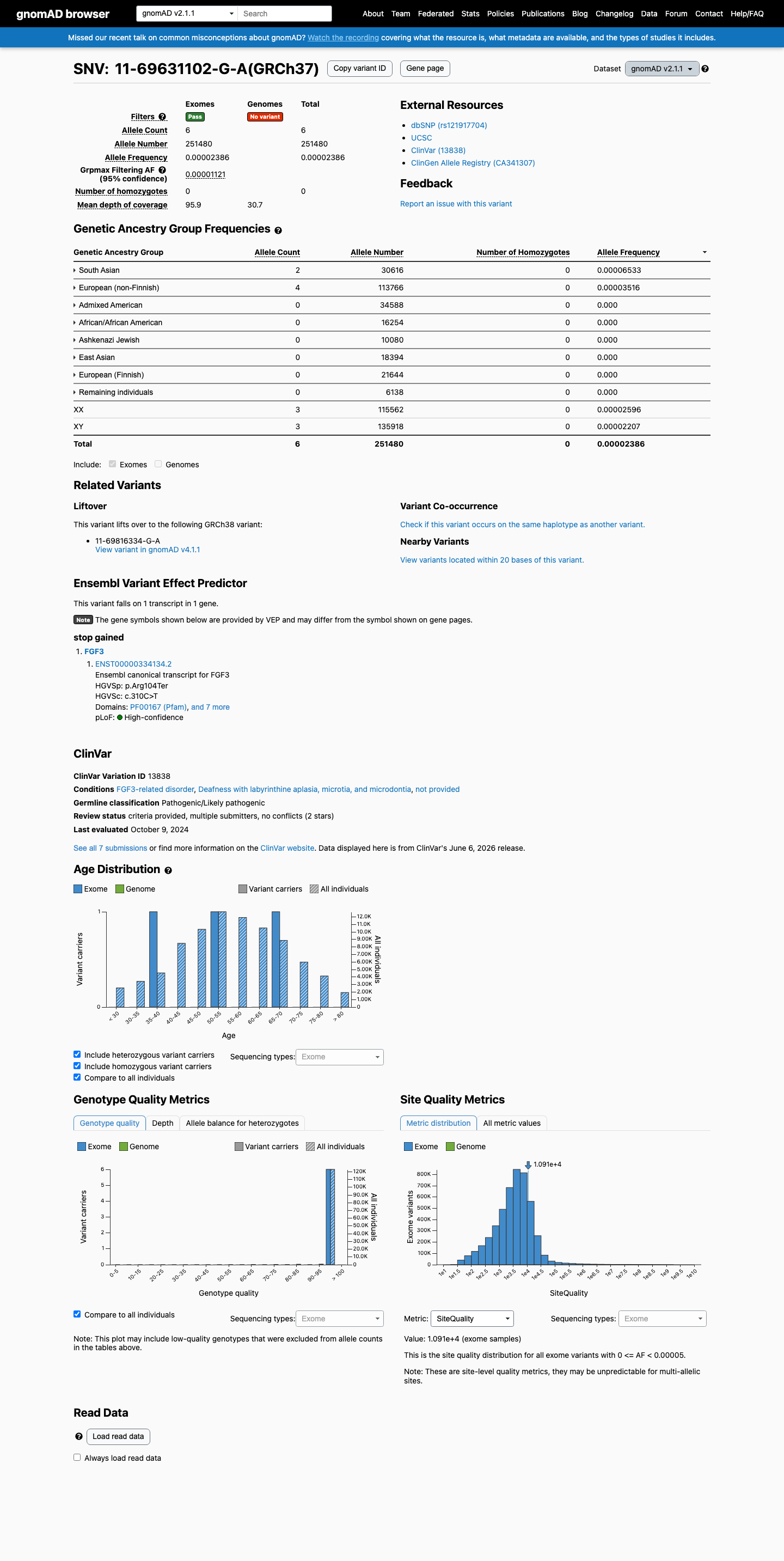
gnomad_v2: total AF 2.38588e-05 (0.00239%, 6/251,480 alleles), 0 homozygotes, grpmax FAF 1.121e-05gnomad_v4: total AF 1.48741e-05 (0.00149%, 24/1,613,542 alleles), 0 homozygotes, grpmax FAF 5.818e-05; highest population MID 0.000329924 (0.033%, 2/6,062 alleles) — still below 0.1%gnomad_canada: AF 0.00010866 (0.0109%, 2/18,406 alleles), 0 homozygotes
PM3 moderate Pathogenic
Met (moderate): the variant is in trans with p.Y49C in an affected compound-heterozygous proband and homozygous in additional affected individuals.
Compound heterozygosity p.R104X (maternal) + p.Y49C (paternal) in an affected LAMM proband, phase confirmed by parental carrier genotypes (PMID:21480479)Homozygous c.310C>T (p.R104X) in all three affected members of family B with heterozygous carrier parents, cosegregating with a fully penetrant autosomal recessive phenotype (PMID:17236138)ACMG/AMP 2015 PM3 rule text: in-trans detection with a pathogenic variant in a recessive disorder = moderate evidence, upgradable to strong with multiple trans observations (PMID:25741868)
PP1 supporting Pathogenic
Met (supporting): cosegregates with LAMM syndrome, homozygous or compound heterozygous in 7 or more affected individuals across 3 families.
Tekin 2007 family B: 3 affected homozygous c.310C>T, parents heterozygous, unaffected relatives het/wild-typeRiazuddin 2011 family PKDF295: 4 affected homozygous c.310C>T co-segregating with deafness; heterozygous carrier III-3 normalSensi 2011 Patient B: compound heterozygote p.R104X/p.Y49C with maternal p.R104X; both parents unaffected carriers
PP4 supporting Pathogenic
Met (supporting): the LAMM phenotype (labyrinthine aplasia, microtia, microdontia) is highly specific to biallelic FGF3 mutations and is seen with this exact variant.
Phenotype of 9 affected individuals (microtia, microdontia, profound deafness, Michel aplasia) with homozygous FGF3 mutations including p.R104X (PMID:17236138)Bilateral complete labyrinthine aplasia with microtia/microdontia in p.R104X homozygotes, PKDF295 (PMID:21306635)LAMM phenotype (labyrinthine aplasia, microtia, microdontia) in Patient B with p.R104X compound heterozygosity (PMID:21480479)
Assessed · not applied
Pathogenic
PVS1 Not assessed: insufficient evidence was available to score the predicted protein-truncating effect; flagged for human review.
PS3 Not assessed: no well-established functional study of this variant was found in the reviewed literature.
PS4 Not met: affected families and absence from 162 matched controls are qualitative enrichment, not a case-control study with statistical testing.
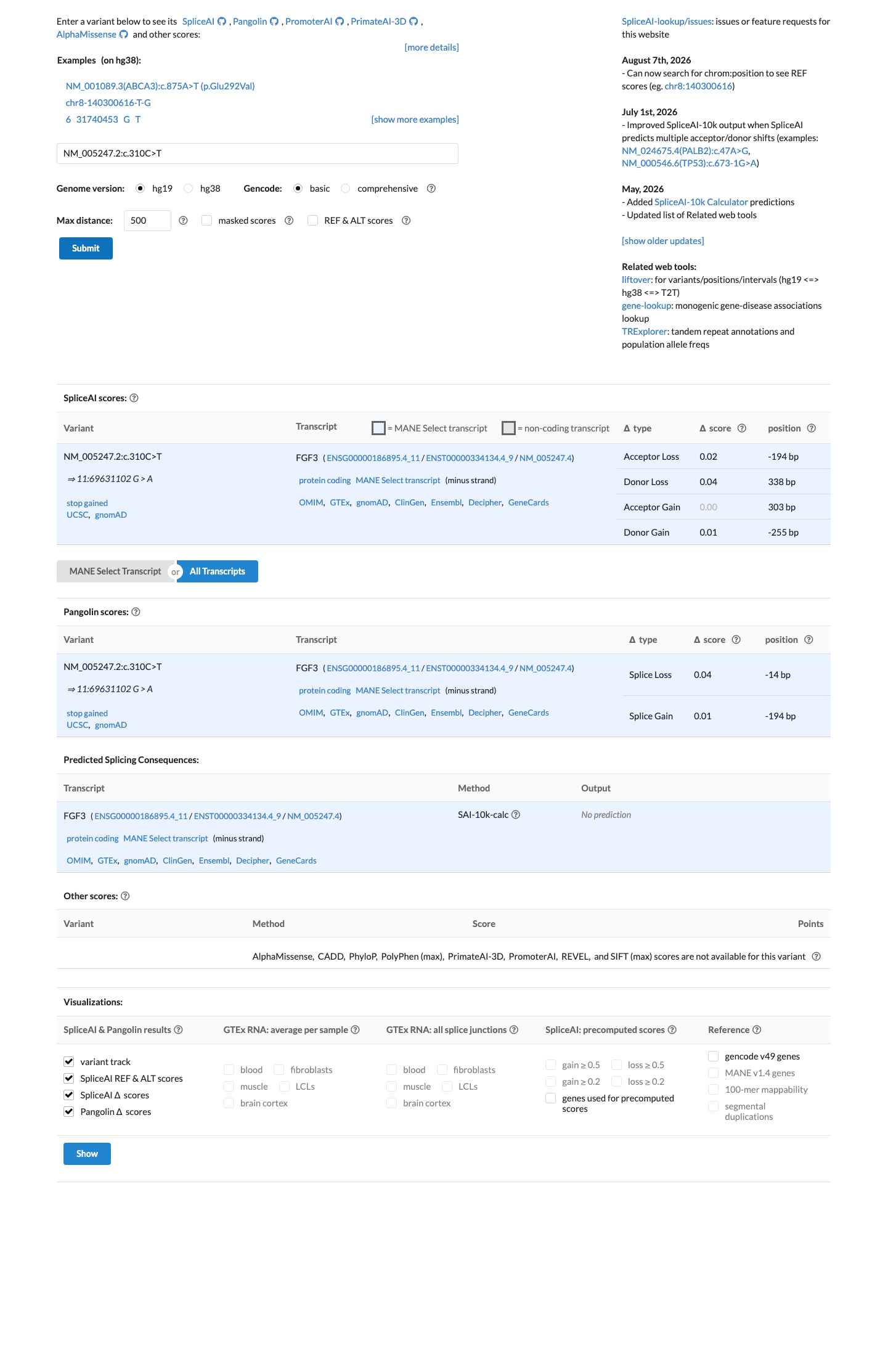
PP3 Not met: SpliceAI max delta 0.04 is far below the 0.20 splice-altering threshold, and missense predictors do not apply to a stop-gained variant.
Benign
BA1 Not met: the highest population frequency is 0.033% (gnomAD v4.1 Middle Eastern), roughly 30-fold below the >1% BA1 threshold.
BS1 Not met: the highest observed allele frequency (0.033%) is about 9-fold below the >0.3% BS1 cutoff.
BS2 Not met: zero homozygotes in gnomAD v2.1, v4.1, and gnomAD-Canada, and documented homozygotes are all affected with LAMM syndrome.
BS3 Not assessed: no functional study demonstrating retained or normal activity of the truncated protein was available.
BS4 Not met: no affected individual lacks the variant; unaffected relatives are heterozygous carriers or wild-type, as expected for recessive inheritance.
BP2 Not met: the documented in-trans configurations (compound heterozygosity, homozygosity) are evidence of pathogenicity, the opposite of this criterion.
BP4 Not met: a single negative SpliceAI prediction (max delta 0.04) cannot offset the unambiguous protein-truncating consequence of a stop-gained variant.
BP5 Not assessed: insufficient data were available to determine whether an alternate molecular basis of disease existed in affected cases.
N/A · 12 PS1 · PS2 · PM1 · PM4 · PM5 · PM6 · PP2 · PP5 · BP1 · BP3 · BP6 · BP7
Research & evidence
Population frequency · supports pathogenic
gnomAD v4.1 screenshot
gnomAD v4.1
gnomAD v2.1 screenshot
gnomAD v2.1
v4.1
This variant is present in gnomAD v4.1 (AF= 1.48741e-05; MAF= 0.00149%, 24/1613542 alleles, homozygotes = 0) and has highest observed frequency in the Middle Eastern population (AF= 0.000329924; MAF= 0.03299%, 2/6062 alleles, homozygotes = 0); grpmax FAF= 5.818e-05.
v2.1
This variant is present in gnomAD v2.1 (AF= 2.38588e-05; MAF= 0.00239%, 6/251480 alleles, homozygotes = 0) and has highest observed frequency in the South Asian population (AF= 6.53253e-05; MAF= 0.00653%, 2/30616 alleles, homozygotes = 0); grpmax FAF= 1.121e-05.
🇨🇦 CA
This variant is present in gnomAD-Canada v1.0 (AF= 0.00010866021949364337, 2/18406 alleles, homozygotes = 0).
Allele frequency by ancestry
three datasets · side by side
gnomAD v4.1
0.0015% · 24 / 1,613,542
0 hom · FAF 0.0058%
Middle Eastern
2 / 6,062
0.033%
African/African American
5 / 75,014
0.0067%
South Asian
3 / 91,062
0.0033%
European (non-Finnish)
14 / 1,179,496
0.0012%
+ 6 not observed (Remaining individuals, Admixed American, European (Finnish), Amish, East Asian, Ashkenazi Jewish)
gnomAD v2.1
0.0024% · 6 / 251,480
0 hom · FAF 0.0011%
South Asian
2 / 30,616
0.0065%
European (non-Finnish)
4 / 113,766
0.0035%
+ 6 not observed (African/African American, Admixed American, Ashkenazi Jewish, East Asian, European (Finnish), Remaining individuals)
gnomAD Canada 🇨🇦
0.011% · 2 / 18,406
0 hom · FAF 0.003%
European (non-Finnish)
2 / 11,728
0.017%
+ 8 not observed (African/African American, Latino/Admixed American, Ashkenazi Jewish, East Asian, European (Finnish), Middle Eastern, Remaining individuals, South Asian)
ClinVar screenshot
ClinVar
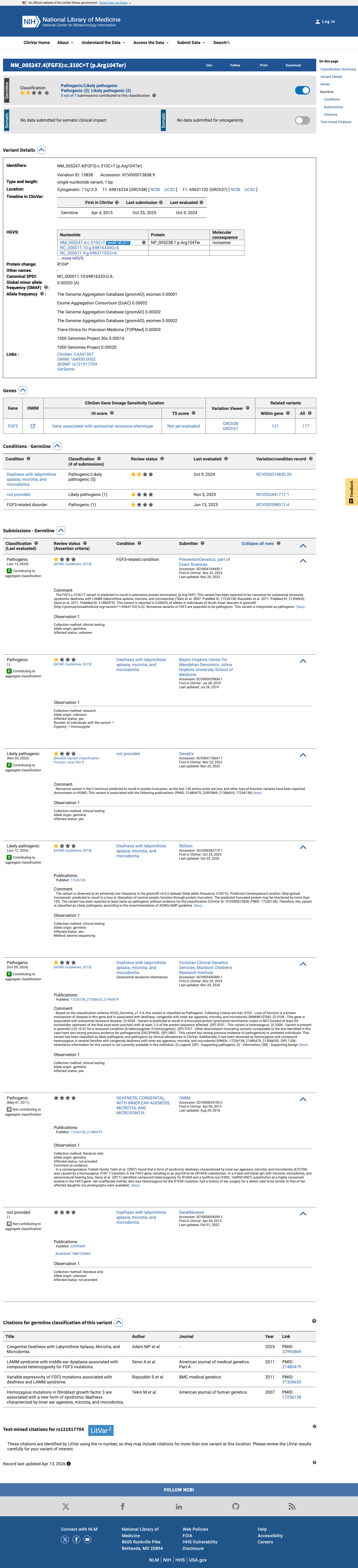
This variant has been reported in ClinVar as Pathogenic (2 clinical laboratories) and as Likely pathogenic (2 clinical laboratories). (ClinVarID = 13838)
SpliceAI screenshot
In silico
SpliceAI predicts no significant splice impact for this variant (max delta score = 0.04). BayesDel score = 0.66.
Functional / OncoKB screenshot
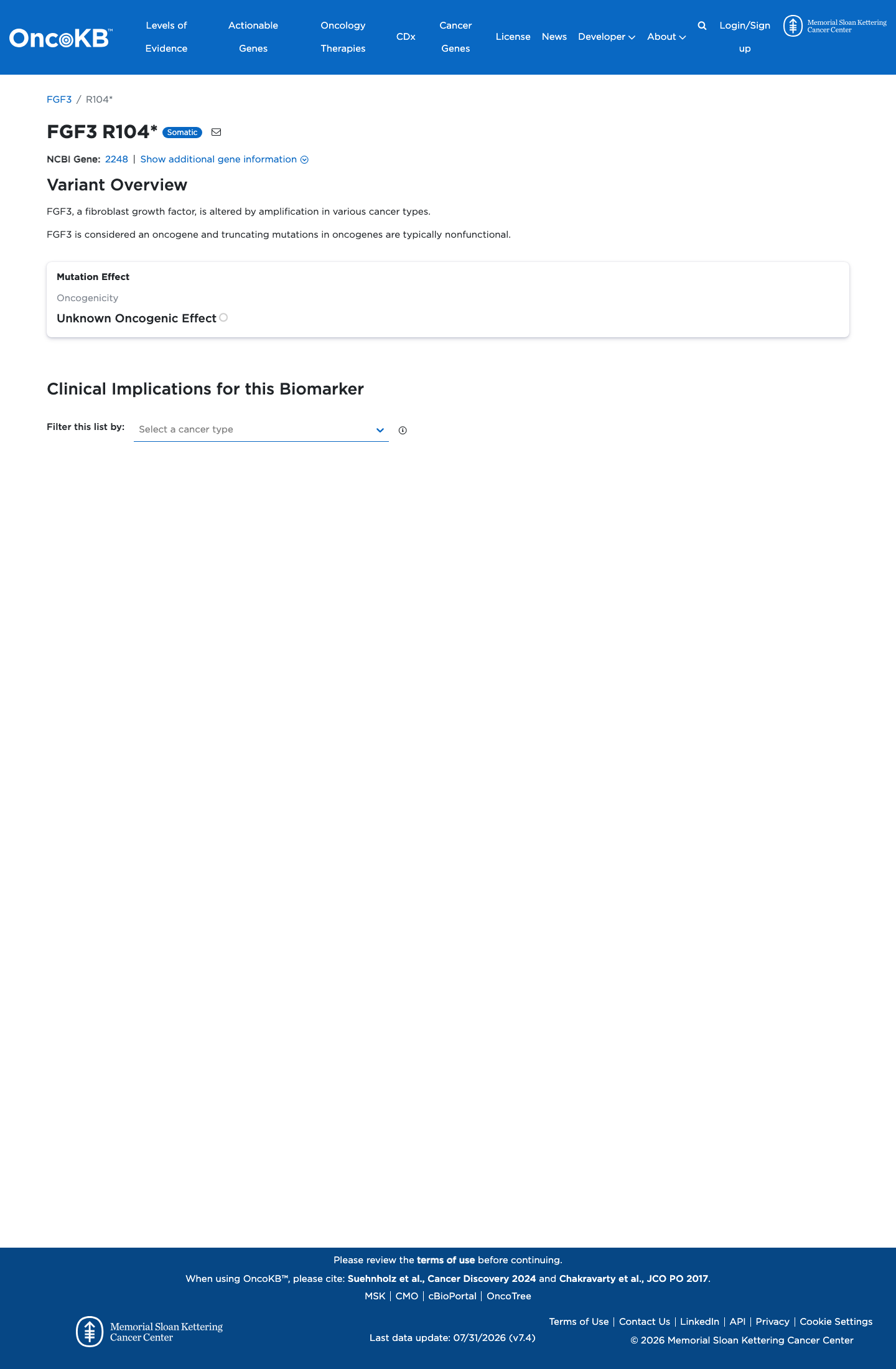
Functional Unknown Oncogenic Effect
OncoKB identified curated literature and non-variant-specific oncogenicity context for review; listed oncogenicity label: Unknown Oncogenic Effect.
OncoKB ↗
COSMIC screenshot
COSMIC
Cancer hotspots screenshot
Cancer hotspots
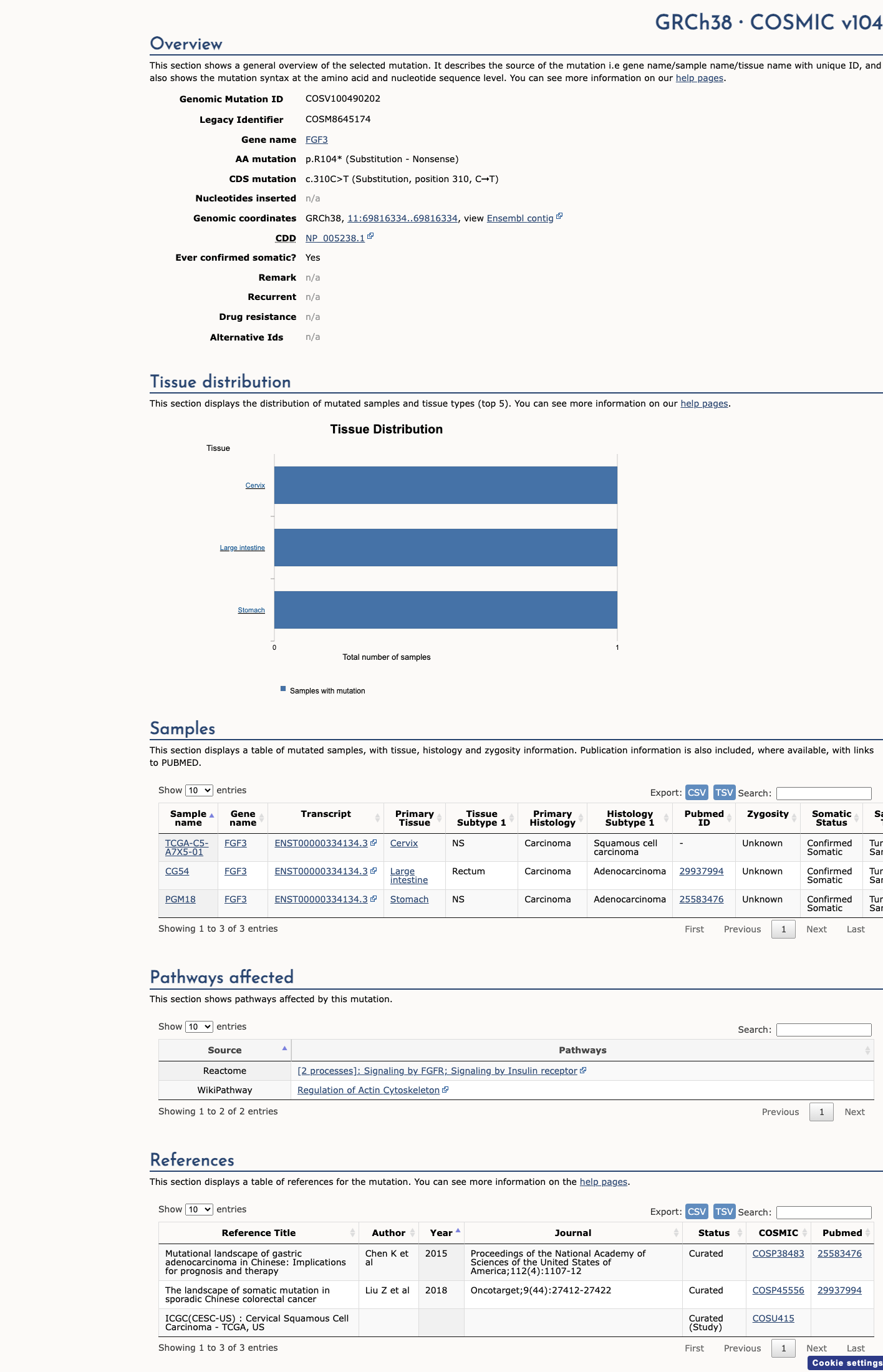
Somatic evidence Not in COSMIC / hotspots
COSMIC
This variant does not lie in a statistically significant hotspot. This variant has previously been reported in somatic cancers (COSMIC; COSV100490202, n = 3 times).
Hotspots
This variant does not lie in a statistically significant hotspot.
Literature · how each cited paper was used
4papers cited
Each card is an audit: what was searched, what was found, whether it names the variant, which criteria it fed, and why. 1 further PMID triaged but not cited — see Sources & References.
Homozygous mutations in fibroblast growth factor 3 are associated with a new form of syndromic deafness characterized by inner ear agenesis, microtia, and microdontia.
Searched
c.310C>Tp.Arg104Terp.R104Xsegregationparents
Found
Original report of FGF3 mutations in LAMM syndrome. In Turkish family B, the nonsense mutation c.310C>T (p.R104X) is homozygous in all three affected members; all available parents are heterozygous carriers and unaffected relatives are heterozygous or homozygous wild-type (pedigree fig. 1). Segregation is fully consistent with completely penetrant autosomal recessive inheritance, confirming the variant is inherited (not de novo). Family A (p.S156P) and family C (p.V206SfsX117) carry different mutations and are not directly relevant to this variant. Note: the extracted OCR text renders the transition as 'c.310CrT' where 'r' is the OCR artifact for '>'.
Variant
✓ Names this variant — characterised directly
Applied to
PM2 moderate
Documents p.R104X exclusively as a rare fully penetrant recessive disease allele observed only in affected families; no population or control cohort frequency reported, consistent with PM2 met.
PM3 moderate
Three affected probands homozygous for the variant (biallelic, variant in trans with itself) with heterozygous carrier parents in a fully penetrant autosomal recessive disorder; supports biallelic involvement and may be counted toward PM3 strength if homozygous observations are accepted as trans evidence.
PP1 supporting
c.310C>T homozygous in all 3 affected members of family B with both parents heterozygous carriers and unaffected relatives het/wild-type - cosegregation consistent with autosomal recessive LAMM
PP4 supporting
Documents the highly specific phenotype (microtia, microdontia, profound deafness, Michel aplasia) in individuals homozygous for this exact variant, supporting phenotype specificity for a single genetic etiology
We found a nonsense homozygous mutation, c.310CrT (p.R104X), in the second exon of FGF3 in all three of the affected members of family B (fig. 7). All available parents were heterozygous, and unaffected relatives were heterozygous or homozygous for the wild-type allele in this family (fig. 1).
Location Results section, Family B paragraph; Figure 1 (pedigrees of three Turkish families); Figure 7 (mutation electropherograms)  ·  Context Three unrelated Turkish families with autosomal recessive syndromic deafness (Michel aplasia, microtia, microdontia); homozygosity mapping with 10K SNP arrays followed by Sanger sequencing of FGF3 exons in all available family members; mutations screened in 300 healthy Turkish controls  ·  full text
Variable expressivity of FGF3 mutations associated with deafness and LAMM syndrome.
Searched
c.310C>Tp.R104Xp.Arg104Tersegregationcarriers
Found
Prospective molecular genetic study of Pakistani families segregating deafness linked to the DFNB63 locus on 11q13. Family PKDF295 segregates homozygous c.310C>T (p.R104X) in four affected members (IV:1, IV:2, IV:7, IV:8) with complete labyrinthine aplasia; the mutation was previously reported and was not found in 162 ethnically matched normal-hearing controls. A heterozygous carrier (III-3, PKDF295) showed no abnormal temporal bone findings on imaging, consistent with recessive carrier status. This adds a second family (4 affected homozygotes) with cosegregation of the variant with disease.
Variant
✓ Names this variant — characterised directly
Applied to
PM2 moderate
Absence of p.R104X from 162 matched Pakistani normal-hearing controls directly supports PM2 (low/absent population frequency).
PM3 moderate
PP1 supporting
c.310C>T homozygous in 4 affected members of family PKDF295 co-segregating with deafness; heterozygous carrier III-3 clinically and radiologically normal - additional recessive cosegregation for PP1
PP4 supporting
Documents bilateral complete labyrinthine aplasia with microtia/microdontia in p.R104X homozygotes, supporting the highly specific LAMM phenotype
One mutation (p.R132GfsX26 (c.394delC) from family PKDF887) was novel and the other two mutations (p.R95W (c.283 C > T) from PKDF817 and p.R104X (c.310C > T) from PKDF295) were previously reported (Table 1 ; Figure 1 )
Location Results ('FGF3 mutations in DFNB63-linked families'); Table 1 (family PKDF295 rows IV:1, IV:2, IV:7, IV:8); temporal bone imaging paragraph on heterozygous carriers  ·  Context Five Pakistani families linked to DFNB63 locus; homozygosity mapping and FGF3 sequencing; 162 ethnically matched Pakistani normal-hearing controls; temporal bone CT/3D-FIESTA MRI in 10 affected and 3 heterozygous individuals  ·  full text
LAMM syndrome with middle ear dysplasia associated with compound heterozygosity for FGF3 mutations.
Searched
c.310C>Tp.R104Xp.Arg104Tercompound heterozygosityparents
Found
First report of FGF3 compound heterozygotes in two European non-consanguineous families. Patient B (Italian) carries the paternal missense p.Y49C in compound heterozygosity with the maternal nonsense p.R104X (c.310C>T), confirming maternal transmission of the variant in a third independent family; both parents are normal-hearing, unaffected carriers. The heterozygous mother had surgically corrected unilateral microtia without hearing loss or dental findings, discussed by the authors as possibly related to heterozygosity but not constituting non-segregation. Family A carries different mutations (p.Y106C/p.W153VfsX51) and is not relevant to this variant.
Variant
✓ Names this variant — characterised directly
Applied to
PM2 moderate
Recurrent p.R104X observed only in affected patients across families; control screening (50 European controls) supports rarity of FGF3 mutations, though it covered the new missense variants rather than p.R104X itself.
PM3 moderate
Variant p.R104X detected in trans with p.Y49C in an affected LAMM proband; phase confirmed by parental carrier genotypes (maternal p.R104X, paternal p.Y49C) — direct PM3 evidence for an autosomal recessive disorder.
PP1 supporting
Patient B affected with biallelic FGF3 mutations including maternal p.R104X; both parents unaffected heterozygous carriers - additional family segregating the variant with disease in the recessive model
PP4 supporting
Confirms p.R104X in a patient with the highly specific LAMM phenotype (labyrinthine aplasia, microtia, microdontia)
In Patient B the paternal missense mutation p.Y49C was found in compound heterozygosity with the maternal nonsense mutation (p.R104X).
Location Results section, Patient B (Italian family); Discussion paragraph on the heterozygous mother's unilateral microtia  ·  Context Two European families from non-consanguineous marriages with LAMM syndrome; FGF3 Sanger sequencing of propositi and parents (NM_005247.2); 50 unrelated European control subjects (100 chromosomes) tested for the novel missense variants  ·  full text
Rule & framework references · cited for criterion definitions, not variant evidence
25741868 ↗ Standards and guidelines for the interpretation of sequence variants: a joint consensus recommendation of the American College of Medical Genetics and Genomics and the Association for Molecular Pathology.
Sources & reference links
8Sources
ClinVar
gnomAD v2.1
gnomAD v4.1
gnomAD-Canada
SpliceAI
OncoKB
COSMIC
Cancer hotspots
Triaged references · 1 PMID not cited in assessment
22993869 ↗ Congenital Deafness with Labyrinthine Aplasia, Microtia, and Microdontia. CLINVAR