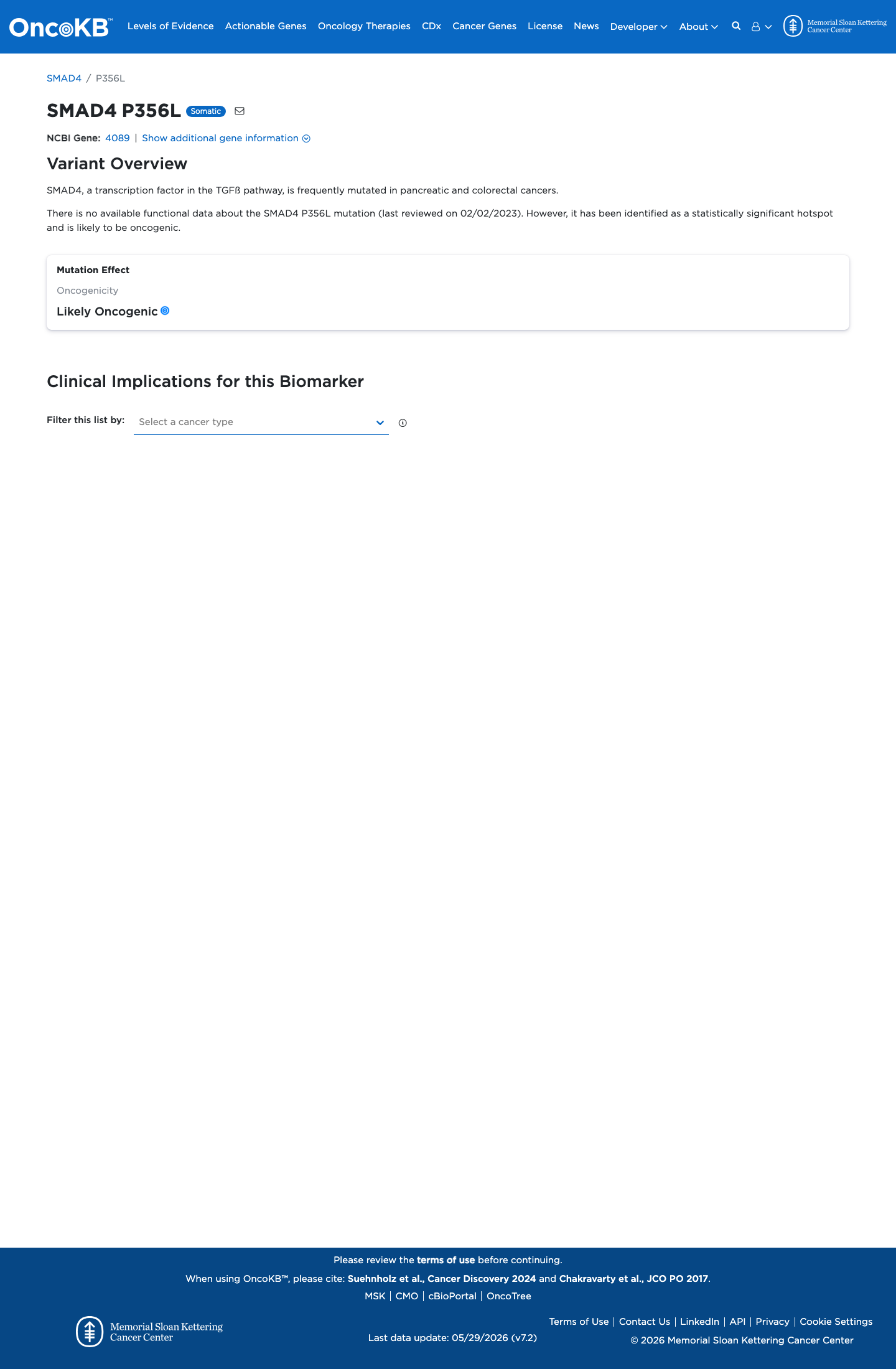
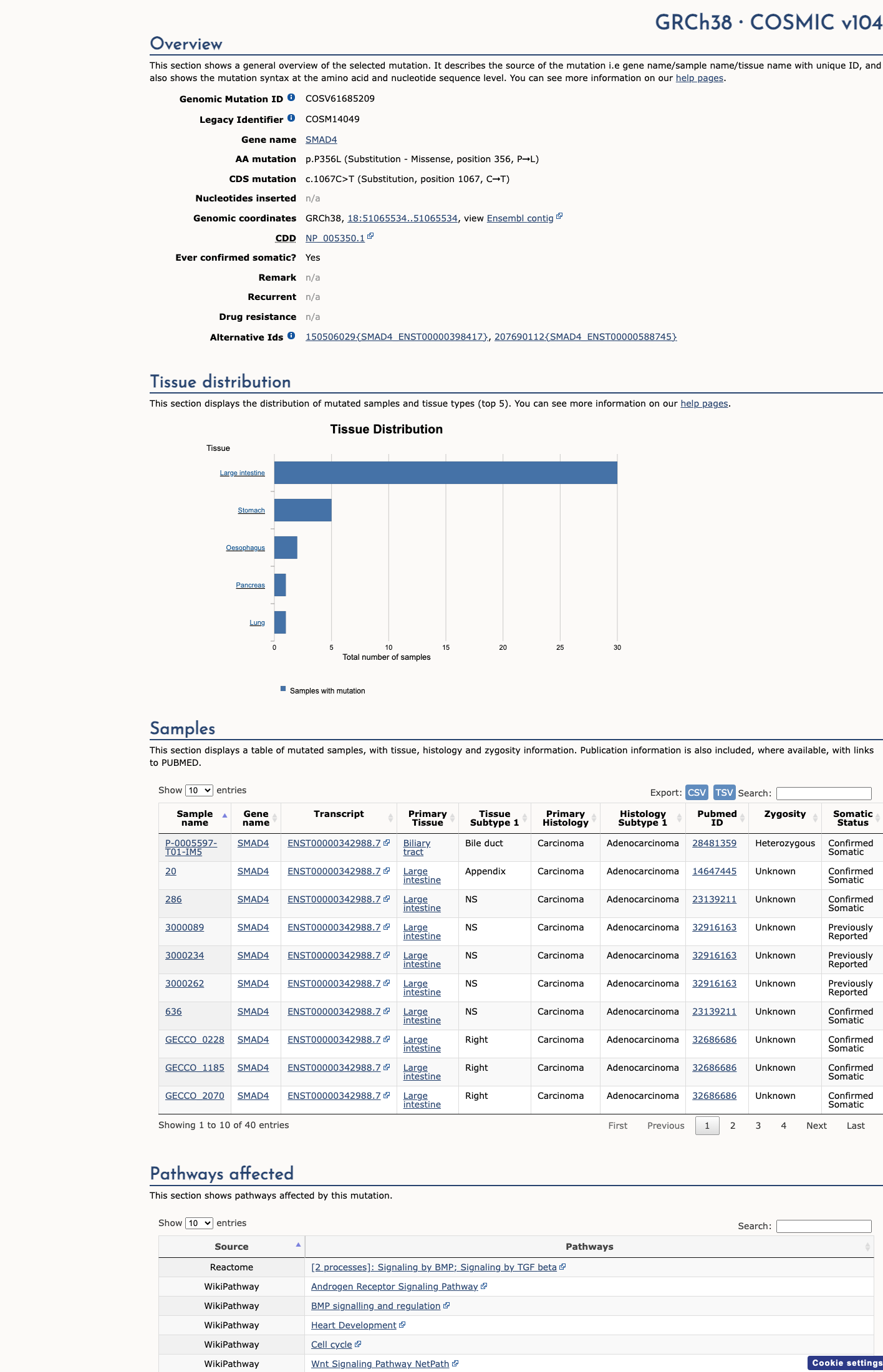
NM_005359.5:c.1067C>T (p.Pro356Leu) is a missense variant in exon 9 of SMAD4. It is absent from gnomAD v2.1, v4.1, and gnomAD-Canada, supporting rarity in the general population.1 Residue Pro356 is located in the SMAD4 MH2 domain (aa 324-552), a well-established critical functional domain that mediates SMAD oligomerization and transcriptional activation. This residue additionally lies within a statistically significant mutational hotspot.2 Multiple in silico predictors support a deleterious effect: REVEL score 0.968 (damaging), BayesDel score 0.541 (damaging). SpliceAI predicts no significant splice impact (max delta 0.03).3 This variant has been reported in ClinVar as Uncertain Significance by a single clinical laboratory (Ambry Genetics; ClinVar ID 1782219). It has been observed in 40 somatic cancer samples (COSMIC COSV61685209) and is classified as Likely Oncogenic by OncoKB.4 PVS1 is not applicable (missense variant). In silico evidence meets PP3 (supporting). Population absence meets PM2 (moderate). MH2 domain location and hotspot status meet PM1 (moderate). Verified criteria: PM1 (moderate) + PM2 (moderate) + PP3 (supporting). Under ACMG/AMP 2015 combination rules, 2 moderate + 1 supporting is insufficient for Likely Pathogenic (requires ≥3 moderate, or 2 moderate + ≥2 supporting). No benign criteria are met. PS3 (functional) and PP1 (segregation) were not assessed because variant-specific evidence could not be verified in accessible full-text publications. Overall classification: Uncertain Significance (VUS).5 Gaps: Variant-specific germline functional studies (PS3) and co-segregation data (PP1) were referenced in exploratory literature review (PMID:20101697, PMID:15031030) but could not be verified — abstracts do not mention this variant and full texts are unavailable. Resolution of these gaps could upgrade the classification to Likely Pathogenic.
Final classification
VUS
PM1PM2PP3
SMAD4
c.1067C>T
p.Pro356Leu
This variant
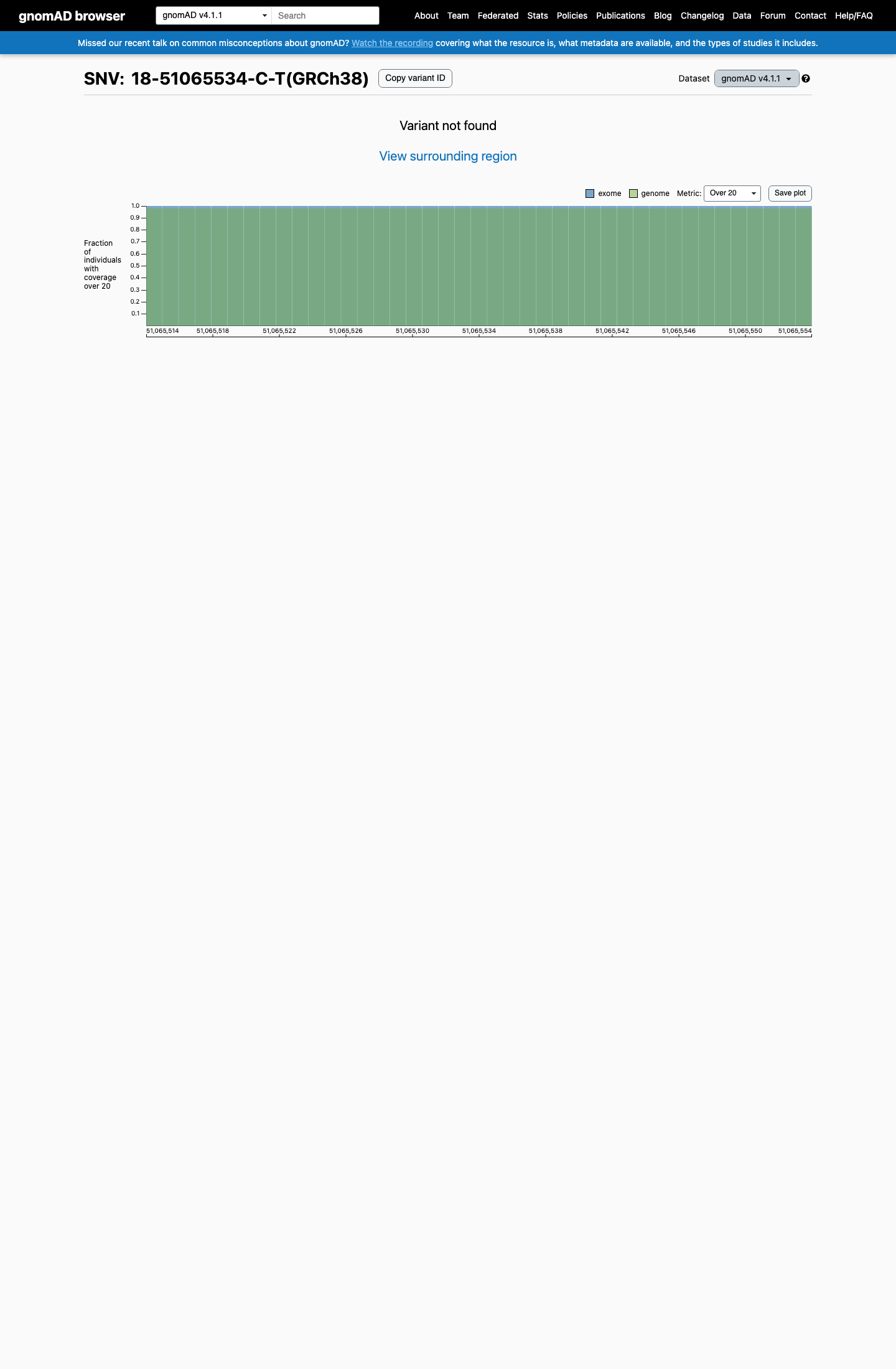
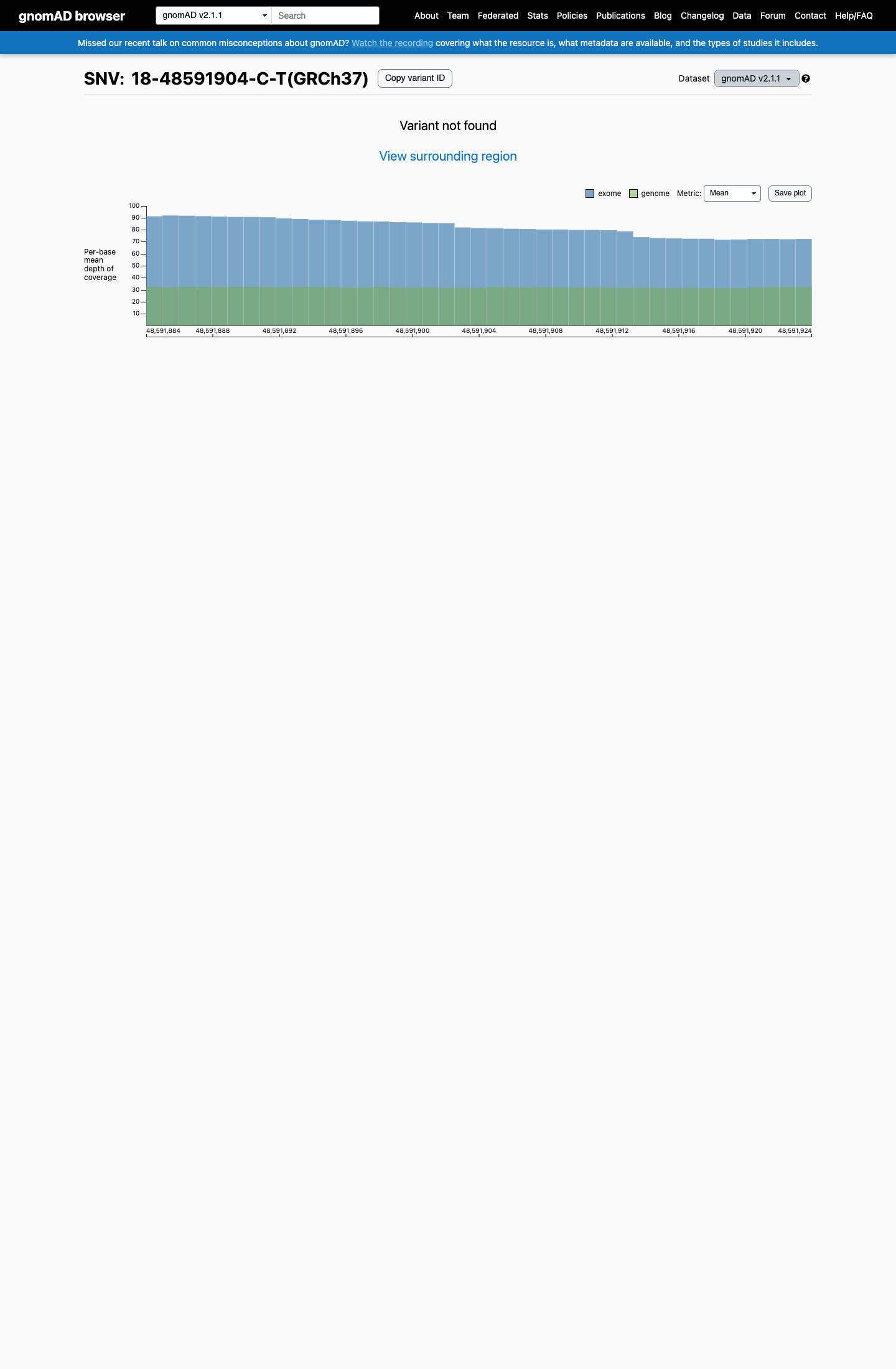
NM_005359.5:c.1067C>T (p.Pro356Leu) is a missense variant in exon 9 of SMAD4. It is absent from gnomAD v2.1, v4.1, and gnomAD-Canada, supporting rarity in the general population.
gene-specific framework lacked a usable explicit final combination framework, so generic ACMG/AMP 2015 final-combination rules were applied as fallback; applied criteria: PM1 moderate, PM2 moderate, PP3 supporting; combination = 2 moderate + 1 supporting, which maps to VUS.
Classification rationale
PM1PM2PP3
VUS
SMAD4 c.1067C>T
PM1 + PM2 + PP3
→
VUS
LYFE Sciences is an AI system, and it can make mistakes. Criteria
may be applied incorrectly, sources may be misread, and a confident-looking
classification can still be wrong. Double-check every criterion and
its underlying evidence before relying on any call.
Gene diagram
· NM_005359.5 · variants mapped to exon structure
SMAD4
NM_005359.5
Fetching transcript structure from UCSC…
Applied criteria · 3 applied · 18 assessed
MetEvidence satisfies this criterion.
Not metEvaluated against available evidence; threshold not reached.
Not assessedApplies in principle, but no evidence was found to evaluate it.
N/ADoesn't apply to this variant type.
Applied · 3
Strength
Supporting
Moderate
Strong
Very strong
PM1
moderate
Pathogenic
Residue Pro356 is located in the SMAD4 MH2 domain (aa 324-552), a well-established critical functional domain that mediates SMAD oligomerization and transcriptional activation. Pathogenic missense variants cluster in the MH2 domain in JP-HHT. This residue additionally lies within a statistically significant hotspot identified by the cancer hotspots pipeline.
SMAD4 MH2 domain (aa 324-552) is critical for protein function.Residue 356 lies in a statistically significant hotspot.SMAD4 loss of function is an established germline disease mechanism for JPS and JP-HHT.
PM2
moderate
Pathogenic
Variant is absent from gnomAD v2.1 (exomes), gnomAD v4.1 (exomes/genomes), and gnomAD-Canada v1.0. Allele frequency is 0.0 across all population databases, well below the <0.1% threshold for PM2 under generic ACMG/AMP rules applied to autosomal dominant disorders.
gnomAD v2.1: absent (AC=0).gnomAD v4.1: absent (AC=0).gnomAD-Canada v1.0: absent (AC=0).
PP3
supporting
Pathogenic
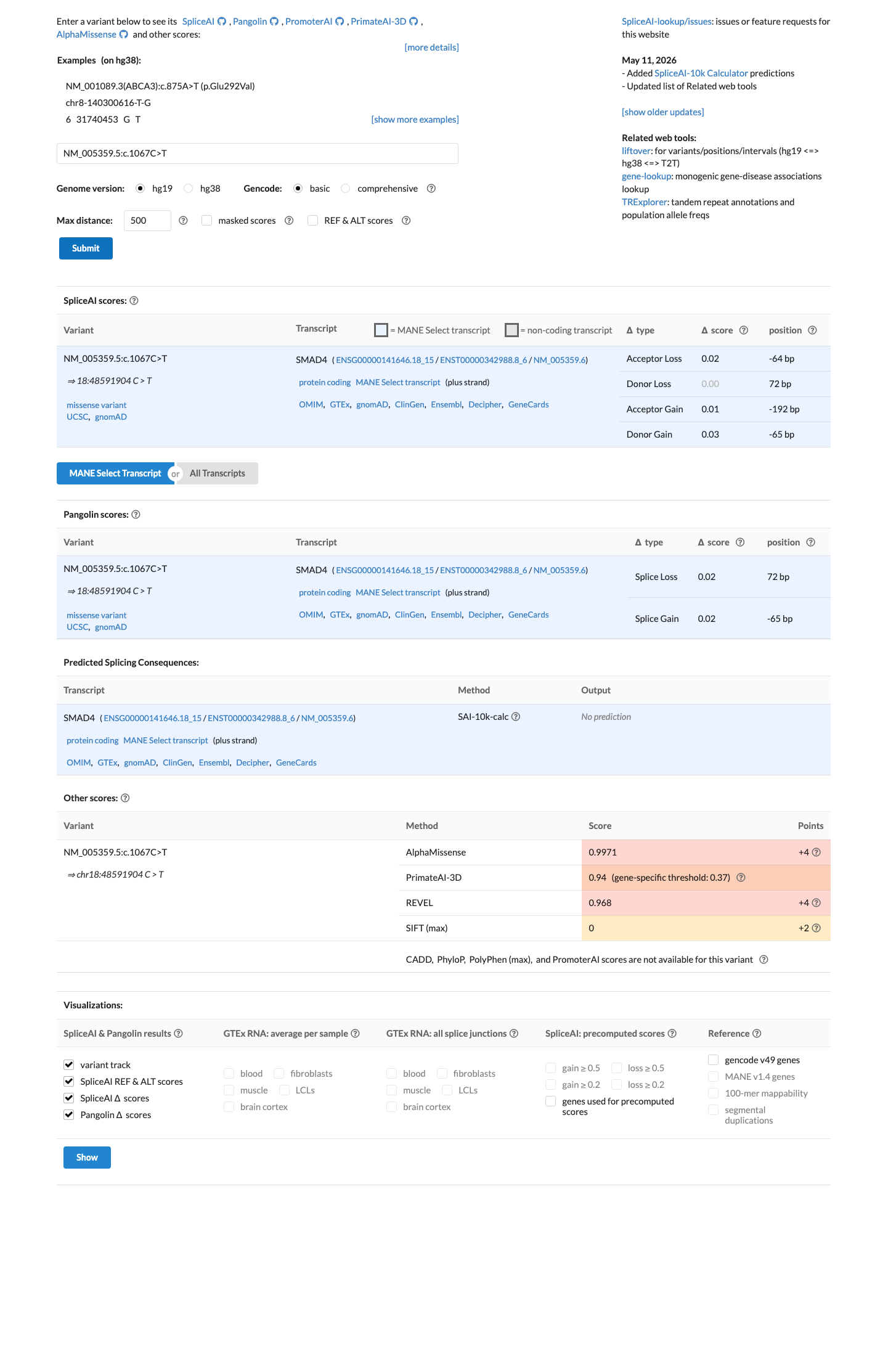
Multiple in silico predictors support a deleterious effect: REVEL score 0.968 (well above 0.932 threshold for damaging prediction), BayesDel score 0.541 (above 0.27 threshold). SpliceAI predicts no significant splice impact (max delta score 0.03), but this does not offset the strong missense pathogenicity predictions.
REVEL: 0.968 (damaging).BayesDel: 0.540787 (moderately damaging).SpliceAI max delta: 0.03 (no splice impact).
Assessed · not applied
· 12 not met · 6 not assessed
Pathogenic
PS1
No evidence of a different nucleotide change producing the same amino acid substitution (Pro356Leu) was identified.
PS2
No de novo occurrence with confirmed maternity and paternity has been reported for NM_005359.5:c.1067C>T.
PS3
OncoKB classifies this variant as Likely Oncogenic based on somatic curated evidence, suggesting functional data exist.
PS4
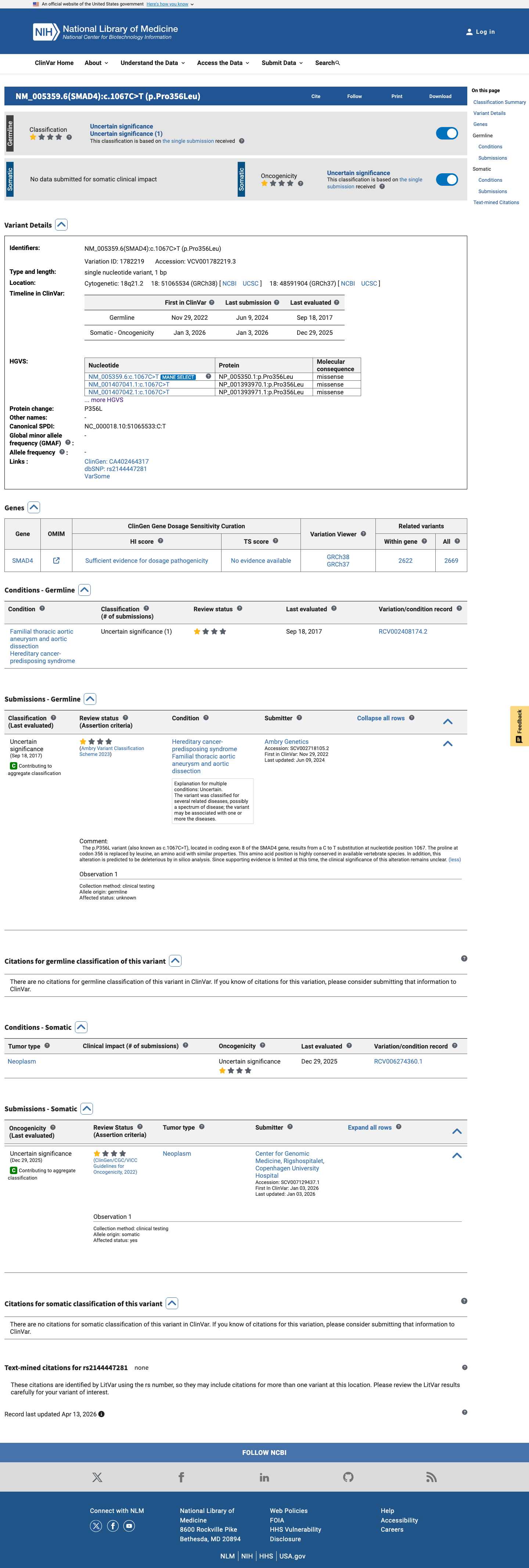
ClinVar contains a single submission (Ambry Genetics, SCV002718105) classifying this variant as Uncertain Significance.
PM6
No presumed de novo occurrence (without confirmed maternity/paternity) has been reported for this variant.
PP1
Exploratory literature review suggested co-segregation of c.1067C>T with JP-HHT in a family (PMID:15031030, Gallione et al.
PP2
PP2 applies to genes with a low rate of benign missense variation where missense variants are a common mechanism of disease.
PP4
No patient-specific phenotypic or family history data were provided for this case.
PP5
ClinVar classification is Uncertain Significance (single submitter, Ambry Genetics SCV002718105), not Pathogenic or Likely Pathogenic.
Benign
BA1
Variant is absent from gnomAD v2.1 and v4.1.
BS1
Variant is absent from all population databases.
BS2
BS2 requires observation in a healthy adult individual (homozygous for recessive, or hemizygous/heterozygous for fully penetrant dominant) with complete penetrance expected at an early age.
BS3
No well-established functional studies demonstrate a benign effect of p.Pro356Leu on protein function.
BS4
No evidence of non-segregation with disease in affected family members.
BP2
BP2 requires observation in trans with a pathogenic variant for a fully penetrant dominant disorder, or in cis with a pathogenic variant for a recessive disorder.
BP4
Multiple in silico predictors support a damaging effect: REVEL 0.968 (damaging) and BayesDel 0.541 (damaging).
BP5
BP5 requires identification of the variant in a case with an alternate molecular basis for disease.
BP6
BP6 requires classification as Benign or Likely Benign by a reputable source without access to the underlying evidence.
N/A · 4
PVS1 · PM5 · BP1 · BP7
Research & evidence
Population frequency
gnomAD v4.1
gnomAD v2.1
v4.1
Absent from gnomAD v4.1.
v2.1
Absent from gnomAD v2.1.
🇨🇦 CA
Absent from gnomAD-Canada v1.0.
Allele frequency by ancestry
three datasets · side by side
gnomAD v4.1
Absent
· 0 / ?
0 hom
0 hom
Not observed in any ancestry group.
gnomAD v2.1
Absent
· 0 / ?
0 hom
0 hom
Not observed in any ancestry group.
gnomAD Canada 🇨🇦
Absent
· 0 / ?
0 hom
0 hom
Not observed in any ancestry group.
ClinVar
This variant has been reported in ClinVar as Uncertain significance (1 clinical laboratory). (ClinVarID = 1782219)
In silico
SpliceAI predicts no significant splice impact for this variant (max delta score = 0.03). REVEL score = 0.968. BayesDel score = 0.540787.
Functional
Likely Oncogenic
OncoKB identified variant-specific curated literature and context relevant to functional review; curated oncogenicity label: Likely Oncogenic.
COSMIC

Cancer hotspots
Somatic evidence
Hotspot
COSMIC
This variant lies in a statistically significant hotspot. This variant has previously been reported in somatic cancers (COSMIC; COSV61685209, n = 40 times).
Hotspots
This variant lies in a statistically significant hotspot.
Sources & reference links
Triaged references · 8 PMIDs not cited in assessment
35101336 ↗
Standards for the classification of pathogenicity of somatic variants in cancer (oncogenicity): Joint recommendations of Clinical Genome Resource (ClinGen), Cancer Genomics Consortium (CGC), and Variant Interpretation for Cancer Consortium (VICC).
CLINVAR
22918138 ↗
Opportunities and challenges associated with clinical diagnostic genome sequencing: a report of the Association for Molecular Pathology.
CLINVAR
24882528 ↗
Canadian Cardiovascular Society position statement on the management of thoracic aortic disease.
CLINVAR
25394175 ↗
A practice guideline from the American College of Medical Genetics and Genomics and the National Society of Genetic Counselors: referral indications for cancer predisposition assessment.
CLINVAR
34131312 ↗
Chromosomal microarray analysis, including constitutional and neoplastic disease applications, 2021 revision: a technical standard of the American College of Medical Genetics and Genomics (ACMG).
CLINVAR
23619274 ↗
American College of Medical Genetics and Genomics technical standards and guidelines: microarray analysis for chromosome abnormalities in neoplastic disorders.
CLINVAR
25173340 ↗
2014 ESC Guidelines on the diagnosis and treatment of aortic diseases: Document covering acute and chronic aortic diseases of the thoracic and abdominal aorta of the adult. The Task Force for the Diagnosis and Treatment of Aortic Diseases of the European Society of Cardiology (ESC).
CLINVAR