Back
NM_005359.6:c.463A>G
p.Ser155Gly · SMAD4
ACMG/AMP
0%
complete
Final classification
VUS
PM2
SMAD4
c.463A>G
p.Ser155Gly
missense · exon 5

SMAD4 encodes a protein that helps transmit TGF-beta and bone morphogenetic protein signals to the nucleus, where it controls genes involved in cell growth and tissue development. It acts as a tumor suppressor and is associated with juvenile polyposis syndrome and hereditary hemorrhagic telangiectasia. Loss or alteration of SMAD4 is especially linked to pancreatic cancer and can also occur in colorectal and lung cancers.

This variant

SMAD4 encodes a tumor-suppressor signaling protein, and inherited SMAD4 alterations are associated with juvenile polyposis syndrome and hereditary hemorrhagic telangiectasia.

Transcript
NM_005359.6
HGVS · transcript:coding
NM_005359.6:c.463A>G
GRCh38
chr18:51054789 A>G
GRCh37
chr18:48581159 A>G
VUS: PM2 (supporting) is the only applied criterion and does not satisfy a generic ACMG/AMP pathogenic or benign combination rule.
Classification rationale
PM2 VUS
SMAD4 c.463A>G missense · exon 5

VUS: PM2 (supporting) is met because the gnomAD v4.1 maximum observed subpopulation allele frequency is 2.23e-05, below 0.0001.

PM2 VUS
LYFE Sciences is an AI system, and it can make mistakes. Criteria may be applied incorrectly, sources may be misread, and a confident-looking classification can still be wrong. Double-check every criterion and its underlying evidence before relying on any call.
Gene diagram · NM_005359.6 · variants mapped to exon structure
SMAD4 NM_005359.6
Fetching transcript structure from UCSC…
Applied criteria · 1 applied · 22 assessed
MetEvidence satisfies this criterion.
Not metEvaluated against available evidence; threshold not reached.
Not assessedApplies in principle, but no evidence was found to evaluate it.
N/ADoesn't apply to this variant type.
Applied · 1
Strength Supporting Moderate Strong Very strong
PM2 supporting Pathogenic
Met at supporting strength: gnomAD v4.1 all-comers allele frequency 1.88e-06 (3/1,594,076) and popmax 2.23e-05 are both below the 0.0001 PM2 threshold.
gnomAD v4.1 all-comers: total AF 1.88197e-06 (3/1,594,076 alleles), homozygotes 0; exome AF 2.08085e-06 (3/1,441,718); genome cohort contributed 0 alleles.gnomAD v2.1 all-comers (exome only): total AF 3.9781e-06 (1/251,376 alleles), homozygotes 0.gnomAD v2.1 exomes-only NON_CANCER subset: AF 4.2223e-06 (1/236,838 alleles), homozygotes 0.
Assessed · not applied · 14 not met · 8 not assessed
Pathogenic
PS1 Not met: no established pathogenic variant shares this p.Ser155Gly change, and c.463A>G is the only nucleotide change at codon 155 that can encode glycine.
PS2 Not assessed: no documented proband-parent testing or confirmed de novo result is available for NM_005359.6:c.463A>G.
PS3 Not met: no functional study tested c.463A>G, and the 12-variant SMAD4 reporter assay panel (PMID:40835297) excludes it.
PS4 Not assessed: no exact-variant case-control enrichment, affected-case count, odds ratio, or statistically supported excess was available.
PM1 Not met: residue 155 is not a statistically significant mutational hotspot and no approved SMAD4 critical-domain table or pathogenic codon-155 variant places it in a functional domain.
PM5 Not met: the three alternative codon-155 missense variants (p.Ser155Asn, p.Ser155Thr, p.Ser155Arg) are all classified Uncertain significance, so no pathogenic same-residue comparator exists.
PM6 Not assessed: no affected proband with presumed de novo inheritance and unavailable or untested parents is documented for this variant.
PP1 Not assessed: no affected relatives, informative meioses, or family cosegregation data are documented for NM_005359.6:c.463A>G.
PP2 Not met: although SMAD4 is missense-constrained (gnomAD mis_z 6.18), only 29 of 371 pathogenic/likely pathogenic ClinVar records (8%) are missense, so missense is not a common mechanism.
PP3 Not met: missense REVEL 0.484 is below the ClinGen SVI PP3 supporting threshold of >=0.644.
PP4 Not assessed: no individual-level phenotype sufficiently specific for a SMAD4-associated disorder was provided for this variant carrier.
PP5 Not met: the exact ClinVar record has zero expert-panel submissions and no Pathogenic or Likely pathogenic expert-panel classification.
Benign
BA1 Not met: the highest gnomAD subpopulation allele frequency, 2.23e-05, is about three orders of magnitude below the 0.05 BA1 stand-alone threshold.
BS1 Not met: the highest observed allele frequency, 2.23e-05, is more than two orders of magnitude below the 0.01 BS1 threshold (Whiffin 2017).
BS2 Not met: zero homozygotes for c.463A>G in any gnomAD dataset (v2.1 and v4.1), and SMAD4 disease is not fully penetrant at an early age.
BS3 Not met: no functional assay tested c.463A>G, so preserved BMP/TGF-beta signalling for p.(Ser155Gly) is unproven, not demonstrated.
BS4 Not assessed: no informative unaffected relatives with documented negative testing and adequate phenotype assessment are available for BS4.
BP1 Not met: 29 of 371 pathogenic/likely pathogenic SMAD4 ClinVar records are missense, so SMAD4 disease is not caused by truncating variants alone and BP1 does not apply.
BP2 Not assessed: no documented phase, cis/trans relationship, or second pathogenic variant is available for this SMAD4 c.463A>G observation.
BP4 Not met: missense REVEL 0.484 exceeds the ClinGen SVI BP4 supporting threshold of <=0.29.
BP5 Not assessed: no exact-variant affected case with a documented alternate molecular basis for disease was identified.
BP6 Not met: the exact ClinVar Likely benign assertion is from a single laboratory, with zero expert-panel submissions.
N/A · 5 PVS1 · PM3 · PM4 · BP3 · BP7
Research & evidence
Population frequency
gnomAD v4.1 screenshot
gnomAD v4.1
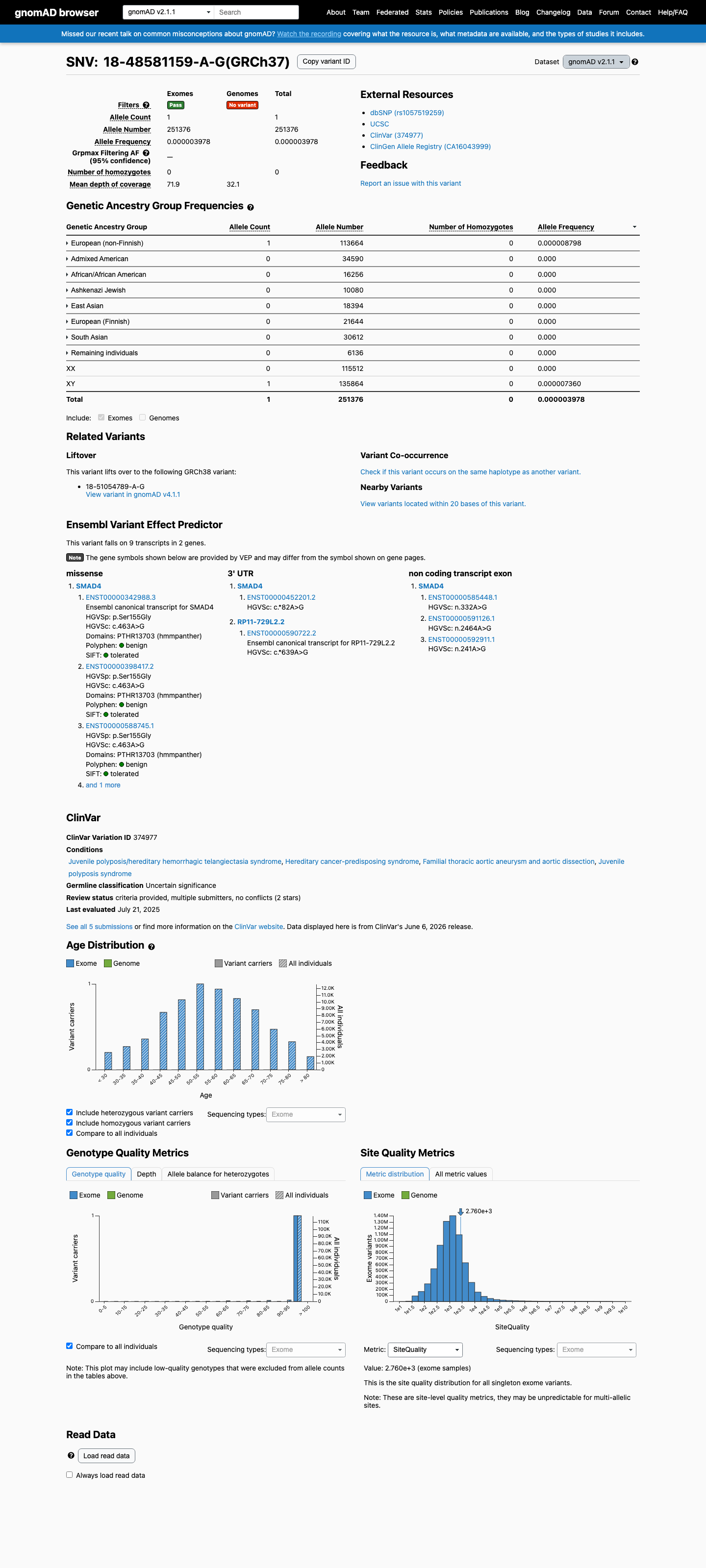
gnomAD v2.1 screenshot
gnomAD v2.1
v4.1
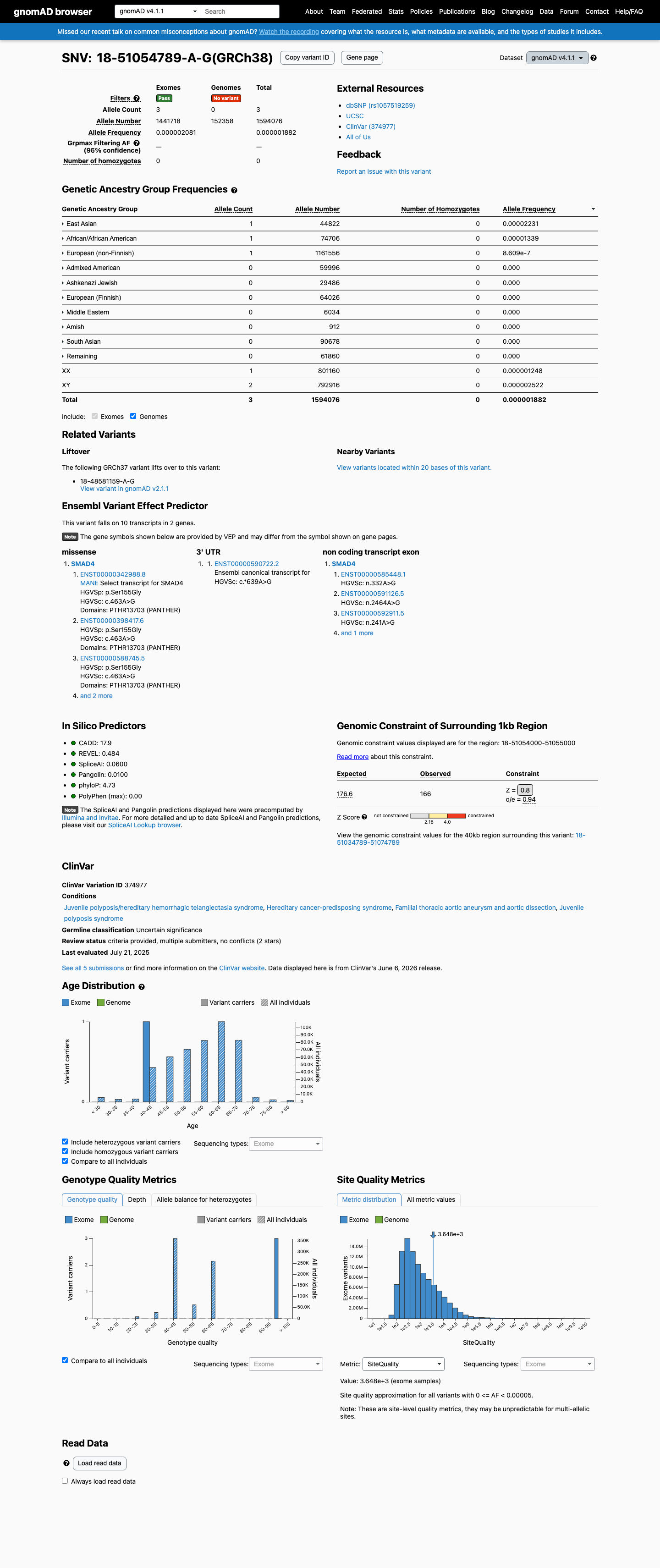
This variant is present in gnomAD v4.1 (AF= 1.88197e-06; MAF= 0.00019%, 3/1594076 alleles, homozygotes = 0) and has highest observed frequency in the East Asian population (AF= 2.23105e-05; MAF= 0.00223%, 1/44822 alleles, homozygotes = 0).
v2.1
This variant is present in gnomAD v2.1 (AF= 3.9781e-06; MAF= 0.00040%, 1/251376 alleles, homozygotes = 0) and has highest observed frequency in the European (non-Finnish) population (AF= 8.79786e-06; MAF= 0.00088%, 1/113664 alleles, homozygotes = 0).
🇨🇦 CA
Not available in gnomAD-Canada v1.0.
Allele frequency by ancestry
three datasets · side by side
gnomAD v4.1
0.00019% · 3 / 1,594,076
0 hom
East Asian
1 / 44,822
0.0022%
African/African American
1 / 74,706
0.0013%
European (non-Finnish)
1 / 1,161,556
8.6e-05%
+ 7 not observed (Remaining individuals, Admixed American, European (Finnish), Amish, Middle Eastern, South Asian, Ashkenazi Jewish)
gnomAD v2.1
0.0004% · 1 / 251,376
0 hom
European (non-Finnish)
1 / 113,664
0.00088%
+ 7 not observed (African/African American, Admixed American, Ashkenazi Jewish, East Asian, European (Finnish), Remaining individuals, South Asian)
gnomAD Canada 🇨🇦
Absent · 0 / ?
0 hom
Not observed in any ancestry group.
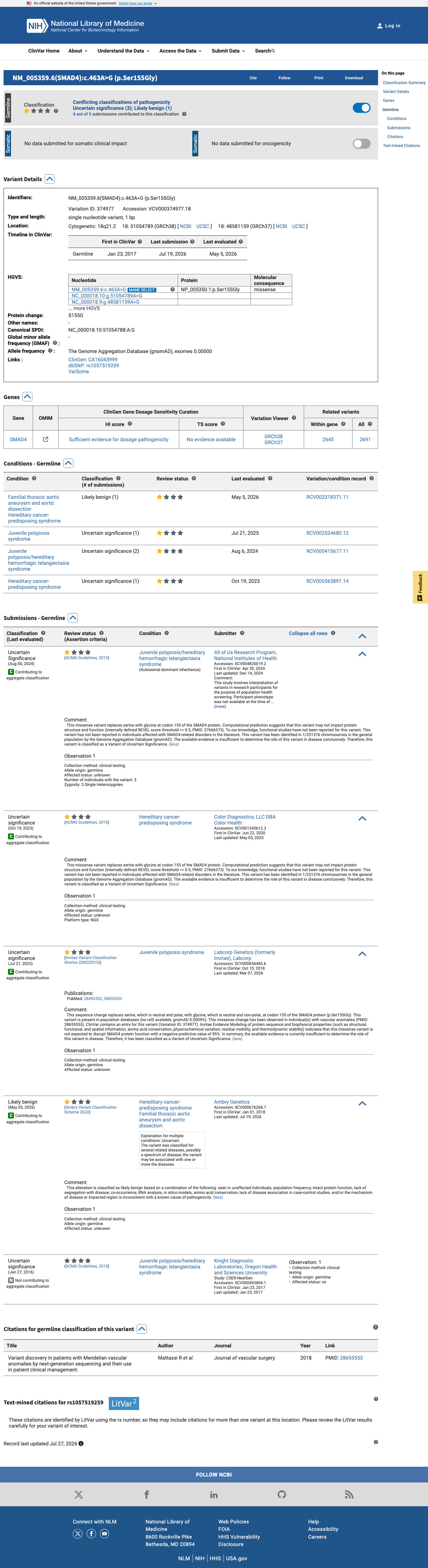
ClinVar screenshot
ClinVar
This variant has been reported in ClinVar as Uncertain significance (3 clinical laboratories) and as Uncertain Significance (1 clinical laboratory) and as Likely benign (1 clinical laboratory). (ClinVarID = 374977)
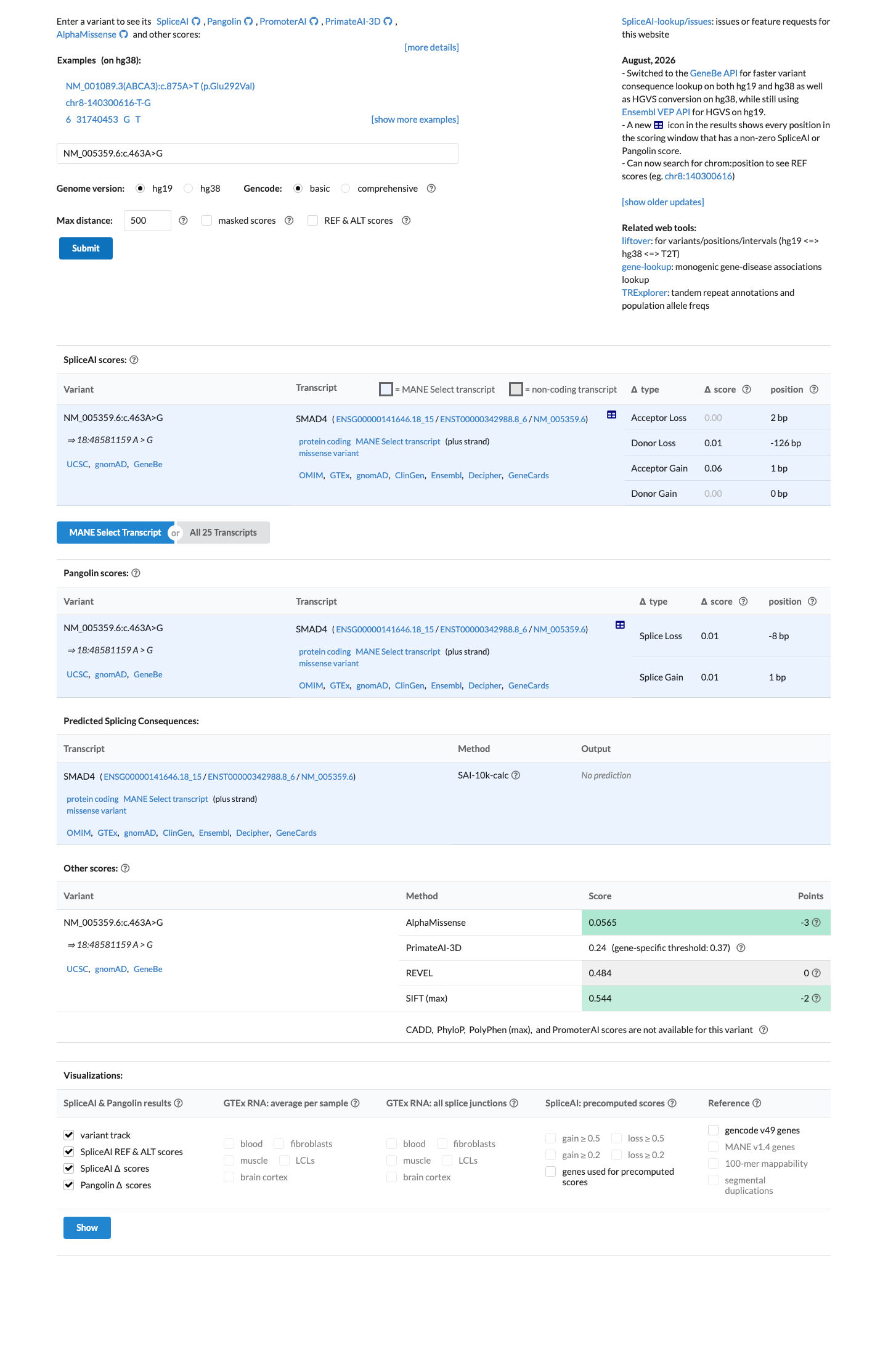
SpliceAI screenshot
In silico
SpliceAI predicts no significant splice impact for this variant (max delta score = 0.06). REVEL score = 0.484. BayesDel score = -0.242868.
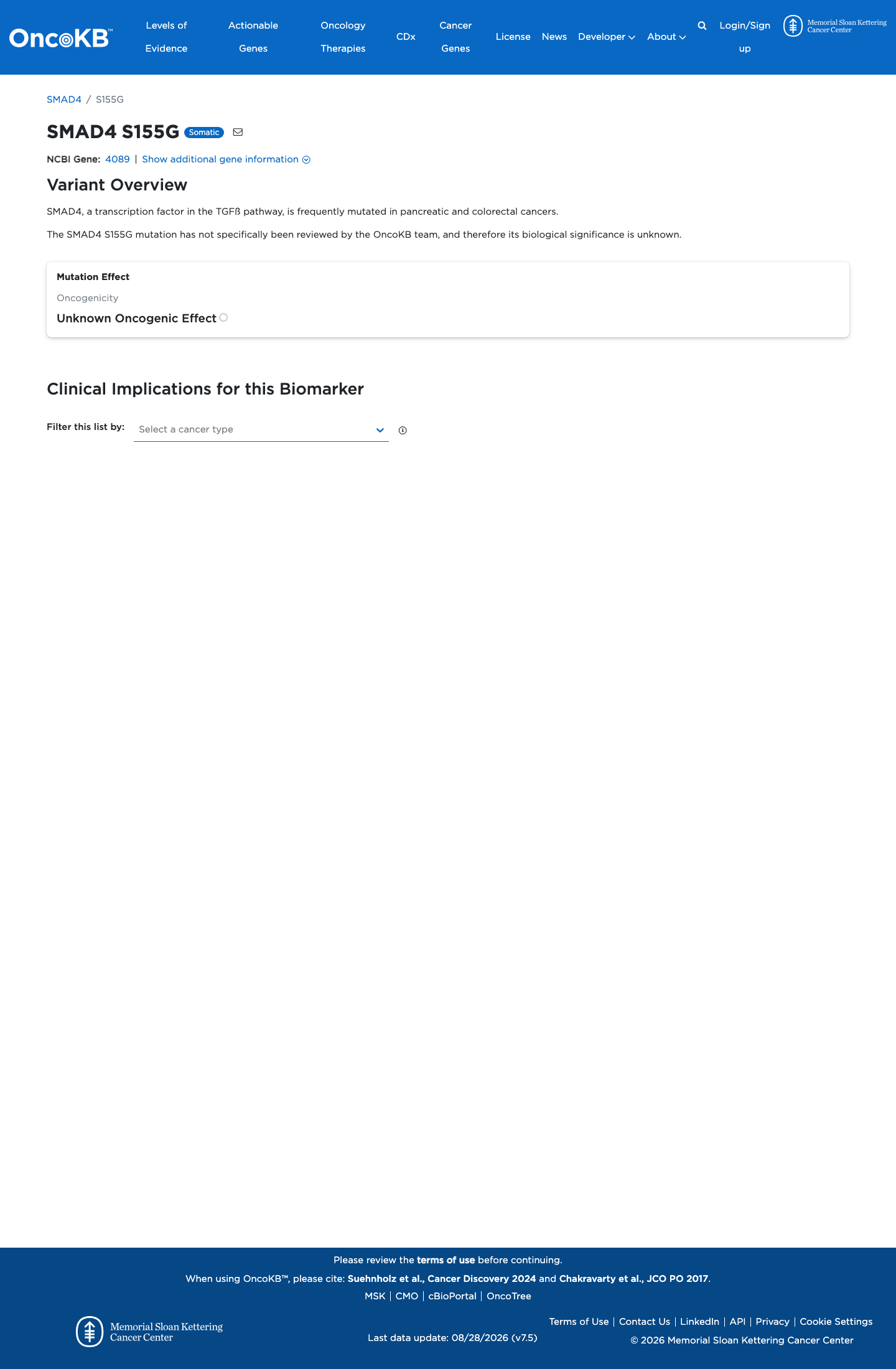
Functional / OncoKB screenshot
Functional Unknown Oncogenic Effect
OncoKB did not identify variant-specific reviewed functional evidence for this variant; gene-level curated context is available for reviewer follow-up. SMAD4, a transcription factor in the TGFß pathway, is frequently mutated in pancreatic and colorectal cancers.
OncoKB ↗
COSMIC screenshot
COSMIC
Cancer hotspots screenshot
Cancer hotspots
Somatic evidence Not in COSMIC / hotspots
COSMIC
This variant does not lie in a statistically significant hotspot. This variant has not previously been reported in somatic cancers (COSMIC).
Hotspots
This variant does not lie in a statistically significant hotspot.
Literature · how each cited paper was used
1papers cited
Each card is an audit: what was searched, what was found, whether it names the variant, which criteria it fed, and why. 6 further PMIDs triaged but not cited — see Sources & references.
Rule & framework references · cited for criterion definitions, not variant evidence
25741868 ↗ Standards and guidelines for the interpretation of sequence variants: a joint consensus recommendation of the American College of Medical Genetics and Genomics and the Association for Molecular Pathology.
Sources & reference links
8Sources
ClinVar
gnomAD v2.1
gnomAD v4.1
gnomAD-Canada
SpliceAI
OncoKB
COSMIC
Cancer hotspots
Triaged references · 6 PMIDs not cited in assessment
20301299 ↗ Heritable Thoracic Aortic Disease Overview. CLINVAR
20301642 ↗ Juvenile Polyposis Syndrome. CLINVAR
26389258 ↗ Cancer Genetics Risk Assessment and Counseling (PDQ®): Health Professional Version. CLINVAR
26389505 ↗ Genetics of Colorectal Cancer (PDQ®): Health Professional Version. CLINVAR
28655553 ↗ Variant discovery in patients with Mendelian vascular anomalies by next-generation sequencing and their use in&#xa0;patient clinical management. CLINVAR
35802134 ↗ ACMG SF v3.1 list for reporting of secondary findings in clinical exome and genome sequencing: A policy statement of the American College of Medical Genetics and Genomics (ACMG). CLINVAR