Back
NM_005373.2:c.1513A>T
p.Ser505Cys · MPL
ACMG/AMP
0%
complete
Final classification
VUS
PS3PM1PM2BP4
MPL
c.1513A>T
p.Ser505Cys
missense · exon 10

MPL encodes the thrombopoietin receptor, a cell-surface protein that helps control the production of megakaryocytes and platelets through JAK-STAT and related signaling pathways. Changes that increase or reduce MPL activity can cause inherited platelet disorders, including abnormally high platelet counts or severe congenital thrombocytopenia with bone marrow failure. MPL also acts as an oncogene: activating changes are associated with myeloproliferative neoplasms such as essential thrombocythemia and myelofibrosis.

This variant

MPL encodes the thrombopoietin receptor, and residue 505 lies in its transmembrane region involved in signaling associated with platelet production and myeloproliferative neoplasms.

Transcript
NM_005373.2
HGVS · transcript:coding
NM_005373.2:c.1513A>T
GRCh38
chr1:43349307 A>T
GRCh37
chr1:43814978 A>T
VUS: PS3 supporting, PM1 moderate, and PM2 supporting are counterbalanced by BP4 supporting under generic ACMG/AMP combination rules.
Classification rationale
PS3PM1PM2 BP4 VUS
MPL c.1513A>T missense · exon 10

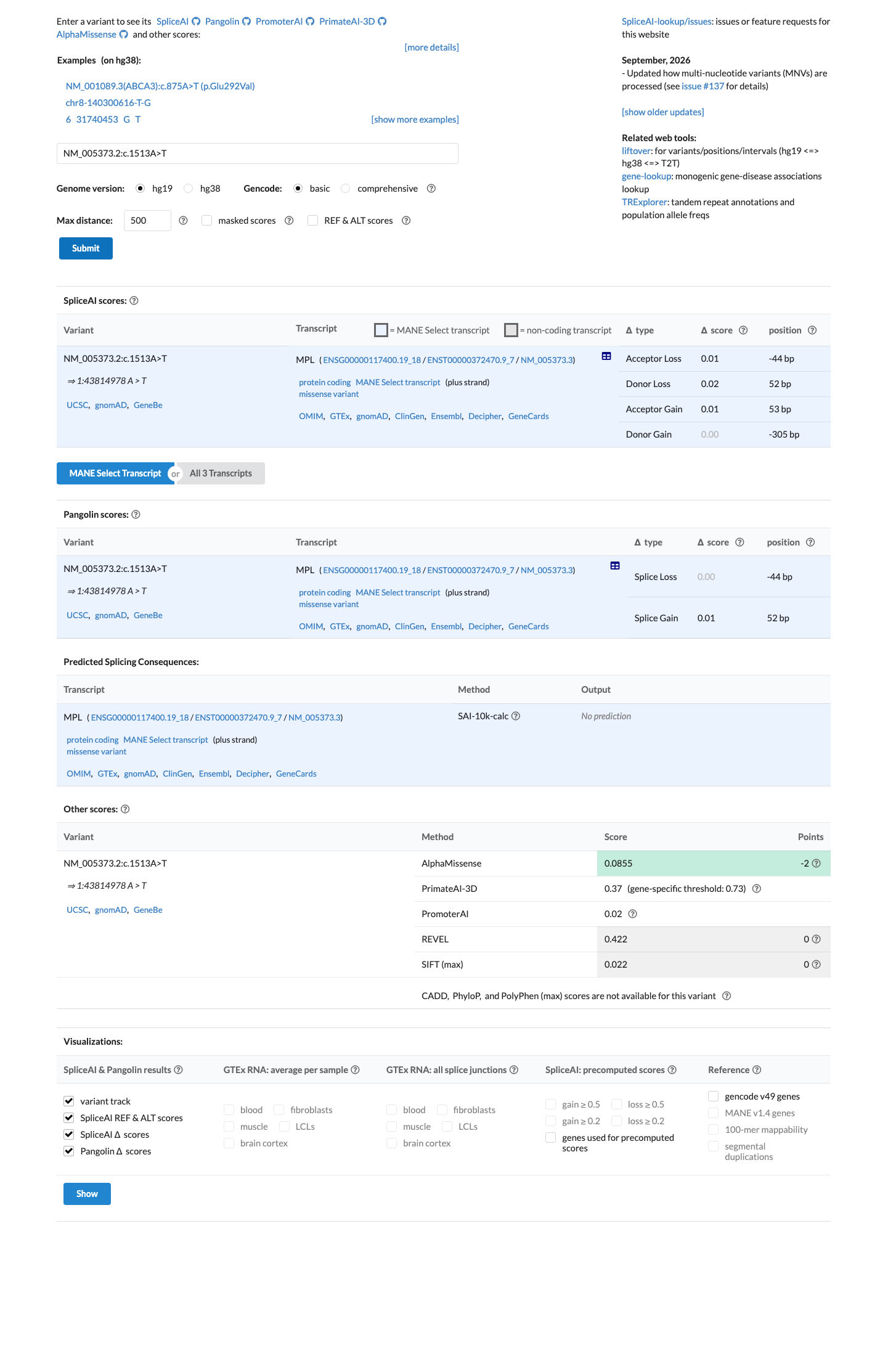
PS3 supporting: S505C enhanced W515R/L-driven MPL signaling and proliferation and formed ligand-independent dimers, but was inactive alone. PM1 moderate: Ser505 lies in MPL's exon-10 transmembrane mutational hotspot. PM2 supporting: the variant is absent from gnomAD and meets the generic rarity threshold. BP4 supporting: SpliceAI maximum delta 0.019 predicts minimal splice impact.

PS3 + PM1 + PM2 + BP4 VUS
LYFE Sciences is an AI system, and it can make mistakes. Criteria may be applied incorrectly, sources may be misread, and a confident-looking classification can still be wrong. Double-check every criterion and its underlying evidence before relying on any call.
Gene diagram · NM_005373.2 · variants mapped to exon structure
MPL NM_005373.2
Fetching transcript structure from UCSC…
Applied criteria · 4 applied · 18 assessed
MetEvidence satisfies this criterion.
Not metEvaluated against available evidence; threshold not reached.
Not assessedApplies in principle, but no evidence was found to evaluate it.
N/ADoesn't apply to this variant type.
Applied · 4
Strength Supporting Moderate Strong Very strong
PS3 supporting review Pathogenic
Met at supporting: S505C increased autonomous STAT5 signaling and proliferation with W515R/L and formed ligand-independent dimers, but was inactive alone.
PMID:34845187 reports S505C in cis with W515R in an essential-thrombocythemia case, confirmed by Sanger sequencing with a 0.37 variant allele ratio.In HEK 293T dual-luciferase STAT5 assays, S505C alone did not induce constitutive STAT5 signaling, whereas S505C combined with W515R or W515L enhanced autonomous STAT5 activity.In IL-3-dependent Ba/F3 cells, S505C alone did not produce factor-independent proliferation; W515R/L supported cytokine-independent growth and the corresponding double mutants increased proliferation.
PM1 moderate Pathogenic
Met at moderate strength: Ser505 lies in MPL's exon-10 transmembrane hotspot, a critical region for disease-associated receptor activation.
PMID:31697803 identifies the MPL single transmembrane domain encoded by exon 10 as a hotspot for somatic mutations associated with myeloproliferative neoplasms and includes residue S505 in its functional mutational analysis.No MPL-specific VCEP specification or domain table was retrieved; therefore the generic ACMG/AMP PM1 rule was used.
PM2 supporting Pathogenic
Met at supporting: gnomAD observed frequency is 0 because the variant is absent, satisfying the <=0.0001 PM2 threshold.
gnomAD v2.1 and v4.1 both report the variant as absent; the available gnomAD v2.1 and v3.1 non-cancer subset results also report absence.The supplied ClinGen SVI recommendation uses PM2 at supporting strength for allele frequency <=0.0001 (PMID:25741868).No disease-specific population calibration, penetrance estimate, or prevalence-based threshold was available; the generic PM2 rule was therefore used without upgrading strength.
BP4 supporting Benign
Met at supporting: SpliceAI maximum delta 0.019 meets the <=0.1 BP4 threshold, despite REVEL 0.422 exceeding its <=0.29 threshold.
The variant is a missense substitution, NM_005373.2:c.1513A>T, p.(Ser505Cys), so BP4 is in scope.SpliceAI maximum delta score 0.019 meets the generic BP4 supporting cutoff of <=0.1; the cutoff is from Jaganathan et al. 2019 (PMID:30661751).REVEL score 0.422 does not meet the generic BP4 supporting cutoff of <=0.29; the cutoff is from the ClinGen SVI REVEL calibration by Pejaver et al. 2022 (PMID:36413997).
Assessed · not applied · 8 not met · 10 not assessed
Pathogenic
PS1 Not met: the exact p.Ser505Cys change is reported somatically, but no established pathogenic same-amino-acid comparator is available.
PS2 Not assessed: no confirmed proband de novo result with genotyped biological parents is documented for NM_005373.2:c.1513A>T.
PS4 Not assessed: no case-control cohort or enrichment statistic is available to establish PS4 for MPL p.Ser505Cys.
PM5 Not met: no distinct established pathogenic missense substitution at MPL residue 505 is documented; functional scan results do not establish PM5.
PM6 Not assessed: no suspected de novo occurrence with documented phenotype and parental relationship information is available for this variant.
PP1 Not assessed: zero informative affected-relative meioses or phenotype-consistent familial transmissions are documented for this variant.
PP2 Not assessed: no applicable gene-level evidence establishes MPL's required predominant missense mechanism and low benign missense rate for PP2.
PP3 Not met: REVEL 0.422 and SpliceAI maximum delta 0.019 are both below their PP3 supporting thresholds of 0.644 and 0.2, respectively.
PP4 Not assessed: essential thrombocythemia is not sufficiently specific, and the reported patient also carried an MPL W515 driver mutation.
PP5 Not met: the exact variant is absent from ClinVar and has no expert-panel Pathogenic or Likely pathogenic classification.
Benign
BA1 Not met: the variant was absent from gnomAD, corresponding to an observed frequency of 0, below the >=0.05 BA1 threshold.
BS1 Not met: the variant was absent from gnomAD, with observed frequency 0 below the >=0.01 BS1 threshold.
BS2 Not assessed: gnomAD reports no carriers or homozygotes, so there is no unaffected-adult observation to support BS2.
BS3 Not met: S505C was inactive alone but enhanced W515R/L STAT5 signaling and proliferation and formed ligand-independent MPL dimers.
BS4 Not assessed: no tested unaffected relatives or informative non-segregation observations are documented for NM_005373.2:c.1513A>T.
BP1 Not assessed: the available MPL evidence does not establish a truncating-predominant germline disease mechanism required for BP1.
BP5 Not assessed: co-occurring MPL W515 mutations provide an alternative basis, but S505C may enhance their activity and is not shown to be irrelevant.
BP6 Not met: the exact variant is absent from ClinVar and has no expert-panel Benign or Likely benign classification.
N/A · 6 PVS1 · PM3 · PM4 · BP2 · BP3 · BP7
Research & evidence
Population frequency
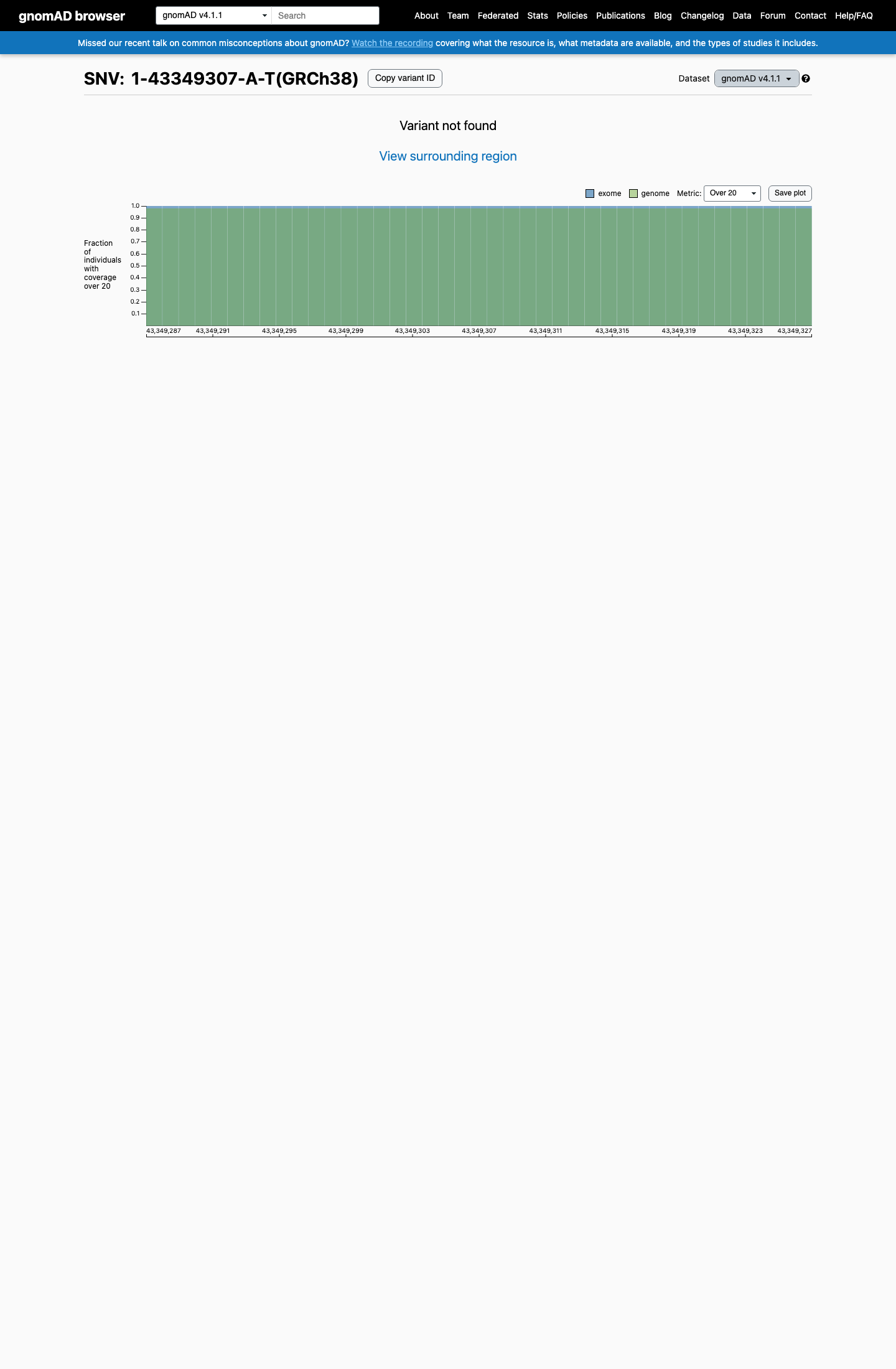
gnomAD v4.1 screenshot
gnomAD v4.1
gnomAD v2.1 screenshot
gnomAD v2.1
v4.1
Absent from gnomAD v4.1.
v2.1
Absent from gnomAD v2.1.
🇨🇦 CA
Not available in gnomAD-Canada v1.0.
Allele frequency by ancestry
three datasets · side by side
gnomAD v4.1
Absent · 0 / ?
0 hom
Not observed in any ancestry group.
gnomAD v2.1
Absent · 0 / ?
0 hom
Not observed in any ancestry group.
gnomAD Canada 🇨🇦
Absent · 0 / ?
0 hom
Not observed in any ancestry group.
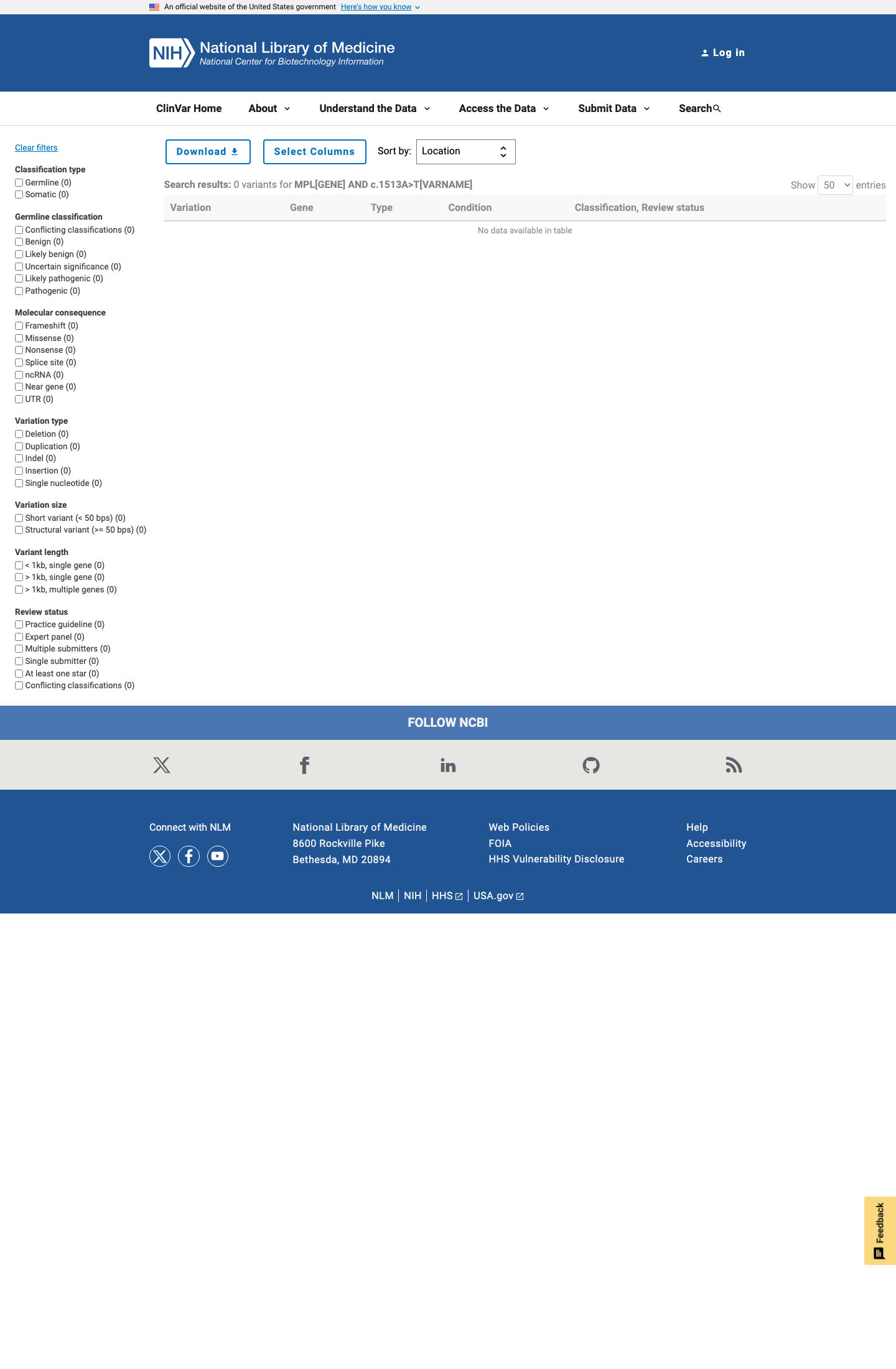
ClinVar screenshot
ClinVar
This variant is absent from ClinVar.
SpliceAI screenshot
In silico
SpliceAI predicts no significant splice impact for this variant (max delta score = 0.02). REVEL score = 0.422. BayesDel score = -0.0484473.
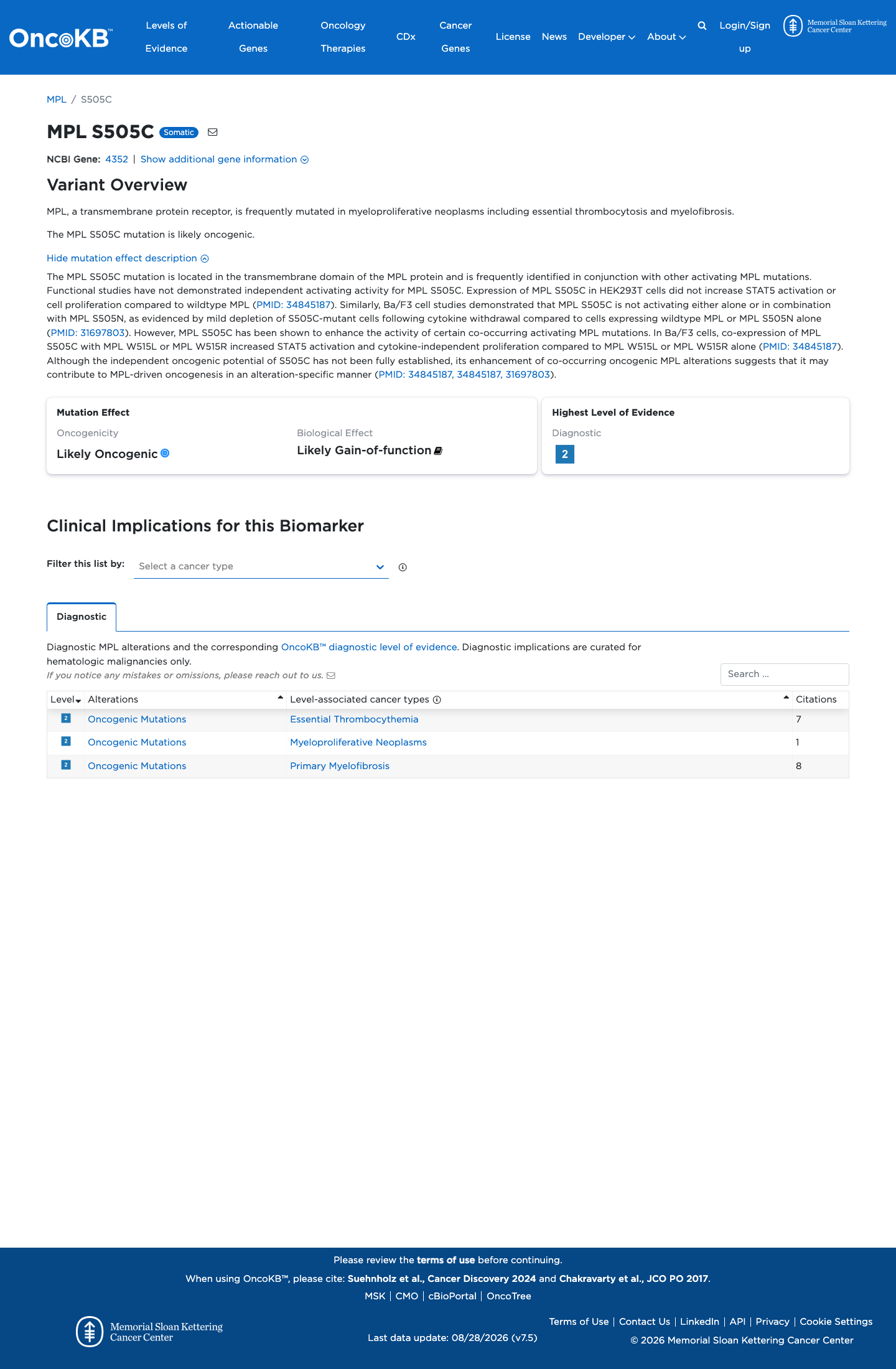
Functional / OncoKB screenshot
Functional Likely Oncogenic
OncoKB identified variant-specific curated literature and context relevant to functional review; biological-effect context: Likely Gain-of-function; curated oncogenicity label: Likely Oncogenic.
OncoKB ↗
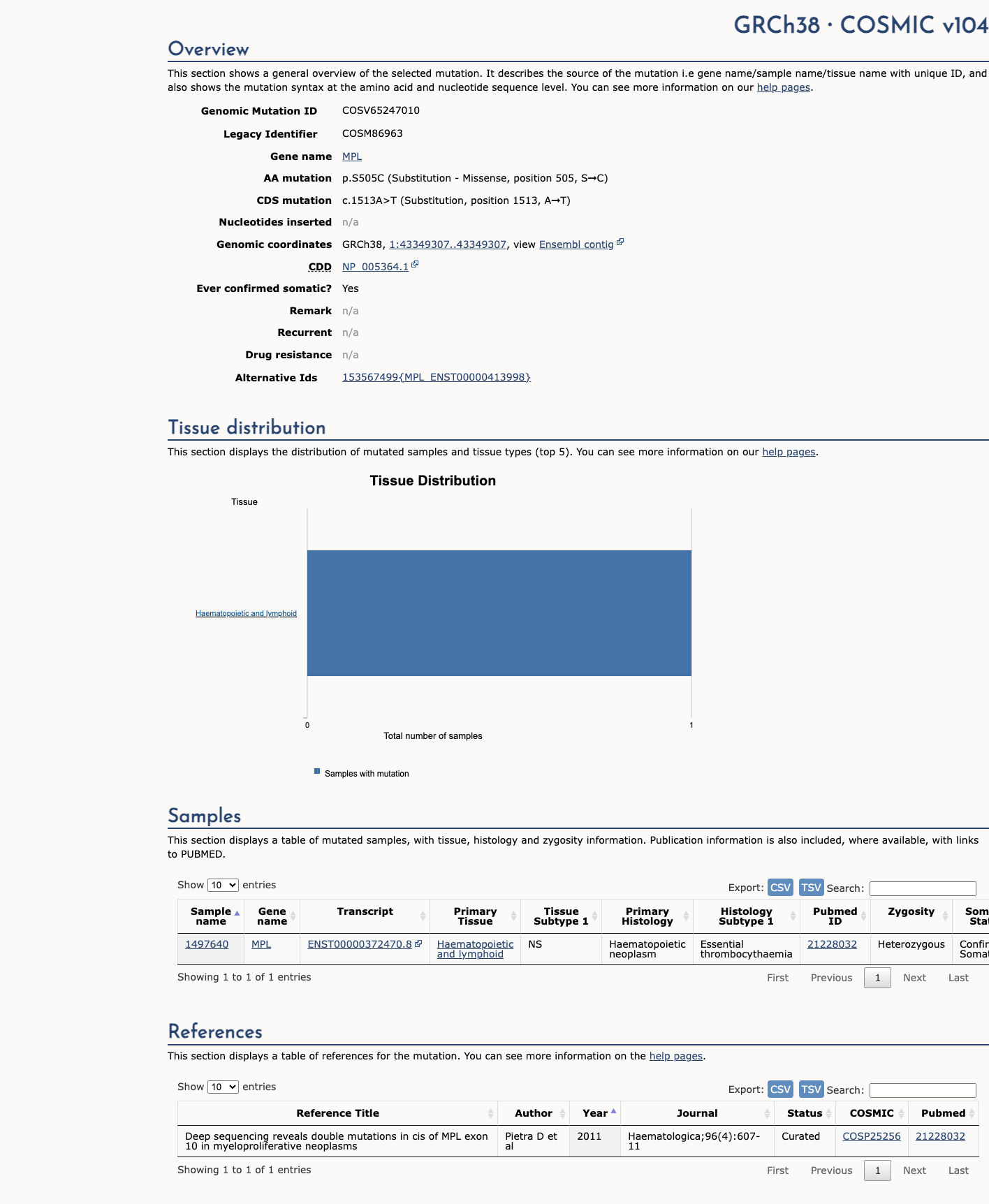
COSMIC screenshot
COSMIC
Cancer hotspots screenshot
Cancer hotspots
Somatic evidence Not in COSMIC / hotspots
COSMIC
This variant does not lie in a statistically significant hotspot. This variant has previously been reported in somatic cancers (COSMIC; COSV65247010, n = 1 times).
Hotspots
This variant does not lie in a statistically significant hotspot.
Literature · how each cited paper was used
2papers cited
Each card is an audit: what was searched, what was found, whether it names the variant, which criteria it fed, and why.
Novel drivers and modifiers of MPL-dependent oncogenic transformation identified by deep mutational scanning.
Searched
c.1513A>TNP_005364.1:p.(S505C)S505CS505N
Found
The paper identifies the MPL single transmembrane domain encoded by exon 10 as a hotspot for somatic mutations associated with myeloproliferative neoplasms. It explicitly reports MPL p.S505C in combinations with W515L and describes deep mutational scanning of the transmembrane domain, but does not establish a distinct pathogenic alternate missense variant at residue 505.
Variant
✓ Names this variant — characterised directly
Applied to
PS3 supporting
Provides independent disease-relevant context for S505C in an activating MPL double-mutant combination, while not supplying a separate S505C-specific assay result.
PM1 moderate
Supports the MPL exon-10 transmembrane domain as a disease-associated mutational hotspot and critical functional region.
The single transmembrane domain (TMD) of the human thrombopoietin receptor (TpoR/MPL) protein, encoded by exon 10 of the MPL gene, is a hotspot for somatic mutations associated with myeloproliferative neoplasms (MPNs). ... Additional published reports of patients with double mutations include ... S505C+W515L ...
Location Introduction and Results/discussion, final paragraph; Figure 2D patient table  ·  Context Deep mutational scanning of MPL transmembrane-domain substitutions using cytokine-independent Ba/F3-cell growth, together with review of MPL exon 10 mutations in myeloproliferative-neoplasm cohorts.  ·  full text
MPL S505C enhances driver mutations at W515 in essential thrombocythemia.
Searched
c.1513A>Tp.(S505C)S505Cresidue 505
Found
The paper reports MPL S505C in an 83-year-old patient with essential thrombocythemia, occurring in cis with W515R, and evaluates S505C in signaling, proliferation, and receptor-dimerization assays. S505C alone did not produce constitutive STAT5 signaling or factor-independent growth but enhanced signaling and proliferation driven by W515R/L; this is direct evidence about the exact variant, not an established same-residue pathogenic comparator.
Variant
✓ Names this variant — characterised directly
Applied to
PS3 supporting
Variant-specific orthogonal assays show context-dependent enhancement of MPL signaling, proliferation, and dimerization.
MPL S505C and W515R mutations were detected in cis ... We found that the S505C did not drive constitutive STAT5 signaling. ... when compounded with the S505C mutation the rate of proliferation increased.
Location Case description and Results; Fig. 1B-D  ·  Context Single-patient essential-thrombocythemia observation with Sanger confirmation, followed by STAT5 reporter assays, cytokine-independent Ba/F3 proliferation assays, and MPL dimerization experiments.  ·  full text
Sources & reference links
8Sources
ClinVar
gnomAD v2.1
gnomAD v4.1
gnomAD-Canada
SpliceAI
OncoKB
COSMIC
Cancer hotspots