Analysis in progress
Initialising…
0%
complete
This report is still being assembled — sections appear as each stage finishes. It isn't final yet.
KMT2A
Final classification
VUS
PM2
KMT2A
c.10244C>T
p.Pro3415Leu
missense · exon 27

KMT2A encodes a histone methyltransferase that regulates gene expression by adding methyl groups to histone H3 at lysine 4, a modification that opens chromatin and activates genes important for early development and blood cell formation. It is essential for normal hematopoiesis and for the expression of developmental HOX genes. Chromosomal rearrangements of KMT2A produce fusion proteins that drive acute myeloid and lymphoid leukemias, including therapy-related leukemias, while loss-of-function alterations have been identified in solid tumors such as bladder, stomach, and endometrial cancers.

This variant

KMT2A encodes a histone methyltransferase essential for blood-cell formation and developmental gene regulation, and its disruption is linked to leukemias and developmental disorders. This p.Pro3415Leu missense variant is classified VUS: its extreme rarity in population databases is the only supporting evidence, with no functional, segregation, or de novo data establishing a link to KMT2A-related disease.

Transcript
NM_005933.3
HGVS · transcript:coding
NM_005933.3:c.10244C>T
GRCh38
chr11:118506145 C>T
GRCh37
chr11:118376860 C>T
Basis No KMT2A-specific ClinGen framework exists for this case, so generic ACMG/AMP 2015 rules were applied; only PM2 (supporting) was met, yielding a VUS.
No KMT2A-specific ClinGen framework exists for this case, so generic ACMG/AMP 2015 rules were applied; only PM2 (supporting) was met, yielding a VUS.
Classification rationale
PM2 VUS
KMT2A c.10244C>T missense · exon 27

PM2 (Supporting): absent from gnomAD v2.1 and gnomAD-Canada v1.0, with only 2 of 1,614,194 alleles in gnomAD v4.1 (AF 1.24e-06, zero homozygotes). Under generic ACMG/AMP 2015 combination rules, a single supporting criterion does not reach the threshold for pathogenic or benign classification, so the variant remains VUS.

PM2 VUS
Gene diagram · NM_005933.3 · variants mapped to exon structure
KMT2A NM_005933.3
Fetching transcript structure from UCSC…
Applied criteria · 1 applied · 23 assessed
MetEvidence satisfies this criterion.
Not metEvaluated against available evidence; threshold not reached.
Not assessedApplies in principle, but no evidence was found to evaluate it.
N/ADoesn't apply to this variant type.
Applied · 1
Strength Supporting Moderate Strong Very strong
PM2 supporting Pathogenic
Met (supporting): absent from gnomAD v2.1 and gnomAD-Canada, with only 2 of 1,614,194 alleles in gnomAD v4.1 (AF 1.24e-06, zero homozygotes).
gnomAD v2.1: variant absent.gnomAD v4.1: total AF 1.23901e-06 (2/1,614,194 alleles), group maximum FAF 4.42e-06, highest subpopulation AF 2.66539e-05, and homozygotes = 0.gnomAD-Canada v1.0: variant absent.
Assessed · not applied · 7 not met · 16 not assessed
Pathogenic
PS1 Not assessed: no ClinVar record of a different nucleotide substitution producing the same p.Pro3415Leu change has been classified pathogenic.
PS2 Not assessed: no proband or parental genotypes document a confirmed de novo occurrence of p.Pro3415Leu.
PS3 Not assessed: no functional assay data (e.g., methyltransferase activity) for this variant were available.
PS4 Not assessed: no affected carriers of this variant or case-control enrichment data were documented.
PM1 Not assessed: no significant hotspot at residue 3415 was found, and its location relative to known KMT2A functional domains could not be confirmed.
PM3 Not assessed: no evidence of this variant in trans with a pathogenic allele in an affected individual was available.
PM5 Not assessed: no pathogenic or likely pathogenic missense variant at residue 3415 with a different amino acid change was identified.
PM6 Not assessed: no de novo observation or parental-testing data are documented.
PP1 Not assessed: no relatives, genotypes, or informative meioses are reported, so cosegregation cannot be evaluated.
PP2 Not assessed: no missense constraint metric (e.g., gnomAD Z-score) was available to quantify benign missense tolerance in KMT2A.
PP3 Not met: REVEL 0.397 falls below the 0.644 PP3_Supporting threshold, and SpliceAI max delta 0.002 shows no splice impact.
PP4 Not assessed: no documented phenotype of a carrier establishes features highly specific for a KMT2A-related disorder.
PP5 Not met: the only ClinVar record is a single-laboratory uncertain-significance submission, not an expert-panel classification.
Benign
BA1 Not met: gnomAD v4.1 allele frequency 1.24e-06 (2/1,614,194 alleles) is far below the >1% BA1 threshold.
BS1 Not met: the highest observed allele frequency (2.67e-05) does not exceed the expected maximum credible frequency for a rare dominant disorder.
BS2 Not assessed: gnomAD v4.1 reports zero homozygotes, and no unaffected adult homozygous or hemizygous carriers are documented.
BS3 Not assessed: no functional assay data demonstrating normal (wild-type-like) function of p.Pro3415Leu were available.
BS4 Not assessed: no unaffected relatives tested negative are documented, so lack of segregation cannot be evaluated.
BP1 Not met: missense variants are a recognized, if less common, pathogenic mechanism in KMT2A, so missense cannot be excluded as disease-causing.
BP2 Not assessed: no phase-resolved data (in trans or in cis with a pathogenic variant) are available.
BP4 Not met: REVEL 0.397 is above the 0.290 BP4_Supporting cutoff (indeterminate zone), and the negative SpliceAI signal alone is insufficient.
BP5 Not assessed: no affected carriers or credible alternative molecular explanation for a relevant phenotype are documented.
BP6 Not met: ClinVar holds only a single-laboratory uncertain-significance submission, with no expert-panel benign classification.
N/A · 4 PVS1 · PM4 · BP3 · BP7
Research & evidence
Population frequency
gnomAD v4.1 screenshot
gnomAD v4.1
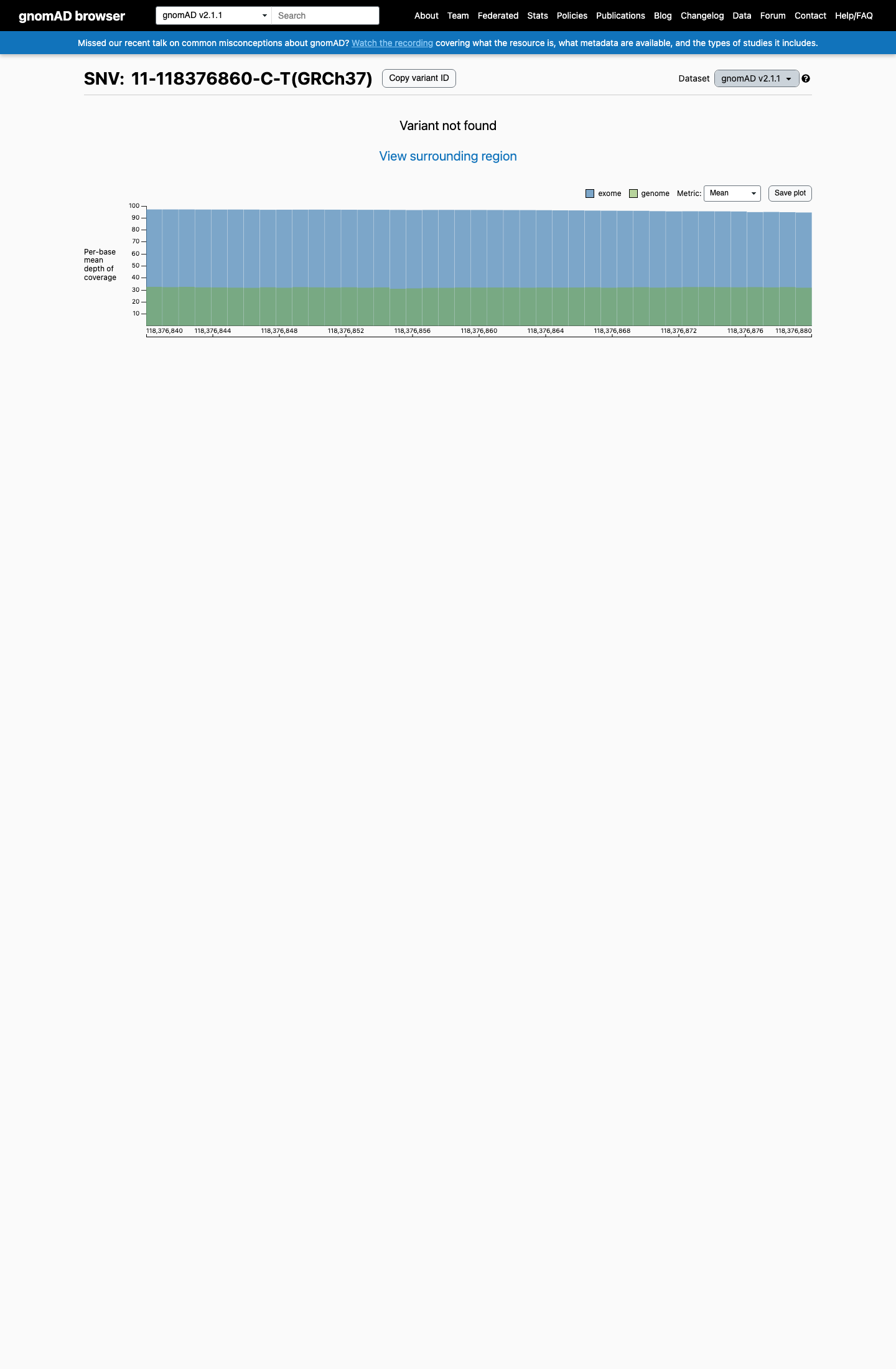
gnomAD v2.1 screenshot
gnomAD v2.1
v4.1
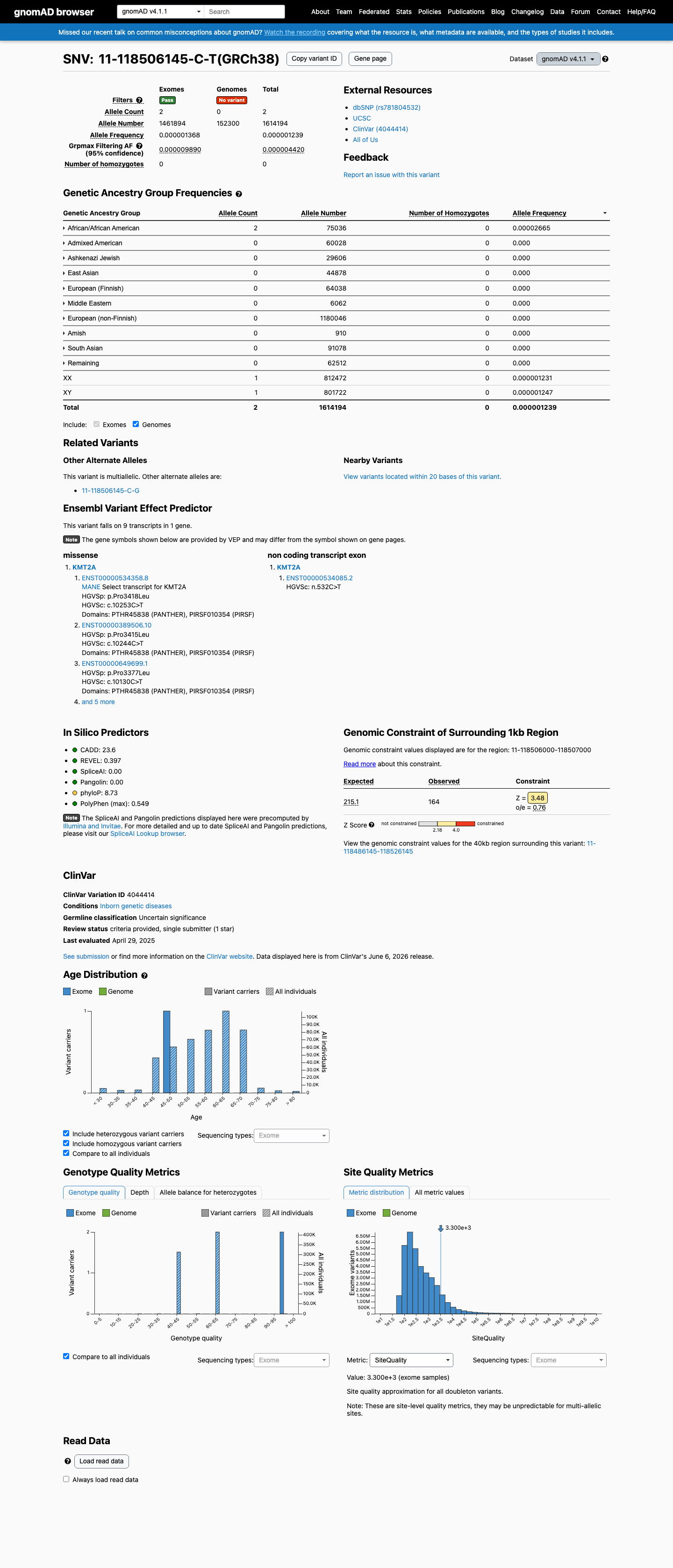
This variant is present in gnomAD v4.1 (AF= 1.23901e-06; MAF= 0.00012%, 2/1614194 alleles, homozygotes = 0) and has highest observed frequency in the African/African American population (AF= 2.66539e-05; MAF= 0.00267%, 2/75036 alleles, homozygotes = 0); grpmax FAF= 4.42e-06.
v2.1
Absent from gnomAD v2.1.
🇨🇦 CA
Absent from gnomAD-Canada v1.0.
Allele frequency by ancestry
three datasets · side by side
gnomAD v4.1
0.00012% · 2 / 1,614,194
0 hom · FAF 0.00044%
African/African American
2 / 75,036
0.0027%
+ 9 not observed (Remaining individuals, Admixed American, European (Finnish), Amish, East Asian, Middle Eastern, South Asian, Ashkenazi Jewish, European (non-Finnish))
gnomAD v2.1
Absent · 0 / ?
0 hom
Not observed in any ancestry group.
gnomAD Canada 🇨🇦
Absent · 0 / ?
0 hom
Not observed in any ancestry group.
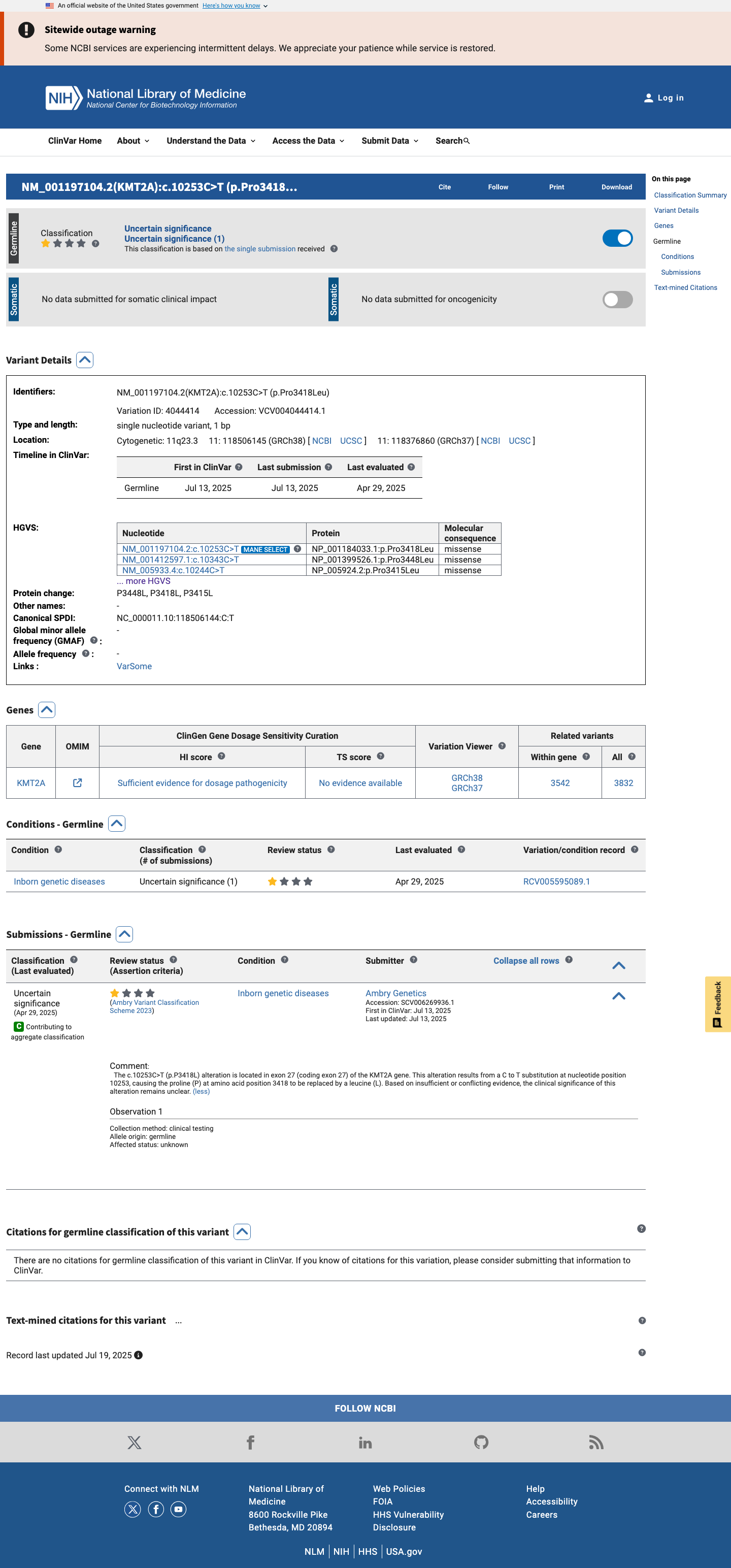
ClinVar screenshot
ClinVar
This variant has been reported in ClinVar as Uncertain significance (1 clinical laboratory). (ClinVarID = 4044414)
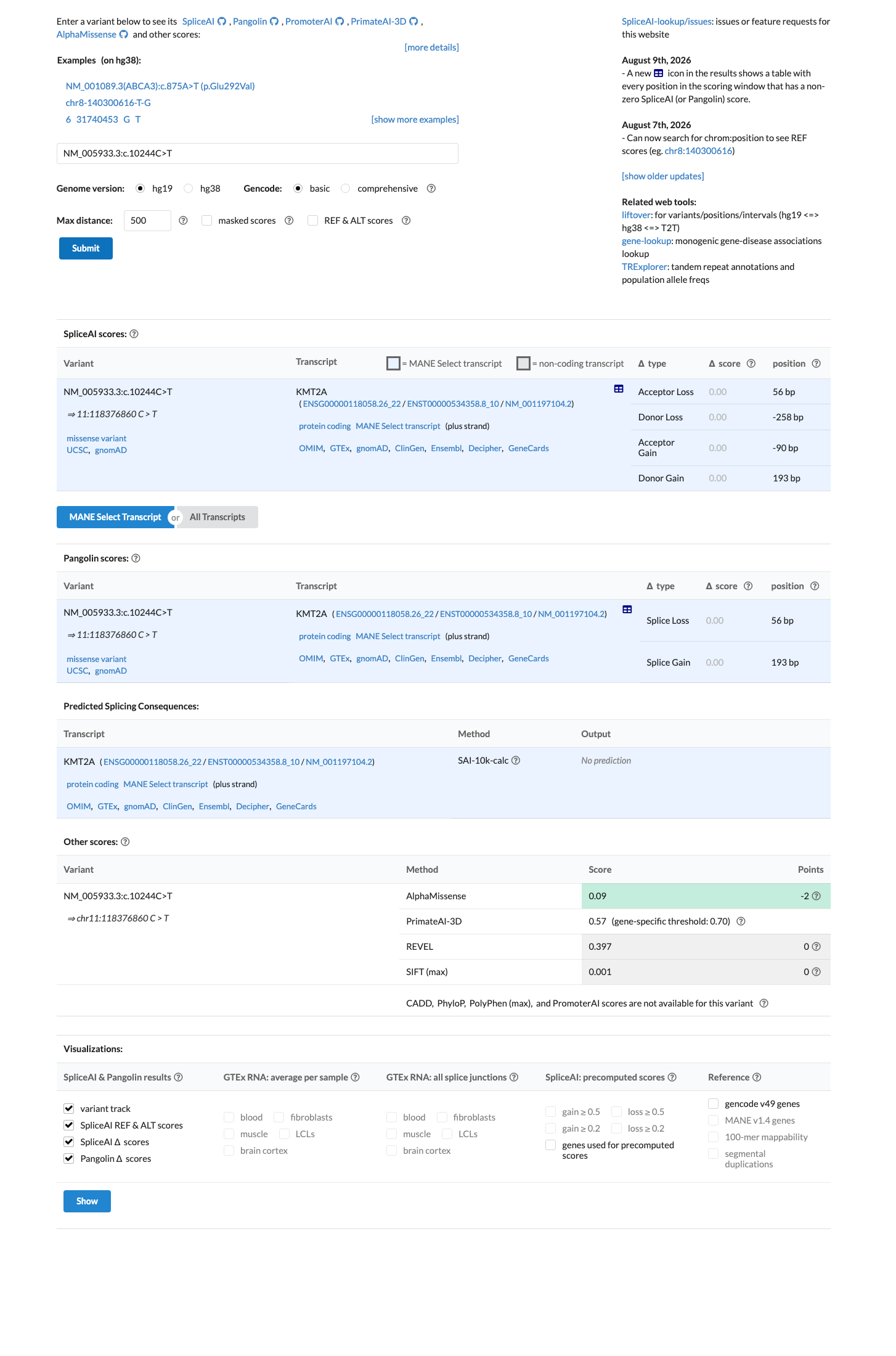
SpliceAI screenshot
In silico
SpliceAI predicts no significant splice impact for this variant (max delta score = 0.00). REVEL score = 0.397. BayesDel score = -0.0423011.
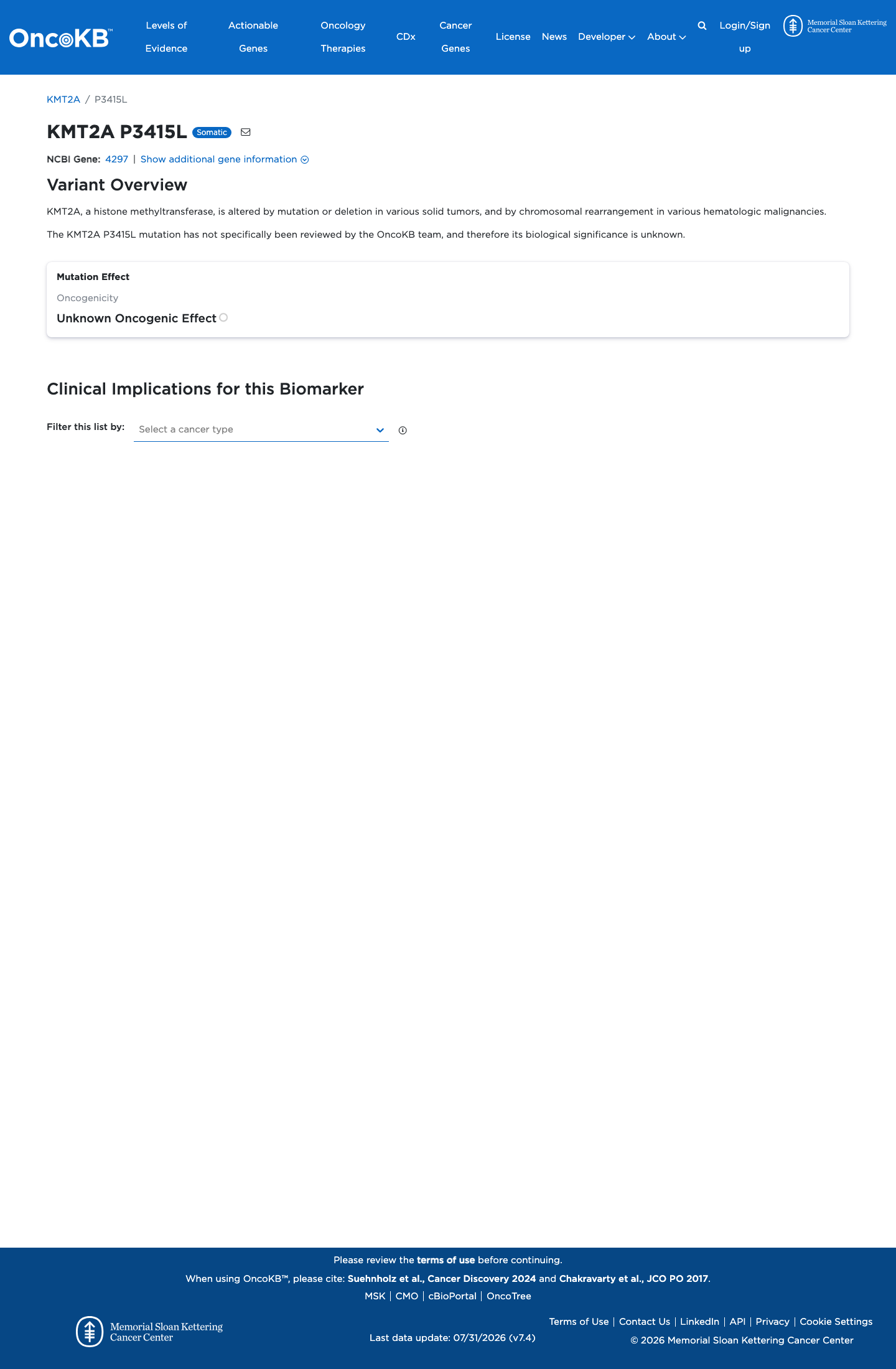
Functional / OncoKB screenshot
Functional Unknown Oncogenic Effect
OncoKB did not identify variant-specific reviewed functional evidence for this variant; gene-level curated context is available for reviewer follow-up. KMT2A, a histone methyltransferase, is altered by mutation or deletion in various solid tumors, and by chromosomal rearrangement in various hematologi
OncoKB ↗
COSMIC screenshot
COSMIC
Cancer hotspots screenshot
Cancer hotspots
Somatic evidence Not in COSMIC / hotspots
COSMIC
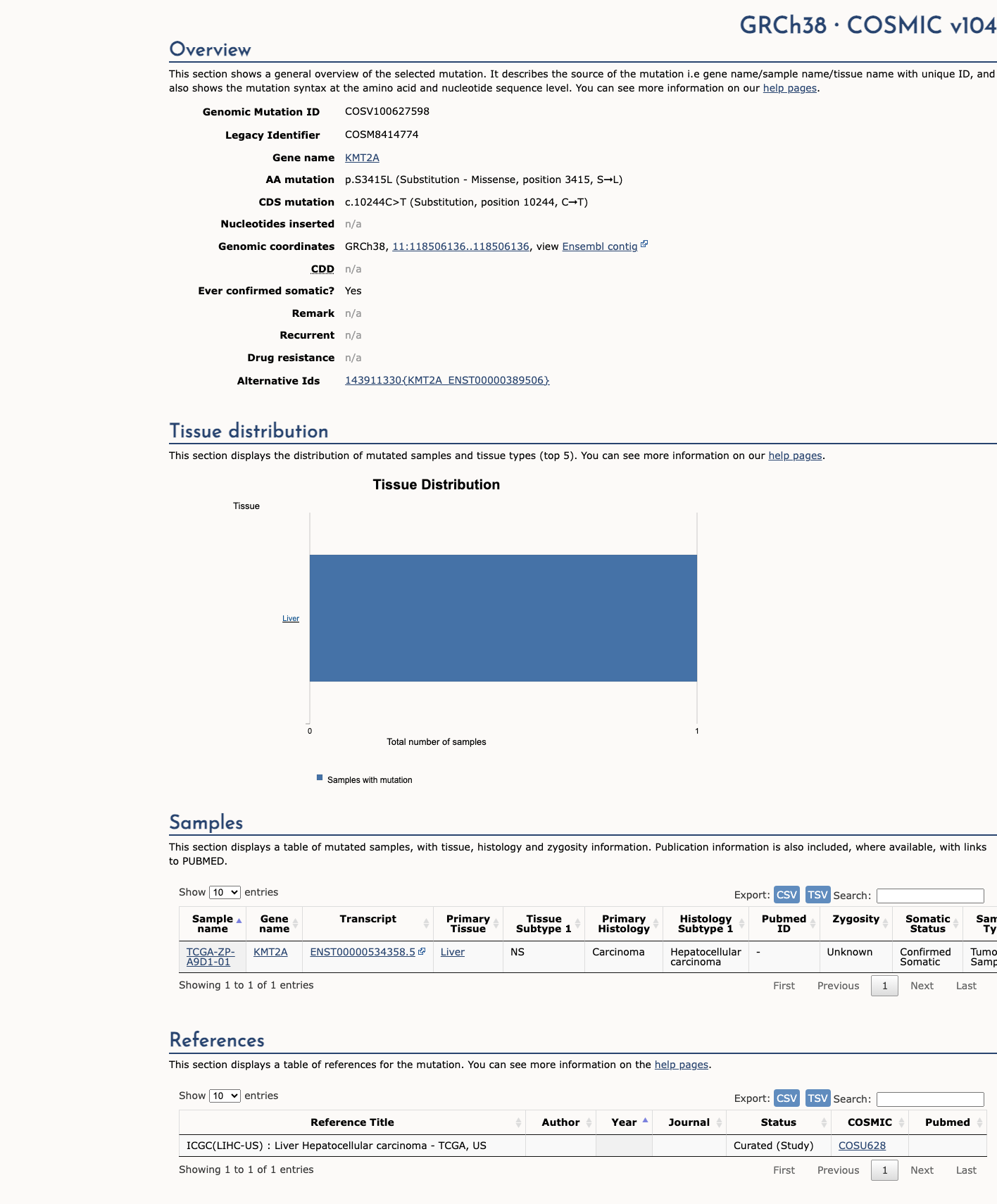
This variant does not lie in a statistically significant hotspot. This variant has previously been reported in somatic cancers (COSMIC; COSV100627598, n = 1 times).
Hotspots
This variant does not lie in a statistically significant hotspot.
Sources & reference links
8Sources
ClinVar
gnomAD v2.1
gnomAD v4.1
gnomAD-Canada
SpliceAI
OncoKB
COSMIC
Cancer hotspots
Triaged references · 5 PMIDs not cited in assessment
23652378 ↗ A framework to start the debate on neonatal screening policies in the EU: an Expert Opinion Document. CLINVAR
25626707 ↗ Whole-genome sequencing in newborn screening? A statement on the continued importance of targeted approaches in newborn screening programmes. CLINVAR
22947299 ↗ Specific guidelines for assessing and improving the methodological quality of economic evaluations of newborn screening. CLINVAR
23881473 ↗ Newborn screening: education, consent, and the residual blood spot. The position of the national society of genetic counselors. CLINVAR
31022120 ↗ ACOG Committee Opinion No. 778 Summary: Newborn Screening and the Role of the Obstetrician-Gynecologist. CLINVAR