Back
NM_005933.3:c.2040G>T
p.Ser680= · KMT2A
ACMG/AMP
0%
complete
Final classification
VUS
PM2BP7
KMT2A
c.2040G>T
p.Ser680=
synonymous · exon 3

KMT2A encodes a histone methyltransferase that regulates gene expression by adding methyl groups to histone H3 at lysine 4, a modification that opens chromatin and activates genes important for early development and blood cell formation. It is essential for normal hematopoiesis and for the expression of developmental HOX genes. Chromosomal rearrangements of KMT2A produce fusion proteins that drive acute myeloid and lymphoid leukemias, including therapy-related leukemias, while loss-of-function alterations have been identified in solid tumors such as bladder, stomach, and endometrial cancers.

This variant

KMT2A is essential for normal blood cell formation and early development, and its disruption is linked to Wiedemann-Steiner syndrome and leukemias. This synonymous change (p.Ser680=) is extremely rare in the general population and is not predicted to affect splicing, but no clinical or functional evidence links it to disease. It is therefore classified as a variant of uncertain significance, which neither establishes nor rules out a KMT2A-related condition.

Transcript
NM_005933.3
HGVS · transcript:coding
NM_005933.3:c.2040G>T
GRCh38
chr11:118473199 G>T
GRCh37
chr11:118343914 G>T
Variant of Uncertain Significance: one supporting (PM2) plus one supporting (BP7) meets no benign or pathogenic threshold under the generic ACMG/AMP 2015 rules.
Classification rationale
PM2 BP7 VUS
KMT2A c.2040G>T synonymous · exon 3

PM2 (Supporting): total allele frequency 0.001% in gnomAD, well below the 0.1% threshold, with no homozygotes. BP7 (Supporting): synonymous p.Ser680= deep in exon 3, with no predicted splice impact (SpliceAI max delta 0.006). VUS: the single supporting plus single supporting combination (PM2 + BP7) meets no benign, likely benign, likely pathogenic, or pathogenic rule under generic ACMG/AMP 2015.

PM2 + BP7 → VUS
LYFE Sciences is an AI system, and it can make mistakes. Criteria may be applied incorrectly, sources may be misread, and a confident-looking classification can still be wrong. Double-check every criterion and its underlying evidence before relying on any call.
Gene diagram · NM_005933.3 · variants mapped to exon structure
KMT2A NM_005933.3
Fetching transcript structure from UCSC…
Applied criteria · 2 applied · 17 assessed
MetEvidence satisfies this criterion.
Not metEvaluated against available evidence; threshold not reached.
Not assessedApplies in principle, but no evidence was found to evaluate it.
N/ADoesn't apply to this variant type.
Applied · 2
Strength Supporting Moderate Strong Very strong
PM2 supporting Pathogenic
Met (supporting): gnomAD total allele frequency is 0.001%, far below the 0.1% PM2 threshold, with no homozygotes.
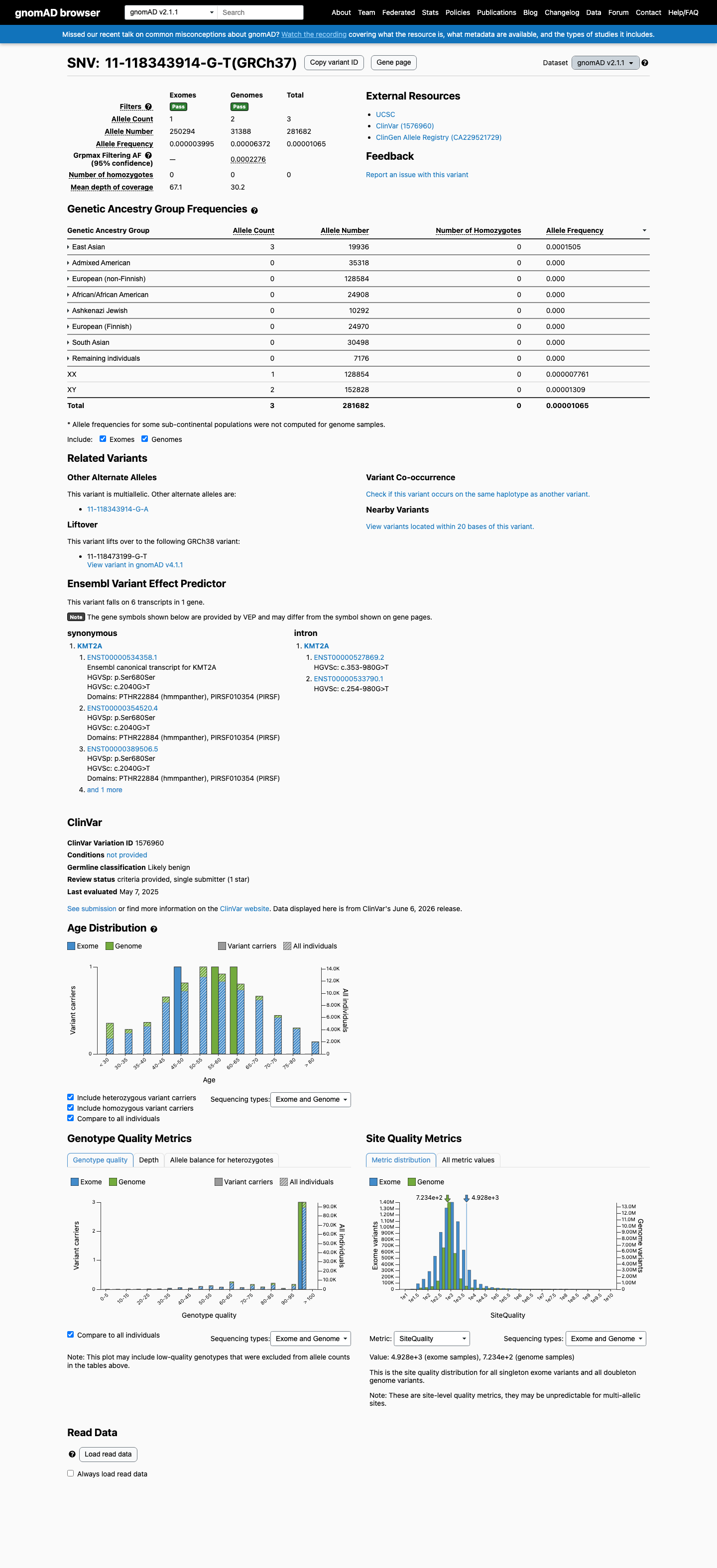
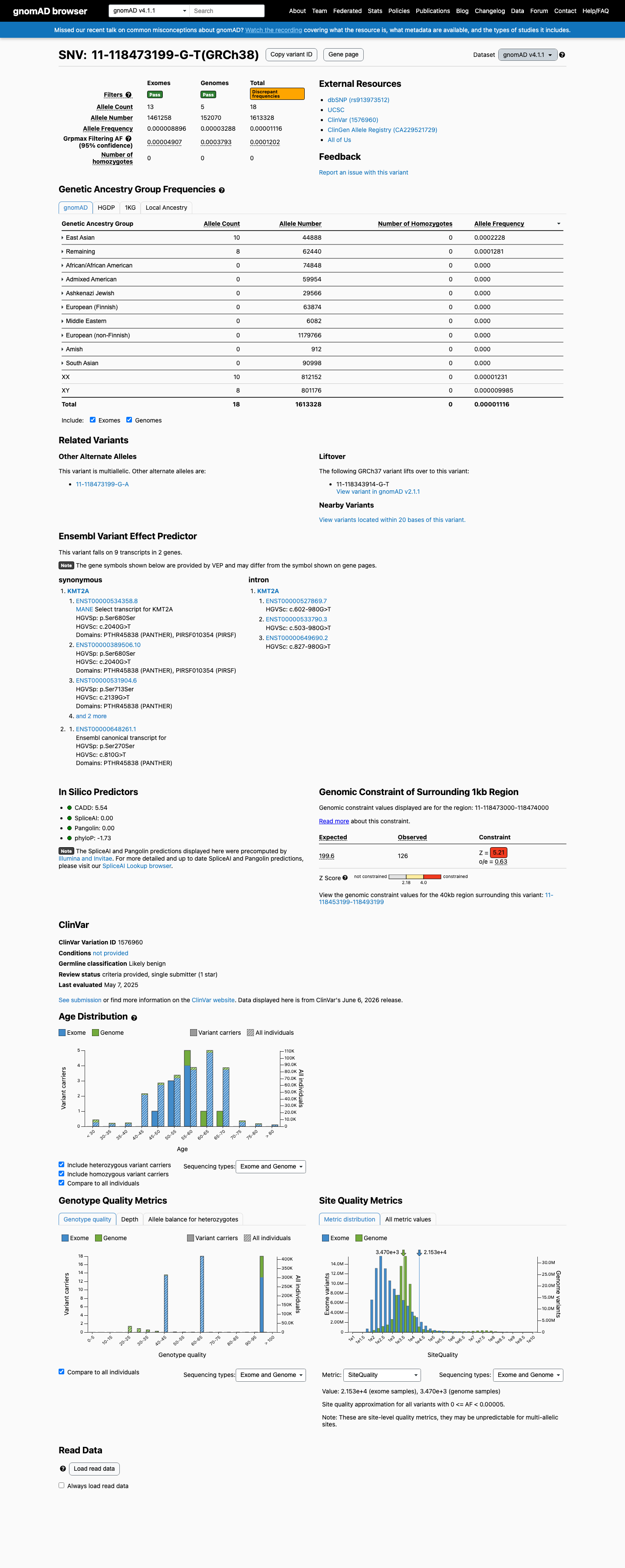
Local non-VCEP PM2 threshold: allele frequency <0.1% (absent or extremely low frequency in controls, per ACMG/AMP 2015 PM2 definition, PMID 25741868).gnomAD v2.1 (gnomad_v2): total AF 1.06503e-05 (0.00107%, 3/281,682 alleles), 0 homozygotes; East Asian max subpopulation AF 0.01505%; grpmax FAF 0.00022756 (0.023%) — all below 0.1%.gnomAD v4.1 (gnomad_v4): total AF 1.11571e-05 (0.00112%, 18/1,613,328 alleles), 0 homozygotes; East Asian max subpopulation AF 0.02228%; grpmax FAF 0.00012016 (0.012%) — all below 0.1%.
BP7 supporting Benign
Met (supporting): synonymous p.Ser680= deep in exon 3 with SpliceAI max delta 0.006, well below the 0.2 splice-altering threshold.
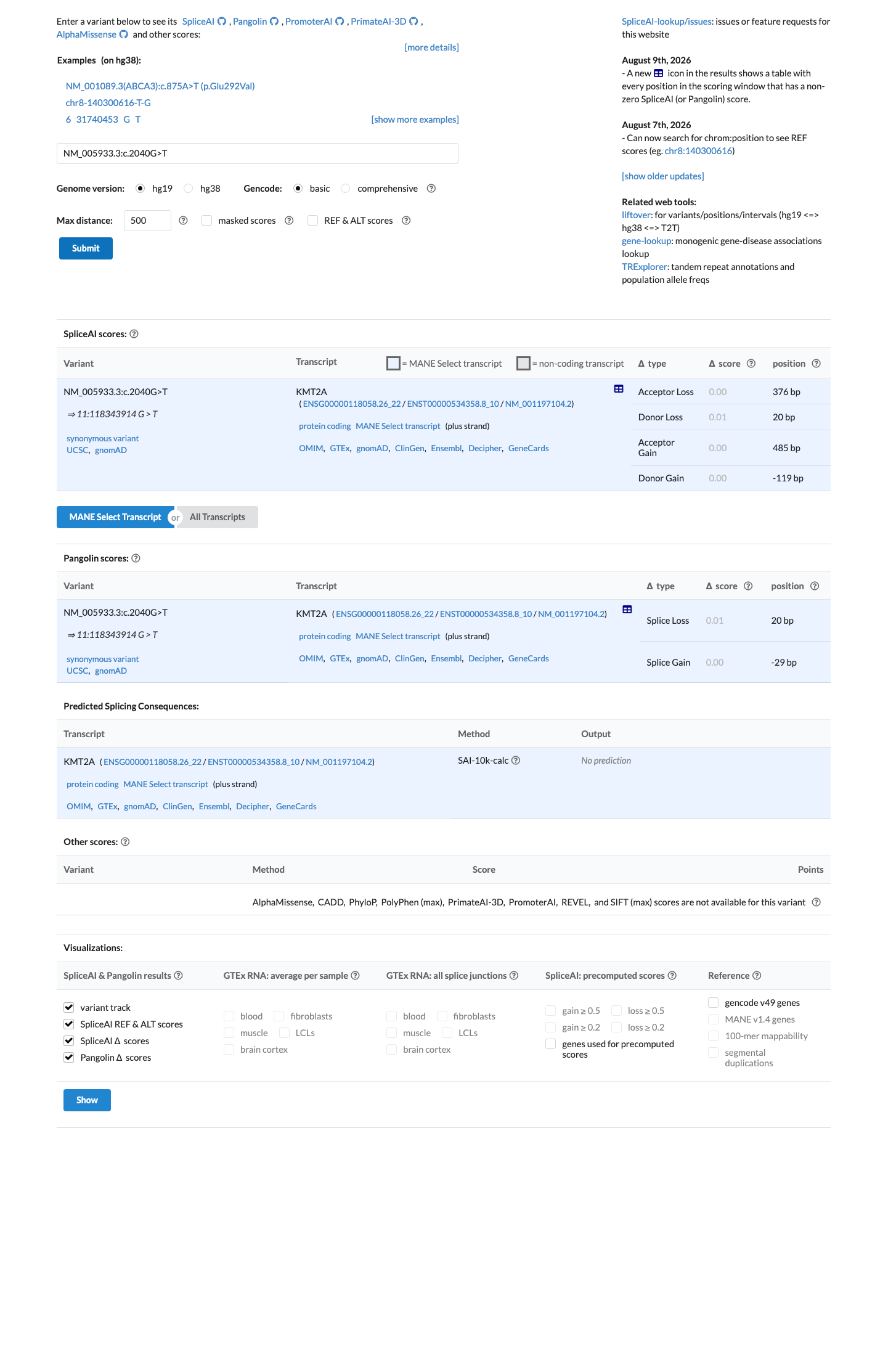
Variant normalization confirms NM_005933.3:c.2040G>T is synonymous, NP_005924.2:p.(Ser680=), in exon 3 of the KMT2A transcript.SpliceAI (Jaganathan et al. 2019, PMID 30661751; spliceailookup.broadinstitute.org) predicts no splice impact for NM_005933.3:c.2040G>T: max delta 0.006 (DS_AG=0.001, DS_AL=0.0, DS_DG=0.0, DS_DL=0.006), well below the 0.2 splice-altering threshold; no impact on the splice consensus sequence and no creation of an alternate splice site predicted.Variant position c.2040 lies ~1.5 kb from the 5' end and ~1.1 kb from the 3' end of exon 3 (exon span c.503-3156), i.e., not within or near any canonical splice consensus sequence.
Assessed · not applied · 8 not met · 9 not assessed
Pathogenic
PS2 Not assessed: no parental genotyping or trio data were available to confirm a de novo occurrence.
PS3 Not assessed: no functional studies of this variant were available to evaluate a deleterious effect.
PS4 Not assessed: no case-control or affected-versus-control enrichment data were available.
PM6 Not assessed: no proband or parental genotyping data were available to evaluate assumed de novo status.
PP1 Not assessed: no family or segregation data were available to evaluate co-segregation with disease.
PP3 Not met: SpliceAI max delta 0.006 is far below the 0.2 splice-altering threshold, and missense predictors do not apply.
PP4 Not assessed: no proband-level phenotype data were available to evaluate phenotype specificity.
PP5 Not met: no ClinVar expert-panel classification exists for this exact variant; only a single-submitter Likely benign assertion.
Benign
BA1 Not met: allele frequency 0.001% is orders of magnitude below the 1% BA1 threshold.
BS1 Not met: observed allele frequency 0.001% does not exceed the 0.3% BS1 threshold.
BS2 Not met: gnomAD carriers are not phenotype-screened for this early-onset disorder, so unaffected adult status is not demonstrated.
BS3 Not assessed: no well-established functional studies showing no damaging effect were available.
BS4 Not assessed: no family segregation data were available to demonstrate lack of segregation.
BP2 Not met: no observation in trans or cis with a pathogenic variant is documented in any source.
BP4 Not met: no independent BP4 prediction exists beyond the SpliceAI result already applied under BP7.
BP5 Not assessed: no affected carrier is reported in whom an alternate molecular basis could be documented.
BP6 Not met: no ClinVar expert-panel benign assertion exists; a single-submitter Likely benign label does not trigger BP6.
N/A · 9 PVS1 · PS1 · PM1 · PM3 · PM4 · PM5 · PP2 · BP1 · BP3
Research & evidence
Population frequency
gnomAD v4.1 screenshot
gnomAD v4.1
gnomAD v2.1 screenshot
gnomAD v2.1
v4.1
This variant is present in gnomAD v4.1 (AF= 1.11571e-05; MAF= 0.00112%, 18/1613328 alleles, homozygotes = 0) and has highest observed frequency in the East Asian population (AF= 0.000222777; MAF= 0.02228%, 10/44888 alleles, homozygotes = 0); grpmax FAF= 0.00012016.
v2.1
This variant is present in gnomAD v2.1 (AF= 1.06503e-05; MAF= 0.00107%, 3/281682 alleles, homozygotes = 0) and has highest observed frequency in the East Asian population (AF= 0.000150482; MAF= 0.01505%, 3/19936 alleles, homozygotes = 0); grpmax FAF= 0.00022756.
🇨🇦 CA
Not available in gnomAD-Canada v1.0.
Allele frequency by ancestry
three datasets · side by side
gnomAD v4.1
0.0011% · 18 / 1,613,328
0 hom · FAF 0.012%
East Asian
10 / 44,888
0.022%
Remaining individuals
8 / 62,440
0.013%
+ 8 not observed (Admixed American, European (Finnish), Amish, Middle Eastern, South Asian, Ashkenazi Jewish, African/African American, European (non-Finnish))
gnomAD v2.1
0.0011% · 3 / 281,682
0 hom · FAF 0.023%
East Asian
3 / 19,936
0.015%
+ 7 not observed (African/African American, Admixed American, Ashkenazi Jewish, European (Finnish), European (non-Finnish), Remaining individuals, South Asian)
gnomAD Canada 🇨🇦
Absent · 0 / ?
0 hom
Not observed in any ancestry group.
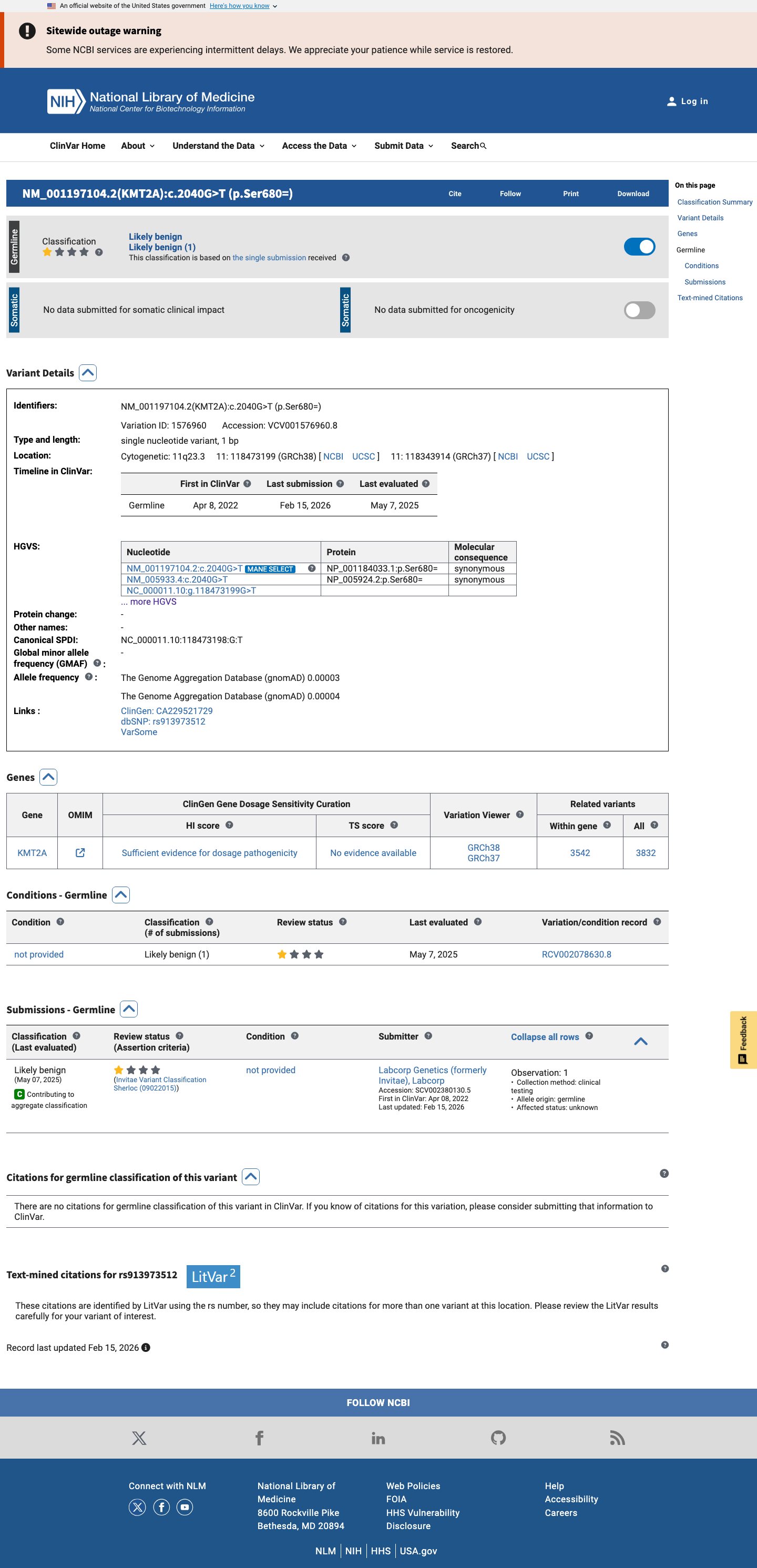
ClinVar screenshot
ClinVar
This variant has been reported in ClinVar as Likely benign (1 clinical laboratory). (ClinVarID = 1576960)
SpliceAI screenshot
In silico
SpliceAI predicts no significant splice impact for this variant (max delta score = 0.01).
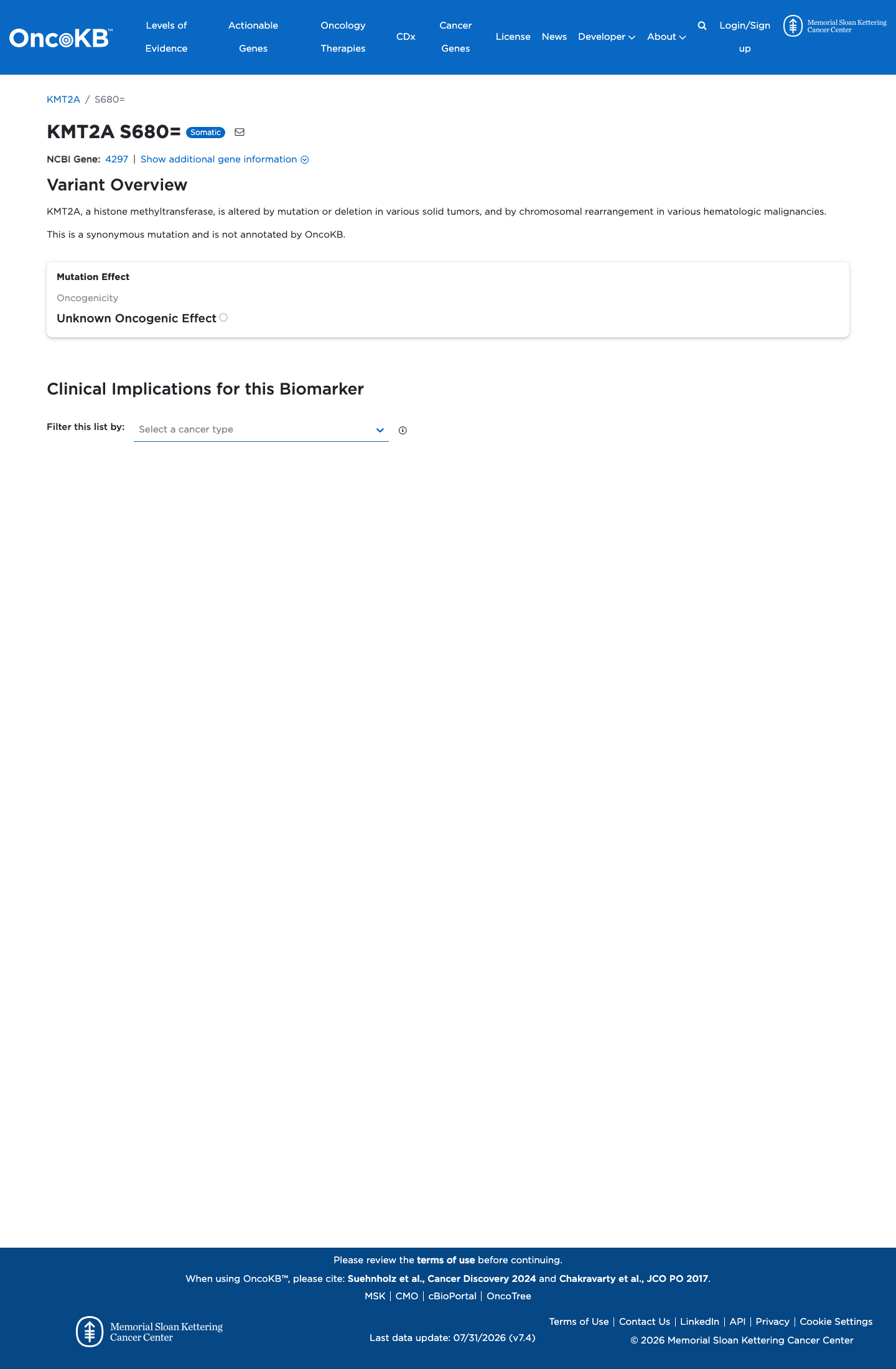
Functional / OncoKB screenshot
Functional Unknown Oncogenic Effect
OncoKB identified curated literature and non-variant-specific oncogenicity context for review; listed oncogenicity label: Unknown Oncogenic Effect.
OncoKB ↗
COSMIC screenshot
COSMIC
Cancer hotspots screenshot
Cancer hotspots
Somatic evidence Not in COSMIC / hotspots
COSMIC
This variant does not lie in a statistically significant hotspot. This variant has not previously been reported in somatic cancers (COSMIC).
Hotspots
This variant does not lie in a statistically significant hotspot.
Sources & reference links
8Sources
ClinVar
gnomAD v2.1
gnomAD v4.1
gnomAD-Canada
SpliceAI
OncoKB
COSMIC
Cancer hotspots
Triaged references · 1 PMID not cited in assessment
28492532 ↗ Sherloc: a comprehensive refinement of the ACMG-AMP variant classification criteria. CLINVAR