Back
NM_006231.4:c.2113C>T
p.Arg705Trp · POLE
León-Castillo et al. 2020 custom POLE framework · vleon-castillo-2020-custom-framework-v1
0%
complete
Final classification
VUS
PM2
POLE
c.2113C>T
p.Arg705Trp
missense · exon 19

POLE encodes the catalytic subunit of DNA polymerase epsilon, the enzyme that replicates the leading strand of DNA during cell division and participates in DNA repair. It contains a proofreading domain that corrects replication errors, keeping the accumulation of mutations in check. Germline mutations in POLE cause polyposis and predispose to colorectal cancer, and are also linked to a rare syndrome of facial dysmorphism, immunodeficiency, livedo, and short stature. Somatic mutations, particularly in the proofreading domain, occur in colorectal and endometrial cancers, where they drive an ultra-mutated tumor phenotype and are associated with better responses to immune checkpoint inhibitors.

This variant

POLE encodes the leading-strand DNA polymerase catalytic subunit and proofreading enzyme, and germline alterations can predispose to polyposis and colorectal cancer through impaired replication fidelity.

Transcript
NM_006231.4
HGVS · transcript:coding
NM_006231.4:c.2113C>T
GRCh38
chr12:132668416 G>A
GRCh37
chr12:133245002 G>A
VUS: only PM2 (supporting) is met, which does not satisfy any pathogenic, benign, or Likely Benign ACMG/AMP combination rule.
Classification rationale
PM2 VUS
POLE c.2113C>T missense · exon 19

VUS: PM2 supporting because the gnomAD v4.1 allele frequency is 5.581014628459454e-06, below 0.0001. VUS: no pathogenic criterion is met for this missense variant. VUS: no benign criterion or benign combination is met.

PM2 → VUS
LYFE Sciences is an AI system, and it can make mistakes. Criteria may be applied incorrectly, sources may be misread, and a confident-looking classification can still be wrong. Double-check every criterion and its underlying evidence before relying on any call.
Gene diagram · NM_006231.4 · variants mapped to exon structure
POLE NM_006231.4
Fetching transcript structure from UCSC…
Applied criteria · 1 applied · 23 assessed
MetEvidence satisfies this criterion.
Not metEvaluated against available evidence; threshold not reached.
Not assessedApplies in principle, but no evidence was found to evaluate it.
N/ADoesn't apply to this variant type.
Applied · 1
Strength Supporting Moderate Strong Very strong
PM2 supporting Pathogenic
Met at supporting: gnomAD v4.1 total AF is 5.581014628459454e-06, below the generic PM2 threshold of 0.0001.
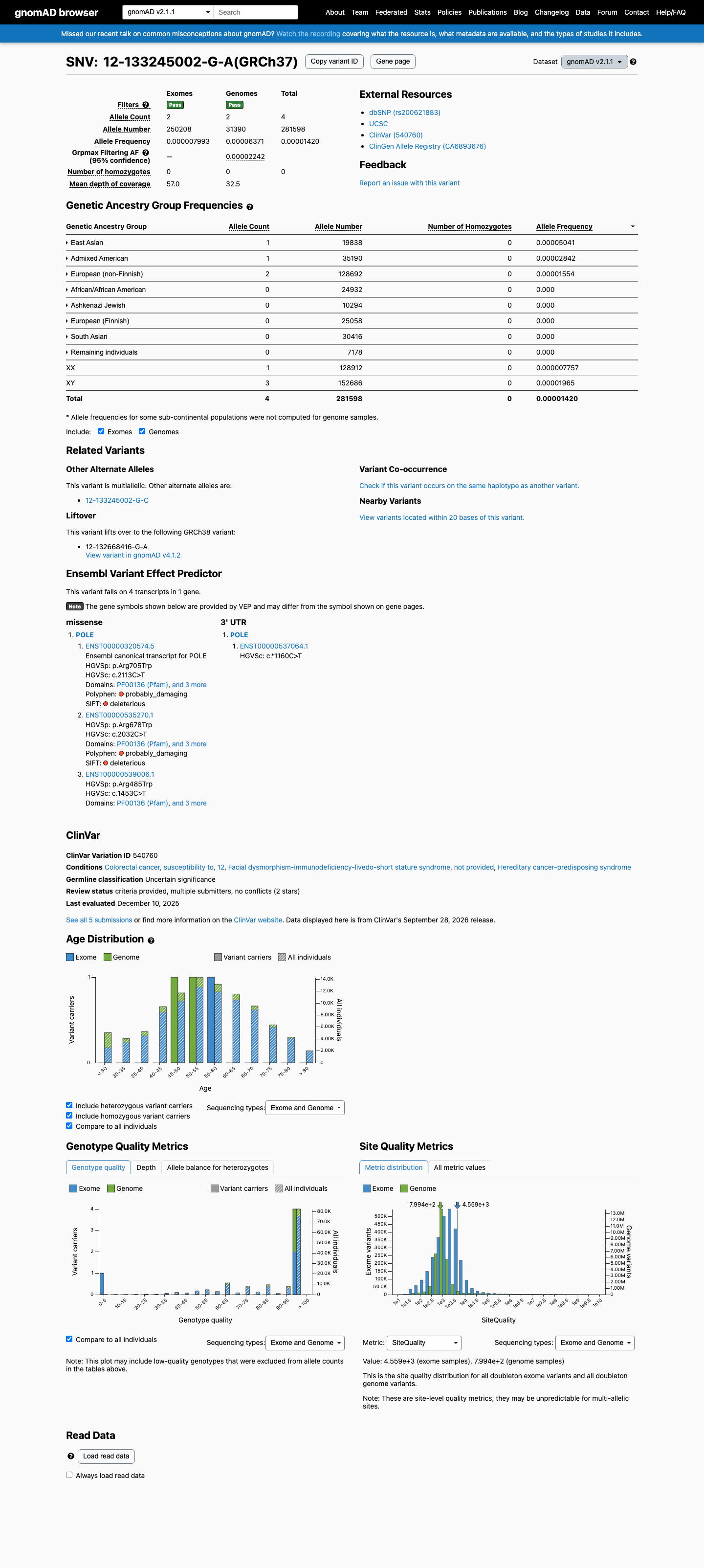
The retrieved POLE framework does not specify BA1, BS1, BS2, or PM2 population rules, so the supplied generic ACMG/ClinGen-SVI PM2 threshold was used.gnomAD v2.1 reports total AF 1.4204646339817755e-05 from 4/281598 alleles, with 0 homozygotes; the highest observed subpopulation AF is 5.0408307289041234e-05.gnomAD v4.1 reports total AF 5.581014628459454e-06 from 9/1612610 alleles, with 0 homozygotes; the highest observed subpopulation AF is 2.230549607423269e-05.
Assessed · not applied · 13 not met · 10 not assessed
Pathogenic
PS1 Not met: governing tables identify R705W but no different pathogenic Arg705 substitution establishing the same-amino-acid-change criterion.
PS2 Not assessed: no proband-parent testing or confirmed de novo observation is documented for NM_006231.4:c.2113C>T.
PS3 Not assessed: no variant-specific validated functional assay, controls, or damaging functional readout were documented for p.Arg705Trp.
PS4 Not met: p.R705W appears in 0 COSMIC and 1 TCGA endometrial-carcinoma case, totaling 1 versus the >=10 PS4 requirement.
PM1 Not met: R705W is exon 19 with EDM Signature 10 contribution N and is absent from the governing POLE PM1 exact-variant lists.
PM3 Not assessed: no affected-proband, second-pathogenic-variant, or validated in-trans phase observation is available for PM3.
PM5 Not met: no different pathogenic or likely pathogenic missense variant at Arg705 was identified in the governing tables.
PM6 Not assessed: no unconfirmed de novo observation or parental genotyping is documented for this POLE variant.
PP1 Not assessed: no affected relatives, informative meioses, or genotype-phenotype segregation results are documented.
PP2 Not met: no applicable POLE PP2 rule or validated low-benign-missense/high-pathogenic-missense dataset supports this exon 19 variant.
PP3 Not met: REVEL 0.321 is below the generic PP3 supporting threshold of 0.644 and the POLE table labels p.R705W Likely benign, not likely disease causing.
PP4 Not assessed: no patient-level phenotype or disease-specific clinical feature set is available to evaluate PP4.
PP5 Not met: ClinVar has zero expert-panel submissions for this exact variant, and the aggregate classification is Uncertain significance.
Benign
BA1 Not met: the highest observed population AF is 5.04083e-05, far below the generic BA1 threshold of 0.05.
BS1 Not met: the highest observed population AF is 5.04083e-05, below the generic BS1 threshold of 0.01.
BS2 Not met: gnomAD v2.1 and v4.1 each report 0 homozygotes, with no healthy-adult or penetrance evidence supporting BS2.
BS3 Not assessed: no variant-specific validated functional assay, controls, or normal-function readout were documented for p.Arg705Trp.
BS4 Not assessed: no informative unaffected-relative testing or documented non-segregation is available for this variant.
BP1 Not met: POLE has established pathogenic missense exonuclease-domain variants, so a primarily truncating disease mechanism is not established for BP1.
BP2 Not assessed: no linked pathogenic variant or phase-resolved cis observation is available to evaluate BP2.
BP4 Not met: REVEL 0.321 exceeds the generic BP4 supporting threshold of 0.29, while the POLE table reports only 1 benign result versus the required 4.
BP5 Not assessed: no affected individual with a documented alternative pathogenic molecular explanation is reported in the available case evidence.
BP6 Not met: no exact-variant ClinVar expert-panel benign classification exists; available submissions are all Uncertain significance.
N/A · 4 PVS1 · PM4 · BP3 · BP7
Research & evidence
Population frequency
gnomAD v4.1 screenshot
gnomAD v4.1
gnomAD v2.1 screenshot
gnomAD v2.1
v4.1
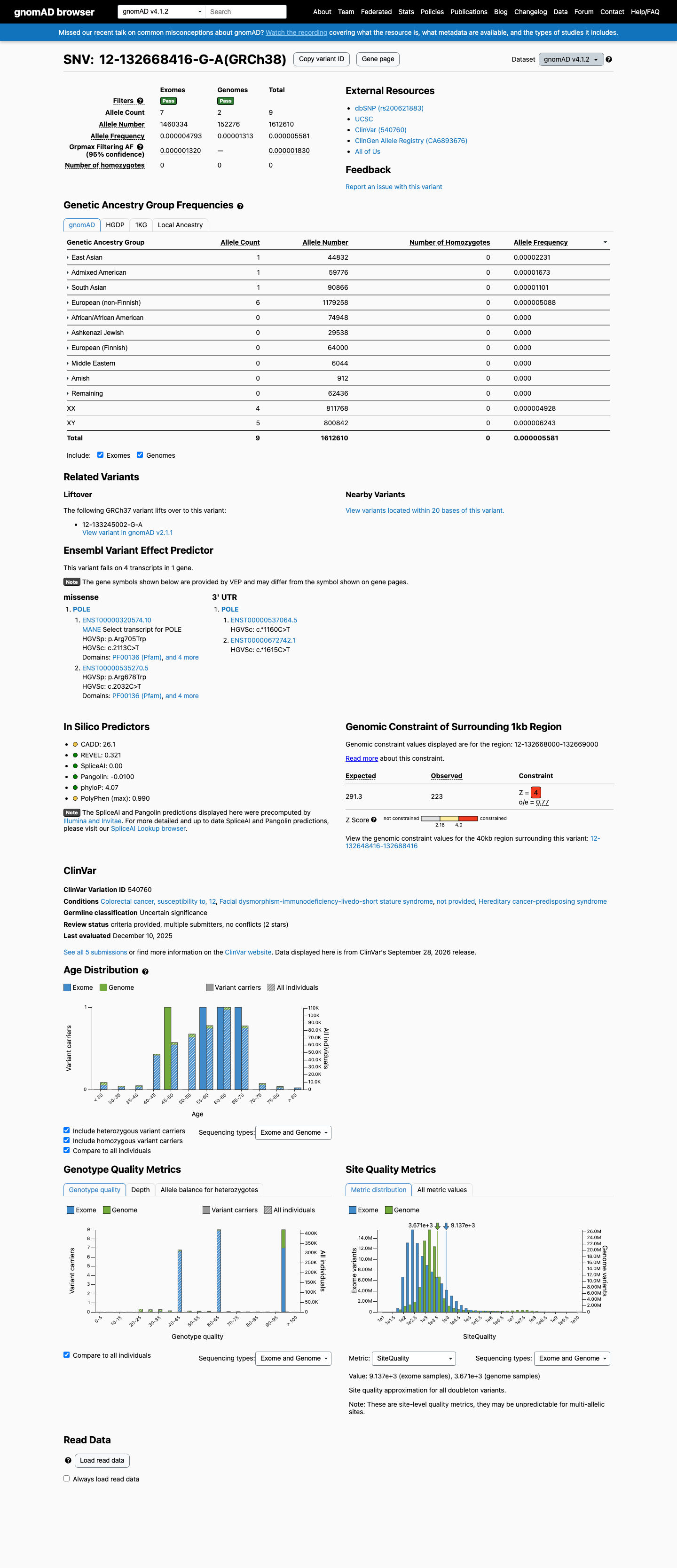
This variant is present in gnomAD v4.1 (AF= 5.58101e-06; MAF= 0.00056%, 9/1612610 alleles, homozygotes = 0) and has highest observed frequency in the East Asian population (AF= 2.23055e-05; MAF= 0.00223%, 1/44832 alleles, homozygotes = 0); grpmax FAF= 1.83e-06.
v2.1
This variant is present in gnomAD v2.1 (AF= 1.42046e-05; MAF= 0.00142%, 4/281598 alleles, homozygotes = 0) and has highest observed frequency in the East Asian population (AF= 5.04083e-05; MAF= 0.00504%, 1/19838 alleles, homozygotes = 0); grpmax FAF= 2.242e-05.
🇨🇦 CA
Not available in gnomAD-Canada v1.0.
Allele frequency by ancestry
three datasets · side by side
gnomAD v4.1
0.00056% · 9 / 1,612,610
0 hom · FAF 0.00018%
East Asian
1 / 44,832
0.0022%
Admixed American
1 / 59,776
0.0017%
South Asian
1 / 90,866
0.0011%
European (non-Finnish)
6 / 1,179,258
0.00051%
+ 6 not observed (Remaining individuals, European (Finnish), Amish, Middle Eastern, Ashkenazi Jewish, African/African American)
gnomAD v2.1
0.0014% · 4 / 281,598
0 hom · FAF 0.0022%
East Asian
1 / 19,838
0.005%
Admixed American
1 / 35,190
0.0028%
European (non-Finnish)
2 / 128,692
0.0016%
+ 5 not observed (African/African American, Ashkenazi Jewish, European (Finnish), Remaining individuals, South Asian)
gnomAD Canada 🇨🇦
Absent · 0 / ?
0 hom
Not observed in any ancestry group.
ClinVar screenshot
ClinVar
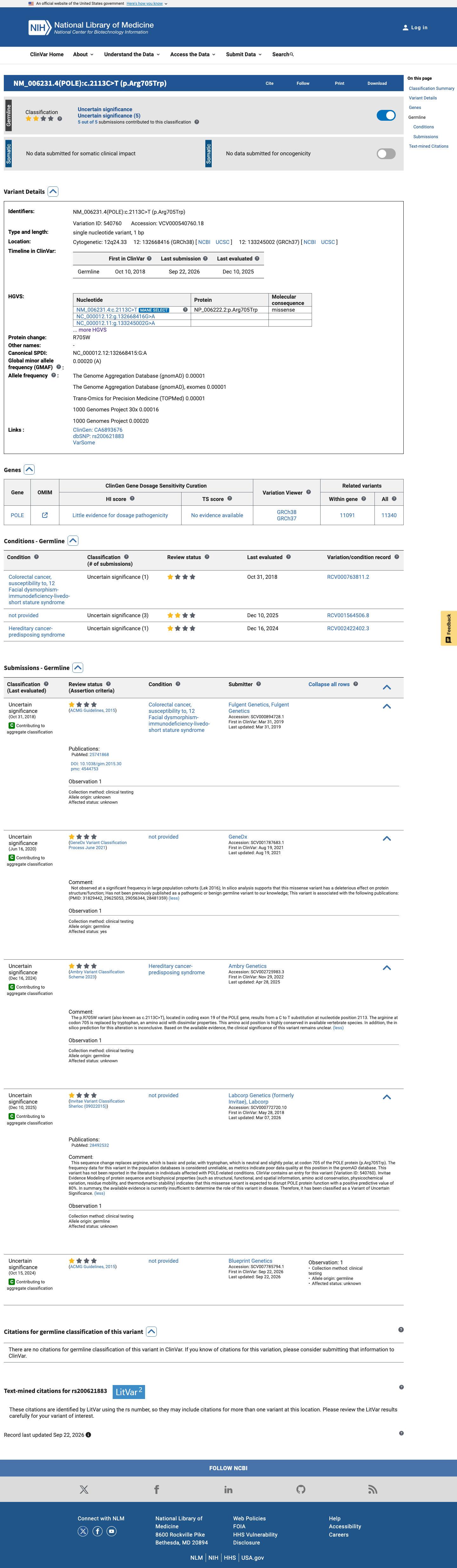
This variant has been reported in ClinVar as Uncertain significance (5 clinical laboratories). (ClinVarID = 540760)
SpliceAI screenshot
In silico
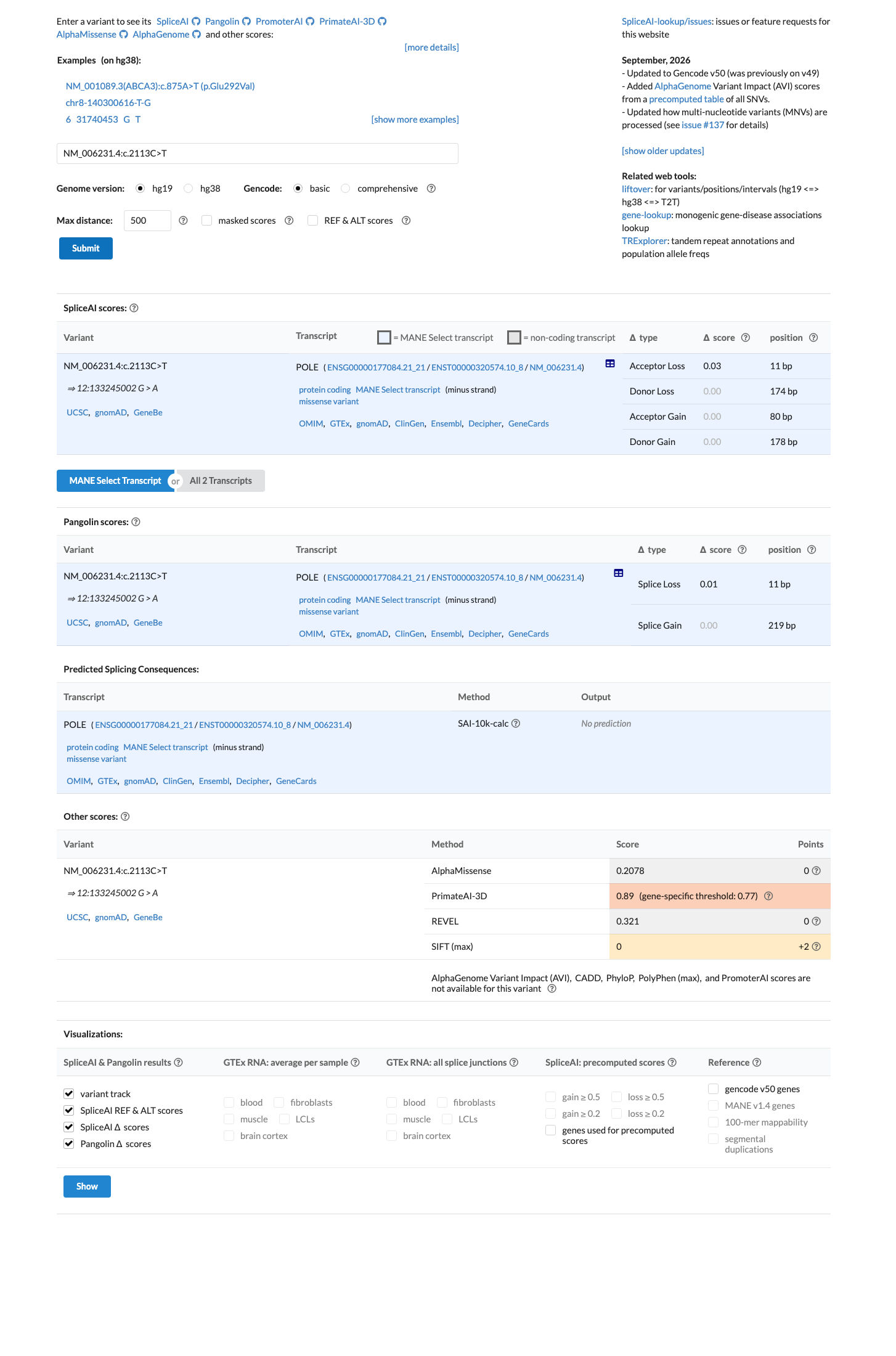
SpliceAI predicts no significant splice impact for this variant (max delta score = 0.03). REVEL score = 0.321. BayesDel score = 0.0580204.
Functional / OncoKB screenshot
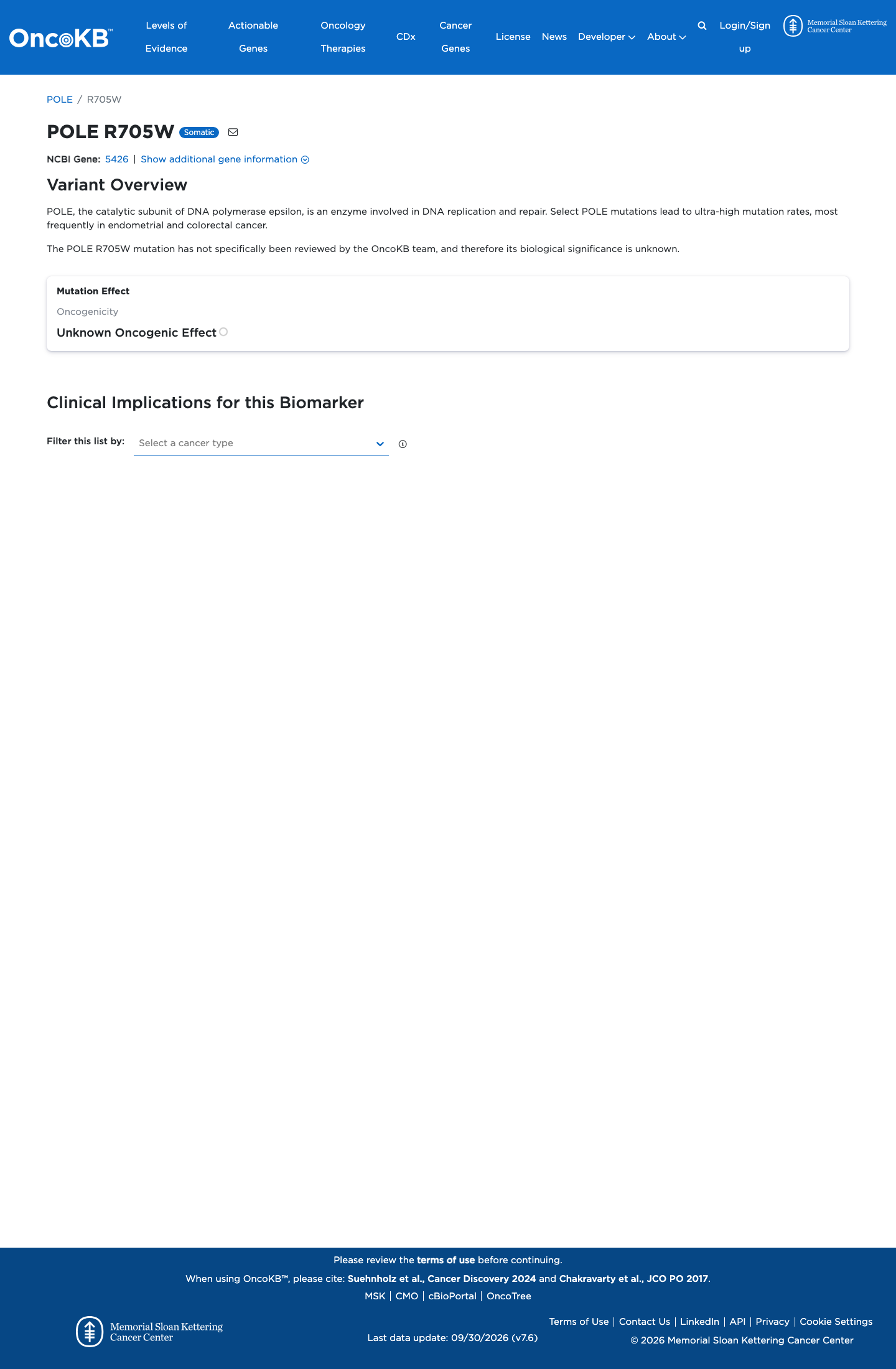
Functional Unknown Oncogenic Effect
OncoKB did not identify variant-specific reviewed functional evidence for this variant; gene-level curated context is available for reviewer follow-up. POLE, the catalytic subunit of DNA polymerase epsilon, is an enzyme involved in DNA replication and repair. Select POLE mutations lead to ultra-high m
OncoKB ↗
COSMIC screenshot
COSMIC
Cancer hotspots screenshot
Cancer hotspots
Somatic evidence Not in COSMIC / hotspots
COSMIC
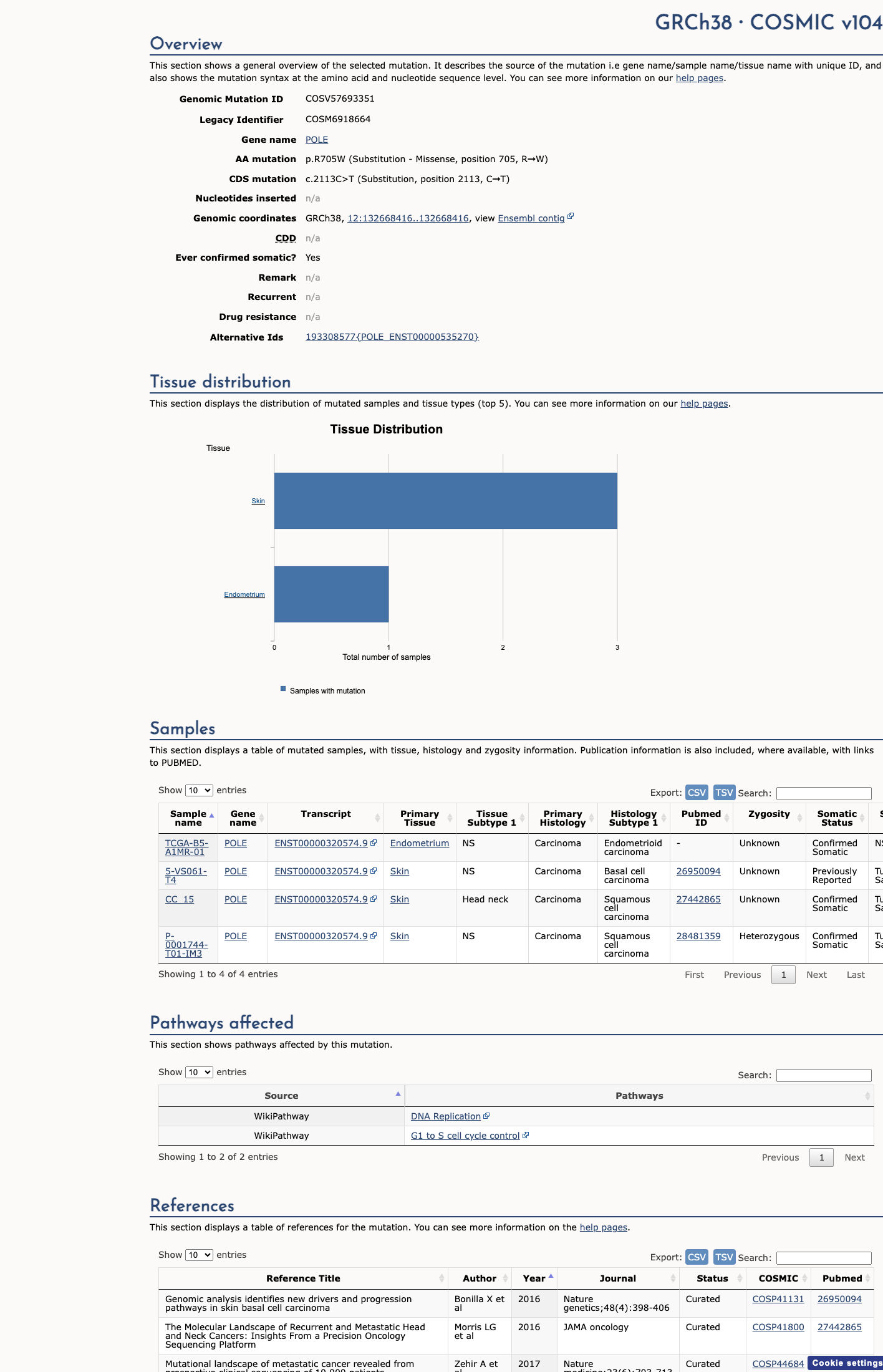
This variant does not lie in a statistically significant hotspot. This variant has previously been reported in somatic cancers (COSMIC; COSV57693351, n = 4 times).
Hotspots
This variant does not lie in a statistically significant hotspot.
Literature · how each cited paper was used
1papers cited
Each card is an audit: what was searched, what was found, whether it names the variant, which criteria it fed, and why. 1 further PMID triaged but not cited — see Sources & references.
Rule & framework references · cited for criterion definitions, not variant evidence
25741868 ↗ Standards and guidelines for the interpretation of sequence variants: a joint consensus recommendation of the American College of Medical Genetics and Genomics and the Association for Molecular Pathology.
Sources & reference links
8Sources
ClinVar
gnomAD v2.1
gnomAD v4.1
gnomAD-Canada
SpliceAI
OncoKB
COSMIC
Cancer hotspots
Triaged references · 1 PMID not cited in assessment
25394175 ↗ A practice guideline from the American College of Medical Genetics and Genomics and the National Society of Genetic Counselors: referral indications for cancer predisposition assessment. CLINVAR